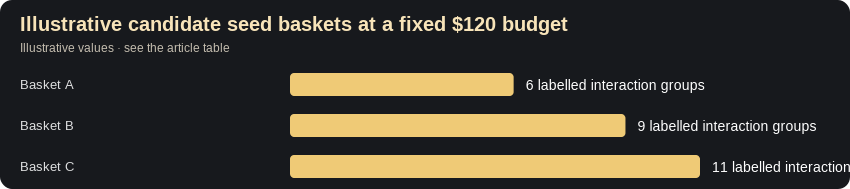
| Category | Value (labelled interaction groups) |
|---|---|
| Basket A | 6 |
| Basket B | 9 |
| Basket C | 11 |
Invented portfolio illustration, not ecological findings; used only to compare scoring rules.
Two bids for a small public garden arrive in the same week. One advertises a long list of flowers. The other identifies where the seed was grown, how much seed of each species reaches the plot, and what should bloom during a gap the garden actually has. Neither has yet planted a square metre. The first number looks persuasive because it is already available. The second offer is easier to evaluate because it tells you what would have to happen for the planting to work. A reasonable selection process should make the long list earn its significance rather than treating it as the outcome.
The comparison starts with a question that can be answered before spending money: which combination of available seed is most plausible for this site, these target visitors, this planting area and this budget? There is then a second question that cannot yet be answered: what grows and who actually visits? Keep the two questions apart. An inventory of documented plant and visitor links makes the first decision less arbitrary. The same inventory cannot substitute for observing the new planting. A lower score with well-supported assumptions can be preferable to a higher score built from records that will not travel and plants that are unlikely to establish.
Decide what the planting is supposed to change
Write down the site gap first. A late-season food gap in a sunny garden is a different problem from the absence of butterfly host plants or the need to replace bare ground on a hard-to-water slope. An easy mistake is to make the goal broad enough that any flowering plant seems to satisfy it. Instead, describe the current condition, the change that would count as progress, and the part of the project the seed purchase can reasonably control. The result should fit on a card an installer can read without asking what the spreadsheet's total means.
For a garden with a productive early spring border but a thin autumn display, the immediate goal might be reliable open flowers in the later window and a modest variety of floral forms compatible with the region. An adjacent demonstration bed intended to teach visitors about caterpillars might prioritize a locally appropriate host plant rather than a higher total of adult flower visitors. A demonstration planting near managed hives may have a forage objective for those colonies, but that is not automatically a conservation objective for wild bees. Maintain separate goals even if the same planting eventually does useful work for both.
Name several things the mix is not meant to buy. The supplier cannot guarantee a specified wild bee population increase. The seed tag does not certify flower density under your maintenance regime. The procurement scoring table cannot demonstrate that an adult insect observed on a flower took nectar or delivered pollen. Naming these exclusions protects the project from inheriting claims the available evidence cannot support. It also frees the team to choose a practical near-term outcome, such as whether multiple different flowering plants are visibly available during a window when the garden previously had few.
Choose the planning scale before specifying a planting calendar. A bed the public walks past, an entire municipal park, and a rural conservation field differ in what a feasible planting looks like. A small bed can use plugs to bridge a local gap while the rest of the site develops from seed. A large sowing might depend on equipment that cannot meter tiny batches without meaningful calibration. These are not interchangeable purchases. If bids differ in installed area, equipment, soil preparation, or protection from repeated disturbance, reconcile those differences rather than asking which of the bids has a longer floral list.
Put three evidence tables beside one another
Build a species and lot sheet, a visitor evidence sheet, and a season coverage sheet. The first describes what you can buy and grow. The second describes links someone documented. The third asks when a locally established stand might offer a resource. Joining them makes the assumptions auditable. Keeping them separate prevents the entry for a well-studied plant from quietly becoming a promise that the seed will thrive. It also lets you update a quote without rewriting visitor evidence or change a bloom forecast without erasing the source behind an association.
In the species and lot sheet, keep the name offered by the vendor, the name used for matching evidence, the source or origin information, the quantity, the basis of that quantity, the cost and the date of the quote. Record whether the supplier can still supply the lot, whether the same lot is available at the quoted rate, and whether it can be delivered when needed. A sensible baseline column is simply eligible, ineligible, or unresolved. Under unresolved, explain whether the issue is identity, provenance, seed quality, available quantity, or compatibility with locally assessed conditions. Unknown should never become eligible just because the sheet has an empty cell.
For the visitor evidence sheet, consider one row per plant and target group, with attached evidence records rather than one line per observation in the summary. Record the named plant, the reported visitor and its taxonomic resolution, the behavior, geography, season or date, and what is known about the observation method. An image showing an insect and a flower is not necessarily a record of the insect feeding. A field annotation explicitly describing floral contact is a different kind of observation. If an entry from your library lists a genus but no species, do not quietly convert that into a species-level link to make a score rise.
In the season coverage sheet, start with coarse windows that relate to the local problem. Keep one column for anticipated open blooms at the site and a second for the confidence or origin of that expectation. A local reference stand observed in several years can inform a prediction, but keep the reference site separate from your new bed. A catalog may list a flowering period for a widely distributed species without telling you what will happen in the shade of a nearby structure or under a different moisture regime. Give uncertainty an actual place in the sheet: dates missing, dates from a dissimilar region, or a reasonable local window with limited observations.
Use stable local record identifiers so evidence stays joined if a name, quote or plan changes. Preserve a version of each external record as a citation or note with retrieval date, not as a copied claim without context. These details matter when the contractor replaces one component two weeks before sowing. Instead of rebuilding from memory, flag the substituted row, re-run compatibility, repeat your coverage check and show exactly which links or windows may change. You are no longer ranking the first brochure against the second brochure. You are evaluating a reproducible supply and establishment decision.
Read documented visitors without rewriting the experiment
Otto and colleagues' Northern Great Plains study is a useful model for bringing interaction and price evidence together. The source can also be read through the USDA-hosted full paper. The authors compiled interaction records from conservation lands in eastern North Dakota and compared hypothetical mixes using seed availability and prices as well as the plant associations in those observations. They handled wild bees and managed honey bees separately. The habitat question for a new site is not answered by copying the output of the regional comparison.
The study usefully distinguishes an observed association from a choice made available on equal terms. Without comparable data on flower availability around the encounters, one cannot treat raw visitor records as a direct measure of plant preference. An abundant flower can have many records partly because it is abundant. A flower with few records may be underrepresented in the surveyed locations or windows. If an analysis does not control for those possibilities, it can still identify documented associations. It simply cannot tell you what a visitor would choose had it encountered an equal amount of each resource under similar conditions.
Read a database entry with the same care. A record may be strong evidence that a group was seen on that plant in a certain region, but weak evidence about the expected rate of encounters per hour at yours. A species-level identification may come from a more intensive survey than the one you can manage with casual observers. An old interaction observation can be relevant without telling you whether the plant available today has the same cultivar, sowing provenance, or structure. These limitations are not reasons to throw out the evidence; they are reasons to label the question it can support.
An observed plant-to-visitor link is also not a measure of conservation benefit. A bee that lands on a blossom can use it in different ways. A larval association is not an adult floral record. An adult butterfly nectaring at a flower is not thereby demonstrating that the plant hosts its larvae. Keep host relationships in a separate evidence column with their own sources and geographic scope. For a plant scored for forage, do not imply that recording one visitor confirms conditions for nesting and overwintering. A seed investment may be worthwhile in conjunction with a broader site plan; the interaction sheet should not claim to account for all parts of that plan.
When two bids tie on the best-supported links, inspect the difference in their uncertain links. Is the gap one group's identification at a coarser resolution, a different geography, or truly a missing observation? The word missing means no adequate evidence in the compilation, not the impossibility of a visit. If one vendor cites an impressive long list without specifying sources, ask whether the records pertain to those plants and from what area. Count enough detail to compare bids fairly, not more detail than you can verify. A defensible summary survives a reviewer clicking through the records.
Make local suitability a gate, not a tiny bonus
Use regional recommendations as a screen and the project site as the test. The Xerces Society's conservation seed mix specifications illustrate why regional context and site tolerances belong in the decision. Its mixes vary by region and purpose, and its overview notes that many listed species are intended for sun and generally suitable drainage rather than extreme conditions. A project with a wet, heavily shaded, or otherwise unusual site should not infer suitability just because it falls within a broad geographic label on the package.
A practical screen records where the seed comes from, where the species is appropriate, and whether the lot corresponds to the promised planting. The label native can collapse those three issues into one word. A plant may be native somewhere in a large part of the continent while its intended provenance remains unclear for your local project. A supplier may be able to document collection region more precisely than a general marketing label suggests. Keep documented provenance distinct from an assumption based on the nursery's address. Where the downstream implications matter, ask a local restoration practitioner to interpret the specific site and supply constraints.
On a walk around the proposed bed, sketch how it changes over short distances. There may be a shallow part that dries hard by midsummer and a shadowed corner that remains damp much longer. Water availability during establishment is different from long-term irrigation dependence. Foot traffic through the center of the site might repeatedly undo a promising seedbed. If your project can manage two zones, do not average their requirements and order one mix that fits neither. If only one management regime is feasible, find candidates that match it and leave some unsuitable species out rather than discounting their suitability with a small penalty.
Establishment risk can depend on the management decision as much as on weather. If the proposed germination or maintenance practice is incompatible with the site's actual access, staff schedule or equipment, say so early. A package that can only be installed with equipment the project will not have fails a constraint. The seed can be high quality and genuinely valuable in another project without being a good choice here. Similarly, a narrow native species list that fits practical installation is not necessarily the final answer if the planting has an essential function that the remaining species cannot perform.
Consider the frequency and consequence of a mismatch. Losing one of three plausible midseason flowers is different from losing the only credible late-season option. Losing several species together because they share a vulnerability is different from independent losses spread over time. You can capture this without false precision by marking assumptions as strong, conditional or weak and describing realistic adverse scenarios. An example is dry establishment conditions affecting several offerings in the same mix. Report what the mix would still provide in that scenario, and what cannot be counted on without changing the installation or splitting the project area.
A boundary on site suitability is especially important when a historical study includes abundant nonnative plants. Such records can help interpret what insects encountered in the surveyed landscape. They do not approve adding the same plants to a different habitat project. Regional ecologists or extension resources can help resolve suitability, potential ecological risks and alternatives. When uncertain plants are integral to the highest-scoring mix, the proposed purchase is not ready merely because those plants were present in the database. Mark the unresolved risk and see whether an eligible replacement maintains the important part of the design.
Make the budget describe seed you can actually install
Set a common budget boundary. Seed-only cost, delivered seed cost, installed cost, and first-year project cost are four different numbers. Put each offer into the same boundary before scoring it. For a seed-only cap, keep installation and management in a separate feasibility ledger. For an installed project cap, reserve those amounts consistently before comparing the seed portion. Counting delivery against one bid and leaving it off the other is a scoring error, not a practical compromise. A cost difference smaller than the unresolved freight or tax estimate is not yet a reliable price advantage.
Use the same intended planted area and a compatible basis for quantity across mixtures. A packet priced for a small test plot is not comparable with the total cost of buying enough for a whole field. A formula that projects a bulk price down to grams may ignore a minimum order. Conversely, a minimum purchase may legally or practically force the budget to pay for seed that does not go into this bed. Record quantity applied and quantity paid for separately. If the project gives a leftover packet to a different team, note the transfer rather than crediting coverage to seed that remains in the storeroom.
Read the sowing rate and label together. The NRCS conservation seeding series identifies seed analysis, calculations, installation and maintenance as distinct elements of a plan. A label can help translate bulk weight to the share of seed that meets the stated purity and viability calculation. Use the basis specified for that lot and project, and confirm any treatment of hard or dormant seed with the applicable guidance rather than assuming every germination label uses the same terms. Do not treat the result as a predicted field germination percentage.
One toy example shows the effect on a quote. Suppose a parcel of seed lists 90 percent purity and a qualifying 80 percent viability for the calculation used in this hypothetical procurement. Multiplication gives 72 percent on the relevant pure live seed basis. To obtain a nominal 100 grams on that basis, the worksheet needs about 139 grams of bulk product, before package rounding. The point is not to prescribe 100 grams for any bed. It is to show why the same bulk price can purchase different quantities on the basis used by the project. Packaging and minimum price might change the payable total again.
Price per viable seed and price per pure live unit of weight answer different design questions. Different plants have very different seed sizes; equal weight shares should not be read as equal counts. For one design, the bounded comparison is the cost of providing each species at its candidate functional rate. For another, it is the maximum cost within a specified seed density across the plot. Neither turns seed label information into a fair comparison of future floral density. If the vendor will not provide enough basis to compare offers, label the uncertainty and see whether a more transparent proposal is available.
Give changes their own budget record. If the minimum order raises the cost of one ingredient, maybe a different species of similar function keeps the critical seasonal window. But a saving that deletes the second reliable late-season entry deserves to be visible as a new risk. Keep the old and revised baskets in the procurement record so the switch is not silently erased. If a grant reimburses only some tested species or methods, track those rules separately from ecological suitability; compliance with the funding program does not by itself establish suitability for the site.
Count unique groups, then look underneath the count
Before tallying groups, define the bins. In a small decision aid the bins might represent observation categories that the survey can recognize rather than individual species. Do not combine fine-grained identities with broad bins in ways that allow a single record to increase two totals. For example, if some visitors can be identified only at a broad level, an uncertain observation should not be counted both as one verified group and as a narrower assignment without evidence. If local observers can reliably separate fewer groups than the regional database, summarize at the common resolution or show the additional detail separately.
Translate a documented plant link into one tick, not one paid point for each photo in the database. Then count the union across eligible plants for a basket. This scoring rule favors breadth across named categories, but it ignores how many eligible plants support each group. Put a redundancy column next to it. One locally reliable plant and three locally reliable alternatives can yield the same one point for a group while offering very different protection against a weak year. Keep the supporting eligible species and windows behind each tick so reviewers can see which group depends on a single candidate.
Timing redundancy matters more than raw redundancy when the goal is to cover a particular gap. Three plants that all bloom at once cannot replace three candidates spread across the gaps the project cares about. Conversely, two flowers opening together may offer useful insurance if one is sensitive to the wetter part of the plot. In the comparison sheet, explicitly show both the number of distinct groups and the number of plausible supports for each required window. State whether a flower counts in more than one window and why. Do not use overlapping windows to imply that the planting area or resources have increased.
Weighting groups is reasonable only if it makes a decision more transparent. The site might want to prioritize several wild visitor groups and report honey bee links in a separate unweighted row. Or a school garden could separately require a documented butterfly host under a local curriculum. Agree on those distinctions before looking at the scores. If the weights appear after the bids emerge, a skeptical reader cannot tell whether the priorities changed or the arithmetic was adjusted to favor an attractive vendor. Publish or retain the unweighted score as well so a later reader can apply a different legitimate priority.
Use uncertainty handling that does not automatically reward information volume. For a straightforward worksheet, keep confirmed regional links, plausible but unconfirmed links and absent records in separate columns. A well-documented broad-scope species may score higher under a strict definition. That may be useful for a public demonstration where observation predictability matters. A long-term native restoration may accept uncertain links because its target community is seldom studied. Changing the eligibility of uncertain entries can move the choice without invalidating either policy. The comparison should show how that happens, not conceal uncertainty inside extra decimal places.
Work through three baskets under the same ceiling
The article's bar chart, Illustrative candidate seed baskets at a fixed $120 budget, is a worked portfolio example. Basket A covers 6 labelled interaction groups, Basket B covers 9, and Basket C covers 11. The units are distinct labels in a fictional workbook; they are not bee species, observations, densities, activity levels or predictions. The $120 is the common maximum for the comparison, not a report of prices at real vendors and not a requirement to spend exactly $120. The chart originates in this invented setup, not in the North Dakota study.
Construct the totals in a way that can be audited. Imagine that A has eligible links to fictional categories G1 through G6. B has G1 through G9. C has G1 through G11 when a catalogue of eligible and candidate links is evaluated in its optimistic scenario. A link can be the combined contribution of several eligible plants, but each G label counts at most once. You can create as many association rows as there are plausible evidence sources; the total does not change until the set of covered labels changes. G categories are placeholders, so the example makes no claim that any actual animal on your site belongs to them.
For the budget demonstration, use $108 for the delivered seed in A, $116 for B, and $119 for C. The amounts are separate worksheet inputs, not chart values. Assume for now a common planted area and comparable lot information. Purely dividing price by the initial count gives $18 per labelled group for A, about $12.89 for B, and about $10.82 for C. The cheapest cost per covered label and the lowest cash outlay are different questions even before accounting for uncertainty. Do not use that quotient to price an actual insect or to compare mixes that define the labels differently.
Now check the important window. A has one locally plausible late-season flowering plant. B has two candidates that can bloom in that window, and both are judged compatible with the proposed conditions. C appears to have two from the catalogue, but one relies on unverified local flowering suitability and one depends on a pending supplier lot with suitable origin. Use a conservative decision sheet in which both uncertain late-season links in C remain open rather than guaranteed. Suppose G8, G10 and G11 have no other qualifying links in C under that conservative review. Then C's group count falls to 8 while B retains 9. The bars still describe the optimistic fictional scoring exercise; the conservative result is a separate calculation, not corrected field data.
The point is not that uncertain candidates fail or that B must always win. They may survive review, or changing the design may let C's strengths become directly relevant. If the new region has strong evidence that all of C's later candidates fit, the first scenario becomes more credible. If B's two later species share the same establishment constraint, B's nominal redundancy is weaker than its table suggests. Perhaps A creates a more viable small trial because it leaves $12 for the purchase boundary's contingencies. Write down which assumptions actually select a basket and which would change the result.
Assume the project adopts two clear gates: at least two credible late-window forage options and a delivered seed total at or below $120. Based on the assumptions just stated, A fails the first gate, B passes both, and C remains unresolved on the first gate until documentation returns. Reporting only the bars would rank C ahead of B. The review shows why a team might sign B today, hold C for supplier confirmation, and reserve A as part of a different design. Budget and coverage gates select among plausible actions without confusing rank with certainty.
Turn any desired improvement into a marginal question. Add a qualifying species to A and ask which currently uncovered G labels or windows it adds, not how high its published visitor list looks in isolation. If it adds no new labels but provides a genuinely different late window or withstands a different management failure, it may still solve the more important problem. Similarly, an addition to C that adds another widely covered midseason group may make the chart slightly better while doing nothing for the project constraint. A worksheet should let the team defend keeping useful overlap and removing overlap that serves no purpose.
Build a comparison that survives substitutions
Enumerate feasible packages before assuming the list can be optimized one species at a time. Several species may be supplied only in a premix, meaning a worksheet cannot freely buy one ingredient but not the others. Bids may involve economies of scale or a shared shipping cost that changes only when the entire order crosses a threshold. Plants may also be physically hard to fit together at the chosen rates and in the available zones. A score assembled from individually cheap items is not necessarily a quote the project can place.
Small projects can explicitly examine each offered option. Start with the mandatory origin, area and season requirements, get comparable quotes, and record the areas each composition can cover. Then look for dominance under the agreed criteria. If two options cover the same required groups and windows with credible evidence, and one costs less without a displaced management burden or additional risks, the weaker one need not advance. Later, if an apparent dominance disappears because a supplier cannot confirm a price or lot quantity, restore that option and explain why. Avoid deleting a row just because its first version was not chosen.
Consider requesting a documented alternate for any ingredient that carries a critical window. A useful alternate is not just any species in the same genus or of the same flower color. Ask whether it matches the appropriate planting locations, founding conditions, locally realistic bloom window and function the original ingredient supplied. If the replacement does not meet one requirement, decide whether a different basket is now a better offer or whether the project scope should be revised. If the contract allows vendor substitution, give the reviewer access to the same assumptions used for the original scoring so decisions remain consistent.
Keep four outcomes separate when the supplier calls back: no change to the lot; same species but a different lot; different species serving the same proposed role; and different species removing a role. A different lot can change costs or fit even though the visible plant list does not move. A change in identity can preserve the planned window while losing a supported visitor category. A role may be preserved in timing but not under the intended moisture regime. Label the level of replacement, then test only the assumptions that need checking rather than ranking all options from scratch.
Run the final candidates through two adverse scenarios with assumptions printed above the totals. For instance, a dry establishment season might leave only one plausible flowering taxon in a key window, and a delayed shipment might move the feasible installation into a different administrative period, forcing changes to the schedule. A scenario is not a probability claim. It is a way to see whether the attractive total depends on everything going well at once. Give reviewers a place to challenge one assumption rather than arguing vaguely about whether the project is too risky.
Where bids closely tie, a small documented test may buy information more effectively than a larger purchase. The constraints that matter are available area, installation timing and how representative the trial is of the eventual site. A demonstration in a protected courtyard can show that a mix grows there, not that it will establish in a compacted verge. Record what the trial resembles and what it leaves unknown. If delaying all work would itself miss a useful opportunity, a phased purchase can keep the better supported portion moving and postpone only the ingredients that cannot yet be justified.
Verify on site without turning public observation into collection
Starting before installation, use repeated views of a designated plot from an authorized path or other permitted vantage point. Record the date, start and end, conditions, visible flowering units and whatever visitor categories can be recognized with reasonable confidence. Photos may assist review when taken without touching the plant, disturbing visitors or leaving marked access. Do not open nests or collect insects for a casual comparison. Follow local access instructions and keep public location detail appropriate for potentially sensitive organisms. A garden's evidence record should not increase disturbance as a condition of collecting better data.
Keep establishment and interaction observations separate. On an establishment walk, record which plants are identifiable, which are visible but unresolved, which are open flowering, and which portions of the plot cannot be assessed from accessible points. On a visitor watch, standardize the effort as much as practical and note alternatives actually in bloom. A species name on the procurement list is not a completed establishment record, and a flowering label from last week is not evidence that flowers were present during today's watch. Conversely, a missing observation on a short visit is not evidence that a plant died or that a visitor group is absent.
Distinguish a watched window with no visitor detections from a window that was not visited, interrupted, or not comparable. Always keep the reason when bad weather, unexpected closure, or equipment failure cuts a visit short. A zero can be an interpretable result for a completed watch under the stated protocol. A blank with no valid watch should not enter a rate calculation as a zero. For the same reason, two watches of different durations should not be compared through totals alone. Retain the amount of time and context needed to decide whether the observations can reasonably be compared.
Track which part of the investment changed the outcome. If a target window remains bare because the anticipated plant did not establish, more visits will not resolve the establishment issue. If open flowers exist but observation conditions consistently miss the window or identification capacity is limited, a new round of seed buying may address the wrong problem. If the site establishes well and visitors are seen, there remains a gap between that record and a claim of greater pollinator abundance at the neighborhood scale. Reporting those distinctions makes a first season useful without making a promise for the second.
Plan a low-friction record for unexpected findings. Suppose a new plant appears that was not in the mix and is difficult to identify. Do not use it to claim the mix produced another species; record it as spontaneous or unresolved, and keep that designation available if a reviewer later identifies it. Suppose a volunteer reports a visitor from an unphotographed moment outside the formal watch. Preserve that report as an incidental observation without merging it into the timed series. The point of structured tracking is not to discard useful information. It is to preserve the boundaries that make each thing useful for the right purpose.
Make the decision readable in a single handoff
Start the handoff with the selected basket and the reason for preferring it now, using the project's target and price boundary. A sample decision sentence is: choose Basket B for the demonstration bed because it passes the two-option late-season gate under the current local assumptions and fits the delivered seed cap, not because nine groups are promised to appear. Then show the current limitations and ownership of the next step. If C is held for an origin certificate, say who checks it and when the choice must be finalized. If a reviewer cannot tell the difference between selected and already installed, the status labels need revision.
Include the source links, lot assumptions and a bounded observation plan in the same packet. Record which figures were taken from a source and which were invented for explanation. Leave the worked bars unchanged if your real purchasing figures arrive later; make a different chart for the real data so the two histories cannot be confused. Keep the data table that made each chart readable. A concise overview can say which groups matter and which open flowers are expected without restating the full taxonomy or copying supplier language.
Review the decision after the first relevant window has passed rather than at the moment of purchase. If the late season is the primary concern, a handsome early bloom does not satisfy the main success criterion. Check whether the project produced the intended flowering opportunity, whether field observations support a narrower visitor claim, and whether operational changes affected either result. Note where the garden is genuinely doing better and where the data cannot answer. Then update the next purchase on the basis of the constraint that actually mattered, not which advertisement had more names on it.
The longest species list can be the right choice. It may have better regional fit, complementary bloom and dependable backup species, backed by transparent costs. It just does not get to skip the same evaluation as a shorter list. Start with a usable objective, keep the evidence types separate, account for seed in comparable units, and make the assumptions behind the highest bars easy to inspect. The resulting purchase has a reason that can be tested when the planting is visible. That is more useful than a total nobody knows how to revisit.
References
- USGS Publications Warehouse: Otto and colleagues, Northern Great Plains plant–pollinator interactions and seed mix evaluation. Regional recorded associations and hypothetical mix evaluation. USDA-hosted full paper.
- Xerces Society: Pollinator Conservation Seed Mixes. Program specifications and regional examples.
- USDA Natural Resources Conservation Service: Conservation Seeding Process. Distinct stages of site planning, seed quality review, calculations, installation and evaluation.