
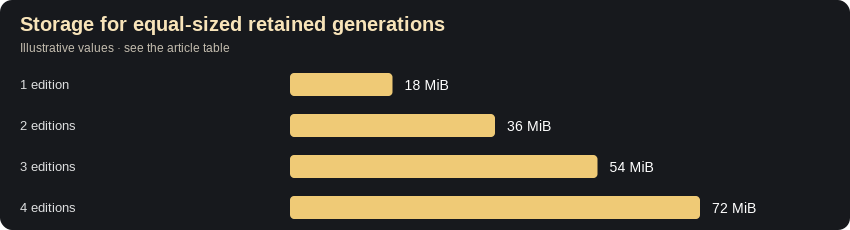
| Category | Value (MiB) |
|---|---|
| 1 edition | 18 |
| 2 editions | 36 |
| 3 editions | 54 |
| 4 editions | 72 |
Illustrative calculation (not sourced observations). Simple upper-bound example: each retained generation occupies 18 MiB of non-deduplicated asset storage; excludes HTML and metadata.
An editor opens a newly published essay and sees its photographs, margin notes, and bibliography. A reader in another city opens the same URL and gets the text, but the photographs appear as empty spaces. Neither person is mistaken. The editor is using a different copy of the page, or a different network path, or a different combination of cached files. Everyone agrees the release completed. What the release actually completed might have been the replacement of one directory, the upload of a set of objects, or the movement of a routing pointer. None of those events proves that all the pages the public can still read have the resources they need.
The essential design decision is to make a release safe even when different readers see different generations. On Monday it should be possible to read Sunday's HTML with Sunday's images, and to read Monday's HTML with Monday's images. There is no need to force the first group to become the second group at the same moment. This approach is especially useful for a publication, where readers may leave a chapter open overnight and follow a figure, footnote, or next chapter in the morning. Publishing should change which edition new readers discover without making the edition an existing reader has open spontaneously incomplete.
This guide develops that decision into a practical rollout. The examples describe a fictional archive rather than a particular hosting provider. Use its numbers to practice comparing policies, not as measured service performance. The techniques apply to a journal with a handful of essays as well as to a library built in many batches. The implementation may be a directory switch, a static host deployment, or a small routing function. The underlying job is the same: prepare complete material, make it discoverable only after verification, and retain the material that reachable documents still reference.
Think in references, not in files uploaded
Take a page that includes a cover image, a chart stylesheet, a PDF supplement, and a small accessibility script. The publication does not succeed merely because there are four successful uploads. The HTML determines which paths will be requested; stylesheets and scripts may point to more paths. A stylesheet can call for a font or background, an image element can name separate widths, and a viewer can fetch a data file when a control is activated. Some requests happen only when the screen is narrow, a panel is expanded, a figure enters the viewport, the reader moves to a different language, or the reader prints the article. The useful object to verify is the network of dependencies, not the total number of objects in the destination.
One way to describe the promise precisely is this: for each HTML representation a supported client might still hold, each local dependency it can request must remain readable at the expected path with the intended representation. The promise applies again to each of those dependencies that has dependencies of its own. It is not necessary for every page to fetch each file on each visit. A page may refer to six responsive widths while a particular visit downloads only one. The library nevertheless needs to know whether all six can be served before treating the page as complete. A successful fetch of the default image cannot substitute for checking its larger or smaller alternatives.
Specify which references the release owns. A chart served from your archive is in scope. A citation that leads to a university repository is an external link; you can record and test it, but keeping that site online is not part of your release invariant. This boundary matters in the editor's decision to approve a release. A missing on-site fallback that the essay needs to explain a result can block promotion. An external link that was already broken might instead be an editorial revision with its own disposition. Treating both the same can obscure what the release engineer can fix and what a content owner must decide.
It also pays to distinguish identity from availability. An image request can return a successful status with bytes that belong to an older chart or with the body of a generic error document. A valid response needs to mean the right thing, not merely exist. Plan evidence appropriate to the file: verify expected type, expected size or digest at the origin, and that a browser actually decodes the image. This turns a vague check for missing assets into an explicit claim about whether a named document can be read as built.
What the caches know, and what they do not
HTTP caches see requests and responses. They do not inspect the new edition's actual dependency map before returning an older page. A cached representation can be fresh under the response's policy even after an upstream copy changes. Once a cache has to validate a stored representation, HTTP validators let it ask whether the stored copy can still be used. A not-modified response is meaningful only alongside the previously stored body it validates; it does not supply a missing image or a replacement page. See the sections on freshness and validation in RFC 9111: HTTP Caching.
A common institutional mistake is to imagine one cache. A reader may have a private browser copy, while an intermediary maintains a shared copy for many people, and a second cache nearer the origin may serve the intermediary. The layers can have different rules and states. Meanwhile, a browser showing an already-open document need not request that document again just because one of its resources is requested later. In the moment that matters, it can possess the old reference without making a new request for the old HTML. Counting only the remaining cache lifetime for a new request therefore misses a whole class of ordinary reader behavior.
Keep separate logs for the two questions “Is this page current?” and “Is this page complete?” A page from last week can be complete even when it is not the current publication. Today's page can be incomplete even if its timestamp and release marker are correct. If the site displays a corrected caption for new visits but older already-loaded pages can still show the prior caption, that is a separate issue from an outright missing image. Whether it is acceptable depends on the nature of the correction. A release operator can make both questions visible without pretending that changing a route retroactively edits everything already displayed to a reader.
Do not assume a response directive is a command to every copy everywhere. It shapes caching behavior for responses that carry it, not for a document somebody saved. A stale response is not simply any old response; staleness depends on the calculated age and freshness policy. Under the conditions in RFC 9111, serving stale is restricted, and some policies explicitly allow additional wrinkle cases. Review what your deployment and intermediary actually send, not just the intended configuration in a repository. For the division between browser and shared caches and examples of versioning, the MDN HTTP Caching Guide is a useful companion to the standard.
Give URLs roles before you give them directives
A public address such as an essay's reading URL is usually an entry point. Its meaning is that a reader finds the current public edition or is directed to it, not that exactly the same bytes live there forever. An edition URL, by contrast, can be a deliberate historical address. It might be useful when someone cites what was in an essay at a particular date. Finally there are asset URLs: the chart graphic, the caption data, and the static design resources that an edition needs. People often put the same caching policy on all three because that is the simplest hosting rule. That hides the most important difference between them: what kind of change is allowed at the same address.
Stable entry points deserve policies that reflect how quickly the archive is willing to converge on the new edition. A short freshness period, or storing with revalidation before reuse, can make sense on a public article entry point. A revalidation requirement is different from a request not to store the response at all, and reviewers should avoid using those terms interchangeably. The entry point may be a response that redirects readers to an edition address. That redirect is itself an HTTP response; if its caching lifetime is too generous for the publishing policy, it can keep sending a client toward the prior edition after the underlying pointer moves.
For an asset with bytes that will not change at a given URL, a long cache lifetime can be an appropriate performance choice. A content fingerprint embedded in the path, or an edition-specific namespace with a strict write-once practice, gives new bytes a new address. If the same chart is corrected, publish a new chart URL and make the next HTML refer to it. Do not overwrite the old chart at its old address. Immediate replacement at that address does not mean a cache will immediately deliver those bytes, and the old page may give the new chart a caption or description that no longer fits.
The optional immutable response extension relates to caching during freshness; it is not a commitment by the host to keep the object's URL valid forever. Its actual definition is in RFC 8246: HTTP Immutable Responses. The operator makes the availability commitment separately through storage and retention. Likewise, putting a long cache lifetime on a URL is not a promise that an edge will retain the object in its local cache until that date. It may still have to retrieve the object later. The persistent copy must therefore be available to the delivery path for as long as the library's reference policy requires it.
Build the release inventory as a useful artifact
An inventory is an answer to the question “What precisely were we going to make readable?” Put an edition identifier and a build timestamp at the top. Enumerate the public routes that will move, the HTML files that implement them, and the dependencies each HTML reaches. For each dependency record the final requested path, object type, and an identity such as a digest of the authored bytes. The inventory should also identify assets that an older retained edition shares. This is not a list of the files a deployment command remembered to upload. Build it from what the material actually references, then compare the result to the files you are going to serve.
Resolve references using the same base address as the browser. This catches paths that look sensible in an output tree but point somewhere else at the real address. A page on a nested reading route can resolve a relative image path differently from the archive homepage. A build preview may be at the host root while the eventual publication is mounted under a prefix. The inventory needs to reason about leading slashes, relative traversal inside the site's own directory structure, canonical trailing-slash behavior, and any base element the build emits. Keep a few intentional edge-case fixtures so a future build change cannot quietly break these assumptions.
Extract references from HTML image and picture sources, links to local supplementary files, preload declarations, stylesheets, and the dependency manifests of any build system that bundles code. Then handle what a simple parser cannot infer. If a chart tool loads a language-specific legend after the reader makes a selection, enumerate the supported variants through configuration or have an integration test record those requests. When a data path depends on code execution, guessing from a filename pattern is not evidence that you covered every request. Write down the coverage method and a set of realistic interactions to exercise it.
Decide how to compare inventories across builds. Some asset names will be new. Some paths will remain, with unchanged data, which is valuable for reuse. A previously published immutable path with changed bytes is a serious preflight exception; it should be rejected, not accidentally overwritten. A deleted dependency is not inherently a problem if it belongs only to a release that was never exposed, but if any supported generation still references it, put it in a retention set. Reviewers should be able to read a summary of changes without sorting through the full manifest by hand.
Inventories also help when verification expectations differ by route. An article that serves a chart graphic and a data download might require browser checks for both rendering and accessibility. A year archive listing many small thumbnails might need an automated coverage sweep with a few human-readable checks. Mark which assets sit on a critical reading path and which are decorative. A decorative failure is still a defect, but the critical labels tell the operator whether to halt all publication or repair the affected edition promptly without disturbing unrelated routes.
Prepare first, expose the pages second
Start with a fresh, unpublished edition identifier and stage the immutable objects. If your platform uses whole-deployment snapshots, determine whether new HTML is automatically exposed only when its entire snapshot is ready and whether older assets remain addressable after the switch. If the platform uploads objects individually, stage the assets before changing entry-point HTML. In either case there is a useful intermediate state: the intended images, fonts, and data can be resolved through the intended serving path, but the public routes have not started referring to the new HTML. This is where most inexpensive mistakes should be caught.
Do not equate “upload API returned success” with “all readers will now find these bytes.” For one provider those events may be nearly equivalent. For another, publication of a mapping, availability in a regional origin, and the path used by a shared cache may be distinct operations. Inspect the deployment model and run probes that use the actual release addresses. An asset staged on a preview domain tells you something about the build, but it does not prove that the same path is routed correctly on the public domain. Where staging and production use separate routing, have an explicit check for that gap before opening the new entry point.
Once the assets are staged and checks are green, move a small public pointer to a known complete edition. A pointer might be one active-release value, a hosting provider's deployment alias, or a directory link managed by the server. The important property is that the visible switch has a smaller failure surface than a long series of per-file rewrites. If your host cannot switch many routes together, treat each coherent group as the unit of release. There is no need to claim the entire archive changed at once if separate article groups expose independent entry points and do not rely on each other's unpublished files.
Make one process responsible for changing the pointer, and include the expected previous edition in its decision. Two people may be staging separate articles while a third is making an urgent correction. A stale job that promotes an older build after a newer one has already been approved can cause a regression even though each build is complete. If the platform cannot require a matching previous pointer as part of its update, serialize promotions elsewhere and review the current value immediately before writing. A release log should show who approved the change, when it was exposed, and which previous edition remains available for rollback.
Retry rules are part of the preparation. If a staged upload is interrupted, resuming should mean “fill the missing expected objects,” not “rewrite all objects whether or not they match.” The inventory gives a retry a definition of sameness. When an object's path and recorded identity already match, a replay can leave it alone. If the content differs under a supposed immutable URL, stop rather than assume the later upload is preferred. For promotion, a retry should first check whether the original change already succeeded; a network error at the operator does not show that the service failed to change the pointer.
A walk-through with a two-edition reading room
Suppose an essay collection has a June reading page with an overview, a chapter on field notes, and a chapter on maps. The June overview references a graphic our fictional inventory names overview June. In July the editors add a correction that revises the map and combines two thumbnails. They assemble a July inventory and discover that the overview chart is unchanged, so the July document can point to the same fingerprinted object. The maps chapter points to a new chart path and a separate July data file. A browser still displaying June cannot accidentally fetch the revised map when it requests the old map path.
The operator uploads the revised map, data, and thumbnails, first to the location that serves the intended public paths. They compare the uploaded objects with July's inventory, check the shared overview chart still resolves, and open the upcoming July view before switching the entry point. Tests cover navigating across chapters, loading the map with no previous browser cache, selecting a narrow layout that uses a smaller thumbnail, and opening the download linked from the chart description. Another test deliberately retains the June page while requesting its map after July's assets arrive. This narrow demonstration is more useful than believing the upload list or taking one flattering homepage screenshot.
The active reading pointer changes from June to July. A warm browser can still show June, while a new reader might get July immediately. That is planned coexistence. If the new page is sound, releasing does not require a purge simply to make June disappear. If the July data file turns out to be the wrong year's numbers, the editor can stop new readers from entering through July by restoring the June pointer. They should not reflexively remove July's resources: someone can still have July open, and broad deletion makes the experience worse. Corrections with privacy or legal consequences are different and need an explicit, scoped procedure.
Retention protects the older archive only within the model you offer. If the library advertises June as an independently citable edition, it cannot delete a June-only asset merely because June stopped being the default. If the library promises only short-term continuity for old active pages, the June-only objects can be reviewed after that grace period, once rollback obligations and current references have been checked. These decisions should be intentional, documented, and understood by the editorial staff. An overdue folder is not evidence that it is safe to delete, just as a missing request in a short log sample is not evidence that no reader can make it.
Work the retention chart without treating it as evidence
The accompanying chart, “Storage for equal-sized retained generations,” uses a toy collection with 18 MiB of independent asset storage per edition. One retained edition occupies 18 MiB, two occupy 36 MiB, three occupy 54 MiB, and four occupy 72 MiB. This is a simple non-deduplicated calculation. It excludes HTML and metadata. It is not an observed comparison of hosting services, and RFC 9111, linked as background in the chart, supplies the caching semantics rather than the storage figures. Each added edition contributes the same amount under the assumptions that generated the bars.
The chart is useful even without vendor pricing. Going from two editions to four in this model means reserving another 36 MiB, because two more inventories of independent assets are retained. It does not mean that a month's storage bill doubles: bills can involve replicas, transfer, request counts, and a different unit of charging. It also does not predict the size of your next release. A special edition might include a substantial gallery and a routine issue might include only a corrected chapter. Altering the simplifying assumption changes what the bars represent, and any serious capacity plan should use bytes measured from actual release inventories.
For a content-addressed collection, the objects that overlap need not be stored twice. Consider a separate hypothetical example with four editions, each containing 18 MiB of asset references. Suppose 12 MiB is an identical common set of objects used by each edition, and 6 MiB is unique to each. Storing one copy of each identity results in 12 MiB plus four sets of 6 MiB, or 36 MiB of distinct object bytes. This lower figure is not another observation and does not belong in the original chart. It illustrates how a change in architecture, rather than a shorter retention promise, can reduce the storage burden.
A count of editions is not a duration. As a separate planning exercise, assume a quarterly publication keeps its current edition and three prior editions. That covers much more calendar time than keeping the same number from a publication that releases daily. And if the team releases twice in one afternoon, a fixed-count queue can evict something readers loaded just a few hours ago. A defensible retention policy incorporates time since last exposure or retirement and identifies editions that must remain available independently. Inventory-based byte accounting can make that policy affordable without confusing an abstract edition count with actual reader protection.
Measure the horizon rather than trusting a stock cache duration
To select a retention window, begin by writing down reasons an old reference could still appear. The entry point may still be fresh under a browser or shared cache rule. A stale-serving policy may offer an additional window in particular conditions. An already open page can perform lazy requests much later than it loaded. A rollback can extend the time during which an edition is deliberately reachable again. A direct edition address might remain discoverable for months or indefinitely. Some of these exposures have finite and reasonably observable horizons. Others are a product promise and should put assets into a protected set until the promise changes.
For example, imagine a library chooses to support normal recent readers of retired entry-point HTML for two weeks after retirement, independent of its much shorter everyday HTML freshness policy. The actual number is arbitrary here. It indicates that a two-hour freshness setting does not justify deleting old objects after two hours, and that the publication is intentionally offering more breathing room than the protocol alone might require. In a measured implementation, read the worst expected cache behavior, test supported client patterns, and document conservative allowance for operational rollback and delays. When evidence changes, revisit the window rather than reusing the original assumption forever.
The retirement clock should restart or be updated when an old edition becomes public again. A rollback to the prior issue exposes it to new visitors who may retain the HTML through the same horizon as any other visitor. Do not compute expiry solely from the first publication date or from the date the edition stopped being newest during its first run. Record the last intentional exposure, the oldest approved rollback target, and an edition's explicit archive status. A housekeeping job that cannot recognize the significance of these categories should not perform irreversible deletion on its own.
For deletion, require an intersection of checks rather than a single age test. Objects eligible for deletion should be old enough under your policy and unreachable across the inventories of all protected generations, including incomplete promotions and approved reviewers' editions where relevant. If a release process cannot tell which inventory is complete, conservatively protect it until the operator can decide. Keep an explanation of why an object was judged unreferenced and an auditable removal list. A dry run can show the fallout by route, much as a build preflight shows new paths. This is particularly valuable when one shared object appears in dozens of earlier documents.
Some material needs different handling. A personal image mistakenly published with an article is not a normal candidate for scheduled retention. Corrective removal may need to take precedence over a seamless old-page experience, and the operator should have a defined, authorization-aware exception process. Such a process should avoid claiming to erase independent browser copies, exports, or third-party archives. For routine content replacements, preserving the object at its old address usually serves readers; for exceptional removals, make the deviation and its expected consequences explicit to the people responsible for the publication.
Prove the release on both slow paths and fast ones
A dependable preflight has a fast phase that checks the whole inventory and a browser phase that samples actual reading. The fast phase reports local dependencies missing from the expected object set, checks identity for all immutable objects it can validate against the authored origin data, and flags unexpected content types or redirects. The browser phase proves that a reader can make the common interaction path without a failed dependent request. It should test by ordinary routes at representative screen sizes and zoom levels. For an interactive chart, a functioning accessible table may matter as much as the graphical rendering.
Add a cold run and a warm run with separate roles. The cold run begins with a fresh session and asks whether the new edition is self-sufficient when no related object has already been retrieved. The warm run intentionally retains the prior HTML or an earlier page session, and asks whether its older dependencies are still available when required later. It is tempting to develop everything in a browser with caching disabled; that has value for one type of test, but it cannot tell you how a reader with a normally cached page will experience the rollover. Make the warm scenario a saved fixture, not a last-minute improvisation.
For a deliberately slow serving path, use an ordinary allowed test location or a controlled delay in a test fixture. Have the tester load an older chapter before switching, hold it open, and request a figure or download after the switch. Probe a second serving path for the newly promoted current page. A real edge can be warm or cold, and observations apply to the path and time actually observed. Report which response body the request received, the release marker, relevant response headers, and the exact asset that failed if there is one. Do not label an unobserved region “healthy” on the strength of a passing origin test.
Headers help explain a finding but are not a substitute for it. For instance, when relevant and available, show the response age, cache-control fields, validator, and any documented cache-status information. Combine these with the generation marker in the fetched HTML and a browser result. If a stylesheet works for an editor but not for the simulated reader, confirm whether the HTML asked for the same path and whether the two copies actually contained the same list of dependency URLs. The difference may be an asset availability problem, not delayed convergence on the newest page. A successful response for a HEAD request alone does not test the resource body that a browser must use.
Capture acceptance criteria before anyone sees the report. An example rule might be that every required object must be staged with the expected identity, all critical browser reading paths must pass in both generation scenarios, and no known dependency gap can remain unexplained on a sampled slow path. Merely saying “the new page loads” leaves considerable room for surprise. If a planned verification region is temporarily unavailable, say it is unverified and use the documented exception decision rather than turning a tooling limitation into a positive claim about the site.
Know whether to repair forward or roll back
Have two viable responses ready before publishing. A forward repair is appropriate when the edition is correct and a known immutable object failed to arrive. If you still have the verified intended bytes for that precise path, restoring those bytes may help everyone who has the affected HTML open. Do not invent a visually similar substitute and store it under the same identity. If the collection has already cached a missing response in some delivery paths, a tightly scoped cache action may be required after the original object is correctly in place. Recheck the particular path that failed rather than assuming a broad invalidation cured the condition.
A rollback is appropriate when the edition itself is wrong, its dependency graph is inconsistent, or it cannot be repaired quickly without uncertainty. Restore the active pointer to a prior edition that has actually been retained and tested, then verify the stable reading address. You may still see the defective edition for some clients because their entry point or document has already been retrieved. That is a limitation of the distribution model, not proof that the pointer switch failed. Keep both resource sets readable while you decide what correction or notice those clients need. When problems concern content accuracy, involve the responsible editor rather than treating the visible words as an engineering detail.
Purging blindly is a weak first move. It can erase useful evidence, force clients toward an origin whose asset set is not ready, and raise traffic during the period when the release is least understood. It also cannot ensure that a private browser cache or an open document changes state immediately. Use it only to address a specific cache condition after you've identified which addresses should change. A purge targeted at one entry address is different from invalidating all images throughout the archive. The more broadly an action affects unrelated readers, the stronger the evidence and approval it should require.
A good incident record includes the pointer before and after, the affected edition and paths, a sample of headers and body evidence, and what the reader could or could not do. Distinguish a proxy holding a previous complete page from a dependency missing under a page that still referenced it. This distinction matters to the next release: shrinking an HTML freshness lifetime may be helpful for a correction policy, but cannot fix a rule that deletes an asset while old pages are still allowed to exist. If the incident reveals a gap in the declared retention horizon, fix that policy and its release tests, not just that morning's visible symptom.
Scale up by keeping the guarantees small and explicit
A small archive does not need sophisticated orchestration to use this design. It can generate an inventory alongside each build, choose a staging folder whose contents are not yet linked from the public index, and keep a simple ledger of protected editions. A second editor can verify a small browse checklist and then approve an atomic switch. When the team grows, automate the steps that are mechanical: dependency extraction, object presence, identity comparison, the two browser scenarios, and a protected-edition deletion report. Keep judgment visible for exceptions, such as whether to delay an editorial correction because an origin probe is unavailable.
Do not turn all metadata into one monolithic release if the library actually publishes independent collections. Group routes that must change together because their documents have mutually dependent navigation or share a data meaning, and let independent groups move independently where safe. A publication that can roll back one series without disturbing a separate series is easier to operate. Each group still has to protect any immutable object that several groups share. Shared objects call for a union of reference sets, not a claim that whichever group first created the object is the only group allowed to retain it.
Watch hidden time costs. Measuring every file through an expensive remote browser does not scale well, while checking every path at the object layer and testing by representative user workflow often does. Repeated defects deserve a reproducible fixture. If an old print stylesheet referenced a font after the archive removed it, add a print path to the warm-edition test. If the archive changed its base path and lost thumbnails on only one kind of index page, add that exact route type to preflight. Learn from a real failure by extending coverage of the underlying mechanism, not merely by adding a one-time test for a specific filename.
Finally, define what success looks like to each role. The editor sees the approved edition become the default and can verify citations, figures, and accessibility. The release operator sees complete dependency sets, evidence from actual delivery paths, and a tested rollback target. The reader does not notice any of that machinery; the page they open can still be read all the way through. Treat an old yet intact edition as a normal result of web distribution, and a missing referenced file as a release design problem worth preventing. A calm rollout is not the one that forces everyone onto the same cache state. It is the one that works while they are in different states.
Sources
- RFC 9111: HTTP Caching, especially freshness, serving stale, validation, and response directives.
- MDN HTTP Caching Guide, for practical caching and versioned-resource examples.
- RFC 8246: HTTP Immutable Responses, for the meaning of the optional immutable directive.