
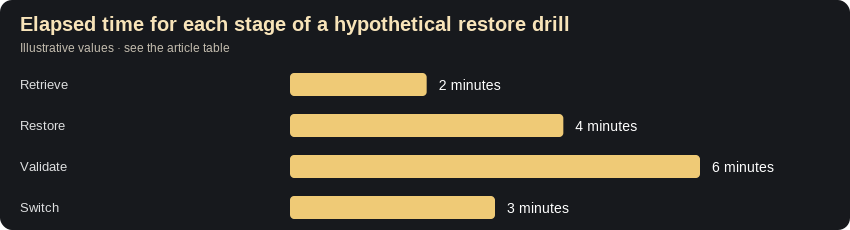
| Category | Value (minutes) |
|---|---|
| Retrieve | 2 |
| Restore | 4 |
| Validate | 6 |
| Switch | 3 |
Illustrative calculation (not sourced observations). Worked serial drill totals 15 minutes including validation; not a promised RTO or an observed restore.
A local editorial search preview can load normally while returning yesterday's titles, old links, or a result that was supposed to disappear. The database opened successfully, and its file had the expected size. Neither observation tells you whether the restored service represents the right editorial release. A convincing recovery drill has to follow the evidence from stored bytes to running queries to what a reader actually sees.
Think of a small archive whose approved articles are kept in canonical release packages separate from its SQLite search index. The index holds titles, routes, short descriptions, and a structure for matching search terms. The archive can rebuild that structure from an approved source package if necessary. It cannot, in general, recover the approved body of an article from a list of search terms. Nor should it use the presence of a row in a restored index to decide whether an article was approved. Recovery is about reestablishing the relationship among objects, not merely locating an intact file with a familiar name.
This guide uses fictional releases and a local drill. There are four checks: verify the contents of the backup package, establish that its database represents a consistent and identified snapshot, open it in a compatible environment, and demonstrate that it answers representative reader requests correctly. Then record what point was actually recovered and how long the sequence took. Each check can fail after the preceding ones pass. None of the times in the example or chart is a promise about production.
Define what the backup is supposed to recover
Start by separating inputs from outputs. In the example, the canonical release includes the published article sources, their stable identifiers and routes, a release manifest, and status decisions that distinguish readable pieces from withdrawn or unreleased ones. The search database is an output of an indexing process. This process applies its own rules for content extraction, tokenization, and search eligibility. The indexing recipe and compatible tool versions are recovery inputs even though they are not themselves articles.
Check this distinction against the actual project. Some indexes contain manually corrected titles, hidden synonym lists, or search exclusions without a surviving copy anywhere else. If an editor's changes exist only in SQLite, calling the entire database disposable is incorrect. Move distinct editorial records into a preserved system of record where feasible, or classify those tables as canonical inputs with their own recovery requirements. Recovery plans should reflect where decisions actually live, not where architecture diagrams imaginatively place them.
Give the database a narrow declaration of scope. A searchable document row might include the logical article identifier, approved revision, displayed title, public route, and body-derived searchable text. A manifest might identify the source release, extractor profile, indexing rules, schema version, and validation fixture used to create that database. The backup file name can express the same release, but it is not authoritative on its own. Renaming a file should not turn a Tuesday backup into a Friday recovery point.
Also document what is explicitly not recovered by this drill: drafts, editorial permissions, production traffic, asset hosting, comments, or another system not present in the local exercise. A local test might verify that a search result opens an approved article in a bundled preview without demonstrating that a real route is reachable under a public hostname. If an outage affected production, additional recovery gates would be needed. A statement limited to the local test is far stronger than a broad promise that readers were restored because a sandbox worked.
Establish a useful recovery point, not a timestamp story
Imagine three fictional release identifiers. Cedar-20 is the last complete pair of canonical source and validated index backed up together. Cedar-21 was approved an hour later and includes an important correction and a new article. Cedar-22 is a draft run, not eligible for reading. A copy of the index with a file modification time after Cedar-22 was prepared appears newest, but its embedded release marker says Cedar-20. The marker, reconciled against the canonical release and verified document mapping, is more informative than the modification time. A file may get a new modification time for administrative reasons with no editorial change.
Now suppose Cedar-21 is separately backed up as canonical source, but there is no validated index for it. You can restore the matched Cedar-20 pair for exact historical reproduction, or rebuild an index from approved Cedar-21 for a more recent reader view. Those choices answer different questions. The first shows that one previously verified pair remains restorable. The second shows that a later canonical release can be reindexed under the preserved recipe. The more recent source does not automatically make an older database a match for it.
A recovery point objective is a target chosen before the drill. A team might tolerate at most one approved release of loss or a specified maximum period between a failure and the newest eligible recoverable state. Define which dimension matters. A library that releases in bursts may prefer that a corrected safety notice or a particular withdrawal is never lost to an ordinary rollback, even if other acceptable staleness is measured by time. A recovery time objective is a separate target about elapsed interruption or restoration time for a defined capability. Neither objective is the same as one stopwatch observation in a local exercise.
An illustrative timeline makes the distinction concrete. Say Cedar-20 became effective at 09:00, its backup package was verified at 09:14, Cedar-21 became effective at 10:00, and the scenario starts at 10:20. Restoring Cedar-20 gives a reader view containing the 09:00 approved state, assuming source and index match. The recovered state predates the scenario start by 80 minutes in this toy timeline. You also missed one approved release. Whether that is acceptable depends on policy and on the kind of change missed. If the team can recover and validate Cedar-21 by rebuilding, the eventual recovered view differs even though a prebuilt backup for it did not exist.
Keep the measurement dates and use them for the right purpose. Package-creation time tells you when the backup process assembled files. Source release time identifies when the represented editorial state was approved for use. Snapshot completion time describes the backup operation. Readiness time is when the recovery workflow met its declared local acceptance criteria. A single field called backup date obscures distinctions that matter when somebody asks what content was lost, what became stale, and how long an operator spent returning to a compatible state.
Make the snapshot with a SQLite-aware method
The SQLite Online Backup API guide explains a supported way for an application to copy a source database into a destination database, including incremental steps and the effect of concurrent changes. This is a different operation from copying a main database file at an arbitrary instant while software is writing it. The API's completion behavior provides a consistent database snapshot, but the broader editorial workflow still must identify what revision that snapshot represents.
The difference is especially visible with write-ahead logging. SQLite's WAL documentation describes the log as part of the persistent database state. A main-file copy without the corresponding state may omit prior committed transactions or be invalid. Do not improvise by taking a main file at one time and a sidecar at another, or by manually discarding a live sidecar because it looks temporary. A supported backup method or a documented, properly quiesced and verified procedure is a decision to make before the recovery exercise, not a guess to improvise while preserving the only good copy.
Read the contract of the interface in use. The SQLite API reference distinguishes an incremental step that copied pages from a result indicating that the whole backup completed. The finish call releases resources; an error-free finish is not by itself proof that the steps completed. A language binding may encapsulate those details; use its documented success condition and error reporting rather than inferring completion from the mere existence of a destination file. Treat a failed or abandoned destination as an unaccepted intermediate outside the backup inventory.
The selected method also has operational costs. An incremental copy can encounter locking or make repeated work under active modifications. Do not assume the time to copy a quiet sample equals the duration when index writes are busy, or decide to retry forever without an operator-visible outcome. For a local draft, keep the example controlled: approved sample release, one intended database, documented compatibility, and a fresh destination. Record exactly what was exercised. A separate test can explore what happens when your documented writer and backup policies interact, without using production or somebody else's systems.
A database snapshot cannot freeze an external directory by implication. Consider a release marker written inside the index only after all intended documents are ingested, with canonical files selected by an immutable release identifier. At backup time use that marker to select the corresponding preserved source package. Check the mapping again after copying. If a rebuild uses a separate configuration or dictionary outside both files, include the endorsed version in the release bundle or refer to a verifiably recoverable artifact. Transactional consistency applies to the SQLite data, not automatically to external files or approvals.
There are several legitimate ways to coordinate the release boundary. You might produce every release's index in a new location before making a local pointer refer to it. Or you might update a mutable database with a committed release marker and export immediately under a tested workflow. A dedicated release artifact simplifies comparisons if the business can afford multiple copies. A mutable database can work too, as long as the relations are checked rather than assumed. The drill is an opportunity to find whether the chosen architecture makes the correct recovery path practical for the actual team.
Inventory the recovery inputs and verify the package
A restore source should identify its parts before anybody opens a database. In the example, the accountable files are the source release manifest, sample article payloads, index database, an index-to-source mapping, configuration identifiers, and a small set of known-answer checks. The package metadata records when it was sealed, by which role, and for what declared recovery point. A written path for obtaining that package makes recovery possible for a second operator who was not present at the original release.
RFC 8493, the BagIt format, supplies a useful distinction. Its payload manifests associate payload files with checksums, and optional tag manifests can cover tag files such as other metadata. A complete bag satisfies the applicable structural and presence requirements; a valid bag is complete and passes the required checksum verification against its manifests. If you describe a package as a BagIt bag, use a conforming implementation and procedure. For a smaller local format, identify it accurately as a custom manifest rather than merely calling any directory with a hash list BagIt.
A matching digest is evidence that the bytes you checked match a recorded value. It says nothing about whether the bytes were originally derived from the intended source or whether the recorded expectation is trustworthy. Someone can mistakenly package an obsolete, perfectly well-formed index and create accurate hashes for it. That result is internally consistent but wrong for the desired release. Keep a trusted release inventory or approval record separate enough that verification is not circular: a manifest received alongside an artifact cannot independently prove that the artifact was the endorsed choice.
Compare the expected package identifier and inventory to what was actually obtained. Missing distributions, a missing search profile, or the wrong input revision are failures even if an untouched database file passes its own checksum. Read file lists with normalized relative paths in the local exercise and use a trusted unpacking method. In the report, include general artifact identifiers and verification status; do not publish private paths, secrets, or copies of articles not authorized for disclosure. Recovery receipt detail serves traceability, not free distribution of all material.
Separate the package's original preserved copy from the writable working database. Once SQLite opens a database under normal application use or writes changes, the copy need not remain byte-identical to the sealed input. Verify the preserved package, extract or copy to an isolated working location, then apply checks to the working instance. If an unexpected migration runs automatically, preserve the as-restored evidence and record that another state was created. The ability to compare before and after can distinguish an inherent backup problem from a local application startup behavior.
Build a local exercise that can actually fail
A controlled exercise needs a known source and a declared failure scenario. Use toy articles or another authorized local fixture, not an unknown production dump. Give the fixture enough structure to make a misleading result possible: an updated title, a renamed route, a withdrawn document, two articles with similar terms, and an expected query with no public matches. Preserve a compatible index, an old but valid one, and a reference source mapping as labeled practice inputs. They make it possible to see which check catches which error without damaging the only backup.
The simulated event could be: the current local index was lost, the canonical files remain recoverable, and the drill operator receives one approved backup package and a compatible reader environment. Set the clock at a specific trigger, such as receipt of the scenario and start of retrieval, and stop when the validated local reader is switched to the restored pair and smoke checks pass. Record deviations, safety pauses, and administrative work outside the scope. A narrowly scoped clock is not misleading if you state what it excluded.
Select a fresh workspace isolated from running systems. Put the original runtime path outside the drill and prevent the local test reader from silently relying on live services. A preview can seem correct merely because it fetched old assets or queries from a cache outside the recovered environment. In the example the operator confirms the actual database path, embedded release marker, fixture bundle, and service identity before interpreting a response. A controlled no-network or explicitly local configuration can reveal dependencies without exercising any external systems.
Establish stop conditions. If the recovered manifest disagrees with the approved source release, if required files are missing, or if the preview exposes a withdrawn result, stop the switch and record the failure. The correct outcome is sometimes to refuse a simulated publication. If an older package also passes verification but does not include must-preserve policy decisions, do not grant it a blanket exception. Test how the system handles read-only degraded operation or offers a static approved browse path, and describe the narrower capability honestly.
Test the exercise with a second operator or a fresh workspace after refining instructions. A backup author sometimes succeeds by recalling an unrecorded configuration or using a file already present. That does not establish transferability of the recovery procedure. The second operator needs only the authorized artifacts and written steps. A missed instruction discovered this way is useful evidence: improve the checklist and repeat the relevant phase rather than removing the problem from the receipt.
Validate database state in layers
First inspect the recovered file with the intended SQLite support available. The application may require a bundled search extension, tokenizer, function, or a particular schema revision. The file can open in one client while a required feature is absent in the actual reader. A suitable validation harness invokes the same software interface that the local reader will use, with the same extensions and schema expectations. Be alert for code that creates an empty database on a wrong path and then treats a successful open as recovery.
Second use engine checks appropriate to the restored database. The SQLite pragma reference distinguishes integrity checks from foreign-key checks. For example, a successful integrity check does not certify referential relations governed by foreign-key constraints; a separate foreign-key check is needed where those constraints matter. Different checks have different scopes and runtime, so record which ran and their results. A schema with no declared relationship between some tables should not imply that the engine tested a relationship your application only assumes.
Third verify editorial invariants. In the Cedar-20 fixture, document A should be the approved revision from Cedar-20, document B should map to its correct route, and document C should remain absent from public search. A duplicate route is a failure even if it happens to be allowed by the database schema. Compare a deterministic inventory of approved document identifiers, revisions, and expected routes against the recovered index. A count alone misses a substitution where one item goes unseen and another appears in its place.
Fourth test search itself. The SQLite FTS5 documentation explains that an external-content full-text index and its content table must remain coordinated, and that a query bypassing the full-text lookup can report content even when matching structures are not populated as expected. Consequently, a title selection and successful table count are not equivalents of a representative search. If using FTS5, use the documented checks for the table design and couple them with matched query expectations. Do not assume every editorial index uses FTS5 or that an engine-level index check validates your application's visibility policy.
Finally use fixture responses rather than asking only if the server returned success. Consider a known query that should find one distinctive article and not the test-only draft. Another query may legitimately have several matches and should include two mandatory results without insisting on an incidental rank tie. In a fixture designed to verify ordering, specify the expected tie-break rule. Test punctuation, normalization, and filter behavior only where relevant to the actual product; a stack can technically support matching but give a poor answer to the queries the site claims to handle.
Connect query results back to what a reader sees
Search correctness includes interpretation of results. For the toy article “Spring Creek Notes,” retrieving the correct logical document does not suffice if the snippet uses an older correction-free revision or the displayed link resolves to a generic page. The drill should open the result in the local preview and compare title, route, and approved revision to the corresponding canonical source. This is also where a filename that survived a slug change can fool a check that validates only an internal row ID.
Add negative cases. The exact unpublished draft title should not be publicly searchable, and a withdrawn sample should not appear in reader-facing suggestions, snippets, or alternate search surfaces within the drill. A duplicate display target resulting from two route variants is a reader-facing problem even if data extraction faithfully populated both records. If search and browse use different visibility filters, test both explicitly. A backup faithfully preserves old bugs as well as old data, so a comparison to previous behavior alone should not be allowed to bless known policy errors.
Define the evidence for an expected match. A result might be compared using a pair of stable identifiers, such as article ID and approved revision, rather than its exact rendered layout. A fixture can check that titles are correct and links are local without enforcing exact scores. If ranking is part of the requirement, keep a deliberately bounded set of high-impact queries where the expectation is known and maintain a documented tolerable variation. Reader-facing correctness should not become a vague metric on one hand or a brittle pixel-perfect comparison for irrelevant differences on the other.
For a collapsed topic category, a faceted query might be a better check than a single search phrase. If the archive serves articles in multiple languages or displays a date from canonical metadata, include a case covering the applicable choice. A fixture set should represent functions the reader uses, not just exercises that are easy to script. Establishing breadth in a small dataset is possible: one distinctive article per critical rule, a handful of interacting cases, and an explanation for any omitted surface. This can be more informative than dumping a large corpus and inspecting the homepage once.
Interpret the figure and compare restore options
The chart shows an illustrative serial local drill. Retrieval takes two minutes, database restoration four, validation six, and the local switch three. Adding the stages gives fifteen minutes. These are invented durations, not measured performance and not a promised recovery time objective. The SQLite backup document linked as a method reference does not supply these numbers. The sequence assumes the stages do not overlap and that the switch stage includes its immediate smoke test. If parallel work occurs, record elapsed time directly rather than simply summing every person's effort.
| Stage in the fictional drill | Elapsed minutes |
|---|---|
| Retrieve approved local recovery package | 2 |
| Restore a working instance of the database | 4 |
| Validate state and reader-facing results | 6 |
| Switch the local reader and smoke-check | 3 |
| Total for these serial stages only | 15 |
The table is the text equivalent of the four plotted bars plus their total. The bars measure stage duration rather than released article counts, and the total is not shown as a fifth time-consuming stage. The arithmetic deliberately shows why stopping the clock at a database open overstates performance: two plus four is six minutes, leaving nine minutes of work before the declared reader-ready endpoint. Take away validation and the switch and you are comparing a fundamentally different milestone, not a faster route to the same goal.
Compare using a preserved index with rebuilding. Suppose another fictional attempt from the same approved source takes thirteen minutes to build a compatible index instead of four minutes to restore it. With the same other stages and no overlap, the serial total would become twenty-four minutes. That calculation has a practical use: compare faster recovery of a matched index against fewer stored derived copies. But it does not decide which option is acceptable. A more recent canonical release that cannot be paired with a verified index might justify the slower rebuild, and real validation time might differ when the indexing environment also changes.
In a third scenario, the restored index loads but tests reveal the source revision was wrong. Preserve that as a failed attempt instead of averaging it with successful runs. There may be no meaningful readiness time for the attempted path. If the operator then retrieves a separate backup, keep track of both the first failure and the ultimate elapsed time from the scenario start. This makes repeated exercises better comparisons, especially if one succeeds quickly only because it measured a direct happy path and the other demonstrates a recoverable failure with fallback.
Simulate a reversible switch and a measured rollback
Only promote the tested pair to the isolated reader in the exercise. Before the switch, identify the known prior local state, the expected new active pair, and the method for reversing the change. A local pointer change might be easy to undo; active connections or caches may still keep using an older state. Verify that the intended reader process actually picked up the change, and test that approved results still resolve after the new pair is active. Updating a routing preference is not the same observation as seeing requests arrive at the expected restored instance.
A rollback exercise should use a prepared alternate local state rather than trying to recreate the previous configuration from memory. Determine in advance which failures require rollback and what status signals would be best observed by an operator. If the previous state is itself stale in a way that violates critical editorial decisions, it is not an acceptable default. The example could retain a validated static browse preview while search is turned off rather than exposing outdated removals. Make that fallback equally testable and record its limits.
Protect the comparison from accidental drift during the switch. Check the same sample case before and after, document the actual package identity, and sample requests with a fresh reader session that is not relying on an older warmed cache. Some tests can report the locally active release ID along with results. That is helpful when a slug or a popular article belongs to both releases and a superficial spot check cannot distinguish them. Do not reveal internal hostnames, real credentials, or local security configuration as part of the exercise record.
A local switch demonstrates procedure and compatibility, not production authority or production guarantees. Your real deployment might have multiple workers, pinned snapshots, queues, approval gates, and external rebuild times that the exercise does not model. Conclude that the local preview was proven against the test set and record what further authorization and tests would be required elsewhere. This keeps the exercise honest and useful as a design tool without mistaking a trial for an actual rollout.
Turn the result into a recovery receipt
A useful receipt names the exercise, date, operator role, scenario, start and stop boundaries, retrieved package, represented editorial state, compatibility profile, and scope. It records one result per gate: inventory verification, snapshot identity, database checks, application behavior, and switch. Link to approved local evidence as appropriate instead of pasting a list of private locations or raw content. Preserve a clear distinction between checks that passed, checks that did not run, and checks that failed. If the exercise never advanced beyond a missing package, do not describe the final stage as a success with caveats.
Add one short recovery point statement and one timing statement. For example, “We restored and validated the Cedar-20 reader view; Cedar-21 was not represented in that restored index. After obtaining the sample package, the local drill met its acceptance gates in fifteen minutes, including the simulated switch.” In an actual receipt, only use measured timing and evidence. This article's invented times would be labeled practice timing or a hypothetical schedule, not imported into the exercise history.
When a failure provides a lesson, ask what made it plausible. A new operator who chose the newest-named archive may have been given a confusing inventory and no rule for validating the release pair. Ownership and correction are still necessary, but blame does not improve the picker. The Google SRE discussion of blameless postmortems emphasizes predefined triggers, investigation of contributing conditions, and follow-through on corrective actions. Apply those ideas to the drill: decide ahead of time what merits a review, assign follow-up checks to owners, and retest changes rather than treating the write-up as the outcome.
An action item should describe what changes and how somebody verifies it. “Improve backups” is hard to close. “Expose the approved source release and index build ID in the fixture picker, then reject a bundle whose values do not match the preserved source release” admits a straightforward test. Another practical action is to add a negative search case that catches a withdrawn title before a switch. Both improve the drill's ability to catch the discovered failure mode, not just the appearance of the checklist.
Retain comparison evidence over time without treating exercise numbers as a precise forecast. A sequence can reveal that validation increasingly dominates, that an obsolete dependency made a fallback unusable, or that beginning with a fresh operator consistently uncovers missing access documentation. Preserve enough context to understand why comparable results changed, including whether the dataset size or test scope differed. Recovery proof is not a one-time screenshot. It is an assertion a later team can evaluate together with the evidence that supported it.
Add negative controls that pinpoint a failed gate
Three practice packages make a useful training set. First, make a disposable copy with a harmless fixture file edited after the inventory was sealed, and retain the original expected checksum. The package gate should reject it before the application opens a database. Second, provide an intact backup of Cedar-20 and state that the operator is expected to recover Cedar-21. It should pass the checksum check and fail the release identity check; otherwise the workflow confuses a valid artifact with the artifact requested. Third, build a small index against the right source but deliberately omit one expected approved toy article. Even if its package and engine are sound, the reader fixture must catch the missing result. These are intentionally flawed local objects used to verify the checks; do not inject such defects into a useful backup or publish the test fixture.
Decide what evidence would distinguish these failures without relying on an operator's intuition. Label one result “package file differs from expected digest,” a second “payload represents an unexpected approved release,” and a third “expected public article missing from a representative query.” These labels help direct the next step. Finding another copy of a wrong version does not resolve the second issue; rebuilding the index from the right canonical input may. Recomputing the manifest around a changed file does not resolve the first issue, because it changes the expectation instead of recovering the expected bytes. Preserving these differences in a small receipt makes future timed exercises more interpretable and improves triage under pressure.
Frequently asked questions
If my SQLite file opens, isn't it restored?
It is present and accessible to that client. That is evidence for one layer of recovery. You may still have the wrong snapshot, lack a required extension, or be missing the source files that make resulting article links usable. A losslessly retrieved file may itself be an older approved or unapproved build. Compare the embedded marker and canonical release, then test the actual reader, including the paths that decide what is visible.
Is a hash check enough if the source files are also in the package?
It can establish that both files match the expected hashes, provided the expectations are trustworthy. It does not prove the files belong together. Validate a relation: source release identity, approved article revisions and routes, and the indexing profile all need to match expectations. If the checksum manifest and the contents were assembled from different versions, their hashes could match individual artifacts while the assembled service is still wrong.
Do I need to preserve a prebuilt search index forever?
That depends on recovery targets, the cost of maintaining a runnable historical environment, and whether the index has unique information not preserved elsewhere. A reliably reproducible and inexpensive index can be a derivable artifact; where fast restores or historically exact queries matter, a verified prebuilt copy can have considerable value. Test that your rebuild can run with preserved inputs and yields the expected reader behavior before making retention assumptions. Never delete the only equivalent artifact based on theory alone.
Can I set an RTO using this chart?
No. The chart is simply a full elapsed-time example that includes validation. A target comes from service needs and acceptable interruption under clearly specified scenarios. A local trial can inform that target by identifying recovery steps and omissions, but cannot demonstrate real performance under different volume, storage, tooling or traffic conditions. If the exercise excludes somebody obtaining approval or an environment becoming available, say so explicitly.
What should I show as the result if a reader test fails?
Report the restored database and which evidence passed, then describe the failing user-facing expectation and withhold promotion in the drill. An accurate failed result is actionable. State whether you were able to use an approved fallback, and if so, its actual editorial release and limitations. Then formulate a follow-up with a defined test. Recovery proof is valuable precisely because it can show that an apparently intact backup is not fit for the job.
Sources and chart note
- SQLite, Online Backup API guide and API return and cleanup reference: database-aware backup, successful completion, and behavior under concurrent changes.
- SQLite, Write-Ahead Logging, PRAGMA reference, and FTS5 documentation: persistent WAL state, scope of structural and foreign-key checks, and external-content index consistency.
- RFC 8493, The BagIt File Packaging Format: package structure, payload and tag manifests, completeness, and checksum verification.
- Google SRE, Postmortem Culture: blameless investigation, predefined triggers, review, and follow-through.
- All release names, timestamps, stage durations and recovery outcomes are hypothetical local teaching examples.