
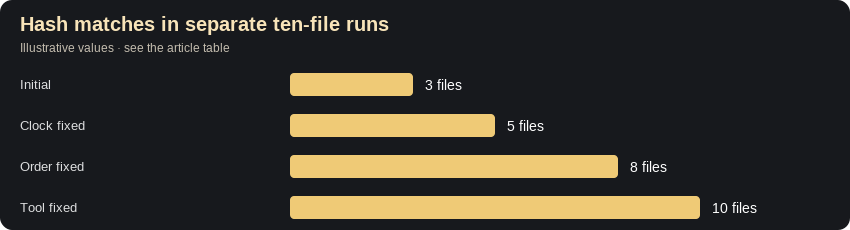
| Category | Value (files) |
|---|---|
| Initial | 3 |
| Clock fixed | 5 |
| Order fixed | 8 |
| Tool fixed | 10 |
Illustrative calculation (not sourced observations). Illustrative independent ten-file runs with hypothesized interventions; no real build outcome or causal estimate.
A botanical handbook is rebuilt six months after its first publication. The source article has the same revision identifier. The preview looks right. Yet the checksum of the downloadable edition differs, some of the generated images are a few bytes longer, and a date hidden inside a document points to the morning of the rebuild. Nobody can yet say whether the same publication was reconstructed. Looking right is useful evidence about what a reader sees. It is not evidence that two sets of files contain the same bytes, or that the same assembly process created them.
A reproducible editorial build is a narrow promise with a meaningful boundary. Define a set of source inputs, the rendering and packaging rules, and the outputs that must match. Then show that two executions separated in time or environment can produce the same bytes within that specified scope. Publication can still be changed intentionally, and a new toolchain can still improve an edition. The point is to distinguish a deliberate new edition from the accidental effects of a new clock, renderer, workspace, dependency, or machine.
Write the claim before collecting a digest
Start by naming the object you expect to reproduce. It might be every file under a static output directory, the payload inside a compressed download, or one final PDF including its metadata and container. Each boundary answers a different question. A downloadable archive can contain identical files and still differ as an archive because its entry metadata or compression stream changed. A rebuilt site directory may contain exactly the same page files while deployment software adds different headers. A result about one boundary cannot do the verification work for another.
State an acceptance rule before you run anything. For a file tree, use equality of the expected relative path set and byte digests at each path. Decide whether directory entries, mode bits, or symbolic links matter to the intended object. If only ordinary file contents are in scope, say that clearly. If the final archive is itself a release artifact, add equality of the archive bytes. If filesystem timestamps are excluded from the tree comparison, do not imply they were compared just because the final archive happens to include them.
Do not silently ignore files that look inconvenient. Reports and receipts can be out of scope when the contract says they are records of distinct build events, not publication assets. If a timestamped receipt is embedded in the deliverable, it is no longer external just because excluding it would make the digest match. A useful technique is to separate the edition from the attestation about the edition. Each run may have new timing, runner identity, and status information, but the editorial object can remain unchanged. Save both, label them differently, and use the correct rule for each.
A claim that two documents are equivalent needs its own definition. Perhaps the body text, section structure, links, figures and page breaks are the properties that must survive a tool migration. Perhaps the project's accessibility contract requires matching heading semantics even when CSS or package bytes differ. The team should state which properties it checked and which differences it accepted. Calling these documents equivalent is defensible if the tests match the stated definition. Calling them byte-identical after a different digest is not.
Provenance answers a third question: where did these outputs come from, and what activity used which materials? A file copied from the historical archive will match the archived bytes, but the act of copying supplies no independent proof that the build inputs can recreate it. Conversely, a fully documented new export can differ from its predecessor and still have excellent provenance. Preserve both kinds of evidence. A comparison reports what matched. A build record explains what was done to obtain the comparison.
Freeze the materials that define the edition
A source revision is necessary but rarely enough by itself. Make an edition input inventory with entries for prose, front matter, bibliography, chart data, illustration masters, fonts, templates, style sheets, renderer code, build configuration, dependency definitions and helper scripts. Some files may live in a different archive from the article. Preserve their identity and how the build locates them. A digest and an access location serve different purposes: the first verifies bytes after retrieval; the second makes retrieval feasible.
Look carefully at every step that reads data rather than at every file that happens to be committed. A chart might read a remote CSV in the middle of the build, a citation formatter might fetch current metadata, or a layout step might load a font from the system rather than from the edition. A pinned article revision says nothing about those dependencies. For a reproducible edition, either preserve the consumed bytes or declare the external service outside the reproducibility boundary and report the narrower claim. The difference is not solved by displaying a Git identifier in the footer.
For tabular data, preserve the actual input used and the transformation that led to any simplified chart table. If the build accepts a frozen filter result, preserve that result and the filter's explanation. If it reruns the filter, retain the input snapshot, ordering and parameters. A date field may require timezone-aware handling, while a count field might just need stable numerical formatting. Keep text encoding, missing value rules, and column definitions adjacent to the raw bytes. Someone rebuilding a chart should not have to infer from its graphic whether a blank was treated as zero.
Record the identity of the input before conversion and the output after it. Suppose an asset pipeline first crops an approved high-resolution illustration and then runs it through a specific image encoder. The recipe is not the same thing as the master. If the crop region is normalized coordinates, note which orientation is considered the starting point. If it is a pixel rectangle, keep the orientation and reference dimensions. A later person should be able to locate the canonical master and know which exact crop was approved, instead of relying on a similar file name.
Generated art needs an explicit decision. Treating a selected file as an input is different from regenerating it from a prompt. Preserve the approved master or relevant rendered asset and identify it in the inventory. Store a model name, prompt and other generation notes where appropriate as provenance. Do not claim those notes alone can reproduce image pixels when the service, weights, implementation or generation environment are not controlled. A deterministic editorial rebuild can still use generated art if the build starts with verified frozen assets. The artwork's origin does not require its generation to happen in every build.
Make an ownership distinction for the material you can preserve. If a font, image or external dataset cannot be stored under the relevant conditions, do not assume that a digest grants you the right or ability to reconstruct it. Record what may be retained and what will need to be reacquired, including permission and availability constraints. If the original cannot be provided, qualify the long-term rebuild claim to reflect that missing material. Durable preservation uses both good identifiers and a practical path to the items those identifiers represent.
Give each output date one job
A page can carry several legitimate dates: first publication, later editorial revision, edition source date, and the time a specific assembly was executed. Conflating these gives both readers and builders misleading results. A rebuild today need not imply that the article was edited today. The date of the build activity can go into the separate receipt, while article and edition dates come from controlled input fields. If design requires a displayed edition date, decide what it represents and which versioned record owns it.
The Reproducible Builds guide to SOURCE_DATE_EPOCH describes a convention for supplying a stable build timestamp to tools that consume it. It is useful for replacing wall-clock timestamps in susceptible outputs. Verify which tools and versions actually inspect the setting. A template that asks the current time, an archive writer that retains source filesystem modification times, and a dependency manager fetching today's packages are three different problems. Setting a common timestamp cannot fix tools or steps that do not read it.
A practical clock probe uses two known execution times with the same inputs and expected source timestamp. Compare the raw outputs. If a mismatch contains the real execution date, find which step introduced it rather than masking that occurrence in the final digest. For a synthetic test fixture, it can also help to change just the intended source date and confirm that the date-controlled fields move correspondingly. That shows the pipeline is not accidentally hard-coded to an unrelated date. Keep either perturbation local and separate from an actual editorial revision.
Prefer an unambiguous representation for machine-owned dates. What time zone applies to a date conversion? When a display label uses month names, who sets the locale? How are offset and precision recorded? One field might need only a date with no implied time zone, while another is a precise instant and should be rendered accordingly. Making all fields accept one timestamp format by coercion can change their meaning. Decide what the source supplies first, then decide what the renderer is allowed to derive from it.
Pay attention to dates not visible in the first page of a document. An export might insert creation and modification metadata or use a timestamp when assigning a document identifier. An archive may use entry times that come from the filesystem. Even an image step can preserve metadata from the preparation workspace. Check hidden fields with format-appropriate inspection where there is a discrepancy. Pick a policy that retains editorially important metadata while removing or specifying environmental metadata that has no business being in the reproducible object.
Define the order of files and values
A builder should not assume directories are naturally returned in the desired order. A file tree generated in reverse order may contain the same set of names, while an iteration over its members happens differently. If that order becomes an index, image list, stylesheet manifest or archive entry arrangement, the result may change. Define a deterministic order based on relative names or explicit keys. If an editorial sequence matters, preserve it in a declared list rather than replacing it with an alphabetical sort for convenience.
Treat the comparison format as part of the protocol. Define how relative paths are represented, how separators are normalized, how items are sorted, and how Unicode filenames are handled. If two names collide after case folding or the chosen normalization, the build should report the collision instead of accepting whichever wins first. Quote or serialize structured manifest records so one path cannot be mistaken for two rows because its name contains an unexpected delimiter. These rules concern consistent interpretation of the digest inventory, not a mandate to rewrite every filename in the source.
Input order is not limited to the file tree. A list of references may be explicitly ordered by first citation, while an index may be alphabetized according to an editorially specified locale. Data objects may serialize in insertion order, and records with the same sort key require a tie-break if their output order matters. Work scheduled concurrently can finish in different sequences. A batch of asset records is stable if assembled by its declared keys rather than by the order that parallel tasks report success. Test the behavior with deliberate order variation.
Line endings and encodings should have a stated contract at the place where they matter. A source received with one type of newline can be interpreted equivalently by some parsers, while a byte-level digest treats it differently. Do not normalize everything at comparison time to make the numbers agree. If the publication format prescribes a canonical encoding and line endings, have the writer produce them. If raw source bytes are archival evidence, preserve them as received and describe the canonicalization as a later transformation. Comparing canonical and original artifacts under separate rules avoids rewriting the historical object.
Locale is not merely a choice of language displayed to the reader. A case conversion, numerical separator, date formatter or collation operation can affect generated content. Distinguish intentional per-edition locale from accidental process defaults. A French edition should not be switched to a fixed English locale just to simplify tests. Its French rules should be explicit and reproducible. If a locale library's behavior is part of the rendering, keep the relevant version or the accepted compatibility range in the input boundary.
Test these assumptions using the smallest useful fixture. Choose a file list with a tie, paths whose order differs between two plausible collation rules, an edition date that visibly changes across zones, and a small chart table with decimal values. Build it twice from different workspace paths with different construction order. A drift visible in a five-item fixture is usually easier to trace than the same drift buried in a large retrospective rebuild. A passing fixture is a regression guard, not itself proof about every current edition; run the full file comparisons separately.
Pin tools, not only package names
Begin with the runtime, parser, template renderer, image tooling and final packaging library. A named package and a floating version can yield different resolutions on different dates. Keep the lock state used by the rebuild and use a deterministic installation mode appropriate to the chosen ecosystem. A lockfile establishes what the package resolver should install under its contract. It does not necessarily describe every system library, native extension, CPU-dependent path, font or environment shim the builder touches.
For a documented environment, name the base image or equivalent system snapshot precisely enough to retrieve and verify it. Record any important architecture assumptions. An image identifier can narrow the environment substantially without freezing every property of the machine underneath it. For example, a tool may choose different numerical or encoding paths on different architectures. A project can choose one supported build target and prove that target first. It should describe cross-platform matching as a separate result, not extrapolate from a pair of builds on the same target.
Do not make the working directory part of the artifact unless it is a meaningful edition input. An absolute temporary path can appear in source maps, error logs, metadata or embedded resource references. Use relative references where the output contract permits them, and verify the comparison in separate workspace paths. Filesystem permissions and operating system defaults can also influence the emitted entries. Natural variation builds confidence when repeated runs still match; fixing every run to the same path without explanation can hide a dependency you do not yet know you have.
Image tools deserve extra scrutiny because a change may be invisible in the preview. The same nominal quality setting is not proof of the same bytes across tool versions. Conversion can depend on embedded color profile, orientation handling, metadata policy, the compression engine, and options controlling the output. Set the relevant parameters in the recipe and preserve the chosen source. If your accepted migration test is pixel equivalence rather than exact binary equality, compare decoded results under consistent color and orientation rules as a separate test. Do not use a visual approximation to satisfy an exact digest claim.
In documents with layout, fonts can turn a small environmental difference into many changed bytes. A machine may substitute a fallback font without failing the build; punctuation, line wrapping and pagination may then drift. Preserve authorized font files or a verifiable resolution strategy. Fail clearly when required fonts are missing instead of quietly generating a plausible-looking substitute. Capture whether the final document embeds fonts or relies on the viewing environment. That choice affects what a file digest can establish about the experience of reading it.
An older toolchain is not automatically the right one for a new edition. Preservation of a historically identified build environment and adoption of a current supported toolchain are different tasks. Keep historical builds isolated and controlled, and evaluate a migration with equivalence tests suited to the publication. If you decide not to carry the historical toolchain because it is unmaintainable, record exactly which claims remain possible: perhaps the original remains accessible and hash-verifiable, but current rebuilds target an equivalent edition rather than the original byte stream.
Keep caches optional and test their effects
A cache is useful if it removes work without changing the promised output. Treat it as an optimization, not as the record of what was installed or as the long-term home for required inputs. The GitHub Actions dependency caching reference describes exact keys, fallback lookup, and cache lifetime policies. A restored prefix match can represent material from a different input state. Even an exact key only supports the identity claim that the workflow chose to make through its key composition. It does not establish the equality of output bytes.
For a dependency-download cache, verify resolved packages through the normal install procedure for the pinned inputs rather than letting a cache hit silently replace that procedure. For a build-fragment cache, define the inputs that govern each fragment. An image derived from a particular master can depend on crop, dimensions, color settings and tooling in addition to the input file. When those inputs change, an older fragment is not the answer even if its filename matches. Test the handoff by ensuring a cold build with no shared cache produces the same edition as a permitted warm build.
Record cache status at the activity level and compare produced bytes separately. A clean build that cannot proceed without a cache may have an undocumented input. A warm build and cold build that both finish but disagree may be selecting different render fragments or tool states. Decide whether the supported build promise includes both paths. If only the no-cache path is a verification path, say so and ensure that it can be repeated without relying on ephemeral caches or on a registry silently retaining a historical binary.
Costs can justify multiple levels of verification, but name each level. A daily small-fixture check may be fast enough to run with every change. A full cold reproduction of a large edition can run on a separate schedule or on a later runner. The smaller test supports confidence in the affected rules, not identity of untested artifacts. Keep the historical comparison results alongside enough context to tell which run actually covered the whole publication. Seeing a green check mark for a cached preview is not the same as seeing a verified release rebuild.
Compare the bytes and diagnose differences by layer
A reproducibility check should begin from two independent output destinations. Clean directories prevent an old output from satisfying a missing step. Use distinct workspaces and avoid copying one run's output into the other. Build both from the same declared material, or rebuild from the preserved materials and compare to a trusted archival reference while recording the distinction. Finish both projects before generating per-file manifests. If either build fails, record it as a failed reproduction attempt rather than comparing a partial directory to a complete one and calling the missing files ordinary differences.
For ordinary file content, compute a digest such as SHA-256 over the bytes of each expected file, not over its text after a parser has adjusted it. Pair the digest with the stable path and optionally the byte length for diagnosis. Compare path sets before comparing digests. Identical digest lists are not meaningful if one run omitted a page and your comparison examined only their intersection. Keep the authoritative full values in the verification record; shortened strings can help a human read an example but should not replace the complete comparison values.
With the path sets aligned, divide records into matching and mismatching files. Use the cause of the first affected artifact to narrow the failure, not merely its position in the folder. A single changed stylesheet may affect many HTML files that embed its digest. A nondeterministic index ordering may change one listing while leaving individual articles untouched. An image binary may differ without reproducing the problem on every chart. An upstream cause can create many downstream discrepancies, so fix the earliest stage you can reproduce and then rebuild everything under the declared rules.
For a file that differs, distinguish an expected semantic difference from literal drift. A text diff can expose timestamps, LF versus CRLF, object reordering or absolute paths. An archive comparison may require opening entry metadata, order and compression settings before looking at member data. A PDF or image tool can display metadata and useful decoded structure. Never transfer the output of that diagnostic inspection into the acceptance digest by accident. It is reasonable to say the payload bytes match even though the wrapper differs if that is what you verified.
Keep a little mismatch ledger for each investigated artifact. Note what was observed, the layer responsible, the input or tool expected to control it, what was changed in a test, and whether the full claim remained satisfied after the change. A note such as fixed random date is less useful than the specific path and rule that imported a real execution time into an edition field. Six months later the same symptom can come from a different layer. Good notes make it possible to tell whether an earlier repair is relevant rather than merely familiar.
One especially revealing test uses identical content but creates incoming files in a different order and runs outside a fixed workstation directory. Another keeps the content unchanged while varying an environmental field that is supposed not to matter, such as the execution time. A third intentionally changes one meaningful content input and confirms that the comparison detects a change. That last test guards against a comparator reading the wrong output path or accidentally comparing the reference to itself. Preserve test settings and report exactly what varied rather than claiming that any imaginable environment has been covered.
Read the ten-file chart as an explanatory exercise
The chart titled Hash matches in separate ten-file runs is a synthetic teaching example. At the Initial checkpoint, 3 of 10 match the illustrative reference. At Clock fixed, 5 match. At Order fixed, 8 match. At Tool fixed, 10 match. Each label represents a separate ten-file run under a stated hypothetical intervention description. These are not empirical results from the linked timestamp methodology page, not a report of a real editorial build, and not an estimate of the effect one intervention should have in another system.
The bar height is the count of files whose comparison result would be a match in that imagined run. In the initial scenario seven would not match; in the clock scenario five would not match; in the order scenario two would not match; and in the tool scenario none would fail the stipulated comparison. Subtraction within a scenario is meaningful because its denominator is ten. Adding the bars would count the same comparison opportunity repeatedly and would not identify a total number of distinct files. The user of a real ledger should retain file identities so it is possible to see which ones changed between runs.
Do not infer that the difference between 5 and 8 was caused solely by fixing order, or that one can expect clock fixes to rescue exactly two files. The example does not define a controlled experiment that isolates every intervention. Even a real step-by-step sequence could combine effects or introduce interactions. A localized test changing only one condition is better evidence about a mechanism. A full output check after that repair tells you whether the editorial promise holds for the entire chosen boundary, a different question from the size of the mechanism effect.
Suppose a real run reports ten matched members. You still need to know whether those ten were the complete expected set, whether the intended member paths matched, and whether the compressed wrapper was included in the claim. If the comparison covered ten HTML documents but excluded all related images, do not present it as a full reproduction of the multimedia edition. The importance of a match count depends on the completeness rule printed beside it. A precise smaller claim can be valuable, but it must not imply the broader claim was tested.
Build provenance that survives the departure of a maintainer
The W3C PROV Data Model distinguishes entities, activities and agents and defines relationships including usage, generation and derivation. Applying that vocabulary does not require changing your storage platform. Think of an input snapshot, a normalized chart table and a finished edition as identifiable entities. Think of conversion and rendering as activities that use inputs and generate outputs. Human and software responsibilities can be recorded without confusing an approval with the act of running a tool.
A minimal activity record identifies the run, material inventory, recipe and environment used, outputs generated, comparison reference, and result. Include the actual event dates on the record, not as new dates inside each supposedly reproducible output. If an image was prepared as a separate activity, link the approved image entity used by the renderer to that earlier transformation. Record an approver or responsible team separately from the program that produced a file. Such links help explain why a particular crop is part of the edition even if it appeared elsewhere under a different name.
Authenticated provenance and digest comparison complement one another. A digest in a trusted receipt can detect mismatch against the named reference, but the digest itself does not establish which publisher authorized the reference or who ran the build. If one compares against a receipt obtained from the same untrusted location as the artifact, the two could agree without resolving identity or authority. Use a review or attestation process proportionate to the archive's purpose, preserve the authoritative reference separately, and keep secrets out of project receipts. Document trust boundaries rather than assuming a checksum provides them.
A handoff should make late questions answerable. If a collaborator wants the exact originally released edition, can they locate and verify its bytes? If they need to rebuild it, can they obtain the materials and run the recorded recipe in a controlled environment? If they want to migrate it, are the accepted equivalence tests and known exceptions clear? These are three workflows. Their records can refer to one another, but an archive recovery does not satisfy a fresh environment rebuild, and a successful migration does not imply the old artifact was byte reproduced.
Make the ordinary workflow durable
A simple adoption sequence starts with one representative edition. Choose an edition with structured text, at least one chart, and a raster image, so the test exercises more than a plain article. Inventory the inputs, freeze the remote data and approved art, and write the output boundary. Rebuild once with the current supported runtime and again in a clean environment from only the named inputs. Preserve the differences and resolve them one layer at a time. Do not begin with a promise to reconstruct every historical release when the first evidence is still missing.
Assign responsibility for checking the claims in each release. The renderer owner can define the controlled variables and explain how to repeat the build. An editor can confirm the dates and assets intended to have public meaning. A different reviewer can verify the manifest and independently interpret the comparison scope. A future restorer needs access to the archived material and clear wording about which parts were never frozen. These roles may be filled by the same small team, but distinguishing the checks prevents a success at one stage from being mistaken for success at all stages.
When a material can no longer be retrieved, categorize the loss honestly. A complete archive may still contain the original release but lack sufficient components for reconstruction. A retained source bundle may allow equivalent rendering when the exact original native encoder is unavailable. Original masters may be recoverable but the old final package cannot be recreated because the archive formatter behaved differently. Mark the precise point of incompleteness. Doing so makes it possible to improve one part of the chain without overstating what was achieved.
Periodically test retrieval itself. A digest that verifies an artifact on the same familiar disk does not prove a second copy or a replacement runner can read it later. Use a bounded rehearsal on representative material and compare against the archived references. If a rehearsal led the team to change a source access location, update the reference inventory and record whether the same bytes were recovered. If the bytes changed, assign a new entity identity rather than changing the interpretation of the old one. The registry should preserve the distinction between moved content and changed content.
Build the status report around observed evidence. One useful formulation is that the two runs used the same declared source bundle and environment, created the same path set and bytes for all scoped files, and did or did not also match the final archive. A second statement can note that fonts, image assets and historical data were recoverable at the time of the test. A third can list untested assumptions, such as a different architecture or a proposed tool migration. All three help editors know what they can responsibly promise.
Leave intentional revisions easy to recognize. A typo fix, a second image caption, or a newly licensed illustration should change the relevant output. The verification job is not to eliminate legitimate change. It is to stop unrelated machinery from quietly changing the result when the declared inputs and rules remain constant. Rebuilds across time become practical when the edition, its materials, its activities and its tests have stable boundaries. The decision to preserve an exact object or produce an equivalent successor then belongs to the editor, not to the clock on the next machine.
Walk through one rebuild decision
Imagine an edition with a Markdown guide, a supplementary chart derived from a versioned CSV, and an approved image master. Its contract names the output HTML, an SVG, a WebP, and a zipped download. An independent rebuild yields three matching individual artifacts but a different ZIP. Inspection of the archives shows that corresponding member contents match while the member timestamps and entry sequence differ. Nothing in that evidence implicates the editor's guide or the graphic rendering. It does show that the promise about the download, which included the container itself, has not yet been satisfied.
The team has two legitimate choices. It can specify the archive writer and its archival settings, rebuild both outputs and test the complete contract again. Or it can decide that the preserved download is a particular historical object, while supported future builds promise the same members with a potentially different container. The second choice narrows the original contract and should be stated as such. It is not a way to turn a failed check into a pass without changing the claim. Future comparison receipts should identify the boundary chosen and preserve the evidence about the original rather than overwriting it.
In the same example, a later toolchain migration changes the WebP bytes but produces an image that passes the agreed decoded-pixel comparison. Record the changed binary digest and the passing image equivalence test separately. If an accessibility review also confirms the caption and alternative text were preserved, include that result as another specific check, not as proof about archive identity. A single status line can summarize the edition, but its underlying tests should allow a reader to distinguish all three facts without guessing.
References
- Reproducible Builds: SOURCE_DATE_EPOCH. Timestamp convention and examples of tool-specific support.
- GitHub Actions: Dependency caching reference. Exact and fallback cache lookups, retention, and behavior.
- W3C: The PROV Data Model. Vocabulary for entities, activities, responsible agents, generation, usage and derivation.