
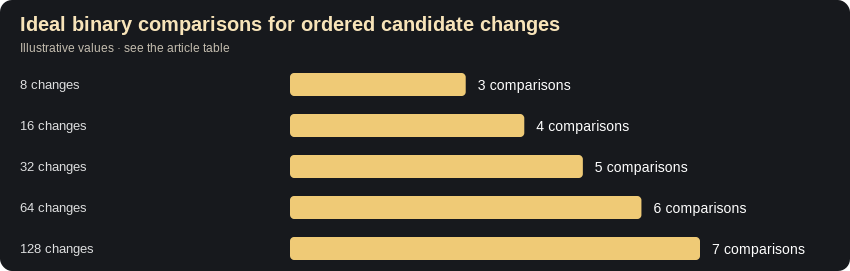
| Point | Value (comparisons) |
|---|---|
| 8 changes | 3 |
| 16 changes | 4 |
| 32 changes | 5 |
| 64 changes | 6 |
| 128 changes | 7 |
Illustrative calculation (not sourced observations). Ideal case ceil(log2(N)) for a monotonic single boundary within N ordered candidates, excluding endpoints, skipped revisions and build overhead.
An issue arrives at an editorial desk after a release: the comparison chart in an article about garden visits no longer names the unit beside the numbers. A reader can see thirty and sixty, but cannot tell whether those are visits, percentages, or minutes. The article still loads. The prose surrounding the chart is intact, the image looks familiar, and a machine that checks only for a successful build cannot tell that anything changed. An editor who compares two screenshots can demonstrate that the label disappeared, but that comparison does not identify which change caused the problem or whether the apparent disappearance was approved. Those are separate questions, and treating them as one turns an editorial repair into a trial over every recent commit.
One particularly useful approach is to turn the complaint into a small, observable rule, reproduce the difference under controlled conditions, and search history for the boundary between editions that satisfy the rule and editions that do not. Git bisection makes that search efficient when the history and the rule support it. The technique is not a way to decide authorial intent, reverse-engineer changing model responses, or prove that an entire article is correct. It is a way to organize evidence about one change in behavior. A good triage record preserves that narrow conclusion, along with what was actually inspected, so a colleague can make a defensible repair without having to trust the person who ran the search.
Separate the symptom, the rule, and the disposition
Begin by writing the observation without diagnosing it. For example: in the locally preserved copy of the current edition, the small-screen chart shows two numerical values and a legend, but does not show the unit attached to the relevant axis. Record the article edition, browser and viewport, the view where the chart is open, and precisely what appears. If the report concerns keyboard focus or a collapsed disclosure instead, record the steps leading to that state. A second person should recognize the same symptom without guessing which of several similar figures the first person meant. If the original edition was not saved, say which later copy was examined rather than implying it is the exact bytes the reader saw.
Now express a rule that can be evaluated. In the example, the resolved chart data has an explicit unit, the figure is an observed-rate chart, and the visible plot or its adjacent caption must explicitly label that rate. A rule about those facts is stronger than “the screenshot should look like the older version.” It defines what matters while allowing intentional changes to margins, colors, or typography. If the issue is a chart marked measured when its numbers are illustrative, the rule might be that a test figure tagged illustrative must have a visible illustrative label associated with it. A check for the literal word somewhere on the page would be too broad; the word in an unrelated note does not repair the figure.
Finally, separate the disposition: what the newsroom decides after the behavior is confirmed. Was the change a defect, an approved redesign, or a change with undocumented intent? Does the new design convey the same information by an approved, tested alternative? Is the old behavior even the right reference? A revision can be first to fail a proposed test and still be correctly implementing a different approved rule. In that case the new test may need revision, not the article. Conversely, approval of a layout does not necessarily approve removal of the unit: a reviewer could be signing off on color and not on meaning. The policy decision belongs in a review with the proper owner and source evidence, not inside the exit code of a search tool.
Preserve useful evidence before trying a repair
Save the smallest packet that supports the reader report. Include an approved old output if one is available, the affected new output, the input needed to render the test chart, the expected wording or semantics with its source, and a small description of how the evidence was captured. Record the exact revision identifiers when they are known, but distinguish them from a generated edition identifier or a published artifact checksum. A source revision and a delivered artifact refer to different things. Several artifacts from one revision may exist if a renderer, resource bundle, or generation run changed between outputs. An old screenshot with no lineage supports a difference in appearance, but does not by itself identify a good commit.
Take care with the character of each item you save. A screenshot can show a visible label at one screen size. A browser accessibility-tree capture may show an alternate name, but does not establish that the same words are visible. The chart data file can establish that the input supplied a unit, but does not establish whether a reader received it. An exported PDF may preserve what was printed but not what a screen-reader user encountered in HTML. Keep these evidence types separate; different revisions may break different output channels. When a statement depends on two channels, run two checks rather than stretching one observation beyond what it can show.
Keep the packet local or in a workspace already approved for the article. Substitute a small synthetic example where real manuscripts contain personal notes, unpublished work, paid source material, or otherwise restricted content. A good synthetic fixture keeps the structural conditions that cause the bug, such as a specific chart type, a unit supplied in article metadata, and a narrow display, without inheriting unnecessary details from the reported article. Preserve the original secure packet when policy allows and refer to it in the ticket by approved identifiers. Do not upload the manuscript to a third party merely to get a visual diff or a clean reproduction. Most editorial checks do not require any network access.
Before editing, make a second reviewable copy. Early experiments often change browser cache, substitute a font, or rebuild an artifact in a way that helps diagnose the problem but makes it harder to reconstruct the original observation. Treat every experiment as a new output with its own label. In the example, a reproduction that brings the missing chart unit back after a template tweak is interesting evidence about the mechanism, but it is not the original new edition. Put those entries in separate slots in the packet. The resulting timeline can reveal that a later tweak happened to hide the regression without restoring the rule for other article types.
Design a fixture small enough to explain
An editorial fixture is an input chosen to make a behavior testable. Start with an unremarkable title, two or three invented measurements, a chart specification with an explicit unit, one restrained caption, and none of the optional extras that are not involved in the complaint. Add features until the symptom appears, then remove features one at a time to determine which ones are essential. Sometimes a missing unit appears only when the figure has both a legend and an open data-table disclosure. In that case collapsing the fixture to a chart with no legend would remove the actual trigger. Minimal does not mean tiny for its own sake; it means that each remaining part has an identified job.
Choose input values that expose the defect instead of accidentally masking it. If a unit is minutes, do not use values already typed as strings such as “30 minutes” and “60 minutes.” The text alone could then satisfy a checker even if the axis label was lost. An illustrative-versus-measured example likewise should not put either label in the title if it is supposed to test the label supplied by the chart template. A fixture can deliberately include a separate paragraph containing the same word so the test proves it is scoped to the figure. That negative control can catch a selector that became far broader than intended.
A robust practice is to keep both a clean control and the minimal affected example. For a particular figure template, use an unaffected figure that correctly displays the unit, alongside an affected figure that shares the same type and has the triggering option. They help distinguish a true defect in a conditional branch from an outdated test that stopped locating all figures. One plain source file of invented values can feed both cases. Give them visible names so outputs are not exchanged by mistake. The test can report both outcomes, but classify history only with the rule whose behavior is being investigated. If the control stops rendering, that is an investigation finding, not automatically proof that the investigated defect occurred.
Record the assumptions of the fixture rather than hiding them in a folder. State the schema version, how paths resolve, whether the article supplies chart metadata locally or imports it, which article layouts support it, and which browser view matters. A reviewer evaluating a mobile-only issue should know that a wide screenshot may be a control, not the failure condition. On revisions before the chart format was introduced, the test fixture may legitimately be unsupported. That is not necessarily an older instance of the same bug. Thinking about compatibility now will later tell you which portions of history are testable with this particular evidence.
Define the result before automating it
Use three result classes: the check passed, the check confirmed the defect, or the revision did not yield a reliable decision. Before you automate anything, write examples of each. Pass might mean that the page rendered with the expected fixture ID and a visible unit correctly associated with the chart. Confirmed defect might mean the same page and fixture rendered normally, the unit still exists in the input, but the named figure lacks the required text in the defined location. A revision that cannot build, a missing fixture, a browser that fails to start, or a renderer that emits only a partial artifact is not automatically bad. It has not produced the observation your defect rule needs.
The order of those checks matters. Suppose the checker asks whether the caption includes the rate unit and returns a failure when it does not. At a revision where the build generated no page at all, a naive check can produce the same failure. Git would treat the missing page as evidence of a missing caption, even though the page not existing is a separate problem. Require the output and relevant fixture markers before evaluating the defect. If those preliminaries fail, classify the revision as untestable for the current question and preserve the reason. With that safeguard, a separate tool failure cannot move the historical boundary simply because its message happened to be unavailable.
Use the most direct observable for the contract. An attribute on the chart specification is sufficient for checking whether the pipeline dropped the unit from structured output. It is not sufficient for checking whether CSS hides it from a reader. For a visible unit, use a rendered-page assertion on the relevant figure, appropriate display or layout state, and the presence of the intended value and unit. Do not infer visibility solely from presence in the document. Conversely, if the contract is semantic association rather than visual placement, the rendering might look fine while the association is absent. Capture the evidence that relates to the requested behavior, and save a screenshot as context rather than making pixels the sole policy.
A threshold can be appropriate if there is no useful structural assertion, but it has to measure the complaint. A small screenshot change across the entire page may be noise, while a one-character minus sign in a temperature comparison may be critical. A large banner update may swamp a lost unit on a pixel-difference map. If a visual check is necessary, crop to an identified area, fix the viewport and text sizing, and keep examples on both sides of the expected decision. Document why the threshold is suitable for the actual rule. When direct checks and screenshot differences disagree, investigate which view of the evidence represents the reader problem instead of averaging the results into a score.
Stabilize the evidence without rebuilding the whole past
An automated check is only useful if it can assign the same outcome to the same revision under comparable conditions. Try the good and bad endpoints more than once using the same fixture and the same observation rule. If every run yields a different picture because an image service is generating new art on demand, you cannot fairly call any one screenshot the old correct state. For a layout issue, use a fixed editorial illustration of the same dimensions and predictable bytes, or reuse an approved and locally archived image. Document what the stand-in holds constant. A new picture whose subject moves from the left to the right changes which text overlaps it; it is not interchangeable for every visual test.
There are situations where a fixed substitute would erase the symptom. If the defect specifically concerns where a generated image is cropped, a generic rectangle with no subject is a poor test. Keep a representative image with a clear composition and record its digest, the crop instructions, the target view, and the approved requirement. If the issue is whether a generator returned a certain kind of content, use archived responses from the relevant versions when you have them. If you do not have the old responses, report the missing evidence. A seed may constrain a generation tool in one environment, but a seed alone does not stand in for the exact model, settings, inputs, and retained asset. Identical prompt text is not proof you reproduced an edition.
Control clocks or locale only when they touch the comparison. The Reproducible Builds project documents SOURCE_DATE_EPOCH as a way for cooperating tools to derive a timestamp from a supplied value. For a fixture, using one documented timestamp and timezone can prevent an irrelevant “generated at” field from changing the tested output. But setting the variable does not force every renderer, plugin, or generator to honor it. It does not fix locale, bundled fonts, unstable image output, different input ordering, or the comparison predicate. When diagnosing a date regression itself, freezing the wrong clock might suppress the bug you are trying to study. Treat such controls as choices affecting what your test can and cannot say.
Do not set an impossible entrance requirement that every historical edition be reproduced byte for byte. The question may concern one caption rule, which can often be tested even if other parts of the historical edition are not reconstructable. A fixture can replace unrelated network services and use only local data. A digest of a retained hero can prevent an otherwise irrelevant mutation from entering the test. The important distinction is between controlled differences and consequential differences. Keep a record of each substitution and why it preserves the behavior under examination. If you cannot defend a substitution, stop narrowing history and inspect the original artifacts with the limits stated plainly.
Choose endpoints on purpose
You need a known good revision and a known bad revision under the same contract. A good candidate often comes from a retained approved edition, not merely the release preceding the complaint. The complaint might have been noticed weeks after the change. Find a revision that produces a passing result using the current fixture and a comparable rendering path. Select a bad candidate with the same certainty. Repeat both tests in the isolated environment and record the full identifiers and evidence. Test any proposed branch or merge relationships locally before assuming the two endpoints mark one clean sequence. A label like “release last Tuesday” is not a sufficiently precise locator by itself.
If the earliest suspected edition is known only from a screenshot, first see whether a source revision associated with that screenshot can satisfy the predicate. If it cannot, do not label the screenshot wrong. A historic renderer may not be available, a caption may have been inserted manually after the build, or the issue may concern an earlier unpublished fixture rather than the finished release. In those cases you might be able to confirm a difference between retained editions but not bisect a code path. The two-edition comparison remains valuable. What you should not do is smuggle an unverified good revision into the search to produce a more satisfying story.
Keep the harness outside the portion of the checkout that will change during bisection, or otherwise ensure that every revision has exactly the same checker. If the harness is tracked only in the latest revision, checking out earlier revisions may remove it or substitute a different version. Avoid turning an authorized editing checkout with unpublished work into an experiment. Use a disposable local checkout or an appropriate isolated worktree with known limits, record what it can access, and give it a fresh output location per candidate. Do not use arbitrary remote code or unfamiliar repositories merely because they appear in a linked article. This procedure is for your own editorial repository or another one you are authorized to test.
Finally, confirm the intended meaning of older and newer. Git permits custom terms for the two states; this can make the search easier to interpret if the states describe two forms of editorial behavior rather than a moral judgment of the changes. Even if your notes use good and bad, define them as pass and fail of a particular fixture rule. The bad side is not a list of inferior articles. It is the set of tested revisions that, in the stated conditions, exhibit the behavior being traced. This distinction helps a team discuss the result without implying that the author of the first failing commit was negligent.
What the chart counts, and what it leaves out
The chart shows an idealized comparison count for a single boundary in ordered candidate changes. In the model, behavior goes from passing to failing once, and splitting the candidate set into halves is always possible. With eight eligible candidates, three binary decisions can single out one of them: eight to four to two to one. With sixteen the model gives four comparisons, thirty-two gives five, sixty-four gives six, and one hundred twenty-eight gives seven. These are instances of the same rule: take the base-two logarithm of the candidate count and round upward when necessary. The known endpoints are not extra entries in those counts.
The horizontal positions are the five labeled scenarios, each doubling the previous candidate count. Read them as ordered teaching cases, not an equally spaced arithmetic scale of commit counts. The vertical values are comparisons in this ideal model, not minutes, staff hours, test successes, or actual measurements from Git. Verifying endpoints, collecting evidence, investigating skips, and building each candidate all have costs not drawn on this chart. If one revision takes twenty minutes because it needs a different renderer, its cost is not equivalent to a one-minute candidate simply because each counts as one comparison. That is why a small fixture has practical value independent of the search mathematics.
Git searches revision history rather than just indexing a list of rows. A graph with merges, commits on side branches, gaps, or skipped revisions can depart from the picture of a neat, evenly split sequence. The observed symptom may also vanish and recur, invalidating the idea of one monotonic boundary. The graph in the article is therefore a model of why dividing a candidate set can help, not a promise that a real project with sixty-four commits will require exactly six test runs. Use the Git bisection reference for the actual behavior of the tool and this chart only for the simplified arithmetic.
Run the search and preserve the trail
For an authorized local repository, the basic cycle is to start bisection, supply a confirmed failing revision, and supply a confirmed passing revision. Git then presents a candidate. At that candidate, regenerate the fixture output in a fresh location, evaluate the rule, and mark the outcome. A manual search is often preferable at first: it lets editors notice when a fixture changed meaning, when the only output is a placeholder, or when an old template does not actually generate the figure being tested. Once the classifications are repeatable and obvious, a harness can automate the same judgments with a clear trail of inputs and outputs.
When using a harness with the run feature, return a successful status for a tested pass, one deliberately chosen supported failure status for an observed defect, and the reserved status 125 for a revision that cannot be tested. Git documents that nonzero statuses from 1 through 127 other than 125 indicate the bad or new state; do not pass through an arbitrary command error just because it lives in that range. A missing test binary is not evidence of an editorial defect, even if a shell reports it with a status Git would interpret as failing. Catch such environment errors in the harness and classify them consciously. An unexpected harness failure should stop the investigation or result in a recorded skip rather than force a false conclusion.
For every tested revision, retain enough information to rerun the same classification: revision ID, predicate version, fixture version, runtime or renderer identifier, classification, and the location of any kept evidence. An untestable result should have a specific reason, such as “renderer cannot parse fixture metadata key” or “no archived dependency compatible with this revision.” Never write a personal access token or a private source excerpt into an unrestricted log. Keep evidence about what differed distinct from build chatter. Saving the bisection log records the classifications; by itself it does not record the browser screenshot or source rights for every input. When the session is done, reset it in the isolated checkout and record where you stopped.
The harness does not need to rebuild an entire publishing system if a small targeted command exercises the same path. That assumption must be tested, not hoped for. A chart-label function unit test that calls the formatter directly can demonstrate that the formatter accepts a unit, but it might bypass the article template that dropped it. An isolated page fixture can exercise the formatter and template together without importing an entire archive. If running the fixture requires loading every remote article or generating new images, shrink the experiment around the actual execution path. A successful narrow search should give a precise diagnosis that can later be confirmed in a realistic output, not merely an argument about a mocked function.
Keep skips and flakes from turning into evidence
A skip is a disposition, not a stage on the way to bad. If one or more skipped revisions border the first observed failure, Git may provide several possible first revisions rather than a unique origin. Report the candidate set or the last confirmed pass and first confirmed failure with the omitted revisions noted. “The defect is supported by comparison in this interval” is more accurate and useful than pretending every commit inside that interval was evaluated. Where a skip came from unavailable local artifacts, see whether approved archived artifacts or a small compatibility adapter can make the revision testable without changing the code governing the symptom. Do not silently patch the very behavior under test to make a historical observation possible.
Consider a case where an old chart file has a different container format but its unit field has the same editorial meaning. If you translate the test payload into the older container, document the mapping and verify it against a known old passing artifact. If translating the unit also changes its meaning, the adapter is no longer neutral. There may be no valid comparison across the format transition. In that case define shorter ranges and say they have different predicates. The goal is not to make Git continue at any cost; it is to move toward an explanation without manufacturing compatibility where the underlying model really changed.
Flakiness is a different problem. Suppose the same revision passes four times and fails once because a permitted webfont sometimes falls back, and the fallback makes a caption wrap behind a clipped container. The result is not genuinely stable, but the intermittent clipping may itself be the defect. You can investigate the problem separately by choosing and documenting the font-loaded and font-fallback states. Then test each state consistently, with a controlled local fixture that triggers each one. Alternatively, if the failures come from environmental noise irrelevant to the article, repair the harness. A majority vote across retries without understanding why the results differ can hide a real intermittent issue or move the alleged boundary.
Check for nonmonotonic history if isolated spot checks contradict your narrative. The issue might first appear, get repaired, and then return after a template was copied. A passing result after an earlier failure may be completely real. To distinguish this from an unstable test, rerun both revisions under the same conditions, confirm the same fixture route was exercised, and inspect commit history around the transitions. Search shorter ranges around the edition under investigation, or use a sequential check over a small set when there is no clear single boundary. In your conclusion, state “the transition associated with this edition” rather than “the first occurrence in the entire repository” unless that wider claim is supported.
Test the mechanism, then decide what to change
When a first failing candidate emerges, reproduce that candidate and its relevant predecessor again under the stable harness. The report should include the exact evidence from both sides, not just Git output. Read the small part of the diff that bears on the behavior. If a refactor moved the chart title into an optional legend area and the unit disappears only with that option, identify the connection between the fixture and the resulting markup. If the commit changed five unrelated files and the behavior is only correlated with one change, keep testing. A local repair that restores the specific contract is stronger evidence than matching the calendar date of a creative change.
On a merge boundary, check the parent appropriate to the edition's actual lineage and consider both the incoming change and how it integrated. A behavior might require a template update from one branch and a new chart shape from another; neither branch would show the combination alone. In that case the merge or integration behavior is a defensible finding even if the surface change began on a side branch. A neat attribution to an individual file or engineer can be misleading. Record the interaction and the edition trigger. That account is more useful to someone deciding whether to adjust the template, fixture coverage, or release review.
Use two ways of testing a proposed solution when possible: keep the minimal case that isolates the regression and also check a representative finished edition. The first shows that the repair hits the identified mechanism; the second catches an interaction outside the fixture. If the unit is restored by placing it in a visible caption, confirm the caption is associated with the correct chart and behaves when the data table is expanded, at the width involved in the complaint, and in the alternative presentation if that was part of the agreement. Do not equate repairing the local draft with having changed the public artifact. Publishing is separate and requires its own sign-off.
Invite the editor responsible for the affected information to review the proposed disposition. A redesign might intentionally move repeated units from every mark to a single adjacent label. That can be appropriate if the requirement is that readers can reliably connect the unit to the values. An aesthetic preference for a shorter caption may conflict with a factual need to distinguish minutes from visits. Make that choice explicit, and update the test to cover the approved convention. The test is a record of an editorial promise, not a fossil of the last screenshot someone happened to accept. If the policy is not yet settled, retain the diagnosis and mark the disposition pending.
A closeout note that another editor can use
A useful closeout starts with one sentence about what changed for a reader. Follow it with the scope: fixture identity, article type, tested view, revisions, and the semantic requirement. Include the confirmed pass and failure and the smallest relevant artifacts, such as before and after captions, screenshot slices, or a chart data extract. Record skipped revisions and why; add a caveat if an exact transition could not be assigned. Note what the chart in this article illustrates separately from the incident itself. Ideal comparison counts are not incident data. They can help decide whether further testing is worthwhile but should not be reported as actual work done.
Then write the proposed or completed disposition, its owner, and the evidence that could change it. A useful entry might say that the stored edition omitted a unit at a narrow viewport, a controlled fixture reproduced the omission in the revised layout, and the current local fix puts the unit in the figure caption and preserves its association with the data table. Record which cases passed after the change and which channels were not checked. If only HTML was inspected, do not imply the printable edition was verified. If the repair is awaiting approval, distinguish that from a failure to reproduce. These are different statuses and ask different people to act.
End with a precise prevention step. For this example, add a small assertive test for figures with explicit units and an optional legend, verify both the affected narrow view and a wider control, and make the retained issue fixture part of the editorial regression suite. Test that it fails when the unit association is removed; a regression test that never fails under an intentional negative control may be checking the wrong thing. Give someone responsibility for maintaining the fixture when formats change. Otherwise the team may have a busy looking archive of tests but no way to tell which ones still protect what readers need to understand.
One last discipline keeps the whole process credible: make it possible to disagree with your result. If the custom terms, test branches, substitutions, and limitations are named, a colleague can point out a different policy or a missing reproduction condition. That is healthy. It means the search has produced evidence rather than a verdict that only its author can interpret. The best outcome is not always a uniquely named commit. It is a small packet that lets collaborators reproduce the behavior, understand what the test did not cover, and choose whether to fix the output, update the rule, restore missing evidence, or leave an intended change in place.
A separate question is whether earlier editions should be corrected. The isolated test can reveal which template variants are likely to share the faulty rule, but it cannot establish the contents of every archived artifact. Start with an inventory of the relevant charts by template and schema, then inspect a small sample of retained outputs to confirm which variants actually show the defect. Prioritize charts where absent units make a comparison ambiguous or materially misleading. An archive policy might distinguish corrected editions from historical records that remain available with a correction note. Whichever approach is approved, keep the original and corrected identities distinct so later citations or incident reviews do not silently point at a different artifact.
Sources
- Git reference: git bisect, for revision selection, run status interpretation, skipped revisions, custom terms, and session reset.
- Reproducible Builds: SOURCE_DATE_EPOCH, for supplying a timestamp to tools that support the convention. The workflow examples and chart calculations here are hypothetical editorial illustrations, not measured results from either reference.