
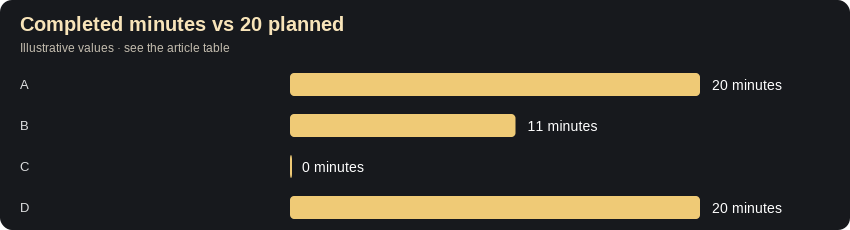
| Category | Value (minutes) |
|---|---|
| A | 20 |
| B | 11 |
| C | 0 |
| D | 20 |
Four synthetic 20-minute reservations yield 20,11,0,20 actual minutes; sum 51 minutes. No weather measured.
At minute eleven of a planned twenty-minute flower-visitor watch, the observer sees a shower arrive at the far end of the path. They stop counting and leave. Back at the desk, the form has room for a count, a duration, and a checked box marked “done.” None of those three fields captures what just happened. Twenty was the planned duration, not the time actually watched. Eleven minutes of observations may still be useful, but they do not tell us what happened in the remaining nine. And “done” could mean the observer finished entering data, not that the intended survey was completed. A one-line note about rain cannot repair those meanings if the numeric fields already say something else.
This is a different problem from deciding whether to begin under unsuitable conditions. A weather rejection at the start normally produces a reservation with no qualifying effort. An interruption after the start creates an observed fragment with a known or uncertain stopping point. The fragment can contain legitimate detections, and it can contain a legitimate zero for a narrowly documented interval. It cannot be stretched into a complete twenty-minute record just because the original calendar slot was that long. This article is about preserving that distinction from field notebook through analysis, including what happens when the crew goes back for a retry.
The examples use a hypothetical fixed watch for flower visitors, not a prescribed bee-monitoring protocol. Local rules may set different weather restrictions, minimum durations, and criteria for a usable segment. Read this as a way to document departures from whatever plan was actually in force. Never remain in an unsafe location to complete a watch or improve documentation. A dry-looking patch or a working timer is not a reason to override site closures, official safety advice, or a field lead's judgment.
Keep three facts that the form wants to collapse
The first fact is what the crew promised to do. A reservation might say: watch one marked flower patch for twenty minutes on Tuesday during an early afternoon window, using the current fixed-watch method. That reservation exists even if the team gets turned around at the entrance. It records the intended site, method, coverage, and timing. Without it, the final dataset has no reliable count of what was planned and no way to distinguish a genuinely sparse roster from a roster full of missing visits.
The second fact is what actually occurred. Did focused observation begin? When did it stop? Was the observer diverted while the clock kept moving? Which part of the patch stayed in view? Were visitors recorded at the level specified in the instructions? The answers can differ from the plan for reasons that do not invalidate everything. For example, a watch can contain eleven securely logged minutes at the right patch even when the route in and out took forty minutes. Time spent on access, setup, checking the conditions, or walking back under shelter is not automatically focused watch time.
The third fact is what an analyst may do with the record. The same fragment might be unsuitable for a primary analysis that compares equal twenty-minute visits, admissible in a secondary analysis of qualifying minutes, and still informative in a separate observation archive. Those decisions depend on the target measure, not just on the existence of a number. The project should record the choice separately from the field status. A reviewer can exclude a complete event because the wrong patch was used, just as they can accept a partial event for one explicitly limited use.
A common error is to let a software status effectively rewrite history. Once a row is labeled excluded, the count and timestamp get cleared. Once the observation is reinstated, the visit is called complete. This makes it impossible to reproduce how one decision was reached or to reuse the raw evidence for another legitimate question. Think of “interrupted” as an account of what happened and “excluded from the full-watch estimate” as a rule applied later. Neither one is a substitute for the other. The EPA citizen science quality assurance handbook is useful here because it separates documented procedures and records from the later assessment of fit for an intended use. Its guidance is general; it does not prescribe a twenty-minute bee survey.
Define interruption at the moment coverage changes
A weather interruption starts when the agreed observation stops, not necessarily when someone begins typing a reason. In a hypothetical watch beginning at 13:00, the observer places the timer in stop mode at 13:11 when attention shifts from a fixed flower patch to getting out safely. If they log the reason at 13:22 under shelter, 13:22 is the entry time. It is not the end of the watch. Keeping separate observation and entry timestamps protects the calculation against an innocent delay and makes it clear what kind of time a later export is showing.
The distinction is equally important when someone does not press stop. Suppose a beep captures the expected end at 13:20, but a notebook says the patch had been out of view since the gust at 13:11. Do not treat the beep as evidence that nine additional minutes were observed. Use the strongest defensible stop evidence, document the timing basis, and record uncertainty if the evidence is vague. The clock may be excellent at measuring elapsed time and indifferent to what counted as coverage. A data system has to supply the meaning that the timer cannot infer.
It helps to define what a break looks like in advance. In a fixed-patch watch it can be the point at which the observer loses the patch, no longer follows the allowed observation procedure, or leaves the position. A brief glance to record a detection might already be part of the method, not a break. But if attention shifts to moving equipment, discussing an incident, or finding shelter, the continuity assumption changes. Do not invent a universal grace period. Instead, specify whether the project permits pauses and what separates a permitted recording action from a loss of coverage.
Partial spatial coverage is not always equivalent to partial time. A route may be scheduled to pass three flower beds and stop at the first two. A stationary observer may finish the scheduled time while surveying only one corner because the rest becomes inaccessible. In the first case the effort ledger should preserve actual segments traversed; in the second it should also flag the change in view even if the full interval elapsed. For a count per fixed area, a smaller observed footprint changes what the count represents. The elapsed minutes alone cannot repair that change. This article's chart intentionally holds the illustration to a time ledger so the area problem stays visible as a separate issue.
Make the field ledger communicate with the data ledger
A minimal reservation row can hold the reservation identifier, a site or route identifier, expected patch or segment, planned date and time window, planned method version, and planned duration. If the project rotates observer pairs or strata, keep the intended assignment there as well. Reserve space for version history when schedules are formally revised. That is not permission to revise the original whenever a watch falls short. Use the active version at the moment of the attempt and preserve earlier versions when a real scheduling change occurred.
A separate attempt row can hold an attempt identifier, its reservation identifier, observation start and end when known, actual focused minutes on the project scale, status, reason, time zone, and a short factual note. Terms like “completed,” “interrupted,” and “not started” should have written definitions and be selectable without filling in a taxon result. A checkbox saying “data entry finalized” is fine if it is kept apart from completion. The chart, tables, and downstream exports should read actual effort from the attempt or segment table, never quietly default to the planned duration when that field is blank.
An observation row can record the attempt or segment, a time or time interval, the project taxon or identification level, what counted as a visit under that method, and a certainty flag if required. Do not manufacture precise timestamps to satisfy a required field. If a visitor was noted sometime before the interruption, record the available interval or the original note under the project's precision rules. A form designed only for perfectly timestamped detections can pressure observers into rewriting decent evidence as precise evidence. A specific “minute unknown within observed segment” option is more truthful than an invented minute.
Finally, use a separate review record to explain data eligibility. It can say which named analysis included or excluded this attempt, what criteria were applied, which protocol version governed the choice, and what human or automated checks found. Review flags can live in a related table or versioned export. The implementation matters less than the ability to retrieve the original state and the rule that produced each published summary. When a single flat spreadsheet is all the crew can manage, distinct columns and a second tab for decision notes can preserve the same structure.
As one example, imagine reservation BR03 calls for a twenty-minute fixed view. Attempt BR03-A starts at 13:00 and stops at 13:11 under an already approved stopping rule. The field note might say “wind increased; coverage stopped when observer left the marked point; timer reading eleven minutes; rain noted while packing.” That note does not need a guess at wind speed. It describes the sequence and source of the time. If the project captures local weather separately, measured and perceived conditions should be labeled instead of treating the note as a calibrated reading.
Read the effort graph before reading a count graph
The accompanying illustrative bar chart displays four invented reservations, A through D, each with a planned twenty minutes. Actual effort is twenty minutes for A, eleven for B, zero for C, and twenty for D. The actual total is fifty-one minutes out of eighty planned. Twenty-nine planned minutes went unobserved: nine from B and twenty from C. In this fictional ledger A and D were completed, B was interrupted, and C did not start. The zero for C is a measured bookkeeping result about effort in the example, not a count of flower visitors.
The difference is clearer if the chart is paired with an outcome table. A and D can have count values if they met the protocol and the observer searched for the specified outcomes. B can have a segment count, but its full-watch outcome remains unavailable. C has no in-protocol count at all: the count cell is not applicable or missing with reason, not zero. The chart does not show any insects, and it does not measure weather. It is not evidence of how often an actual team encounters interruptions, what any shower does to pollinators, or how much effort is ideal. Those distinctions apply even if the graph is visually persuasive or looks like a dashboard someone would actually use.
The same four rows yield multiple correct but different coverage summaries. Two of four reservations completed the full watch. Three of four started. Fifty-one divided by eighty equals 63.75 percent of the total planned time. These are separate quantities. The first is reservation completion, the second is initiation, and the third is minute coverage. None is automatically the fraction of sites represented, the proportion of the landscape sampled, or the chance of detecting a taxon. If B and C were scheduled at the same patch while A and D were at different patches, site coverage would depend on the actual site identifiers rather than merely counting bars.
Reporting the decline from planned to actual effort is more informative than treating it as a failure to conceal. If the reader sees only A and D, a tidy chart with two twenty-minute watches can imply that the schedule worked perfectly. If the reader sees all four reservations but is told there were four closed visits, it can imply that the intended watch happened for C. A chart with labeled actual time and accompanying completion counts conveys the gap directly. The headline should not mix a duration denominator in one year with a reservation denominator the next. Both figures are useful when their definitions remain stable.
Treat a zero as a result with a question attached
Suppose B's observer documented that no visitor meeting the rule was seen during eleven attentive minutes. That is a segment zero, with the method, target, and duration attached. It answers a narrow question: how many qualifying encounters were recorded in that observed window? It does not answer how many would have been recorded in the original twenty minutes, how many insects were present elsewhere, or whether an unseen species was absent. By contrast, if the observer did not monitor the patch after minute eleven, the next nine minutes have no outcome. A spreadsheet row for the full watch should not concatenate those two different statements into a single zero.
Unknown is also distinct from zero within the segment. An observer who spent time at the correct point but lost their tally card before making a backup may have eleven defensible minutes and an unknown count. An observer who clearly recorded several possible visitors without the ability to identify them may have detections with unresolved identities, not zero detections. Keep count completeness and identification certainty in separate columns if both affect the study. Under some protocols a count of all visitors can include unresolved groups; under others it cannot. The distinction belongs to a defined data product, not to a universal spreadsheet convention.
If a second method captures photographs, be careful about counting a null image archive as a null watch. No photographs can mean nothing was photographed, whether or not anything was seen. Conversely a photograph taken while leaving might document one opportunistic encounter without documenting all activity in the planned watch. It is legitimate to save that evidence separately if local rules allow it. Do not repair a missing survey log by assigning photos outside coverage to the watch. The resulting row would look complete while making the underlying observation boundaries unknowable.
The Cornell Lab's eBird protocol guide distinguishes incidental bird checklists from focused records with effort information, and also distinguishes missing effort on historical records from a genuinely incidental activity. Use that as an analogy for the importance of effort and reporting scope, not as a reason to label an interrupted bee watch with eBird's bird protocol names. A partial focused period may have well documented effort even if it is not a full standardized visit. A casual encounter during a rain detour can be a different kind of record even if it happens beside the same marked patch.
Keep weather notes anchored to the observation clock
An interruption record is more informative if it says whether the disqualifying condition began during observation, was discovered after the event, or was only inferred from a different source. A short note can distinguish “drops began at about the end of the observed segment” from “field crew did not measure rain; nearby station reported rain later.” The first is an eyewitness timing note; the second is an external contextual record. If the team uses both, retain the source, time zone, resolution, and location appropriate to each. The two kinds of evidence can disagree without either being useless.
The sampling plan should specify what a condition label means. “Rain” can be a recorded reason for leaving, a weather observation, or the name of a data exclusion rule. These are not identical. The reason for leaving can be entered quickly, even when no gauge is available. A weather measurement needs its own instrument or source and time. Whether the segment meets an analysis criterion is a downstream decision. When three meanings share one dropdown, reviewers may infer measurement precision or a prescriptive threshold from an ordinary reason code. A short code list and plain-English notes prevent overreading the evidence.
For a mixed-weather example, suppose a localized shower passed over the parking area and the watch patch still appeared dry to the observer when they left. The reason recorded might be that the crew moved to safety under the field plan, not that the patch definitely received rain at minute eleven. If the project later adds nearby weather data, represent the difference in spatial scale. The record can still explain the stopping decision without making a claim about precipitation over the patch. No extra data quality work is worth extending exposure during an active incident; finish the note when appropriate, and mark what was only reconstructed afterward.
If expected stop conditions are ambiguous, log that ambiguity rather than using a default category to help the dashboard look orderly. Imagine a volunteer stops at a wet boardwalk and another describes the reason as blocked access. A project might code the immediate cause as access and retain weather as contributing context. The difference matters if the team is studying missed effort under changing accessibility, but does not require blame. If uncertainty remains, allowed categories such as unknown or multiple reasons are more accurate than forcing one person to reconstruct a minute-by-minute incident beyond what they observed.
Decide when separate blocks are separate attempts
An observer who has completed eleven minutes might be tempted to come back after the shower and finish the last nine. That can be useful under a protocol explicitly designed for segmented watches, but it is not automatically the same as twenty continuous minutes. Between blocks, weather, time of day, bloom conditions, observer position, and the composition of visitors can change. The possibility of repeat encounters also changes: the same visitor could appear on both sides of the break. A single start and end pair with nine minutes of downtime hidden inside makes these possibilities impossible to inspect later.
If your method allows segmented effort, preserve a start, stop, covered area, status, and effort for every block. Record the elapsed gap separately. Retain the actual effort budget and the number of blocks. Document whether the protocol treats their encounter counts as additive and how uncertain repeated appearances are handled. In a study of uninterrupted watches, that same representation means the reviewer can exclude the combined attempt without deleting either block. In a different analysis, users might accept both segments, one, or neither according to their preregistered or otherwise documented criteria.
Consider three records with eleven minutes before a shower and nine after it. One stopped for a few minutes and stayed on site under conditions allowed by the protocol. One came back the following afternoon. One came back an hour later but watched a different patch because the original approach was closed. All three could add to twenty nominal minutes, but they do not have the same time, location, or continuity. Merging them by arithmetic loses the very information needed to decide which comparisons are reasonable. The same risk arises from combining intervals without checking for overlaps. Two people observing together may constitute one paired watch, not two serial blocks or forty independent minutes.
When the plan does not allow pauses, restarting should normally create a separately identifiable attempt, linked to the original reservation or explicitly marked as a new reservation according to the schedule. Keep the original status and do not convert a repeat into a continuation simply because doing so makes a single row easier to export. If data entry software only permits one row per reservation, create an attempt register outside that software or adapt the export. Otherwise it will be very difficult to distinguish two visits to one patch from a single observation that crossed a gap.
Reschedule transparently and retain the original attempt
Good retry rules define the window in which a repeat may substitute for an original reservation and who authorizes the change. A return later the same day may still be qualitatively different from the intended early afternoon sample. A return a week later could fall in a different flowering phase even if it is the same clock time. Which limits matter depends on the study. Write the criteria before outcomes are known and record enough detail to check them. If options are constrained by staffing or access, report that honestly rather than pretending every retry was a perfect match.
Start with the same sampling objective. If the target was a particular fixed patch during a short bloom window, retain the patch and window on the retry order rather than substituting a nicer looking location. If the aim was coverage of a habitat stratum regardless of the exact plot, preapproved alternates drawn from that stratum may make sense. Replacements have different implications from moving to the first dry place nearby. The former carries forward something identifiable about the design; the latter can change both the exposure and the population being compared. An alternate should have its own site identifier even if the analysis treats it as representing the same stratum.
Define both an attempt denominator and a reservation denominator. Suppose B had eleven minutes, C never started, and the crew returns successfully for B but not C. Five attempt rows now represent four original reservations. Three original reservations may be counted as satisfied when the accepted repeat is eligible, even though only two original attempts completed. If the repeat contributes another twenty minutes in a separate effort view, the cumulative logged effort across all attempts is seventy-one minutes. Dividing seventy-one by the original eighty minutes now describes accumulated field work relative to the original plan, not simple coverage of the planned intervals. Depending on retry policy, it can ultimately exceed one hundred percent. State which denominator a report uses rather than quietly switching after a repeat.
Keep the original record even if the replacement earns a full result. If only one qualifying attempt can enter the primary estimate, record the rule that selected it, such as earliest completed repeat in the allowed window. If both a partial and full attempt enter another analysis, preserve their linkage so multiple measurements of the same patch do not masquerade as extra independent sites. An analyst can then choose to aggregate within site, model dependence, or report segments descriptively. Throwing away the original attempt loses evidence about how often the design depended on retries and which sites required them.
What if the retry succeeds under unusually good weather? Report success without treating the earlier loss as random. A project can state that a planned visit received an eligible replacement while also noting the replacement occurred at a different time, under better conditions, or with a different observer. The original and replacement dates are not interchangeable. A plot by realized date should use actual event timing, while a planning audit may group the attempt under the original reservation week. Keep both views explicit. The time chosen for the horizontal axis can change how the same field operation is interpreted.
A rate can be honest arithmetic and still answer the wrong question
When qualifying minutes are known, a count divided by those minutes describes a recorded encounter rate during the included windows. In a fictional example distinct from the chart, a stopped eleven-minute fragment with three qualifying encounters yields three divided by eleven encounters per minute, or about 16.4 encounters per hour after multiplying the rate by sixty. No one watched for sixty minutes. The conversion is a change of units, not a forecast or a claim about what the remaining time would have yielded. Show the original count and duration next to the rate; otherwise the scaled figure can look more precise than the small record warrants.
Suppose a second, twenty-minute watch also records three encounters. Its rate is nine per hour, a mathematically smaller value, but the two windows could cover different conditions or phases of activity. It is tempting to call the first patch more productive. The simple comparison cannot tell whether the difference reflects the site, short-duration variability, time of day, or the circumstances around the stop. For a primary equal-duration comparison, the shorter event might be ineligible. In a sensitivity check, its participation can be described transparently, without assigning any made-up count to the missing time.
Be specific about the aggregation question. Pooling the two fictional counts and dividing by their pooled effort gives six encounters across thirty-one watched minutes, about 11.6 per hour. Averaging the two separately scaled rates gives about 12.7 per hour. The first weights watched minutes equally. The second weights these two attempts equally. Neither produces a twenty-minute count for the partial attempt. A site-level study may need still another weighting if one flower patch contributes many repeat segments and another contributes one. Choose based on the stated target, not whichever arrangement makes the chart look smoother.
An analysis designed for variable effort might use an effort term in a count model, but the denominator alone does not adjust for changes in what is observed. A simple exposure adjustment usually relies on enough comparability to interpret effort as time at risk under the stated model. If later minutes are systematically different, or if the conditions that truncate visits also change detectability, an effort adjustment can be inadequate. Use these models only if their assumptions fit the design and records. For a small field project, a line stating “three encounters in eleven documented minutes; not used in the full-watch analysis” may be more defensible than a complex correction announced without support.
Audit which weather, sites, and hours you stopped observing
Imagine weather interrupts more afternoon than morning visits. A complete-only dataset can then put more weight on morning activity, even if the calendar originally gave equal attention to both windows. A comparison across weeks could appear to change simply because the mix of completed hours changed. Similar problems occur when interrupted watches cluster in exposed sites, when only certain volunteers can retry, or when access to the wettest patches changes after a storm. Retaining the failed reservations makes it possible to detect these imbalances. It does not itself recover the unobserved outcomes.
First, state the intended inference. A design that deliberately samples only fair-weather periods may support a fair-weather comparison within the sampled sites and time windows, and that restriction should be visible. It cannot automatically estimate activity over all weather conditions. If the question really concerns how visitor activity changes before, during, and after rainfall, fair-weather-only coverage leaves out part of the target. Appropriate changes would require a separately planned, safe sampling design, not improvisation by volunteers during adverse conditions. A missing interval in the existing data should remain missing.
Next, show the roster by meaningful strata before showing biological results. For each sufficiently populated stratum, report reservations planned, attempts started, qualifying minutes, interruptions, and successful replacements. Reflect the most important design features: site, month or bloom phase, time band, and weather eligibility when recorded. For a small sample, raw counts often convey more than a percentage rounded to look stable. If some combinations have no coverage, label them directly. An open-ended discussion of possible weather effects cannot replace clear reporting that, for example, no watch at one exposed site finished in the intended afternoon window.
Take care when assigning reasons to strata. A nearby station reading can be available for a reservation that never started, but a patch-level eyewitness note often is not. If only completed or started surveys have weather observations at the patch, a summary by that variable can itself exclude the events that matter most. Use preexisting planned categories where possible, and keep an explicit unknown weather category when the information is unavailable. It is better to show the asymmetry in evidence than to use the summary to imply the team measured local conditions consistently on every scheduled day.
The result of this audit should determine the wording of any biological claim. A board member might ask, “Do the quieter observations after storms mean there were fewer bees?” A rigorous answer could be: “We recorded fewer encounters in the completed watches available after storms. We also had fewer afternoon completions and lost coverage at the exposed patch, so those counts do not isolate a change in bee activity.” This is not a refusal to interpret evidence. It names the result actually measured, the coverage discrepancy, and the remaining uncertainty in one place.
Validate the boundary without erasing the field story
Set basic consistency rules that make mistaken entries recognizable. A reservation can exist without an attempt. A not-started attempt should have zero focus time if non-initiation is known, and no in-protocol encounter count. An interrupted attempt may have positive time, a reason, and a supported stopping point or an uncertainty flag. A completed attempt generally needs evidence of meeting the time and coverage criteria of its own method. The field value can still be marked completed pending review if a formal quality check may later reject it for a separate reason. These checks are more robust than assuming a missing timestamp is equivalent to a decimal zero.
Check that effort matches segments and units. If eleven minutes becomes eleven seconds during a mobile export, a rate can inflate dramatically while still passing a naive nonnegative check. If multiple rows share an attempt identifier, inspect whether they are sequential portions, parallel observers, or duplicates. Flag any impossible end time, rounding that materially changes the count's interpretation, and original/retry links pointing to nonexistent reservations. Work with time zone-aware timestamps where appropriate, preserving the original local-time representation if it matters. For simple interval arithmetic, a clearly labeled duration plus date and local time will still be more auditable than an unlabeled device timestamp.
When the data system finds a contradiction, repair it from the available field evidence rather than averaging the conflicting values. A timer export says twenty; the notebook says “watched eleven then left.” Note the timer discrepancy and preserve the original export if allowed. If the observer can verify the note, record who made the correction and what was changed. If neither source can be reconciled, mark effort uncertain rather than selecting a convenient value. Allowing uncertain rows to remain visible is essential: otherwise a review rule can silently transform an imperfect field record into a perfect-looking invention.
Distinguish reviewer reconstruction from observed facts in summaries as well. If actual effort is approximated from meeting times or handwritten notes, disclose the estimation rules and precision. A project might allow one-minute resolution for a descriptive chart while excluding uncertain-duration rows from an analysis sensitive to small differences. That is not a contradiction; it is different treatment for different analytical purposes. If a dataset has many low-confidence rows, report that as a reason to tighten the future workflow, not as evidence that completing a form will retroactively improve field coverage.
Put three views in the final handoff
An internal handoff works best when it gives readers a coverage view, an observed-data view, and a decision view. The coverage view starts from the planned roster and summarizes actual effort, interruption, non-initiation, and retry outcomes. The observed-data view contains only what was actually recorded, with duration, coverage, and observation scope available alongside the count. The decision view states the rules applied to produce each chart or model, identifies the analysis version, and explains exceptions or unresolved records. This is a practical way to show accountability without forcing a reader of a public summary to inspect every raw field note.
Use the coverage view for operations. If one site accounts for a disproportionate number of stranded reservations, prioritize fixing access routes or providing better rescheduling windows rather than immediately deciding that it is ecologically unusual. Use the observed-data view to spot variation and to check effort accounting. Use the decision view to explain why a given analysis dropped a complete but incompatible watch and retained a partial one for a different question. Keep private details out of outward-facing outputs when publication is unnecessary. A generalized site label and reason category may convey the point without sharing a volunteer's identity or precise movement history.
In the imagined four-reservation example, a defensible handoff could say: “Two of four planned watches completed. The four attempts logged fifty-one focused minutes of eighty planned. One watch stopped at eleven minutes and one did not start. The primary standardized comparison uses the two eligible completed watches, with fragment evidence retained separately. We do not report zero visits for the unobserved time.” This explanation is brief but leaves a reader able to recover the denominator. If a retry is later accepted, the handoff can be revised using both counts, preserving what was known at each version rather than silently changing the published meaning of completed.
Before releasing any summary, ask a reviewer who did not attend the visit to reconstruct the sequence from the records. They should be able to identify which window was planned, what was watched, why and when the watch stopped, whether a retry changed the observation window, and which measured quantities were retained. If they cannot tell whether a zero was a biological outcome or a time ledger entry, the summary is not finished. The fix is usually one extra label or one missing linkage, not a larger model. The quality gain comes from making the evidence legible before deriving a result from it.
The interruption is part of the study's history whether or not the partial count enters its main analysis. Preserve the reservation, make the observed fragment easy to recover, and record the inclusion decision without overwriting the field event. Those steps turn a missed nine minutes from a temptation to fill a blank into useful evidence about how the survey performed. A ledger that respects its blanks can support better retry planning and more modest ecological claims at the same time.
Sources
- U.S. EPA, Handbook for Citizen Science Quality Assurance and Documentation. General guidance for sampling plans, documents and records, and data review. The example site, observation states, calculations, and proposed data fields in this article are original illustrations, not EPA survey rules.
- Cornell Lab of Ornithology, eBird Protocols. Consulted for the distinction between focused and incidental checklists and the role of effort information. A bird checklist format is not a flower-visitor protocol.