
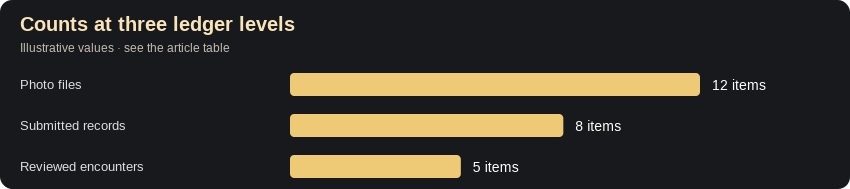
| Category | Value (items) |
|---|---|
| Photo files | 12 |
| Submitted records | 8 |
| Reviewed encounters | 5 |
Toy 5 encounter IDs link to photo counts [3,3,2,2,2] and submission counts [2,2,2,1,1].
At 9:14, Mara sees a bee working a patch of mountain mint. She takes a photograph as it lands and two more as it turns. At the end of the walk, she includes the observation in a team checklist and also submits an individual record with her best photograph. Leon, beside her, uploads his own view after she points out the insect. The archive can now show three digital submissions under more than one contributor's name. It can also show several photographs, at least two identification opinions, and an honest account of one directly shared encounter. None of the contributors has done anything wrong. A mistake starts only if a downstream report calls those three submissions three encounters, or calls three photographs three bees.
The difference matters when the same dataset must answer more than one question. A reviewer deciding whether an identification is credible might be delighted to see the same encounter from different angles. A project coordinator who wants to know how many hours people volunteered may need contributions from everyone in the party. A comparison between two beds needs counts that behave the same way whether one observer uploads a burst or another writes down only a single line. None of those jobs needs the originals thrown away. They need a ledger that remembers what happened, what was submitted, how those things are related, and which layer is appropriate for the question being asked.
This article proposes such a ledger. Its examples are made up. The approach deliberately stops short of identifying individual free-flying bees from routine photographs or estimating a population from a small set of walks. The narrower goal is to prevent a person's choice to take more pictures, use two apps, or share a list from quietly becoming a claim that more bees were encountered.
Before merging anything, name the thing you would count
An archive can honestly answer “how many?” in several different ways. It can count received files, distinct image assets, submissions, participants, sampled visits, encounters or organisms. Some of these numbers will agree in a very simple dataset. That agreement is a coincidence of the workflow, not an argument for treating the measurements as interchangeable. Ask the project owner to finish the sentence “we count one when...” before writing any deduplication rule. If the sentence ends with a different noun in a dashboard than in a data dictionary, fix the discrepancy at the definition, not at the chart.
For a timed flower watch, a workable local definition could be one interval in which the observer continuously follows a bee moving among flowers within the designated observation area. The interval ends when visual contact is lost or the observation period ends. This is a chosen observation unit, not a universal definition of a biological encounter. A second observer might record two landings during the interval; a flower interaction study could legitimately count both. In the interval ledger, those landings are details of one encounter rather than two encounter rows. A protocol interested in landings should define their start and end independently.
A group walk and a second formal visit can also produce different results even if they cross the same beds. If two people walk together and discuss what they see, a group-level checklist is one shared account of the visit. Both people may be credited. If each person is assigned a separate interval and completes it without access to the other's results, the design may warrant two survey events linked to a common parent outing. Those two events are still not guaranteed statistically independent: weather, repeated use of a patch, and the same individual flying through both intervals can induce dependence. The ledger preserves the structure so analysis can handle it explicitly.
Darwin Core is useful vocabulary for this distinction, not a plug-in deduplication algorithm. The Darwin Core Quick Reference Guide distinguishes an occurrence from a digital record of that occurrence, describes an event as a place-and-time action or circumstance, and distinguishes an organism from its occurrences. The scope of a local bee encounter depends on your protocol; it does not automatically match the scope of every Darwin Core occurrence. A receiving organization can tell you which level it expects and how to represent parent sampling events. Local identifiers can be retained as provenance without claiming that every project table is already an interoperable Darwin Core export.
One practical test is to imagine replacing every phone with a notebook. Would the record of one uninterrupted encounter suddenly become several? If your estimate changes simply because participants have more devices, the design is not yet isolating encounter counts. There may be a real increase in reporting effort, usable identification evidence, or coverage. Those are worth reporting in their own columns. They should not be used as a proxy for the outcome unless that connection is measured and explicitly justified.
Keep files, submissions, observation effort, and reconciliation separate
Start with four kinds of things. The first is a media asset with its own identity. Store when it was received, how it arrived, a checksum of the received bytes where appropriate, a file type, and a link to any permissible private original. The second is a submission, which is what a contributor or source system reported. Preserve original timestamps, location claims, supplied taxa and counts, and platform-specific IDs. Third is the sampling event: the visit or organized period for which the team has a definition of effort. Finally, keep a table of reviewed encounter units and a ledger showing how submitted claims map to them.
The useful relationship is often many-to-many. A submission might contain a checklist of six taxa and several separate encounters; a reviewed encounter can have evidence from many submissions. An image can show two insects at once. Two reviewers can annotate the same image without creating new field observations. Instead of forcing every upload to have exactly one encounter ID, link at the level you actually know: a claimed line on the checklist, a time interval in a video, or the whole submission as general context. If a reviewer cannot isolate an individual from a group photo, the photo may still be useful evidence of a count at that moment.
Consider the simplest project that works in a spreadsheet. One tab holds versioned submissions; another contains the events, with stop and start information; another links submission rows or claims to working encounter IDs. A last tab records decisions, including who made each decision and with what evidence. Don't put every fact in a single sheet and solve disagreement by overwriting a cell. A contributor correcting a typo in the time should create a new version or a correction entry, not retroactively make the original text unobservable. A checksum match can be noted without removing a contributor's right to credit.
If submissions arrive with names or precise sensitive coordinates, keep the relationship ledger in an appropriate access-controlled project space. Do not expose the underlying contact sheet, device data, or contributor contact information just to prove that a public count is reconciled. A public report usually needs definitions, examples and decision totals, not enough detail for someone to trace an individual volunteer or sensitive location. Work with the applicable data and licensing rules rather than assuming that storing an original grants a right to republish it.
Assets are especially easy to conflate because file names look concrete. Two files named DSC_0051 are not necessarily the same. A cryptographic checksum of bytes is evidence that the byte strings match, not that two reporters independently detected the animal. A crop, screenshot or color-adjusted copy may have different bytes yet be derived from the same exposure. Conversely, two same-looking frames may be adjacent frames of a burst rather than one copy. An archive can use visual similarity to find candidate relationships while keeping the raw assets and the grounds for linking them.
What the three bars actually show
The accompanying chart has three bars: 12 photo files, 8 submitted records and 5 reviewed encounters. The numbers are synthetic and have no biological interpretation outside the example. Imagine five encounter IDs, with three, three, two, two and two linked photo files respectively. Those add to twelve. The same encounters have two, two, two, one and one submitted records, which add to eight. Each encounter contributes exactly one unit to the reviewed encounter view, giving five. These totals can all be accurate at once.
One way to reconstruct the exercise is to call the encounters A through E. A has two reports and three photos; B also has two reports and three photos; C has two reports and two photos. D and E have a single report and two photos apiece. The exercise makes every report assignable for simplicity. Real ledgers often contain unlinked material, rejected determinations, or cases where a report lacks enough detail to choose a single encounter. In a real table, those statuses are additional information, not an excuse to quietly assign records to the most convenient bar.
The bars are not consecutive stages of disposing of data. Eight is not the number of files remaining after reviewing twelve. Five does not mean only five photographs survive. An individual record can include no photograph at all, and one record can attach several images. The chart does not imply that exactly seven observations were spurious or that three contributors were excluded. It compares cardinalities of three different units after assigning relationships for a classroom example. The data can coexist in the underlying ledger, even when only one unit is displayed for a particular use.
If you want to teach with these numbers, ask two students to calculate the rates incorrectly before showing the distinction. One student might divide twelve by one hour and report twelve encounters per hour because there are twelve files. Another might divide eight by an hour because there are eight reports. Only if the five encounters actually come from the same qualifying hour could the reviewed view support five encounters per hour in the exercise. The figure itself supplies no time denominator. That condition deliberately separates reconciling reports from establishing a valid effort measure.
One final trap: even five correctly counted encounters do not imply five individual bees. There could be a return from the same organism after the first interval ended, and the project may have no defensible way to tell. A statement about particular marked individuals should cite the independent evidence for individual identity. A statement about general encounters should use the protocol's definition and stop there. If a publisher wants both a photo participation count and an ecological count, print both labels explicitly rather than making the reader infer the difference from axes.
Mark the group relationship before volunteers split up
The easiest duplicate is one you never have to infer from a photograph. Give the team one code for the outing and a clear way to label a shared watch. A short form might ask whether the observer was part of a team event, whether the record was independently made or copied from a group note, and whether a second file is evidence for an earlier entry. This is not an interrogation about how people used their devices. It is the smallest bit of context that allows the data manager to distinguish a second view from a second sampling action.
A coordinated session can use a lead observer to call the beginning and end of a watch while other participants handle notes or photography. All their work can be credited. When two people log separate views to resolve a difficult identification, attach each account to the encounter and leave the preliminary taxon determination visible. If a team deliberately runs parallel observations without sharing results, write that assignment down before they begin. Keep a common parent session so analysts can see that the observers worked under the same site conditions.
Be careful with words like “independent.” An independently written note should not require independence in the statistical sense. A contributor may have located an insect without hearing about it from someone else, even if she and another contributor watched the same plant at almost the same time. Those notes can be separate evidence about what happened. Whether they correspond to two encounter units depends on the protocol and later comparison. It matters that the observer did not copy the claim, but it may not tell you whether the same bee moved between adjacent flowers.
A single participant sometimes creates multiple platform copies when connectivity is poor. A phone makes a draft, another app receives the best photo, and at home the observer exports a spreadsheet. Ask platforms or contributors to retain their originating IDs or record numbers wherever feasible. Keep a separate ingestion identity for each import. If a CSV row and a website listing share an originating ID with the same publisher, that is strong evidence of a repeated digital record. It is not a reason to delete both. Preserve the multiplicity in the receipt ledger, then use the source lineage to avoid treating it as additional ecological evidence.
The Cornell eBird review guidance provides a useful contrast from birding. It distinguishes same-effort duplicated submissions from shared checklists and treats the former differently for public visibility. The bee workflow here is a local proposal, not an application of Cornell's publication policy. The transferable lesson is that a second entry from one person's duplicated effort and a legitimately shared reporting arrangement are different relationships. It's easier to honor both once a form records them instead of trying to infer them from the presence of common names in a list.
Separate candidates from decisions
Reconciliation is best done as two operations. One identifies sets of records worth comparing; the other documents whether a relationship is supported. Candidate detection can be broad because it costs little to present several possibilities. Decisions need evidence because a mistaken merge changes the analysis and may hide real sightings. Never present a candidate-match score as a probability of identity unless you actually calibrated it against the project's data and protocol. Without that work, it is a sorting device.
Start with strong administrative links: same source ID and publisher, explicit shared watch ID, a contributor's statement that a later upload replaced an earlier one, or a documented export from an originating checklist. Then look at timestamps, overlapping observation windows, the named patch, compatible taxa and where photos appear within a burst. Treat all of these as imperfect. A five-minute bucket can bridge an event boundary or split two views of the same bee. An imported upload time can occur hours after a sighting. A location label like “north garden” could refer to more than one bed in a long route.
Uncertainty in locations should enter candidate selection as uncertainty, not as a distance magically removed by rounding. A coarse coordinate can be compatible with several precise observations without supporting a particular pairing. Points a few meters apart can be on the same path segment or on two parallel watches separated by a boundary. The right search tolerance depends on the observation geometry and on the actual coordinate evidence. For some datasets no coordinate comparison will resolve anything. In those cases the candidate record should show that limitation without forcing a match.
Evidence that pushes against a proposed merge is just as important. A record with two insects clearly in the frame cannot be interpreted as proof that the two people each watched only the same single bee. Two separately timed route stops cannot be made the same effort merely because the same plant and species are listed. A submitted observation that starts after the first watch ends may correspond to the same individual reappearing, but if the local unit is an observed interval, the two qualifying intervals may legitimately remain separate. Write specific evidence of distinction rather than a vague flag saying “different.”
The hard part is resisting attractive false precision. If two contributors both write “large fuzzy bee” and their photos lack distinctive markings, the name agreement gives weak evidence of identity. If two event times both round to 9:15, the values agree at the resolution of reporting, not at the resolution of flight paths. The reason to document uncertainty is not to keep a file forever in editorial limbo. It is to let the eventual user understand which numerical claims do not survive reasonable changes to the reconciliation policy.
Use a small set of decisions with concrete meanings
The review vocabulary should be simple enough that two people can assign the same label given the same facts. One decision might record a repeated digital submission. Its reason is common lineage: a platform import, second upload, or contributor-confirmed replacement. Another decision might record two genuinely different pieces of evidence linked to one encounter. In that case contributors or images are not duplicates as artifacts; they describe the same operational field unit. A third decision could retain reports as separate encounter units based on the supplied protocol and context. A fourth, unresolved, captures plausible but unsupported relationships. An out-of-scope state is also useful for an off-route observation that is valid but not part of a formal timed count.
Keep identification review separate from relationship review. One taxon label might be narrowed using a clear lateral shot while the encounter linkage remains unresolved because nobody noted whether the photos apply to the same minute. In another case the exact same exposure might appear in two submissions with different species labels. Their media lineage is known, but all available views might leave identification uncertain. One acceptance checkbox cannot express these different states without creating false implications. Maintain a determination record and a relationship decision, and make both visible to the people permitted to assess them.
A minimal relationship decision includes the affected IDs, type of decision, a short reason, the version of the rules used, the evidence reviewed, who reviewed it, and when. When one piece of evidence is disputed, the reviewer can mark the point of disagreement rather than simply assign a lower score. Keep the reason human-readable. A cryptic code for “same media” can speed aggregation, but a sentence that says “platform export with an identical originating ID and unchanged image bytes” makes the action understandable months later.
A review console should not require everyone to reenter data the team already has. Present a contact sheet with original and derived images grouped where permissions allow it; list claimed and normalized observation times separately; indicate whether an event assignment was made in the field or inferred during import. Overlays and thumbnails should never be the only accessible way to compare records. A timestamp transcript, descriptive file list, and typed reviewer statements can make the same context available without requiring that a reviewer interpret a complex visual control.
Avoid treating a chain of rough matches as proof of transitivity. A and B may be possible matches because their times overlap; B and C may be possible matches because they are from the same side of the garden. If A was certainly on a different timed stop from C, merging all three defeats the evidence. Use candidate grouping as a way to open a review case. Within the case allow accepted links, explicit separations and pending links. Confirmed relations based on common administrative lineage may justify grouping several rows together, but broad fuzzy links should not acquire certainty by repetition.
Walk through the difficult cases before the first busy weekend
Test the policy with a shared sighting in which one photographer produces a burst and someone else writes a note. Suppose the note names the patch, the recorded encounter time and the photographer who called it out. The observer's file contains an uninterrupted sequence that matches the description. The evidence supports relating the note and the burst. Credit both roles. Keep the photographs available for examination, but export one unit for the shared encounter count. The merge concerns the operational field unit, not the people or the media.
Now imagine two observers recording similar bees at the same exact minute on adjacent flowers, with no sign that they shared the detection. Both camera clocks have minute-level time exported. One account notes a bee leaving to the east; the other starts halfway down the path and does not give flight direction. This case is a candidate for review, not a merge. One observer could have seen the same animal a few seconds later, or could have seen a different animal. If the protocol treats each observer's independently recorded interval as a unit, the method can retain both and note common place and time in the design. If the required outcome is distinct physical individuals, the evidence is insufficient. The ledger should not use the easiest interpretation to fill a number.
Another useful test involves a smartphone and a borrowed camera with an unset clock. A photograph whose embedded time is earlier than the trip does not automatically rule it out. An application log might verify an upload time while saying nothing about capture. The person responsible for the camera could have numbered the images in a notebook, and a sequence may share visual details with other known photos. Store the raw timestamp and normalized timestamp separately, including the basis for any correction. If there is no reliable anchor, a coarse interval is more honest than a reconstructed second.
Try the opposite case too: same media, demonstrably different claims. A group leader attaches the wide shot of an outing as context for every checklist. Its common file hash does not make all of the checklist claims duplicates. It is shared media at a different level. Store that attachment against the parent outing or note that it is context only, and keep the claim-specific evidence distinct. If a reporter presents the same crop to support a second reported location and the lineage is unclear, flag the mismatch; don't choose the location that makes the tidy summary look better.
Finally, consider a submission split. One line reads “three visits” but its personal notes list separate landings on three flowers and explicitly say the bee remained visible throughout. An interaction survey may recognize three qualifying landings; an encounter survey may recognize just one continuous interval. A new project should not both split and merge that row without recording which metric it is supplying. Treat a split into subclaims as an interpretation with its own provenance. Preserve the person's reported count field and clarify the new reporting denominator to prevent a future analyst from thinking the raw number was simply wrong.
Preserve a path from release number back to evidence
A release should be reproducible after two more seasons of edits. Imagine a project has 60 encounter rows in a spring release, but a late upload shows that two already accepted entries belong to the same shared watch. Publish a new internal view or release revision with the documented relationship. Don't rewrite the earlier result and give it the same identifier. A colleague reproducing the older report must be able to reach the rules and bounds that were actually used then. A current analyst must be able to see why the number is lower even though the evidence collection grew.
Keep old IDs useful on merge and split. A previously used working encounter ID can carry a redirect to a successor or a supersession note rather than changing silently. Splits can map a retired ID to multiple successors, with a note describing which claim or observation interval moved to which branch. If records are ever exported outside the project, the data manager should check the recipient's rules for persistent identifiers before choosing how to issue corrections. A private handling policy for a class demo does not necessarily satisfy a larger archive's requirements.
There is often an honest distinction between operational immutability and retention forever. Where policy allows, retain submitted origin and exact corrections long enough to audit analyses. If legitimate deletion, privacy or retention requirements apply, follow them. An audit trail can sometimes record that a relationship was reviewed and that related material is no longer available without keeping the private content itself. Do not promise a permanent replay from raw evidence when a disposal requirement may make that impossible. Explain the limit before publishing a far-reaching claim that depends on replay.
Treat the review result and analytical projection as two separate products. The ledger answers what was reconciled, what was uncertain, and why. The projection answers which units count under a versioned question. A project can generate a team-effort view and a conservative encounter view from the same records without losing the circumstances of the visit. This division also enables a clean change in policy: retain the evidence and outcomes of review, but rerun the projection using a different inclusion rule rather than pretending past reviewers had different observations.
If a large discrepancy appears between claimed counts and reconciled counts, inspect which contributors or devices are affected before drawing a trend conclusion. Suppose one season used one paper sheet per watch, while the next let each visitor submit a picture independently. A rise in submissions might reflect convenience rather than a rise in observation effort. A small comparison restricted to the same protocol might say much less than the original dashboard, but it will say it more accurately. A transparent discrepancy is an invitation to improve the protocol, not proof of poor conduct.
Make the rule fail visibly instead of making the data look complete
Build a few mechanical checks even if the project is small. Each working link references existing records and a known decision type. Each qualifying encounter belongs to an eligible event unless the export explicitly excludes effort. A candidate link alone never increases or decreases the reviewed count. A replacement submission does not destroy its predecessor's version. An event with no eligible encounters should not disappear from an effort analysis that requires valid zeros. A cancelled or missing watch is a separate state, even if a spreadsheet might print both cases as blank cells.
Run the same fixture through the process twice. The toy five-encounter example should consistently give twelve files, eight submissions and five reviewed encounters for the stated selection. Then add a ninth digital submission that explicitly copies an existing record. The intake total should grow; the encounter count should not. Then add a genuinely separate assigned interval with one qualifying new encounter. Both the reviewed event and encounter projections should grow, and the export should preserve the shared site context if the assignment was under the same outing.
Also test a believable ambiguous pairing. Add a sixth working encounter whose only claim could correspond to one of the existing five but cannot be distinguished with the current evidence. Avoid using that fixture to claim the true biological total lies between five and six: unidentified bees already counted or missed bees may make the biological number very different. It can be useful to report the range of five to six under specified duplicate-handling scenarios if all other relationships and inclusion rules are held fixed. The limits describe how a reporting count changes, not a confidence interval or population bound.
The next check concerns scope. Ask one reviewer to answer how many evidence-bearing reports need identification review, and another to answer how many qualifying timed encounters the study has. Both numbers should be extractable without reading a social feed or editing the raw rows. If the reviewer for taxon identifications has to count encounter rows first, or if the analyst has to guess measurement units from filenames, the model is still coupling responsibilities that should be distinct.
Keep a short changelog for rule versions: the old definition, the new one, when it applies, and what the change might do to an old release. For example, an early project may end a continuous observation at every departure from a flower; a later version may keep watching while the bee crosses to another plant. If identification of individuals is not possible, the count series cannot be made equivalent by merely renaming both outcomes “visits.” The team can compare under common data coverage, publish separate series, or explicitly limit inference. A decision record makes those options visible.
A lightweight handoff for the next observer
A small project can get most of the benefit before adding any software. Prepare blank submission and event IDs, one visible cue for a shared effort, a way to attach additional photos without creating a fresh encounter claim, and a field for “unknown whether this repeats another report.” Train with a burst, a parallel watch, a true digital duplicate, and an ambiguous pair. Ask each person what would be gained or lost by grouping the pair. If they cannot say which count changes, revise the definition before asking them to apply it in the field.
At the end of the first session, reconcile one case in a group and ask a second reviewer to reproduce the conclusion. Don't only feed the group easy examples. Cases in which everyone agrees from the same filename will not reveal which intervals observers thought they were supposed to mark. Pay attention to the distinction between participants' workload and analytical effort: the photographer and note taker both did useful work even if the experiment intended just one group watch. Make contributor credit a separate deliverable instead of inflating field statistics to recognize it.
The public-facing result can be brief. Report the period, the encounter definition, the number of qualifying events, the reconciliation status of overlapping reports, and any exclusions or grouping choices material to the result. If there were twenty readings still open to review, give either an explicitly provisional figure or a sensitivity result that doesn't treat all of them as verified. Do not silently convert a partly resolved log into a complete count. The report is stronger when a reader can tell whether a volume increase came from additional fieldwork, additional evidence, or additional accounts.
Multiple photographs can make an identification case stronger. Multiple volunteers can improve coverage and carry different perspectives. Neither benefit is threatened by a reviewed encounter count that refuses to count evidence as effort. The durable practice is to keep the original materials, name the question first, and change only the view made for that question. What looked like three observations may still be three useful contributions to one defensible statement about the field.
Make an unresolved case useful for future sampling
An unresolved case can reveal a practical improvement instead of becoming dead weight in the archive. If similar arrivals at two ends of the same hedge could not be distinguished because observers omitted the direction of travel, add an optional direction note for the next pilot and check whether observers can capture it without neglecting the rest of the watch. Do not retroactively infer a direction for the historical case. Keep the change limited to the uncertainty the team actually faced: a more elaborate form that discourages completion may cost more useful context than it recovers. Look for repeated sources of ambiguity and address those first.
Sources and chart note
- Cornell Lab of Ornithology: eBird Data Quality and Review. Used for the distinction between duplicated effort and a shared checklist in Cornell's own birding context.
- Biodiversity Information Standards (TDWG): Darwin Core Quick Reference Guide. Used for occurrence, digital record, event and organism terminology. The reconciliation ledger and decision rules above are proposed local practice, not requirements of the standard.
- The chart is an illustrative ledger exercise: 12 media files and 8 submissions linked to 5 reviewed encounter IDs. It is not observation data and provides no evidence about wild bee abundance.