
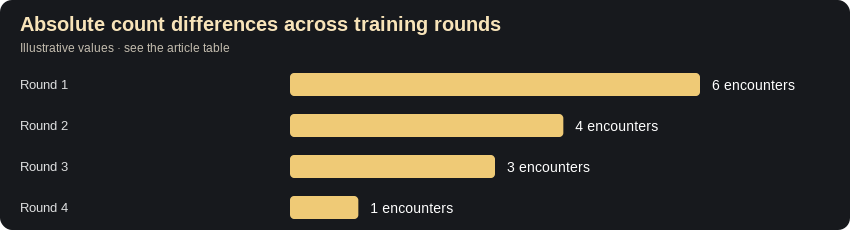
| Category | Value (encounters) |
|---|---|
| Round 1 | 6 |
| Round 2 | 4 |
| Round 3 | 3 |
| Round 4 | 1 |
Example pairs (15,9), (11,7), (13,10), (12,11); plot absolute differences. This is not a performance claim.
Mara and Luis left the same flower bed with different numbers. They had started at the same time and had each watched for ten minutes. Mara recorded fifteen visits. Luis recorded nine. The crew leader could tell that the numbers differed, but almost nothing else. Were they looking at the same flowers? Had Mara counted a bee that moved between blossoms three times while Luis counted its original arrival? Did one observer see an entire side of the bed that the other could not see? Did one count insects hovering above the flowers? The difference of six was real. Its explanation was still open.
This article lays out a way to train two people without confusing agreement with accuracy. The project is a garden survey in which two people make simultaneous, independent records, then compare those records against a rule they can write down and reuse. The workflow works equally well when the ultimate survey will have one observer per visit. The two people are not putting in two independent samples. They are testing whether the same method travels from one observer to another.
The garden, people, and numbers in the worked examples are fictional. The point is to give a project leader a method for interpreting a discrepancy before anyone has to defend a favorite tally. Documentation principles come from the EPA handbook for citizen science quality assurance. A separate Cornell eBird guide to reviewing observations and checklists is an example of how a mature community project distinguishes a report from the evidence and review behind it. Neither source provides the toy counts or prescribes the pollinator rules below.
Start with a decision, not a competition
The practical decision is whether two people can use the same survey method without quietly measuring two different things. A park group might need to rotate volunteers all summer, so that comparisons between beds or dates are not dominated by who held the clipboard. A school project might need enough consistency that its morning and afternoon teams can describe activity in a common language. A research group might be developing an observation method before it decides what questions the method can support. These projects can all run a paired round, but the training evidence they need is different.
Begin by describing the eventual use. A garden newsletter might compare broad activity during two short watches and show the two raw tallies. A monitoring design that will estimate a small difference between planting treatments needs much stronger calibration. In the newsletter case, visible disagreement can be part of the account. In the monitoring case, it may be large enough to undermine the comparison unless the project changes the protocol or design. Neither project gets a universal passing score just by naming a respectable percentage.
There is also a choice about the relationship between partners. A senior observer can teach the procedure, but their field sheet is still an observation rather than an infallible key. If one person always checks the other, and the pair never sees disputed examples in which the more experienced person made the mistake, the exercise can train conformity instead of measurement. Let the rule and the evidence settle what they can. Record where neither person can settle the question. A participant should be free to say, “I did not see enough to count that,” without being treated as unhelpful.
State the decision in a sentence that determines what happens next. For example: we want volunteers to apply the flower-contact rule independently in a clearly visible garden patch, keep unknown visitor categories rather than guessing, and flag compromised watches. If the test shows the unit is being understood differently, pause the comparable survey and repair the instructions. If it shows poor visibility rather than a misunderstanding, fix the station or narrow the scope. A test is only useful if its findings can change the method.
Make the countable unit visible
Before the first round, write a plain-language rule about what earns a tally. A possible local rule is to count a new encounter when a flying insect arrives from outside a marked flower patch and is seen making contact with one of the eligible flowers. Under that deliberately narrow choice, hovering alone is not an encounter. An insect that is already inside the patch when the timer starts does not generate an arrival at time zero. Movement between eligible flowers during the same continuously observed stay does not add new arrivals. This is a boundary-arrival metric, not a measure of every flower-to-insect contact, individual abundance, pollen transfer, or species diversity.
That rule is not always the best one. A program that studies a single flower species may want to record visits to specified blooms rather than arrivals from over the border. A team working with short phone videos might not see arrivals reliably because the camera cuts off the path below the flowers. In either case, choose a unit the observer can actually see and assign it a name different from tempting alternatives. A watch that cannot distinguish arrivals from short within-patch flights should not claim that it measured boundary arrivals well. A simpler contact rule can be a better design, provided the analytical question changes with it.
Specify the boundaries at the level a new volunteer can reproduce. A sketch on the field sheet might show the path, the allowed viewpoints, the left and right ends of the patch, and a distinct plant that marks the back edge. Indicate which flowers are eligible and whether a small overlap with a neighboring pot is in or out. Decide how to handle an insect that touches the boundary plant but is only visible after entering the patch. A permissible entry could be uncertain arrival rather than countable arrival. Record the distinction explicitly. The exercise is revealing only if the partners have something more definite to share than the phrase “watch the flowers.”
Give the team a short list of edge cases, not dozens of fascinating exceptions. What if the insect drops out of view under the foliage and reappears? What if two insects arrive together? What if a fly contacts a flower while the observer is writing and only a second observer saw it? What if the contact happens as the ending timer sounds? Decide what to do when an event is not comparable or cannot be timed. One useful line is to require witnessed contact, ask the observer to mark uncertainty when continuous tracking is lost, and never convert uncertainty to a confident identification during collection.
Do not ask volunteers to solve two hard classification problems at once. Practice the arrival or contact rule with broad categories before asking for finer groups. A row can use insect visitor unknown when the triggering behavior is seen but the identity is not. That row can legitimately count toward all eligible encounters while remaining unavailable for a bee-specific total. A second observer who writes fly and a first observer who writes unknown may have agreed on the countable event and differed only in the identity evidence. The project should not erase that distinction.
Separate a shared view from separate decisions
There are two kinds of independence here. First, the partners need to make decisions without hearing or seeing the other's tally. Second, the eventual study needs to avoid treating two notes about the same underlying activity as two independent visits to the site. The first kind is a design goal for training. The second is a warning about analysis. Two people can make separate decisions about a shared set of insects without producing two independent ecological samples.
Hold the setting as constant as the site allows. Mark a feasible shared patch, not the entire most attractive bed. Place observers close enough to have substantially overlapping sight lines without forcing one person to look through the other. Document their positions, and note places where the rear edge is invisible from one of them. Synchronize the start and end with a single timer and keep observations silent. Repositioning is allowed only if the round calls for it; otherwise, a mid-round move can become one more unrecorded reason that the leaves looked different from the same supposed station.
Let observers record the minimum needed to compare events. Even a short time bin, a rough patch sector, and a broad visitor category can help. For a busy patch, a silent timepiece or a form with preprinted bins can reduce time spent looking away. The observers should not repeatedly consult their screens while claiming that the watch was continuous. On a teaching round, narrow the patch or slow the pace of recording. In a production protocol only request a precision people can achieve without sacrificing the observation.
If one person's position is intrinsically different, design a second round to test that fact. Swap the near and far stands, keep the rules unchanged, and see whether the higher tally follows the person or the position. Compare both positions on a later day rather than relying on a single swap; activity and light can change while people move. Pairing controls some environmental differences within a round. It does not make each succeeding round a replay of the first one, and it does not isolate a causal effect of position unless the arrangement is replicated with appropriate care.
Set rules for interruptions in advance. A visitor may step between the partners and the patch. A gust may hide half the marked flowers. A timer may not sound. A denied or compromised round should not acquire a zero because the data form demands a number. A zero means the agreed window was observed and the qualifying behavior was not recorded. A missed start, an obscured interval, or an unusable view is different information. Report both the raw tally that exists and the amount of the agreed window to which it actually refers.
Build examples that expose false agreement
Start indoors or at a quiet patch with a handful of demonstrations. A short locally recorded clip can provide a common scene and let the participants inspect the same sequence twice. Choose material that includes complete cases, such as a clearly visible approach and contact, and hard cases, such as a flower blocked by a leaf just as the insect lands. Include one example in which an insect moves between two flowers and another in which two insects are visible in the same sector. Ask observers to mark uncertainty rather than forcing a binary decision every time.
A clip is not truth merely because it can be replayed. The camera may miss the first contact, make a movement look continuous that was actually interrupted, or obscure exactly the detail used to distinguish two insects. Reviewers should say what the clip supports from that angle. A clip can settle whether an insect was already on the visible flower at the start; it cannot tell whether an unseen approach happened earlier. A training library with deliberately indeterminate cases teaches the boundary of the method, which matters as much as teaching perfect examples.
Show one scene that gives equal totals under different errors. Suppose Mara records the first, second, and fourth eligible encounters. Luis records the first and fourth plus a harmless hover that the procedure does not count. Both have three. Their agreement conceals an omission and a false addition. If they only write a grand total, the round will never expose that problem. With coarse timing or recorded sectors, a reviewer can find that their decisions diverged even though the numbers matched. This is why an identical total can still earn a training note.
Include the opposite case: the rule is being used correctly, but the insects and the views differ. Luis may see a flower obstructed by a railing from Mara's position. If a neutral camera shows the insect clearly from only his side, his extra note need not mean he is more vigilant. The instructional response is to define a shared visible patch or record the uneven views. If the survey actually seeks broader detection by combining sight lines, that is a different design and should be written as such rather than smuggled into a calibration round.
Use fresh examples after the lesson. Replaying a clip until everyone remembers the answer demonstrates memory and familiarity. It may be reassuring, but it does not test transfer. A held-out clip, a different bed, or a fresh timed window provides better evidence of whether the rule can handle new combinations. Introduce difficult conditions gradually so that failures remain interpretable. If the first live round is at a dense flowering hedge during a rush of insects, the exercise may mostly test the participants' ability to keep writing rather than their understanding of the unit.
Use the chart for what it actually says
The accompanying chart uses four hypothetical pairs. In round one, the recorded counts are fifteen and nine, giving an absolute difference of six encounters. Round two pairs eleven and seven, giving four. Round three pairs thirteen and ten, giving three. Round four pairs twelve and eleven, giving one. Each bar represents the size of the gap between two tallies for one round. The bars do not represent the number of insects in the patch or the number that either person missed. The values were invented to show the calculation, not collected to assess an actual observer.
The absolute difference is a practical shorthand: subtract the second tally from the first and ignore the sign. To distinguish the direction, keep a signed difference alongside it and consistently define the order. In all four toy pairs, the first count is higher, so the signed differences A minus B are positive six, four, three, and one. The fact that the signs are the same is useful information the chart alone cannot show. It suggests a line of questioning in a real exercise: are the people using different interpretations, are their sight lines systematically different, or did the comparison occur under a collection arrangement that favors the same observer?
The smaller last bar may invite a claim that training caused a decrease. The chart cannot support that claim. There is no comparison group, no repeated observer pair, no control over the underlying number or character of visits, and no event-level evidence. In a real exercise, later rounds may have been quieter or easier to watch. The patch may have been simplified after the first round. A late round with few eligible visits can show near-perfect agreement while leaving the most difficult counting conditions untested. The visual pattern is a prompt for review rather than a pass guarantee.
Even the meaning of a gap depends on scale. A gap of three against two large tallies is different, in relative terms, from a gap of three in a very quiet watch. But ratio statistics also behave differently at tiny denominators and can be undefined when both counts are zero. If a project chooses to add a relative measure, name the denominator, show the two raw counts, and explain what happens in zero or small-count rounds. Keep absolute differences in encounter units so the audience can see when a percentage is doing too much storytelling.
The four toy pairs have signed differences that average three and a half encounters, and because all signs point in the same direction the mean absolute difference happens to be the same. That equality will not generally hold. Differences of plus five and minus five would average zero on the signed scale while the average absolute difference remains five. In a real sheet, a mean signed difference near zero is not a substitute for a record of individual disagreements. It can hide large opposing errors or the fact that discrepancies are concentrated in a particular habitat, visitor group, or observation condition.
Compare observations through an event ledger
Freeze the original notes before comparing totals. Take a picture of two paper sheets after the timer has stopped or use a form that captures the first submission as a separate record. A later interpreted decision can sit beside the original entries. The review record might include round identifier, observer identifier, protocol version, time bin, patch sector, eligible action seen, broad group, confidence, and evidence reference if available. Do not require exact seconds if the original data only support a coarse time range. False precision makes mismatches look more meaningful than they are.
Make an initial candidate match based on a predeclared window and sectors. A small tolerance makes sense where people note times after looking down, but too wide a tolerance can align different insects in a busy watch. Start with a short window that fits the form and make the most straightforward matches first. For a plausible but uncertain match, preserve that state. Do not create a one-to-one pairing where the record says only that two things may have happened near the same flower. Root the result in evidence the participants can inspect together.
Consider a fictional minute with three candidate entries. Mara writes “near, hover then contact”; Luis writes “near, hover, uncertain contact.” Those may describe one event viewed from different angles. A clip with an unobstructed flower face could resolve the contact, but absent that evidence each raw record keeps its own state. Next Mara writes “far, unknown hopper”; Luis records an eligible arrival at the near edge. An agreement on minute does not overcome a sector conflict. Third, both write “right, insect of unknown group, contact seen.” The behavior may match even though neither person can classify the insect. Each problem needs different review treatment.
A useful review outcome names both the confidence and the reason. A pair can be a supported match, a plausible match without sufficient evidence, apparently different events, or impossible to compare because the watch conditions diverged. When reviewing specific actions, distinguish accepted contact, no eligible contact, and contact not resolvable. When reviewing identity, retain the broadest group the evidence supports. The reviewer should not silently use a taxonomic judgment to settle the contact judgment. A clear photograph of wings can support identity while saying nothing about how the insect arrived.
There is no requirement to adjudicate every single entry before taking a useful next step. On a high-activity round, review a subset defined by a rule, such as every first candidate mismatch per minute and all low-confidence decisions. Choose that rule before reading totals so the sampling does not favor cases that make one partner look good. Keep routine matched cases in the audit at least occasionally. Otherwise, the team may discover difficult misses yet miss the quiet agreement that was actually false.
Diagnose disagreement without inventing an explanation
The four first questions are whether the partners observed the same extent, same time, same triggering action, and same classification requirement. A clear difference in any one of those dimensions matters before calculating advanced agreement statistics. If one person observed eight minutes and the other ten, rescaling counts by time does not recreate the two missing minutes. It would also assume a rate across windows that may not hold. Compare the shared interval if identifiable; otherwise mark the noncomparability and repeat the trial.
When the evidence supports a rule difference, change the instruction, not just the number. Suppose Mara counts every reappearance after an insect slips under a flower while Luis only counts confirmed arrivals from outside. If the protocol intends boundary arrivals, improve the rule for brief losses of sight and add an example in the teaching set. If the underlying unit is continuous movement among blossoms, that may not be the right study metric at all. The training leader should be able to point to the exact sentence changed and explain which downstream fields need to change.
When the evidence points to observation conditions, consider a geometry fix. Make the frame smaller, move the far edge closer, select flowers that are actually visible, or stand where both people can see without casting a shadow over the bed. Note the changed station so the improvement does not look like an observer breakthrough in the next chart. Training may still matter, but a practical design that people can apply consistently is usually better than forcing an unwieldy design to survive by memorization.
Animal movement is itself an ambiguous explanation. An insect can genuinely cross both sectors within one bin, so near and far observations are not always contradictory. Two visually similar insects can also appear almost simultaneously and get collapsed into one candidate. If the procedure concerns what happened in a sector, rapid crossings may require a better time or path note. If the procedure concerns numbers of unique individual insects, note that an arrival stream may not be able to support that inference at all without a separate method and an explicit design. Do not quietly promote the ledger into an individual history.
If the partners agree about an encounter and disagree on the broad visitor group, check whether the form gave them a safe “unknown” option. A volunteer may be tempted to look at the common labels and select the least implausible one. Practice identity separately with suitable references or review photos when feasible. If the distinction is not detectable at the chosen distance or duration, simplify the published groupings. Turning uncertain records into apparent certainty improves neither the count nor the field method.
Keep the review protocol versioned
A versioned procedure does not have to be a complex database. One page with a date and version number can carry the question, unit rule, patch boundary, timer, uncertainty codes, review roles, allowed evidence, and the resulting action when certain problems recur. Record who ran the training, what was demonstrated, and how participants practiced. The EPA handbook explicitly discusses documenting volunteer training and maintaining accessible procedures and records, with the intensity of quality assurance adapted to intended use. A local project implements those principles at an appropriate scale.
Separate the versions of the collection rule and the review rule. Clarifying that an obscured contact should be marked uncertain is a collection instruction. Changing the allowed time tolerance for matching two independent notes is an adjudication instruction. One can change while the other stays the same. For example, release collection version 1.1 to make a boundary sketch legible without changing the rule. Later release review version 1.1 to require a second reader for unresolved category disagreements. The original sheets keep their collection version, and any later match lists identify the review version that produced them.
Maintain an effort record and an observation record apart from final summaries. The effort record describes the round, duration, patch, visibility, personnel, boundaries, and completions. Each original observer observation links back to the appropriate task and round. The review adds decisions with pointers to the original rows, not text that overwrites them. A final report is an output of the chosen rules and reviewer judgments rather than the source of truth. If someone changes a decision later, the project can reproduce the report readers actually saw while also making a corrected version.
For a disputed record, insist that a change gives enough reason for a neutral reader to understand it. “Senior observer agrees” is not a reason. “Camera shows visible contact at the marked far flower before timer end; original sheet's time noted in later bin after the observer looked down” is a reason when the clip supports it. If the clip proves contact but not origin path, say that too. The disposition may remain uncertain under an arrival rule. A concise, precise decision log has more value than an authoritative-sounding correction with no evidence attached.
Not every audit note should be public. Keep sensitive locations, faces, incidental conversations, and unrelated media out of shared training packets. Choose examples with consent where appropriate and describe the evidence without distributing private files. A public methods note can report changes and decisions without encouraging readers to inspect raw camera files. Do not use background media you cannot appropriately share to represent a public citation. The goal is traceable reasoning, not indiscriminate disclosure.
Use community review examples within their limits
The Cornell eBird guide gives a useful analogy: unusual submissions can be flagged for review, and documentation can help a reviewer evaluate an unusual observation. The guide distinguishes whole-checklist review from individual record review. It also explains that duplicate effort for the same birds at the same time by the same observer or observers is different from valid shared checklists. Those distinctions are worth reading before designing data handling for a paired garden watch. They do not tell us that eBird accepts flower-visitor observations or that its rules transfer directly.
Adapt three procedural ideas without importing the birding policy. First, a flag is a request to look, not a finding that someone was wrong. Second, an entire compromised watch can require review even if many individual entries look reasonable. Third, a repeated submission and an independent note about the same shared watch should be represented differently. The latter may be exactly the planned quality-control evidence you want. The former is a data intake problem if the file is inadvertently added twice.
In an ecological analysis of timing or bed use, paired observers are linked to one watch. They are not evidence of two visitation opportunities. If you choose to report an adjudicated count, state how unresolved events were treated. If you decide one observer is the designated production observer and the other is a calibration partner, retain that designation and do not quietly switch mid-study. If a pair contributes two raw observer rows to a comparison table, label the purpose explicitly so the resulting file is not used later as independent encounter-rate data.
Agree on continuation criteria before seeing the numbers
The project needs a fair basis for deciding whether to advance. Define a small suite of conditions that ought to be represented, such as a quiet round, a round with repeated flower movements, a patch with uncertain visibility, and a round with at least one uncertain visitor category. If realistically available, include more than one day and vary who takes each position. Do not choose “three close counts in a row” as the only criterion; a garden can supply plenty of quiet rounds without challenging the procedure at all.
Ask the reviewers to look for a few classes of serious disagreement. A repeated conflict over whether hovering counts is a sign the rule is still being interpreted differently. A partner who reliably notes an interval as missed when blocked is following the method, even if the result produces a gap. Misclassifying lost time as a zero may matter more than a temporary difference of one completed encounter. A training agreement should make these priorities explicit, leaving small discretionary matters for coaching rather than treating every mismatch as failure.
Decide in advance what to do with signed differences that persist. If one role tends high only at the near viewpoint, alter the layout. If one person tends high across locations and their evidence shows the chart's unit is understood differently, arrange another independent training activity after revising instructions. If signed gaps appear chiefly during bursts of activity, shorten the observation sector or add recording support. Those are testable explanations; they are better than calculating a universal correction factor from a few practice rounds. Adding two to each low tally would conceal the measurement problem.
Avoid combining training and treatment decisions. Suppose the survey compares a dense flower bed with an open one, and the first tests suggest observers disagree more in the dense bed. If you simplify the dense bed's view but leave the open bed unchanged, future rates may not be comparable unless the sampling frames reflect the revised question. Consider defining and documenting equivalent visible subareas in both beds, or treat them as separate descriptive watches. Decide that before a claim about planting treatment depends on a feature of the observation frame.
After a protocol change, retest it independently. If the rule changes which arrivals count, do not annotate earlier summaries with the new version as if nothing changed. If suitable evidence exists, a versioned review can produce a new classification for selected cases. But new coding applied to a subset with videos is not a magic replacement for the earlier dataset. Say which records can be re-evaluated and which cannot. A later researcher should not have to infer from a spreadsheet adjustment that the old and new counts meant different things.
Practice a half-day rollout
Imagine a small team with a facilitator and two observers. At the first stop, the facilitator reads the rule, sketches a feasible boundary, and collects two independent interpretations of a clear and a difficult example. She asks the partners to explain what evidence moved the decision, not just to reveal their answers. They notice that “leaving the frame” meant one thing to the camera operator and another thing to a person standing by the bed. The team adds a distinction between crossing the patch boundary and vanishing from an individual sight line.
On the first field watch, Mara and Luis take their left and right viewing positions and label all sheets before the timer starts. Each marks the ten minutes independently. A passerby blocks one entrance to the bed while the clock is running. The partners do not rewind their memories later to replace data. Each marks the affected minute, notes which patch sector it affected, and freezes the sheet. They find enough shared visual coverage to compare two short portions, but leave the full-watch totals out of the training chart's comparable rounds.
On the next watch, they use a patch visible from both places. They exchange positions afterward and do not change the action rule. A later comparison shows that both sometimes miss within-patch movement but no longer treat it as new arrivals. Instead of saying the earlier counts were wrong, the facilitator explains that a changed field layout is part of the improved conditions. The training log now has a concrete example of why changing both rules and positions in one step makes the evidence harder to interpret.
The last exercise takes place in a separate bed. Each observer independently records a valid watch with a small number of insects that cannot be identified to broad group. Their totals agree, but the review includes at least two same-time candidate notes that are hard to distinguish. The group records “acceptable for broad eligible encounter counts in this patch” and “insufficient support for confident classification in dense foliage.” Those two sentences are more useful than a global claim that observers are now calibrated for all sites and reporting goals.
If the group later builds a seasonal report, it can include a small methods box. Describe how people were trained, what counted, where they stood, how uncertainty and interrupted effort were recorded, what was compared during paired checks, and how production assignments were made. Report squarely that the paired exercise tested consistency in specified conditions and did not estimate the total numbers of insects. Explain major revisions rather than leaving a reader to guess whether the table combined watches made under different definitions.
Review the decisions you actually made
A repeatable count method is a set of decisions about the observable world. The observation boundary, action rule, eligible flowers, timing, and uncertainty categories all determine what the numbers mean. When two observers differ, the useful work is to uncover which decision was difficult, then place that case in a review log someone else can use. When the observers agree, review enough matched notes to find hidden disagreements that totals alone cannot show. A well-designed check makes the limits visible before the data are used to answer a bigger question.
Keep the four toy bars in perspective. Six, four, three, and one are examples of the arithmetic. The useful project result is not to imitate their downward shape. It is to decide when agreement is adequate for the actual question, document conditions where the procedure fails, and make a later watch comparable without pretending that every visitor was observable. A new volunteer who knows why an uncertain record stays uncertain may be a better long-term observer than one trained to make every row look settled.
Sources
- U.S. Environmental Protection Agency, Handbook for Citizen Science Quality Assurance and Documentation. See the templates on training, records, sampling design, and reviews.
- Cornell Lab of Ornithology, The eBird Review Process. See unusual observation documentation, checklist review, and the distinction between duplicate effort and shared checklists.