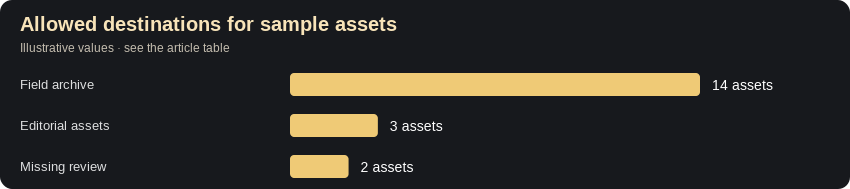
| Category | Value (assets) |
|---|---|
| Field archive | 14 |
| Editorial assets | 3 |
| Missing review | 2 |
Inventory is fictional: 14 originals, 3 illustrations, 2 awaiting evidence review. Do not submit the illustrations as observations.
A magazine photograph and a field record can show the same kind of insect without answering the same question. One helps a reader enter a story. The other helps someone decide what an observer actually encountered. Both can be worth keeping, but each fails if it is asked to do the other's job. A beautifully lit bee in a designed banner does not demonstrate that a particular bee was present at a monitoring plot. A tiny, awkward original frame may support that claim when it is tied to an encounter and carries enough visible information. Its awkwardness is not a defect in the record simply because it would look bad on a screen.
That distinction ought to survive download, reassignment, review, website production, and any later reuse of the files. A notice under the banner is a helpful start, but the notice alone will not accompany a thumbnail dragged out of a browser, a folder copied by a new editor, or an automated dataset export. The objective is to make the distinction durable at the level of named records, access, and actual workflow. Record the claim, preserve the observed material, and give every image a declared role before giving it a destination.
This guide describes a small workflow for a conservation group, a garden project, or an editorial team that publishes about pollinators. It is not a recommendation to photograph every encounter, nor does a photograph replace a structured survey. Examples throughout are fictional. The useful test is whether a different person could tell what an asset supports without having to remember what the photographer, editor, or tool intended.
Begin with the claim, not the pixels
Suppose a volunteer writes that a bee landed on one flowering stem during a timed watch. A photo might support the presence of an insect on a flower and allow another person to suggest a group. It may not support the species the volunteer initially named, the number of visits during the watch, whether the insect was collecting pollen, or whether it transferred pollen to another flower. The sharpness of the photo does not expand its scope. Conversely, if the photo was taken at a separate site, it cannot establish presence at this plot even if the species identification in the image is excellent.
Write the claim in a sentence before grading the picture. Ask which part the file can support, which part is supported by field notes or another observation method, and which part is only plausible. For a photograph of a bee approaching a corolla, arrival is not necessarily contact. For two frames of a striped insect on neighboring flowers, the images do not automatically document two individuals. A single shot of a bee and blossom can be credible evidence of a moment without being a census, an interaction network, or a repeat record. An article can explain those distinctions explicitly when they matter; it does not need to inflate the assertion to justify the space taken by a picture.
A visual for a story has a different acceptance test. It should orient readers, convey an idea, and avoid implying documentation it cannot provide. A generic commissioned illustration can give an accurate general impression of a meadow's structure without identifying any observed location. A reference portrait from a known photographer can depict a taxon accurately without depicting the focal encounter. A diagram of a hypothetical insect path can clarify the difference between visits and individuals. None of these contributions is worthless because it is not evidence. The problem arises when its relationship to the claim becomes ambiguous or the asset is copied into the observation feed.
Classification comes first because resemblance is a poor fallback. Two identical-looking files may have entirely different acquisition paths, and visibly different files may descend from the same original. An editor who sees a realistic generated meadow next to an original meadow photo should not be expected to recognize the source by the shape of petals. A curator who sees a tight high-contrast crop should not have to infer whether the corners were removed, the insect was moved, or the file was drawn from scratch. The system should carry answers to those questions with the file.
Give each record one identity and each file its own identity
Use separate identifiers for the field event, the occurrence record, and the digital asset. In a short garden visit, an event might be one defined watch. An occurrence is the documented presence or state of a particular organism within a recorded place and time. The asset is the individual original or rendition containing pixels, sound, or other media. Keeping the identifiers apart makes ordinary revisions possible without silently redefining the underlying observation.
The TDWG Darwin Core Quick Reference documents separate identifiers for field events and occurrences and distinguishes related media from the occurrence itself. Use its definitions when designing the export; not every local column has a Darwin Core counterpart. A local crop identifier or evidence-review status can remain in an internal database. If there are separate export tables, record which local key maps to which published key, how versions are represented, and which information is held back. A Darwin Core field is a vocabulary choice, not a certificate for the asset that fills it.
For a fictional event E042, an observer might create occurrence O042-03 and return three exposures of the same encounter. Assign each original its own asset ID. Two of the files might be usable and one obscured by a leaf; the third is still part of the capture sequence, but it need not be attached to a public record. A cropped review view gets a new ID and cites its source asset. If an editor commissions a spot illustration to accompany a summary of the survey, that file has an editorial link to the article, not an evidential link to O042-03. A reader sees the summary; a curator sees the distinction when the records are opened side by side.
Do not use a filename by itself as an identifier. Cameras, phones, and importers may produce the same short name multiple times, and people reuse friendly names when replacing pictures in a publishing system. Store original names as received, assign stable internal keys, and keep a derivative's relation to its parent even if its friendly name changes. The key can be simple; consistency and unique scope matter more than elaborate syntax. It should be possible to look up an asset ID and recover the relevant record without guessing the date or searching several camera-roll folders.
A file can have several legitimate relationships. A wide context exposure might show a habitat feature and be attached to an event rather than to every occurrence recorded that morning. A series might cover the same individual approaching and leaving a blossom, with only one frame revealing the useful features. A group can define relationship values such as evidence, context, review derivative, and editorial reference internally; exports should carry only the relationships intended for the destination. Avoid using proximity in the storage tree as the implicit relation. Moving folders for archiving should not make a flower photo suddenly become proof of a species in the records beside it.
Preserve what the collector actually delivered
An original, for purposes of this workflow, is the earliest file the project actually received from a documented acquisition path. A JPEG produced by a phone camera is an original for that project if it is the captured artifact delivered directly; this does not mean it is raw sensor data or that there was no in-camera processing. A copy received through a service that strips metadata or recompresses images may be all the project has, but it should be described as a received copy rather than represented as the untouched source. Neither a missing original nor a missing metadata block should ever be made to disappear by rewriting history.
At intake, store the received bytes in a protected area and calculate a checksum for later comparison. Record who provided the file, how it arrived, which clock or notes anchor the event time, and whether a separate source version is believed to exist. Make a backup and periodically demonstrate that you can retrieve the matching bytes. A checksum answers whether two byte sequences match; it cannot say whether the bee was there, whether the source is the photographer's file, or whether a caption is truthful. That requires the surrounding evidence trail and human assessment.
Be especially careful with the attractive shortcuts in a busy project. Rotating an original in a library interface may write the file rather than merely change the view. A cloud optimizer may display a visually equivalent image while storing a different object. A social media download may supply a small rendition with no reliable event metadata. A sync client can overwrite an earlier version if two folders use the same filename. None of these operations is necessarily wrong when performed on a copy for a declared reason. They are hazardous only when their output is treated as the original without a traceable record of what changed.
Keep the capture facts, interpretations, and public permissions in separate fields. Capture or intake facts are claims about the file's history: receipt time, contributor, filename, bytes, and reported date. Interpretation records might include tentative insect group, evidence strength, which visible feature supports the identification, and which features are absent from view. Permission is a separate decision tied to the media, purpose, and destination. A file may be suitable evidence for internal review without permission to publish it on a public blog. An image authorized for a report may not be transferable under the licensing terms of another platform. A reliable file archive keeps all three lines of inquiry open instead of expecting one approval checkbox to settle them.
Look for enough evidence rather than the most flattering frame
The file that looks best in a banner often favors visual simplicity. The field documentation you need might favor a side view, a different focus plane, enough background to link the frame to its sequence, or a view that rules out an overlooked lookalike. Do not discard an imperfect image just because there is a prettier alternative. Instead, choose a manageable evidence packet that preserves relevant information, limits repetitive copies, and does not pretend that multiple exposures validate multiple encounters.
For a tentative identification, ask reviewers to state what they can see and what they cannot. One could write that the outline and markings support a broad bee group, while the image does not reveal the structures needed to choose among close alternatives. That is better than choosing a species on the basis of a polished reference or a familiar name. If the project accepts a broader identification, retain the chain of reasoning and retain the initial proposed identification as history where appropriate. The article can call it a bee or a broad group if that is all the evidence supports, without sacrificing readability.
Keep evidence of uncertainty when it changes the interpretation. Examples include a disputed time, a place resolved only to a large area, whether the organism was wild or cultivated, or a mismatch between the reported event and the file sequence. In a running observation project, a suspected upload error is not an opportunity to make things look consistent by quietly replacing the date or location. Mark it for review. Compare the original, the event log, and the contributor's explanation if available. Record the eventual resolution, or show that none was reached. An accurate uncertainty field is more useful than a confident value invented to make an export pass.
The iNaturalist Data Quality Assessment guidance explains the platform's verifiability requirements, including date, location, and evidence such as photos or sounds, and describes how community input affects a grade. That is a platform-specific workflow, not proof that every externally recorded claim is correct. In your own process, treat the grade as one piece of review history rather than as a substitute for examining the underlying observation or describing its limits. Do not assume every sound or image is adequate for the identification at the proposed rank.
Even the best evidence of presence is biased toward what the observer could document. Larger, slower, or more obvious insects may be easier to photograph. Better light makes it easier to resolve details and may coincide with times or places that differ ecologically. Compare photo counts only after deciding whether photo acquisition formed a consistent part of the sampling protocol. If it did not, an image count describes the image collection. It should not be repurposed as an abundance measure, even if the image catalog is impeccably maintained.
Track derivatives by what they change
Make review views from a protected source rather than editing the only copy. Record whether a derivative was rotated, cropped, resized, or adjusted, and log the source identifier and processing settings when the transformation could matter. A correction for orientation has low interpretive stakes in many cases, but a crop can remove surroundings that show whether the image belongs to the claimed encounter. A white balance adjustment can change a character someone wants to use to identify the insect. A new frame blended from two burst exposures can combine details that never coexisted in a single exposure. The more a change can influence interpretation, the more important it is that the reviewer can see the source and understand the change.
Opening a review derivative next to its original also keeps discussions concrete. If the edge of a wing appears cut on one rendition, the source lets you check whether that edge was outside the crop or actually obscured when photographed. If a compressed image turns fine hairs into a smooth patch, a reviewer can avoid treating the artifact as an anatomical character. If an enlarged view seems to disclose a mark that cannot be found at native size, describe the mark cautiously and avoid relying on it as the sole reason for a narrower identification. Apparent detail is not necessarily captured detail.
Distinguish a source-backed crop from an editorial montage. A graphic can use authentic excerpts with separate captions in adjacent panels. But overlapping images, changing relative scale, or removing backgrounds creates a new editorial statement about the relationship of the depicted subjects. Label the graphic as a composite and identify the sources of its panels when permissions allow. Do not attach a composite to one occurrence as though the panels were recorded together. This remains true if all underlying pictures are real. Authentic components do not guarantee an authentic scene.
Generative fill and simulated sharpness require particular care. If an editor extends a meadow to make a wider banner, the added parts are invented even though the center began as an original capture. If an enhancer invents a wing margin or resolves obscured markings by pattern completion, it creates plausible pixels rather than recovering an independently observed feature. For observation review, use the unmodified source or a clearly documented, limited rendition that does not add visual content. For editorial treatment, declare the changes and preserve the linkage without placing the result in the evidence field. If you cannot confidently classify a transformation, hold the resulting file outside the evidence export until you know.
Permission to display the photo does not imply permission to modify it, and a contributor may be comfortable with a reference crop but not with a wide download that reveals the survey site. When an original supports an important claim but its public version must omit sensitive detail, describe that limitation without giving away the omitted information. The private review path and the public gallery can legitimately expose different versions. What matters is that the public depiction does not make a stronger factual claim than the authorized evidence supports.
Build an intake gate and keep the review queue visible
Intake should be easy for contributors and strict where it matters. Ask people to submit each observation as a small coherent packet: the event or occurrence identifier if one exists, the reported capture time and approximate place, the author's preferred credit, permission terms if known, and the media files received. Leave room for an uncertain time, a shared recorder, or an image that documents habitat rather than a target insect. A practical submission form should not force contributors to guess a species or publicly expose coordinates to complete an internal review.
At the gate, confirm that each incoming object opens, store its bytes, preserve the received name, and either match it to a known record or assign it a hold reason. Preserve already approved assets as they are rather than overwriting an older import with the current batch. A shared queue for unresolved items keeps intake failures from becoming invisible. One record might be awaiting confirmation of which of two visits the file belongs to. Another might need a rights decision. A third might be visibly observational but have incomplete data for public deposition. These are different cases, and grouping all of them under an unexplained status such as bad image causes work to repeat.
It helps to give every hold a specific question and an owner. For a location discrepancy, ask a field coordinator to check the event notes. For conflicting versions, ask the contributor which copy came from the camera or report that the answer is unknown. For rights, ask the person responsible for permissions to record what may be published on each surface. For weak identification, ask the reviewer to state the narrowest supported classification and explain the missing feature. Until the answer arrives, set a temporary status with a recorded reason, not a quietly affirmative decision.
Avoid assuming every holding item will eventually pass. Some submissions cannot be linked to an occurrence, some will remain ambiguous, and some may be excellent documents that cannot be released. A record for rejected or unresolved media may be useful internally for audit, subject to the team's policy and applicable privacy constraints. Rejections need not be visible to everyone, but they should be legible to the appropriate reviewer. A general lesson from review is that silence and approval are not the same data value. If there are no rights recorded, do not treat that as unlimited permission. If there is no match recorded, do not treat visual resemblance as association.
When an intake decision changes, append a review entry recording the previous state, new state, person or role making the decision, date, and a short reason. For a simple spreadsheet, this can be a second tab with one row per decision. For a database, an append-only decision history is a useful design. Do not use a person's current access level as the only history of their ability to change a record. A project may need to reconstruct why a public image was removed months later, even if the editor and curator have moved on.
Read the inventory chart as a routing exercise
The chart on this page is a worked example of file routing. It contains fourteen field originals assigned to the field archive, three illustrations assigned to editorial assets, and two files still awaiting evidence review in the category called Missing review. The categories are counted as one current primary disposition per asset in this fictional inventory. The first two destinations have a defined role; the third is a hold, not a green light. All three amounts add to nineteen assets at this point in the workflow. They are hypothetical, not figures from iNaturalist, TDWG, an actual collection, or a survey.
The categories are not taxonomic classes, confidence grades, approval rates, or proof of coverage. Fourteen original media objects might document fewer than fourteen encounters because some encounters produce several frames. They also might not all support an identification at the intended resolution, nor be publishable. Three illustrations can serve excellent editorial purposes without belonging to the observation record. Two files missing review are not automatically bad files or absent organisms. They are two unanswered questions about asset disposition. The chart gives a manager a sensible next action: open the two hold rows and see what decision is missing.
Keep that kind of chart distinct from counts by use. If you later want to count how many article pages display an approved reference photograph, you are counting placements, not asset objects. One asset can be used in multiple approved placements. Conversely, one article placement can show a composite built from more than one asset. Replacing a homepage thumbnail might increase the derivative count without touching the field archive. An increase in derivatives is neither an increase in pollinator encounters nor automatic evidence of a publication problem. The unit of a count should appear beside the number wherever the number is reused.
A useful routine is to reconcile clear totals rather than rely on an exact-looking percentage. At the end of the fictional example, the inventory can explain why each of nineteen unique IDs appears in exactly one disposition bucket. It cannot claim that seventeen out of nineteen were scientifically verified: the three illustrations are not in that review universe, and routing the fourteen toward the archive does not certify them. If a manager does want a rate of completed evidence review, define a separate eligible population and what counts as an adjudicated decision. Then include inaccessible, pending, rejected, and excluded cases consistently according to the question.
If a held item is subsequently established as an editorial illustration, move its primary disposition in a new dated inventory view. The resulting view can legitimately differ. Preserve whatever snapshot was originally used for a public or internal figure so a reader does not see an unexplained change to a historical count. The current dashboard evolves; a published figure is a representation of a particular dataset version and scope. A small timestamp or version note can spare anyone trying to reproduce it from wondering why the chart and today's folder differ.
Make public access a distinct decision
A useful evidence library is not necessarily a public library. Location, timestamp, recorder identity, and image content can jointly disclose far more than a contributor intended. Exact coordinates in a metadata field are not the only location signal. A frame might show a recognizable gate, numbers on a greenhouse plot, landmarks in the distance, or reflections from an adjacent building. A sequence of dates and nearby visits might narrow an area even if each file omits a coordinate. Review the combined release, not just a single column.
Plan separate private and public representations. The evidence curator may retain an original with embedded metadata necessary for legitimate internal review. A public rendition can omit that metadata or preserve only an appropriately generalized place. Test the actual downloadable object rather than assuming a website's rendered crop strips the underlying fields. Also check the published filename, caption, alt text, browser-visible structured data, and links to a larger copy. A plan to protect a site becomes ineffective if a structured feed exposes the detail removed from the caption.
Rights are similarly granular. A person may provide a file for private assessment, agree to a thumbnail with credit, allow a modified educational version, or prefer no onward release. Attribute the source accurately using the authorized credit and distinguish rights in the image from rights or permissions attached to a data record. Do not assume a public listing, a search-engine result, or a specimen citation grants a photographer's permissions. The operational rule for a small editorial team is straightforward: preserve the evidence privately within the project policy, and publish only the scope the rights record actually supports.
Not every editorial need warrants running a difficult privacy review on occurrence media. If the concept can be conveyed with a generic illustration that does not imply a particular place or insect, make that editorial choice explicitly. Doing so may make a genuinely important documentary image stand out when releasing it serves the story and the public version can be authorized safely. Filling space is not a sufficient reason to share a detailed image from a sensitive plot. Nor is visual continuity between the article and a dataset reason to allow the article's banner to appear as a dataset attachment.
Access for contributors, reviewers, and the public should follow their duties. The person writing a short caption usually needs a limited approved media view and a claim note, not access to every unredacted original. The person resolving an identification dispute may need the source packet but not contact details irrelevant to that inquiry. An export system should read the smallest approved view that serves its role. This avoids relying on one busy person to remember a prohibition every time they copy a file. It also makes it easier to revoke a mistaken permission without guessing which additional systems learned about the media.
Make editorial labels do work for readers
A useful caption tells readers both what is shown and why it is here. For a generated banner, say that it is an illustration and not a record of the reported event. For a documentary image, say whether it depicts the observed subject at the event or a different documented example of the general topic. For a composite, explain that panels have been assembled and whether they share a scale, time, or place. For a site map or explanatory diagram, distinguish drawn, measured, and inferred features. Short and specific beats a broadly worded legal notice that tells a reader little about the important boundary.
Consider an article that compares two garden plots but has no cleared pictures from either. A banner caption could say, “Generated illustration of a flower border. It does not depict either monitored plot.” An unrelated photo that was licensed independently might be captioned, “Reference photo of a flowering border, taken outside the survey.” Neither claim confuses the garden observation with the visual. A public image of a verified focal encounter can be captioned more directly, with a carefully scoped field note: “Image accompanying the field record; the insect was recorded at group level.” If the project cannot publicly share the occurrence identifier, say why in general terms only when relevant to understanding the source.
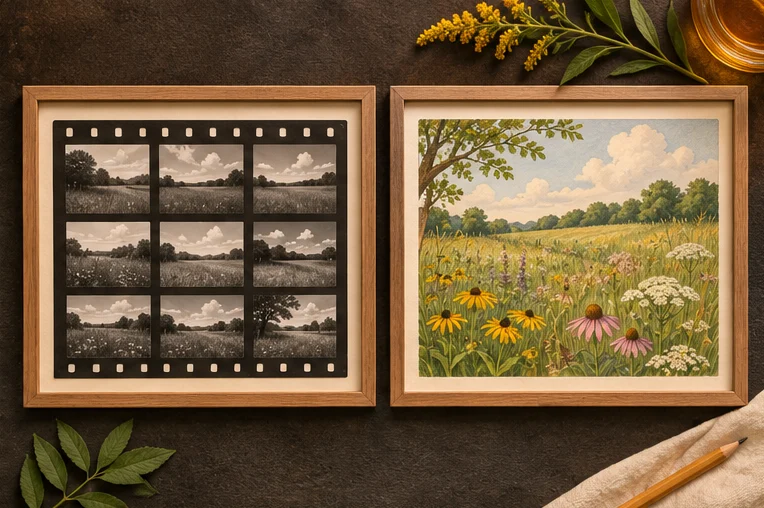
Alt text serves another purpose: it should describe relevant visual content or functionality without forcing a user to infer it from the caption, while allowing the surrounding page to present the provenance. A suitable concise alternative for a generated banner might describe two contrasting panels with photo-like frames beside a drawn meadow. The nearby caption should supply the provenance that the image is illustrative; when the image is reused as a standalone object or the caption disappears, the reuse context must still make the distinction legible. It is not enough to put provenance only in an accessible description that sighted users may never encounter, or only in a fleeting tooltip that keyboard and touch readers may miss.
Inspect less prominent surfaces too. Homepage cards and messaging previews often inherit a hero without inheriting its caption. A sentence in the article will not prevent an image on a search card from looking like direct documentation. Sometimes the most robust decision is to choose a visibly illustrative visual language for those detached surfaces, or to display a short provenance label adjacent to the image wherever it can travel. Content editors should know which surfaces can show context, which ones do not, and which visuals are approved for standalone reuse. File-level annotations can help downstream systems, but today you still need to check the rendered output.
Good labels also protect the meaning of a genuine source. If an article uses a small annotated version of a field photo to point out the flower, the label can state both that the exposure comes from a monitored encounter and that the annotation is editorial. Readers can see which part of the picture was observed and which part was added to explain the observation. Do not blur that distinction by labeling every image simply as a photograph, or by branding every enhanced asset as original. A caption that tells the truth about the workflow is usually more informative than a caption that hides it to make the design cleaner.
Test the release in both directions
Before sending a dataset to partners or publishing a new article, take one current export from each path and inspect the actual output. In the observation delivery, every attached medium should resolve to a record with a compatible role, a reviewed relationship, and the permission required for that destination. Check the object behind the link as well as the link itself: an unchanged address might point to a replacement file. In the article delivery, every documentary claim attached to a picture should trace back to a source or a reviewed rendition; every illustration should have the labeling needed in its displayed context. The tests should be explicit about which staged snapshot they cover.
A small trial with deliberate counterexamples can reveal more than a long list of approved files. Select a generated image that has attractive flower detail and verify it fails the observation export even when someone accidentally assigns it the right occurrence ID. Select a documentary original with a withheld location and verify that a general public export cannot obtain the protected file. Select a publicly authorized derivative and confirm it is exactly the intended version and retains the approved attribution. Finally, pass a held item through the preview workflow and confirm that it does not silently become publishable because the article renderer knows how to load the file.
Review the effect of each change where it lands. Suppose a site-wide redesign removed all figure captions from the compact card view. The database may still correctly describe a banner as generated, but that description now fails to reach people reading in the new layout. Repairing the page text alone does not address the card. Similarly, if a data importer discards a property representing role, inspect its accepted format and map the relevant permissions before uploading again. A policy is useful only if the last application in the chain can respect it or receive a safely filtered representation.
Count ambiguous links separately from missing files. A completely intact JPEG attached to the wrong encounter is a more serious evidential problem than a missing hero on an article. The first can mislead future analysis; the second is usually noticeable as a display defect. This distinction should affect escalation. Correct the attachment and record why, trace downstream exports that received it, and notify the responsible review role according to the team's process. Avoid quietly making a new media object at the same address and leaving every prior assessment untouched. A fix for one view is not necessarily a correction of datasets already delivered elsewhere.
Practice the correction before a real problem arises. Pick a fictional occurrence used in a training environment, replace a draft association with one known to be wrong, then show how the team would retract and correct it while preserving the decision history. Check that the corrected export no longer carries the wrong linkage, and that the article's approved illustration remains unaffected. If you cannot safely reproduce that sequence in a test copy, there is a good chance a real correction will be improvised under pressure. Document who can withdraw an item from each publication channel and what downstream systems are outside your control.
Carry a small routine forward
At the end of each field and publication cycle, pick an example from each role and trace it both ways: event to original, original to review, approved derivative to public placement, and illustration to its caption. Open the held set and ask which hold needs a human answer. Reconcile unique assets against the count shown in any chart and keep the version used for the article separate from the evolving inventory. Test an older packet occasionally, because the usefulness of an archive becomes clear when someone other than its creator needs to recheck it.
The point of this routine is not that a plain photograph always deserves more trust than a stylish image. It is that their trust comes from different things. A picture can be captivating without being documentary, a documentary frame can be inconclusive without being useless, and a carefully scoped claim can survive a redesign if its evidence is stored independently of its layout. Retaining that distinction lets a team use strong editorial art without compromising the modest, checkable records that make real observations useful.