
Electron beams and X-rays can widen industrial sterilization options. The difficult work is proving that a particular product, package, and production route still meet their requirements.
The least visible stage of manufacturing can determine whether a carefully designed medical device reaches its user in a usable condition. A molded component may meet its dimensions, a mechanism may move correctly, and a package may look intact, yet the finished product still depends on a validated route through sterilization. Changing that route is therefore more consequential than changing the machine at the end of a conveyor. It changes the evidence that connects a manufactured object to its intended condition when opened.
A study listed by Pacific Northwest National Laboratory on September 22, 2026 illustrates both the opportunity and the limits. Researchers compared gamma, electron-beam, and X-ray treatment of a commercial pulsed lavage device. The institutional abstract reports that tested product functionality was not inhibited, while the X-ray-treated device battery showed greater voltage loss and some polymers showed statistically significant appearance differences. The authors support the alternatives for the particular device investigated. That is a device-specific materials and function result, not a blanket approval of every product or a standalone demonstration of microbial sterilization performance. Primary institutional abstract.
For a reader outside the industry, the useful question is not which radiation source wins a universal contest. It is what must remain true when a manufacturer switches sources. Does the product still work? Does the package still perform its role? Is the treatment sufficiently consistent throughout the approved load? Can the process be repeated, monitored, investigated, and documented? Can the organization distinguish a reassuring experiment from the evidence needed for a production decision?
Those questions also explain why new capacity can be promising without making transition effortless. A spare machine is not automatically a spare manufacturing route. This article examines that distinction through published studies and explicitly hypothetical engineering examples. It is an explanation of industrial evidence and decision making, not a recipe for irradiating products, a clinical recommendation, or advice on a particular regulatory submission. No numerical example below specifies a sterilization dose for an actual device.
Start with the product, not the radiation label
Consider a hypothetical disposable instrument assembled from a flexible tube, a rigid housing, a small seal, an adhesive bond, and a battery-powered mechanism. A person looking only at the housing might describe it as a plastic product. That shorthand hides the engineering problem. The product is a collection of materials, interfaces, and functions. Its essential performance may depend on the smallest component, or on a connection between components that look satisfactory when inspected separately.
Suppose the housing remains strong after processing but the seal changes enough to affect the assembly. A successful housing test does not resolve the seal question. Suppose the mechanism works immediately but the package is expected to remain in storage before use. Immediate operation does not answer the storage question. Suppose every individual component meets its specification while the completed assembly becomes difficult to operate. A list of component passes is then an incomplete description of the finished product.
This is an ordinary systems problem with unusually important consequences. The relevant unit of analysis must match the claim. A statement about a polymer coupon supports a claim about that coupon under its tested conditions. A statement about an assembled instrument has a different scope. A statement about a packaged product after a specified storage period is different again. These categories can inform one another, but they should not be substituted silently.
A manufacturer evaluating an alternative can therefore begin with a claim map rather than a marketing comparison. One column lists the function being protected. Another identifies the evidence that addresses it. A third records what remains outside the test. For our fictional instrument, that might distinguish housing integrity, seal behavior, mechanism operation, package performance, and storage-related questions. The map is a reasoning aid, not a universal validation protocol.
The map also prevents a common communication failure. A successful experiment is often reported at its broadest emotionally appealing level: the device survived. Engineers need the narrower description: which device version, which configuration, which measured functions, and which conditions? Narrow language does not diminish the achievement. It makes the result portable, because another team can see exactly what is relevant to its own problem and what needs fresh work.
Similar physical mechanisms do not make identical production systems
Thomas Kroc's simulation study, first posted in August 2022 and revised in October 2023, compared the lower-energy electron spectra produced by gamma radiation, electron beams, and X-rays. Its abstract reports no difference in the simulated spectra below the examined energy threshold and concludes that there is no energy-dependent difference of that kind for radiation sterilization. This is a useful physical comparison. It does not establish that every industrial arrangement delivers an identical spatial distribution, or that every material and product will perform identically after processing. Only the author abstract was used here. Primary author record.
An analogy helps separate the levels of argument. Two ovens can transfer heat to food through the same physical principles while producing different results for a tray with uneven thickness. Knowing the mechanism is necessary for understanding the process, but it does not eliminate questions about placement, timing, geometry, and the object being treated. The analogy is limited: sterilization is not cooking, and no oven setting translates into a radiation-processing instruction. Its purpose is to expose a logical gap between shared mechanism and interchangeable implementation.
The same gap appears in software and manufacturing. Two machines can execute the same calculation while differing in reliability, throughput, and interfaces. Two cutting tools can remove the same material while requiring different fixtures. A statement about a fundamental interaction does not contain a complete description of a production line. Treating it as though it does creates an avoidable disagreement between physicists who are making one claim and engineers who must answer several others.
For a practical comparison, the important sentence is therefore conditional. If a proposed route can deliver the required treatment consistently, and if the product remains within its relevant performance limits, then the shared physics can support the case for equivalence at the appropriate level. Each condition requires evidence. Removing the conditions makes the sentence easier to repeat and less useful for deciding whether to change a real process.
This distinction is also valuable for public communication. A headline about equivalent radiation should specify whether equivalence refers to an interaction mechanism, a measured material response, or a validated product process. These are related ideas, not synonyms. A careful article can welcome evidence at the first level without pretending that the final level has already been achieved everywhere.
A window is more informative than a single target
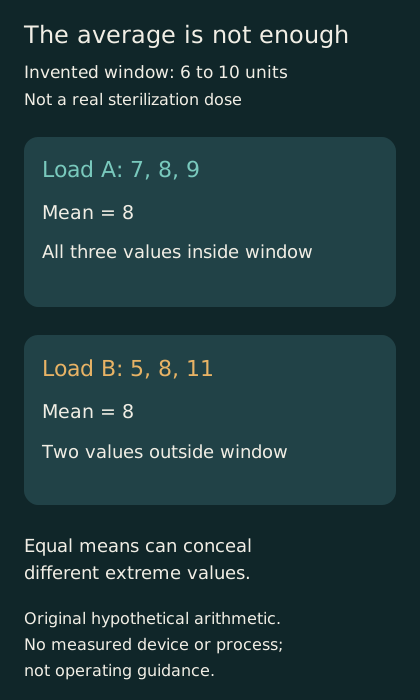
Original hypothetical arithmetic in arbitrary units, not a real sterilization dose, measured process, or operating guidance.
Imagine an entirely hypothetical processing requirement expressed in arbitrary units. The lowest acceptable treatment level is six units, and the highest level compatible with the fictional product is ten. These values are invented for arithmetic, not taken from a device standard or intended as operating settings. A proposed load contains locations that receive seven, eight, and nine units. All three fall within the illustrative window. Another load averages eight units but contains locations receiving five and eleven. Its reassuring average conceals two different problems.
The first problem concerns the lower boundary; the second concerns the upper boundary. They cannot be repaired by announcing that the mean is correct. The appropriate reasoning is spatial and conditional: where are the extremes, how confidently are they known, and how do they compare with the established limits? A central value can be useful, but it cannot represent every part of a heterogeneous object or load.
This invented example explains why an equipment brochure and a product qualification answer different questions. A brochure may describe a source's capabilities. A qualification must connect those capabilities to the object, arrangement, and requirements actually at issue. The question is not merely whether the source can produce enough treatment. It is whether the proposed route can keep the relevant product conditions within the acceptable region, with justified confidence and repeatability.
Uncertainty belongs inside this picture. Suppose a nominal value is barely within the window, but the evidence leaves substantial doubt about its actual value. The nominal pass should not be mistaken for a large margin. Conversely, a process with comfortable separation from both boundaries may offer more room for ordinary variation. How that uncertainty is evaluated belongs to the applicable professional framework; the conceptual point is that an unqualified single number hides the distance to failure.
The figure accompanying this article uses only this invented window. It does not plot measured industrial performance, specify a recommended dose, or compare actual suppliers. Its usefulness lies in the geometry of the decision. A good average can coexist with unacceptable extremes. That fact is simple enough to draw and important enough to remember whenever a complex process is reduced to one favorable number.
Materials evidence gets stronger when its boundaries are visible
A 2021 study summarized by PNNL compared gamma, electron-beam, and X-ray effects on single-use blood collection devices with plastic components. The institutional abstract describes mechanical, appearance, and functional assessments, with no functional failures under the study's tested conditions and some statistically significant differences in measured properties. The relevant achievement is a direct comparison on specified products and materials. The abstract does not justify assuming the same result for an unrelated device, a changed formulation, or every future production arrangement. Primary institutional abstract.
There are two opposite ways to misuse a result like this. One is to turn a favorable finding into a universal claim. The other is to insist that a bounded finding has no value because it is not universal. Both mistakes flatten useful evidence. A carefully described result can reduce uncertainty about a particular material system, suggest what deserves further testing, and help teams avoid beginning every comparison from nothing.
The question is how far the result travels. Imagine two fictional products that use the same general polymer family. One is a thick rigid component; the other is a thin flexible part joined to an adhesive. The shared family name is relevant but incomplete. Without additional evidence, it does not establish that the two products have the same tolerances, failure modes, or performance requirements. The comparison might be a sensible starting point for investigation, but it is not the investigation's conclusion.
A useful evidence summary therefore separates observed outcomes from proposed extensions. The observed outcome belongs in a sentence with the tested object and conditions. The proposed extension belongs in a different sentence beginning with a question or a conditional. This small editorial discipline makes scientific progress easier to assess. It lets readers see what has been established, what has become plausible, and what remains an engineering task.
It also makes negative or mixed findings more useful. A difference in appearance may be central for one product and secondary for another. A small mechanical change may be harmless within one design margin and important near another limit. The appropriate interpretation depends on the function and specification, not on whether a statistical test produces a convenient headline. Evidence becomes more informative when the relevant performance question is explicit.
Statistical differences and practical decisions are different objects
A study can identify a difference without establishing that the difference matters for the intended use. Equally, a study can fail to detect a difference without demonstrating exact equivalence. These distinctions are basic to experimental reasoning, but they become easy to lose when a technology is being promoted as a replacement. A sentence about statistical significance should not be rewritten as a sentence about product acceptability unless the supporting analysis connects the two.
Consider an invented measurement of a component property. The original version averages one hundred arbitrary units, and the alternative averages ninety-nine. If the requirement is at least ninety, that difference might sit comfortably within the fictional margin. If the requirement is at least ninety-nine and a half, the same average change has a different significance for the design. Neither example specifies a real material test. They show why a percentage difference has no complete meaning without a requirement and a distribution.
The distribution matters because a product is not manufactured only at its average. Suppose two candidate routes share the same mean but differ in variability. One might place more units close to a limit. Suppose a sample is small enough that rare problems would be difficult to observe. A report of no observed failures then means what it says about the tested sample; it does not become proof that failure is impossible. Readers should ask what the experiment was capable of detecting.
A decision-oriented summary can keep three questions separate. Was a measurable difference observed? Is that difference relevant to an established functional requirement? Is the evidence sufficient for the proposed decision? These questions may produce different answers without contradiction. A result can be statistically distinguishable, functionally acceptable, and still insufficient to support a broader process change without additional information.
This is especially important when studies evaluate several properties at once. A product can perform well on most measures while one measure deserves investigation. A responsible summary does not hide the exception, nor does it pretend that one exception automatically invalidates everything else. It describes the pattern, the limits of access to the evidence, and the remaining decision. That is more useful than a simple victory narrative for one technology.
An assembled device adds questions that a coupon cannot answer
PNNL's July 26, 2024 record for a universal bone cement mixer study describes comparisons across gamma, electron-beam, and X-ray treatment of the device's plastic components. The author abstract reports differences in appearance and mechanical behavior while supporting the investigated alternatives for that particular application. It is another product-specific comparison, not a substitute for all the evidence needed to establish the finished product's sterility, packaging performance, or suitability under a different configuration. The full journal article was not used for claims beyond the accessible institutional abstract. Primary institutional abstract.
The broader engineering issue can be understood through a fictional hinge-and-latch assembly. A material coupon may show acceptable strength. The hinge may also move correctly when tested alone. Yet the assembled latch may depend on a narrow fit between two parts. If both parts change slightly in opposite directions, their interaction can matter even when neither isolated measurement looks dramatic. Assembly-level questions are not an objection to materials testing; they identify what materials testing does not cover by itself.
Packaging adds another interface. A package is both an object with its own properties and part of the route by which a device is handled, stored, and delivered. An evaluation that stops at the unpackaged device leaves a different claim unresolved. Conversely, a package assessment does not establish that the device inside retains its function. The two bodies of evidence must meet rather than compete for attention.
Time adds a further dimension. A product may not be used immediately after processing. A decision about its intended storage period therefore needs evidence appropriate to that period, rather than an assumption that a satisfactory measurement today answers every later question. This is a general inference about the scope of a claim, not an assertion that every irradiated material necessarily deteriorates or that one technology causes a particular failure.
For an outside reader, the key is to resist treating the word compatible as a property without conditions. Compatible with what product, at what stage, according to which measured requirements, and over what intended interval? Once those questions are asked, the engineering conversation becomes less mysterious. Compatibility is a relationship supported by evidence, not a permanent label attached to a material name.
Recognition is not a product-specific permission slip
The FDA's recognized-standards database lists AAMI TIR17:2024, concerning compatibility of materials subjected to sterilization, with a December 23, 2024 entry date. Its public scope includes several sterilization modalities and qualification of polymers, ceramics, and metals. The database record recognizes the standard; it does not declare every product made from those materials acceptable under every process. This article consulted the public recognition record, not the complete underlying standard, and does not reproduce or interpret its detailed procedures. FDA primary recognition record.
The distinction matters because standards and approvals are often compressed into the same phrase in casual reporting. A standard can provide a shared framework or recognized method without supplying the actual measurements for a particular product. A manufacturer still has to connect the relevant evidence to its own claim. The existence of a framework makes that connection more structured; it does not make the connection unnecessary.
A simple analogy is a building drawing convention. A common convention allows engineers to communicate clearly, but the convention is not itself a structural calculation for a specific building. Likewise, knowing which framework applies is different from knowing whether a particular design satisfies the relevant requirements. The analogy does not describe a regulatory pathway. It clarifies the difference between a rule for organizing evidence and the evidence organized under that rule.
For journalists and purchasers, a useful follow-up to a standards claim is therefore specific: what exactly is recognized, and what exactly has been demonstrated for the product being discussed? A response that names a standard but never identifies the product-specific evidence may be incomplete. A response that describes a successful test but never explains its relationship to the intended claim may also be incomplete. Neither omission should be filled with an assumption favorable to the speaker.
Jurisdiction and date should remain visible. The FDA record cited here is a United States source accessed on November 1, 2026. It should not be represented as a description of every country's requirements or as advice about a particular submission. The public can understand the structure of a technical decision without receiving an oversimplified legal instruction or an invented assurance that a named product has been cleared.
Redundancy has to exist before the emergency
In its January 26, 2024 sterilization town hall, FDA staff discussed product-specific considerations and the potential supply-chain value of validating multiple sites or modalities. The transcript emphasizes validated and controlled processes rather than treating a new location as automatically interchangeable. This is a dated first-party account of the agency's discussion, not evidence that any particular manufacturer has completed an alternate route. FDA town-hall transcript.
The organizational implication is straightforward. If an alternative route is first investigated only after the original route becomes unavailable, the investigation itself becomes part of the interruption. A business may possess a list of possible suppliers without possessing a ready alternative. The difference resembles having a map of nearby bridges versus knowing that a particular truck can use one under the relevant conditions. Names on a list are not the same as established capability.
Consider a fictional manufacturer with one primary route and one proposed backup. The backup facility has available equipment, but the product configuration has not been evaluated there, the supporting documentation is incomplete, and transport arrangements are unresolved. Calling the backup fully operational would conceal several dependencies. The honest status is more useful: a candidate route with defined gaps. Management can then allocate effort to the gaps rather than discovering them during a shortage.
A second fictional manufacturer has completed the relevant preparation but relies on the same vulnerable upstream component for both routes. It has diversified one part of the process without diversifying the entire chain. That may still be valuable. The error would be to describe a local improvement as total resilience. Good planning identifies the boundary of the redundancy and the failures it does not address.
These examples suggest a better way to talk about capacity. Installed equipment, available appointment slots, qualified product routes, and delivered finished goods are different quantities. An increase in the first can create an opportunity for the others, but the transition requires work. A useful public account asks where the bottleneck actually sits rather than assuming that every new machine immediately becomes usable capacity for every waiting product.
Throughput is an end-to-end question
Imagine a fictional process that spends very little time at its central machine but several days waiting for transport, release documentation, or an available downstream step. Improving the central machine alone might produce only a small reduction in total delivery time. Conversely, a modest change in scheduling could improve delivery even without changing the physical treatment. The example is a generic operations model, not a measured comparison of radiation technologies.
This is why throughput claims need a boundary. Does the reported rate refer to the equipment under selected conditions, the facility with loading and handling included, or the entire route from manufacturer to released inventory? Each number can be legitimate. Comparing them without aligning the boundaries creates a misleading contest. A fast central step can coexist with a slow overall route, just as a slow step can be managed effectively within a reliable schedule.
Product mix also matters to the logic of a capacity claim. A facility capable of handling one family of products is not necessarily available for every other family on the same terms. The relevant question is how the proposed product fits the established route, not how impressive the largest headline number appears. This is a reason to seek product-specific planning, not a claim that any particular technology is inherently inflexible.
An economic comparison should likewise distinguish equipment cost from the cost of making a usable route available. Transport, inventory, qualification work, downtime, and the consequences of delayed supply may matter alongside processing charges. Their relative importance will vary by situation. Without a defined boundary and assumptions, a low quoted unit price cannot establish the lowest overall cost, and a high capital cost cannot establish poor value.
For the public, the central point is that industrial alternatives are judged through an ecosystem of constraints. The accelerator is visible and technically interesting, but the organization around it determines whether its capability reaches a product at the right time with the right evidence. A serious comparison makes those surrounding requirements legible instead of treating them as administrative clutter added after the real engineering is finished.
A process change is also a recordkeeping problem
FDA's public sterilization overview describes multiple methods and the role of validation and recognized standards in medical-device sterilization. It also discusses efforts to support alternatives and address supply concerns. The page is useful as a map of the agency's public resources, not as a complete instruction manual or a finding about a specific device. Its current accessible contents were checked on November 1, 2026; no claim here assumes that every historical pilot or pathway has identical conditions indefinitely. FDA primary overview.
A hypothetical change record can make the practical issue concrete. It identifies the product version, the proposed route, the reason for the change, the evidence reviewed, the unresolved questions, and the people responsible for the decision. It also records what did not change. That last category matters because an evaluation can become difficult to interpret if several modifications occur together and their contributions are never separated.
Suppose a fictional company changes a material supplier, a package dimension, and a processing route at the same time. If later testing reveals a difference, the combined change complicates attribution. The organization may still be able to investigate, but the evidence problem is harder than if the changes had been clearly isolated or deliberately evaluated as a combined system. This is general experimental reasoning, not a claim that simultaneous changes are always prohibited.
Records also protect against accidental expansion of a successful result. A test associated with one product revision can gradually become described as covering the entire product family unless its scope stays attached to it. A clear record allows later teams to see whether a proposed use falls within the original evidence or asks a new question. Without that discipline, institutional memory can become more confident as the details become less accessible.
The public rarely sees these records, and confidential product information may legitimately remain private. That does not make transparency impossible. An organization can explain the categories of evidence, the boundaries of its claims, and the difference between completed work and ongoing investigation without publishing every technical detail. Meaningful transparency is not the same as unrestricted disclosure; it is enough specificity to prevent an audience from drawing conclusions the evidence does not support.
Separate the uncertainty you measured from the uncertainty you inherited
An evaluation can be precise about one question while remaining uncertain about another. Imagine that a fictional team measures a component dimension repeatedly with excellent agreement. The measurement uncertainty may be small. Yet the team might still be unsure whether that dimension adequately represents the function it is trying to protect. More repeated measurements of the same dimension would improve the first problem without necessarily resolving the second. Precision and relevance are separate qualities of evidence.
A similar distinction applies to a comparison drawn from another product. The original study may be carefully executed, while the uncertainty lies in transferring its conclusion to a changed design. That transfer uncertainty is not a criticism of the original authors. It belongs to the new claim. A responsible summary keeps the two locations of uncertainty separate instead of suggesting that a published result must be either universally decisive or scientifically weak.
One way to organize the reasoning is to distinguish measurement questions, representation questions, and decision questions. Measurement questions ask how well a property was observed. Representation questions ask whether the tested sample and conditions correspond to the proposed use. Decision questions ask whether the evidence is sufficient for the consequence at stake. This is an original explanatory framework, not a replacement for any professional standard. Its value is that it prevents confidence in one category from automatically filling gaps in the others.
Consider a hypothetical comparison of two batches. Both meet the same measured requirement, but one batch was selected from an unusually narrow part of production. The observed pass is real for that batch. Whether it represents the broader population remains a separate issue. Conversely, a broadly representative sample measured with a poor instrument presents a different weakness. The remedy should address the actual weakness rather than adding more of whatever evidence happens to be easiest to collect.
This way of thinking also changes how progress is reported. A project may have resolved material compatibility questions while still investigating the proposed load configuration. It may have established a route for one product revision while another revision remains under evaluation. Reporting those intermediate achievements accurately is more informative than assigning the entire project a vague green or red label. Partial completion is legitimate; undisclosed expansion of partial completion is the problem.
For readers assessing a company announcement, a practical question is whether the uncertainty has been located. A statement that more testing is needed is less useful than an explanation of what that testing is intended to determine. No confidential parameter is required to say that a remaining question concerns storage performance, a changed configuration, or the applicability of earlier evidence. The audience can then understand why the project is promising without assuming that the remaining work is merely ceremonial.
What an honest comparison table would contain
A comparison table can clarify this subject if its rows describe questions rather than declare a universal winner. For a fictional procurement review, one row could identify the product family covered by available evidence. Another could distinguish a proposed route from an established one. Others could state which performance claims were tested, which documents are available to the decision maker, and which dependencies remain unresolved. The table would organize an argument rather than compress unlike evidence into a single score.
The most important cell might be unknown. Leaving it visible prevents a numerical rating from disguising missing information. Suppose candidate A has a detailed record for a narrow product range, while candidate B advertises a broader capability but provides less product-specific evidence. A simple points total may reward the broader claim even when the decision concerns a product already covered by A. The comparison should follow the actual decision, not the size of the marketing vocabulary.
Costs also deserve explicit denominators. A price per processed unit, a price per shipment, and a cost per released usable device answer different questions. An invented route with a lower processing fee could still require more inventory or more complicated transport. Another route could cost more per batch while reducing a particular disruption risk. Neither conclusion follows from the fee alone. A credible comparison identifies which costs are counted and which remain outside the calculation.
Finally, the table should carry a date and a version. Evidence can change when the product changes, when the proposed site changes, or when additional work closes an uncertainty. A comparison frozen without those identifiers can become misleading even if it was careful when first assembled. Versioning is not decorative bureaucracy. It allows a future reader to tell whether a claim refers to the route actually under consideration or to a previous configuration that only looks similar.
Ask what would change the conclusion
A strong evaluation identifies not only why the proposed route appears acceptable but what evidence would count against that judgment. This is useful because a project can become socially committed to a preferred outcome before all questions are answered. When success is defined only as collecting favorable findings, an unresolved result can be treated as an inconvenience rather than information. Clear decision criteria reduce that temptation.
For a fictional product comparison, the team might specify the functions it must preserve, the uncertainty it must resolve, and the boundaries beyond which the result will not be generalized. These are not operating instructions. They are features of an accountable argument. A later reader should be able to understand why the evidence supports the decision and where the decision would need reconsideration if the product or process changed.
The same discipline improves reporting on new technology. Instead of asking only whether electron beams or X-rays can replace an established route, ask which products have supporting evidence, what kind of evidence was examined, and what remains to be established. A materials study, a facility announcement, a regulatory record, and a production validation are different kinds of news. They should not be placed on a single ladder without explaining the missing steps.
There is room for optimism in that more demanding account. Product-specific studies can accumulate. Shared physical understanding can guide comparisons. Standards and public regulatory resources can make the questions more consistent. Organizations can prepare alternate routes before an interruption forces urgency onto the process. None of those advances requires claiming that every transition is simple or that the same answer applies to every device.
The durable lesson is that sterilization capacity is not merely a quantity of radiation or a count of machines. It is a documented relationship among a product, its package, a controlled process, and the evidence supporting their use together. Accelerators can expand the available tools. The public benefit arrives when those tools are connected to reliable products through careful, bounded, repeatable engineering—and when the claims made about that engineering remain no larger than the evidence behind them.