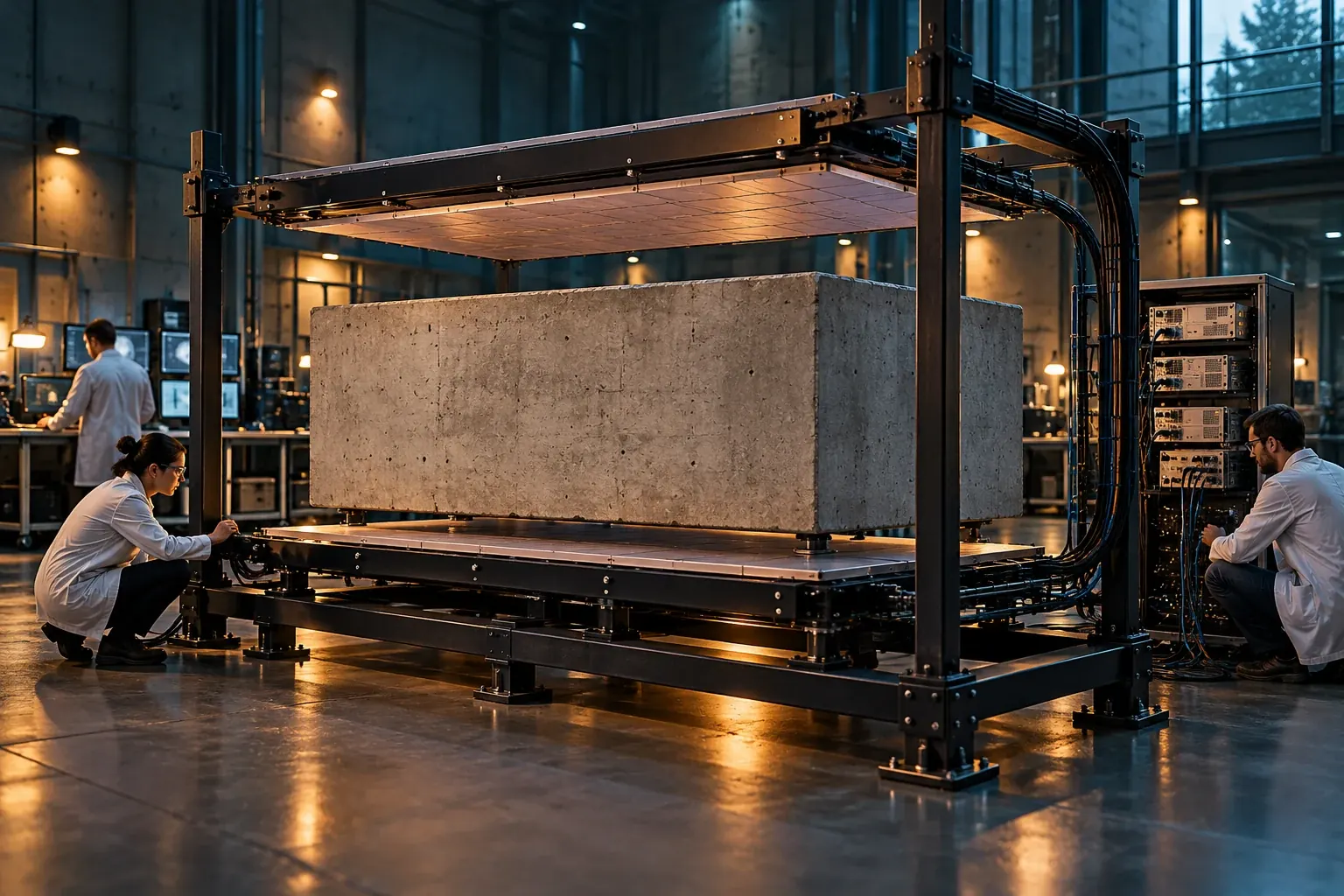
Muon imaging can reveal hidden space and dense inclusions, but a particle image is not yet an archaeological explanation or a structural safety certificate.
A stone monument, a concrete beam, and a sealed industrial container have something in common: their surfaces can conceal information that matters. Opening them may be expensive, destructive, hazardous, or simply unacceptable. Muon imaging offers an unusual way to ask what is inside. Instead of supplying an artificial imaging beam, an instrument records naturally arriving particles and uses their passage through material to infer features that ordinary light cannot reveal.
The work is moving beyond spectacular archaeological demonstrations. A preprint first posted in June 2026 and revised on October 15 reports experimental imaging of a 205-liter mock waste barrel with a one-square-meter detector bench. Bajou and colleagues combine simulations with measured scattering data and report identification of internal inclusions under their test conditions. The object was a mock barrel, and the work remains a preprint in the version examined here—not a universal certification of industrial waste inspection. Primary preprint, version two.
A separate March 2025 preprint by Pallav and colleagues investigates muon absorption in civil-structure materials using scintillation detectors and Geant4 simulations. Its MARS experiment explores mapping inhomogeneities in concrete with overlapping detector paddles. It is an experimental and modeling study of feasibility, not a declaration that bridges can now be cleared for service from one scan. Primary preprint.
These examples illustrate both the promise and the interpretive burden. A reconstructed image must be connected to the instrument, the available viewing directions, the time spent collecting particles, and the question the user actually needs answered. Seven primary works, checked on November 1, 2026, provide the evidence for this account. The calculations and inspection scenarios below are explicitly illustrative. They are not instructions for handling hazardous material or substitutes for qualified engineering assessment.
The sky supplies probes, not a ready-made picture
Cosmic-ray interactions in the atmosphere produce muons that can travel through substantial amounts of material. Muography uses changes in the particles that reach detectors to obtain information about an intervening object. In transmission imaging, the important signal is how the observed flux differs across directions. In scattering imaging, measured changes in track direction provide another form of contrast. The civil-structure preprint distinguishes these approaches and their differing requirements for detector access. MARS study.
That description is already enough to correct a common visual misconception. The detector is not looking through stone in the manner of a camera looking through glass. It is accumulating events and reconstructing a relationship between those events and material along their paths. An attractive colored image can be the final product, but its colors represent an analysis. They are not colors that exist inside the object. The distinction matters because a rendering can look more definite than the evidence supporting each region.
Think of the difference between a photograph of a room and a set of clues about what blocks several lines of sight through it. The clues can reveal a great deal, especially when the geometry is favorable. They do not necessarily identify every object uniquely. More views can help; prior knowledge can help; a known reference can help. Each additional source of information should be identified so that a reader understands which features come directly from the observations and which depend on the reconstruction assumptions.
The natural source is an advantage and a constraint at the same time. It removes the need to install a particular artificial source for the measurement, but it does not let an operator choose any desired illumination pattern at will. The instrument has to work with the useful events that arrive and the directions it can observe. A practical proposal therefore begins with geometry and counting opportunities, not with a promise that anything opaque can be made transparent immediately.
Two objects can cast the same particle shadow
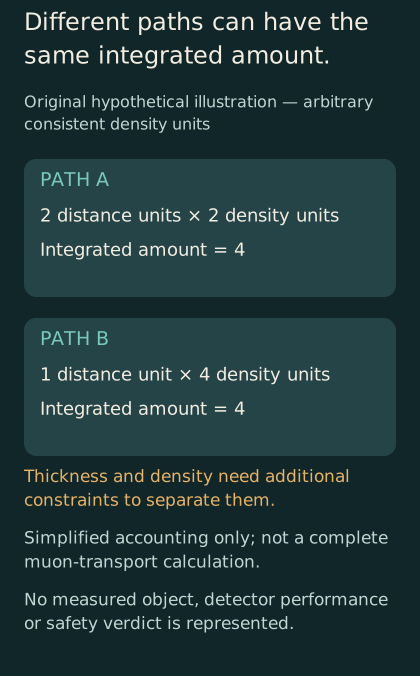
Original simplified arithmetic showing a thickness–density ambiguity. This is not a complete muon-transport calculation or measured detector result.
A useful first approximation in transmission reasoning is to think about the amount of material encountered along a path. Consider a deliberately simplified hypothetical example. A path through two meters of material with density two units per cubic measure contains the same path-integrated amount as one meter at density four, when the units are chosen consistently. The products are both four. This is not a complete muon-transport calculation; it illustrates why thickness and density can be entangled in an image interpretation.
If the outer geometry is known well, that knowledge can reduce the ambiguity. If it is uncertain, the reconstruction may attribute a difference to internal density when part of it comes from path length. The solution is not to abandon imaging. It is to include the relevant geometry and its uncertainty in the analysis. Survey information and construction records can therefore be important companions to the particle data, even though they do not sound as novel as the detector itself.
The same ambiguity appears in everyday shadows. A dark patch on a screen may reflect a small opaque object nearby or a larger one farther away. Moving the viewpoint can help distinguish them. In a particle measurement, multiple positions can similarly constrain the location of an anomaly, although the underlying transport and reconstruction are more complex than a visible-light shadow. The analogy is useful only if it does not imply that a single view always yields an unambiguous three-dimensional shape.
This is why a picture labeled tomography deserves a methodological question: how was depth information obtained? It may come from multiple views, from tracking on different sides, from a physical model, or from a combination of these. The answer affects what kinds of features are reliably resolved. A two-dimensional projection can be valuable without being promoted to a complete volumetric map. Clear naming preserves that value while preventing the reader from imagining information the instrument did not collect.
What the pyramid result actually established
In 2017, the ScanPyramids collaboration reported a large void above the Grand Gallery in Khufu's Pyramid, with a minimum length of thirty meters. The author abstract describes confirmation through three detector technologies and independent analyses. It explicitly states that the void's intended role was not known. The result therefore establishes evidence for a previously unrecognized internal feature, not a discovered treasure chamber or a settled account of how the monument was built. Original research abstract.
That boundary between detection and interpretation is especially important in archaeology. A physical feature can be real while its function remains uncertain. Calling a space a chamber, a passage, a construction feature, or a ritual element adds an interpretation that may require different evidence. Imaging can guide the next question without supplying the whole historical explanation. The discovery remains significant even when the researchers refrain from assigning a dramatic purpose to it.
Multiple detector technologies strengthen a result because they can have different sources of error. Agreement does not make every conceivable uncertainty disappear, but it makes an explanation tied to one instrument less persuasive. The independence of the analyses matters as well. Three visualizations produced from one reconstruction are not equivalent to three independent observational routes. A public account should identify what was independent rather than merely counting the number of images displayed.
For a museum visitor or interested reader, the most productive question is what changed in the evidence. Before the result, a particular internal feature lacked the reported observational support. Afterward, its existence was supported by the measured particle excess and the checks described by the collaboration. Questions about purpose, access, and construction remained. That is a substantial revision of knowledge without the need to replace uncertainty with a speculative story.
A second pyramid study sharpened a different feature
A March 2023 paper characterized the North Face Corridor behind the pyramid's Chevron zone. Using observations from multiple positions and two detector technologies, the authors estimated a corridor-like structure about nine meters long with a cross-section around two meters by two meters. This is a separate feature from the larger void reported above the Grand Gallery. Confusing the two would merge distinct studies and locations into an inaccurate discovery narrative. Original corridor study.
The distinction is a useful reminder that the name of a famous site is not enough to identify a scientific result. A monument can contain several targets, each observed in different campaigns with different instruments and purposes. A later paper may refine one feature rather than rediscover another. Preserving the location, measurement period, and specific question helps readers understand cumulative progress instead of treating every headline about the same landmark as a repetition.
The corridor study also illustrates a difference between finding an anomaly and characterizing its geometry. An initial observation can indicate that the expected material distribution does not fit the data. Follow-up observations may constrain where the feature is and how far it extends. The required evidence changes with the claim. A detection threshold does not automatically supply a precise dimension, and a dimension estimate does not automatically identify a historical function.
A fictional archaeological example makes the distinction concrete. Suppose an image supports a low-density region behind a wall. A conservation team might first ask whether the region is real, then whether it intersects a planned intervention, and only later whether its shape supports a particular historical hypothesis. Each question could require a different measurement or expert assessment. The particle image is part of a sequence of decisions, not a license to skip directly to the most exciting interpretation.
Scattering asks another question of the same particles
The 2026 mock-barrel preprint uses multiple Coulomb scattering rather than only transmitted counts. Its reconstruction draws on changes in muon direction and compares measured data with simulations. It reports ten-millimeter reconstruction resolution and simulation-derived discrimination estimates corresponding to days of exposure for certain dense inclusions; the real barrel dataset totaled nearly fifty-two days. Those figures belong to the specified setup and targets; they do not establish equal sensitivity to every material or shape. Primary experimental preprint.
The general distinction can be pictured without inventing a performance chart. One method asks how many useful probes arrive from a given direction after crossing an object. Another asks how their paths have changed. Both can contain information about the object, but they are not interchangeable measurements. A setup optimized for one may not be practical for the other. In particular, the ability to place instruments around an object can determine which information is available.
Imagine a hypothetical container in an accessible workshop. There may be room for detector planes above and below it. Now imagine a mountain or a massive wall with access only from one tunnel. The same idealized detector arrangement cannot simply be transferred between them. The physical access problem comes before the reconstruction algorithm. A clever algorithm can use available information efficiently, but it cannot make an inaccessible measurement geometry equivalent to an accessible one without additional assumptions.
This helps explain why muography is better described as a family of methods than as a single universal scanner. The target size, material distribution, access, required resolution, and available time all shape the instrument and analysis. The right question is not whether muons can see through everything. It is whether the available configuration can answer a specified question about this object with enough confidence to support the intended decision.
A concrete block is a valuable test—but still a test
Niederleithinger and colleagues published a proof-of-concept study in July 2021 using a reference reinforced-concrete block. The experiment detected built-in features and compared images with established nondestructive methods. The paper notes that the muon data required acquisition on the order of weeks, while the other methods used much shorter acquisition times, and it calls for further quantitative validation. Its value is an experimentally demonstrated capability with explicit limitations, not a claim that every conventional inspection method has become obsolete. Original concrete study.
A reference specimen has an important advantage: the investigators can compare the image with known internal features. That provides a basis for testing whether a reconstruction detects what it should and whether it invents what it should not. An operating structure is often less cooperative. Its true internal condition may be incompletely documented, and the feature of greatest concern may not resemble the convenient test object. A demonstration therefore needs a validation path toward the intended class of structures.
This does not make laboratory specimens artificial in the dismissive sense. Controlled specimens are how researchers isolate questions that would be difficult to resolve in a complex field setting. The key is to state what has been controlled and what remains untested. A specimen can establish sensitivity to a particular geometry without establishing sensitivity to every defect. It can reveal an image-quality limitation that guides a better instrument before an expensive deployment.
For an engineer considering a new technique, the useful comparison is task-specific. Locating reinforcement, identifying a large void, detecting a small crack, and estimating load-bearing capacity are different tasks. One method may contribute strongly to one and weakly to another. A scan that correctly locates material does not by itself determine the mechanical consequences of a flaw. That further interpretation belongs to an engineering assessment combining appropriate evidence.
Resolution is not one number that travels everywhere
A published spatial resolution can sound like the size of the smallest defect that will always be found. In practice, detectability also depends on contrast, geometry, location, noise, and the analysis task. Two nearby features may be separable under favorable conditions but not under another arrangement. A sharply displayed voxel grid does not establish that each voxel contains independently resolved information. The display can be finer than the measurement's effective resolving power.
Consider an original hypothetical image with square pixels one centimeter wide. If the measurement process blurs information across several pixels, drawing a small colored patch does not mean a one-centimeter object has been reliably identified. Conversely, a large feature with weak contrast might be difficult to detect despite spanning many pixels. Pixel size, resolution, and detection probability describe related but distinct aspects of an imaging system. A useful specification should not substitute one for another.
The direction of resolution can matter too. A configuration with many useful paths through one orientation and few through another may constrain some dimensions better than others. Reporting only the most favorable direction can create an incomplete picture. A reader should ask whether the stated value applies throughout the volume, near its center, or only to a particular test feature. These questions are general imaging principles, not a claim that a cited team concealed such information.
A more useful performance statement would connect the number to a task: under this geometry and acquisition time, this class of feature was distinguished according to this criterion. Such a statement may be longer than a single resolution figure, but it is closer to what a user needs. It allows the evidence to be compared with a proposed application rather than encouraging a transfer of the best laboratory number to every field condition.
Counting time is part of the instrument
Muon images accumulate from discrete events. That makes the observation period a physical part of the measurement, not merely an inconvenience in the project schedule. If too few useful events sample a region, the reconstruction cannot be interpreted as though that region had been observed as well as another with much richer information. An image should ideally make this uneven support visible, rather than allowing a smooth rendering to imply uniform confidence.
A simple hypothetical counting example helps. If one category receives about one hundred independent events and another receives ten thousand, their relative counting fluctuations are not comparable. In a basic Poisson illustration, the square-root scale is about ten for the first count and one hundred for the second, corresponding to roughly ten percent and one percent relative scales. This is not a full uncertainty model for a muon reconstruction. It shows why more counts can improve statistical information without guaranteeing the removal of systematic errors.
The useful event rate can differ from the total particle rate recorded by an instrument. Some events may fall outside the relevant directions, fail quality criteria, or provide little information about the target region. Quoting a high overall count rate therefore does not establish a short time to a particular inspection answer. A proposal should explain how the recorded events connect to the target task and what level of uncertainty is expected after the proposed acquisition period.
Time also interacts with whether the target changes. A stable monument and a changing industrial process create different interpretation problems. A long acquisition may provide excellent information about a stable object but average over changes in a dynamic one. The relevant question is whether the reconstruction represents a sufficiently stable state for the intended decision. Faster imaging can be valuable, but the evidence for speed should identify what temporal and spatial information remains reliable.
A volcano adds an environment to the physics
The MEV project described a muon telescope designed for work around Etna. Its 2018 author abstract reports a detector built and tested during 2017, with about 120 days of data collection at the extinct Monti Rossi crater. It emphasizes mechanical and electronic design for a remote, difficult environment. These are instrument-development and test results, not a claim that the telescope predicts eruptions. Primary project abstract.
A remote installation changes the practical definition of a good detector. Performance measured on a stable laboratory floor is only part of the question. Power, weather exposure, access, data transfer, alignment, and maintenance become elements of the system. A device that achieves excellent resolution when carefully attended may need substantial adaptation before it can provide dependable observations elsewhere. That is an engineering development task, not evidence that the underlying physics has failed.
A hypothetical field campaign illustrates the trade-off. A larger instrument could collect more useful events but be harder to transport and stabilize. A smaller one could be easier to deploy but require a longer observation period. The better choice depends on the target, access, and scientific question. There is no universal rule that maximizing detector area maximizes the value of a campaign. The design must account for the information gained relative to the logistical and environmental constraints.
The interpretation also benefits from complementary observations. A particle-derived density anomaly is one kind of evidence about a volcanic structure. Its geological meaning may depend on other measurements and on the physical model of the system. The same caution that separates a pyramid void from its historical purpose separates an imaging anomaly from a forecast of volcanic behavior. Muography can contribute to understanding without being assigned a predictive capability that the cited test did not demonstrate.
Simulated success and experimental success answer different questions
Pezzotti and colleagues' 2025 structural-diagnostics study used detailed Monte Carlo simulations and deep-learning enhancement. The modeled task included reconstructing one-centimeter iron bars in thirty-centimeter concrete blocks. The accessible full author version makes clear that the work develops and evaluates an approach using simulated data. It is not a report that a neural network inspected an unknown operating bridge and verified its condition. Original author version.
Simulation is especially useful when the investigator needs to know the true internal arrangement. It allows systematic variation of features and controlled comparisons between methods. It can reveal whether an idea is plausible before an instrument is built. But the simulated world includes choices about particle distributions, material properties, detector response, and geometry. A method can perform well within that world while encountering difficulties when some of those choices differ from reality.
A sound development program therefore asks where the model has been checked against measurements and where it has not. Agreement for one calibration target is valuable but may not cover every intended target. The question is not whether simulations are real or fake. It is whether the simulated relationships relevant to the proposed inference have been validated sufficiently for the intended use. That framing avoids both uncritical enthusiasm and the equally unhelpful dismissal of computational work.
For readers, the simplest safeguard is to keep the word simulated attached to the result when it belongs there. An image of a modeled bar can look almost identical to an image reconstructed from measured tracks. The visual similarity does not erase the difference in evidence. A caption that identifies the data origin is therefore doing substantive scientific work. It tells the reader which stage of development the image represents.
A cleaner image can be a less honest image
Image enhancement aims to make useful structure easier to see. The danger is that an algorithm can also make an uncertain result look confident. A reconstruction that resembles familiar training examples may be visually persuasive even when the measurements provide weak support for a particular feature. This is a general risk in learned imaging, not a finding of misconduct or failure in the cited simulation study. It motivates specific validation questions before using an enhanced image for a consequential decision.
One question is whether the method was tested on structures unlike those used during development. If every example contains neat parallel bars, a model may learn that arrangement strongly. An unusual missing segment or displaced feature could be more difficult. Another question is whether the method preserves an uncertainty indication. A sharp boundary can be useful for visualization, but the user should know whether its position is stable under plausible changes in the input data and reconstruction settings.
A fictional blind test could include several specimens whose internal arrangements are withheld from the imaging team. Some would contain expected features, some unusual arrangements, and some no target anomaly. The test would evaluate both detections and false alarms, using criteria specified before the answers are revealed. This is an illustrative validation design rather than a claim that any particular certification scheme requires it. Its purpose is to make the difference between plausible appearance and demonstrated performance concrete.
The raw or minimally processed evidence should remain linked to the enhanced product where practical. That allows later investigators to understand what the algorithm changed and to reassess the result when a model improves. Preserving provenance does not mean every user must inspect every track. It means the attractive final image should not become an orphaned illustration whose relationship to the measurement can no longer be reconstructed.
A decision threshold needs a decision context
An anomaly score can be converted into a flag by choosing a threshold. Lowering the threshold may detect more true features while also increasing false alarms; raising it can have the opposite effect. The appropriate balance depends on what happens after a flag and what happens after a missed feature. A research metric summarizes performance across a test set. An operational decision requires a specified use case and an acceptable response to uncertainty.
Consider a hypothetical screening task involving one thousand ordinary specimens and ten specimens with a target feature. Even a small false-positive rate among the ordinary specimens can produce several flags. The number of false flags must be interpreted alongside the number of true detections and the cost of follow-up. A high-looking aggregate performance score does not remove that accounting. This example is about statistical interpretation, not a method for concealing material or defeating inspection.
It also explains why a system that is useful for prioritizing further examination may not be sufficient for a final determination. The first task can tolerate some uncertainty if a qualified follow-up resolves it. The second requires evidence appropriate to the consequence of the decision. Labeling a tool as a screening aid or a characterization method clarifies its role. Neither label should be treated as inferior; the important question is whether the tool is reliable for the role it is assigned.
For industrial applications, the complete workflow includes what information accompanies the image, who interprets it, and how ambiguous findings are handled. A detector does not by itself establish a chain of responsibility. The technical report should distinguish a successful measurement from a decision made using it. That separation makes it easier to improve the instrument while retaining the professional and institutional safeguards appropriate to the target.
Structural safety is a further inference
A civil structure's internal geometry matters, but geometry is not the whole of structural behavior. The condition of materials, loading, connections, history, and other relevant evidence can affect an engineering judgment. An imaging system may help locate reinforcement or identify an unexpected region. It does not automatically turn those observations into a safe-or-unsafe label. This article does not provide such an assessment for any real structure.
Imagine a hypothetical beam whose internal reinforcement is found exactly where drawings predict. That is useful information. It does not, by itself, establish every material property or loading condition needed for a capacity assessment. Now imagine a beam with an unexpected internal feature. The feature may require further investigation before its significance can be determined. In both cases, the image narrows uncertainty without necessarily completing the decision.
This distinction should shape procurement language. A contract promising an image is different from one promising detection of specified features, and both differ from a professional assessment of structural adequacy. The deliverable, validation standard, and responsibility should match the promise. A technology vendor and an engineering team may contribute different parts of the workflow. Making those roles explicit reduces the risk that an impressive visualization is treated as a conclusion no one actually established.
The most productive future for muography may therefore be complementary rather than exclusive. It can supply information that is difficult to obtain by another method, while other methods answer questions for which they are better suited. A combined investigation need not crown one technology as the universal winner. It should identify which uncertainties each method reduces and where disagreements require further examination.
The survey plan can matter as much as the reconstruction
Before data collection, a team has to decide what question the survey should resolve. Is the objective to locate a suspected void, compare a known specimen with a reference, or map a broad region without a specific target? These goals lead to different choices about viewpoints, duration, and validation. An instrument can produce a technically competent image that is poorly matched to the decision if the question was never defined clearly.
A hypothetical heritage survey shows why. If the immediate conservation question is whether a proposed intervention intersects an unknown space, the relevant region may be small and well defined. A broad exploratory image could be scientifically interesting but fail to constrain that region adequately. Conversely, a narrowly targeted survey might miss unexpected features elsewhere. Neither design is inherently wrong. The team should state which goal it is pursuing and avoid claiming that the result answers the other automatically.
Documentation of the instrument's position is part of that plan. A reconstructed feature has meaning in relation to the object's coordinates. If the transformation between detector coordinates and the surveyed structure is uncertain, the reported location should reflect that uncertainty. A visually precise overlay can otherwise imply more positional certainty than the underlying alignment supports. This is a general geometric consideration, not an allegation about a particular published survey.
The survey record should preserve enough information for later reinterpretation: the measurement geometry, acquisition intervals, relevant calibration, processing version, and stated assumptions. The exact record depends on the instrument and application, but the principle is consistent. An image that can be traced back to its evidence remains useful when questions change. An image without that context becomes harder to distinguish from an attractive illustration.
What would make the next result convincing?
A persuasive new study need not claim the largest object or the sharpest image. It might instead demonstrate reliable performance on a well-chosen blind test, shorten acquisition for a defined task, or show that a field instrument remains stable over a demanding campaign. Each would address a practical limitation. The value of the result depends on the question it resolves, not solely on whether its visualization is more dramatic than the previous one.
For an experimental claim, readers should look for a clear distinction between measured and simulated data. For an improved algorithm, they should look for the test distribution and the handling of unfamiliar cases. For a field deployment, they should look for the actual measurement conditions and any limitations imposed by access or environment. For a proposed application, they should ask whether the necessary evidence has been demonstrated or remains a future objective.
The comparison baseline should also be explicit. A new method can improve on one earlier reconstruction without outperforming every alternative. A faster result can be valuable even if it sacrifices some resolution, provided the trade-off is stated. A higher-resolution result can be valuable even if it takes longer, if the application permits that time. Honest trade-offs make a result more usable than a universal claim of superiority.
Finally, conclusions should preserve the difference between seeing a feature and knowing what it means. The pyramid studies, concrete experiments, volcano instrument, and mock-barrel work all illustrate different parts of that distinction. Muography earns its place by producing evidence that was difficult to obtain otherwise. Its strongest applications will be those in which that evidence is integrated carefully with the rest of the problem.
Color should reveal confidence, not conceal it
A final rendering often assigns bright colors to reconstructed contrasts. The palette can help a reader distinguish regions, but it can also encourage an unintended ranking. A red region may look dangerous even when red merely denotes a numerical range. A dark region may look empty even when it denotes missing data. The legend should say what the colors encode and distinguish an unobserved region from a measured low value. Those categories are visually easy to confuse and scientifically very different.
For a hypothetical public exhibition, two panels could be more informative than one spectacular image. The first would show the reconstructed feature with a clearly labeled scale. The second would show the viewing geometry and the regions with stronger or weaker observational support. Visitors could then appreciate both the discovery and the reasoning behind it. This is an original presentation proposal, not a reproduction of a particular project's display or a claim about its existing practice.
The same principle applies to a digital model that lets viewers rotate an internal feature. Rotation creates a powerful impression of a fully known object. If some surfaces are inferred more weakly than others, the interface should retain that distinction instead of replacing every boundary with a uniformly solid surface. An uncertainty-aware rendering can still be compelling. It invites the viewer to understand how a scientific image differs from an artist's reconstruction, and why that difference is part of its value.
A patient form of seeing
There is something remarkable about using particles that arrive without being summoned to investigate an object that cannot easily be opened. The technique connects atmospheric particle physics with questions about buildings, landscapes, artifacts, and industrial materials. Its appeal does not depend on pretending that the detector produces an instant transparent view. The actual process—accumulating tracks, comparing directions, testing models, and constraining an interior—is interesting enough.
The limitations are part of that interest. Geometry can restrict what is knowable from one position. Counting time can determine whether a subtle contrast becomes informative. A model can help reconstruct a feature while also introducing assumptions that need checking. These are not merely caveats placed after the exciting image. They are the mechanisms by which the image acquires meaning and the conditions under which it can support a useful decision.
Muon imaging is therefore best understood as an additional way to interrogate solid structures, not a universal replacement for every inspection technique. It can reveal a hidden space without naming its purpose, locate an inclusion without certifying an entire container, and improve knowledge of concrete without signing off a bridge. That bounded capability is substantial. The particles from the sky supply the probes; careful experimental design and interpretation turn their passage into evidence.