
The antihydrogen gravity result is a milestone in measurement—not a final certificate that every property of matter and antimatter is identical.
A question that sounds like a playground experiment became a decades-long challenge in physics: what happens when antimatter is allowed to fall? The difficulty was never merely finding something exotic to drop. Researchers had to make a suitable anti-atom, keep it from encountering ordinary material, control its motion, and distinguish the influence they wanted to measure from other forces that could overwhelm it. The familiar word falling conceals most of that work.
On September 27, 2023, CERN announced ALPHA's observation of gravity's effect on antihydrogen motion. Released anti-atoms behaved consistently with attraction toward Earth, at roughly twenty-percent precision—not proof of exact equality. This is a dated milestone, not a new November 2026 announcement. CERN primary account.
There has been further progress in the tools used to investigate antihydrogen. A January 17, 2025 paper reported simultaneous observation of two accessible hyperfine components of its 1S–2S transition. The authors described a seventyfold improvement in the data-taking rate for the relevant spectral characterization and showed applicability to laser-cooled anti-atoms. This is a spectroscopy result, not a seventyfold improvement in the gravity measurement. Its relevance is that precision experiments depend on the quality of the sample and the ways researchers interrogate it. Original spectroscopy study.
Together, these developments invite a more interesting account than either antimatter is ordinary after all or Einstein has been proved forever. The useful story is how an experiment earns a conclusion, what that conclusion excludes, and why a result consistent with expectations can create new work rather than end it. The following discussion draws on seven distinct primary research works or first-party accounts of those works, with access limitations recorded separately. Illustrative examples are identified as examples, not attributed to the ALPHA data.
The everyday picture hides the experimental problem
Dropping a familiar object seems simple because the object is easy to hold, easy to see, and easy to replace. We ordinarily know where it started and where it landed without designing a detector. The surrounding apparatus is almost invisible in the description: the hand, the floor, the air, and the clock. In a precision experiment, each of those conveniences becomes a possible source of influence or ambiguity. The experiment is partly an effort to replace the everyday conveniences with arrangements whose effects can be measured.
The anti-atom also changes what counts as a successful observation. A photograph of a large object traces its position directly in a familiar way. Atomic experiments often infer a process from a detector response and an established relationship between that response and the event of interest. That does not make the inference illegitimate. It makes the relationship part of the evidence. The public explanation should show enough of that chain to make clear why the researchers regard a signal as informative.
Consider a fictional experiment in which tiny objects can leave a chamber through either of two exits. Counting the exits could tell us something about a force, but only if we understand how the chamber and release process affect those counts. A slight asymmetry in the exits could imitate a preference. A difference in detector sensitivity could exaggerate it. A thermal distribution could allow some objects to leave against the average force. The count becomes a measurement only after these possibilities have been considered.
The lesson is not that complicated experiments are too uncertain to trust. It is that trust should rest on the handling of complications rather than their omission. A short explanation can still be accurate if it identifies the measurement, the main competing influences, and the limits of the result. Replacing that explanation with a cartoon of a glowing anti-apple falling onto a table makes the story easier to picture but harder to understand.
Neutral does not mean unaffected by every field
Antihydrogen combines an antiproton and a positron into an electrically neutral atom. Neutrality reduces a major obstacle posed by charged particles, but magnetic behavior still matters for confinement and control. ALPHA primary account.
A useful analogy is a balance designed to weigh a very light sample. Removing a draft helps, but it does not automatically remove vibration, thermal drift, or a calibration error. Addressing one important disturbance creates the conditions for a better measurement; it does not imply that all other disturbances vanish. The analogy should not be taken as a literal description of the antihydrogen apparatus. It illustrates why a well-chosen test object still needs a carefully characterized environment.
This distinction matters when describing traps. A device used to manipulate charged particles and a magnetic configuration used to confine neutral anti-atoms are not interchangeable simply because both appear within the same experimental program. Calling every trap by the same name can create a false account of what holds the sample. A reader does not need to memorize every component, but the explanation should preserve the difference between controlling the constituents and confining the resulting atom.
The broader experimental strategy is to choose a system in which the desired effect is accessible and the unwanted effects can be bounded. There is no requirement that the test object be unaffected by everything except gravity at every moment. Rather, the measurement must explain how the relevant influences enter the analysis. That is a more demanding standard than saying the sample is neutral, and a more realistic one than imagining a perfectly isolated object with no preparation history.
Holding the sample was a scientific result in its own right
In June 2011, the ALPHA collaboration reported confinement of antihydrogen for one thousand seconds. The paper also examined the trapped population's energy distribution and compared release behavior with simulations. Those results established experimental capabilities needed for later interrogation of anti-atoms; they were not yet a precise gravity measurement. The author-hosted full paper distinguishes the neutral-atom magnetic trap from the charged-particle arrangements used in production. Original confinement study.
A thousand seconds is sixteen minutes and forty seconds. The conversion is useful because it makes the scale tangible, but it can also mislead if it is treated as the natural lifetime of antimatter. A demonstrated confinement time is a statement about what the experiment maintained and observed under its conditions. It is not automatically an intrinsic decay time. A bottle that retains a sample for a certain interval does not establish that the sample must cease to exist at the end of that interval.
This is a common distinction in experimental science. A measured survival period can be limited by the observation window, the environment, or the decision to release the sample. To infer an intrinsic lifetime requires a different argument. Readers should ask what ended the observation: the physical process under study, an interaction with the apparatus, or the experimenter's schedule. These possibilities lead to different conclusions even if the elapsed time is identical.
Longer confinement also changes the menu of possible questions. A fleeting sample may support a detection claim but leave little opportunity for repeated or carefully timed interrogation. A controlled sample can be prepared, observed, and compared under more conditions. The scientific value therefore extends beyond the headline duration. It lies in the new experiments that become practical and in the improved ability to separate a property of the sample from an accident of its production.
A loose limit can still be a useful first measurement
ALPHA's April 2013 gravity-method paper searched for a tendency of released antihydrogen to move downward. Its limits were broad: after allowing for worst-case systematic effects, the work excluded sufficiently large positive ratios of gravitational to inertial mass, above 110, while also constraining sufficiently large negative values. The paper explicitly treated the result as a methodology leading toward the near-equivalence regime, not as a determination that the ratio was one. Original 2013 study.
At first glance, a limit far from the expected value may seem disappointing. That reaction confuses two kinds of progress. One is narrowing an already accessible measurement. The other is establishing an experimental route to a quantity that had resisted direct observation. A first method can be scientifically useful even when it cannot yet distinguish the most interesting nearby alternatives. Its value depends on whether the analysis is sound and whether it identifies a route to improvement.
Imagine a fictional scale that can initially establish only that a tiny sample weighs less than a large upper bound. If the old situation was no direct measurement at all, the bound contains new information. It may also reveal which disturbance dominates the experiment. The next design can target that disturbance rather than merely repeat the same procedure longer. A broad bound is therefore not equivalent to an empty result, though it should never be advertised as a precise confirmation.
The historical sequence matters because it prevents hindsight from flattening the research. Once a later experiment gives a much sharper answer, the earlier method can look obvious or inadequate. At the time, demonstrating that the signal could be related to the desired physical quantity was part of the challenge. A fair account recognizes that contribution while retaining the original uncertainty. Celebrating the method does not require enlarging its conclusion.
Why a fraction of exits is not a fraction of gravity
The 2023 account describes escape fractions consistent with simulations of about eighty percent downward and twenty percent upward, plus measurements with varied magnetic bias. Those fractions do not directly equal fractions of gravitational acceleration. CERN and ALPHA describe the same work, counted once. Experimental account.
The logical issue is the mapping between an observed quantity and the parameter being inferred. In a fictional thermometer, a colored column's height does not equal the temperature until a calibration relates them. In a voting poll, the share of respondents who answer a question is not the same as the share who support a candidate. Likewise, a measured event fraction can depend on several physical and instrumental variables. Its interpretation requires a model of that dependence.
A simple hypothetical example makes the point. Suppose a detector system maps a parameter value of one to a seventy-percent lower-exit fraction because the release distribution has a substantial spread. A parameter value of two might map to eighty-five percent, not one hundred and forty percent. The relationship need not be linear. These numbers are invented solely to illustrate the distinction. They are not a simulation of ALPHA-g and should not be used to infer anything about its data.
The correct public-facing question is therefore: what analysis converts the observations into the reported acceleration, and how was that conversion tested? Asking only how many atoms went down leaves out the central inference. Conversely, dismissing the result because some atoms went up would make the same mistake in reverse. An ensemble can have varied individual outcomes while still carrying strong information about the force shaping its distribution.
Uncertainty is part of the result, not an apology
A measurement with an uncertainty interval says more than a single best-fit number. It describes the range of values compatible with the analysis under stated assumptions and conventions. The central estimate is not a promise that the true value occupies exactly that point. Nor does an interval make all imaginable alternatives equally plausible. It is a structured description of what the experiment can distinguish, with details that matter when comparing hypotheses.
Consider a fictional measurement of a dimensionless ratio. One experiment reports a best estimate of 0.9 with an uncertainty of 0.3; another reports 0.99 with an uncertainty of 0.01. Both may be described informally as consistent with one. They do not provide the same degree of constraint. The first leaves room for substantial differences; the second examines a much narrower neighborhood. Agreement with an expected value is therefore meaningful only when its precision and interpretation accompany it.
A familiar mistake is to subtract the best-fit value from one and announce that the experiment has discovered a difference. If the uncertainty includes the expected value, that subtraction alone does not establish a discrepancy. Another mistake is to treat consistency as proof of exact identity. An experiment with finite precision cannot certify equality to infinitely many digits. These errors point in opposite rhetorical directions but arise from the same refusal to read the uncertainty as part of the measurement.
Different sources of uncertainty also deserve different treatment. Random variation, calibration uncertainty, and imperfectly known modeling inputs are not necessarily reduced by the same action. More observations can help one component while leaving another largely unchanged. A plan for better precision must identify the dominant limitation rather than assume that collecting more of the same data will solve every problem. That is why an uncertainty budget can be as informative as the headline result.
A detector sees events, and analysis gives them meaning
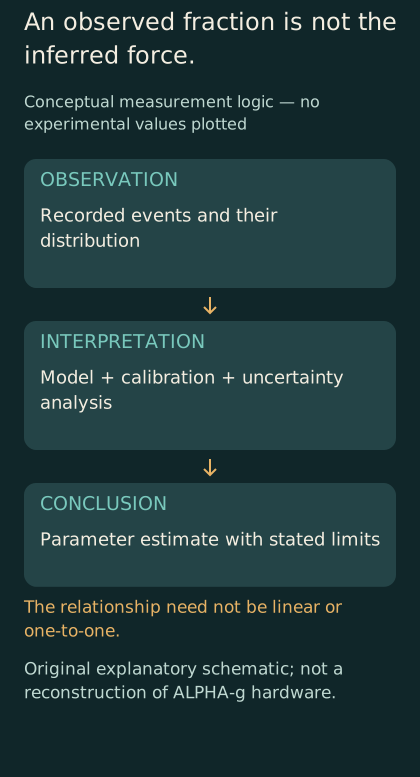
Original conceptual diagram separating recorded observations from the model-assisted parameter estimate. No experimental data or apparatus geometry is represented.
The public often imagines a scientific observation as an unambiguous visual encounter. Much of experimental physics instead relies on a sequence: a physical interaction produces a detector response, the response is reconstructed into an event, and the event is selected for an analysis. Each step can be tested. None should be hidden behind the implication that the researchers simply watched tiny objects with their eyes. The value of the method lies in making the chain reliable and quantifying its limitations.
A hypothetical two-exit experiment would need to understand whether its detector recognizes events equally well near both exits. If the lower region were easier to detect, an apparent preference could arise even without a physical preference in the sample. A calibration or control study might identify and correct that effect. The correction would then carry its own uncertainty. This example is a general measurement concern, not a claim that a particular detector defect affected the published antihydrogen result.
Background events pose a related problem. A signal-like event can occur for reasons unrelated to the prepared sample. An analysis needs an estimate of how often that happens and how the background is distributed. Removing every inconvenient event after seeing the desired pattern would be unreliable. Defining and testing selection criteria helps distinguish an informative sample from a collection assembled to favor an outcome. The exact procedures belong to the experiment's methods, where they can be scrutinized.
For the reader, these details provide a better basis for confidence than the fame of the laboratory alone. Institutional expertise matters, but a reproducible argument should identify what was measured and how alternative explanations were handled. A prestigious logo cannot substitute for that argument. Equally, the existence of corrections, selections, and models does not make a result arbitrary. Their documentation is often what allows other researchers to evaluate whether the conclusion is warranted.
Cooling creates a better question, not a shortcut around analysis
In March 2021, ALPHA reported the first laser cooling of antihydrogen. CERN's first-party account explains that reducing the anti-atoms' kinetic energy improves the conditions for spectroscopic and gravitational studies. It describes a demonstrated technique and its application to spectroscopy, while anticipated improvements to later gravity experiments remain a motivation rather than a completed result in that announcement. The original paper's repository route was inaccessible during this review, so this account does not pretend that the full paper was read. Primary experimental announcement.
An intuitive way to understand the value of a better-prepared sample is to imagine trying to detect a gentle drift in a population whose initial motions vary widely. Reducing the variation can make the drift easier to distinguish. That does not remove the need to know how the sample was selected or how the detector responds. It improves one part of the problem. The remaining analysis still has to connect the observed behavior to the physical parameter of interest.
This distinction prevents a common technological narrative in which a new tool is said to solve an entire scientific question. A cooling method can be a major advance without making every later measurement straightforward. It may shift the dominant uncertainty to another part of the apparatus or create new questions about the selected population. The appropriate response is to examine the new uncertainty budget, not to assume that the old one has simply been reduced by a universal factor.
The same reasoning applies to data-taking speed. If a new protocol produces a useful spectrum much faster, it can make additional comparisons practical. But a speed improvement is not automatically an equal improvement in precision, and neither is automatically an equal improvement in a different experiment. The reported quantity should retain its name. Converting every technical improvement into a generic claim of being more accurate obscures the actual achievement and makes progress harder to compare.
Spectroscopy and falling are complementary tests
The first observation of the 1S–2S transition in trapped antihydrogen was published online in December 2016, before its 2017 journal issue. The accessible accelerated article preview reports the transition in ALPHA-2, allowing a comparison with the corresponding feature in hydrogen. It is a measurement of internal atomic structure through interaction with light, not a direct measurement of the atom's downward acceleration. Original accepted article preview.
Two tests can concern the same physical object while asking different questions. Measuring a clock's tick rate and measuring its trajectory are not the same experiment, even if a broader theory relates them. Agreement in one comparison can motivate confidence in a theoretical framework without replacing every other comparison. The distinction becomes especially important when a popular summary combines all results under the broad phrase matter and antimatter behave the same.
A useful editorial habit is to complete the sentence: behave the same in which measured property, to what precision, under which conditions? That is not pedantry. It identifies the actual knowledge gained. A spectrum, a charge-to-mass ratio, and an acceleration each constrain different observables. Their agreement can form a powerful combined picture, but the picture is built from distinct measurements rather than from one experiment repeated under different names.
The complementarity also explains why researchers pursue several methods. If every test shared exactly the same sensitivity and assumptions, repeating it would add less independent information. Different methods can expose different systematic effects or constrain different possible deviations. A result that agrees with expectations in one channel can coexist with an unresolved question in another. Scientific coherence comes from explaining those relationships, not from demanding that every experiment deliver the same style of headline.
Sixteen parts per trillion is not the precision of the drop test
BASE's charge-to-mass comparison, published in January 2022 and later posted by the authors on arXiv, reported a fractional uncertainty of sixteen parts per trillion for the proton–antiproton comparison. The abstract describes four long-term studies using different methods and setups, plus an interpretation involving a clock form of the weak equivalence principle. Those are distinct from ALPHA's direct antihydrogen-motion experiment. This article uses the author abstract and does not claim access to the full BASE paper through the failed publisher route. Primary research abstract.
Large differences in quoted precision can tempt readers to rank experiments without considering what they measure. A number expressed in parts per trillion sounds inherently more decisive than a result with a much larger fractional uncertainty. For its own observable, it may indeed be extraordinarily precise. But precision does not transfer automatically between observables. A highly precise measurement of one quantity cannot simply be relabeled as an equally precise measurement of another because both involve antimatter.
Imagine measuring a vehicle's wheel diameter extremely accurately while estimating its stopping distance much less precisely. The first measurement can inform a model of the vehicle, but it does not make the stopping-distance estimate equally precise. The analogy is deliberately mundane. It captures the logical issue without implying that the physics relationships are identical. When moving from one observable to another, the model, assumptions, and additional uncertainties have to travel with the inference.
This is particularly important when discussing indirect constraints. An indirect test can be powerful and scientifically rigorous. Calling it indirect is not a dismissal. It identifies that the conclusion depends on a relationship between the measured quantity and the target property. A direct dynamical test provides a different route. The strongest account explains why both are useful and what assumptions distinguish them, rather than declaring one redundant solely because the other reports a smaller numerical uncertainty.
The theory is tested in pieces, not certified wholesale
The weak equivalence principle concerns the universality of gravitational response under appropriate conditions. A laboratory test examines a defined implementation of that idea with specified objects and precision. It does not place every consequence of a complete theory beyond further investigation. This is how physical theories remain useful while being continually tested: each experiment probes a part of their predictions, and the collection of results constrains where alternatives could differ.
An everyday analogy is a map. Finding that one route matches the terrain supports the map's usefulness along that route. Checking many routes, scales, and landmarks builds broader confidence. It still does not imply that every detail has been verified. Nor does an untested region make the verified routes worthless. Scientific theories are not literally maps, but the analogy helps separate local confirmation from an unlimited certificate of correctness.
The same distinction applies to an exclusion. Ruling out a particular repulsive-gravity scenario in a specified experimental setting is a substantive result. It is not necessary to expand it into the elimination of every imaginable unconventional interaction. A hypothesis must be stated clearly enough to predict something the experiment could have observed. Otherwise, it can be adjusted indefinitely after the fact and ceases to offer a useful test. Precision in the excluded claim is therefore part of the achievement.
A responsible headline can be short while preserving that discipline. Antihydrogen's motion supports attraction toward Earth is less theatrical than all mysteries of antimatter solved, but it gives the reader a correct starting point. The details can then explain the apparatus and uncertainty. The goal is not to drain a result of excitement. It is to let the excitement come from what was actually established rather than from an enlarged claim that later explanation must retract.
Why the cosmological mystery does not disappear
The apparent imbalance between matter and antimatter in the observable universe motivates many precision comparisons, including the primary studies discussed here. It does not follow that any single agreement resolves that imbalance. A test can constrain one possible difference while leaving other questions open. The relationship between a laboratory observable and a cosmological explanation requires a theory connecting the two. Without that connection, a successful measurement is not automatically a solution to the larger puzzle.
This is a useful place to separate motivation from inference. A research paper may begin with a broad question to explain why the work matters. Its actual result may concern a narrow, precisely measured quantity. The broad motivation does not enlarge the result's scope. Readers should be able to move from the introduction to the conclusion and identify exactly which step has been taken toward the motivating problem. The gap between them can be scientifically productive rather than embarrassing.
A hypothetical analogy is a study of one component in a complex engine. The component may matter to the engine's overall performance, but finding that it behaves as expected does not identify every cause of an engine-wide problem. It removes or constrains one candidate explanation. That can be valuable, especially when the measurement is difficult. The mistake would be to announce that the entire problem has been solved merely because one proposed contributor has been tested.
The converse mistake is to call the result unimportant because it did not solve cosmology. Fundamental measurements can matter by establishing new experimental access, improving a bound, or eliminating a class of explanations. Those contributions are cumulative. A field advances through many such results, some dramatic and some quiet. Judging each only by whether it overturns a famous theory gives an inaccurate picture of how reliable knowledge is built.
Replication means more than repeating the headline
A later experiment can strengthen a conclusion in several ways. It may repeat the measurement with more data, improve control of a dominant systematic effect, or use a substantially different apparatus. These approaches answer related but different questions. Repetition tests stability under similar conditions. A changed method can test whether the result depends on an unnoticed feature of the first setup. Neither should be reduced to a simple count of papers that agree.
For a fictional measurement with two competing explanations, the most valuable follow-up might be the one that makes their predictions diverge. If explanation A and explanation B produce the same result under the original conditions, collecting more data only there may not distinguish them. Changing a controlled condition could be more informative. This is a general principle of experimental design, not a proposed operating procedure for an antimatter facility.
Independent analysis also has layers. Recalculating a published number from supplied data checks one part of the chain. Reconstructing the detector events checks another. Building a different experiment checks still more, while introducing new limitations of its own. It is useful to say which kind of independence has been achieved. A successful numerical reproduction is valuable without being described as a complete independent physical replication.
For public reporting, these distinctions support a more informative follow-up story. Instead of asking only whether the new result agrees, ask what uncertainty it reduces or what alternative it tests. The answer may explain why an apparently modest improvement matters. A narrower uncertainty can close a previously open range of possibilities. A different method can increase confidence that agreement is not an artifact. Both can be important even when the central conclusion remains unchanged.
How to read the next antimatter announcement
The first question is the identity of the measured system. Is it a charged antiparticle, a neutral anti-atom, or another bound system? The next is the observable: a frequency, a ratio, a trajectory-related quantity, a storage time, or a demonstrated preparation capability. These distinctions often appear early in the primary source but disappear in abbreviated headlines. Restoring them prevents the reader from treating all antimatter experiments as measurements of the same thing.
Then look for the comparison. A value may be compared with ordinary matter, with a theoretical calculation, with an earlier experiment, or with a simulation of the apparatus. Each comparison has its own assumptions. An improvement factor should identify what improved: precision, event rate, preparation time, or another quantity. A claim of consistency should include the uncertainty or the relevant level of sensitivity. These details make an announcement interpretable without requiring the reader to master the entire field.
The date also matters. A preprint posting date, an online publication date, and a journal issue date can differ. A news story may revisit an older result while discussing a newer instrument. That is legitimate when the chronology is clear. It becomes misleading when the older result is presented as though it happened today or when a proposed next step is described as completed. The evidence ledger for this article preserves those distinctions rather than flattening them into a single recent date.
Finally, notice what the announcement does not claim. A careful paper may state that a result is compatible with a prediction, excludes a specified alternative, or demonstrates a technique. Those are strong statements when properly supported. They do not need to be inflated into universal proof. The discipline of reading the exact conclusion is especially valuable in a subject where everyday words such as anti, gravity, and symmetry invite much broader associations than the experiment can address.
A useful error budget tells researchers what to build next
Consider a wholly invented measurement with three uncertainty contributions of comparable size. One comes from limited event counts, one from a calibration, and one from a model input. Suppose collecting much more data makes the first contribution negligible while the other two remain unchanged. The final uncertainty will improve, but it will not vanish. The example illustrates why the best next investment may be a calibration study or a better characterization of the sample rather than a longer run of the existing experiment.
The arithmetic of combining contributions depends on their relationships. Independent random contributions are often handled differently from fully correlated shifts. If two measurements share the same calibration error, averaging them does not remove that shared error merely because there are two measurements. A public summary that says the uncertainty fell with the square root of the sample size should therefore explain which component behaves that way. Applying that rule to every uncertainty would be an unjustified shortcut.
A fictional example with a household scale makes the issue concrete. Weighing the same object one hundred times may reduce uncertainty associated with small random fluctuations in the readings. If the scale consistently reads too high because of an incorrect calibration, the average can remain wrong. Repetition and calibration are both useful, but they solve different problems. The analogy is not a description of ALPHA's error model; it is a way to understand why precision laboratories devote substantial effort to measurements that never become the headline.
The distinction also matters when a result moves after an improved analysis. A changed central value is not automatically evidence of misconduct or of a discovery. It can reflect a better calibration, a revised model, or ordinary statistical variation. What matters is whether the change is explained, whether earlier versions remain identifiable, and whether the revised uncertainty is justified. Transparent revision allows the scientific record to improve without pretending that every first estimate was final.
For the next generation of antimatter experiments, the most informative progress report may therefore include a revised map of limitations. A previously dominant uncertainty may have become small enough that another effect now controls the sensitivity. That is an achievement even before a dramatic new central result appears. It demonstrates that the experimenters understand more of the measurement chain and can direct further work toward a specific unresolved constraint rather than a vague desire for better accuracy.
The achievement is the controlled question
There is a particular satisfaction in a surprising object giving an unsurprising answer. Antihydrogen does not have to behave exotically for the experiment to be remarkable. The achievement lies in making a direct question about its gravitational behavior experimentally accessible and in building a chain of evidence that supports a bounded conclusion. A result aligned with expectations can validate a method, constrain alternatives, and reveal where the next improvements should be made.
The research history also changes the meaning of a simple phrase such as let it fall. Behind it sit the ability to produce a sample, confine it, characterize it, interrogate it, and interpret its release. Each capability has its own evidence and its own limits. Combining them is an experimental accomplishment rather than a theatrical flourish. The clearer that chain becomes, the less a reader needs exaggerated claims to appreciate the work.
The next meaningful question is not whether a headline can make the result sound stranger. It is how tightly the relevant quantities can be measured, how independently they can be checked, and which possible differences remain within reach. Antimatter's downward behavior is a milestone. The precision program that follows is what turns that milestone into a steadily sharper test of the physical world.