
Encrypting a lookup is valuable. It does not make the resolver blind, authenticate every answer or turn the rest of a browsing session anonymous.
The lock protects a particular conversation
A device asks a question before many familiar online activities can proceed: how can it find the service named by an application? That question can reveal something about what the device is doing even when the later connection is encrypted. Protecting the lookup therefore matters. But a setting labeled secure DNS can invite a much larger conclusion than the technology supports. The word secure needs an object: secure against which observer, for which information, along which part of the exchange?
The Internet Engineering Task Force's DNS privacy analysis, published as RFC 9076 in July 2021, distinguishes risks in transit from risks at servers. Encryption can reduce exposure of the message to observers along a connection, while the resolver processing the question remains an important point of visibility. The document is an informational analysis, not a new 2026 announcement. Its dated descriptions of deployment should not be mistaken for measurements of current adoption. RFC 9076.
The practical question is not whether encrypted DNS is worthwhile. It is how to explain its benefit without promising anonymity, universal correctness or protection from every participant in a person's online activity. A protection that solves one problem should be credited for that problem. It should not inherit the promises of other technologies merely because their names also include security or privacy.
This article uses an original fictional example: a reader working on a laptop in a public library, looking up material for a local-history project. No real person's browsing data are involved. Following the reader's questions through a simplified system helps separate the roles of transport encryption, resolver choice, data minimization, authentication and user-interface design. It also shows why a privacy setting is not fully explained by the presence of a lock icon.
A lookup is not a complete browsing history
The fictional reader opens a local-history website. The device may need information associated with the site's name, and the page may refer to other services. A lookup record can therefore be related to browsing without being a literal transcript of every page read or every action taken. Conversely, the absence of a new lookup does not prove that no activity occurred: information may already be available through caching or another part of the system.
This distinction matters for privacy and for evidence. A name can be revealing, but it should not automatically be interpreted as proof of the user's intention. A background application, a prefetched resource or an embedded component can produce network activity without a deliberate visit to the corresponding service. An investigator who equates every observed name with a conscious human choice can overstate what the record establishes.
For the fictional reader, the question is therefore twofold. How much can an observer learn from the available record? And how certain is the observer's interpretation? Privacy can be harmed by plausible inferences even when those inferences are imperfect. A misleading profile can still influence how a person is treated. Protecting privacy is not only about hiding facts that are known with certainty.
The user interface should avoid teaching the opposite misconception: that encrypted DNS makes the whole browsing record disappear. It protects a defined exchange. Other parts of the activity can generate their own records, and the application or destination may have information unrelated to the lookup. The benefit is real, but it belongs in a larger map of observers rather than a binary story in which the device becomes either visible or invisible.
Transport encryption and data authenticity answer different questions
DNSSEC and encrypted DNS are frequently discussed together, but their core purposes differ. RFC 4033, the March 2005 introduction to DNS Security Extensions, describes data-origin authentication and integrity protection and explicitly states that DNSSEC does not provide confidentiality. A signed answer can therefore support a claim about the data's origin without hiding the question or answer from everyone who can observe the exchange. RFC 4033.
An original analogy is a letter. A verifiable signature can help establish who signed its contents. A sealed channel can prevent certain outsiders from reading it while it travels. Neither automatically supplies the other property. The analogy is incomplete, as all analogies are, but it prevents the word encrypted from being treated as a synonym for true and the word signed from being treated as a synonym for private.
For the fictional reader, an encrypted connection to a resolver means that the resolver is still a participant in the conversation. The reader needs a reason to trust the endpoint and an account of how answer validation is handled. Protecting the path to an endpoint is not the same as endorsing every decision that endpoint makes.
A clear product explanation would keep these assurances separate. It could describe the protected transport, the intended resolver identity and the handling of authenticated DNS data. It should not combine them into a single badge that leaves the user unable to tell which protections are present. Separation is not needless technical complexity. It is the minimum information needed to understand why one protection can work while another problem remains.
DNS over TLS protects a segment
RFC 7858, published in May 2016, specifies DNS over Transport Layer Security, commonly called DoT. Its focus is securing the exchange between a client's stub resolver and a recursive resolver. The protocol uses TLS to protect that transport against passive observation and on-path interference. This description concerns the protocol's purpose, not a claim that every device using the name has been configured identically or that all later DNS exchanges are thereby encrypted. RFC 7858.
In the library example, the reader's device and the selected resolver are the relevant endpoints of that protected exchange. An observer situated between them faces a different view than it would have of an unencrypted message. The resolver, however, must process the request. Drawing a lock over the entire Internet would erase this boundary and misrepresent the benefit.
A better illustration draws a protected segment and labels the participants at both ends. It then shows that other relationships remain to be considered. The diagram does not need to reveal packet details or teach network configuration. It needs to answer the ordinary question: who is inside the protected conversation and who is outside it?
That framing also makes troubleshooting more honest. If the resolver cannot be reached under the selected privacy requirements, the application faces a choice about how to proceed. The resulting behavior may affect availability, privacy or both. A protocol name alone does not tell the reader which choice the application will make. The meaningful promise includes how the implementation behaves when its preferred path is unavailable, not just how it behaves when everything works.
DNS over HTTPS is a transport, not a universal disguise
RFC 8484, published in October 2018, maps DNS queries and responses onto HTTPS exchanges. Its privacy discussion also recognizes that HTTP and the underlying connection can introduce correlation information. The specification advises minimizing unnecessary data and says clients should not accept HTTP cookies unless a use case explicitly requires them. Those are implementation considerations, not evidence that a named provider tracks users or that HTTPS makes lookup traffic indistinguishable from all other activity. RFC 8484.
The important distinction for the fictional reader is between using a familiar secure transport and obtaining every privacy property the reader might associate with it. HTTPS can protect the connection to the selected endpoint. It does not decide the endpoint's retention policy, eliminate all metadata or prevent the application from generating identifying information elsewhere.
A browser-specific setting also raises a scope question. The reader may assume that a change made in one application applies to the whole laptop. That assumption should not be made without checking the actual implementation. Other applications may use different resolution paths or settings. This article does not claim a particular current browser default; the point is that interface scope should be explicit rather than inferred from a broad label.
The strongest explanation would say whether the control applies to this application, to a device service or to another defined set of requests. It would show the selected endpoint and the behavior used when the intended service is unavailable. A label such as private browsing for all traffic would be inappropriate if the feature only changes one class of lookup. Precision helps users understand the improvement without dismissing it for failing to solve unrelated problems.
QUIC changes transport behavior, not the meaning of trust
RFC 9250, published in May 2022, specifies DNS over dedicated QUIC connections, or DoQ. It describes privacy properties similar to DNS over TLS and uses separate streams for query-response exchanges, addressing transport behavior such as head-of-line blocking. The standard's design goals are not a universal benchmark proving that DoQ is always faster on every device and network. Performance depends on the actual implementation and conditions. RFC 9250.
For the reader, choosing among transport mechanisms should not be confused with choosing how much to trust the resolver. The same operator could potentially receive questions through different supported transports. Changing the transport can alter the path's protection and performance without changing the organization's ability to process the decrypted request.
This distinction matters when privacy products are marketed as a race among acronyms. A newer transport can be a useful engineering development without automatically providing a stronger organizational privacy policy. A familiar transport can be deployed responsibly or poorly. The evaluation should identify the property being compared rather than treating technical novelty as a general quality score.
A sensible performance comparison would use representative conditions and state what was measured. Connection setup, a cached response, an uncached response and recovery under loss are different experiences. Reporting only the fastest favorable case can conceal the behavior that most affects a particular user. None of these measurements should be relabeled as a privacy score unless the relationship between the metric and the privacy claim is explicitly demonstrated.
The practical takeaway is modest: transport design can improve important aspects of a lookup service, but it does not remove the need to explain endpoints, data handling and failure behavior. Those questions survive a change of acronym.
Resolver choice is a choice of observer
The fictional reader may obtain a resolver through the library network, a device setting, an application preference or another arrangement. The privacy question is not settled merely by moving the service farther away or choosing a more recognizable name. The relevant comparison asks what information each arrangement exposes, to whom and under which commitments.
A locally operated service may have a direct relationship with the network's users. A remote service may serve a much larger population. Either arrangement can have advantages and risks, depending on implementation, data practices and the user's needs. This article does not rank current providers or infer their policies from their size. Such a ranking would require current, provider-specific evidence.
Instead, the reader can distinguish technical access from organizational use. An endpoint may need to see information to answer a request. That does not establish how long it retains the information, who can access it or whether it combines it with other records. A claim about the protocol cannot answer those questions on the operator's behalf.
The distinction also prevents a false dilemma. It is possible to value encryption while questioning the concentration of information at particular services. It is possible to prefer local accountability while still wanting encrypted transport. These are separate design dimensions, not opposing ideological camps.
A useful comparison therefore describes the flow and the commitments without pretending that geography or brand recognition is a complete trust model. The fictional reader should be able to ask a concrete question: if this operator receives my lookup, what does it promise to do with the associated information, and what evidence supports that promise? The answer belongs alongside the transport setting, not behind it.
Data minimization begins after the message arrives
RFC 8932, an October 2020 best-current-practice document, addresses DNS privacy service operators. It recommends minimizing retained data, limiting access and making deliberate choices about operational collection and privacy statements. It does not provide a universal legal rule or establish that every service follows its recommendations. It is a primary source for the distinction between encrypted transport and responsible handling of information at the service. RFC 8932.
The fictional reader's concern is not only whether a stranger on the local network can read a message. It is also whether a service creates a durable record that can later be misused, disclosed or misunderstood. A short-lived operational observation and a long-lived user-linked history have different implications even if both begin with the same request.
A privacy statement should therefore identify the categories of information it discusses. Query contents, source addresses, diagnostic events and aggregate service statistics are not interchangeable. Saying that a service does not keep browsing history may be ambiguous if it retains detailed lookup records under another name. The reader needs an explanation of the actual data categories, not a comforting phrase with undefined boundaries.
This is an editorial recommendation for clarity, not an accusation against any operator. The same standard should apply to local, commercial, nonprofit and public services. Good intentions do not make an unclear retention statement informative, and a technically sophisticated service does not become accountable merely by publishing a long policy.
The most useful statement connects a purpose to a category and a retention boundary. If an exception exists for troubleshooting or abuse response, the exception should be described in terms that a user can understand. Otherwise the stated rule may reveal less than the exception conceals.
Minimizing the question is different from encrypting it
A recursive resolver may need to consult other name servers to answer a request. QNAME minimization reduces how much of the original name is exposed in those upstream steps. RFC 9156, published in November 2021 and replacing RFC 7816, describes the technique as one privacy tool among several. It does not make the selected recursive resolver blind to the original request, and it is not a replacement for transport encryption. RFC 9156.
An original analogy is asking for directions in stages. A person asking which office handles a district does not necessarily need to disclose the complete purpose of the eventual visit to every desk along the way. Each participant can receive enough information for its role without receiving every detail available at the start. The analogy explains minimization, not the exact DNS algorithm.
For the fictional reader, this expands the privacy map beyond the first connection. Protecting the device-to-resolver exchange and reducing unnecessary upstream disclosure are complementary ideas. One concerns who can read a message on a path. The other concerns how much information a participant is given in the first place.
This distinction is valuable far beyond DNS. Encryption can protect information while it moves, but it does not justify sending more information than the recipient needs. Conversely, reducing a message's contents does not make an exposed message unreadable. A mature privacy design can use both strategies without claiming that either is complete.
The interface challenge is to communicate this without a wall of jargon. A service description might separately explain encrypted connection handling and upstream minimization. It should not roll them into a single anonymous lookup claim. The user deserves to know which observer learns less and which observer remains able to see the original question.
Padding hides one clue, not every clue
An encrypted message can still have an observable size. RFC 7830, published in May 2016, defines an EDNS padding option that allows requests and responses to include additional bytes. The option provides a mechanism; it does not by itself prescribe a complete privacy policy or guarantee resistance to all traffic analysis. RFC 7830.
RFC 8467, published in October 2018 as an experimental document, discusses padding policies and their implications. It is distinct from the standard defining the option. Its focus on size-based correlation should not be expanded into a claim that timing, destinations or every other observable feature disappears. RFC 8467.
A fictional parcel analogy makes the distinction visible. Putting small letters into a limited set of larger envelopes can make exact letter length harder to infer from envelope size. It does not conceal when the parcels are sent, where they travel or what a recipient does with them. Nor does it prove that every letter is equally difficult to guess. The analogy illustrates why reducing one clue can be worthwhile without eliminating the entire inference problem.
The reader should be skeptical of a product explanation that treats padded as synonymous with untraceable. A meaningful claim identifies the feature that is being obscured and the assumptions under which that helps. If a performance cost is discussed, it should be measured rather than invented. This article supplies no universal percentage overhead because the relevant behavior depends on the chosen policy and traffic.
The broader lesson is that privacy protections often reduce evidence available to an observer rather than creating absolute invisibility. That is not a failure. It is a reason to describe the reduction accurately and to avoid using a dramatic promise where a bounded engineering claim is available.
Oblivious DNS separates roles under assumptions
Oblivious DNS over HTTPS adds another design idea: separating the party that sees a client's network address from the party that processes the DNS question. RFC 9230, published in June 2022, describes this experimental protocol as an independent submission, not an Internet Standards Track specification. Its security model depends on assumptions about the proxy and target; compromising or colluding across both roles defeats the intended separation. RFC 9230.
For the fictional reader, the appeal is understandable. Rather than asking one service to promise not to combine two pieces of information it can see, the system tries to arrange the exchange so the pieces are separated. That can change the trust structure. It does not eliminate trust or make all subsequent Internet activity anonymous.
An original classroom exercise would draw two columns: information visible to the intermediary and information visible to the answering service. Students could then ask what changes if the columns are combined. The exercise should be labeled conceptual. It does not establish the behavior of a particular deployment or measure the likelihood of collusion.
The organizational question follows directly. Are the roles genuinely separated in the arrangement being offered? Which assumptions are stated? What happens to associated logs? If the marketing emphasizes two servers but omits who controls them, the user has not received enough information to evaluate the claim.
The point is not that every reader must audit a cryptographic design. It is that the promise should reveal its main dependency in ordinary language. Privacy through separation is a different assurance from privacy through a single operator's policy. Both can be discussed honestly, but they should not be presented as the same thing with different branding.
Discovery does not decide whom you should trust
A device needs to learn where an encrypted resolver is and how to connect to it. Discovery can reduce the manual configuration burden, but finding a service and deciding that its privacy practices fit a user's needs are different tasks. A mechanism can identify an available endpoint without making an ethical endorsement of its operator.
RFC 9462, published in November 2023, defines Discovery of Designated Resolvers. It allows clients to discover encrypted configuration using DNS records, with the design limited to resolvers operated by the same entity or cooperating entities in the relevant upgrade scenario. The document includes validation and downgrade considerations; its existence does not mean every network supports it or every discovered endpoint should be trusted without the specified checks. RFC 9462.
For the fictional reader, discovery could make an improvement less visible precisely because it becomes automatic. That can be convenient. It also creates a communication challenge: the reader may not know that an endpoint or mode has changed. A good interface need not interrupt every transition, but it should make the current arrangement inspectable.
The useful design question is what the user can learn without becoming a network engineer. Which service is being used? Is the intended encrypted connection active? Does the application distinguish an authenticated endpoint from a merely available one? What happens if the upgrade cannot be completed? These questions concern the meaning of the displayed state, not a demand that the screen expose every protocol field.
Automatic discovery is most trustworthy when it reduces effort without erasing accountability. The user should not have to reconstruct a hidden chain of defaults to understand the basic promise being made on the screen.
The network's suggestion is not the same as the user's consent
RFC 9463, also published in November 2023, specifies discovery information conveyed through DHCP and IPv6 Router Advertisements for network-designated encrypted resolvers. It includes security considerations about the trustworthiness of local configuration information. The lesson is not that discovery should be rejected, but that encrypted communication with an endpoint does not by itself prove that the endpoint was selected through a trustworthy process. RFC 9463.
The fictional library may have legitimate reasons to provide a local service. It may need to support local resources, manage operations or meet an institutional policy. The reader may also have a legitimate privacy preference. Those interests should be addressed transparently rather than disguised as a technical inevitability. This article does not recommend bypassing a network's controls or changing a managed device without authorization.
A useful notice would distinguish what the network offers from what the application requires. If a device is managed under an organizational policy, the scope of that policy should be clear to the person using it. If a user has meaningful choice, the interface should not conceal that choice behind vague language about automatic security.
The distinction is especially important when the person choosing the network is not the person configuring the device. A shared terminal, a school-issued laptop and a personal laptop can have different authority arrangements. A privacy explanation that assumes a single autonomous user will not fit all three.
Good design makes those relationships legible. It does not need to turn a connection screen into a legal contract. It does need to avoid implying that the presence of encryption settles every question about selection, policy and consent.
Failure behavior is part of the privacy promise
A privacy feature is often demonstrated under favorable conditions. The endpoint is reachable, the necessary information is available and the connection succeeds. The harder test is what happens when one of those conditions fails. A system can preserve availability by changing its behavior, but the change may also alter the privacy assurance the user thought was active.
RFC 8310, published in March 2018 and updating RFC 7858, distinguishes strict and opportunistic privacy profiles for encrypted DNS usage. The profiles make different tradeoffs about authentication and fallback. The relevant point is that a user-facing promise should identify its failure behavior rather than treating all attempts to use encryption as equivalent assurance. RFC 8310.
Imagine that the fictional reader's application cannot establish the intended protected exchange. One possible design stops and explains the problem. Another may use an alternative under a documented policy. A third may change behavior silently. The correct choice depends on the product's purpose and the user's requirements, but silence can leave the user believing a protection remains active when it does not.
A useful interface distinguishes requested protection from achieved protection. It can show that the preferred mode is enabled while also reporting that the current connection does not satisfy it. This is more informative than a toggle that stays green regardless of the actual outcome.
The explanation should also avoid blaming the user for a technical failure they cannot diagnose. It can state the immediate consequence and the available authorized choices without inventing a cause. A failure message that says the network is spying, when the application only knows that a connection did not succeed, would be as misleading as a success indicator that ignores the fallback.
Design a privacy map before a privacy score
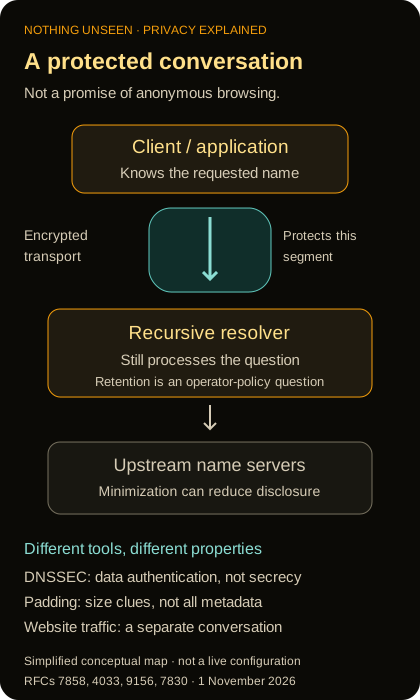
Simplified conceptual roles, not a measured network. Encrypted transport, DNSSEC, minimization, padding and operator policy address different questions. Primary RFC sources linked in article.
The fictional reader's situation can be represented as a map of actors and information. The device knows what the application requested. A local observer may see aspects of network activity. A recursive resolver processes the questions it receives. Upstream servers receive information needed for their roles. The destination application has its own relationship with the user. These roles can overlap in real deployments, which is why the map should identify organizations as well as technical components where known.
A score such as ninety percent private would obscure more than it explains unless a rigorous, relevant measurement model supported it. What would the denominator be: messages, names, observers, possible inferences or people? Without a clear answer, the score would merely convert a complicated discussion into an attractive but unsupported number.
A conceptual map can be both honest and useful. It can show which segment is encrypted, which endpoint still processes the question and which additional protections affect other disclosures. Labels should supplement color so the meaning remains visible to people who cannot distinguish the palette. A caption should state that the diagram is simplified and does not depict a particular user's actual configuration.
This kind of visual also supports comparison. Instead of declaring one arrangement universally best, the reader can see what changes when a resolver is moved, a proxy is introduced or a minimization technique is used. The comparison can identify a reduced exposure without pretending that the remaining exposures are equally important to every person.
A good privacy explanation helps users form a better question. It does not manufacture a precise answer to a question nobody has defined.
Test the explanation with ordinary users
Technical accuracy is necessary but not sufficient for a useful interface. A sentence can be correct and still lead most readers to an incorrect conclusion. The fictional library could evaluate its explanation by asking participants what they believe the feature does, rather than asking whether the wording sounds reassuring.
An original usability exercise might present a simple statement about encrypted lookup transport and ask who can still process the query. Another task could ask whether the setting applies to every application on the device. A third could ask what the interface means when the preferred service is unavailable. The exercise would test comprehension, not the cryptographic strength of the protocol.
The results should not be treated as proof that all users will understand the feature. They would reveal particular misunderstandings in the tested group. If participants repeatedly infer anonymous browsing from a transport-only explanation, the design needs revision even if a specialist can defend each sentence literally.
The library should also avoid measuring success solely by the number of people who enable the feature. Increased adoption can be desirable, but an interface that encourages adoption through an exaggerated promise has not solved the communication problem. A better evaluation asks whether people understand both the benefit and the boundary well enough to make an informed choice where choice is available.
This is a proposed study design, not a report of completed testing. It illustrates a broader editorial standard: privacy communication should be judged by the mental model it creates, not only by whether a disclaimer somewhere contains the missing qualification. The qualification belongs near the promise that could otherwise be misunderstood.
Performance claims need a defined workload
The reader cares whether the local-history page opens promptly. That concern is legitimate, but a quick page load does not isolate the performance of DNS. The page may use cached information, the destination may respond differently or other network conditions may dominate. A benchmark claiming that one lookup arrangement is faster needs to separate the component being measured from the entire browsing experience.
An original comparison plan would define the request set, connection state, cache conditions and network environment before collecting results. It would report failures as well as successful response times. If one arrangement is measured with an established connection and another with a new connection, the difference may reflect the test design rather than a general property of the protocols.
The privacy implications should remain a separate part of the comparison. A service that responds quickly may still retain information in ways a user dislikes. A service with stronger data-handling commitments may not be the fastest in every location. Presenting a latency chart as a complete ranking would hide those dimensions.
The same caution applies to averages. A small improvement in a typical case may coexist with difficult outliers. The relevant statistic depends on the experience the product is trying to improve. No universal performance number is supplied here because this article has not conducted such a benchmark.
The honest conclusion is that performance and privacy can be evaluated together without being collapsed into one score. A useful report tells the reader what was tested, what was observed and what remains outside the experiment. It does not turn a favorable measurement into a promise about every device, network and future session.
A meaningful privacy statement survives the exception
Many privacy promises sound strongest before the reader reaches the exceptions. Operational diagnostics, abuse investigation, legal requirements and service improvement can be described so broadly that they swallow the apparent rule. The problem is not that exceptions can never be justified. It is that an undefined exception prevents the user from understanding the actual commitment.
For the fictional library, an evaluation of a resolver's statement could ask whether the language distinguishes routine handling from exceptional access. Does it describe who can authorize the exception? Does it identify the categories of information involved? Does it explain whether the event changes retention or sharing? These are editorial questions about intelligibility, not an interpretation of a particular jurisdiction's law.
A statement should also distinguish an operator's own commitments from properties imposed by the protocol. If the operator promises a short retention period, that is a policy claim requiring appropriate evidence. If the transport encrypts the message between endpoints, that is a technical property under stated implementation assumptions. Neither should be used to disguise uncertainty about the other.
The reader should not be expected to verify every claim personally. Independent audits, transparent documentation and accountable institutions can help. But the existence of an audit should be described with its scope and date, not invoked as a permanent all-purpose endorsement. An assessment of one system at one time may not cover later changes or every related service.
Clear exceptions can strengthen trust because they reveal the limits of the promise. Vague exceptions weaken it even when the headline is impressive. The standard is not a world without tradeoffs. It is a world in which the tradeoffs are understandable before the user relies on them.
The useful promise is smaller and stronger
Encrypted DNS changes the visibility of a specific class of conversation. It can make it harder for observers along the protected segment to read the lookup directly. Additional mechanisms can reduce upstream disclosure, obscure some size information or separate the observer of a client's address from the processor of the question. Those benefits deserve accurate descriptions rather than being bundled into an unsupported claim of total anonymity.
The fictional reader does not need to memorize every RFC number. The reader needs a few durable distinctions: transport is not retention policy; encryption is not data authenticity; discovery is not consent; a resolver is still a participant; and a preferred setting is not proof that the intended protection was achieved during a failure. These distinctions make future product claims easier to evaluate even as implementations evolve.
For designers, the challenge is to make those distinctions visible without overwhelming the screen. Show the scope of the setting, identify the selected service where appropriate, explain the current state and keep the most important limitation near the benefit. Provide deeper technical detail for readers who want it, but do not hide the basic boundary in an appendix.
For institutions, the task is to align the technical arrangement with the stated privacy commitment. A carefully encrypted connection paired with an unclear data policy is an incomplete answer. So is a strong policy paired with an interface that silently communicates a different assurance. The system and the explanation should describe the same reality.
The lock icon is not useless. It is simply not the whole map. A better privacy story begins when the user can tell which conversation is protected, who remains inside it and what happens to the question after the protected journey ends.
Evidence and publication notes
Prepared November 1, 2026. This is a current explanatory analysis of established protocols, not a claim of a new 2026 standard or a live adoption survey. Thirteen distinct primary RFC works are linked. Experimental status is explicit for RFCs 9230 and 8467; RFC 9230 is an independent submission. RFC 9076 is informational. Official text was opened directly; the RFC Editor route for 9250 returned a rate-limit response, and the official IETF Datatracker text was successfully opened instead. The library reader, usability exercise, benchmark plan and governance examples are original hypothetical analysis. No current provider ranking, product default, unauthorized bypass procedure, legal advice or invented measured performance is supplied.