
New deposits matter, but so do gas purity, storage buffers and the losses between experiments. A useful helium strategy follows the atoms through the whole system.
On October 23, 2026, the United States Department of Energy announced that it had designated helium a critical material under the Energy Act of 2020. The corresponding Federal Register notice appeared on October 27. The agency connected the designation to supply-chain risk and essential technological uses. That is a verified policy development. It is not a report that a new volume of helium has entered a storage vessel, a production plant has opened, or a laboratory's next delivery is guaranteed. DOE's announcement and the published notice.
The distinction between recognition and physical supply is a useful starting point. A gas can be essential, geologically present and commercially unavailable at the moment a particular user needs it. Conversely, an institution can reduce its dependence on fresh deliveries without discovering a new deposit. It can capture helium that would otherwise leave after use, clean it, store it and return it to service. The second route does not replace the first, but it changes how quickly the first must replenish the system.
Consider an imaginary research campus with several instruments that use liquid helium. In the old arrangement, each instrument receives a vessel, uses the cold liquid and releases the resulting gas. In a proposed recovery arrangement, return lines collect that gas for reuse. The apparent change is a pipe. The actual change is a new industrial system whose success depends on contamination, timing, compression, cooling, measurement and maintenance. A return connection is only the beginning of a supply chain.
This article follows that chain in both directions. Upstream, it asks what turns geological helium into a usable resource. Downstream, it asks what turns used helium into another dependable delivery. Between those questions lies a common accounting problem: a quantity is meaningful only when its physical state, quality, location and availability are specified. Counting the same atoms repeatedly can exaggerate supply; ignoring their repeated usefulness can exaggerate demand.
A geological occurrence is not yet a delivery
Cheng and colleagues' primary research, published online March 1, 2023, examined the formation of nitrogen-helium gas fields in intracratonic sedimentary basins. Their model connects crustal gas generation, basin evolution and the emergence of a free gas phase into which helium can partition. The accessible primary abstract supports a mechanism for evaluating resource potential, not a declaration that every analogous basin contains a proved commercial reserve. The distinction between formation conditions and a developable project remains essential. The primary geological abstract.
A resource story has several questions hidden inside it. Is helium generated or supplied to the geological system? Can it migrate into a place where it accumulates? Does a suitable trap retain it? How much is present, at what concentration, and with which other gases? Can the accumulation be produced at a useful rate? Finally, can the extracted mixture be processed and transported to the customer? A positive answer at one stage does not settle the remaining stages.
An original hypothetical example illustrates the difference between concentration and quantity. Field A contains a small volume of gas with a high helium fraction. Field B contains much more gas with a lower fraction. Multiplying gas quantity by helium fraction can make B the larger helium occurrence even though A has the more attractive percentage. The percentage alone cannot rank the projects, and the calculated contained quantity still does not establish how much can be recovered economically.
Flow rate introduces another distinction. A large accumulation that produces slowly cannot necessarily replace a smaller source that supplies customers rapidly. A production project needs both an inventory and a deliverable flow through wells, treatment and transport. The analogy is a reservoir with a narrow outlet: the amount stored and the amount available this week are related but different properties.
The surrounding mixture also matters. Two streams with the same helium concentration can require different separation work if their other constituents differ. A concentration figure without composition is incomplete process information. The feasibility question is not merely whether helium is present, but what must be removed, how reliably that can be done, and what happens to the rest of the stream.
Terms such as resource and reserve should therefore remain attached to the classification and assumptions used by the reporting body. In broad practical language, geological potential, assessed recoverable inventory and an operating supply are different stages of knowledge and development. A newspaper sentence should not silently promote one stage into another. This article does not supply a new national reserve estimate or infer current production from a geological paper.
The atmosphere records loss without becoming an easy warehouse
Birner and colleagues' May 9, 2022 study measured changes in the atmospheric helium-four-to-nitrogen ratio using archived air samples. The primary abstract reports an increase in atmospheric helium-four associated with fossil-fuel exploitation, while also discussing unresolved implications for isotope measurements. The observation concerns a change in the atmosphere. It is not an estimate of an economically recoverable atmospheric stock or proof that dispersed helium can be collected at the cost of a concentrated source. The primary atmospheric study.
The engineering issue is concentration. A material can remain physically present while becoming much harder to retrieve after dilution. If a valuable gas is mixed into a much larger volume of other gases, a recovery system must process more material for each unit collected. The atoms have not ceased to exist, but their useful organization has been lost. Conservation of matter does not imply conservation of an economical supply.
Use an original idealized comparison. A feed containing one helium unit in every hundred units requires processing at least one hundred feed units to obtain one helium unit, even with perfect recovery. A feed containing one in ten thousand requires at least ten thousand. The second stream needs a hundred times as much feed handling for the same helium amount before real inefficiencies are considered. This is a mass-balance observation, not a cost model for a particular separation technology.
It explains why collecting gas near its point of use can be attractive. A return line may intercept a concentrated stream before it becomes mixed with room air. Once dilution has occurred, the recovery task changes. The best location for collection is therefore not necessarily the most convenient location for installing a large machine; it is often where the valuable stream can still be identified and kept sufficiently separate.
That principle should not be confused with permission to compromise safety. Helium systems involve pressure, very low temperatures and the possibility of oxygen displacement. Recovery arrangements require qualified engineering and site-specific safety controls. An editorial mass balance is not an operating procedure, and an ambition to conserve gas must never imply that required protective venting should be blocked or defeated.
The broader lesson is that a loss can be economic and operational before it is absolute. A campus may still possess helium inside a contaminated buffer that its purifier cannot process. A supplier may own gas that cannot reach a customer before a deadline. A plant may have liquid available but lack a suitable transfer or transport arrangement. Useful supply requires more than physical existence.
A litre needs a state attached to it
Helium quantities are often reported in volumes, but gas volume changes with temperature and pressure, while liquid volume belongs to a different state altogether. A litre of liquid and a litre of room-temperature gas are not interchangeable inventory units. A report that moves between them without an explicit conversion can create a large apparent gain or loss that exists only in the bookkeeping.
NIST's August 2023 equation-of-state report provides a thermodynamic description for helium-four in the normal-fluid region. It gives properties through a Helmholtz-energy formulation and explicitly excludes superfluid helium. The report is a reminder that property calculations have a defined range and phase boundary. A normal-fluid model should not be treated as a universal description of every low-temperature helium application. NIST IR 8474.
For ordinary inventory reasoning, mass or amount of substance can provide a common basis across physical states. A gas volume can then be converted using its stated temperature, pressure and an appropriate property model. If a supplier reports a standard volume, the reference conditions need to be known. The word standard does not relieve the reader of checking which standard is meant.
An original ideal-gas example shows the temperature issue. Imagine the same quantity of gas at the same pressure, first at 273 kelvin and then at 300 kelvin. In the ideal approximation, its volume increases in proportion to absolute temperature, by about ten percent. No helium has been created. The example deliberately uses rounded temperatures and an ideal model; it does not justify applying that approximation to high-pressure storage without checking real-gas behaviour.
Pressure deserves the same care. An instrument that reports pressure relative to the surrounding atmosphere is not reporting the same quantity as absolute pressure. A calculation using the wrong basis can produce a substantial error, especially near ambient conditions. Engineering documentation should identify the convention rather than leaving the inventory analyst to guess from a bare number.
A useful ledger might therefore carry separate fields for physical amount, measurement uncertainty, temperature, pressure, purity and location. It can display convenient liquid-equivalent or standard-gas volumes for users, but those should derive from a consistent accounting basis. Otherwise different departments can report incompatible totals while each believes it is measuring the same stock.
Changes in state also separate availability from ownership. Gas held in a buffer is not immediately equivalent to liquid ready for an instrument. The conversion takes equipment, time and energy. A campus with ample gaseous inventory but a failed liquefier may still need an external liquid delivery. A supply report should distinguish what is owned from what can be delivered in the required form.
Recovery is a sequence of efficiencies
Return piping, compression, purification and liquefaction each have a function. Their efficiencies should not be merged casually into one flattering percentage. A collector may capture most of the gas leaving an instrument, while contamination or downstream losses prevent some of it from returning as useful product. A system-wide claim must follow the material all the way to the stated endpoint.
KIT's Institute for Technical Physics describes separate impure and pure helium storage, external cleaning and compression before gas becomes available again to liquefaction plants. Its storage table explicitly states reference conditions for gas volumes. This first-party facility account provides a concrete example of both physical separation by quality and disciplined unit reporting. It is not a universal design prescription or a promise that every laboratory can reproduce its capacity. KIT storage and compression.
Consider a fully hypothetical loop receiving one hundred units of helium from instruments. Collection retains ninety-five. Purification retains ninety percent of that collected helium, and the remaining return stages retain ninety-eight percent of what they receive. The useful return is about eighty-three point eight units. Reporting only the collection efficiency would describe one stage accurately while overstating the completed loop.
The multiplication is ninety-five percent times ninety percent times ninety-eight percent. Each percentage uses a different incoming denominator. This is why adding losses expressed as percentages of different streams can be misleading. A five-percent loss at the first stage and a ten-percent loss at the second do not necessarily mean fifteen units lost from the original hundred, because the second stage receives less material.
Another important distinction is between a stream's purity and the fraction of helium recovered. A product can be extremely pure while the process discards a large amount of helium elsewhere. A process can retain nearly all the helium while delivering a mixture unsuitable for the next stage. Purity and recovery answer different questions and belong in separate columns.
The measurement interval also matters. During commissioning, some helium may accumulate inside equipment or storage. During a later period, that inventory may be drawn down. A simple ratio of output to input can exceed one without violating conservation if the system is consuming stored material. Conversely, a low short-term output may reflect inventory buildup rather than permanent loss. The balance must include changes in stock.
For a whole facility, the governing idea is straightforward: starting inventory plus incoming material equals ending inventory plus outgoing material and losses, within measurement uncertainty. Recovered gas moving between departments is an internal transfer if the boundary includes both departments. Counting it as a new external supply at every transfer would inflate the apparent resource.
The purity bottleneck can dominate the whole loop
At ALBA, a 2026 conference paper reports that the existing liquefaction plant's recovered-gas purity requirement constrained which streams it could use. An upgrade during 2025–2026 added purification capability intended to accept substantially more contaminated return gas, and the paper describes initial operation of the integrated arrangement. The result is facility-specific. It shows why collecting additional gas is not sufficient if the next process cannot accept its quality. The primary ALBA facility paper.
A useful way to understand the bottleneck is to distinguish helium load from contaminant load. Suppose two hypothetical return streams each deliver ten units of helium per hour. One brings a tenth of a unit of contaminant with it; the other brings one unit. They deliver the same useful material but impose very different cleaning duties. A purifier rated only by total flow would be difficult to evaluate without knowing the composition behind that rating.
Contaminants can also differ in their consequences. A small amount of one species may be more troublesome at a particular cold stage than a larger amount of another. The appropriate specification depends on the process and the intended use. A single bulk purity percentage is useful but may not fully describe compatibility. The analytical question is which impurities are present and which limits matter at the relevant boundary.
This creates a case for separating streams rather than mixing every return immediately. In an original fictional campus, one instrument produces a relatively clean continuous stream while another produces an intermittent stream with more contamination. Combining them could turn a readily reusable flow into a more difficult mixture. Separate collection and storage may preserve options, though it adds equipment and operational complexity. The choice requires a system analysis, not a blanket rule that more separation is always better.
The same reasoning applies to testing. A sample taken only during steady operation may miss contamination introduced during a transfer, maintenance event or restart. The gas-quality record should cover the situations that determine whether the downstream equipment remains usable. A system whose average sample looks excellent can still experience troublesome excursions.
Purification also has a cycle. Some processes need regeneration, cleaning or replacement of working components. Their advertised instantaneous throughput may not equal the average throughput available over a month. If regeneration interrupts production, storage and scheduling must bridge the interruption. The value of a purifier depends on the useful material delivered over its operating cycle, including the work needed to restore its capability.
The cheapest incoming stream may not be the cheapest usable helium
A procurement comparison can be misleading when it prices unlike things as though they were the same product. Gas at one purity, gas at another purity and liquid ready for use impose different downstream work. A low incoming price may reflect that work being left to the buyer. The relevant engineering comparison follows the stream to a common usable endpoint rather than stopping at the invoice description.
Consider an original hypothetical choice between two feed streams, expressed in arbitrary material and cost units. Stream A costs one cost unit per feed unit and contains ninety percent helium. Stream B costs eight tenths of a cost unit per feed unit and contains sixty percent helium. Suppose, solely for the example, that downstream treatment retains ninety percent of the helium from either stream. One feed unit of A then yields eighty-one hundredths of a helium unit; B yields fifty-four hundredths.
Before any processing costs are added, A costs about one point two three cost units per recovered helium unit, whereas B costs about one point four eight. The cheaper feed is already the more expensive source of retained helium. If B also requires greater purification effort, the difference could widen. If a different treatment recovered B more effectively, the comparison could change. These are invented numbers showing why a common denominator matters, not a market-price estimate or a recommendation about a supplier.
The contaminant burden is different too. A feed unit of A contains one tenth of an impurity unit, while B contains four tenths. Producing the same retained helium amount from B requires more feed and brings more non-helium material into the process. A system constrained by contaminant handling could therefore reach its limit before its nominal total-flow capacity is exhausted. The useful capacity depends on the mixture, not just the size of the pipe.
A similar issue arises inside a recovery network when streams are mixed. Suppose a hypothetical clean stream contains nine helium units and one impurity unit, while another contains one helium unit and one impurity unit. Combining them produces ten helium units in twelve total units, or about eighty-three percent helium. The combined stream is less pure than the first and more pure than the second. No component has been removed; mixing has redistributed the quality problem across a larger volume.
That calculation does not establish whether mixing is wise. A robust purifier might handle the blend efficiently. Another system might have processed the cleaner stream directly but require a separate treatment for the blend, reducing overall availability. The decision needs the acceptance limits, capacities and operating schedule of the actual equipment. Quality management can preserve flexibility even when it does not change the total amount of helium physically present.
Contract terms can create another mismatch between a paper balance and a usable supply. A quantity promised over a year may not cover a concentrated restart campaign. A replacement arrangement may provide material in a form that requires local processing. The operational specification should identify delivery timing, acceptable condition and the handoff at which the customer can actually use the material. Those are engineering requirements to clarify with qualified procurement and technical teams, not legal conclusions about a particular agreement.
A common-endpoint comparison also makes maintenance visible. A cheap stream that repeatedly interrupts processing can impose costs through lost instrument time, additional analysis and delayed deliveries. Those effects should be measured rather than assumed, and they should not be assigned an invented universal monetary value. The campus can first record them in their natural units: hours unavailable, batches rejected, usable sessions lost and additional material required.
The result is a more informative purchasing question. Instead of asking only how much helium costs on arrival, the institution asks what it takes to deliver a specified quantity of acceptable helium to the instrument when needed. That question connects extraction, recovery, purification and storage without pretending that any one stage is the whole supply chain. It can reveal opportunities for improvement that a nominal price or a single recovery percentage would miss.
Liquefaction saves helium while spending energy
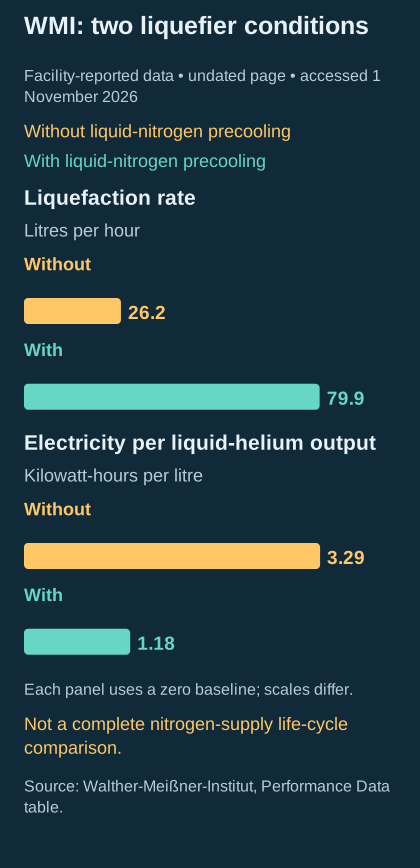
Facility data, not universal performance; upstream nitrogen energy is outside this comparison.
The Walther-Meißner-Institute's facility page reports two operating conditions for its liquefier. With liquid-nitrogen precooling, its listed liquefaction rate is 79.9 litres per hour and electricity use is 1.18 kilowatt-hours per litre; without precooling, the corresponding entries are 26.2 and 3.29. These are first-party facility performance data, not a controlled comparison of every installation or a complete life-cycle account of the nitrogen supply. WMI's liquefaction plant data.
The two questions are distinct: how much helium returns, and what resources are spent returning it? Recovering the same atoms can reduce purchases while increasing on-site electricity use. That may be entirely worthwhile, but the result should be evaluated at the relevant boundary. A material-conservation claim is not automatically an energy-efficiency claim, and neither alone establishes an environmental comparison.
In an original hypothetical accounting exercise, a campus recovers one hundred material units using fifty energy units. A later configuration recovers one hundred twenty material units using seventy-two energy units. Total recovered material rises, but energy per recovered unit rises from one half to three fifths. Whether the change is desirable depends on the value of the additional recovery, available capacity and the comparison being made. Neither percentage by itself decides the question.
The useful denominator should also be specified. Electricity per litre produced at the liquefier differs from electricity per litre actually delivered to an experiment if storage and transfer losses occur afterward. A comparison based on delivered service may additionally consider whether the instruments operate as intended. Producing more liquid does not help if the facility cannot move it safely and reliably to the point of use.
Utilization influences the balance. A plant may spend energy preparing to operate, maintaining a condition or waiting for enough gas to process. Its annual energy per delivered unit can therefore differ from a favourable steady-state test. A realistic evaluation includes start-up, idle periods, maintenance and partial loads where they matter, while separating those observations from assumptions about future use.
There is no need to reduce every decision to one universal environmental score. The campus can report helium retained, electricity consumed, other process inputs, maintenance demand and service reliability separately. That makes the tradeoffs inspectable. A single sustainability label can hide a system that performs well on one dimension and poorly on another.
A sensitive instrument can veto an otherwise efficient system
Yin and colleagues' helium-recovery study, first posted in January 2024 and revised December 3, 2024, demonstrated a compact arrangement attached to a low-temperature scanning probe microscope. The authors reported recovery above ninety-four percent and assessed the effect on demanding microscope measurements. The full author manuscript describes a particular apparatus and operating experience. Its recovery figure and vibration assessment should not be transferred automatically to another instrument or presented as a universal guarantee. The primary recovery manuscript.
For the imaginary campus, the service requirement is not simply to return liquid. It is to support the experiment. If a recovery connection introduces vibration, pressure variation or operational interruptions that degrade measurements, a high material-recovery percentage may not make the arrangement useful. The acceptance test must include the scientific function that justified helium use in the first place.
An original hypothetical example makes that tradeoff visible. Instrument A produces ten usable measurement sessions per week before a retrofit and eight afterward because the new arrangement introduces interruptions. Even if its helium purchases fall, the cost per usable session might rise. Instrument B retains its full output while reducing purchases, giving a different result. A campus-wide average could conceal the problem at A.
The appropriate test should therefore compare relevant measurement quality under defined conditions, not merely ask whether the apparatus still turns on. Depending on the instrument, useful outcomes might include repeatability, baseline stability, drift or the ability to resolve a specified reference feature. The exact criteria belong to the instrument specialists. A generic recovery-system specification cannot substitute for them.
Operational transitions deserve particular attention. An arrangement may be quiet during steady running yet disruptive during transfer, compressor changes or maintenance. A demonstration taken during the calmest interval can miss the condition that determines whether the instrument is usable. Evaluation should include representative transitions without turning the article into instructions for handling cryogenic equipment.
This is also an argument for reversible, reviewable project stages. Before connecting an entire campus, the team can define what evidence a limited trial must produce and what would make it unsuitable. The trial should record both material performance and instrument performance. A negative result is valuable if it identifies an incompatibility before the recovery network becomes difficult to change.
Storage turns an average flow into a dependable service
Recovery and demand rarely occur at exactly the same rate. An instrument may return gas continuously but need liquid in occasional deliveries. A purifier may operate in cycles. A liquefier may have maintenance periods. Storage absorbs these mismatches, making it possible for individually variable processes to support a more dependable service.
CERN's July 28, 2026 account of its Long Shutdown 3 warm-up describes helium collection, reliquefaction and a combination of on-site and external storage arrangements. It also sets out a plan for off-site helium to return during 2028–2029. Those future returns remain plans in this account, not completed movements. The first-party report shows that even a major cryogenic operation must coordinate inventory form, storage capacity and timing. CERN's dated operations account.
A simple original buffer calculation explains the logic. Suppose a hypothetical collector receives twenty units per hour for four hours while the downstream plant can process only ten per hour. The excess accumulates at ten units per hour, reaching forty units by the end of the interval. If the input then stops, four more hours of processing clear that buffer. An average daily flow alone would not reveal the temporary storage requirement.
Now suppose the downstream process is unavailable for part of the collection period. The required buffer grows. If a planned maintenance interval coincides with a large return event, the system may face a storage constraint despite having adequate average processing capacity. The useful design question concerns the time profile, not only annual totals.
Storage itself has a quality dimension. A vessel containing gas that awaits verification may not be available as clean feed. A vessel reserved for an emergency function may not be ordinary operating stock. A physical inventory should therefore be accompanied by an availability inventory: which amounts can be used, for what purpose, and under which conditions?
Location matters as well. Material held off-site may be economically owned but unavailable until transport and receiving capacity align. A contract for later return does not eliminate the need to coordinate the return. A facility restarting several instruments at once can face a short-term demand peak even if its annual balance looks comfortable.
The campus should distinguish its steady-state loop from unusual campaigns. A building shutdown, equipment replacement or coordinated restart can move more helium over a short interval than ordinary operations. Planning those events as exceptions, with their own inventory and capacity analysis, is more credible than assuming the normal average captures every condition the system will face.
Reuse slows depletion; it does not make losses disappear
A high recovery fraction can have a large cumulative effect. It can also coexist with a continuing requirement for fresh material. Every imperfect cycle leaves some amount that must eventually be replaced if the working inventory is to remain constant. The supply strategy therefore needs both a reuse loop and a replenishment route.
Consider a hypothetical inventory with ninety-percent retention through each complete use-and-return cycle and no replenishment. After one cycle, ninety percent remains. After ten cycles, about thirty-five percent of the original inventory remains. At ninety-nine-percent retention, about ninety percent remains after ten cycles. These are geometric calculations using constant assumed retention, not predictions for any cited facility.
Another way to express the benefit is through repeated service. If each retained fraction can be used again under the same idealized conditions, the sequence of useful passes forms a geometric series. A retention fraction of nine tenths gives ten total pass-equivalents in the infinite-series limit; ninety-nine hundredths gives one hundred. Real systems have changing requirements, downtime and finite project lives, so the series is an illustration of leverage rather than a forecast of operating history.
The calculation highlights why apparently small improvements near high retention can matter. Reducing loss from ten percent to one percent is a much larger change in replenishment demand than the phrase nine percentage points might suggest. But the improvement must be established at the same boundary and over comparable operating conditions. A better fraction measured over a narrower part of the loop may offer less benefit than it appears.
It also matters whether demand is expanding. A campus can improve recovery and still buy more helium because it adds instruments or increases activity. That is not necessarily a failure of the recovery project. The appropriate comparison separates changes in service demand from changes in material use per unit of service. Otherwise growth can obscure efficiency gains, or declining activity can be mistaken for them.
A clear account would report fresh purchases, net inventory change, useful output and losses over the same period. It would explain unusual events that make the period unrepresentative. Those records allow the institution to tell whether it is conserving helium, drawing down stock, reducing activity or simply moving material between accounting categories.
The most valuable improvement may be an ordinary measurement
A return network can accumulate uncertainty at every handoff. Flow measurements have calibration limits. Inventory estimates depend on state and purity. Transfers may be recorded at different times. A small apparent loss can be difficult to distinguish from measurement mismatch, while a large unexplained discrepancy can hide behind inconsistent units.
An original uncertainty example shows why precision matters. Suppose a hypothetical balance compares one hundred units entering with ninety-eight leaving, and each quantity has an independent standard uncertainty of two units. The uncertainty in their difference is about two point eight units. The apparent two-unit loss is not well resolved by those measurements alone. That does not prove there was no loss; it means the measurement system is too uncertain to establish that particular small difference confidently.
If both quantities share a calibration error, the independence assumption may be wrong. Some common errors cancel in a difference, while others do not, depending on how the measurements are related. The accounting method should reflect the instruments and procedures actually used. A spreadsheet that produces many decimal places cannot compensate for an uncertain measurement boundary.
This suggests a practical priority: improve the observations that constrain the largest uncertainty in the balance. Installing another high-performance process stage may be less useful initially than determining where material is going. A well-defined baseline allows later improvements to be attributed rather than guessed. It can also reveal whether the dominant issue is collection, contamination, storage, transfer or demand management.
The baseline should include time. A gas return recorded today may not become liquid output until next week. Comparing daily totals without allowing for that delay can create a false impression of loss followed by a miraculous recovery. Tracking work in progress is as important in a helium loop as in any other production system.
A good report preserves discrepancies rather than forcing the balance to close by assigning everything unexplained to a convenient category. The unexplained remainder is information about the present quality of the accounting. As measurements improve, that remainder can shrink or reveal a genuine process problem. Hiding it makes the system look more mature while making improvement harder.
A critical material strategy has to reach the instrument
The public designation at the beginning of this story identifies a supply concern. The practical response can operate at several scales: geological assessment, extraction and processing, transport and storage, instrument design, recovery and reuse. These scales are connected, but their achievements are not interchangeable. An encouraging exploration result is not an operating return loop, and an excellent campus loop is not a substitute for all new production.
For the imaginary campus, the most useful plan would name a service rather than a slogan. Which instruments need which form and quality of helium? How much working inventory is required? Which losses can realistically be reduced? What happens during downtime? Which measurements establish that the loop is performing as claimed? Those questions turn conservation from a general aspiration into an engineering objective.
The plan should also examine alternatives without assuming they are equivalent. A change in cooling technology may reduce a particular instrument's need for liquid deliveries, but it can introduce other requirements for power, maintenance or vibration control. A redesign should be assessed against the actual experiment, not selected merely because its description contains the phrase closed cycle. The relevant result is dependable scientific service with a clear resource account.
Helium's usefulness does not end when the liquid warms into gas. Often that moment is the beginning of a second opportunity, provided the system can retain the stream before dilution, preserve its identity and return it in a usable form. The return pipe is valuable because it connects those opportunities. What determines its success is the quieter work around it: the purity specification, the buffer, the measurement and the people who can keep the loop functioning.
A stronger supply chain therefore includes both the helium that can be newly produced and the helium that does not need to be replaced. Following the atoms makes that second quantity visible. Following their quality, energy cost and timing makes it useful.