
Planetary protection asks how to preserve a sample's scientific meaning while preventing an uncertain hazard from crossing a boundary. A landing is only one stage in that argument.
A sample from another world would arrive with more than its own history. It would also carry the history of everything that touched it: collection hardware, containers, transport, instruments and the assumptions used to interpret each measurement. The scientific task is to distinguish the world inside the sample from the journey surrounding it. The protection task is to keep uncertainty about that world from becoming an uncontrolled exposure.
On May 27, 2026, the US Geological Survey posted the record of a research paper proposing a biological risk and sample-safety assessment framework for Mars sample return. The primary abstract describes work by a NASA–ESA-assembled team on biological questions, testing concepts and a statistical basis for evaluating possible release from containment. It is a proposal, not an approved operating protocol or a declaration that Martian material is safe. The full publisher text was inaccessible during verification, so this article uses only the abstract's stated purpose and scope. McDonnell and colleagues, proposed assessment framework
The programmatic context is equally important. A July 23, 2026 Government Accountability Office report described the Mars Sample Return program initiating closeout activities after proposed cancellation and scope reductions, with remaining work focused on selected technologies. It reported that NASA had not yet determined their further development under Mars Future Missions. Those are dated oversight findings, not evidence of a committed return schedule. The scientific and protection questions remain relevant without pretending that a particular mission architecture is currently proceeding unchanged. GAO's 2026 Mars Sample Return assessment
The enduring question is what evidence would justify each step between collecting material and making it available for wider study. That is more demanding than asking whether a capsule can land. It combines physical containment, measurement limits, sample representativeness, contamination knowledge and decisions made by authorities whose responsibilities extend beyond the scientific team.
Two directions of concern
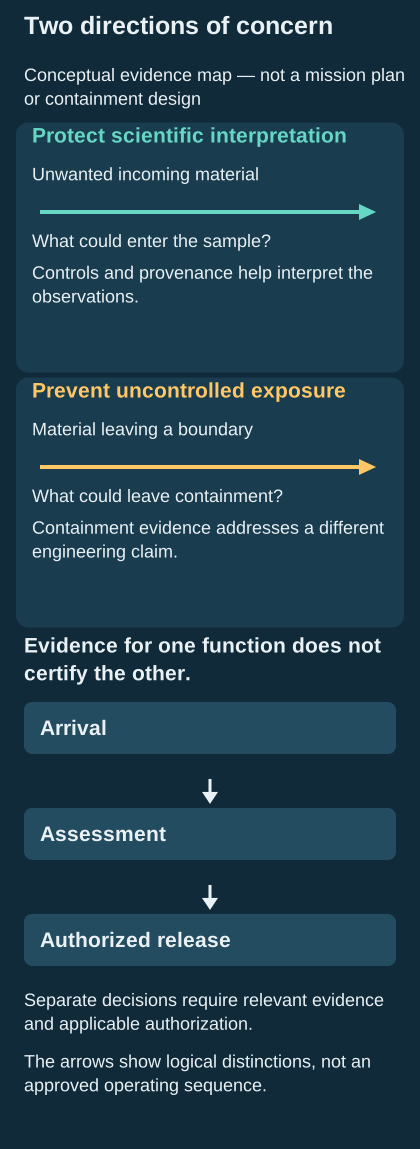
Conceptual distinction between preserving scientific interpretation and controlling exposure. Arrival, assessment and authorized release are separate decisions; this is not an operating procedure or approved mission plan.
The word contamination can point in opposite directions. Material brought from Earth can compromise the interpretation of a planetary sample or alter the environment being explored. Material brought back from a destination can raise a different question about the receiving environment. These concerns can interact, but they are not the same claim and do not have the same evidence.
Consider an invented example involving a chemical signal in a returned specimen. If the same signal occurs in material used during spacecraft assembly, it might reflect terrestrial contamination rather than the destination's chemistry. That ambiguity can damage scientific interpretation even if the contaminant is harmless. Conversely, an unknown material could require containment while producing no dramatic signal in the particular scientific instrument being used. Scientific novelty and biological hazard are different dimensions.
This is why cleanliness and containment must be evaluated separately. A clean system reduces unwanted material entering the sample's scientific history. A contained system controls material leaving a defined boundary. A design can perform well at one task and still require additional evidence for the other. Neither adjective is a substitute for a description of the material, boundary and function involved.
An original analogy is a sealed envelope containing an old manuscript. Preventing ink from a modern pen from marking the manuscript protects interpretation. Preventing material from the envelope from escaping serves a different purpose. The analogy is limited: planetary samples involve far more demanding physical and biological uncertainty. It nonetheless shows why a single reassuring label cannot cover both directions of material transfer.
The practical consequence is a need for separate questions at each interface. What could enter and confuse the evidence? What could leave and create an exposure? What records would reveal either occurrence? The questions are relevant during collection, transport and analysis, but the appropriate answers depend on the actual mission and approved protection requirements.
A reader should therefore be wary of arguments that use a successful contamination-control result as automatic proof of containment, or a strong containment design as proof of scientific purity. Both may be essential. The evidence for one should not be borrowed to fill a gap in the other.
The destination changes the category
A sample return is not assigned the same protection approach simply because it travels through space. The origin and the scientific assessment of that origin matter. Treating all returned material as identical would discard the distinctions that make a reasoned policy possible. Treating a familiar destination as a precedent for every other destination would make the opposite mistake.
The COSPAR planetary-protection policy published in January 2026 distinguishes restricted and unrestricted Earth return within Category V. Its editorial records approval in November 2025. Mars is listed for restricted return, with containment and subsequent assessment central to that category. COSPAR supplies an international scientific policy framework; it is not itself a universal national statute or a mission-specific release authorization. The distinction between the framework and its implementation should remain visible whenever the policy is invoked. COSPAR's 2026 policy and approval history
Classification is a decision based on available evidence and the consequences of uncertainty. It should not be read as a discovery announcement. Assigning a precautionary category does not establish that life is present. Nor does the absence of an established discovery automatically justify removing the precaution. The category answers a planning question under uncertainty, not the scientific question that the mission might eventually investigate.
That distinction can feel unsatisfying because ordinary conversation often seeks a binary answer: dangerous or safe, inhabited or sterile. Engineering and scientific assessment frequently operate between those labels. A system may be required to maintain containment because a relevant possibility has not been adequately excluded, while researchers continue to regard the probability of a particular scenario as uncertain.
An original decision example helps. Suppose two hypothetical materials have the same estimated likelihood of an undesirable property, but one is easy to isolate and the other would be widely dispersed during handling. Their management decisions can differ because the pathways and consequences differ. Conversely, two materials with different estimated likelihoods may justify the same initial precaution if the available evidence is too weak to support a less protective choice.
The point is not to invent a numerical risk for Martian material. It is to show why a category cannot be interpreted from probability alone, especially when the probability itself is poorly constrained. The policy framework organizes responsibilities and evidence demands before the underlying scientific questions have been fully answered.
A safe arrival is one decision among several
The return journey contains distinct transitions. Hardware may begin its return, approach Earth, enter the atmosphere, reach a recovery location and eventually transfer material for analysis. A successful earlier transition does not by itself establish the conditions for a later one. Each changes what is exposed, what is observed and what options remain available.
NASA's August 30, 2022 baseline technical standard, NASA-STD-8719.27, treats backward-contamination prevention across mission phases. It distinguishes reporting and readiness for return, entry and release, and it addresses containment during landing, transport, storage, curation and assessment. These are requirements within NASA's technical framework, not evidence that a particular future facility has been built or approved. The standard is cited here for the separation of functions and decisions, not as a construction or handling manual. NASA planetary-protection technical standard
An assurance argument should follow those transitions rather than end at the most photogenic event. A capsule can arrive intact while questions remain about later transfers. A facility can be well designed while its operating evidence remains incomplete. A measurement can be scientifically valuable while insufficient for a release decision. These are not contradictions. They are different propositions.
For a hypothetical review, write each proposition separately: the material remains within its approved boundary; the identity of the material is preserved; the measurement is valid for its stated purpose; the proposed next action is justified. Evidence supporting one proposition may contribute to another, but the contribution should be explained. Otherwise, confidence can migrate through the argument without a corresponding observation.
This is especially important when a program changes. A different transport arrangement or analytical sequence may preserve the broad mission objective while altering the protection argument. Calling the mission by the same name does not preserve the validity of every earlier assumption. The relevant question is which interfaces and conditions changed, and which evidence still applies.
A staged decision structure also prevents a common rhetorical shortcut. Demonstrating that one path to a desirable outcome exists is not the same as showing that the entire proposed path is ready. The intermediate states deserve scrutiny because that is where material changes hands, observations acquire meaning and previously available alternatives may disappear.
What an observation can say about life
Scientific analysis can address several different questions: whether a material contains an interesting molecule, whether a structure has a biological interpretation, whether an observed pattern is consistent with past life, and whether something present could be active. Those questions overlap without collapsing into one another. A result should be described at the level actually supported by its method and context.
A hypothetical molecule illustrates the problem. Suppose a measurement establishes its presence convincingly. That alone does not identify how it formed, when it arrived, whether it belongs to the destination rather than the spacecraft, or whether it participates in a living system. Additional evidence may make one explanation more plausible, but the initial detection should not carry all those conclusions by itself.
The reverse inference is equally delicate. Failure to detect one class of signal does not establish the absence of every biologically relevant property. The conclusion depends on what the instrument could detect, the condition of the material, the portion examined and the relationship between the measured signal and the hypothesis. Broad statements about absence require broader justification than a single negative observation can usually provide.
For this reason, scientific interpretation benefits from explicitly competing explanations. A feature could be intrinsic to the specimen, introduced during collection, introduced later, or produced by the analytical process. The investigation should seek observations that distinguish those explanations rather than merely accumulate more measurements that all respond to the same ambiguity.
This is an epistemic point, not a recipe for testing unknown biological material. Any actual assessment would require authorized specialist facilities, validated methods and the applicable oversight. The useful public question is whether the claimed conclusion follows from the evidence described, and whether credible alternatives were examined.
An especially important boundary separates scientific interest from release suitability. A specimen might be fascinating because it preserves a rare chemical history while requiring continued containment. Another might yield little evidence relevant to life while still leaving uncertainty about properties outside the measurement's scope. Scientific disappointment does not certify safety, just as scientific excitement does not by itself establish danger.
The missing signal and the missing material
A negative test result has at least two possible limitations. The relevant property may have been present in the portion examined but not detected. Or it may have been absent from that portion while present elsewhere in the material. These are different problems: measurement sensitivity and sample representativeness. Improving one does not automatically solve the other.
An original, nonbiological thought experiment makes the distinction concrete. Imagine a box containing one thousand numbered beads, ten of them marked. If ten beads are selected without regard to their location, there is a substantial chance of missing all marked beads. A flawless scanner cannot detect a mark on a bead that never enters the scanner. Conversely, examining every bead would not help if the scanner cannot recognize the mark under the conditions used.
The analogy becomes more difficult if the marked beads occur together in one corner rather than being evenly mixed. A sampling method that repeatedly draws from another region can produce many negative results without offering much information about that corner. Increasing the number of measurements from the same accessible region may create an illusion of coverage while leaving the original blind spot intact.
Returned geological material can also contain meaningful spatial structure. The general inferential lesson is that a claim about an entire collection requires an argument connecting examined portions to that collection. The argument may rely on physical characterization, spatial context or a justified statistical model. It should not be replaced by a statement that the analytical instrument is very sensitive.
There is a tradeoff here that cannot be solved by simply asking for more destructive analysis. Material is finite, and some relationships may be altered when it is divided or transformed. A scientifically useful plan must explain what information is gained, what is consumed and what uncertainty remains. Protection decisions and scientific priorities need to confront that tradeoff explicitly rather than pretend that unlimited independent material is available.
The most useful reporting distinguishes the unit tested from the population claimed. Is the conclusion about one measurement, one fragment, one container or the complete returned collection? Moving between those levels requires evidence. The words attached to a negative result should reveal that movement instead of concealing it.
Repetition is not automatically independence
Ten measurements can contain much less than ten measurements' worth of new information. If they share the same preparation, instrument limitation or unrepresentative material, they may repeat the same vulnerability. Agreement is valuable, but its meaning depends on what could make the measurements wrong together.
Consider an explicitly hypothetical instrument with a calibration error. Measuring the same reference repeatedly may produce tightly clustered values. That precision would show repeatability under the shared error, not accuracy. A second independently characterized reference could reveal the problem more effectively than another hundred repeats. The example is ordinary measurement reasoning, not a claim about any returned-sample instrument.
The same logic applies when different instruments depend on the same altered material. They can provide complementary observations while sharing an earlier loss of information. Calling the instruments independent does not make the whole evidence chain independent. The point where their histories converge matters as much as the point where their measurement techniques diverge.
An original probability illustration shows why the distinction matters mathematically. Suppose two hypothetical checks each miss a relevant condition one time in ten. If their misses are independent under the stated condition, the probability that both miss is one in one hundred. If they always miss the same cases, the combined miss probability remains one in ten. The individual performance numbers are identical; the dependence structure changes the combined conclusion tenfold.
Neither set of numbers estimates the performance of a planetary sample assessment. They show why multiplying small probabilities without a justified independence assumption can create false confidence. A serious argument identifies shared influences and tests whether the observations are meaningfully complementary.
This perspective does not demand that every method be unrelated to every other. Some shared information is unavoidable and useful. It demands that dependence be modeled or bounded rather than erased by counting instruments. Diversity is valuable when it addresses different plausible errors, not merely when it produces a longer equipment list.
Rare-event engineering lives partly inside models
Containment reliability presents a related challenge. Some desired failure probabilities are too small to establish directly through an affordable number of full-scale trials. Engineers therefore combine physical understanding, testing and models. The result can be rigorous, but it remains conditional on the model's scope and the evidence used to support it.
Sanderson and colleagues' July 10, 2025 version of a primary statistical study examines uncertainty in simulations of an Earth-entry capsule. The authors use a Bayesian framework and Gaussian-process modeling to study rare-event reliability. This is a computational case study, not an observed frequency of failures in a fleet of returning Mars capsules and not a release authorization. Its relevance is the explicit treatment of uncertain inputs and model-based extrapolation into a demanding tail of the distribution. Primary reliability case study, version two
A simple original calculation explains why direct demonstration becomes difficult. In a hypothetical sequence of independent, identically distributed trials with failure probability one in a thousand, the probability of seeing zero failures in one hundred trials is approximately 0.999 raised to the hundredth power, or about ninety percent. A hundred successes would therefore be unsurprising even if that failure probability were real. Observing no failures does not make the underlying probability zero.
With three thousand such independent trials, the probability of zero failures would fall to about five percent. That comparison is a teaching calculation, not a sample-return requirement, certification method or sufficient test plan. It assumes a stable probability and genuinely representative independent trials. Violating those assumptions changes what the result can support.
Models can extend reasoning beyond the observed cases, but they introduce questions of their own. Which physical variables are represented? Which uncertainty comes from natural variation and which from limited knowledge? How well does the model reproduce the observations used to check it? Does its behavior remain credible in the region where the safety conclusion depends on it?
A model that performs well near typical conditions may still need additional justification in an extreme region. Conversely, a conservative bound can be useful even when it is not a precise prediction. The right question is whether the model supports the particular decision being made, with uncertainty and exclusions visible, rather than whether it produces a reassuring number with many decimal places.
Multiplying probabilities in the right direction
Different logical structures require different probability calculations. Two independent protections that must both fail before an unwanted outcome occurs can produce a product of failure probabilities. Two successive operations, either of which can prevent mission success, behave differently. Confusing these structures can turn a reassuring-looking calculation into an answer to the wrong question.
Take a purely fictional, nonbiological example of a parcel moving through two independent sorting stages. Suppose the first stage has a two percent probability of misrouting it and the second has a three percent probability. If either misrouting counts as failure, the chance of avoiding both is 0.98 multiplied by 0.97, or 0.9506. The chance of at least one misrouting is therefore 0.0494, or 4.94 percent. Multiplying the two failure probabilities would instead give 0.06 percent, which describes both failures occurring under the stated independence assumption.
The arithmetic has no assigned relationship to a spacecraft or containment system. Its purpose is to expose the logical question before inserting numbers. Does the undesired outcome require every listed event, any listed event, or a particular sequence conditioned on earlier events? The answer determines the calculation. A diagram of the claim can be more important than another decimal place in an input estimate.
Conditional probabilities introduce another distinction. If the second operation is attempted only after the first succeeds, its relevant probability is conditional on reaching that state. A statistic collected under a different set of starting conditions may not apply. The population used to estimate an input must match the state represented in the model, or the mismatch must be addressed explicitly.
The consequences also need a definition. Losing a scientific measurement, losing a specimen's provenance and losing containment are different outcomes. They may share causes without sharing consequences. Combining them into one undifferentiated mission-failure rate can hide the very distinction a protection review needs to examine. A program may need several related models rather than one headline probability.
Finally, probabilities do not encode all uncertainty merely because they are written numerically. An estimated value can depend on uncertain parameters, disputed assumptions or omitted mechanisms. The appropriate conclusion may be a range, a bound or a statement that the available model cannot resolve the required question. Refusing unsupported numerical precision is part of quantitative rigor, not an abandonment of it.
When a more precise number is not a stronger answer
Measurement uncertainty concerns the value inferred from an observation. Interpretive uncertainty concerns what that value means. A highly precise measurement can coexist with an unresolved interpretation if several explanations predict essentially the same observation. Improving instrumental precision alone may then add little information about the question that matters.
Imagine an invented analytical feature measured as one hundred arbitrary signal units. Suppose two competing origin hypotheses both predict values between ninety and one hundred ten under the relevant conditions. Reducing measurement uncertainty from five units to one unit would improve knowledge of the signal. It would not necessarily distinguish the hypotheses. A different observation that they predict differently could be more informative, even if measured less precisely.
This is one reason contextual information can be as important as sensitivity. A spatial relationship, a comparison with a relevant control or the history of an intervention may discriminate between explanations that a single more precise measurement cannot. The best next observation is determined by the unresolved alternatives, not automatically by the instrument with the smallest advertised detection limit.
The distinction also matters when analytical treatment changes the specimen. A result obtained after an intervention describes material in its resulting state. Connecting that result to the original state requires an account of what the intervention could preserve, remove or transform. The inference can be sound, but it should not be treated as if the original material had been observed without alteration.
For a hypothetical scientific allocation, one approach might preserve spatial relationships while providing coarse composition, and another might provide detailed composition while consuming those relationships. Choosing between them depends on the question, the availability of comparable material and the value of preserving future alternatives. There is no universal ordering in which the most detailed compositional measurement is always the most informative first step.
A well-structured assessment therefore distinguishes three things in its records: the observation, the interpretation and the decision supported by that interpretation. The observation might remain valid even if the interpretation changes. A decision might need revision when new context appears, without implying that the original instrument was defective. Keeping these layers separate makes the scientific argument more resilient to discovery.
This separation is particularly valuable for an unfamiliar sample. Familiarity can make an inference feel immediate; unfamiliarity makes its assumptions easier to overlook. Writing the intermediate reasoning down allows another reviewer to ask whether the same observation could arise through a different route. That question is often where the most useful next piece of evidence begins.
The failure paths that share a cause
A list of protective features can suggest redundancy without proving it. Two features might depend on the same environmental assumption, manufacturing process, power source or verification method. If that shared dependency fails, the nominally separate protections may fail together. Counting components is therefore a weak substitute for examining dependencies.
In an invented generic system, suppose two sensors are intended to provide independent confirmation of a state. If both rely on the same incorrectly recorded reference, their agreement can reinforce the error. Adding a third identical sensor may improve resilience to an isolated sensor fault while doing little about the common reference problem. Different failure mechanisms require different forms of redundancy.
The same reasoning applies to documentary evidence. Several reports can repeat one underlying test rather than provide several independent demonstrations. A paper, presentation and institutional news release may be valuable descriptions of the same work, but they do not multiply its experimental sample. An assurance argument should trace claims back to the underlying observation, not count the number of places where the claim appears.
A useful dependency map therefore includes evidence as well as hardware. Which conclusions depend on one specimen? Which rely on one physical model? Which use the same environmental assumptions? Which would change together if a calibration, material property or mission condition were revised? This map helps identify where a new experiment would add the most information.
The goal is not to imagine an unlimited catalogue of arbitrary failures. It is to identify plausible shared causes within the stated system and compare them with the coverage of the evidence. Unsupported speculation is not improved by making it frightening. Equally, a low estimate for several individually considered events does not address an omitted common cause.
This discipline can strengthen both public communication and technical review. A persuasive account explains why the protective measures address different vulnerabilities, what remains shared, and how those shared dependencies are evaluated. That is more informative than presenting a stack of barriers as though every added layer automatically multiplies certainty.
Contamination knowledge is part of the specimen
The scientific meaning of a returned sample depends partly on knowing what else could be present. A record of potential terrestrial contributions can help distinguish a destination's chemistry from the spacecraft and handling history. The record is not a substitute for contamination control. It is a way to interpret the contamination that control cannot guarantee is absolutely absent.
Dworkin and colleagues' 2018 primary investigator account of OSIRIS-REx describes defining achievable cleanliness requirements and documenting contamination through witness materials and archived spacecraft components. The complete author abstract was available at the University of Arizona; the full paper was not used here. Its focus is the contamination-control strategy for Bennu science, not a biological-containment authorization for Mars. OSIRIS-REx contamination-control account
For a hypothetical analytical result, imagine detecting a chemical feature in a specimen and in a relevant witness material. The match may point toward a shared terrestrial contribution, but it does not automatically prove that every occurrence in the specimen has the same origin. Conversely, a feature absent from the available witness material is not automatically extraterrestrial. The witness may not represent every exposure or every compound with equal sensitivity.
The value lies in narrowing explanations. A well-chosen comparison can identify a plausible source, establish a background range or reveal a change during handling. The interpretation should state which of those jobs it performs. Treating a control as a universal purity certificate would overstate its role and make later discrepancies harder to understand.
Records also need to preserve identity through subdivision. If a fragment is divided, each resulting portion inherits part of the original context and acquires a new history. A later measurement should be traceable to the portion actually examined, not merely to the name of the mission. Otherwise, differences between analyses can be mistaken for instrument disagreement when they reflect different material or different treatment.
This is why provenance has scientific content. It determines which comparisons are meaningful, which observations can be combined and which alternative explanations remain plausible. A perfectly preserved physical fragment with an ambiguous handling history can be less interpretable than a carefully documented fragment whose known limitations are explicit.
Curation preserves future questions
A returned collection has value beyond the first analysis campaign. Future researchers may ask questions that the original team did not anticipate or use instruments that were not available when the material arrived. Preserving some of that possibility is a scientific objective, but it must be reconciled with the evidence needed for protection decisions and with the effects of earlier analysis.
Righter and colleagues' April 8, 2023 paper describes curation planning and facilities for Bennu material before the scheduled return. It discusses dedicated facilities, documentation and the scientific need to control and understand contamination. The paper is a planning account from that date, not a report of every subsequent curation outcome. Bennu's return context is also distinct from restricted Mars return, so the article provides lessons about scientific stewardship rather than a ready-made containment template. Bennu curation-planning paper
An original allocation example makes the tension visible. Suppose a hypothetical collection contains one hundred units of material. Assigning thirty units to immediate analyses, twenty to method evaluation and fifty to future study is an allocation of opportunity, not merely mass. If the first analyses consume a unique feature found only in one region, the remaining mass may not preserve an equivalent opportunity. Equal mass does not guarantee equal scientific value.
The reverse is also true: reserving material without adequate characterization can leave future researchers uncertain about what was preserved. Some early observations may be necessary to make later allocation intelligent. The useful objective is not maximal preservation in isolation, but a reasoned balance between learning now, retaining options and satisfying the applicable protection obligations.
Documentation can preserve information that physical preservation cannot. Images, spatial relationships, measured changes and the sequence of interventions may become essential after a portion has been altered. A final catalogue should therefore distinguish the original state, observations made without consuming material, transformations caused by analysis and inferences drawn afterward.
The best stewardship treats the collection as a set of relationships as well as objects. A result gains meaning from where the material came from, what other material accompanies it, what happened during return and which questions remain open. Protecting those relationships is part of protecting the scientific return.
Who is entitled to make the next decision
Technical evidence can inform a decision without conferring authority to make it. A research team can propose a method, a model can estimate reliability, and a facility can demonstrate a capability. None of those acts alone establishes permission for unrestricted release. The distinction matters because the consequences of a protection decision extend beyond the people who collected the data.
NASA's currently displayed NPR 8715.24, effective September 24, 2021, requires an assurance case, independent review and participation by relevant authorities for restricted-return decisions. Its chapter on procedural requirements distinguishes return activities, entry, post-landing containment and release. The document also states its applicability boundary rather than purporting to bind the public universally. These are agency procedures; the particular authorizations for a future mission would have to be established through the applicable process. NASA procedural requirements, Chapter Three
The scientific contribution to that process is strongest when it identifies what has been established and what remains conditional. A statement that a method detected a particular signal under specified conditions is more useful than a broad claim that the method proves safety. A model with documented limitations can support a decision better than a precise-looking estimate whose assumptions are unavailable.
Independent review should examine the chain of reasoning, not merely reproduce its conclusion. Reviewers need access to the definitions, relevant observations, uncertainty treatment and alternative explanations. They should be able to identify which additional evidence would materially change the decision. Agreement without that ability is less informative than a clearly documented disagreement about a consequential assumption.
A proposal also needs a way to accommodate new information. If a later observation changes the scientific interpretation, the response should not depend on preserving the wording of an earlier announcement. The decision process should be capable of revising the permitted activity while maintaining the integrity of the evidence already collected. That is a strength of a staged argument, not a sign that the initial work was worthless.
Public confidence is better served by clear boundaries than by categorical reassurance. The public can be told which questions have been answered, which have not, who reviews the evidence and what a particular decision permits. Uncertainty becomes more manageable when it is attached to specific claims and actions instead of being compressed into a single dramatic label.
What a convincing return story would contain
A convincing account of future sample return would connect three histories. The first is the material's geological and planetary context. The second is the engineered path that brought it into a controlled setting. The third is the evidence history through which observations became scientific interpretations and authorized decisions. Losing any one of those histories would weaken the meaning of the others.
The account would distinguish completed work from proposed work and observations from projections. It would identify the material actually examined, the scope of the methods, the relevant controls and the assumptions behind reliability estimates. It would make clear when several publications describe one experiment rather than several independent experiments. It would explain the basis for each transition without revealing sensitive facility details or pretending that public communication can replace specialist review.
Most of all, it would resist the temptation to make landing the end of the story. Landing can be an extraordinary engineering achievement while leaving important questions unresolved. Continued containment can be a responsible state in which valuable science proceeds, rather than a failure to reach a more dramatic ending. Release is a separate conclusion that requires its own justification.
The ambition of sample return is not simply to transport matter across space. It is to make that matter interpretable without turning unresolved uncertainty into an uncontrolled consequence. The evidence has to arrive with the sample, survive the journey through analysis, and remain strong enough to support the next decision.