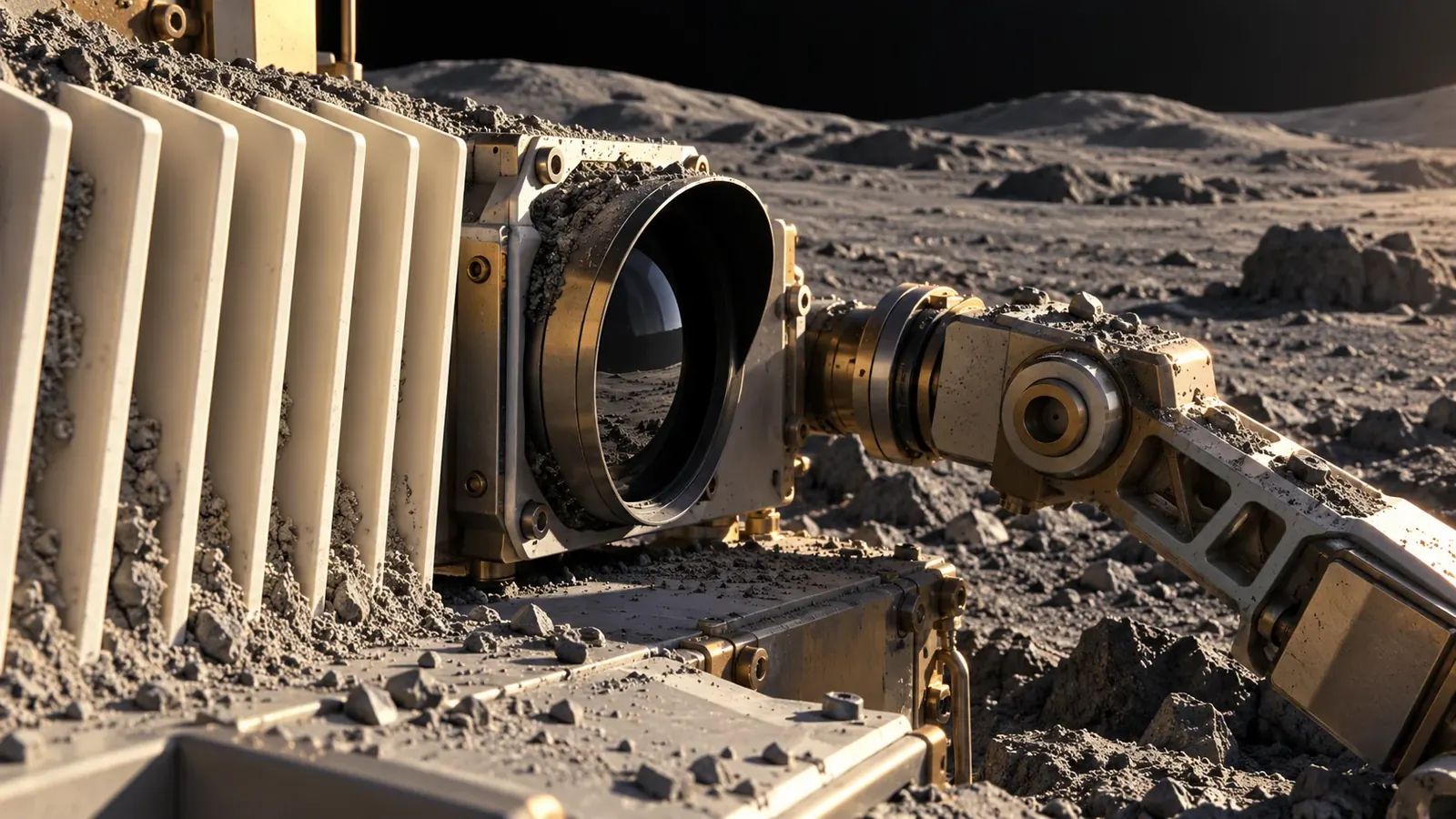
A cleaner-looking panel can still be a compromised radiator, and a dust-tight mechanism can still wear out. The next challenge is measuring what lunar hardware can continue to do.
A useful lunar dust experiment has two endings. In the first, particles leave a surface and the camera records a cleaner patch. In the second, the hardware does its job again: a radiator rejects heat, an optical surface transmits useful light, a mechanism moves within its torque allowance, or a seal retains pressure. The endings can occur together. They should never be treated as interchangeable.
The distinction acquired a particularly concrete form in a NASA investigator presentation at the June 22–26, 2025 Joint Conference on Electrostatics. The team reported that its Electrodynamic Dust Shield had removed lunar dust from glass and radiator test surfaces during the March 2025 Blue Ghost mission. The slides also exposed the measurement work behind the pictures: a failed illumination source complicated one surface's image analysis, while shadows required treatment on the other. This was a real lunar demonstration, with real observational qualifications, rather than a laboratory animation of the intended effect. Buhler and colleagues, flight presentation
A later primary abstract, published for the July 12, 2026 International Conference on Environmental Systems, takes up a different question. Howard, Acosta and Toth describe testing the thermal consequences of dust shielding on coated radiator coupons, including effective emittance after cleaning. The accessible abstract explicitly separates optical cleaning effectiveness from thermal effectiveness. It does not provide the full numerical results, and none are inferred here. Its importance is the question being asked after a successful demonstration: which function has actually been recovered? The shield acts electrically, using electrodes and forces on charged or polarized particles rather than simply brushing a surface. Coulomb forces concern electrical charge; dielectrophoretic forces involve a polarizable particle in a nonuniform electric field. These mechanisms offer ways to move particles without a conventional wiping contact. Their usefulness still depends on the surface assembly, available power and resulting particle motion. An electrically actuated cleaning layer is also part of the radiator structure, which is why its presence and its cleaning action require thermal evaluation. Radiator and dust-shield investigation
That question changes the way a lunar machine should be judged. A dust-removal percentage is a description of an intervention. It is not automatically a description of the remaining mission capability. The distance between those two descriptions is where much of the engineering lives.
Start with the surface that matters
Imagine a hypothetical rover returning from a short traverse. Dust lies across its chassis, radiator, instrument window and wheel mechanisms. The vehicle might look uniformly dirty in a photograph, yet the engineering significance of that dirt would be extremely uneven. A thick patch on a noncritical cover could be tolerable. A small deposit at a sensitive interface could deserve immediate attention. The relevant variable is not simply how much material arrived, but where it arrived and what that location must accomplish.
This suggests a more useful mental model than a single dust score. Give each important interface a state: available heat rejection, optical throughput, actuation margin, electrical behavior, leakage performance. Then ask how contamination changes that state and how reliably the change can be measured. The model does not assume that every particle causes damage. It requires a causal route between contamination and lost function before assigning significance to a dusty photograph.
Historical evidence supports taking those routes seriously. James Gaier's analysis of Apollo mission documents, in its April 2007 revised edition, catalogued varied effects on equipment and operations, including abrasion, mechanism problems, thermal degradation and contamination. The revision also removed a stronger speculative statement about possible additional suit use. That correction matters: historical experience establishes that dust caused operational difficulties, but does not license every later prediction about how quickly a different design will fail. Gaier, revised analysis of Apollo records
A design review can turn the interface model into a practical comparison without pretending to know the eventual exposure perfectly. For each surface, identify the required function, the suspected failure mechanism, the observable warning, and the possible recovery action. A coating might reduce deposition but complicate optical calibration. A cover might prevent exposure while closed but introduce another moving joint. A cleaning device might recover performance while consuming power or displacing particles toward another component.
The comparison is strongest when those consequences remain separate. Combining them prematurely into a weighted total can hide a decisive weakness. A solution that receives excellent scores for appearance and power consumption cannot compensate for failing a necessary containment function merely by averaging well. Some criteria are tradeable; others are constraints. The first act of dust engineering is deciding which is which for the particular interface, rather than for an imaginary universal lunar surface.
Why a grain's location is more informative than its mass
Two deposits with equal mass need not present equal obstacles. In a simple geometric thought experiment, divide one spherical particle into eight equal-volume spheres. Each new sphere has half the original radius. Their combined surface area is twice that of the original sphere, although total material volume and mass remain unchanged. Real regolith is neither spherical nor uniform, but the calculation shows why a mass-only description can miss changes in available contact area and particle number.
The same thought experiment changes the count of possible encounters with small gaps. Eight separate grains offer more opportunities for at least one grain to reach a sensitive location than one grain does, although whether they actually enter depends on geometry and motion. This is not a prediction that finer dust always produces greater damage. It is a warning that a single weighing cannot preserve all the information a mechanism needs.
Adhesion itself is a measurable contact problem, rather than merely a synonym for stickiness. A 2007 NASA primary abstract by Bradley, Jeevarajan and Thomas describes attaching a simulant particle to an atomic-force-microscope cantilever and measuring its interaction with different materials. The accessible record supplies the experimental approach, not a ranked material list or universal adhesion values. It provides a useful example of examining a particular particle–surface pair instead of assigning one adhesion constant to all lunar dust. Particle–surface attraction experiment
For an engineering argument, the distinction between contact force and particle weight is also important. Consider an explicitly invented example in which a removal action applies the same force to two particles, while one particle requires twice as much force to detach. Identical external treatment would then produce different outcomes. Counting only the treatment setting would conceal that difference. A useful report therefore describes both the applied action and the response distribution, including particles that remain.
This is why an average clearing result should invite a question about the residue. Perhaps the remaining particles are concentrated at edges. Perhaps they occupy shallow recesses. Perhaps a small persistent fraction accounts for most of the subsequent impairment. Those are competing hypotheses, not facts about every dust shield. They lead to different follow-up observations and different design changes.
The most revealing comparison may be between the particles removed first and those removed last. If additional cleaning produces progressively less functional improvement, the residual may be unimportant. If a final small deposit controls the remaining fault, bulk removal can look impressive while the engineering problem persists. That relationship has to be observed at the interface; it cannot be reconstructed from the total removed mass alone.
A seal has more than one way to succeed
Mechanical exclusion and pressure retention are related but distinct jobs. A rotating shaft seal can be assessed for whether particles pass toward a protected mechanism. A hatch seal can be assessed for whether the closed assembly retains gas. Neither test automatically substitutes for the other. Their contact geometries, movements and consequences differ, even if both components are called seals.
In a June 2010 NASA technical memorandum, Delgado and Handschuh reported preliminary tests of spring-loaded polymer seals against rotating shafts, with and without lunar simulants and under dry-room or vacuum conditions. No simulant was observed crossing the interface in the reported tests through ten thousand cycles, while wear measurements and the limited endurance scope remained part of the assessment. The authors explicitly distinguished initial feasibility from the much longer endurance testing needed for contemplated service. Preliminary rotating-seal investigation
A separate 2022 investigator abstract describes dust-tolerance tests on representative subscale hatch and docking seals, using controlled simulant deposition and subsequent leakage measurements. Its question is the effect of contamination on a pressure-retaining interface. Only the complete abstract was available for this article's final verification; the linked poster timed out, so no unviewed leakage thresholds are supplied. Representative hatch-seal dust testing
An original comparison helps explain why these tests should not be collapsed into one durability claim. Suppose a hypothetical mechanism excludes all externally supplied grains during an inspection, but its own contact material sheds debris internally. The exclusion result can be true while the mechanism's condition deteriorates. Conversely, a hypothetical pressure seal might contain a few particles without exceeding its specified leakage allowance. Visible contamination would then be real without proving immediate functional failure.
Neither case justifies indifference. Both show why acceptance criteria need to refer to the function and the damage mechanism together. An inspection can ask whether foreign material crossed a boundary, whether the contact surfaces changed, and whether the measured performance remains acceptable. Three answers are more useful than one reassuring adjective.
Duration adds another distinction. A successful short test constrains early failures under the tested conditions. It says less about accumulated wear, repeated reopening, aging of the contact material or a changed exposure sequence. Extending the duration is valuable, but extending it under a physically different regime can answer the wrong question. More cycles are not inherently more representative if the loading, motion or contamination differs from the operation being claimed.
Cleaning is another load case
It is tempting to divide a component's life into damaging operation and restorative maintenance. Cleaning can occupy both categories. It may remove contamination while changing a surface, redistributing material or altering a contact. A useful maintenance evaluation therefore looks beyond whether the cleaning action visibly worked on its first attempt.
NASA's August 2024 technical memorandum on lunar docking and hatch seals describes a second phase of investigation focused on cleaning. The accessible author abstract identifies several separate outcomes: material removal, leakage after cleaning, surface damage and changes in adhesion. The final article relies on that abstract-supported scope because the full report exceeded the retrieval tool's size limit during rechecking. It does not rank uninspected methods or present a procedure for servicing a flight seal. Jimenez, Mather and Dunlap, cleaning investigation
For a hypothetical qualification exercise, picture two cleaning approaches that restore the same initial performance. One takes longer but leaves the functional surface unchanged within measurement uncertainty. The other is faster but gradually alters it. Choosing the faster approach after a single cycle could be rational for a disposable test article and mistaken for a repeatedly serviced mission component. The decision depends on the intended use history, not only on the first recovery result.
A simple cumulative model makes the hidden assumption visible. Suppose, purely for illustration, each maintenance event consumes one unit of a component's allowance, while an alternative consumes three. After twenty events, the difference is forty units. This arithmetic does not claim that real damage is linear or measurable in such units. Its purpose is to show that a small per-event difference can become the dominant comparison when maintenance repeats.
Actual damage could instead be front-loaded, accelerate with surface change, or depend strongly on the order of exposures. Those possibilities call for a record of performance across the sequence. A final before-and-after photograph cannot reveal whether the component recovered after every cycle or failed temporarily in the middle. A single final measurement can also miss an increasing maintenance burden: the same end state may require progressively more intervention.
The result worth preserving is therefore a trajectory. How did the interface behave before exposure, after exposure, after cleaning and after renewed operation? How much time and energy did recovery require? What new material appeared elsewhere? A maintenance strategy becomes credible when those questions can be answered together, without treating a clean-looking final frame as the complete history of the hardware.
Abrasion connects materials to motion
Material selection is important, but the phrase abrasion-resistant can conceal the conditions that gave it meaning. A contact has geometry, force, relative movement, temperature and an environment. Particles may enter, become trapped, fracture, leave or embed in a softer surface. A laboratory ranking is most informative when those details resemble the interface for which the ranking will be used.
Kalácska and colleagues' August 27, 2024 primary study examined stainless steel and polytetrafluoroethylene material pairs with lunar and Martian regolith simulants in a laboratory tribology arrangement. The investigators characterized the simulants and examined friction, wear and surfaces. This is evidence about tested material–particle–contact combinations. It is not a measurement of a complete mechanism's lifetime in lunar vacuum, and the inclusion of more than one simulant does not erase the environmental differences. Primary simulant abrasion study
One way to read such experiments is to ask what was held constant while another factor changed. A comparison between materials under matched conditions can identify a useful direction for further testing. A comparison in which material, particle mixture and loading all change at once may still be informative, but it cannot isolate which change caused the result without additional evidence. This is an experimental-design issue, not a criticism unique to dust research.
Consider an original geometric example. A rotating contact at radius one centimeter travels approximately 6.28 centimeters per revolution. At radius two centimeters it travels approximately 12.57 centimeters. At the same rotational speed and number of revolutions, the second contact therefore accumulates twice the sliding distance. A statement that two samples survived the same cycle count would omit a relevant difference if the contact radii were different.
That example also explains why a miniature mechanism is not automatically a conservative test of a larger one. Scaling dimensions can change distance traveled, contact area, stiffness and local loading in different proportions. Preserving one variable does not preserve all of them. A well-designed scale test identifies the relationship it is meant to preserve and the relationships it cannot preserve.
The public-facing lesson is straightforward: ask for the denominator behind the wear claim. Per cycle, per distance, per exposure event and per operating hour are different quantities. Each may be useful. None should silently replace the others when a laboratory result becomes a statement about a future rover's endurance.
A radiator can be dirty in several physically different ways
Thermal surfaces introduce another set of distinctions. Solar absorptivity describes how much incident solar energy a surface absorbs. Infrared emissivity describes its capacity to emit thermal radiation relative to a reference emitter. A deposited layer can also affect the path by which heat reaches the exposed surface. Howard and Stewart's August 2024 NASA technical account distinguishes changes in optical properties, insulating effects and abrasion when examining lunar rover thermal challenges. A darkened photograph alone cannot measure all of those effects. Thermal impacts technical account
A deliberately simplified heat-balance example shows why the distinction matters. Imagine a panel of one square meter exposed to an invented incident radiant flux of one thousand watts per square meter. If its absorptivity changes from 0.2 to 0.4, absorbed input changes from two hundred to four hundred watts. The additional two hundred watts must appear somewhere in the energy balance. This example is not a lunar environmental specification and does not use a measured dust effect.
Now consider a different idealized change: a reduction in emissivity while temperature, area and surroundings remain fixed. The emitted thermal power decreases in proportion to emissivity in that simplified comparison. If the component must reject the same internal heat, its temperature or another operating condition must change. The first example changes absorbed input; the second changes the ability to reject heat. Similar-looking deposits could therefore have different consequences depending on illumination and surface properties.
An added layer introduces a further question about temperature differences within the structure. The visible outer surface need not share the temperature of the component being cooled. A camera aimed at the exterior might provide valuable information while still leaving the internal thermal path unresolved. Inferring the component's condition requires a model of that path and observations capable of checking it.
There is also an important distinction between a clean starting surface and a surface that has been cleaned. If the intervention leaves a film, changes texture or modifies a coating, the restored appearance may not imply the original thermal properties. Those are testable possibilities rather than assumptions of failure. The engineering task is to determine which differences matter within the allowed operating range.
A persuasive thermal demonstration consequently states the illumination, surrounding thermal environment, internal load and measured temperatures alongside the contamination condition. Without those details, a change in temperature can be real yet ambiguous. It might reflect changed heat input, changed heat rejection, a transient state or several effects at once.
A negative result needs its boundaries too
A preliminary experiment can be useful precisely because it does not produce the expected dramatic effect. Leibach and colleagues' paper for the May 4–8, 2025 Nuclear and Emerging Technologies for Space meeting reports thermal-vacuum testing of radiator prototypes with simulant deposition. Under the reported conditions, the initial measurements did not establish the anticipated relationship between adhered dust and radiator performance. The paper discusses deposition difficulties, changing chamber surroundings and properties of the tested surfaces. It does not establish that dust is thermally harmless on the Moon. R2D2 radiator experiment
The right response to such a result is not to discard it for contradicting a compelling story. It is to identify the alternatives it leaves open. Perhaps the imposed exposure had little effect on that surface under those conditions. Perhaps the measured variable was relatively insensitive. Perhaps another changing influence obscured the effect. Those alternatives require different follow-up comparisons; a more dramatic photograph would not distinguish them.
An original numerical example illustrates the problem of sensitivity. Suppose a hypothetical test can reliably distinguish a ten-watt change, while the effect of interest under that particular condition is three watts. A result reported as no detected change would not establish an effect smaller than one watt, much less exactly zero. It would establish that the experiment did not resolve the proposed change at its available sensitivity. The actual threshold must come from the experiment, not this illustration.
Similarly, a chamber comparison is strongest when the surroundings are controlled well enough to interpret the component's response. If both the test surface and its environment warm during an experiment, a simple temperature difference may mix several processes. A reference surface, repeated baseline or independently measured boundary condition can help, but only when its relationship to the tested surface is understood. Adding another sensor does not automatically remove a confounder.
Negative and positive results deserve symmetrical discipline. A successful cleaning event should not become proof of unlimited service. An experiment without a resolved degradation should not become proof that protection is unnecessary. Both findings are pieces of evidence with a domain. Good engineering expands that domain through deliberately chosen comparisons rather than through stronger adjectives.
What a clearing percentage actually counts
An image-based measure needs a definition of clean. The criterion might be a change in brightness, a classified particle area, or a comparison against a reference image. Those quantities can be useful, but they answer different questions. Lighting direction, shadows, optical texture and the scale of visible features can influence the relationship between pixels and deposited material. The definition should therefore travel with the number, rather than disappear when the result enters a headline.
An original calculation shows a second ambiguity. Suppose a hypothetical surface starts with one hundred units of contamination and a treatment removes ninety percent. Ten units remain. A second surface starts with ten units, receives an eighty percent removal treatment, and retains two. The first treatment has the higher percentage removal; the second leaves the lower absolute residue. Ranking the treatments without their starting states would confuse intervention efficiency with final condition.
Functional recovery introduces another denominator. Suppose an invented optical channel begins at one hundred units of throughput, falls to sixty after contamination, and returns to ninety after treatment. The recovery is thirty units out of forty lost, or seventy-five percent of the impairment. It is also ninety percent of the original throughput. Both descriptions are correct, but neither is a dust-removal percentage. A reader should be able to identify which denominator was used without reverse-engineering the accompanying graphic.
A before-and-after comparison can also be affected by where observations are taken. If a camera examines only the center of a panel, successful clearing there does not measure the edges. If an average includes both a critical aperture and a large insensitive border, the border can dominate the statistic. An appropriate region of interest is tied to the engineering function before the comparison is made. Otherwise, changing the region can change the apparent success without changing the hardware.
The strongest reporting therefore keeps several quantities distinct: initial loading, residual loading, spatial distribution, functional loss and functional recovery. They need not all be measured with the same instrument. Indeed, independent measurements can be valuable because they expose disagreement between a surface appearance and its operating condition. If two methods disagree, the disagreement is evidence to investigate, not merely an inconvenience to average away.
This does not demand impossible precision from an early experiment. It asks for honest definitions. A study can report a carefully bounded optical result while leaving thermal or mechanical recovery for another investigation. What makes the result misleading is not that it is narrow, but that a later description silently expands it beyond the quantity that was observed.
Repeated exposure creates a different mathematical problem
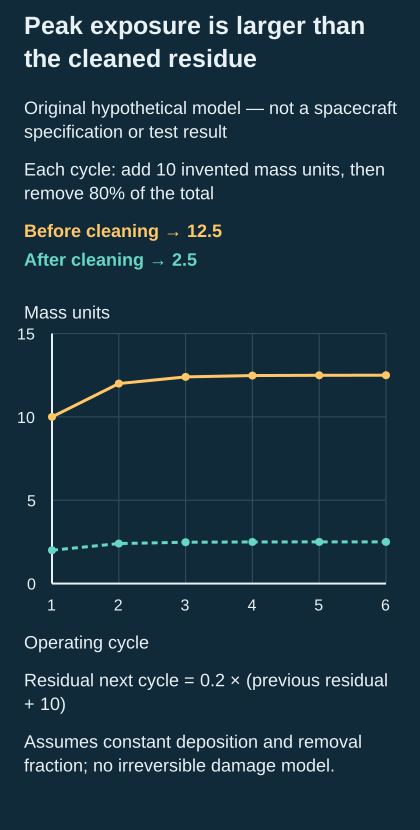
Original hypothetical recurrence with ten invented mass units deposited each cycle and eighty percent removed afterward. The graph distinguishes peak exposure from residual loading; neither curve is measured spacecraft performance.
Cleaning efficiency becomes more interesting when contamination returns. Consider an explicitly hypothetical model with an incoming deposit of ten mass units per operating cycle. At the end of each cycle, a treatment removes eighty percent of everything present. Let the residual after cleaning be the state carried into the next cycle. Starting from a clean surface, the first residual is two units; the second is 2.4; the third is 2.48. Under these invented, unchanging assumptions, the sequence approaches 2.5 units after cleaning.
The calculation follows a simple recurrence: the next residual equals the fraction retained, here 0.2, multiplied by the previous residual plus ten incoming units. At equilibrium the residual must equal 0.2 multiplied by the sum of itself and ten. Solving gives 2.5. Immediately before cleaning, however, the corresponding loading approaches 12.5 units. An interface that only tolerates five units would exceed that hypothetical tolerance even though the cleaned state looks satisfactory after every cycle.
This distinction between peak exposure and post-cleaning residue is easy to lose in a maintenance narrative. A sequence of good final photographs says little about what the component experienced immediately before each intervention. If impairment occurs during the exposure interval, recovery afterward may not undo the lost operation. If damage is irreversible, the residual mass after cleaning may be a particularly poor record of accumulated harm.
Now change only the incoming amount in the hypothetical model, from ten to twenty units per cycle. The equilibrium residual doubles to five units, and the pre-cleaning loading doubles to twenty-five. The removal percentage is unchanged. Yet the interface's exposure has changed substantially. An apparently stable cleaning technology can therefore require a different operational schedule when the deposition environment changes.
Real surfaces can depart from this model in many ways. Removal may depend on loading, particle properties or prior surface history. Some residue may become harder to dislodge. The deposit may arrive in infrequent bursts rather than equal increments. The model is useful precisely because its simplifying assumptions are exposed: it identifies which observations are needed before the arithmetic could support a real maintenance argument.
For example, repeated tests can examine whether the retained fraction stays constant and whether the measured function tracks the residual, the peak loading or the cumulative exposure. Those are distinguishable possibilities. A model fitted only to final cleanliness could predict the wrong operational margin even while reproducing every final photograph. Recording the intermediate state makes the difference between describing the cleaning cycle and understanding what the component has endured.
The demonstration and the lifetime are different experiments
A flight demonstration answers questions that a laboratory cannot fully reproduce. A controlled ground experiment can vary factors and inspect components in ways that a short flight demonstration cannot. The two approaches are complementary, but only if their claims remain distinct. Real exposure is valuable; experimental control is valuable. Neither is a universal substitute for the other.
A hypothetical development program might use an early component experiment to identify a promising contact arrangement, a controlled assembly test to measure recovery and repeated wear, and a flight experiment to examine behavior in the actual environment. The purpose of each stage would be stated before its result was used to justify the next. Otherwise, the most visually memorable stage could absorb claims that were never measured there.
Lifetime is especially vulnerable to this substitution. Demonstrating that an action works once establishes capability under the observed condition. Estimating service duration requires a model of repeated exposure and failure, supported by evidence about how the relevant state changes. A mechanism might fail abruptly, degrade gradually or remain stable until a different environmental condition occurs. Extrapolating a short successful interval assumes something about which of those patterns applies.
The assumptions should be visible in the language of the claim. A model-projected lifetime based on laboratory cycling is not an observed lunar lifetime. A component endurance result is not an endurance result for the integrated vehicle. A successful system test with a replaceable part is not evidence that the part needs no replacement. These distinctions do not diminish genuine progress; they tell a reader what kind of progress occurred.
They also suggest useful reporting practices. Preserve unsuccessful runs and changes to the apparatus. Report interruptions that limit the sample. Distinguish planned exposure from completed exposure. Explain whether the same sample was cleaned and reused or a fresh sample was installed. Those details can determine whether apparently independent results are actually stages of one specimen's history.
Most importantly, describe the functional endpoint. If a dust experiment aims to preserve thermal capacity, measure thermal capacity under the intended comparison. If it aims to protect a moving joint, examine the relevant motion and its margin. A demonstration becomes much more persuasive when the measured endpoint matches the engineering promise, even if the resulting picture is less spectacular.
Where the removed particles go
Removal is a transport event. A particle that leaves one surface has not ceased to exist. This elementary observation becomes important when several exposed functions share a vehicle, a work area or a sequence of handling operations. A local improvement can be genuine while creating a new exposure elsewhere.
Consider a fully hypothetical layout with a cleaning surface above an instrument opening. If the cleaning action directs particles toward that opening, the surface can pass its local cleanliness criterion while the assembly becomes less useful. Moving the opening, altering the cleaning direction or providing a suitable receiving region could change the outcome. The point is not to prescribe a particular lunar design. It is to include the destination in the definition of success.
A simple mass balance organizes the question. Starting contamination equals material remaining on the original surface, material collected elsewhere and material outside the observed accounting region, subject to measurement uncertainty. Reporting only the first term leaves the other terms unresolved. That may be acceptable for an early mechanism experiment, but it should be stated before the result is generalized to a system containing other sensitive components.
The accounting region itself deserves attention. A camera may observe a small patch while a larger surface receives redistributed material. A collection device may capture particles of some sizes more effectively than others. A measurement of total recovered mass may miss a small, functionally important population. None of these possibilities makes measurement pointless. They indicate why several complementary observations may be necessary.
Transport also makes the order of operations important. Cleaning before a protective cover opens could have a different outcome from cleaning afterward. Repeated handling might recontaminate a surface that was satisfactory at the end of a test. A qualification sequence should therefore represent the intended interfaces between operations, not merely a set of individually successful actions performed in an arbitrary order.
This is a particularly useful way to evaluate elegant technologies. Instead of asking whether the mechanism looks sophisticated, ask where it moves material, what it consumes, what new surfaces it introduces and what happens when it is unavailable. Those questions can reveal whether a clever local solution is compatible with the rest of the machine.
Turning observation into a decision
A lunar operator cannot inspect every interface continuously. Measurements therefore need to support decisions rather than merely produce data. A camera, temperature sensor or actuator-current record is useful when its relationship to the relevant function is sufficiently understood to guide action. The relationship may be indirect, and its uncertainty should remain visible.
Imagine a hypothetical joint whose electrical current rises during movement. Increased resistance from contamination is one possible explanation. A changed commanded motion, temperature-dependent behavior or another mechanical fault could also matter. Responding automatically with cleaning would assume a diagnosis that the current measurement alone might not establish. Combining the current record with motion, temperature and recent exposure history could make the inference more informative.
A decision rule also needs to distinguish a warning from a limit. A warning can prompt additional observation while sufficient margin remains. A limit can require a restricted mode or suspension of an operation. Conflating the two can produce either excessive interruption or delayed intervention. The appropriate separation depends on the component's verified behavior and the consequences of uncertainty, not on a universal percentage of visible dust.
For a simple invented example, suppose a component has one hundred units of usable operating margin and a measurement uncertainty of ten units. A reported remaining margin of fifteen units is a different decision problem from a reported margin of sixty. The arithmetic does not establish an engineering threshold. It shows that uncertainty consumes part of the confidence available for continuing operation. A nominal value should not be interpreted without its uncertainty when the decision is close.
Recovery also requires confirmation. If an intervention is performed because a measured function declined, the post-intervention check should return to that function. A cleaner image is supporting evidence, not necessarily the closing test. If the original symptom remains, the operator has learned something about the diagnosis or the intervention even when the surface looks improved.
These considerations favor a small number of well-understood observations over an impressive collection of poorly connected indicators. The goal is not to make every grain visible. It is to know when important capability has changed, what explanations remain plausible and which actions have a demonstrated chance of recovering that capability without creating a larger problem.
The useful future question
The most revealing question for a new dust technology is therefore not whether it can make a surface cleaner. It is what becomes possible after it does so. Can the component maintain its required function through the intended exposure sequence? Can the effect be distinguished from changing surroundings? Can the intervention repeat without consuming the very surface it is meant to protect?
A credible answer need not arrive as a single comprehensive experiment. It can emerge from a chain of bounded results: contact measurements, functional component tests, representative assembly trials and carefully interpreted flight observations. The chain is strong when each link has a clear purpose and the transitions between them are explicit. It is weak when a result from one level quietly acquires the meaning of another.
For readers, this offers a practical way to separate achievement from extrapolation without becoming reflexively cynical. Look for the actual function measured, the environment used, the exposure completed, the residual uncertainty and the next question the result makes possible. A modestly described experiment with those details can be more important than a sweeping promise built around a dramatic image.
For designers, the same discipline places dust management inside the architecture rather than at its cosmetic edge. Interfaces, accessible measurements, recovery paths and the destination of removed particles all affect what the machine can keep doing. The hardware should be judged by that continuing capability. On the Moon, cleanliness is useful when it protects work.