
Turning discarded NdFeB into another useful magnet means preserving or rebuilding magnetic performance. The decisive questions concern coatings, grain boundaries, temperature and the product that will use it.
The material leaving a magnet recycler can look disappointingly ordinary: powder, a clean metal component or a container of recovered rare-earth compounds. The difficult achievement is hidden. A useful permanent magnet is an engineered arrangement of phases, grains, interfaces and orientation. Recovering its constituent elements is valuable, but it does not automatically recover that arrangement.
On January 15, 2026, the University of Birmingham announced the opening of a West Midlands facility for separating and recycling rare-earth magnets. The university is a participant in the technology and facility, so its account is first-party evidence of the launch rather than an independent audit of sustained production or environmental performance. The opening provides a timely industrial question: what must happen between receiving discarded magnets and supplying material that another manufacturer can confidently use? University of Birmingham facility announcement.
That question is narrower, and more demanding, than asking whether neodymium can be recovered from waste. A buyer may need a specified shape, magnetic direction, resistance to demagnetization, corrosion protection and performance at operating temperature. A batch can contain the desired elements and still fail one of those requirements. It can also succeed in a different application from the one it originally served.
There are consequently several possible destinations for an old magnet. It might be reused as a component, processed into material for a new magnet, or broken down chemically so that selected elements can enter a new manufacturing chain. None is automatically the best route for every feedstock. The useful comparison follows what each route preserves, what it must rebuild and what it can demonstrate at the end.
The examples below are original, simplified illustrations rather than operating recipes. Industrial magnet processing involves strong magnetic forces, reactive powders, heat, gases and chemicals that require appropriate facilities and expertise. The aim here is to understand the evidence behind a recycled product, not to explain how to process discarded magnets at home.
The specification starts with a magnetic curve
A magnet's performance cannot be reduced to a single adjective such as strong. Remanence describes the remaining magnetic flux density after an appropriate magnetizing history. Coercivity concerns resistance to reversal, with intrinsic coercivity distinguished from the field at which magnetic flux density reaches zero. Maximum energy product describes a useful feature of the demagnetization curve. These quantities have different units and answer different questions; temperature and measurement conditions belong beside them.
Keszler and colleagues' study of field-assisted processing of hot-deformed Nd–Fe–B scrap, first published in October 2023 and appearing in a 2024 issue, measured how recycled content, particle size and oxygen uptake affected resulting properties. Some mixtures performed substantially better than fully recycled specimens under the tested conditions. The paper does not support a blanket claim that every recycled magnet matches a commercial original. Direct recycling by field-assisted sintering technology.
A fictional purchasing example makes the distinction clear. Product A requires a particular minimum remanence and moderate resistance to demagnetization. Product B needs less remanence but must tolerate a stronger opposing field at a higher temperature. The same recycled batch could be suitable for A and unsuitable for B. Calling the batch inferior without naming the application is as unhelpful as calling it equivalent without identifying the property being compared.
A comparison also needs a consistent measurement state. A result at room temperature is not interchangeable with a result at the intended service temperature. A small laboratory specimen may be useful for characterizing the material but does not by itself demonstrate the behavior of a finished component with different geometry. A number copied from a table can lose its meaning when those conditions disappear.
The most informative qualification plot would show the relevant curve over the operating range, with uncertainty and an explanation of how the specimen was prepared. A single peak or best-performing sample can conceal the behavior of the rest of a batch. If a product specification applies to every delivered component, the distribution of results matters alongside the average.
This is the first major difference between a recovered material and a qualified product. Recovery establishes that something useful was obtained. Qualification establishes that a defined thing can perform a defined task under defined conditions. The recycling process becomes commercially meaningful when it can repeatedly bridge those two statements.
Atoms are not a complete manufacturing history
Two pieces of NdFeB can have similar bulk chemistry and different magnetic behavior. Their processing histories may have produced different grain sizes, alignment, boundary phases or defects. Chemical analysis remains essential, but it is not a substitute for knowing how the material is organized.
An author-deposited 2026 study by Tomše and colleagues investigated a grain-boundary diffusion strategy for reprocessed magnets. Its accessible repository abstract describes localized enrichment and a change in coercivity while maintaining substantial remanence under the reported conditions. Only that abstract and metadata are used here; the linked PDF failed to render. The result illustrates the relevance of where an addition ends up, rather than simply how much of an element is present in the overall composition. In-situ grain-boundary diffusion study.
Imagine two fictional batches with the same total amount of a useful alloying element. In one, the element is distributed where it most effectively influences the reversal behavior required by the application. In the other, it is concentrated in regions that contribute less to that objective. A bulk assay could make them look equivalent while a magnetic test distinguishes them immediately.
The analogy is not that microstructure is mysterious. It is that a bulk number averages over location. The more deliberately a material has been engineered at interfaces, the more care is needed before assuming that breaking it apart and reforming it will preserve the benefit. A short recycling route may retain valuable structure, alter it or create an opportunity to rebuild it differently. Which outcome occurs is an experimental question.
For the recycler, this changes the meaning of a feedstock label. “NdFeB” identifies a material family, not a complete processing prescription. Knowing whether a batch came from a particular manufacturing route or service history can help define the questions that need testing. Where that history is missing, characterization must carry more of the burden.
For the customer, it changes the meaning of a composition certificate. A certificate can establish that the chemical contents are within stated limits. It cannot, by itself, certify grain alignment, resistance to demagnetization, coating integrity or durability in an assembled device. Those claims require evidence that addresses the relevant structure and function.
Liberation can change the material being liberated
Before a magnet can be recycled, it often has to be separated from the product around it. The obvious objective is to recover it with minimal material loss. A less obvious objective is to avoid creating contamination or damage that makes the next stage harder.
Walton and colleagues' 2015 work investigated using hydrogen to separate and recycle NdFeB-type magnets from electronic scrap. It established a route in which the magnet material could be transformed and separated from surrounding components, rather than treating the entire discarded device as one undifferentiated feed. The original article was opened in full during research; a later retrieval failed, which is recorded in the source log. Hydrogen-assisted separation and recycling study.
The broader design problem can be expressed without a process recipe. A separation step has at least three outputs: the recovered magnetic material, the nonmagnetic material removed from it and the altered condition of what remains. Looking only at the first output can hide why a high recovery fraction produces a difficult downstream feedstock.
Suppose a fictional line recovers ninety-five percent of the magnet-containing material by mass but carries a small amount of coating debris into it. A second line recovers ninety percent with much less contamination. The first has the larger immediate yield. It is not necessarily the better route to a qualified final magnet if the contamination causes rejection, extra treatment or restricted applications later.
This comparison should not be settled by assuming that purity always deserves priority over yield. Some downstream routes may tolerate or remove the contaminant more readily than others. The right question is where the burden moves. Does a faster dismantling method create more work in powder preparation? Does preserving the component's shape make reuse possible? Does aggressive liberation destroy information that would have helped sort the material?
A useful process assessment follows the material across those boundaries. It identifies where the reported recovery begins and ends, what is counted as useful output and what condition that output is in. A photograph of a clean-looking pile cannot answer those questions, and a high percentage does not become more informative simply because it appears next to the photograph.
A coating can protect in service and complicate recycling
The outside of a magnet is part of its history. Coatings and adhesives may have served useful roles in the original product. At end of life, they become potential sources of unwanted material, barriers to a selected process or reasons to choose a different route.
Grau and colleagues' 2024 experiment examined thermal demagnetization in air for differently coated NdFeB specimens. The study tracked changes in oxygen, carbon and zinc-related contamination and showed that the result depended on the coating and initial condition. It also investigated subsequent removal of affected surface material. Those are results for specified samples and treatments, not a universal preparation schedule for mixed industrial scrap. Thermal demagnetization, microstructure and contamination.
The lesson for interpreting a recycling claim is that “before processing” may already include consequential processing. If a supplier's material was demagnetized, heated, blasted, cut or stored before it entered the experiment, those steps can affect the result. Comparing two studies without that history can attribute a difference to the main recycling method when it began earlier.
An original batch example shows why sampling location matters. Imagine contamination concentrated near the surface of a component. A bulk measurement that averages the entire piece may report a small concentration. A powder made preferentially from that surface region could have a much higher concentration. Conversely, removing a thin affected layer may change the remaining feed substantially while discarding relatively little of the original bulk.
The arithmetic of averages does not establish which separation method should be used. It does show why a representative sample must represent the material that will actually proceed to the next stage. Testing a clean interior fragment and then processing an entire coated batch answers the wrong question.
Visual inspection has limits as well. A surface can look clean while retaining chemically important material. A surface can look discolored without that appearance alone specifying the type or depth of contamination. Photographs are useful records of condition, but chemical and microstructural questions need appropriate measurements.
This is one place where design for recycling becomes highly specific. Information about the coating system, adhesives and magnet location can reduce uncertainty for the future recycler. A general promise that a product is recyclable is much weaker than a design that allows the valuable component to be identified, accessed and characterized without unnecessary damage.
Three routes preserve different things
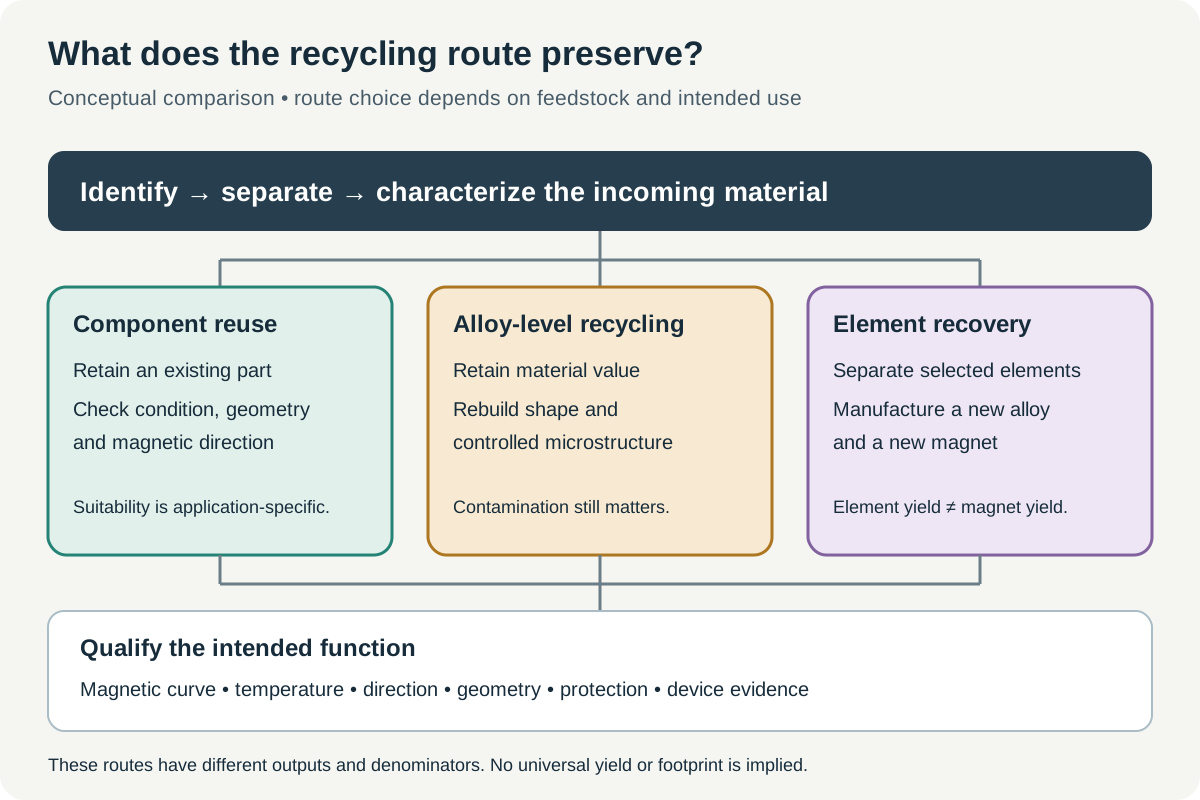
Conceptual route comparison. Reuse, alloy-level recycling and element recovery preserve different things and produce different intermediate outputs. Qualification must match the intended application.
Reuse preserves the greatest amount of the original component when it is technically appropriate. A material-level route can preserve much of the alloy while changing shape and microstructure. An element-recovery route separates selected constituents and then relies on subsequent manufacturing to build a new magnet. These are different outputs, so their success metrics should not be merged.
A 2022 study by Islam and colleagues reported scale-up of membrane solvent extraction for rare-earth recovery from scrap permanent magnets. The accessible author-institution abstract describes larger membrane modules, a skid system and recovered rare-earth oxides. Its reported purity and yield concern that recovery operation; they do not mean that the same fraction of whole discarded products became finished magnets. Membrane solvent extraction scale-up.
A separate January 2025 Ames Laboratory account described Oak Ridge work on selective recovery of dysprosium from a particular electric-vehicle magnet feedstock. This is first-party project evidence about a targeted separation demonstration. It should not be read as proof that every mixed magnet stream can be separated with the same performance. Selective heavy-rare-earth recovery demonstration.
The distinction is easiest to see through an original accounting example. Suppose a fictional recovered component weighs one kilogram and contains 300 grams of a group of target elements. Recovering ninety percent of those elements yields 270 grams of target material before any adjustment for the chemical form of the product. That is ninety-percent elemental recovery, not ninety-percent recovery of the original component's entire mass. If the output is an oxide, its measured mass also includes oxygen, so comparing it directly with the initial metal mass requires a consistent basis.
Neither number is inherently misleading. The problem arises when the denominator disappears. A process can have high recovery of a selected element and still leave much of the original material in other streams. A magnet-to-magnet process can retain more alloy mass while facing a different set of purity and performance constraints.
The useful decision is therefore conditional. Which route fits the feedstock's identity, contamination, geometry and intended market? A clean, traceable component may support options that a mixed, degraded stream does not. A chemical route may be appropriate where reconstructing the alloy is preferable to preserving an uncertain one. The evidence should explain the choice rather than declare one route universally superior.
A thousand kilograms is several different denominators
A recycler's throughput can refer to incoming products, separated magnets, processed powder, recovered rare-earth compounds or saleable finished magnets. These quantities occupy different points in the chain. Treating them as interchangeable can make a pilot result sound like a much larger supply contribution.
Consider an entirely hypothetical system receiving 1,000 kilograms of discarded assemblies. Suppose they contain 100 kilograms of target magnet material. Liberation recovers 90 kilograms. A later stage retains 90 percent of that, leaving 81 kilograms, and final qualification accepts 90 percent, yielding 72.9 kilograms of usable output on this simplified common-mass basis. The three stage yields are all ninety percent, but their product is 72.9 percent of the original magnet material and 7.29 percent of the incoming assemblies.
This is not a forecast for any recycling plant. It is a demonstration of why a stage yield cannot substitute for a chain yield. The result also depends on the definition of accepted output. Material that misses one specification might be useful in another product, held for reprocessing or genuinely lost. A single rejection category can conceal those differences.
Now add a time dimension. A line capable of processing a stated mass per hour does not necessarily operate at that rate every hour of the year. Feedstock availability, maintenance, changeovers, testing and customer demand affect realized output. A facility opening announces the availability of infrastructure; a year of production records demonstrates something different.
The same caution applies to capacity additions. Two stages with nominal capacities of different materials cannot simply be added together. A plant that separates magnets and then remanufactures them has a linked process, not two independent sources of magnet supply. If one stage is the bottleneck, expanding another may improve resilience or future readiness without immediately increasing finished output.
A technically informative announcement would therefore attach a material basis and a time basis to every capacity figure. It would distinguish nameplate capacity from measured operation and identify whether qualification is included. Those distinctions may make a headline less dramatic, but they make it possible to compare a facility with the actual demand it aims to serve.
Why matching one magnetic number is insufficient
A small idealized calculation explains why changes in remanence can have disproportionate consequences. Assume, only for this illustration, a straight second-quadrant relation B equals Br plus μ₀H, with H negative. Here B is magnetic flux density, Br is remanence and μ₀ is the vacuum permeability. The useful magnitude of the product BH is then maximized at H equal to minus Br divided by twice μ₀. Under these assumptions, the maximum is Br squared divided by four times μ₀.
This derivation is not a prediction of a real magnet's performance. It assumes an idealized curve and sufficient resistance to reversal to reach the calculated operating point. Its limited purpose is to show the square dependence: reducing Br to ninety percent of its original value reduces this idealized maximum to eighty-one percent, not ninety percent. The arithmetic alone does not say that a finished motor must become nineteen percent less efficient.
A device designer can sometimes compensate for material differences through geometry or other design choices. Such compensation has consequences for space, mass, cost, thermal behavior and the rest of the system. Whether it is worthwhile depends on the application. A claim that a recycled magnet is equivalent should therefore identify whether equivalence was achieved with unchanged geometry or with a redesigned device.
Resistance to demagnetization adds another constraint. A material with a high remanence can still be unsuitable if its curve develops an unfavorable knee under the conditions of use. Reporting only the room-temperature remanence would miss that problem. Conversely, a material that exceeds the required coercivity by a large margin may offer little additional value if another property limits the design.
For a purchaser, the sensible target is a performance envelope rather than an isolated maximum. The envelope specifies the relevant temperatures, fields and tolerances, along with the geometry and measurement convention. It also separates reversible changes from irreversible loss. Those distinctions prevent a temporary response during a test from being confused with permanent damage, or a reassuring recovery after one test from being generalized to every service condition.
The idealized equation is useful precisely because its limits are explicit. It tells the reader why one material parameter can matter strongly while refusing to translate that parameter directly into a claim about an entire product. Recycling comparisons need the same discipline: connect each measured property to the decision it can support, and stop before the unsupported extrapolation.
Direction is part of the recovered function
A magnet also has an orientation. A component that fits the available space can still be wrong for the assembly if its magnetic direction is inappropriate. Preserving shape, therefore, is not the same as preserving function. A reuse assessment needs to establish how the component's magnetic behavior relates to its geometry and to the intended magnetic circuit.
An elementary vector example makes one consequence visible. Suppose an idealized magnetic moment has magnitude M and is intended to point along a chosen axis. If it is tilted by an angle θ, its component along that axis is M times the cosine of θ. At thirty degrees, that projection is about 0.866M. This is original geometric arithmetic, not a model of the total field or torque of a real motor. It shows why an orientation error can matter even when the material's measured magnitude has not changed.
The perpendicular component matters too. It has not vanished; it points somewhere else. A test that measures only the intended-axis projection can therefore miss part of what changed. The relevant characterization depends on the device, but the general lesson is that a scalar number can conceal a directional mismatch.
Reforming material introduces a related distinction between the orientation of the final component and the internal alignment produced by manufacturing. A correct external placement cannot necessarily compensate for an unsuitable internal structure. Conversely, a material with useful intrinsic properties can be wasted by incorrect orientation in the finished assembly. These are separate places where the route from recovered material to useful field can fail.
A clear comparison keeps the specimen coordinate system visible. It identifies the direction in which magnetic measurements were taken and how that direction corresponds to the component drawing. If a reused piece is cut into a new geometry, the new drawing should retain the relationship rather than assume that the longest dimension is the relevant magnetic direction. Shape alone does not establish that fact.
This is also an example of information that can be lost before any material is lost. A recovered component may remain chemically intact while its orientation record disappears during dismantling and sorting. Re-establishing that information can be possible, but it requires a deliberate measurement rather than a guess based on appearance. Preserving an appropriate identification record can therefore save work without changing the physical recycling process at all.
The acceptance question is consequently multidimensional: composition, structure, curve, direction, geometry and condition. A process that preserves five of those while leaving the sixth uncertain has made substantial progress, but the remaining uncertainty still belongs in the product description. Calling the part recovered is reasonable. Calling it ready for an arbitrary assembly is not.
The device is the next experiment
Schönfeldt and colleagues' March 2025 study tested recycled or reused magnets in demonstrators for a pedelec, an e-scooter and a hoverboard. The authors compared induced voltage over rotational speed and reported similar or higher values relative to the corresponding original configurations. These are useful device-level measurements. They are not, by themselves, a lifetime field trial covering every mechanical, thermal and corrosion condition the devices might encounter. Functional recycling and reuse in electromobility demonstrators.
The step from material testing to a demonstrator closes some important gaps. It tests whether the chosen components can be integrated and whether the assembled system exhibits the measured response of interest. It also introduces new variables: placement, dimensional tolerances, assembly condition and interactions with other components. A good comparison controls those variables or explains how they changed.
Imagine a fictional test in which a recycled magnet produces the same induced voltage as the reference at one speed. That is encouraging evidence about that operating point. It does not establish identical performance throughout the speed range, under load or at elevated temperature. Measuring a wider range narrows those uncertainties. It still does not automatically establish resistance to long-term corrosion or repeated thermal cycling.
This is not an argument for withholding all conclusions until a product has completed its entire service life. Engineering necessarily uses a combination of tests, models and previous experience. The requirement is to identify which part of the confidence comes from each. A short demonstrator campaign can support a bounded claim while a separate qualification program addresses durability.
The comparison should also distinguish reuse from remanufacturing. An old magnet installed in a new application carries a different history from powder that has been processed into a new component. Grouping both under “recycled” may be convenient in ordinary language, but it obscures which manufacturing steps and failure modes were actually evaluated.
The most useful next-stage report would present the device configuration, the relevant material measurements, the acceptance criteria and the results across the tested range. It would state what was not tested. That structure lets a buyer decide whether the evidence fits their application rather than forcing them to infer a complete qualification from a successful demonstration photograph.
Mixed feedstocks create a distribution, not an average magnet
A mixed scrap stream can contain magnets that differ in composition, coating, geometry and prior service. An average assay may be useful for bulk planning, but it cannot reveal every subpopulation that matters to the process. The question is whether the next manufacturing step responds to the average or is sensitive to a minority of difficult material.
Consider a fictional batch containing ninety pieces with one contamination level and ten with a much higher level. If every piece is homogenized completely before the relevant process, the average may be a useful input. If the high-contamination pieces behave differently during separation or contribute localized defects, the average can conceal a problem. The same chemical mean can correspond to very different distributions.
This makes traceability a technical resource. Keeping lots separate long enough to characterize them can preserve options. Once incompatible or poorly understood streams are mixed, recovering that information may be expensive or impossible. The value of sorting is therefore not limited to raising purity; it can reduce uncertainty about how a process will behave.
There is also a sampling problem. Testing the easiest-to-access pieces can systematically miss the difficult fraction. A sample selected from visually clean components may not represent the incoming stream. A sample collected after an undocumented manual sorting step may characterize the sorter’s choices rather than the material a future plant will receive.
An informative study explains the feedstock's origin, selection and variability. It makes clear whether the material was production scrap with a known composition, separated end-of-life components or an intentionally mixed stream. A process demonstrated on a clean, uniform feed can be valuable without being portrayed as ready for every discarded product.
The original management implication is to treat feedstock categories as testable hypotheses. If two categories repeatedly produce indistinguishable behavior under the relevant conditions, they may be combined with evidence. If their behavior differs, keeping them separate may be worth more than the convenience of a larger pooled stock. The decision should follow observed process compatibility, not the broad label on the collection bin.
Recycled content and recovered function are separate claims
A finished magnet can contain a high fraction of recycled material while failing an intended specification. Another can contain a lower recycled fraction and deliver the required function with less total material. Both the recycled-content claim and the performance claim matter, but neither should be used as a substitute for the other.
Take a hypothetical blend made from eighty kilograms of recovered alloy and twenty kilograms of primary additions. On that simple input-mass basis, the blend has eighty-percent recycled content. If later manufacturing removes material, the finished product's accounting needs to specify how those losses are allocated. A statement about input content should not silently become a statement about the origin of every kilogram leaving the factory.
Now imagine that a small primary addition allows the product to meet a demanding specification. The addition does not erase the value of the recovered material, but it belongs in the description. Conversely, a claim of “all recycled” does not establish that no processing aids, coatings or other inputs were used. The scope of the claim needs to be explicit.
Functional comparison requires another denominator. Suppose one design uses a certain mass of material to meet a stated device requirement, while another requires more material to meet the same requirement. A comparison per kilogram of magnet answers a different question from a comparison per device delivering the specified function. Neither is universally correct; the choice depends on the decision being evaluated.
A credible claim can carry both views. The material perspective shows how effectively the stream is recovered and processed. The functional perspective shows what that output enables in use. When they point in different directions, the disagreement is useful information rather than a reason to hide one measure.
This distinction also discourages misleading superlatives. The highest recycled fraction, highest recovery yield and highest magnetic performance may occur in different experiments. Combining the best number from each into a description of one imagined process creates a product that has never been demonstrated. A reader should be able to trace each result back to the specimen, process and conditions that produced it.
Environmental comparisons need an actual product boundary
A June 2026 life-cycle assessment by Prados and colleagues modeled Nd–Fe–B magnet production in a Brazilian context using database and literature inputs. It considered stages from resource processing to magnet manufacture and identified burdens in more than one part of that chain. The study is a modeled environmental assessment, not a direct measurement of the Birmingham facility or a universal footprint for every magnet. Life-cycle assessment of Nd–Fe–B production.
The comparison with recycling must therefore specify what is being displaced. Avoiding a primary material-processing step can matter greatly, but the recycled route still has collection, preparation, processing and finishing requirements. The relative result depends on the routes and the function being compared. A percentage taken from one system should not be attached to another facility without showing why the boundaries and assumptions transfer.
An original example illustrates the role of yield. Suppose a fictional process uses ten units of energy per kilogram entering a stage. At a useful-output yield of eighty percent, that stage contributes 12.5 energy units per kilogram of useful output. At fifty-percent yield, it contributes twenty. The input energy intensity is unchanged, yet the output-normalized value rises because more input is required for the same useful quantity. These invented values demonstrate the denominator effect; they are not estimates for magnet recycling.
Rejects complicate the calculation. Material that can be reprocessed has a different consequence from material that leaves the system permanently. Giving all rejects a zero burden can make the accepted product look artificially favorable. Assigning every shared burden to one output can create the opposite distortion. The allocation rule needs to be visible enough that a reader can understand the comparison.
The environmental categories also need to remain separate. A route that reduces one burden may change another through its electricity supply, consumables or waste treatment. A single climate number does not describe every environmental effect. This does not invalidate a climate comparison; it limits the question the number answers.
For a new plant, the most informative progression is from pilot measurements to an explicitly modeled scale-up, then to operating data with a consistent product boundary. A forecast can be valuable before the plant has a long production history. It should be labeled as a forecast, with the assumptions that could most strongly change the result.
The next recycling cycle begins in today's product
A magnet does not leave the circularity problem behind when it enters a second product. The way that product is assembled, identified and serviced will influence what happens at its next end of life. Recycling can preserve material while the new design either preserves or destroys future access to it.
A useful design discussion begins with specific questions. Can the magnet be located without dismantling unrelated parts? Is its material family and magnetization direction documented? Are coating and adhesive systems identified? Can the component be removed without unnecessary contamination or damage? Are the relevant records likely to remain available when the product is retired?
Those questions do not imply that easy disassembly overrides every other engineering requirement. A product may need mechanical retention, corrosion protection, electrical isolation or a particular geometry. The aim is to expose tradeoffs early enough to evaluate them. A design that improves recycling but compromises safe service is not an acceptable solution; a design that serves well and documents its end-of-life constraints gives the recycler a much better starting point.
There is a similar choice in how qualification information is preserved. A future recycler may benefit from knowing the original grade and processing route, but a label alone cannot establish the component's condition after use. The record should be treated as evidence to combine with examination, not as a permanent guarantee.
An original practical distinction is between identification and permission. Knowing what a component is does not automatically make it suitable for reuse in any device. The receiving application still needs its own assessment. This prevents a useful material passport from being misread as an unrestricted approval certificate.
The benefit of better information is that it can reduce unnecessary destruction. Where reuse or a shorter material route is supported, the recycler can preserve more of the work already invested in the component. Where the history or condition makes that route inappropriate, the same information can support a justified choice to recover elements instead.
What success would look like on the factory floor
A mature magnet-recycling operation would be able to connect an incoming material category to a controlled process and a repeatably qualified output. Its evidence would include more than a best sample. It would show the range of feedstocks accepted, the conditions that trigger a different route, the distribution of product properties and the destination of material that does not meet the first intended specification.
Its capacity statements would identify the material and time basis. Its environmental claims would identify the product boundary and whether the numbers came from measured operation or modeled scale-up. Its customer demonstrations would state which device behaviors had been tested and which durability questions remained open.
Most importantly, it would avoid treating the recovered atoms as the final achievement. The valuable object is a material whose structure and properties fit a real use. Sometimes that means preserving a component. Sometimes it means rebuilding an alloy's microstructure. Sometimes it means separating elements so that a different manufacturing chain can start again.
The Birmingham opening is evidence that infrastructure for this work is being built. The broader technical case rests on connecting that infrastructure to the less photogenic details: representative feedstock, controlled contamination, magnetic curves, meaningful device tests and consistent definitions of yield. Those details determine whether yesterday's magnet becomes a reliable part of tomorrow's machine.