
On 30 September 2026, the Food Standards Agency and Food Standards Scotland published guidance addressing growth media and toxicological assessment for cell-cultivated foods in Great Britain. Its practical focus is revealing: an applicant must account for substances entering production and establish what can remain in the food people consume. The publication explains evidence expectations; it does not authorise a particular product. FSA and FSS guidance.
That is a useful place to begin a discussion too often dominated by the size of a shiny vessel. A bioreactor contains a changing mixture of cells, liquid and other materials. A package contains a food with an ingredient list, a composition, storage conditions and an intended preparation. Between those two objects sit separation, recovery, formulation, quality checks and decisions about whether a production run can be released. A photograph cannot establish how successfully that chain works.
The central industrial question is whether the entire process can repeatedly turn specified inputs into specified saleable output. Answering it requires several denominators: output per vessel volume, output per day, medium consumed per unit recovered, energy per unit of finished food and variation between independently produced lots. A record cell concentration can matter without settling any of the other questions. A successful safety assessment can matter without demonstrating low manufacturing cost.
This article follows that chain from the cell bank to the finished product. Its calculations are deliberately hypothetical and describe accounting or physical relationships, not operating instructions. They show why two apparently contradictory statements about cultivated meat can both be true: the biological process may have advanced, while the evidence for an affordable, dependable food operation remains incomplete.
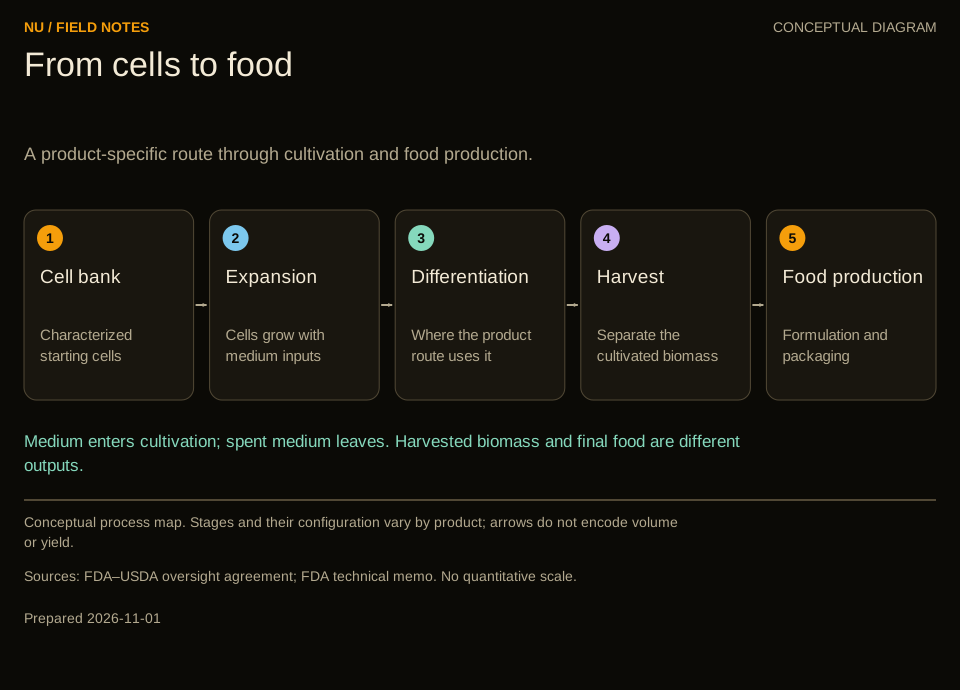
Conceptual process map. Stages and their configuration vary by product; arrows do not encode volume or yield.
Start by naming the material
Before discussing scale, ask what the proposed output actually is. Cultivated fat intended as a flavour ingredient, a blended product containing animal cells and plant ingredients, and a structured piece of muscle-like tissue have different manufacturing objectives. Their performance cannot be compared sensibly using a single category called meat production. Even their most relevant unit of output may differ.
A fat ingredient might be judged partly by the sensory effect delivered at a particular inclusion rate. A bulk protein ingredient raises questions about protein content and processing behaviour. A structured food introduces requirements for shape, texture and consistency through its thickness. These are editorial examples of product specifications, not claims that any particular manufacturer has achieved them. They illustrate why the destination should be established before selecting impressive process numbers.
The FDA's scientific memorandum of 14 November 2022 for UPSIDE Foods defines the evaluated material at harvest and describes a particular sequence involving proliferation, differentiation and collection of cell sheets. Its discussion of cell banking explains a standardised starting source, with master and working banks. This is evidence about one described process, rather than a universal recipe for cultivated meat. FDA consultation memorandum CCC 000002.
The distinction suggests a simple reporting discipline. A mass figure should name the material, its moisture basis and its position in the process. Was it measured before washing, after dewatering, after blending, or in the package? Does it include a carrier that remains as an ingredient? Is the quoted quantity an actual accepted lot or a projected annual capacity? These questions are not an exercise in diminishing progress. They make progress comparable.
A company could substantially improve recovery while leaving cell growth unchanged. Another could improve the final recipe while using the same cultivated ingredient. Both are meaningful advances, but neither should be described as a multiplication of biological productivity. Naming the material helps readers see where the improvement occurred.
A cell bank is a production starting point
A useful cell line must do more than multiply once. It must retain the characteristics needed for the intended product over the production history being claimed. A freezer inventory, a species identification and a growth curve each answer different questions. The first concerns the physical starting stock, the second its biological identity, and the third its behaviour under particular conditions.
Imagine two hypothetical runs beginning from different working banks. Their final cell counts match, but one run takes longer and produces a different proportion of the desired cell type. A headline based only on the final count conceals a scheduling difference and a composition difference. The operational comparison needs the bank identifier, passage history, process conditions and final characteristics together. None of those fields is a substitute for the others.
The July 2026 FSA and FSS identity guidance asks for evidence concerning cell identity, genomic and phenotypic stability, and the production history. It also treats the final food's identity as something that must be described, including retained structural materials where applicable. Those requirements connect the starting cell population to what is ultimately offered for consumption. Identity, production and microbiology guidance, published 10 July 2026.
One consequence is that faster growth is not automatically an improvement in every dimension. A change that makes expansion easier could alter downstream differentiation, composition or recovery. The right comparison is the whole production chain using the changed line. If an earlier stage saves time but a later stage becomes less reliable, the net effect may be small or negative.
Replication also needs a named unit. Five measurements from one sample describe measurement repeatability differently from five separately produced lots. If those lots all depend on the same input batch, their shared dependency remains relevant. A public result need not disclose every supplier detail to explain that distinction. It can state whether the variation comes from repeated instrument readings, separate samples, separate production runs or different campaigns. Without that information, a narrow error bar can look like evidence of dependable manufacturing when it describes only precision in measuring one material. The distinction is especially useful when a promising result is being used to justify the next increase in production scale.
This also changes how continuity should be discussed. Repeatedly producing an acceptable material from a documented starting point provides a stronger basis for manufacturing claims than repeatedly obtaining a high count from loosely described cultures. The relevant achievement is reproducibility of the intended result, not merely persistence of living cells.
Expansion and maturation ask different things
A production process may separate the expansion of cell numbers from development of the characteristics desired in the food. Those stages should not disappear inside a single growth-rate claim. Time spent building the population and time spent changing its state both occupy equipment and consume materials, even when only one stage produces the most dramatic increase in cell count.
Consider a fictional process with seven days of expansion and three days of subsequent maturation. Shortening expansion by one day reduces the combined biological schedule from ten days to nine, assuming everything else remains unchanged. It does not reduce the entire schedule by one seventh. Adding cleaning, preparation and release delays makes the percentage improvement smaller still. The arithmetic is elementary; the reporting error is easy to make.
A useful process description would therefore distinguish the purpose of each stage, its entry and exit criteria, and what happens to the material between stages. Transfer can involve a change of vessel, physical environment or medium. Every transfer also has an output quantity and a recovery fraction. A diagram that shows only arrows between increasingly large tanks may omit the step that determines the final food's character.
The same reasoning applies when comparing products. A process designed for a dispersed ingredient should not be penalised for failing to create a thick cut it never intended to make. Conversely, a demonstration of dispersed cells cannot establish the manufacturability of an organised structure. The intended food sets the relevant test.
This is why a transparent process map can be more useful than a single maximum-density result. It reveals which claims concern expansion, which concern maturation, and which concern food assembly. Readers can then ask whether each stage has been demonstrated at the scale and repetition implied by the overall claim.
Enlarging a vessel changes the problem
Simple geometry explains part of the difficulty. If every linear dimension of an idealised vessel doubles, its volume increases eightfold while its surface area increases fourfold. Surface area per unit volume is halved. This calculation does not predict a real reactor's performance, but it establishes why a larger vessel cannot be assumed to exchange heat or interact with its contents in exactly the same way per litre.
Mixing raises a related question. Two vessels can share the same average measured concentration while containing different local environments. Material introduced at one location takes time to spread. A sample near a well-mixed region may fail to describe a poorly mixed region. A useful scale-up argument consequently needs to explain which conditions are being preserved and which are allowed to change.
David Humbird's 2021 techno-economic study examined conceptual cultivated-cell production facilities and identified constraints involving metabolism, transfer, shear and contamination safeguards. Its conclusions arise from specified process models and assumptions, not an inspection of every subsequent commercial design. The study is valuable as a structured challenge to easy scale extrapolation; it should not be used as a timeless verdict on all possible processes. Humbird, “Scale-up economics for cultured meat”.
One way to interrogate a scale claim is to ask for the preserved quantity. Is the argument based on similar mixing time, similar power per volume, similar transfer capacity, or comparable biological outcomes? These can pull design choices in different directions. Saying that a large vessel resembles a small one visually provides no answer.
There is also an alternative to making every vessel larger: operate more vessels. That can reduce the leap between demonstrated and deployed unit size, while increasing the number of connections, transfers and parallel schedules. Scale-out changes the problem rather than removing it. The comparison must include the supporting plant, staffing and coordination demanded by the chosen arrangement.
Oxygen arrives through an interface
Oxygen transfer provides a concrete example of why the liquid's average appearance tells little about capacity. A common simplified expression multiplies a volumetric transfer coefficient, written kLa, by the difference between an equilibrium concentration and the actual dissolved concentration. The result has units of oxygen mass transferred per liquid volume per time. Cell demand must be considered alongside that supply relationship.
Take a purely illustrative coefficient of 20 per hour and a concentration difference of 5 milligrams per litre. Their product is 100 milligrams per litre per hour. Across 1,000 litres, the corresponding transfer quantity is 100 grams per hour. These invented values are a unit demonstration, not a design recommendation or a claim about a cultivated-meat facility. Altering the concentration difference alters the calculated transfer even if the coefficient stays fixed.
The example also shows why a single oxygen reading is insufficient. It describes a state at a location and time. Transfer capacity describes a rate under conditions. Demand changes with the biological population and its activity. A system can hold an acceptable reading during one part of a run and encounter a limitation later. The relevant evidence is the relationship over the operating history being claimed.
A 7 April 2025 preprint by Minki Kim, Daniel Harris and Radu Cimpeanu models fluid motion, mixing, oxygen transfer and shear in a rocking bioreactor. It is a computational study, not a demonstration of commercial food output. Its usefulness here is the explicit treatment of competing hydrodynamic behaviours rather than reliance on one average mixing measure. Version-one preprint and full text.
The editorial inference is straightforward: a persuasive scale-up account should connect a physical measurement to a biological result. Better transfer alone does not establish better food production if another change damages the cells, complicates recovery or consumes disproportionate energy. The relevant improvement survives the rest of the process.
Density, yield and productivity belong in different columns
Density describes how much material occupies a volume. Yield describes output relative to an input or an earlier amount. Productivity includes time. These concepts can move independently, and combining them into a vague claim of efficiency makes a process difficult to evaluate.
Here is a deliberately fictional accounting example. A 1,000-litre working volume reaches 80 grams of wet biomass per litre. That gives 80 kilograms of wet biomass before recovery. If the recovery fraction is 80 percent, the recovered amount is 64 kilograms. If cultivation takes ten days and turnaround takes another two, the schedule averages about 5.33 kilograms of recovered wet biomass per day for that vessel, before any additional downstream bottleneck.
None of those numbers describes a real company. Their purpose is to expose the missing terms. Reporting only 80 grams per litre drops recovery and time. Reporting 80 kilograms per run drops recovery. Dividing 64 kilograms by ten days drops turnaround. Each shorter calculation can be internally correct while answering a less useful question than the reader assumes.
Moisture introduces another denominator. Suppose, again hypothetically, that wet material is one quarter dry matter and that protein constitutes three fifths of that dry matter. Protein would then represent 15 percent of the wet mass. A kilogram of the wet material and a kilogram of protein are plainly different outputs. A comparison that changes between them without notice can create a large apparent improvement from bookkeeping alone.
The best performance table keeps these quantities separate and identifies their measurement methods. It should also show variability, because the average may conceal failed runs or wide fluctuations. A peak density is informative about a demonstrated state. Recovered, conforming output over an actual calendar period is more informative about production capability.
Continuous operation still has boundaries
Batch, fed-batch and perfusion arrangements distribute inputs and outputs differently. In a batch-style accounting picture, much of the material is collected at the end. Adding feed changes the input history. In a perfusion arrangement, liquid exchange can occur while a retention system keeps much of the cell population in the process. The comparison should follow the actual streams rather than assume that continuous operation automatically means lower resource use.
A hypothetical 1,000-litre system exchanging one vessel volume of liquid each day would handle 1,000 litres of daily liquid flow. That statement alone says nothing about the nutrient utilisation, the amount of biomass recovered, or the treatment required for the outgoing stream. Retaining cells does not establish that every useful dissolved component is recovered. A flow diagram must distinguish those functions.
Pasitka and colleagues reported continuous cultivated-chicken manufacturing research in Nature Food in August 2024. The publisher abstract describes extended harvesting and an economic analysis of a theoretical large facility. The experimental result and the modelled facility are different evidence layers. Only the complete abstract and publication metadata were accessible for this article, so no uninspected methods or commercial operating record are asserted. Pasitka and colleagues, published 21 August 2024.
For a long-running process, continuity itself needs a definition. How long did the observed period last? Were output composition and recovery stable throughout it? How were interruptions handled? What establishes the boundaries of a lot for traceability and testing? These questions do not presume failure; they identify the evidence needed to interpret a continuous-production claim.
An impressive uninterrupted demonstration can reduce one uncertainty while leaving others open. It may show that a particular culture arrangement can persist, yet leave unanswered how often it needs replacement, how downstream handling performs, or how representative the run is. The value of the demonstration becomes clearer when those boundaries are stated rather than silently expanded.
Medium cost follows consumption, not the bottle label
A low price per litre of medium attracts attention because it is easy to compare. The economically relevant quantity also depends on how many litres are used per unit of accepted output. A more expensive liquid can be cheaper per kilogram of product if less is needed, while a cheaper formulation can be costly if consumption or losses increase.
In an invented example using abstract cost units, medium priced at 0.5 units per litre and consumed at 50 litres per kilogram contributes 25 units per kilogram. Medium priced at one unit per litre and consumed at ten litres per kilogram contributes ten units per kilogram. These are not market prices. They demonstrate the multiplication that a cost claim must make visible.
The same logic extends to preparation and handling. A supplied ingredient price may exclude mixing, water treatment, quality checks, storage losses and disposal. Some of those costs may be small; others may matter. Their importance should be established from the process rather than assumed from the price of one component. A reduction in purchasing cost is valuable, but it is only one term in the calculation.
Descriptions of media also need precise language. Removing serum, removing all animal-derived inputs and defining the chemical composition are different attributes. A label addressing one attribute should not be read as evidence for the others. For a reader evaluating a claim, the useful follow-up is the actual definition used by the authors and the production stages to which it applies.
There is a broader supply-chain question as well. A formulation can work with carefully characterised research supplies without establishing that multiple suppliers can deliver equivalent material at the intended volume. That is an inference about manufacturing evidence, not a claim that a particular ingredient is unavailable. Demonstrating interchangeability requires showing that the relevant output remains acceptable when the input source changes.
A support material can become part of dinner
Cells grown with structural supports create a second material-accounting problem. If the support is removed, separation and residual material need to be considered. If it remains, it contributes to the food's composition and physical behaviour. The word scaffold describes a production role; it does not by itself settle the material's fate or suitability in a finished product.
Zhou and colleagues' February 2025 Nature Communications study used edible macroporous microcarriers to produce fish muscle- and adipose-cell microtissues for printing research fillets. This is an experimentally described approach to combining cell growth with food structure. It does not establish an industrial throughput or a market authorisation. Zhou and colleagues, published 18 February 2025.
The distinction changes how mass should be reported. If a final composite includes both cells and retained support, its total mass should not be silently treated as cell biomass. Nor should the support be dismissed as irrelevant merely because it was introduced during cultivation. Its contribution may be important to the intended texture, ingredient declaration and nutritional composition.
Imagine two hypothetical samples with identical total mass. One contains more cells and less structural material; the other contains fewer cells and more structure. They could have different functional properties despite sharing a headline yield. A fair comparison would specify composition and the performance target rather than ranking them automatically by the higher cell fraction.
This is also where biology and food design meet. The most useful structure for growing cells may not produce the most desirable eating quality after processing. The process therefore needs evidence linking cultivation performance to the final material. A successful cell-support experiment establishes one part of that chain. Demonstrating the complete food requires testing the additional transformations rather than assuming their outcome.
Harvest determines what reaches the next room
The transition from culture to ingredient is a major accounting boundary. Material may be separated, washed, concentrated or otherwise prepared for formulation. Each operation can change the amount recovered and the composition of what remains. The relevant production figure should identify the point at which those changes have already occurred.
Suppose a hypothetical plant improves a growth stage by 10 percent but experiences a larger proportional reduction in downstream recovery. Its final output can fall even while the biological result improves. The inverse can also happen: an unchanged culture process may deliver more saleable material because recovery becomes more consistent. Measuring both stages prevents the wrong improvement from receiving credit.
A whole-line capacity claim should likewise identify the bottleneck. If three fictional stages can handle 80, 50 and 100 kilograms per day respectively, the line cannot sustain 100 kilograms per day simply because the final machine can. Storage can buffer temporary differences, but it does not indefinitely eliminate a slower stage. Real scheduling is more complicated; the minimum-capacity example explains the basic constraint.
The measurement challenge is to keep the mass balance closed. Starting material, recovered material, retained liquid and discarded streams should have compatible definitions. Unexplained differences invite errors, especially when water content changes. A dry-matter balance can reveal something that a wet-mass total conceals, although it still does not establish the identity of every component.
For outsiders, the useful question is whether reported output has passed the process's acceptance criteria and is available for its intended downstream use. Material still awaiting evaluation is different from released ingredient. Material released as an ingredient is different from a finished package. Those distinctions let a production claim describe what the plant has actually accomplished.
Food safety is tied to the process being assessed
The practical safety question follows the material through its transformations. Potential problems can enter with inputs, arise during handling or become relevant after harvest. A controlled growth environment is one part of the account. The finished food also has a composition, a storage history and an intended use.
The July 2026 identity and microbiology guidance requires applicants to connect microbiological controls to the described production stages and scale. Its emphasis on process-specific evidence matters: a general statement that a facility is clean cannot replace an explanation of how the relevant hazards are controlled along that particular route. FSA and FSS production guidance.
For a reader, it helps to distinguish a detection result from a prevention system. A test examines the material sampled using a method with particular capabilities. A prevention system concerns how the process reduces the opportunity for a problem to arise or persist. The two forms of evidence complement each other. Neither should be inflated into a guarantee extending beyond its scope.
The same applies to an absence claim. A report should state what was sought, in which material, using which analytical method and at what point in production. A result from an early intermediate cannot automatically describe the finished food after later handling. A finding from one lot cannot alone establish the distribution of results across future production.
This is not a set of instructions for making or releasing food. It is a way to read the evidence offered for a food process. Responsible reporting should avoid both an unsupported promise of inherent safety and an unsupported assertion that cell cultivation creates a unique, unmanageable danger. The assessment concerns the identified product, its inputs, its process and its proposed consumption conditions.
Residues make the final matrix important
The September 2026 growth-media guidance calls for component information, appropriate residue measurements and exposure assessment in the final food. It also distinguishes analytical detection limits from a demonstration that a substance is absent. For biologically active inputs, it asks about their fate through processing and consumption-relevant conditions. FSA and FSS toxicology guidance.
That framework discourages two shortcuts. Listing a substance used somewhere in production does not establish the amount a consumer encounters. Conversely, saying that processing removes a substance does not establish how much remains unless the removal claim is supported. The evidential bridge is the relationship between input, transformation, residual concentration and the food's intended use.
An illustrative measurement problem shows why the matrix matters. An analytical method may perform well on a simple liquid but differently on a mixture containing fat, protein and structural ingredients. Establishing performance in the relevant material is part of making the result interpretable. The number printed by an instrument acquires meaning through the method and sample, rather than through precision of decimal places alone.
A hypothetical exposure calculation also requires consistent units. A concentration expressed per kilogram of ingredient cannot be combined directly with a serving mass expressed in grams without conversion. If that ingredient is only part of a composite food, its inclusion fraction matters as well. These are accounting observations, not a calculation of a safe dose for any real substance.
The larger lesson is that process inputs and consumer exposure occupy different places in the evidence chain. Good reporting traces the connection instead of letting an alarming ingredient name or reassuring process description stand in for measured, product-specific information.
Nutrition is a property of the food offered
The FSA and FSS nutritional guidance, published in December 2025, considers composition, digestibility, bioavailability and the role of the proposed food in the diet. It distinguishes the cultivated material submitted for assessment from the food as consumed, where relevant. Its allergenicity discussion also requires attention to the source and manufacturing inputs. Allergenicity and nutrition guidance, version 1.0.
This prevents a species label from carrying more information than it contains. Identifying a source as chicken or fish does not by itself specify the nutrient composition of every resulting product. The formulation, retained materials and preparation may all affect what the consumer receives. A nutritional comparison therefore needs named foods and a defined basis.
For example, comparing an uncooked cultivated ingredient with a cooked conventional dish would mix process differences into the comparison. Comparing equal wet masses answers a different question from comparing equal amounts of protein. Neither basis is automatically wrong; the choice should follow the question. The difficulty begins when the basis changes between the headline and the supporting table.
A further distinction concerns replacement. An ingredient used in small quantities for a particular food function has a different dietary context from a food intended to replace a large share of a familiar staple. Evaluating the proposed use requires knowing how much enters the final product and how that product is expected to be consumed. That context cannot be recovered from a cell-growth result.
Readers should therefore look for composition measurements of representative material and an explanation of the comparison being made. Claims of nutritional superiority deserve their own evidence. A successful cultivation process, an acceptable safety conclusion and a favourable nutrient comparison are related accomplishments, but each requires a separate demonstration.
An authorisation statement needs a jurisdiction and an object
The United States' FDA–USDA agreement of 7 March 2019 divides oversight for foods derived from cell lines of USDA-amenable species, with FDA responsibilities through cell culture and a coordinated transition at harvest to USDA responsibilities for the relevant downstream activities. Its species-specific scope should be retained when explaining the arrangement. FDA–USDA formal agreement.
When the FDA announced completion of its first pre-market consultation in November 2022, it explicitly described that voluntary consultation as distinct from an approval process and identified additional requirements before market entry. A no-further-questions conclusion about submitted information should be reported in those terms, with the named product and process. FDA announcement, 16 November 2022.
Great Britain's September 2026 authorisation guidance describes a pathway through assessment and a ministerial decision, with conditions attached to authorised products. It also explains why changes in production can require further regulatory consideration. Guidance for England, Scotland and Wales should not be silently presented as a rule for every jurisdiction. FSA and FSS regulatory authorisation guidance.
The European Food Safety Authority's novel-food page, last reviewed on 21 October 2026 and accessed for this article on 31 October, states that no cell-culture-derived foods of animal origin had yet been approved for sale in the European Union. That is a dated agency statement, not a prediction of subsequent decisions. EFSA also distinguishes its scientific assessment role from the approval decisions of the Commission and member states. EFSA novel-food overview.
Together these examples suggest a better headline grammar: identify who decided what, for which material, under which described process, and in which jurisdiction. An announcement about one stage of review should not expand into permission for every product in the category. Nor does a regulatory milestone establish the commercial volume actually supplied. Market access and manufacturing performance answer different questions.
Cost depends on the calendar
Manufacturing cost combines variable consumption with resources that continue to cost money while production is interrupted. A favourable estimate can therefore be highly sensitive to assumed utilisation. A plant's nominal capacity describes what a model or design permits under specified conditions. Actual accepted output records what happened over a period that includes maintenance, changeovers and unsuccessful runs.
Consider a fictional annual fixed cost divided first by 1,000 tonnes and then by 500 tonnes of accepted output. With the numerator unchanged, the fixed-cost contribution per tonne doubles. No change in medium price is needed. This simple relationship explains why a pilot cost and a projected mature-factory cost may differ without either being calculated dishonestly. They may embody very different utilisation assumptions.
The useful disclosure is a bridge between them. Which costs were measured? Which were quoted by suppliers? Which depend on a future scale, a future ingredient price or a future success rate? Which activities are outside the boundary? A single final cost obscures these distinctions, while a sensitivity analysis can show where the estimate is most fragile.
Failure accounting deserves particular care. Reporting only successful runs can describe what the process can achieve, but it does not describe the average resource cost of obtaining those successes. Materials, energy and time consumed by rejected output remain part of the production history. Their treatment should be explicit in any cost or environmental calculation.
This does not imply that early production must already meet mature economics to be scientifically useful. It means that progress should be reported on the correct scale. Demonstrating a new capability, lowering a measured input requirement and validating a commercial cost are different milestones. Each becomes more credible when the next unproven step is named.
Environmental comparisons depend on the chosen future
Sinke and colleagues' January 2023 life-cycle assessment models commercial-scale cultivated meat in 2030 using prospective process and supply-chain assumptions. It examines energy and input choices rather than reporting the footprint of a mature industry already operating at that scale. The June 2023 correction should be read with the original, particularly when using its environmental results. Original assessment, published correction.
Risner and colleagues' study, published online in December 2024 and in a 2025 journal volume, explores near-term scenarios with different assumptions about medium production and refinement. Its purification treatment is an estimated modelling factor, not a measurement of every supplier's process. The analysis foregrounds upstream inputs and discloses important boundary exclusions. Full primary paper.
Comparing those studies usefully begins with their questions and boundaries, rather than selecting the more dramatic result. A prospective efficient factory and a near-term input-intensive scenario are different propositions. The next empirical work is to establish which assumptions resemble a particular production system and which remain ambitions.
An original arithmetic example makes one dependency visible. If a hypothetical process uses 15 kilowatt-hours of electricity per kilogram, an electricity intensity of 0.4 kilograms of carbon dioxide equivalent per kilowatt-hour gives six kilograms of electricity-associated emissions per kilogram of output. At an assumed intensity of 0.05, the same electricity consumption gives 0.75 kilograms. These invented inputs illustrate multiplication only. They omit ingredients, heat, construction, transport, waste and other life-cycle terms.
Changing electricity supply can therefore change one important contribution without proving that the whole product has a particular footprint. Likewise, reducing direct plant energy does not account for upstream energy embodied in inputs. An environmental claim needs a clearly defined product, functional unit, boundary, comparison and time horizon. The phrase cultivated meat supplies none of those automatically.
What a repeatable food process would show
The most informative future evidence would connect several records that are often published separately. It would link the starting cell bank and process version to run duration, input consumption, recovered composition, accepted output and downstream food performance. It would explain variation across production rather than featuring only the best result. It would distinguish measured operations from the extrapolations used to describe a larger facility.
That connection is valuable even when some commercial details remain confidential. Public reporting can state the boundary of an observation without disclosing a proprietary formulation. It can identify whether output is wet biomass or final food, whether a facility was operated or modelled, and whether a result represents one demonstration or repeated production. Those distinctions do not require a complete factory blueprint.
For readers, the most productive question is where the evidence chain currently ends. Perhaps cell growth is demonstrated while downstream recovery remains a projection. Perhaps repeated product composition is established while costs still depend on future procurement. Perhaps a regulatory assessment is complete but commercial utilisation remains unknown. Each situation supports a different, specific account of progress.
Cultivated meat will be understood more clearly when those accounts replace a contest between technological inevitability and categorical dismissal. The cells are part of the story. The food process includes everything needed to turn them into consistent output, under a defined safety case, with resources and claims that can be counted. That is the level at which an interesting biological demonstration becomes an intelligible manufacturing achievement.