A large percentage reduction can be a genuine engineering achievement and an insufficient biological result. Ballast-water treatment makes that distinction unusually concrete. A ship can take up water containing many organisms, remove or inactivate most of them, and still discharge a concentration above a specified limit. Evaluating the system requires both ends of the calculation: what entered and what remained.
A May 2025 study by Oscar Casas-Monroy and colleagues examined eleven paired uptake-and-discharge events on ten ships in the Great Lakes and St. Lawrence River region, using samples collected in 2019 and 2022. Treatment reduced organism abundance substantially, but four discharge samples exceeded the limit for the larger regulated size class; all met the smaller-class limit. The paired design made the treatment effect visible even where the endpoint was missed. Those results describe a sampled set of operations, not a contemporary global fleet failure rate. Casas-Monroy and colleagues, primary study
The regulatory framework is also changing through a process that should be described accurately. IMO's convention-and-guidelines page, checked on October 31, 2026, says a package of amendments was approved in May 2026 for adoption at a December 2026 session. Approval for future adoption is not the same as completed adoption or entry into force. The same page records earlier changes to commissioning tests and record books. This article explains the evidence behind treatment and assessment; it does not determine the legal obligations of a particular ship or voyage. IMO's implementation and amendment account
Behind those institutional steps lies a biological problem with several stages. Organisms must be taken aboard, survive or remain capable of later reproduction, leave the ship and encounter conditions in which they can establish. Treatment targets the transport pathway before that sequence is completed. A good assessment asks how much of that pathway has been interrupted and what the measurements can actually demonstrate.
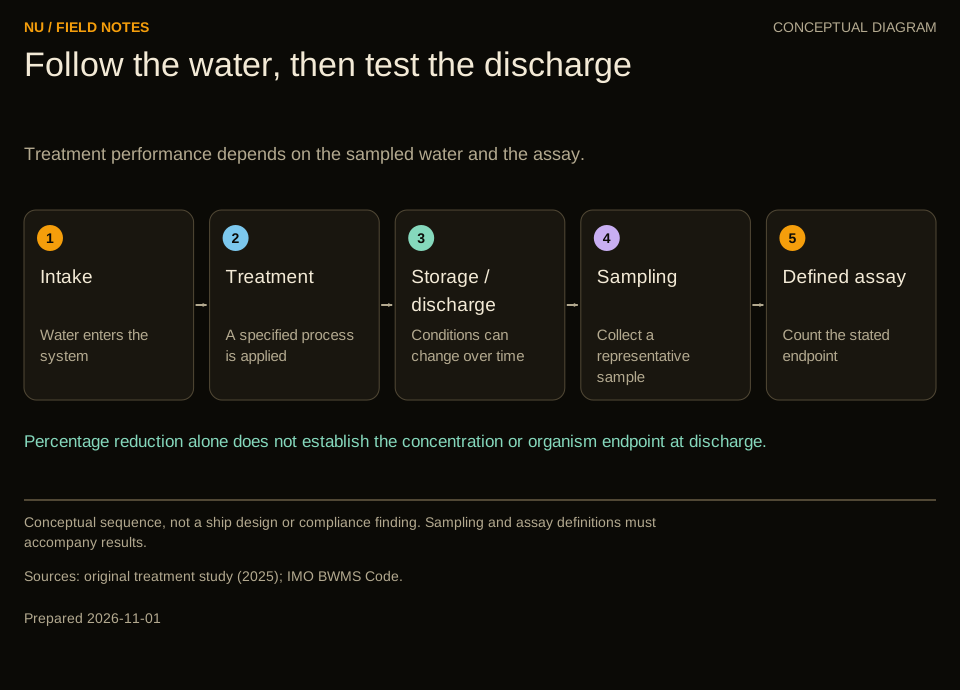
Conceptual sequence, not a ship design or compliance finding. Sampling and assay definitions must accompany results.
Follow the water rather than the equipment label
Ballast water serves a ship's operational needs, including stability as loading conditions change. From an ecological perspective, it also creates a connection between places that might otherwise exchange organisms much less directly. The tank is part of a journey, not a sealed laboratory vessel. Its water has an origin, an uptake time, a treatment history and an eventual destination.
Consider a fictional vessel, the Northhaven, used here only as an analytical example. It takes on water at one port, retains some from an earlier operation, treats incoming water and later discharges through another part of its system. A brochure describing the installed treatment technology would not by itself reveal the biological state of that final discharge. The relevant history includes which water passed through which process and when.
A useful diagram would therefore begin at uptake and continue through every relevant branch. Storage belongs on the diagram because the interval before discharge can change the sample being assessed. Return lines and residual volumes belong if they affect the water's route. The diagram need not disclose sensitive ship information to explain this logic. Its purpose is to connect the tested endpoint to the process claimed to produce it.
This also clarifies why an equipment approval, an installation check and an operational sample answer different questions. Approval evaluates a system under specified testing conditions. An installation check concerns the system as fitted to a vessel. A discharge sample observes a particular operation. Each can provide evidence, but none makes the others redundant.
For Northhaven, a hypothetical fault might arise from an incorrectly configured installation, a water condition outside the tested range or a measurement problem rather than a defective treatment principle. Diagnosing the cause would require records and suitable observations. A single non-compliant result should not be inflated into proof that every system using the same technology fails, just as a passing result should not be treated as a permanent guarantee.
This is a practical reason to preserve operational context with biological results. A count without its sampling time and treatment stage is easy to misinterpret. A system log without biological testing may show that equipment ran while leaving the endpoint uncertain. The two records become more useful when they can be aligned to the same water-handling event.
The denominator is part of the standard
IMO distinguishes a volumetric water-exchange standard from the D-2 discharge-performance standard. Its official explanation describes the latter in terms of organism concentrations, with fewer than ten viable organisms per cubic metre in the class at least fifty micrometres in minimum dimension, and fewer than ten per millilitre in the class from ten to below fifty micrometres. Specified indicator microbes have separate limits. These are different size classes and different volume units, not two versions of the same count. IMO's explanation of the standards
One cubic metre contains one million millilitres. Omitting the volume unit can therefore create an enormous numerical misunderstanding. A dashboard saying only ten organisms would be incomplete even before considering whether those organisms were alive, capable of reproduction or in the relevant size range. The unit, biological category and measurement method belong together.
An original hypothetical calculation shows why reduction and endpoint need separate reporting. If uptake contains one hundred thousand organisms per cubic metre, a ninety-nine per cent reduction leaves one thousand per cubic metre. A reduction of ninety-nine point nine nine per cent leaves ten. Where the comparison is strictly fewer than ten, exactly ten is not below the numerical boundary. This arithmetic is illustrative, not a compliance determination for a real discharge.
The example also shows why two systems reporting the same percentage can produce different remaining concentrations. If one starts at one thousand and another at one hundred thousand, the same reduction fraction leaves different totals. A percentage without the starting concentration can conceal the challenge the equipment faced. An endpoint without uptake information can conceal a substantial treatment effect.
Both quantities are useful, but for different purposes. The reduction helps characterize treatment performance. The remaining concentration addresses the specified discharge endpoint. Neither directly calculates the probability of a successful invasion, which also depends on the organisms and receiving environment. A responsible report can place all three concepts side by side without substituting one for another.
Size classification introduces another potential error. The relevant minimum dimension is not necessarily the longest visible feature on an organism. A cell or animal may have projections that make a quick visual estimate misleading. Laboratories need a defined classification procedure, and comparisons between studies should check whether their size categories actually match. A label such as small plankton is not precise enough for a threshold-based analysis.
Living and capable of reproduction are different questions
The IMO BWMS Code, adopted in April 2018, defines viability in terms of the ability to generate new individuals. It also links assessment methods to treatment technology and recognizes several possible characteristics of life used in testing. The distinction matters because an organism can show a biological signal at the time of observation without necessarily retaining reproductive capacity. This is a description of the code and biological concepts, not a claim that every administration accepts every assay interchangeably. IMO's BWMS Code.pdf)
The words should be unpacked before comparing instruments. A test might observe movement, an enzyme-dependent fluorescent signal or growth under culture conditions. These are different observations. Movement can be absent in an organism that is not normally motile. A stain can be affected by the organism's properties and the way the assay is performed. Growth depends on conditions that permit growth as well as the state of the cell.
For a hypothetical treated sample, imagine that an immediate assay detects activity in several cells while a later reproduction-based assay detects fewer successful growers. The difference does not automatically mean one analyst made a mistake. The assays may be measuring different consequences of treatment. To interpret the disagreement, investigators must consider the mechanism, timing and validation of each method.
For the Northhaven example, the appropriate question is therefore more specific than whether its water is alive. Which organism class is being assessed? Which property does the test observe? At what interval after treatment? Under which accepted procedure? Those details determine what a positive or negative result means.
It is especially important not to import an old paper's regulatory description into a current compliance claim. Research can remain useful for understanding an assay even when rules or accepted methods have changed. The scientific result and the applicable administrative requirement should be dated and checked separately. This article does not use historical method disputes as a substitute for current jurisdiction-specific advice.
An ultraviolet experiment tests a mechanism, not every harbour
A primary study published online in September 2017 by Hugh MacIntyre and colleagues developed quality-control criteria for a culture-based most-probable-number assay and measured ultraviolet-C responses in twelve phytoplankton species. The species differed markedly in sensitivity, and the study evaluated loss of reproductive viability rather than relying only on an immediate signal of activity. Its controlled experiments provide evidence about the assay and tested organisms. They do not demonstrate identical performance for every natural community or every full-scale installation. MacIntyre and colleagues, primary experiment
This distinction between mechanism and deployment is useful across treatment technologies. A laboratory can isolate a variable and determine how a selected organism responds. A vessel must process a changing mixture of organisms and water properties under operational constraints. Both settings are necessary for understanding performance, but their advantages differ.
An original thought experiment illustrates the inference problem. Suppose two hypothetical organisms are exposed under the same controlled conditions and one remains capable of growth while the other does not. That establishes a difference for those organisms and conditions. It would not justify assuming that every organism of the first one's size is resistant, or that every organism of the second one's broad group is susceptible. The relevant variation may not follow the simplest visual category.
The same caution applies when reading a treatment percentage from an experimental paper. A percentage measured under a stated challenge is not automatically a recommended operating setting. Translating research into a certified installation involves engineering design, validated limits and authorized procedures. This article supplies no dosing instructions or advice to alter shipboard safety settings.
For readers evaluating a vendor claim, the useful questions concern the demonstrated range. Which water conditions were tested? Which organism classes were assessed? How was performance measured? Were the results repeated? Is the claim about the treatment reactor, the complete system or a particular installed configuration? Asking these questions is more informative than assuming that the name of a treatment method determines its effectiveness.
A strong technical claim can be narrow and still valuable. Evidence that a system performs reliably under a defined set of conditions provides a foundation for use within those conditions. The problem arises when the boundaries disappear in retelling, turning a qualified demonstration into a promise of universal performance.
Reproducing a count across laboratories
A separate study published online in July 2018 tested the reproducibility of the serial-dilution culture method across three laboratories using three phytoplankton species and controlled viable and heat-killed cultures. The results supported the method's precision and transferability under that experimental design. This was a useful validation step, while its limited set of organisms and controlled mixtures remain part of the scope. MacIntyre and colleagues, inter-laboratory validation
Reproducibility matters because a method should not depend entirely on one experienced team's unrecorded judgement. Shared protocols, reference materials and quality controls make it possible to distinguish biological variation from differences in handling or interpretation. When laboratories disagree, the investigation should examine the whole chain rather than treating the instrument reading as an isolated fact.
A hypothetical inter-laboratory comparison could divide one well-mixed sample into several portions and send them to separate laboratories. Agreement would be informative, but it would not by itself test whether the original sample represented the vessel's entire discharge. That is a separate sampling problem. Laboratory validation and field representativeness protect different links in the evidence chain.
Similarly, a method can be precise but biased. Several laboratories might repeatedly obtain values close to one another while systematically missing a class of organisms. Precision describes repeatability; accuracy concerns correspondence to the quantity being estimated. A validation programme needs questions capable of exposing both kinds of problem.
The distinction becomes important near a numerical boundary. A result of nine, ten or eleven can look decisive on a screen, while the underlying uncertainty may make the differences difficult to interpret. The legally applicable decision procedure should be followed, and the analytical report should not hide its uncertainty. An explanatory article cannot replace that procedure with an improvised rounding rule.
Clear documentation also allows a result to be revisited. If sample volume, dilution, handling time and counting criteria are recorded, another analyst can investigate a discrepancy. If only the final pass-or-fail label survives, the opportunity to learn from it is much smaller. That loss affects both environmental protection and the fair diagnosis of equipment problems.
The culture method remains a subject of scientific criticism
A December 2024 review by Louis Peperzak argues that culture-based estimates can be compromised by failure of some taxa to grow and by growth of organisms outside the target size class. It also questions particular uses of standard most-probable-number tables for mixed assemblages. These are methodological criticisms, not a new fleet survey. They belong alongside controlled validation studies because success with selected cultures does not resolve every challenge posed by a natural mixture. Peperzak's methodological review
The competing concerns can be explained without declaring a universal winner. A test aimed at reproduction is closely aligned with one biological endpoint, but its culture conditions may not reveal all capable organisms. An immediate activity assay can be faster but observe a property that is not identical to future reproduction. The practical task is to characterize these limitations, establish appropriate uses and follow the relevant approved method.
Such disagreements are not a reason to abandon measurement. They are a reason to describe the measured endpoint clearly and improve methods where their limitations matter. Scientific criticism can identify which comparisons are still needed. It can also prevent a convenient rapid assay from acquiring more authority than the evidence supports.
For a general reader, the warning sign is a claim that a single biological signal definitively settles every question about treatment and invasion. Different assays can contribute complementary evidence. Their results become more useful when the report explains what each detects, what it may miss and how its performance was tested against an appropriate reference.
A rapid monitor needs a validated interpretation
A 2024 primary experiment by Leonardo Romero-Martínez and colleagues compared four compliance-monitoring devices using natural ultraviolet-treated water and two detailed reference approaches. Its conclusions emphasized that validation outcomes depended on the reference method, instrument and chosen decision limits. The study does not justify a timeless ranking of devices across all waters and treatments. It shows why a rapid reading needs an interpretation matched to the conditions and comparison used. Romero-Martínez and colleagues, primary paper
A monitor that provides a quick indication can be operationally valuable even if it does not directly enumerate every relevant organism. The key is to preserve the distinction between an indicative signal and the underlying biological concentration. Converting one into the other requires validation, not just a convenient display scale.
Imagine a fictional device reporting a fluorescence value. The reading might respond to the amount of a particular biological material, the state of the organisms or characteristics of the surrounding water. A calibration built on one set of samples could perform differently on another. Without examining that relationship, it would be unsafe to assume that doubling the signal always means doubling the number of viable target organisms.
The selection of a reference method also affects an apparent success rate. If a rapid instrument is compared with an assay that observes immediate activity, agreement answers a different question from agreement with a reproduction-based assay. Neither comparison should be described simply as agreement with truth without acknowledging the reference's own limits.
A useful validation report would therefore describe the sample set, treatment conditions, organism composition where known, decision thresholds and types of disagreement. False reassurance and unnecessary alarms have different operational consequences, but both matter. Reporting only overall agreement can conceal poor performance in the small subset of samples closest to a decision boundary.
For Northhaven, an indicative reading could prompt a closer look at system performance or an authorized follow-up test. It should not be used as a reason to improvise an unapproved discharge decision. The role of the instrument belongs in a defined procedure, with trained interpretation and a clear record of what was observed.
Sampling begins before the bottle reaches the laboratory
IMO's G2 sampling guidelines address representativeness of the discharge and recommend sampling near the discharge point where practicable. They explain why an in-tank sample may not estimate the discharged concentration accurately, particularly when treatment occurs during discharge. The guidelines also address handling and custody. These provisions support the principle that a technically excellent assay can still answer the wrong question if it receives the wrong sample. IMO's G2 sampling guidelines.pdf)
An invented calculation shows how an observation acquires its denominator. Suppose an analyst starts with one cubic meter of water, concentrates the retained material into 100 milliliters, mixes it uniformly and examines ten milliliters. These assumptions describe a teaching example, not an approved sampling procedure. The examined portion is one tenth of the concentrate. If eight target organisms are counted, multiplying by ten gives an estimated eighty organisms in the original cubic meter before any recovery correction.
Now suppose, purely for this example, that an independent recovery experiment supports an eighty-percent recovery assumption. Dividing eighty by 0.8 gives an adjusted estimate of one hundred organisms per cubic meter. Multiplying by 0.8 instead would move the estimate in the wrong direction: the correction is accounting for organisms assumed to have been missed, not removing another fifth of those observed.
Both numbers depend on assumptions. If the concentrate was unevenly mixed, ten milliliters might not represent one tenth of its organisms. If recovery differs among organisms or conditions, one correction factor can conceal uncertainty. Even flawless arithmetic cannot turn water from the wrong place or interval into a representative description of a whole discharge. The calculation explains the chain from counted objects to a reported concentration; it makes no finding about Northhaven's compliance or any real vessel.
Finally, sampling is a safety-sensitive activity on a working vessel. An explanatory account should not encourage unauthorized access to tanks, interference with piping or improvised collection. Actual work belongs to qualified personnel using approved arrangements. The need for representative evidence does not remove the obligation to protect the crew, inspectors and vessel.
Why a zero count needs a volume
When the target organisms are scarce, a small sample can contain none even if the larger discharge contains some. This is a statistical property of sampling, not evidence of misconduct. A report saying zero detected should therefore include the effective volume examined and the method's detection characteristics.
An original simplified model makes the point. Assume organisms are randomly and independently distributed at an average concentration of ten per cubic metre, and assume perfect collection and detection. A sample of one tenth of a cubic metre then contains one organism on average. Under a Poisson model, the probability of observing zero is about thirty-seven per cent. A zero result from that sample would not establish that the actual concentration was zero.
At the same hypothetical concentration, a full cubic-metre sample has an expected count of ten and a much lower probability of yielding zero under those assumptions. The example shows why volume matters; it is not a recommendation for a regulatory sample size. Real organisms may be clustered, methods imperfect and sampling non-independent, so the simple model can misrepresent actual uncertainty.
Clustering is especially important. If organisms occur in patches or aggregates, two samples of equal volume can differ more than a random independent model predicts. Increasing the number of observations across relevant parts of an event may answer a different question from increasing the volume drawn at one instant. The design should match the source of variability rather than assume all added volume provides identical information.
Subsampling introduces another denominator. A laboratory may receive a large concentrated sample but examine only a fraction. The reported concentration must account for the original volume, concentration process and fraction actually analysed. Losing track of any one of these can create an apparently precise but incorrect result.
Uncertainty is not an excuse to ignore an exceedance or a licence to declare compliance whenever the result is inconvenient. It is part of interpreting evidence within the applicable procedure. The scientific report should make its assumptions and limits visible so that the authorized decision-maker can apply the proper rule rather than a misleadingly exact number.
Operational evidence should not be read as a random fleet census
A February 2024 primary study by Okko Outinen and colleagues compiled treated ballast-water samples from 228 ships collected during 2017–2023. The results differed by organism category and by testing context, with commissioning tests showing a higher compliance rate than compliance tests. The study identified continuing operational challenges. Its sample collection and analytical context are essential: the result is not automatically the proportion of every ship worldwide that would fail on any given day. Outinen and colleagues, primary study
The distinction matters because tested vessels may not be selected randomly. Some are sampled during installation-related checks, others during ordinary operation or targeted assessment. Their routes, water conditions and equipment histories may differ. A combined percentage can be useful for describing the dataset while remaining unsuitable as an unbiased estimate of the entire fleet.
A hypothetical survey illustrates the issue. Suppose investigators deliberately focus on difficult intake conditions because they want to understand failure modes. The resulting exceedance rate could be higher than a randomly sampled fleet rate. That would not make the study flawed; its purpose is different. The problem would be reporting it as representative without explaining the selection.
Conversely, testing only convenient vessels under favourable conditions could make performance look better than it is across normal operations. A research programme needs both controlled tests that explain mechanisms and field samples that reveal the range of practical challenges. Their findings should be linked carefully rather than pooled as though every observation came from the same design.
Repeated sampling of the same vessel also requires attention. Ten events on one ship can reveal variability over time, but they are not identical to ten independent ships. Shared equipment and operating history can make those observations correlated. Reports should preserve the distinction between the number of vessels, the number of events and the number of laboratory subsamples.
This level of detail is useful for improvement. If failures concentrate under particular conditions, that can guide targeted investigation. If the pattern disappears when sampling methods change, measurement may be involved. If no clear predictor emerges, the absence of a simple explanation should be reported rather than filled with speculation about crew competence or manufacturer quality.
Sediment creates a different retention problem
IMO's 2012 G12 guidelines address design and construction intended to reduce sediment uptake and entrapment and facilitate its removal, sampling and safe access. Their continuing inclusion in IMO's current guidelines list shows that sediment remains a distinct management topic. The document does not establish the biological condition of any particular tank. It recognizes that water handling and retained material are related but separate design concerns. IMO's sediment-control guidelines.pdf)
For the fictional Northhaven, sediment remaining after a water operation would make the tank's history longer than the most recent intake. A later water movement could interact with retained material. Whether that creates a meaningful biological contribution would require evidence, but assuming that a newly recorded intake date describes everything in the tank would be too simple.
This is another reason to distinguish pathways. A treatment process applied to water moving through a line does not necessarily describe the condition of material retained elsewhere. Conversely, finding biological material in sediment does not by itself quantify what will be released in a particular discharge. Retention, resuspension, treatment and release each need to be considered.
Molecular detection adds a further interpretive step. A genetic signal can help identify organisms or material associated with them, but it is not automatically a count of individuals capable of establishing a population. A biological inventory and an assessment of current viability can be complementary without being interchangeable. The appropriate conclusion depends on the assay and sample.
Sediment management also belongs within ship safety and authorized maintenance. It is not an invitation for a curious observer to enter a tank or disturb retained material. Confined spaces and shipboard systems require professional procedures. The ecological importance of a sample does not make improvised collection acceptable.
The broader lesson is to describe the complete transport system. Water is the obvious medium, but retained material, residual volumes and treatment timing can all matter to what finally leaves the vessel. A clear account makes these possible connections explicit while avoiding unmeasured claims about the amount of viable material involved.
Reducing transport is not the same as predicting establishment
Treatment aims to reduce the delivery of organisms, but a successful biological invasion requires more than arrival. The receiving environment, the organisms' traits, the timing and the possibility of reproduction all influence what follows. A discharge standard is a management instrument for the transport pathway; it is not a statement that every concentration below it has identical ecological consequences everywhere.
A hypothetical comparison makes this intuitive. Two ports receive the same measured concentration of the same organism class, but one discharge occurs in conditions poorly suited to those organisms and the other in conditions that allow survival. Even before considering local ecological interactions, equal concentrations need not imply equal establishment probabilities. This example does not assign either port a risk value.
Volume and repetition matter as well. A low concentration discharged in a large volume can deliver more individuals than the same concentration in a small volume. Several repeated introductions can present a different opportunity from one isolated introduction. These relationships explain why concentration is informative without being a complete description of ecological exposure.
It would nevertheless be a mistake to infer a precise invasion probability from simple multiplication. Organisms differ, individuals may not act independently, and establishment can involve several life stages and ecological constraints. A count is an input to that analysis, not the finished probability. Models should state their assumptions and be tested against observations where possible.
Monitoring at the receiving port addresses another part of the problem. Detecting a non-native organism can prompt investigation, but identifying the specific ship or pathway responsible may be difficult. Several transport routes can operate simultaneously, and detection may occur long after introduction. Evidence of presence should not be transformed into an accusation against a particular vessel without a supported causal chain.
Prevention and surveillance therefore serve different roles. Treatment reduces transport opportunities. Surveillance seeks evidence of what has arrived or established. Better performance in one does not eliminate the need to understand the other. Their results become most useful when reporting distinguishes prevention measures, measured discharge conditions and observed ecological outcomes.
An investigation should test competing explanations
When a treatment result is unexpected, the first explanation offered may not be the correct one. A useful investigation can lay out several possibilities without assigning blame in advance. The water may have presented an unusual challenge; the installed process may not have operated as intended; the sample may not represent the intended stage; or the analysis may contain an error. More than one possibility can contribute to the same outcome.
For a hypothetical Northhaven event, suppose the system log looks ordinary but the biological result is unusually high. Repeating the same laboratory measurement could help assess analytical consistency. It would not establish whether the original sample came from the right location. Checking sample identity would address that issue, while reviewing the operating interval would address another. The order of investigation should follow the evidence rather than a preference for exonerating or condemning the equipment.
A second example concerns a surprisingly low count. A very favourable result could reflect effective treatment, unusually low uptake abundance or loss of organisms during sample handling. These alternatives have different implications for confidence in the system. A low number deserves quality checks as much as a high one, especially if it lies outside the range normally observed.
Investigations become easier when the initial record includes both expected and unexpected conditions. If an anomaly is removed from the dataset simply because it is inconvenient, the remaining results may look cleaner while becoming less informative. Excluding a sample can be justified by a documented problem, but the exclusion and its reason should remain visible.
The aim is not to turn every result into an endless inquiry. It is to identify which uncertainty matters to the decision and which observation can resolve it. A concise explanation of a verified fault, a corrected procedure and a subsequent test can be more persuasive than a lengthy assurance that the system is generally reliable. Equally, where the cause remains unresolved, saying so preserves the distinction between a measured outcome and an explanation that has not yet been established.
What a convincing treatment claim would show
A convincing account would begin with a clearly defined endpoint and a traceable sample. It would name the organism class, concentration unit, assay and timing. It would distinguish the installed system's approval status from the result of the particular event. It would also retain enough operational context to investigate a surprising result rather than presenting an unexplained pass-or-fail label.
For Northhaven, the ideal explanatory record would connect uptake conditions, treatment stages, storage interval, discharge observations and laboratory analysis. That does not require turning a public article into an operating manual. It requires giving readers a defensible account of how the conclusion was reached and what remains outside its scope.
The report should preserve both improvements and shortcomings. A large reduction can show that treatment is doing substantial work. A remaining exceedance can show that the endpoint has not been achieved. Reporting both is more informative than choosing whichever number makes the system appear wholly successful or wholly useless.
Method limitations should be handled with the same balance. A rapid monitor can be useful within a validated role. A culture assay can answer a reproductive question under suitable conditions. Microscopy can reveal organisms that another method misses. None should be promoted as universally definitive merely because it is convenient, familiar or commercially available.
The most productive questions are specific: which conditions challenge the system, which stage needs investigation, which organisms remain uncertain and which additional observation would change the conclusion? Those questions lead towards better evidence and more reliable performance. They also avoid turning a technical disagreement into an unsupported claim that treatment is either pointless or infallible.
Ballast-water management ultimately depends on keeping several distinctions intact. Reduction is different from the remaining concentration. An activity signal is different from demonstrated reproductive capacity. A sample is different from an entire discharge, and a discharge is different from an established invasion. Connecting those stages carefully is how a treatment claim becomes an environmental protection claim that readers can actually evaluate.