A small piece of material changes temperature when its electric field changes. That observation can be fast, reversible and technologically intriguing. It is not yet a refrigerator. To cool an object repeatedly, the material must absorb heat at the right moment, release it somewhere else, and repeat the process without losing the advantage to electrical dissipation or poor thermal contact. The real invention is the organized journey of heat, not simply a cold instant.
A Nature paper published on May 6, 2026 makes that distinction unusually clear. Guo and colleagues reported multilayer capacitors with electrocaloric effects extending across and below room temperature, together with repeated electrical driving without breakdown under their test protocol. The paper also evaluates cooling cycles using an ideal fluid regenerator and assumed work recovery. Those calculations describe a possible device architecture under stated assumptions; they are not measurements of an assembled refrigerator delivering the projected efficiency. The material study and cycle analysis
This is an important advance precisely because materials and devices have different jobs. A material operating over a more useful temperature range can expand the design space. It can remove a limitation that previously constrained prototypes. But the eventual device must still move heat through contacts or fluids, supply the electric field efficiently and reject heat to an environment that may be inconveniently warm.
Electrocaloric cooling consequently deserves neither a reflexive dismissal as a laboratory curiosity nor a headline declaring that established refrigeration has already been replaced. The evidence is more interesting between those extremes. Different research groups are solving different parts of the problem, and their results become useful when temperature changes, cooling power, operating span and electrical work remain distinct. A reader who keeps those quantities separate can see both the progress and the unfinished engineering.
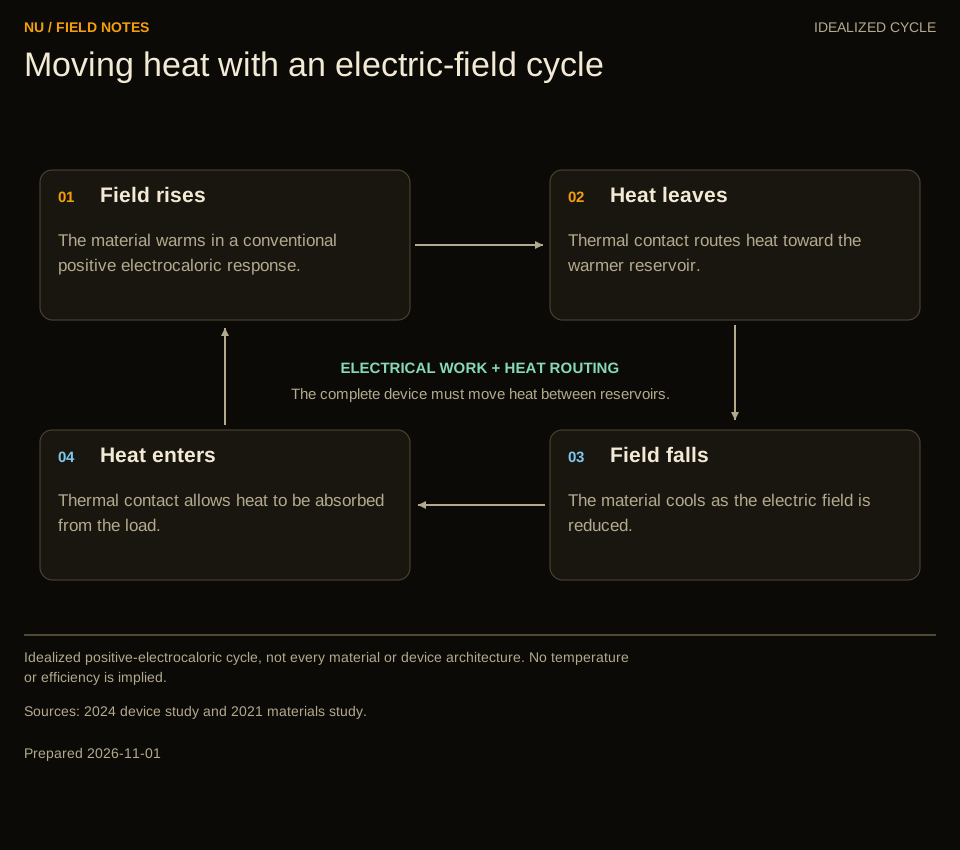
Idealized positive-electrocaloric cycle, not every material or device architecture. No temperature or efficiency is implied.
Follow one parcel of heat through a cycle
An idealized positive-electrocaloric cycle can be understood in four conceptual stages. Changing the electric field rapidly enough to limit heat exchange can warm the working material. The warmer material then releases heat to a sink. Reducing the field can cool it, after which it absorbs heat from the load. Repetition can transfer heat from a colder place toward a warmer one when the timing and thermal connections are arranged appropriately. This sketch describes one conventional conceptual cycle, not every material response or prototype design.
The order matters. If the material warms while remaining firmly connected to the object that is supposed to be cooled, some heat may go in the wrong direction. If it cools while connected to the sink instead of the load, the useful cold interval may be wasted. A device therefore needs a way to change thermal relationships during its electrical cycle. Moving a working body, changing contact or directing a fluid are different possible approaches to that task.
Imagine an explicitly fictional cooling element that absorbs two joules from a load each cycle and receives half a joule of net electrical work. In a steady idealized balance with no other energy terms, it must reject two and a half joules to its surroundings. The load's heat does not disappear. The surrounding sink receives the load heat plus the work consumed in moving it. A laboratory photograph showing a cooled surface should prompt a question about where that rejected heat went.
This is also why a good material response can coexist with a disappointing device. The material may produce a useful temperature change while the contacts transfer too little heat during the available time. Or the electrical circuit may dissipate enough energy to erode the benefit. Neither outcome disproves the electrocaloric effect. It identifies a different bottleneck in the complete cycle.
A useful experiment records more than a minimum temperature. It connects electrical timing, material temperature, heat entering from the load and heat leaving toward the sink. Those observations describe a process. A single thermal image describes a state within that process, and can be informative without telling the entire story.
Four numbers that answer different questions
A material's adiabatic temperature change measures its response to a field change under a specified approximation to thermal isolation. A device's temperature span measures the difference between its hot and cold ends. Cooling power measures heat removed per unit time. Coefficient of performance compares useful cooling with the work required under a stated boundary. These quantities are related, but none is a universal substitute for the others.
Consider a hypothetical device that establishes a ten-kelvin span when almost no external heat is applied. That result demonstrates an ability to create a temperature difference against internal leakage. It does not establish that the device can maintain ten kelvin while removing ten watts. Increasing the applied heat load usually changes the operating point. The scientifically useful product is a relationship between load and span, not a pairing of separate maxima.
The distinction appears in published prototype reporting. Han and colleagues' May 2024 Nature abstract describes a self-oscillating polymeric refrigerator whose peak coefficient of performance was measured at zero temperature span, while a separate figure describes operation at a four-kelvin span. The abstract is accessible, but the full research text was not read here. The bounded lesson is that the operating conditions attached to the two performance figures differ and must remain attached when the work is discussed. The authors' abstract
Zero span does not mean zero scientific value. It can be a useful condition for evaluating heat-transfer capability or comparing devices consistently. It simply does not represent every refrigeration task. Cooling an object below its surroundings requires a finite lift, and the device's behaviour at that lift is the relevant evidence. A spectacular zero-span value may be one part of a useful performance map rather than the answer a particular application needs.
The units deserve equal care. Watts per gram of active material differ from watts per gram of the whole device. A polymer film may weigh little while its electrodes, supports, power electronics and heat sink weigh much more. Both normalizations can help research, provided the denominator is visible. Relabeling active-material power density as packaged-system power density would change the claim without changing the experiment.
The interval between two contacts sets a limit
Fast electrical response does not guarantee equally fast heat transfer. Heat must move through the working material and across its interface to another body. Increasing cycle frequency can raise the number of cooling opportunities per second, but only if enough useful heat moves during each opportunity. Eventually a faster cycle may shorten contact so much that the heat transferred per cycle falls substantially.
Imagine a deliberately simplified device that moves one joule per cycle at one cycle per second. Its cooling power is one watt. At two cycles per second, suppose incomplete thermal exchange reduces the useful heat to six tenths of a joule per cycle. Power becomes 1.2 watts, not two. At five cycles per second, a fall to one tenth of a joule per cycle would produce only half a watt. These invented values illustrate a possible tradeoff, not a prediction of any published prototype.
Metzdorf and colleagues addressed heat transfer through a different architecture in a March 2024 paper. Their prototype used evaporation and condensation of ethanol to transfer heat from electrocaloric components. The reported specific cooling power at five hertz was normalized to active mass and evaluated at zero temperature span; the methods describe how that value was obtained from the load relationship. It is evidence for a particular heat-transfer solution, not proof that all electrocaloric devices are fluid-free or deliver that power at a large lift. The latent-heat-transfer prototype
Thermal resistance provides another useful teaching model. In a steady simplified connection, transferring two watts across a resistance of three kelvin per watt requires a six-kelvin temperature difference. If the available useful temperature swing is small, losing several kelvin across the interface can be decisive. Improving the caloric material while leaving that interface unchanged may produce less system benefit than expected.
The appropriate interface depends on the application. A rigid component, a flexible surface and a flowing liquid create different contact opportunities. A device designed around one geometry should not be assumed to fit another simply because its active material is thin. The mechanical and thermal arrangement is part of the cooling technology, not a detachable accessory to a material specification.
A regenerator remembers where the heat belongs
A regenerator can help a caloric device develop a span larger than a single material temperature jump. Conceptually, it uses a temperature-distributed thermal store so that heat exchanged during one part of a cycle can assist another part. The working body or fluid interacts with different portions of that distribution. The benefit depends on preserving the useful pattern rather than mixing everything into one uniform temperature.
An original analogy is a staircase with several landings. A small step does not reach the entire height in one motion, but a sequence can connect the levels. The analogy is limited: actual heat flows according to temperature differences, and the cycle requires work. Its purpose is to explain why the temperature change of one material sample need not equal the final hot-to-cold span of a regenerative device.
Now imagine an imperfect staircase whose landings move toward the same height whenever someone steps on them. The sequence becomes less useful. In a thermal system, unwanted mixing, conduction along the regenerator or poorly matched heat exchange can similarly erode the temperature distribution. An ideal regenerator in a calculation may preserve relationships that a physical fluid channel only approximates.
A model should therefore identify which thermal masses participate, how heat is exchanged and whether pressure losses or moving components are included. A prediction that assumes perfect recovery or balanced regeneration can be valuable as an upper bound. It becomes misleading only when the assumptions disappear from the headline and the bound is presented as a measured appliance result.
For an experiment, startup and steady operation should be distinguished. Building a temperature distribution takes time and energy. A test that reports the eventual span after many cycles answers a different question from a device expected to provide useful cooling immediately after switch-on. Both duties can matter, depending on whether the application is continuous refrigeration or short-duration thermal protection.
The most informative prototype study would show how the span develops, how an applied load changes it and how the device responds when that load changes again. Those observations reveal whether the regenerator merely stores an initial advantage or supports continuing heat transfer. They also provide a basis for improving the design without treating every temperature fluctuation as a mysterious property of the material.
Electrical energy can circulate without being free
Electrocaloric elements are commonly driven as capacitive structures. Energy supplied during part of the electrical cycle may be recoverable rather than necessarily dissipated. Recovering it can reduce net work, but the circuit that performs that recovery has losses and practical constraints. A calculation assuming perfect recovery should remain distinct from measured energy at the system's electrical input.
For an elementary illustrative linear capacitor, stored energy is one half of capacitance times voltage squared. A one-microfarad capacitor at one hundred volts stores five millijoules. The same capacitance at two hundred volts stores twenty millijoules. Real ferroelectric behaviour can be nonlinear and hysteretic, so these are not calculations for an actual electrocaloric sample. They show why voltage and recovery deserve attention even when the current averaged over time appears modest.
Suppose a fictional cycle receives ten millijoules during charging and returns eight to a recovery circuit. Net supplied energy is two millijoules before other losses are included. If an instrument records only the charging pulse, it could overstate net consumption. If an analysis subtracts an ideal eight-millijoule return that the actual circuit fails to recover, it could understate consumption. The measurement must identify energy entering and leaving the chosen boundary.
Nouchokgwe and colleagues' June 2021 study directly measured heat and electrical work in highly ordered lead scandium tantalate. The paper explicitly distinguishes a material-level ratio of exchangeable heat to driving work from a device's coefficient of performance and from efficiency relative to a thermodynamic limit. That distinction is central: a material figure greater than one is not a claim that a complete refrigerator converts electricity into cooling with impossible efficiency. The original material-efficiency study
A useful system test would account for the driver, recovery electronics and any separate pumps or actuators. It would also identify standby demand and whether auxiliary instruments contribute heat to the measured region. This is not a demand that every exploratory experiment behave like a finished product. It is a request that the experimental boundary remain explicit so later engineering can add the missing terms correctly.
Efficiency improvements can then be assigned to their real source. Better electrical recovery, smaller hysteretic loss and improved thermal exchange are different achievements. Combining them in one headline may be convenient, but separating them helps another team reproduce the result and decide which improvement would matter most in a different device.
A thin film can move as well as change temperature
Some electrocaloric polymers also deform under an electric field. That creates the possibility of combining thermal response and mechanical motion in one working body. Instead of adding a separate motor to shuttle material between surfaces, a design may exploit the material's own electromechanical behaviour. The resulting simplicity is potentially valuable, but the two responses must cooperate under the same operating conditions.
Luo and colleagues' April 9, 2026 paper examines that cooperation in polymer nanocomposites. Different filler amounts favoured the largest electrocaloric response and the largest strain; the best device choice consequently involved a tradeoff rather than selecting the maximum of one material property. Their reported prototype span belongs to a specified electric field and open-environment test. The work supports joint optimization of motion and heat transfer, not a universal rule that adding more filler improves cooling. The coupled-response study
Imagine a fictional film that produces a large temperature change but moves too little to make reliable contact with the sink. Another film produces a smaller change but reaches both surfaces consistently. The second might remove more heat in a device even though it loses a material-only competition. This is an original design illustration, not a reconstruction of the cited experiment. Its lesson is that device selection depends on how properties interact.
Contact also has a history. Surface roughness, repeated bending, contamination and changes in stiffness can alter the thermal connection over time. A successful initial oscillation does not establish stable contact over all future cycles. The device may remain electrically active while its useful heat-transfer area declines. That is why electrical endurance and thermal endurance should be evaluated together rather than treated as synonyms.
The word self-oscillating should not be mistaken for unpowered. The electrical stimulation remains an input, even if the working body supplies motion that would otherwise require another actuator. Eliminating a separate mechanism can reduce complexity without abolishing the need for energy. A clear description explains which external component is absent and which functions the material now performs.
For local cooling, mechanical compliance could be as important as raw capacity. A surface that bends or has a complex shape may be difficult to serve with rigid hardware. Whether a particular film helps requires evidence about attachment, fatigue, electrical isolation and heat rejection in that geometry. Flexibility is an enabling property, not an automatic certificate of suitability for wearable or consumer use.
Field strength and voltage describe different burdens
A paper may report a large electric field in a very thin layer while the voltage across the layer remains much smaller than a reader expects from the field's numerical value. Field is voltage divided by distance in a simplified uniform geometry. Confusing the two can make a result seem either more practical or more alarming than the stated experiment supports.
For an original unit example, a field of ten megavolts per metre across a ten-micrometre layer corresponds to one hundred volts. Across a hundred-micrometre layer, the same field corresponds to one thousand volts. These are conceptual conversions, not operating instructions or safe-use limits. Actual field distributions depend on the structure, and a device's power supply and isolation must be designed by qualified specialists.
Reducing layer thickness can lower the voltage needed for a given field, but it changes other design questions. More layers may be required to obtain a useful active volume. Electrodes and inactive regions occupy space and add thermal mass. Fabrication defects or uneven thickness can influence local fields. The useful comparison therefore includes the multilayer structure, not just the nominal thickness of its active dielectric.
A hypothetical stack with one cubic centimetre of active material inside a three-cubic-centimetre assembly has a different package-level power density from an ideal calculation using only the active cubic centimetre. If the inactive material also changes temperature during the cycle, it can dilute the useful response. The exact effect requires a thermal model and measurements; the denominator alone already explains why active and packaged figures differ.
There is a manufacturing consequence as well. A laboratory can select a particularly good specimen. A product needs many specimens with an acceptable distribution of properties, made repeatedly at a viable yield. A slightly smaller effect with better uniformity could be preferable to an outstanding effect found only rarely. The proper comparison is between reproducible device populations rather than the most favourable single measurement from each material.
These considerations do not imply that thin-film or multilayer approaches are inherently fragile. They identify what evidence would support reliable scaling: distributions, repeated production, clear rejection criteria and performance after assembly. The electrical field is one part of the story; the ability to create and maintain that field throughout a useful manufactured structure is another.
Improving heat conduction can change the active response
A material modification aimed at one problem can alter another property that the device depends on. Adding a thermally conductive component might help heat leave the working body while changing polarization, stiffness, electrical leakage or the transition responsible for its electrocaloric response. There is no general guarantee that independently favourable ingredients produce a favourable combination.
Wang and colleagues' January 15, 2025 paper investigates a two-dimensional polyamide component in electrocaloric polymer composites. The work connects molecular organization and field-driven conformational transitions to altered cooling behaviour, rather than treating the added material only as a passive heat conductor. It is a specific materials study with its own characterization evidence, not a demonstration that every conductive additive improves electrocaloric performance. The original confinement study
An original engineering thought experiment makes the tradeoff concrete. Suppose a modification halves the thermal resistance but also halves the heat available per cycle. At a slow cycle rate, where the original material already had time to exchange most of its heat, the modification may hurt. At a faster rate, where the original was strongly transfer-limited, the result could differ. Neither the conductivity number nor the caloric-response number alone decides the outcome.
The experiment should therefore compare complete operating points. If the new sample is driven at a different field, frequency or temperature, the comparison may combine several changes. That can still be a legitimate optimization, but it should not be described as isolating the effect of one ingredient. A careful report distinguishes a controlled materials comparison from a separately optimized device comparison.
Uniformity matters at more than one scale. A composite may have an appealing average composition while local regions carry different electrical or thermal burdens. A macroscopically stable temperature curve does not reveal every local stress. Characterization and endurance tests provide complementary information: one helps explain the structure, while the other shows what happens under repeated use.
This is why the path from chemistry to cooling often loops rather than proceeds in a straight line. A device test identifies a limitation; a material change addresses it; the change alters another aspect of operation; the geometry or timing is revised. Progress is a coordinated search among coupled properties, not a sequence in which one record material makes the remainder of the engineering automatic.
A simulated chip is a useful experiment with a boundary
Electronic cooling demonstrations often use a controlled heater to represent a component. That approach can make heat input known and repeatable. It can also simplify the geometry and transient behaviour compared with a real processor, battery or sensor. The word simulated is therefore an important description of the experiment, not a reason to dismiss it.
Zou and colleagues' August 2024 study used a ceramic heating plate as a simulated CPU while investigating polymer-composite cooling and pyroelectric energy harvesting. The authors' methods identify the heat source and compare material arrangements under specified conditions. That evidence concerns the test assembly; it should not be retold as a deployed cooler operating inside a commercial processor or as proof that every watt required by the system came from harvested waste heat. The cooling and harvesting experiment
Consider a hypothetical heater whose temperature falls from eighty to fifty degrees Celsius after a device is switched on. If the surrounding sink is at twenty-five degrees, the heater is still above the sink. The temperature drop is not a fifty-five-kelvin refrigeration lift below ambient. It may reflect improved heat transfer, active pumping, changing thermal storage or a combination. Determining the contribution requires an appropriate comparison and energy balance.
Now suppose the heater continues receiving two watts throughout the test. Maintaining a lower steady temperature is stronger evidence of continuing heat removal than a brief decrease after the heater is switched off. Yet it still does not establish performance at a different heat flux, contact area or sink temperature. A controlled heater permits these variables to be studied systematically precisely because it does not reproduce every detail of a real application at once.
An application evaluation should also examine where the temperature is measured. A surface sensor can miss an internal hotspot or be affected by its own contact with the assembly. The appropriate sensor arrangement depends on the question. Reporting the hottest relevant location, the average and the measurement uncertainty can be more useful than selecting the most visually impressive thermal image.
Energy harvesting introduces an additional boundary rather than an exception to thermodynamics. The recovered electrical output should be compared with all supplied electrical work and with the thermal conditions that drive the conversion. A cooling-and-harvesting demonstration can be scientifically valuable without being self-powered. The reader deserves to know which claim was actually measured.
A million cycles has a duration and a duty
Cycle counts are appealing because they compress a long experiment into one number. They need interpretation. One million cycles at one hertz lasts about 11.6 days. At ten hertz it lasts about 1.16 days. Neither duration automatically represents years of product service, and neither is uninformative. The test establishes endurance under its particular electrical, mechanical and environmental conditions.
The same number of cycles can impose different stresses. A material driven electrically while held in a stable fixture may avoid the repeated contact, bending and thermal gradients of a moving cooler. A packaged device may face humidity, changing ambient temperature or irregular loading absent from a controlled experiment. Transfer between these conditions requires evidence or a validated acceleration model, not simply a larger numeral.
A hypothetical endurance record might show stable peak temperature change but increasing leakage current. Another might retain low electrical loss while contact deteriorates and cooling power declines. A third might survive repeated cycles but fail during an infrequent startup condition. These are distinct possible failure modes, not allegations about any cited study. They show why several observables should accompany an endurance claim.
It is also important to define failure before the test. Catastrophic breakdown is one endpoint. A specified reduction in cooling power, a rise in input energy or an unacceptable change in contact may be another. A device can remain functioning in a broad sense while no longer providing the service required by an application. The acceptance threshold should follow that service.
Statistical confidence depends on the number of specimens as well as the number of cycles. One successful sample provides less information about manufacturing variability than many independently fabricated samples tested under the same conditions. A long record from one specimen and a shorter record from a larger population answer different questions. Reporting both dimensions prevents endurance from becoming a competition in a single impressive count.
The eventual product case should connect laboratory tests to expected use: operating frequency, pauses, temperature range, load changes and maintenance or replacement options. A promising early endurance result can justify that next stage without already establishing it. The distinction protects the value of the result by keeping its meaning precise.
Compare a cooling service, not a photograph
An electrocaloric device should be compared with alternatives performing the same thermal task. Holding a small object a few degrees below a controlled sink is different from rejecting heat to hot outdoor air. Protecting a brief electronic hotspot is different from continuously cooling an insulated compartment. A comparison becomes useful when the required load, temperatures, response time and physical envelope are specified first.
Imagine a fictional sensor enclosure requiring one watt of continuous cooling at a five-kelvin span. An experimental device that produces a large no-load span but only a fraction of a watt at five kelvin does not meet that duty. Another device with a less dramatic maximum span might meet it efficiently. A performance map can reveal this immediately; a ranking by maximum temperature change cannot.
Uncertainty can change the apparent winner when the differences are small. Suppose two hypothetical devices are reported as removing 1.00 and 1.05 watts, but each result has an uncertainty of approximately 0.10 watts under the comparison conditions. The second reported central value is larger, yet the measurement does not establish a robust five-per-cent advantage. More repeat measurements, improved calibration or a different test design may be needed. This is an invented example about interpretation, not a claim about any published result.
The experiment should also distinguish uncertainty from variability. A calibrated sensor can still observe a device whose performance changes from cycle to cycle or specimen to specimen. Averaging those observations may estimate a mean accurately while concealing occasional behaviour that matters to an application. A component sensitive to overheating could care about the weakest cooling interval rather than the average. Reporting a distribution, along with how the test conditions were controlled, helps make that distinction visible.
The installation should include the warm-side solution. If the laboratory uses a large temperature-controlled bath, the product may need a different sink with its own size and power demand. Replacing that bath with an ordinary ambient interface can change performance. The bath is a legitimate experimental tool, but its role should remain visible when discussing application readiness.
Noise, moving parts, footprint and maintenance may matter alongside energy consumption. A thin local cooler could be valuable in a space where another approach is awkward, even if it does not dominate every efficiency comparison. Conversely, a highly efficient active layer may offer little practical advantage if its supporting electronics and thermal hardware exceed the available space. The application chooses the relevant combination of constraints.
A fair test would also distinguish steady and transient duties. A short burst of cooling may protect a component during an exceptional event without supporting a continuous load. Thermal storage can assist that burst, but must eventually be restored. Reporting the recovery interval and repeated-burst behaviour would show whether the device provides a recurring service or spends a one-time stored advantage.
These comparisons are not an argument for waiting until every uncertainty disappears. They help identify an early application where the demonstrated strengths matter and the remaining weaknesses are manageable. A technology can become useful in a narrow setting before it becomes a general replacement. Choosing that setting well requires specificity rather than the broadest possible promise.
Environmental claims need the whole device
Using an electrocaloric solid as the active refrigerant can change the direct leakage problem associated with some conventional cooling systems. It does not establish zero environmental impact. Electricity, materials, fabrication, replacement and any heat-transfer fluid remain relevant. The correct comparison depends on the actual device and the alternative providing equivalent service.
The distinction between active refrigerant and heat-transfer medium is particularly important. A solid-state caloric mechanism can coexist with a fluid that carries heat elsewhere, as one of the cited architectures demonstrates. Calling the whole system fluid-free would erase that part of its design. Likewise, a device without a compressor may still contain moving material or auxiliary components. Accurate language should identify what is absent rather than infer the absence of everything associated with older systems.
An original life-cycle comparison would separate manufacture, operation and end-of-life. A material that performs well but requires frequent replacement could have a different total burden from a slightly less efficient durable alternative. A fabrication improvement might reduce energy or waste without changing the device's measured coefficient of performance. Those benefits deserve evaluation, but should not be guessed from a single laboratory processing step.
Materials handling also belongs to the product design. The presence of a particular element or polymer does not by itself determine the risk of a finished device; containment, production exposure, failure modes and disposal matter. Conversely, the fact that the active component is small does not exempt it from responsible handling. A public article should not translate a materials paper into a safety approval or a universal environmental ranking.
The most credible claim would state which burden has been reduced and which has not yet been quantified. That approach allows genuine advantages to stand without borrowing certainty from unanswered questions. Environmental promise is strongest when it is connected to measured service and a transparent boundary, rather than used as a substitute for either.
The next advance may be an interface
Electrocaloric research is often introduced through a striking material response. The next decisive improvement may instead come from a contact that transfers heat more reliably, a driver that recovers energy more effectively or a package that preserves performance through repeated use. Such progress can look less spectacular in a headline while bringing a device closer to a useful duty.
A practical development programme would ask which constraint currently dominates. If heat transfer is limiting, a larger intrinsic temperature change may help less than a better interface. If electrical losses dominate, adding more active material may enlarge the problem. If the device operates only over a narrow temperature window, a chemistry change may matter more than a faster actuator. The answer should come from measurements that distinguish those possibilities.
This also suggests a clearer way to report progress. Present the material response, the device's load-versus-span relationship, the electrical boundary and the endurance conditions as connected observations. Identify calculations as calculations and heater demonstrations as heater demonstrations. Explain what changed between versions and why that change addresses the observed limitation. Readers can then recognize meaningful progress without needing to treat every prototype as a finished appliance.
The central idea remains compelling: an electric field can help organize a solid material into a repeatable heat-pumping cycle. Making that idea useful means arranging where heat enters, where it leaves and what work is required along the way. A cooler succeeds when the whole journey repeats reliably under the conditions that matter to its user. The brief cold moment is the opening move; the engineered route for heat is the achievement that follows.