A promising electrical conductor can be judged by how little it resists current. A protective device may be judged by how quickly it starts resisting. Superconducting power equipment occupies both positions. In a cable, the preferred operating condition is sustained superconductivity. In a resistive fault-current limiter, a transition away from that condition can be the intended response to an abnormal event. That apparent contradiction is the beginning of a useful grid story, rather than a flaw to explain away.
On September 18, 2026, SuperGrid Institute posted an account of tests on a small-scale direct-current limiter. Its research summary describes a test reaching 46.5 kilovolts, with 1.8 megajoules injected, in which a prospective current of 43.6 kiloamperes was limited to 5.3 kiloamperes. The institution identifies a superconducting prototype and a high-power test facility, not an operating commercial transmission network. The available originating abstract supports that bounded result; it does not establish a fleet reliability record. SuperGrid's test account
The important question is what would make such a result useful outside the test hall. A real network must carry ordinary load, survive disturbances, isolate damaged equipment, restore service and remain maintainable through many years of changing demand. Those duties connect a material transition lasting a tiny fraction of a second to decisions about substations, street excavation and spare machinery. Neither the resistance of a sample nor the drama of a fault test answers the whole question.
Superconducting grid technology is most intelligible when followed through those connections. The conductor belongs inside a cooled assembly. That assembly belongs inside an electrical circuit. The circuit belongs inside a network whose constraints may concern space, contingency transfers or the interrupting capability of existing equipment. A useful assessment moves between these scales without assuming that success at one automatically settles the others.
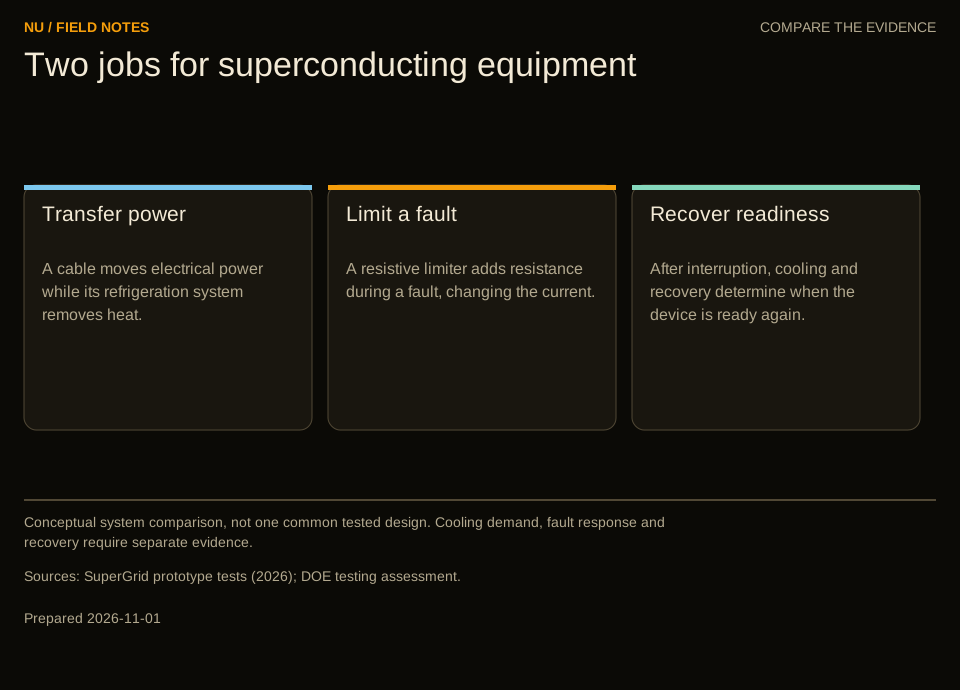
Conceptual system comparison, not one common tested design. Cooling demand, fault response and recovery require separate evidence.
Start with the route that is difficult to build
Imagine an explicitly fictional city with two substations separated by a congested transport corridor. One has spare supply capacity during an emergency; the other serves a district whose existing feeders are heavily loaded. An additional connection could make that spare supply useful. Yet several conventional circuits might require more duct space, road access or construction disruption than the available route can accommodate. In that situation, compactness has a value distinct from energy efficiency.
The relevant comparison is not simply a metre of advanced conductor against a metre of copper. It is a complete way of making the connection: route, excavation, terminations, protection, cooling, access and the resulting network capability. A more expensive cable assembly could conceivably reduce some other cost. Conversely, a conductor that occupies little space could require terminal facilities that do not fit at the chosen sites. The answer depends on the actual bottleneck.
Nexans, a supplier involved in Chicago's Resilient Electric Grid project, describes a compact superconducting installation using its cable and AMSC wire and refrigeration equipment. Its published electrical figures are 12 kilovolts, 3,000 amperes and approximately 62 megavolt-amperes. This is an originating supplier account, not an independent reliability audit. The same page gives conflicting operational years in different sections, so those years are not used here as a settled commissioning date. The supplier's project description
A straightforward arithmetic check helps interpret those figures. For a balanced three-phase circuit, apparent power is approximately the square root of three multiplied by line-to-line voltage and line current. Twelve thousand volts times three thousand amperes times about 1.732 gives roughly 62.4 million volt-amperes. That consistency is useful, but it does not turn apparent power into an identical amount of useful real power under every operating condition. Power factor and the chosen rating boundary still matter.
In the fictional city, the operator should first describe the service it needs: how much transfer, under which contingency, for how long, and with which equipment unavailable. Otherwise the project may optimize an impressive current rating while leaving the binding constraint elsewhere. A downstream transformer, a bus section or a protection limit could prevent the promised transfer even when the cable itself remains comfortably within its rating.
Current capacity changes the questions around voltage
Transferring more power at a given voltage requires more current, other things equal. Conventional networks often use higher voltage to avoid the penalties associated with very large current. A superconducting connection changes part of that tradeoff, but it does not eliminate the remainder of the electrical system. Switchgear, terminations, transformers and protection still have duties tied to voltage and current. An unusually capable cable is surrounded by equipment that must be evaluated on its own terms.
A fictional balanced three-phase link carrying 100 megawatts at unity power factor would require about 5,774 amperes at 10 kilovolts. At 100 kilovolts, the corresponding current is about 577 amperes. These are arithmetic illustrations, not proposed designs. They show why the voltage choice changes the demands on every current-carrying connection. Reducing conductor resistance addresses one consequence of high current, not all possible consequences.
At the same time, a lower-voltage connection might avoid a particular transformation step or fit an existing network architecture. Whether it does so is a project-specific question. It would be misleading to count a transformer as an avoided expense if the remaining system still needs it for another duty. A network diagram should show which assets actually disappear, which remain and which are newly required.
The Munich utility SWM provides a useful maturity distinction. Its January 21, 2025 interview describes a SuperLink prototype under test since October 2024 and a proposed 15-kilometre connection contingent on meeting requirements. The account discusses a future commercial route; it is not evidence that the entire route was already operating at the time of publication. Its dated intention should not be converted into a verified present completion merely because a target year is mentioned. SWM's prototype and project interview
For readers, this suggests a better way to compare announcements. Ask whether a stated voltage applies to a material test, a completed cable system, an energized prototype or a commissioned route. Ask whether the stated distance is installed, tested or planned. These distinctions do not diminish engineering progress. They identify which uncertainty the progress has actually reduced and which decision still lies ahead.
A long route also introduces questions that a short sample cannot answer by multiplication alone. Cooling must remain effective along the relevant distance; joints and changes in elevation matter; inspection and repair access must be planned. Electrical capability and logistical feasibility grow together only if the project addresses both. A successful short installation is evidence that can inform scaling, not a complete demonstration of every scale-dependent feature.
The electrical loss is only one heat source
The phrase zero resistance describes a property under appropriate superconducting conditions. It is a poor substitute for a complete energy balance of an alternating-current installation. Changing currents and magnetic fields, ordinary metallic components, joints and heat entering from the surroundings can all contribute to the load that the cooling system must handle. The distinction is physical, not merely an accounting objection to an attractive technology.
Consider an original thermal example. Suppose a hypothetical cooled link receives two kilowatts of heat through its insulation and supports, another kilowatt from current-dependent effects and half a kilowatt through its ends. Its cold-side load is three and a half kilowatts. Calling the superconducting conductor's direct-current resistance negligible does not make those contributions vanish. The refrigerator must remove the heat that actually arrives at the cold region.
Now imagine improving the conductor so that the current-dependent contribution falls by half. The cold load declines from 3.5 to 3 kilowatts, an improvement of about fourteen per cent rather than fifty per cent. That difference is not evidence that the improvement was unimportant. It identifies the other terms that now deserve attention. Once one contribution is reduced, further gains may depend more on the cryostat or terminations than on the conductor.
Experimental measurement itself can be demanding. Elschner and colleagues' paper on concentric cables, first posted in 2014 and revised on arXiv in 2017, describes how contact resistances in short samples can distort current sharing and hence loss measurements. The authors developed a particular experimental arrangement to investigate this problem. The complete abstract was read for this article, not the full experiment, so its result is used only to illustrate the need to examine how a loss measurement was obtained. The authors' abstract and version history
A claim of low loss therefore needs a test condition attached: current waveform, frequency, temperature, geometry and the components included in the measurement. Comparing two figures without those conditions can reward the more favourable experiment rather than the better system. A cable tested at a fraction of its intended current cannot automatically be compared with another operating near its limiting condition.
There is a practical consequence for procurement. A buyer should be able to distinguish measured electrical dissipation inside the cold assembly from the electricity consumed by the plant that keeps it cold. Both are useful quantities. Treating them as interchangeable can produce a persuasive percentage that answers the wrong question. The system boundary should remain visible from laboratory report to operating-cost estimate.
Refrigeration is part of the power connection
Removing heat from a cold region requires work and produces heat elsewhere. In a superconducting grid installation, refrigeration is therefore part of the electrical service rather than an incidental laboratory accessory. Its power demand, availability and maintenance needs belong in the comparison with conventional equipment. The cooling plant can perform well and still impose a material burden; that burden can be justified and still need to be measured.
For an illustrative refrigerator with a coefficient of performance of 0.1, removing five kilowatts of cold-side heat requires fifty kilowatts of electrical input under the stated boundary. The warmer side must reject approximately fifty-five kilowatts when those are the only energy terms. These numbers are a teaching example, not a predicted performance curve. They clarify why a watt deposited at low temperature and a watt drawn from the grid are different quantities.
Nakamura and colleagues' 2017 presentation abstract on the Yokohama cable project reports that earlier grid testing revealed refrigerator-related problems and describes development of a Turbo-Brayton system. The abstract gives achieved target characteristics for cooling capacity, efficiency and maintenance interval, and distinguishes a later demonstration that had begun from its planned continuation. The repository abstract and metadata were inspected here; the entire presentation was not audited. Its value is the explicit attention to the cooling subsystem, not a universal performance guarantee. The originating technical presentation record
A design comparison should also consider how the refrigerator behaves away from its preferred operating point. A system sized for a peak cold load may spend much of the year elsewhere. Fixed heat leaks continue even when electrical throughput falls. An annual average calculated by applying one rated efficiency to every hour could misrepresent the real profile. A useful estimate would retain the relationship between load, operating mode and auxiliary power.
Heat rejection has its own geography. The underground cable route may be compact while the cooling equipment needs space, ventilation, water or other services at a terminal. None of those requirements should be assumed without project information, but all deserve examination. Moving a burden from the street trench to a substation can be a good trade. It is not the same as eliminating the burden.
Maintenance changes the picture again. If a cooling unit requires service, the connection may need redundancy, an alternative operating arrangement or an outage. A proposed maintenance interval is not identical to a demonstrated fleet interval under local conditions. The operator needs a plan for routine work as well as an emergency response. Dependable cooling becomes one of the conditions under which the cable's electrical capability exists.
Existing cold resources change the comparison
An industrial site may already handle cold fluids for another purpose. That can create an opportunity for a superconducting connection unlike one in an ordinary urban substation. It also creates an accounting problem: a resource that appears free within one departmental budget may still have an energy or production cost elsewhere. The comparison must explain what would happen to that resource without the cable.
NEDO, SWCC and BASF Japan reported a plant-grid demonstration conducted from November 2020 to September 2021, with the English announcement issued in February 2022 as a translation of a December 2021 release. Their account emphasizes continuous operation and the use of existing facilities. Its larger loss-reduction prospect is conditional on suitable high-power industrial applications and available cold resources; it should not be generalized as a measured saving for every superconducting installation. The originating demonstration announcement
Imagine a fictional factory where a cold stream would otherwise warm without useful recovery. Using some of that available cooling could improve the cable's overall case. Now imagine a second factory where the same stream is essential to a production process. Diverting it might require additional cooling elsewhere. The equipment could be identical while the net energy result differs, because the alternative use of the resource differs.
A careful assessment would compare complete before-and-after operations. If the cable requires extra production of a cryogenic fluid, that production belongs somewhere in the boundary. If it uses an otherwise wasted opportunity without increasing production, the assessment should state that assumption and test whether it remains true over time. The phrase existing infrastructure describes a starting condition, not a perpetual exemption from accounting.
Scheduling can matter as much as annual totals. The electrical connection may be required continuously while an industrial cold source operates intermittently. A yearly surplus of cold energy does not guarantee availability at the hour of peak electrical need. Backup arrangements, storage or an alternative mode may be necessary, depending on the actual design. Their costs should be associated with the service they make possible.
This is one reason a successful demonstration at a particular plant deserves precise description. The local combination of electrical demand, available space and thermal resources may be the essential innovation. Treating it as a generic cable replacement loses that insight. Transfer to another site should begin by asking whether the enabling conditions transfer, rather than assuming that the same conductor necessarily produces the same benefit.
A fault changes the job in milliseconds
During normal operation, a power connection is evaluated partly by its ability to carry current without excessive loss or heating. During a fault, current may rise far beyond its ordinary level. Equipment must withstand the disturbance until protection isolates the affected part of the system. A fault-current limiter seeks to modify that disturbance, but it is not automatically a replacement for all the equipment responsible for disconnection.
A simple fictional circuit illustrates the idea. If an ideal source voltage is ten units and the relevant impedance is one unit, the initial simplified current is ten units. Adding one more unit of series impedance would reduce that simplified value to five. Real fault transients involve time dependence, network contributions and equipment behaviour that this arithmetic omits. The example explains why adding impedance can help, not how to design a protective device.
In a resistive superconducting limiter, the desired abnormal response differs from the cable's ordinary duty. A transition can increase resistance and restrict current. Yet the device must also handle the energy associated with that event and remain compatible with the rest of the protection system. A large reduction in a test waveform is encouraging only when its implications for heating, voltage and subsequent operation are understood.
It is especially important to distinguish prospective current from observed limited current. Prospective current describes what the test circuit would supply under its specified alternative condition without the limiting action. It is not a simultaneous second current flowing through the protected equipment. Comparing the two quantities describes the effect within that test arrangement; it does not establish the same percentage reduction in every network.
Similarly, a voltage rating, a tested voltage and a maximum current are not interchangeable headline numbers. A report may identify a nominal class while describing a particular test below that nominal voltage. Preserving those labels is part of scientific accuracy. The strongest useful statement is the one that retains the actual combination of conditions, rather than selecting the largest number from each column and presenting them as one demonstrated operating point.
For a utility, the limiter's attraction may be that it enables an otherwise difficult network connection. Joining two strong sources can increase the current available during faults. If existing switchgear cannot accommodate that increase, a limiter could be one option among network reconfiguration and equipment replacement. Its merit then concerns the complete set of avoided and added changes, not the device's performance in isolation.
Recovery is a separate operating state
Surviving the first disturbance is only part of the protective duty. A system must also become ready for continued service or a subsequent event. That interval can matter because network operating practices may call for rapid restoration or because an initial disturbance may be followed by another. A component that performs impressively once may still be unsuitable if its recovery conflicts with the required sequence.
A February 2009 assessment prepared for the US Department of Energy explicitly discusses recovery under load among fault-current-limiter testing requirements. It distinguishes that duty from familiar tests for conventional equipment and explains the relevance of cooling after a superconducting limiting event. This is a historical originating technical assessment, not a claim about the latest standard or a certification of today's products. DOE's testing assessment
Imagine an original operating scenario in which a protective device completes its intended action, but the network is asked to resume full load before the device is ready. The protection success and the restoration problem can both be real. An operating plan needs to define the intermediate state: whether the connection remains isolated, whether another path carries load and what evidence permits return to service. Ignoring that state turns an incomplete sequence into an apparently complete success.
Thermal recovery also depends on where energy went, not just the total energy assigned to the event. A uniform temperature estimate can conceal a locally stressed region. Conversely, a high local temperature does not necessarily imply that the whole assembly has the same condition. The appropriate measurement and model depend on the design. A public account should avoid using a single average as proof that every component remained within its permissible range.
The same reasoning applies to repeated events. A second test after a long cool-down answers a different question from a closely spaced sequence under continuing load. Neither is inherently the wrong experiment. The problem arises when the result of one is advertised as evidence for the other without justification. A qualification programme should identify the operating sequences it represents.
These considerations make recovery an engineering requirement rather than a footnote about inconvenience. The utility purchases a recurring service: transfer power, respond to abnormal conditions, return safely and repeat. A demonstration that covers the full sequence can be more informative than one with a more spectacular single-event number. Reliability emerges from the transitions between states as much as from the best performance within one state.
More transfer can alter the rest of the network
A new low-impedance connection changes the distribution of current. Power does not follow a commercial contract or a coloured arrow drawn on a planning map. Its division among paths follows the electrical network and operating conditions. A cable intended to relieve one constraint could shift loading elsewhere, particularly when a different component is unavailable. That is a reason for system analysis, not an argument against making new connections.
Consider a deliberately simplified pair of parallel paths between the same two points. If their resistances are equal in a direct-current teaching model, current divides equally. If one resistance is much lower, that path carries a larger share. Alternating-current transmission requires impedance and a broader network model, so the example is not a power-flow calculation. It simply shows why an altered connection can change which component becomes limiting.
A fictional planner might initially celebrate a new link's ability to carry a large emergency transfer. A subsequent contingency study could show that one adjacent transformer reaches its limit first. The project may still be worthwhile, but its useful rating is constrained by the combination. Advertising the cable's maximum as the network's newly available capacity would overstate what customers can actually receive.
Protection settings also belong to the changed network, not only to the new equipment. Devices that previously saw one pattern of fault contributions may see another. The existence of a fault-current limiter does not eliminate the need to evaluate selectivity: the intended part of the system should disconnect while unaffected parts remain available where the design permits. The details require qualified engineering and site-specific studies, not a generic setting copied from an article.
A robust comparison would therefore examine ordinary operation, relevant outages, abnormal events and restoration. It would identify which results are simulated, which are tested and which are observed in service. Simulation can explore conditions that cannot responsibly be staged on a live grid, while field operation can expose practical details absent from a model. The two forms of evidence complement each other when their boundaries remain explicit.
The outcome may be a narrower but more valuable claim than universal replacement. A particular connection may improve resilience at a particular constrained site. That is sufficient to justify serious attention if supported. Requiring every advanced cable to replace every conventional cable is an unnecessary test; implying that one successful installation settles all other locations is the opposite mistake.
Availability has a common-cause problem
Redundancy is often described by counting duplicate components. Two refrigerators, two electrical feeders or two control units can improve resilience, but the improvement depends on what they share. A common cooling circuit, power supply, enclosure or maintenance error can affect both. Counting units without examining common dependencies can create an optimistic reliability figure that the physical arrangement cannot deliver.
As an original probability illustration, suppose two independent units each have an unavailability of one per cent during a specified interval. If either can provide the full required service, simultaneous unavailability would be one hundredth of one per cent under the independence assumption. Introduce a shared dependency that is unavailable for one per cent of the interval, and the simple multiplication no longer describes the system. The numbers are fictional; the point is the assumption hidden inside the calculation.
A superconducting installation also creates interfaces between organizations that may normally maintain different equipment. Electrical protection, cryogenic machinery, vacuum insulation and instrumentation require coordinated responsibility. A maintenance action that is routine for one subsystem can alter the conditions assumed by another. Written responsibility and tested operating procedures are part of the installation's practical reliability, even though they do not appear in a conductor's specification.
Repairability should be considered before failure rather than improvised afterward. What can be replaced locally? Which spares are unique? Which repair requires specialist transport or a lengthy recommissioning sequence? These are questions for the project team, not predictions that every installation will suffer those problems. Their purpose is to turn an expected outage duration into a defensible estimate with identified dependencies.
A small demonstration may receive exceptional expert attention. That attention can make it highly informative while also limiting direct transfer to routine fleet operation. An economic assessment should distinguish the staffing used to learn about a new technology from the staffing expected for normal service. Learning costs can decline, but their decline should be evidenced rather than assumed because the installation worked under close supervision.
The most useful operating record would include ordinary interruptions, maintenance actions and anomalous conditions alongside successful hours. A flawless-looking summary can be less valuable than a detailed account of a problem that was understood and corrected. Utilities need to know how equipment behaves when conditions are imperfect, because maintaining service is largely the work of managing those conditions.
The annual comparison should follow the load
A superconducting connection may have a different loss profile from a conventional one. Some costs continue while the connection is energized or maintained cold even at low electrical throughput. Other losses grow with current. The annual comparison therefore depends on the load profile, not just the peak rating or one favourable operating hour. This can change the answer for two otherwise similar sites.
Suppose a fictional conventional connection dissipates forty kilowatts at full load and ten kilowatts at half load, consistent with a simplified current-squared relationship. Suppose an alternative system consumes a total of twenty kilowatts at full load and sixteen at half load after including its defined auxiliaries. It wins the full-load comparison and loses the half-load comparison. Neither observation alone determines the annual result.
If each condition lasts four thousand hours, the conventional example uses two hundred thousand kilowatt-hours in those intervals, while the alternative uses one hundred and forty-four thousand. If full load occurs for only one thousand hours and half load for seven thousand, the corresponding totals become one hundred and ten thousand and one hundred and thirty-two thousand. These are invented values, not estimates for a real technology. They demonstrate why duration can reverse a ranking.
A complete assessment would include other operating states and the service each option provides. If one option enables emergency transfer that the other cannot deliver in the available space, energy cost is not the only criterion. Conversely, resilience should not become a vague label that excuses an unexamined energy penalty. Each claimed benefit needs a measurable relationship to the problem the project is intended to solve.
Construction impacts and equipment replacement also occur at different times. An option with a larger initial burden might avoid repeated excavation; another might require less specialist material but more route length. Without project data, an article cannot settle those comparisons. It can insist that the comparison use equivalent service, realistic lifetime assumptions and explicit treatment of replacement rather than selectively counting only favourable components.
The result should be a decision that another analyst can revise when conditions change. Electricity prices, load growth, maintenance evidence and route constraints may evolve. A model that preserves separate terms can incorporate new information. A single percentage advertised without its assumptions cannot. The purpose of careful accounting is not to prevent a choice; it is to make the choice intelligible and correctable.
Commissioning should connect the measurements
A project can accumulate many successful component tests without yet demonstrating that the installation works as a coordinated system. The conductor may meet its electrical requirement, the refrigerator may meet its thermal requirement and the protection hardware may respond correctly to a simulated signal. Commissioning asks whether the interfaces preserve those achievements when the components operate together. This distinction is especially important when separate suppliers are responsible for different parts.
Consider a hypothetical acceptance test in which the cold assembly reaches its required operating condition while the electrical circuit remains unloaded. That establishes something useful about initial cooling, but it does not establish the temperature distribution under sustained current. A second test under load adds information. A third examination of an altered operating state might reveal whether an alarm arrives soon enough for the intended response. These are conceptual distinctions between test objectives, not a sequence for operating high-voltage equipment.
Measurements should be comparable across those objectives. If one subsystem records local time without a reliable relationship to another subsystem's clock, reconstructing the order of a disturbance can become difficult. An apparent protection delay might be a timestamp mismatch. Conversely, synchronized records could reveal that a thermal warning preceded an electrical anomaly rather than followed it. Time alignment is therefore part of the explanation of events, not merely a convenience for drawing plots.
A similarly important interface is the definition of a limit. One supplier might specify a local component condition while an operator monitors a remote average. The monitored quantity is useful only if its relationship to the limiting condition has been established. A reassuring display value should not be assumed to represent the most stressed location. This is a general measurement problem made consequential by a system whose useful electrical state depends on temperature and current together.
The acceptance record should preserve the conditions under which an observation was made. A successful test with temporary extra instrumentation, an external cooling resource or an unusual operating restriction may be entirely legitimate. It should still be distinguishable from the final service configuration. Otherwise later readers may believe that the permanent installation demonstrated a duty that was actually achieved with an additional support system.
The questions a neighbour can reasonably ask
Public discussion of an underground power project often concentrates on the visible construction period. Residents and nearby businesses may care more about repeated access, noise, space occupied by supporting equipment and how quickly normal streets return. A compact conductor can potentially reduce some disruption, but a credible account should explain the construction footprint rather than infer it from the conductor's diameter alone.
Imagine a fictional comparison between a narrow route requiring several substantial access locations and a wider route with fewer intermediate works. Which is less disruptive depends on local traffic, existing services, working hours and the locations of those access points. A photograph of the cable cross-section cannot settle that comparison. The appropriate public explanation would distinguish the continuous corridor from terminal works and other construction areas.
Operational communication should be equally specific. A project can explain the role of its cooling equipment, how routine maintenance is organized and which organization handles public concerns without releasing sensitive protection details. People do not need proprietary drawings to understand why supporting machinery exists. Nor should a broad claim of resilience be used as an answer to a concrete question about local effects.
These questions can improve the engineering decision rather than merely obstruct it. Constraints discovered through local consultation may change the preferred route or reveal a maintenance access problem before construction. If the project's principal advantage is avoiding difficult excavation, then the geography of disruption belongs near the centre of the evidence. The social value of compactness is realized through an actual construction and operating plan, not through an abstract comparison of materials.
An engineering success can be specific
Superconducting equipment does not need a story in which ordinary conductors suddenly become obsolete. It needs a clear account of where its characteristics solve a difficult problem. High current density may matter most in a constrained corridor. A limiter may make a network connection feasible without a different package of upgrades. Available industrial cooling may alter an otherwise unattractive energy balance. Each is a distinct proposition with a distinct test.
For an editor, the strongest announcement would explain the next uncertainty as clearly as the latest achievement. A successful electrical test might leave recovery under repeated duty unresolved. A working prototype might leave route construction and maintenance economics unresolved. A year of service might establish operational learning without establishing a multi-decade failure rate. Reporting these boundaries gives progress a meaningful location on the path to dependable use.
For a utility, the essential document is not a collection of maximum numbers. It is an integrated explanation of the service the installation can provide, the conditions required to provide it, and the alternatives available when those conditions are lost. The cold plant, the electrical protection and the surrounding network belong in that explanation together. Separating them for organizational convenience should not separate them in the final judgment.
The larger opportunity is therefore practical rather than magical. A remarkable material can change the options available to a crowded, aging or increasingly stressed power system. Turning that option into durable value requires ordinary engineering disciplines applied across unusual interfaces. The cable may be cold, but the decision remains rooted in the streets, substations, operating sequences and people around it.