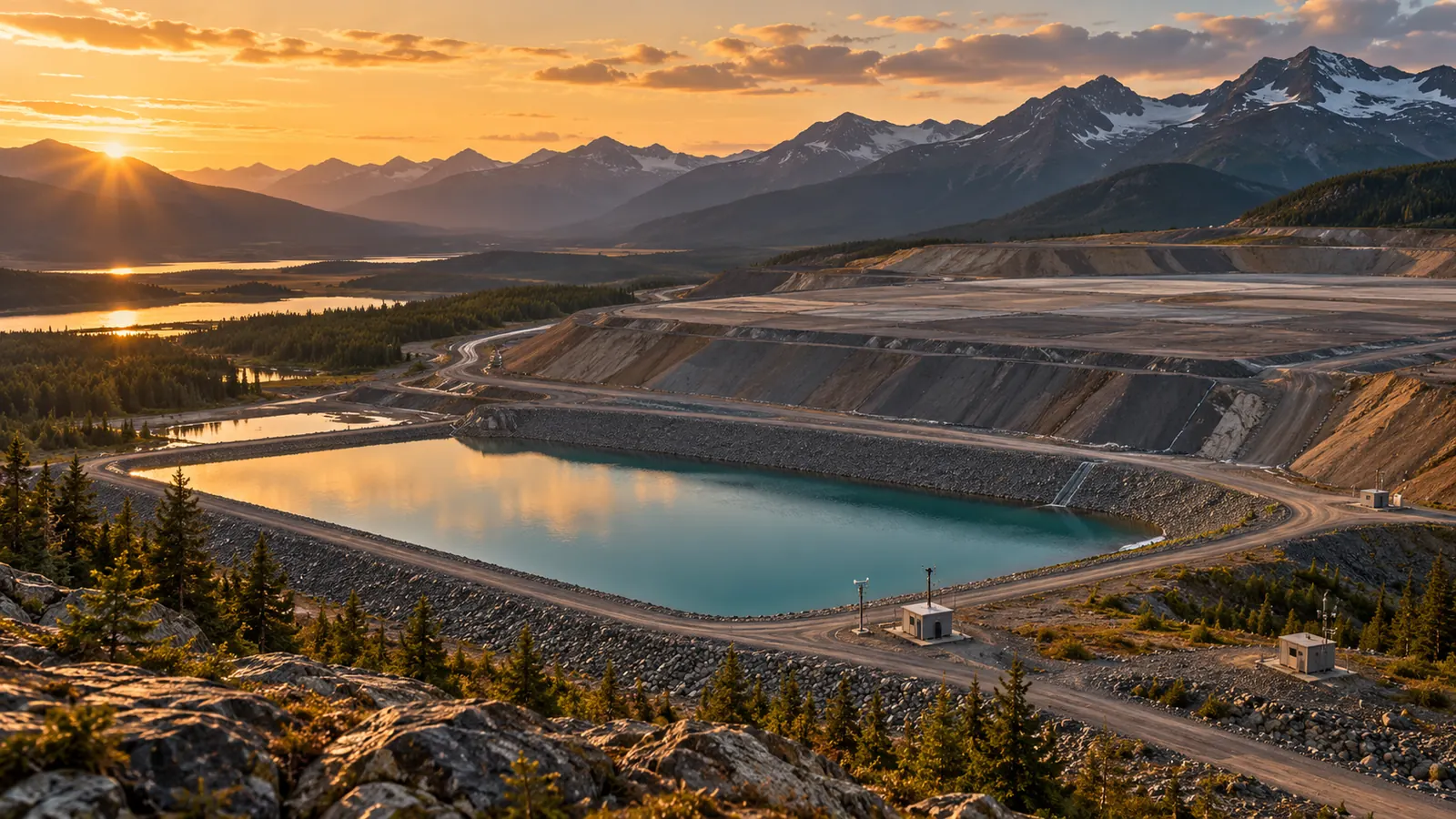
<!-- ARTICLE_BODY_START --> A disposal cell built in 1996 needed a substantial water-management intervention almost three decades later. In an April 28, 2025 account, the US Department of Energy described rising water levels inside the Rifle disposal cell in Colorado and a project adding extraction and monitoring wells, evaporation capacity and remote monitoring. The agency said its previous system could no longer keep pace and that saturation threatened structural stability. This was an operator's report of a problem and response, not a finding that every closed tailings facility faces the same conditions. Its significance is the timescale: completing construction had not completed the obligation. DOE's Rifle project account
That distinction belongs near the beginning of any discussion about mining's waste. The ore-processing equipment has an operating schedule. A pile or impoundment of finely divided residual material has a different clock. Rain continues to fall. Groundwater continues to move. A drain can clog, a surface can erode and a chemical reaction can proceed after the workforce that built the facility has dispersed. A closed gate does not isolate the material from the physical world.
Tailings management therefore connects several kinds of evidence that are often reported separately. Geotechnical observations address how the material and its containment behave. Water records address where water enters, accumulates and leaves. Chemical measurements address what that water carries. Governance records establish who must interpret the findings and act. Financial arrangements determine whether that action can be paid for when the mine's income has ended.
The question is broader than whether an embankment looks sound today. It is whether the facility can remain understandable, maintained and accountable through changing weather, changing ownership and changing institutions. This article uses dated official sources and original, explicitly hypothetical examples to examine that question. It is not a design manual, a safety certification or an allegation about an unnamed mine. No failure cause is inferred from an image, a headline or a single instrument reading.
Start by identifying the material and the boundaries
Tailings are the material left after processing ore to recover a desired product. That description does not establish their grain-size distribution, chemistry, water content or mechanical properties. Two facilities with similar-looking surfaces may contain material with very different histories. A useful account begins with what was processed, how the residual material was deposited and what is known about its condition.
Consider a fictional site, Alder Basin, used throughout this article as an analytical example. Its owners describe one tailings facility on a map. The operational reality includes a containment embankment, deposited solids, a pond, drainage structures, water-return equipment, roads and monitoring points. Beyond the boundary are upstream catchments and downstream land uses. Deciding where the facility ends administratively does not decide where its water or potential consequences end physically.
A public inventory should distinguish the mine, the individual facility and its separate components. If a company operates several facilities, a reassuring statement about one cannot stand in for information about the others. If a facility has been expanded in stages, the present structure includes that construction history. A single commissioning date may conceal later raises, changes in deposition or modifications to drainage.
For Alder Basin, the first useful document would be a plain-language map showing the current configuration and naming the records that support it. The map would distinguish confirmed features from uncertain historical ones. A buried drain shown on an old drawing should not automatically be described as a functioning drain today. Conversely, an unrecorded detail should be marked as an information gap rather than confidently reconstructed from appearances.
This is the foundation for later calculations. If the physical system has been described incorrectly, a sophisticated model can produce precise answers about the wrong facility. Establishing identity and configuration is an engineering task as well as an exercise in record keeping.
Water is both inventory and force
A water balance is an account of flows and storage. Over a chosen interval, the change in stored water equals inputs minus outputs, provided the boundary and terms are defined consistently. Inputs might include rainfall, runoff and process water. Outputs might include evaporation, recovered water, controlled discharge and seepage. The exact terms depend on the site; an omitted pathway does not disappear because it is absent from the spreadsheet.
Imagine Alder Basin receives 100,000 cubic metres during an invented month and loses 80,000 through all measured and estimated outputs. The calculated increase is 20,000 cubic metres. If a survey suggests storage barely changed, the discrepancy asks a question. Perhaps an input was overestimated, an output underestimated, storage measured poorly or the reporting periods misaligned. The answer should be investigated before the balance is used to justify a decision.
A monthly total is only one view. A short intense inflow can matter even when the month ends with little net change. Equipment may remove water over several days while the critical rise occurs within hours. Conversely, a small persistent imbalance can accumulate over many months. Both the peak and the long trend belong in the evidence.
Water also influences forces within porous material. Total load and water pressure are not interchangeable quantities. In the simplest effective-stress description for saturated soil, the stress carried by the granular framework is total stress minus pore-water pressure. The relationship is a conceptual starting point, not a complete stability model for a real facility. It explains why a change in internal water pressure can matter even when the visible outline looks unchanged.
Alder Basin's water account should therefore connect to its physical assessment. A pond-level graph and an embankment assessment filed in different departments are not automatically an integrated understanding. The people responsible need to know which water changes affect which assumptions about the facility's behaviour.
The pond surface cannot describe the interior
A photograph of a low pond is not a measurement of every internal water condition. Water within deposited material, perched zones or a foundation may respond differently from the visible surface. A useful monitoring interpretation asks what each instrument samples and how that location relates to the physical question.
Suppose a hypothetical monitoring point at Alder Basin shows a stable level while another rises. One explanation is that they observe different parts of the system. Another is an instrument problem. Treating the stable record as proof that the rising one can be ignored would choose the reassuring explanation before checking it. Treating the rising record as automatic proof of imminent failure would make the opposite error.
The appropriate response starts with the measurement itself: identification, location, reference elevation, calibration and recent changes. It then considers the expected relationship between readings. Does rainfall normally produce a delayed response? Did pumping change? Was a nearby construction activity recorded? The aim is to connect observations to competing explanations without allowing a preferred explanation to become invisible.
An instrument network has a spatial limit. Ten sensors in one accessible area may describe that area well while leaving another poorly constrained. More data are valuable when they reduce a relevant uncertainty, not merely when they increase the number of dashboard tiles. A monitoring plan should state which conditions it is intended to detect and which it cannot resolve reliably.
Public reporting can preserve this distinction. Instead of saying all instruments are normal, it can state whether readings remained within defined operating expectations, whether any instruments were unavailable and what investigations followed departures. That language is less absolute, but it tells a reader what was actually observed. A facility's condition is inferred from a body of evidence, not certified by the existence of a green screen.
Drains and channels have working lives
A drainage feature is an asset with a function. Its presence on a plan does not establish its present capacity. Maintenance records, observations and appropriate tests help show whether it continues to perform the role assumed in the assessment. This is especially important when a structure becomes difficult to access after later construction or deposition.
At fictional Alder Basin, an operator might report reduced drain flow as an improvement because less water is leaving the facility. That interpretation could be correct if the source of water declined. It could also be wrong if the drainage path became obstructed while water accumulated elsewhere. Flow should be read alongside pressure, rainfall, pumping and condition records. The same numerical trend can have different meanings in different contexts.
Surface-water channels have a related problem. Their intended role can change if sediment accumulates, vegetation obstructs a section or upstream land use alters runoff. A channel's original dimensions describe a design state. Inspection establishes something about the present state. A maintenance decision connects the two. These are separate pieces of evidence.
The distinction between clean and contact water is also operational rather than magical. A diversion intended to keep runoff away from tailings works only while the actual route remains separated. If water crosses contaminated material or an unexpected pathway develops, the original label does not guarantee its quality. Classification should follow the observed system and relevant measurements.
For long-term planning, the important question is what happens when a component underperforms. Can it be inspected? Can it be repaired without creating a different problem? Is access available in the conditions that make the component most important? A design that depends on maintenance should say so. Describing it as passive merely because it lacks a motor would hide the labour needed to keep its physical pathways open.
Storage capacity needs an operating explanation
A volume printed in a permit or design document can mean several things: capacity for deposited solids, space for water, a defined operating allowance or a reserve for specified conditions. A reader needs the definition before comparing the number with current storage. The apparent emptiness above a pond is not necessarily available for routine use.
In an invented example, Alder Basin has an identified operational water allowance of 300,000 cubic metres. That number should be accompanied by the conditions under which it was derived and the actions required as storage approaches it. It should not be presented as a universal safe limit applicable after any change in geometry, material or inflow assumptions.
Operating space can be consumed by more than water. Continued deposition changes the shape of the storage area. Sediment movement can alter flow routes. Survey uncertainty can affect the conversion from a measured water elevation to volume. A curve connecting elevation and volume is therefore a model of a particular geometry, not a permanent law of the site.
The relevant public question is whether the operating plan is consistent with the latest physical information. If a survey revises available capacity downward, the change should reach production planning and water management. If an old capacity estimate remains in a financial report while a new estimate guides engineers, the organisation is communicating two versions of the same facility.
There is also a temporal issue. Capacity that is adequate under normal operations may not address a sequence in which equipment is unavailable during a wet period. Assessing such combinations is not the same as assuming every imaginable extreme occurs simultaneously. It means identifying credible dependencies and understanding whether the plan has room for them. A reserve is useful only if the events it is meant to accommodate have been described honestly.
Chemistry can outlast the operating plan
EPA's explanation of abandoned mine drainage distinguishes acidic, alkaline and metal-bearing drainage. It describes how water interacting with sulfur-bearing minerals can generate acidity and mobilise metals. That account is a reminder to investigate the actual material rather than assume that all mining drainage has one chemistry. It does not establish the chemical behaviour of a particular tailings facility without site evidence. EPA's drainage explanation
For Alder Basin, the relevant questions include which minerals and processing residues are present, how they vary through the deposit and what conditions allow reactions to proceed. A laboratory sample can help answer some of those questions. It represents the sampled material under the test conditions, not automatically every part of a heterogeneous facility over every future season.
A useful prediction therefore connects sampling strategy, test interpretation and field observations. If the material deposited early in the mine's life differs from material deposited later, one convenient sample may be misleading. If water measurements change after a long delay, the result may reveal a process that the initial observation period did not capture. The report should distinguish an absence of measured change so far from proof that change cannot occur.
Water quantity and quality should be interpreted together. A concentration can fall because the chemical load declined or because more water diluted it. A higher concentration can occur during lower flow without implying the largest total release. Neither concentration nor flow alone describes the complete transport problem.
That is why closure needs more than a statement that treatment is currently successful. It needs an account of the conditions likely to sustain or change the source of contamination, the pathways by which it could move and the evidence that would trigger a revised response. A clear model can be updated when observations disagree. An unexplained assurance gives future custodians little to work with.
Concentration and load answer different questions
An original arithmetic example makes the distinction concrete. Suppose a hypothetical discharge carries a constituent at two milligrams per litre while flowing at one million litres per day. The daily mass is two million milligrams, or two kilograms. If flow doubles and concentration halves, the daily mass remains two kilograms. The lower concentration is real; a claim that the mass release halved would be false.
Now consider exposure at a receiving stream. The same released mass can produce different downstream conditions depending on mixing, timing, background chemistry and where organisms or people encounter the water. A mass calculation is necessary for some questions but cannot replace the environmental assessment. A compliance threshold, where applicable, also has its own defined sampling and averaging basis.
Alder Basin's public record should identify whether a graph reports concentration, flow, load or a derived estimate. Units should travel with the numbers. A monthly average should not be described as a peak measurement, and an instantaneous sample should not be presented as the complete monthly history. Missing observations matter particularly when short events may carry a disproportionate part of the load.
There is a further accounting issue when treatment transfers a constituent into a residue. The water may improve while sludge or another solid phase accumulates. That can be an intended and useful treatment outcome. It also creates a material that needs an identified destination and management plan. Removal from water is not equivalent to removal from existence.
This broader balance is a good test of a treatment claim. Ask where the constituents go, how the quantities are estimated and what happens when the receiving container, storage area or disposal route reaches its operating limit. A treatment plant is part of a system of material flows, not an endpoint that makes all downstream obligations disappear.
A cover is a functioning landscape
EPA's CLU-IN resource describes evapotranspiration covers used at mining sites in arid climates. These covers store incoming moisture and subsequently release it through evaporation and plant transpiration, limiting infiltration into underlying material. The description establishes a design concept and examples, not a guarantee that the same cover performs equally well in every climate or on every tailings deposit. EPA CLU-IN on mining covers
The useful question for Alder Basin is what function a proposed cover must provide under local conditions. Is the aim to limit water entry, control erosion, reduce oxygen access, manage dust or support a particular future land use? Several functions may be required, and success in one does not prove success in all the others. A vegetated photograph demonstrates vegetation, not necessarily the intended subsurface water performance.
A cover also changes over time. Settlement, erosion, roots and animal activity can affect its configuration. These are reasons to define inspection and performance measures rather than to assume either inevitable failure or permanent success. The management plan should distinguish cosmetic change from change relevant to the function being protected.
A useful evaluation might compare observed moisture and drainage behaviour with the assumptions used in the design. If performance depends on a seasonal drying period, a sequence of unusually wet conditions deserves attention. If a surface is damaged, the repair should restore the relevant layers and drainage relationships, not merely make the area look tidy.
The long-term aim is a landscape whose behaviour is understood well enough to maintain its intended protective functions. That may require active maintenance, restrictions on use or periodic reassessment. Calling the surface reclaimed can describe an important achievement. It should not erase the evidence needed to show what the reclamation is accomplishing beneath the visible layer.
Less water does not mean no water problem
Terms such as filtered, thickened or dry-stacked describe important differences in how tailings are prepared and placed. They should not be treated as complete safety conclusions. A comparison between alternatives needs the actual material properties, site conditions, operational requirements and closure performance being proposed.
For a hypothetical alternatives review, Alder Basin might compare a wetter deposition approach with a more dewatered one. Reducing the water transported with solids can change storage and recovery requirements. It may also introduce different demands for handling, placement, compaction or dust management. The analysis should follow those changes through the whole system rather than count only the benefit most attractive to the presenter.
A label containing the word dry does not mean rain cannot fall on the facility or that deposited material contains no moisture. The relevant water balance still exists. The physical assessment still needs to consider how the material behaves under the conditions it can encounter. The question is which hazards are reduced, which remain and which new dependencies are introduced.
This is where a comparison table can be useful if it resists turning into a scorecard with unexplained weights. Each alternative should have a description of evidence, uncertainties, operational constraints and consequences of underperformance. A method with lower routine water demand might require a different maintenance system. A method with a smaller footprint might have different constraints on future expansion.
The outcome should be a reasoned choice for the site, not a universal ranking of technologies. Readers should be wary of both promotional claims that one category eliminates all risk and blanket claims that no improvement matters. Engineering progress can be substantial without abolishing the need for qualified design, controlled operation and long-term care.
A monitoring result needs an action attached
Monitoring becomes protective when an observation reaches someone able to interpret it and respond. A sensor that records a concerning trend without a decision pathway is a witness, not a safeguard. The operational question is what the organisation will do with the information before the conditions it tracks become harder to manage.
Imagine Alder Basin defines several response levels for a particular class of observations. At an early level, staff check the instrument and increase review. At another, qualified personnel reassess operations and consider restrictions. The actual thresholds and actions must be site-specific; this illustration supplies no engineering limits. Its purpose is to show that detecting, interpreting and deciding are separate steps.
The plan should identify who can authorise a change, who covers absences and how conflicting evidence is handled. If the designated decision-maker is unavailable, responsibility should not vanish into an unanswered message. If one team believes a reading is instrumental and another believes it reflects a physical change, the disagreement needs an escalation route and a record.
False alarms deserve analysis too. Repeated nuisance alerts can train staff to dismiss warnings. The response should be to understand and improve the system, not quietly silence it. Equally, a desire to avoid unnecessary interruptions should not make thresholds so permissive that useful warning is lost. The balance must remain connected to the consequences and lead time of the condition being monitored.
A practical public disclosure could report meaningful departures, the response taken and whether the issue was resolved or remains under investigation. It need not disclose every security-sensitive operational detail. It should give affected people enough information to distinguish a functioning management process from a dashboard that displays measurements without showing whether anyone acts on them.
Models should expose the uncertainty they organise
A numerical model can help connect sparse observations to a physical explanation. Its authority depends on the assumptions, data and tests behind it. A visually detailed output is not evidence that every part of the facility has been observed at comparable resolution. The model may contain far more cells than there are independent measurements.
For Alder Basin, several parameter combinations might reproduce the available water-level records. Those combinations could predict different responses to a new operating condition. Selecting one because it produces the most convenient forecast would hide the uncertainty rather than resolve it. A more informative assessment would show how decisions perform across plausible interpretations and identify observations that would distinguish them.
Calibration and validation should also be described carefully. Matching the observations used to fit a model is not the same as correctly predicting a later period or a different condition. Both exercises can be useful, but they answer different questions. A model that fits ordinary conditions may need additional examination before being used for a demanding scenario beyond the fitted range.
Sensitivity analysis can reveal which uncertain inputs matter most to the decision. If changing one poorly constrained parameter reverses the conclusion, that parameter deserves attention. If wide variation in another input barely changes the outcome, measuring it more precisely may be less urgent. This is a way to prioritise evidence, not a reason to claim that unimportant inputs are known exactly.
The public-facing conclusion should preserve the distinction between observation and prediction. It can say that a model supports an operating choice under specified assumptions and that monitoring will test those assumptions. It should not turn a range of possible futures into a single guaranteed line. A model is most useful when it makes the conditions for revising a decision visible.
Closure changes the organisation around the facility
During production, a mine may have a workforce, equipment, roads, electricity and an immediate commercial reason to keep systems operating. After closure, some of that infrastructure may disappear. The tailings plan has to account for the resulting change in the capacity to observe, repair and respond.
Alder Basin's closure assessment should therefore begin before the last ore is processed. It should identify which functions continue, which can be reduced and what evidence would justify each reduction. Turning off a pump because production stopped is different from demonstrating that pumping is no longer needed. Reducing inspection because the workforce shrank is different from demonstrating that the relevant conditions have stabilised.
The Geological Survey of Finland's mine-closure resource describes post-closure water-treatment objectives as site-specific, dependent on water quality, quantity and local conditions. It includes long-term functioning, stable treatment residues, integration with other water management and capacity for seasonal fluctuations and peak flows. These are objectives to evaluate, not a single technology prescription. GTK's closure treatment objectives
A closure schedule should connect physical milestones to institutional ones. Before a contractor leaves, who receives the records and practical knowledge? Before a building is removed, does it contain equipment needed for continued monitoring? Before a road is abandoned, is it still required for maintenance or emergency access? These details can determine whether an otherwise sensible technical plan remains executable.
Closure is also a chance to simplify dependencies where evidence supports doing so. Fewer components requiring constant intervention may reduce some operational burdens. But simplification should be demonstrated through performance and maintainability rather than asserted through terminology. A site that still depends on active water management should be described that way, with a credible organisation and budget behind the dependence.
Long-term care needs a legal address
DOE's programmatic framework provides a specific example of responsibility continuing beyond remediation. For its US Uranium Mill Tailings Radiation Control Act Title I disposal sites, the department describes a general licence for long-term custody that does not expire, annual disposal-cell inspections and site-specific surveillance plans. This is a defined US programme involving particular materials and sites, not a rule that automatically applies to every mine worldwide. DOE's legacy-site framework
The broader question for Alder Basin is who has the continuing duty and authority to act. A name in an old permit is inadequate if the entity no longer exists or has transferred responsibility without a functioning successor. A long-term plan should identify the responsible legal entity, access rights, reporting duties and the mechanism for updating those arrangements.
Different jurisdictions can distribute responsibilities differently among operators, owners and public authorities. An article should not flatten those differences into a universal legal claim. Anyone evaluating a real facility needs the applicable law and current site-specific documents. The analytical point is that technical continuity requires institutional continuity; neither can be assumed from the other.
Access is a particularly concrete issue. A monitoring point may be physically present but unreachable without permission across land whose ownership changed. A treatment system may require a discharge or water-management authorisation that has its own conditions. Maintenance may need contractors permitted to handle the material involved. A plan should identify these dependencies before the moment they become urgent.
The institutional record should be as durable as the engineering record. Future custodians need to know what obligations remain, why they exist and who can approve a change. A beautifully documented facility with an uncertain responsible party is not fully managed. Neither is a clearly assigned responsibility whose holder cannot obtain the information or access needed to fulfil it.
Funding must match the work, not the optimism
A long-term cost estimate should begin with the functions the facility needs. Inspection, maintenance, water treatment, residue management, data preservation and contingency response have different cost patterns. A one-time construction allowance cannot automatically pay for recurring care. An annual allowance cannot automatically absorb a major replacement project.
Consider an original financial illustration rather than a proposal for any real mine. If a required activity costs one million currency units each year for thirty years, the undiscounted total is thirty million. Discounting those future costs produces a different present value depending on the rate chosen. The arithmetic does not make the future work cheaper to perform when it arrives. It changes how the obligation is valued today.
A credible arrangement therefore needs more than one attractive present-value number. It should state the assumed duration, inflation treatment, replacement cycles and contingencies. It should consider what happens if care lasts longer or costs more than expected. It should identify which party bears the shortfall and whether the funds remain available if ownership or corporate circumstances change.
These questions are not an accusation that an operator intends to avoid its duties. They are ordinary tests of whether a plan survives conditions other than its preferred forecast. The financial resilience of the responsible organisation and the physical resilience of the facility are connected because maintenance requires resources.
For public accountability, a useful disclosure would distinguish money estimated, money committed and money secured through an identifiable mechanism. It would also explain the limits of any assurance. A guarantee is only as useful as its terms and the ability to enforce it. The goal is to ensure that future decisions are driven by the facility's needs rather than by discovering, too late, that the only available budget assumed those needs would end.
Standards create questions that can be audited
The Global Industry Standard on Tailings Management, published in August 2020 by UNEP, ICMM and PRI, addresses the facility lifecycle, affected communities, technical knowledge, monitoring, accountability, emergency preparedness and disclosure. It explicitly includes closure and post-closure. The standard is a framework for responsibilities and assessment; its existence is not proof that a particular facility conforms or that a national regulator has incorporated every requirement into law. The primary standard and official repository
On January 21, 2025, UNEP announced the launch of the Global Tailings Management Institute, with an intended role in an independent auditing and certification framework against that standard. A launch announcement establishes that institutional development and its stated purpose. It does not certify every facility mentioned elsewhere in the industry, and this article does not infer a current certification status for any operator. UNEP's institute announcement
For Alder Basin, the useful question is what an assurance statement actually covers. Does it name the facility and assessment date? Does it identify the criteria, assessor and limitations? Does it explain unresolved findings and required follow-up? A corporate commitment and a completed facility-specific assessment are different records. A finding of conformance at one time is also different from a guarantee about all future conditions.
Independence needs practical support. Reviewers require access to relevant information and a route to communicate concerns without those concerns being filtered into harmless language. Operators need a process for responding to findings. A report that documents a problem but never reaches a decision-maker is an incomplete assurance system.
Standards are most valuable when they turn broad intentions into questions that can be checked. The reader should be able to trace an assertion to evidence, a responsibility and an action. The least useful application is a logo that stands in for those connections. Credibility comes from the traceable process, not from the visual prominence of the claim.
Downstream people need usable information
A technically accurate report can still fail the people who must use it. A resident deciding how to interpret a warning needs different information from a specialist reviewing a stability analysis. The two accounts should remain consistent, but they need not use the same vocabulary or level of detail.
At hypothetical Alder Basin, a useful public explanation would identify the facility, describe the main issues being managed, explain who receives concerns and distinguish routine updates from urgent instructions. It would make clear where authoritative notices will appear and how people without reliable internet access will receive them. Communication that assumes everyone can open a large technical file leaves part of the audience outside the system.
Emergency planning also needs local knowledge. Routes, mobility constraints, language needs and changing land use can affect whether a plan is usable. An instruction that works on a map may fail when a bridge is inaccessible or when people cannot travel as assumed. These are reasons for engagement and testing, not for inventing generic evacuation directions in an article.
The information relationship should continue outside emergencies. People can contribute observations about water, access and changes around the site without those observations becoming automatic proof of a particular cause. A credible process records the report, investigates appropriately and explains what was found. Dismissing every concern as unqualified and treating every concern as a confirmed hazard are equally poor ways to learn.
Public disclosure should also respect legitimate limits, including personal privacy and sensitive security details. Those limits need not prevent clear reporting of responsibilities, findings and unresolved questions. Affected people should not have to choose between accepting a vague assurance and becoming technical experts simply to understand what is being managed in their vicinity.
The durable product is a continuing capacity to act
A tailings facility's future cannot be reduced to a single factor of safety, a single water sample or a single certification. Each answers a bounded question. The management obligation is to keep those answers connected as the physical system and the organisation around it change.
For Alder Basin, a credible long-term record would preserve the facility's construction and deposition history, current geometry, water account, relevant material characteristics, monitoring interpretation and outstanding uncertainties. It would connect those records to named responsibilities, response processes, access rights and funding. It would show how the plan changes when observations challenge an assumption.
That record should be useful to someone who was not present when the facility was built. Future staff need more than conclusions; they need the reasons behind them. Why was a particular drain important? Why was a monitoring location chosen? Which observation justified reducing an activity? Without that reasoning, an apparently minor change can remove a function whose importance was understood only by people who have left.
The lesson from long-term management is therefore practical rather than fatalistic. Persistent obligations can be recognised, organised and funded. Engineering improvements can reduce hazards and simplify care. Monitoring can reveal problems early enough to respond. But each benefit depends on maintaining the capacity to interpret evidence and act on it.
The mine's commercial life ends when extraction and processing stop. The responsibility for the material left behind ends only when the applicable obligations and physical conditions genuinely allow it to end. Until then, the facility remains a working relationship among water, solids, structures and institutions. Treating that relationship as part of the original project is more honest, and more useful, than discovering decades later that closure was only the beginning of another operating phase.