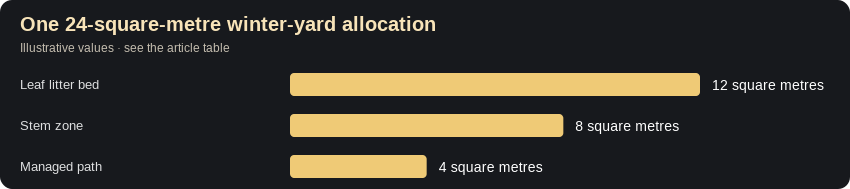
| Category | Value (square metres) |
|---|---|
| Leaf litter bed | 12 |
| Stem zone | 8 |
| Managed path | 4 |
Illustrative footprint for one hypothetical site; not target percentages.
On the first wet November morning, the shortcut from the back door to the gate might be the most revealing place in the garden. Oak leaves have settled against the bed edge, where they can stay. Others have drifted across the paving, where they hide the change in level and slide under a shoe. A row of dry perennial stems still stands beyond the paving. The impulse to solve all three situations with one pass of the mower is understandable, but they aren't the same job. Wet leaves on a route are a maintenance problem; fallen leaves below a shrub can be useful cover; a dry stem can contain an occupied nest that you cannot see.
A two-zone winter yard is a way to keep those jobs separate. Reserve one bed primarily for retaining leaf litter and a second area primarily for retaining upright stems. Keep a managed route between or beside them. The route isn't a third habitat prescription. It is what makes the arrangement usable and makes it possible to see both habitats without moving anything. No minimum lawn size, universal cleanup date, or target percentage is assumed. The first season's success is whether the materials stay where you intended, whether people can use the route, and whether both can happen without repeated intervention.
The method can work behind an apartment building, in a shared garden, or on a stretch of school grounds where the manager approves it. The authority to make the change matters as much as the sketch. If another person has to clear the path or inspect the site, get that person's input before placing a stake or promising to leave a planting standing. The layout should reduce the amount of fine judgment required in the middle of an ordinary maintenance shift, not turn every fallen leaf into a dispute.
Know what you are protecting before choosing a boundary
Leaf litter is the layer of fallen leaves and fragments resting at the surface. Under a tree it may include fresh whole leaves over darker material from earlier seasons. That makes it different from loose compost brought in by the wheelbarrow or from a thick pile made after a neighborhood cleanup. The National Park Service’s guide to leaving leaves describes fallen leaves as winter cover for various insects, some of which are present as eggs, larvae, or pupae. It recommends preserving whole leaves rather than shredding them and notes that leaves can be moved a short distance from a route into a nearby bed. Its message is about reducing disturbance, not making a uniform blanket of a prescribed thickness.
A perennial stem is the upright or leaning material left by a plant after aboveground growth dies back. An opening may be a natural hollow, exposed soft tissue called pith, a broken end, or a cavity worked by an animal. A stem that looks solid from the side can be useful once an opening is available. One that looks open from a path is not automatically occupied. The USDA Forest Service and Pollinator Partnership guide Bee Basics is a useful introduction to the differences among North American bees, including species that make nests in soil, use cavities, or excavate material. It is not a guide to identifying whatever might be in an individual stem by looking at its entrance.
Those categories also describe overlapping habitat, not occupancy compartments. A stem bed with a few leaves at its base is still a stem bed. A leaf bed with an old upright stalk doesn't need the stalk removed to preserve the diagram. Draw the zones according to how the crew should maintain them. The purpose of the label is to tell a person where to stop sweeping, digging, or cutting, not to say that insects observe the border. A local observation can confirm that an animal used a particular material at a particular time; it cannot sort everything else into the inventory boxes.
One other distinction keeps the design from doing harm: some ground-nesting bees use exposed soil, and access to that soil can matter. If a quiet sunny edge already has visible soil openings or repeat insect activity, don't cover it just because it falls inside a box labeled leaf bed on your first sketch. Shift the outer boundary, leave the opening alone, and note what you saw without declaring which insect made it. Bee Basics gives the wider nesting context; the site visit should determine where the proposed change is a bad fit.
Start with a route that must keep working
Walk the yard once before working on it. Approach from the entrance you normally use, and follow the path somebody else would take to the gate, shed, trash enclosure, bench, or hose shutoff. Look for a low step that leaves can hide, a drain that is already slow, a corner where a person carrying a bag has to turn, and a blind spot when a door swings out. Use the route a second time from the opposite direction. What looks like a generous curve from one side might be a pinch point from the other.
If you share the site, do not use your own stride as the measure of adequate access. Ask the person responsible for the facility what route must remain clear and whether there are dimensional, surface, or sightline requirements. That includes more than the path through the drawing: there may be windows, driveways, fire lanes, utility access, and an entrance a crew reaches only occasionally. Keep an eye on overhead clearance and branches that can lean under rain or snow. A bench approach that is unusable is not a successful route simply because there is open space beyond it.
Mark the route on a simple sketch and mark separate no-go points such as a drain, curb ramp, access cover, or door swing. No tape measure is required for a first pass, but use one before staking territory on a narrow site. The unit of area is not the unit of usable width. Four square metres could mean a broad short connection or a long strip too narrow for the intended job. Likewise, a photograph of a straight stretch says little about how people get past each other at a bend. Where you need a safe route immediately, maintain it before measuring or photographing the yard.
A good boundary doesn't have to be a raised edge. An existing break between pavement and soil, a low clearly visible marker set away from the walking line, or a jog in a bed can do the job. Loose rocks or logs may roll, hide under leaves, or become obstacles on the route. Existing markers are often better than a new one; an owner who already recognizes the edge of a stone walk need not remember how to read a different landscape symbol. If access or service staff already solve a similar problem nearby, borrow their convention rather than invent one for a single bed.
Place the litter bed where leaves can stay
Begin in the area already collecting leaves. An existing tree or shrub bed often does the work of catching leaves, reducing the amount that moves when the next wind arrives. A position slightly sheltered from an exposed corner can save repeated sweeping. Observe where the first rain leaves water; a roof outlet, curb inlet, or irrigation box is a poor place for a deliberate accumulation. Inspect the spot from the route rather than only from overhead on a map. If a wheel, snow shovel, or person needs to reach over the proposed bed to use a gate, the leaves will probably be cleared there anyway.
Favor leaf retention in place over moving an existing settled layer just to make it photogenic. If you do move leaves, choose fresh drift that must be removed from a path and move only what the neighboring bed can readily hold. No imported material is necessary for the principle to work. Set material softly into a bed rather than compacting it into a barrier or dragging a rake through the underlying soil. Keep leaf material from blocking vents, sitting against building details that need air, or filling a channel that carries water away. A site with no suitable place for excess material can still keep its naturally settled leaves while sending the excess from the route to its ordinary permitted destination.
There is no need to inspect leaf undersides one by one to prove the space deserves to stay. The moment that activity requires lifting and turning the established layer, observation is becoming the disturbance you intended to avoid. A close-up of whatever is already exposed at the edge is different from an inventory of what lies beneath it. A dry, breezy day and a wet one can produce different surface appearances without telling you what is alive under the same patch. Record whether cover remains, where it tends to move, and whether the ground beneath can still do what people need it to do.
Keep an eye on transition zones. A small hump of leaves at the seam between deck and soil might be acceptable if nobody uses that seam; it may be a problem at the opening of a gate. At one end of a bed you might clear the edge by hand or broom. At the other end a leaf drifting beneath a shrub needn't be moved at all. Write the reasons for those differences on the sketch. If the note only says to clean an edge, a new helper might clean the full perimeter and remove the strip you meant to retain.
Keep upright stems in the right place and the right age class
Choose a stem zone around plants already producing persistent stems rather than building around a bundle of material collected elsewhere. In-place stems are attached, easier to locate again, and less likely to roll across a path. An existing stand of perennials behind a low planting can be visible without pressing into the walking area. Look at the arrangement when stems are wet or bent by wind, not just on the calm day you sketch it. A driver sightline and a public passage should be treated as constraints before deciding which material can remain.
A spring cleanup rule meant for entire yards does not settle what to do with an individual stem. The National Park Service gives a broad recommendation to defer major tidying. NC State Extension’s stem study and management guide asks a narrower question. In their study, stems from perennial gardens in North Carolina were sampled across seasons. The researchers distinguish newly dead stems that have not already been opened from stems that were cut, broken, or available during the prior growing season. Their resulting practice is to retain stems that might already contain nests; for suitable plants and circumstances, an identified new stem can be shortened in its first winter to make an opening while leaving a standing portion for later use. That isn't an invitation to clip a mixed bed on a date or to assume every intact-looking end is new.
Age is useful only when you actually know it. If you noted a flowering stem from this year's growth and watched its tip remain intact, that is different from discovering a dry stalk in a bed containing several years of growth. An old weathered stem might be hidden under fresher branches. A broke-off tip needn't be new just because you saw it yesterday. If the origin is uncertain, keeping the stem in place is the least irreversible option. In a shared yard, telling a crew to preserve all uncertain stems may be more reliable than asking them to apply an age test to dozens of stalks under time pressure.
Consider a simple mark on a bed map for the current cohort: not a tag on every stem and not a cord that can crush fragile material. Some maintainers will want a wide photograph at the end of the growing season showing which clump held living stalks. They can compare it from the same spot after dieback. Others can draw a little circle around the original planting and annotate the area as mixed age. You are writing a maintenance record, not reconstructing every insect generation. Year one can be entirely observational; year two benefits from even one clearly dated note.
A capped opening, an ordinary hole, or short flights near a clump should not trigger opening the stem. A plug can be consistent with nesting but cannot on its own establish the occupant, timing, or success of a nest. A solitary wasp may also use a stem; that is not a defect in a pollinator-oriented yard. If a stem encroaches on a route or a high-use area, prioritize safe access and ask the manager how to deal with material that might be occupied. Plan the next year's stem zone farther back rather than designing a recurring conflict at the same corner.
Read the chart as a floor plan, not a habitat formula
The chart uses a hypothetical 24-square-metre strip, six metres long and four metres wide. Its three bars are 12 square metres of leaf litter bed, 8 square metres of stem zone, and 4 square metres of managed path. You can picture three adjacent bays along the long dimension if you want to check the arithmetic: one three metres long, one two metres long, and one one metre long, all four metres deep. Those bays provide an easy check on the sum, not the only arrangement and not a guarantee of a suitable walking corridor. In a real courtyard, a strip intended for traffic may follow a diagonal or widen at a gate, and the beds may run alongside it rather than across the building frontage.
At that total, the fractions are one half, one third, and one sixth. Those numbers do not say a yard should have half its area in leaves. Nor does the larger litter bar establish that litter is more valuable than stems. Each bar is an assigned footprint for a different maintenance purpose in a fictional yard. No stems were counted, no leaf depth was measured, no insects were observed, and nothing was compared with a reference site. If you choose six square metres of path for local access instead, the change has to come from one or both habitat areas in a fixed total, but the ecological result cannot be calculated from that subtraction.
Use the figure as a prompt to state assumptions in your own notes. Measure or sketch the whole portion of the yard you are actually changing, not the total lot unless the total lot is part of the project. If a strip already includes a paved route and a service alcove, decide whether both are included in your accounting. Count an area once even if leaves and upright stems share it. If your aim is to track how much upright vegetation remains in a bed, measure that separately; it is a condition of the bed rather than an extra layer of land that can be added to the area total.
The example is simple enough to adjust before moving anything. If the original path connects a gate but ends shy of the water tap, sketch a spur and check the turn before cutting an edge. If the litter bed covers the only well-drained opening in an otherwise wet yard, use a smaller footprint farther from the opening. If the stem patch will shade a window when it grows next year, identify a different clump now. This is the value of a small allocation exercise: it reveals tradeoffs while they are still pencil marks. It doesn't tell you to force an unsuitable site to match a bar.
A worked visit from the first drop to the first warm spell
Imagine the 24-square-metre strip behind a small shared hall. A paved connection reaches from the accessible entrance side to the service gate. There is an old planting bed with a deciduous shrub, and there are summer-blooming perennials along the back fence. Beneath the shrub, the wind carries some leaves out toward the gate, but most settle behind a curve in the bed. Closest to the fence, the wind is calmer. On the first walkthrough, the volunteer writes a note that rain always leaves a shallow puddle next to the entrance, so that corner remains part of the managed access area.
Before the main leaf fall, two people take a wide photograph and discuss how the caretaker gets the waste bin to the street. They stand where the bin turns rather than guessing from the planting plan. The turn needs a little space near the gate latch. Instead of putting all 12 square metres of the litter zone against the gate, they extend it toward the existing shrub, staying away from the low spot and maintaining the curve. The stem zone remains at the fence behind the other beds. One particularly tall clump is visible from the route, but it isn't on the side where the latch needs to swing.
At the first cleanup, they sweep wet leaves off the paving and remove excess from the drainage corner. They put some of the fresh neighboring drift into the sheltered edge of the shrub bed but leave existing leaf cover where it has settled. They don't comb the soil to create a perfectly straight border. They resist taking the easiest shortcut to the fence through the leaf bed; the paved route is right there, and they intend to see whether ordinary foot traffic will respect the new arrangement. The stems remain standing. The only note around them is a sketch showing which clump they observed flowering that summer, and which clumps are older or uncertain.
After a storm, the caretaker takes a second photo from the doorway and writes that leaves covered part of the threshold. The person on duty clears the threshold. On the sketch, there is a repeated drift line from a gap between shrubs, not a failure of the entire litter patch. One response is to hold back a smaller amount of moved litter near that gap. Another is to leave the same bed boundary and simply check the threshold more often in windy weather. The stem clump nearest the gate has leaned a little, but it hasn't entered the travel line. They decide to watch it without tying it to a new stake just for the sake of symmetry.
In late winter, one volunteer sees an opening on a previously broken stem end. She notes the stem and the angle of the photograph, and leaves it alone. A visitor asks whether this means there are more bees. The answer is that they have seen a possible entrance, not an occupancy estimate or evidence of a population change. On a later mild day somebody notes a small insect in flight at the clump, but its movement behind the stems prevents a reliable identification. The record is based on the parts both people can actually see. No one opens the stem to settle the question.
The first warm spell is not the signal to reset the yard. They again check drainage, access, and material likely to move. Dry stems that can already remain without interfering still remain. The next handoff to the summer crew includes the map and the note that the new stems will eventually become next season's older cohort. One year later their best evidence may be as modest as two photos with an intact clump and a clear route. That is enough to tell them the yard can be maintained this way. An inference about insect benefit would require different evidence.
Measure condition without turning the yard into a sampling trap
There is a difference between a maintenance check and a biological survey. Maintenance requires looking for hazards or disturbance: is the passage clear, did a drift relocate, did tall stems bend into the route, has a drain become hidden, or are people cutting through a protected bed? You can record the answer quickly. Biological observations require more discipline if you want to compare visits: time spent, what was visible, where you stood, whether you returned to the same view, and which behaviors you could actually distinguish. An accessible yard does not need to provide a scientific dataset to justify retaining its structure.
For simple non-destructive notes, start with the date, an approximate time, a viewing point, and the weather in ordinary words. Indicate which zone you observed and whether a person could see the material from the maintained route. Note a dry stem that has snapped or fallen, a leaf edge that has moved, or an animal already visible. You might write that three openings were visible on the path-facing side of a clump and that no insect was seen in a ten-minute stationary look. That is not the same as stating that exactly three openings existed or that the stems were empty. Losing the view during a rain shower is not a negative observation.
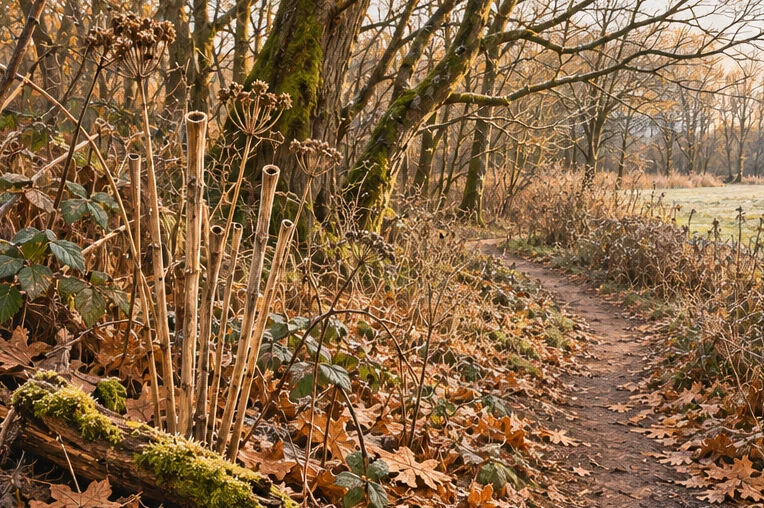
Photograph from the same location if possible. A wider view preserves the relation between planting and path, which a macro shot alone cannot show. A close-up, when it can be taken from where you already stand, can document a feature that looked like an opening; leave it uncropped in the project archive even if you eventually show a tighter copy. Take care with neighboring yards, windows, and people in frames made for public sharing. An especially useful image may be one that shows changes from earlier photos rather than a dramatic insect close-up. The generated illustration above is only an editorial picture and is not evidence of this yard, its geometry, or its occupants.
If you see the same activity again on a subsequent visit, resist recording it as a count of distinct animals. The same individual could make multiple trips across your view. One visible encounter, even if identified confidently, cannot establish nest success or the effect of the project. If a naturalist can help with an identification from a photograph, share the photograph and the general setting without revealing sensitive locations unnecessarily. There is no need to display the precise location of a suspected cavity to every visitor. A community sign can describe the habitat while the project log keeps finer notes for the site team.
A useful way to report the first winter is to keep three columns in your head. First is what was put in place: the bed boundary, the chosen stem clump, the path, and the work routine. Second is what happened physically: cover persisted, drift moved, a stalk lodged across paving, or service access stayed open. Third is what was seen alive: an insect crossing the canopy, a bird using seed heads, or an unidentified animal near the leaf edge. Only the third column is a wildlife observation, and even that is usually a record of presence, not causation. Writing those down separately makes the report honest enough to reuse.
Adapt the design to moisture, wind, local seasons, and rules
A map made in a sheltered deciduous garden will not transfer unchanged to a windswept coastal lot, a hot dry courtyard, or a snow-storage strip. In each climate, the triggers for maintenance differ. Continuous wetness, dry wind, seasonal snow clearing, or irrigation during a dry period can change where material accumulates and how quickly people need to intervene. Timing also affects opportunity to observe. In a cold climate, a deep snowpack may conceal the whole yard for much of the season. In a warm place, warm winter days do not necessarily tell you that previously occupied stems are now empty. Use local extension guidance on relevant plants and current conditions rather than applying a calendar date from a different region.
In a yard with little natural leaf fall, a small retention area around existing foliage may be more appropriate than collecting large quantities of material. Don't move litter, stems, or soil among natural areas as a way to stock the bed. Besides needing owner consent, material taken from one habitat may already support organisms and could carry unwanted material to another site. In a site with low winter rainfall, do not add irrigation just because a photograph elsewhere showed damp litter. Maintaining a stable edge with the materials that are already present may meet your aim with fewer side effects.
Defensible-space, flood, or facility management requirements can overrule the first layout. Where fire safety rules apply, confirm where dry material may be retained and keep it well away from areas designated to remain clear. Where a site floods, don't treat leaves around inlets or seasonal channels as protected habitat. In a region with frequent snow removal, coordinate before selecting an area that the crew uses for storing snow. The right question for a small yard is not whether habitat work can override those requirements, but whether a different, lower-conflict location can retain some structure while respecting them. Sometimes the workable answer is one modest bed and a small stem corner rather than both at the preferred scale.
If you manage a shared public site, consider which exceptions belong on an internal notes page and which need to be obvious on the map. For example, a routine to clear the pavement and gate swing is a clear site-wide instruction. A note to watch a particular new stem cohort is specific work for somebody trained to recognize it. Staff changes should not turn the plan into a guessing game. Put the intended outcome and the route clearance priorities beside each other. Instructions that name only the habitat may get ignored during a rush; instructions that name only the maintenance surface may erase the habitat.
Local plant selection can be a useful later project, but it need not come first. Start with suitable plants already in place, then ask regional experts which species fit the soil, climate, available light, and intended layout. Stem utility is only one criterion. A plant which produces an upright winter structure but grows across a gate will require regular disturbance. A plant with decorative flowers but a persistent problem with local spread may create a different maintenance burden. Favor a layout that fits the expected mature growth rather than one that looks best from the nursery pot.
Design for the next person who holds the rake
The simplest maintenance plan is a pair of short written instructions, one for what should stay and one for what must stay clear. For example, a sign in a staff area might say: keep settled leaves in the shaded bed, and leave the dry perennial clumps at the far fence unless they encroach on the marked route. The map then shows the route and the spots to check after a storm. That is clearer than naming every insect the project might benefit. A note for visitors can explain that the site is intentionally leaving material for seasonal shelter and invite people to watch from the path, not to step into the bed or look inside stems.
Agree on who checks the yard after conditions change. The team does not need a daily inspection for the sake of having a chart. It may need to check after a windstorm, after a freeze-thaw cycle at the gate, or before a busy public event. Attach each check to something already in the site's routine if possible. If a groundskeeper already clears a threshold each morning, they should be empowered to do it without requesting permission from the habitat team. A volunteer can review whether the bed drifts too often and discuss a boundary adjustment without asking the maintenance worker to leave a slick route unattended.
Use a small set of decisions rather than a list of prohibitions. Leave material in place when it is stable and causes no issue. When loose leaves obstruct a necessary passage, clear the passage first. When a stem threatens access or sightlines, handle the immediate safety problem and note why; then reconsider future placement. When a plant or insect raises a question you cannot identify, let uncertainty stand and seek local advice if it matters. You do not need to classify the whole yard before preserving a straightforward low-conflict section. Nor do you need to assign collectible value to a stem just because somebody saw a possible opening.
A seasonal record is particularly helpful when volunteers rotate. Keep the map in a shared location with a dated version. Write any boundary change as an actual change, for example that the retained litter edge was moved away from the threshold after wind carried leaves onto a turn. Don't erase the previous version until you have compared the two. It may show where the first mistake was and help at another site. Attach two views, one facing the gate and one taken looking back, so the next person can see the edges that matter when they weren't present at the first setup.
Communicate the option to leave less if the original arrangement is difficult to maintain. If one corner is a recurring conflict, changing its footprint is better than privately asking everyone to be more careful. A slightly smaller bed that remains largely untouched can be more practical than a wider bed raked apart every week. A low planting buffer may help neighbors understand what was meant to remain, but it shouldn't become another object for the crew to trim or step over. Even a piece of well-placed existing pavement can define the border more reliably than an elaborate new treatment.
Catch the problems that look like successes
A photograph immediately after setup may show clean paving, a tidy leaf line, and evenly tall stems. That does not necessarily tell you what will happen in the next gust. An apparently perfect boundary can also reflect too much intervention: repeated raking may be necessary to hold a clean stripe, especially when the bed receives wind from two sides. If the bed requires you to move the same settled litter for the sake of appearances, it may work better to adjust the public edge or move the boundary back. Measure the amount of repeated work, not only how sharply defined the bed looked on one overcast afternoon.
Similarly, an active-looking corner might be convenient for photographs but inappropriate next to a narrow exit. Watch where visitors naturally stop and how their activity interacts with the route. A busy bottleneck can be fixed by moving the observer point to a widening or by making the most visible stems farther away from the turn. Don't invite public watching from a place where somebody needs to move back into the roadway to let another person pass. Anyone unable to reach the view should be able to get the gist from the route sign or a written description without being expected to leave the paving.
An accumulation can also appear stable because nobody has seen it after a different kind of rain. Compare the edge during one mild period and after at least one significant weather change before making large commitments about next year. If maintenance duties differ by season, check the conditions in which those duties begin. The shaded walk that is easy to sweep in autumn may be where ice persists after winter rain. The fence that blocks ordinary breezes may also be where gusts pile everything up. When you keep notes on the trouble spots, distinguish a one-off event from a pattern requiring a layout change. The first message after an incident can ask for a clear route without asserting that a whole approach has failed.
One overlooked type of success is doing nothing. If older stalks remain well away from the route and no practical issue has arisen, a review does not have to invent work. A decision to retain marked stems again is an actual management decision. If the team wants more color or an easier way to find the bed in winter, adding a permanent reference mark farther from the stems is generally less disruptive than rearranging the contents to make a new focal point. You can treat the conservation feature as a backdrop that stays intact across different seasons of use rather than an annual display to rebuild from scratch.
A first-season checklist for what you can verify
Before leaf fall, locate the proposed zones, mark the route and service points, and make a short record of existing plants and boundaries. Ask who will maintain the route and find out which requirements already apply. Put each proposed zone where the desired material can remain without turning into a recurring safety or work problem. If no safe site exists for one of the zones, don't force the design to have the same dimensions as the example. Keep the scope small enough to learn from the actual yard.
At setup, preserve existing leaf cover where suitable, sweep or lift leaves that have reached the passage, and avoid churning the retained layer. Leave standing stems without opening them or inspecting their interiors. Write down which stalks are known to be winter's new cohort and which remain uncertain. After changing conditions, return from the managed route and check the spots that were identified in advance. Note exactly which part of the plan failed when an issue occurs. Clearing the gate is an immediate fix; figuring out why the gateside bed keeps producing a drift is the design task.
At the end of the first cycle, compare the first map and last map. Can somebody else trace the required route from door to gate? Can they point to a part of the litter bed that was largely undisturbed? Can they recognize a clump of stems they will not cut simply because its vegetation is brown? Is a future caretaker able to understand the notes without looking up every plant or insect? If those checks pass, the yard has a workable maintenance layout. If you also made observations of wildlife, state what you saw and how you saw it. Don't elevate a few visual checks into a claim of increased nesting, diversity, or survival.
This approach is ultimately about making a practical choice visible. The useful boundary is not the one that keeps every leaf in an exact place. It is one that helps the person holding the rake choose what to clear, what to leave, and when to come back to see how things settled. Protecting a leaf layer and a set of upright stems are different actions, and a working path lets both coexist. The chart shows one possible distribution of space. The rest of the design comes from watching the real site and leaving room for the next person to keep it working.
Sources
- National Park Service: Leave the Leaves, agency overview of leaf retention and overwintering cover.
- Bee Basics, USDA field-office archive; working issuing-agency copy, Forest Service and Pollinator Partnership. Broad introduction to varied bee nesting habits and life histories.
- NC State Extension: Garden Cleanup for Pollinators. Authors report their North Carolina stem study and describe a first-winter management approach for the circumstances they address.