
| Category | Value (files) |
|---|---|
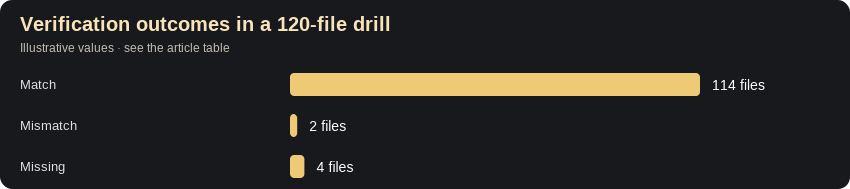
| Match | 114 |
| Mismatch | 2 |
| Missing | 4 |
Illustrative calculation (not sourced observations). Fictional exercise for 120 expected payload files: 114 match, 2 present with bad fixity, 4 absent. Not measured preservation statistics.
The photograph opens. The chart preview looks right. The archive is the expected size, and someone remembers approving the caption. Six months later, an editor needs to know whether this particular photograph is the one that accompanied the published caption. None of those observations answers that question. A picture can open after a harmless re-export that changes its file bytes. An incorrect image can have the same size as the correct one. A rendered preview can come from a cache while the local copy is incomplete. A colleague's memory can point toward the right edition but cannot stand in for its original receipt.
A fixity report answers a narrower question that is useful precisely because it is narrow. It records whether particular bytes, read at a particular time from a particular copy, agree with a recorded expectation. To turn that into an archival handoff, the editorial team also needs an explicit inventory of what belongs in the edition and evidence that the expectation came from the right release. Design the report so a recipient can verify the payload without having to rebuild the site, call the original editor, or decide which folder looks newest. Design the acceptance rule so a correct checksum does not excuse missing materials or a mislabeled release.
Start with the object you mean to preserve
Take a fictional edition of an illustrated article distributed as an offline reading bundle. Its reading copy is HTML, with styles, a generated editorial illustration, a plotted graphic, and a locally linked table. The release includes a Markdown companion and a short description of what the package does and does not contain. The editorial record links the illustration to an approval decision and marks it as an illustration rather than photographic evidence. Two versions of the illustration exist in the working directory: the original approved source image and an optimized derivative used by the reader. The editor must decide whether the preservation package includes both or only the published derivative plus a recorded reference to the source.
That choice belongs in an inventory, not inside the meaning of a digest. A reader can compare an expected and observed hash without knowing that the chart ought to have a separate table. The comparison cannot discover that an editor meant to include a second SVG, or that the agreement requires source photographs as well as WebP files. Write down the representation being preserved before packaging: an as-published offline edition, an editorial source bundle, a public delivery artifact, or a combination whose members have distinct roles. If an optional master is out of scope, say so. An omitted item that was intentionally excluded is different from a required item that never arrived.
Give the edition a durable identifier separate from its display title, public URL, date, and folder name. Each can change on its own schedule. A title correction might leave a canonical URL intact; moving an archive between volumes might change the directory path without changing any payload bytes. A stable accession or release identifier gives the receiver a way to ask which inventory governs the copy in front of them. If an edition contains more than one representation, assign independent identities to the representations as well. This keeps a digest computed for a compressed delivery file from being mistaken for a digest computed for the original illustration.
A useful inventory names the exact relative path, role, stable object identifier where needed, and whether the member is required under the agreement. Add expected size when readily available, and map a derivative to its source and publication use where that relationship matters. A short inventory for a one-page publication might distinguish the reading entry point, figures, alternate chart data, appearance assets, and editorial source. The full package listing belongs in a machine-readable file. The prose agreement can explain why these roles exist and how to handle items that are intentionally linked externally rather than preserved locally. If the release depends on external material, call it a dependency and qualify offline expectations instead of counting that material as silently present.
Separate byte agreement, package completeness, and provenance
Byte agreement asks whether a file matches a reference digest under the named algorithm. For ordinary operational preservation with a sound digest and a trusted reference, agreement is strong evidence of unchanged bytes. It is not proof that the original pixels were authentic, accurate, or approved, nor that the asset remains legible in a browser. A file can be an exact copy of a draft with the wrong credit. A correct caption can sit beside an illustration of the wrong species. Verification does not repair a mistaken original decision or imply an independent editorial review.
Package completeness asks whether the expected set arrived without missing required components, unaccepted extras, or naming ambiguities. There are two sets to compare: the submitted package's own claims and the agreed edition inventory. A transfer can conform to its internal manifest even though the sender bagged the wrong subset. Conversely, it can contain every file in the editorial inventory while omitting a required packaging document, leaving the receiving system unable to accept it as the specified package type. Record these as distinct checks. It is useful to be able to tell the sender, “The archive internally validates, but the agreed data table is absent from the release inventory,” rather than sending an unexplained red indicator.
Provenance asks how the reference arose, who authorized the association between edition and bytes, and what was done to each copy afterward. If an assistant downloads a package today, hashes it, and writes a manifest, the result may make a good baseline for future checks. It cannot establish what the publisher sent yesterday. For that, compare against an independently retained release receipt or sender record and understand its trust limits. Logging a later discovery without backdating it is more valuable than making an old release appear better documented than it was. The first trustworthy reference and the first time a copy was actually verified may be different dates.
A helpful operational distinction is between evidence about an object and evidence about an event. The object can have a stored algorithm and digest. A later attempt to calculate and compare that digest has its own agent, time, scope, method, and outcome. Confusing those records is how a repository comes to report an old ingest checksum as proof that a newly restored copy is sound. Keep the reference and observation separate even when their values match. When a mismatch occurs, their separation is necessary to record the failure honestly.
Give payload and packaging metadata separate jobs
RFC 8493 describes BagIt 1.0, a structured way to bundle a payload directory and handling metadata. Think of the payload as the preserved edition's content. At the bag root, the bag declaration identifies the bag format and tag encoding, and one or more payload manifests associate checksums with payload paths. Under BagIt 1.0, every payload manifest covers all payload files, with each name listed once. A payload manifest is not just an informal asset list and does not substitute for a human understanding of which asset is editorially important.
An optional tag manifest checks eligible packaging metadata rather than files under the payload tree. It covers all payload manifests and may also cover inventory and description files. This matters because an unverified manifest is a weak reference: an accidental change in the reference itself can look like a change in the media. Tag coverage is worth making explicit in the report. If a transfer document used to make rights decisions is not covered by a tag manifest, do not imply that the package verification examined it anyway. For the archival profile in this article, choose to include the independently approved inventory among the checked tags; that is an agreement choice, not a requirement that every bag include that inventory.
Packaging plans should identify a steward for the root structure. Decide which tags accompany the edition, and distinguish stable handoff records from later local observations. A useful split is to include the sender's frozen edition inventory and baseline evidence in the distributed bag, while storing validation results from the recipient in its repository or a separately identified receipt. That way, receiving the same bag twice does not generate different internal bag contents merely because the verifiers have different clocks. It also avoids creating a circular expectation in which an event would have to contain proof of the verification of its own current bytes.
Many teams transport a directory inside a ZIP or other container. Container-level verification and member-level verification can both be useful, but name the layer. A receipt for the ZIP concerns the bytes of that one container. Repacking the exact same member files with different ordering or compression can change the ZIP digest without changing the edition payload. Conversely, a known-good container digest does not automatically establish that a particular extracted copy still matches it after local processing. A recipient who writes both observations should be able to say which object was hashed before extraction and which objects were verified after extraction. Do not treat a list of readable ZIP entries as a complete payload validation.
In the RFC, structural completeness and validity are not synonyms. A conforming complete bag has its required structure and expected listed elements; validity additionally requires successful verification of all relevant manifest digests. If a bag contains all expected paths and a file compares unequal, the team can have a complete but invalid bag. If required payload files are missing, there is no valid bag even if every file that could be read matched. A count such as the optional total of payload octets and streams is useful as an early rejection check. A matching total is not a substitute for per-file validation, because a set of wrong files can match the same size and file count.
The format permits some transfers to name payload files that will be retrieved after handoff. An editorial repository can choose a more restrictive offline profile: require those dependencies to be materialized before acceptance, or disallow remote retrieval during routine verification. That means a report for an offline edition can be explained without regard to whether a third-party website was reachable. For an intentionally deferred-delivery arrangement, receipt of the first piece might be logged as pending rather than accepted. A later, separately recorded check should establish when the package actually became complete under the agreed profile.
Make the release inventory before media can drift
At the point of approval, choose the exact staging tree that represents the proposed handoff. Avoid gathering dependencies from a mutable shared folder long after the editorial decision. In the fictional bundle, the publication entry page points to one illustration and one alternate transcript or data table. Open that entry page against a frozen working copy to check that the intended files satisfy the reader's contract. That usability step should happen before baselining, but do not write “fixity passed” on the basis of the browser test. Its result is a separate observation about the reading experience.
The inventory can record that the dominant illustration appears on the article page, that an alternate file carries a printed version, and that the archive retains the underlying data table. For a media app, it can include captions and poster images as well as the playable asset. Consider requiring local support files for the listing page even when the article body is independent of them. Many archives are complete from the perspective of a single document but cannot be navigated from their entry point. A single digest cannot tell you whether the representations are internally coherent. A format policy and a bounded opening test can.
Pick an explicit path convention. Paths in an inventory should identify real stored items unambiguously without relying on the operating system's display habits. A team that uses case-insensitive workstations and case-sensitive storage can reject two names that would collide in either environment. Choose a documented treatment for Unicode normalization and avoid silently rewriting delivered names on ingestion. If the repository intentionally normalizes naming, record original paths and a mapping to the normalized representation as an event or derivative relationship. Exact relative paths should still be checked against the unchanged delivery before any approved transformation.
Avoid treating relative path and object identity as the same field. When moving an unchanged illustration from one directory to another in a corrected edition, the relative path changes, and the manifest necessarily changes. The media bytes may still match the established image object; whether that record identity can be reused depends on the repository's policy. Because the contents of a package are not simply a set of hashes, two required paths may even reference bit-identical files and still serve distinct editorial functions. Neither duplicate elimination nor a hash-only listing tells a browser where to find both paths.
Freeze the intended baseline before anyone signs off on the transfer. A common failure is to hash the working directory while a designer is exporting assets into it. Then the recorded path might describe an old image while the container picked up a new one. Use staging that is stable for the duration of inventory, hashing, and export, and verify the outgoing package from its actual bytes rather than assuming it reflects the tree. Transfer receipts should point to that frozen identity and distinguish the scope of the check. If the outgoing digest set is computed afterward from a different staging tree, it is not reliable release evidence merely because the numbers appear well formed.
Inspect in an order that preserves evidence
On receipt, record which copy arrived and where its reference came from. Preserve the original package while working with a separate inspection copy. Before interpreting any content or retrieving anything it refers to, identify the format, validate names and paths within the agreed boundaries, and look for ambiguous or unusable entries. These are defensive controls for storage and intake, not a reason to accept unfamiliar archives by opening them directly in a normal work directory. An unsafe path or an unexpectedly expansive package is a reason to stop and handle the package through the repository's isolated intake process, not to relax a rule so the verification can proceed.
Next compare the declaration and supplied metadata against the expected edition and profile. Confirm that the chosen tools know what digest algorithms and tag encoding mean. Reconcile the bag's payload paths and, where applicable, the checked tag paths with the actual directory tree. Then compare the edition inventory itself to the external handoff agreement. Keep lists for unexpected payload, ambiguous paths, and mismatched expectations even if the particular files eventually hash correctly. If a required tag is missing, the manifest audit should say that directly rather than leaving the operator to infer it from a final status.
Once file names resolve safely and scope is established, compute the selected digests from the stored bytes without opening them for editing or conversion. Compare each observed value to its corresponding reference; do not equate a file that could not be read with a file whose checksum was computed and disagreed. In a large intake, the collector can continue reading other files after a failure to give the sender a repair plan. Report whether checking stopped at the first failure or continued across the full scope. If the run stopped early, do not label the undispatched remainder either matching or missing.
Finally inspect the selected representation for its intended use. Test that an entry page opens from the accepted structure, essential assets are visible, and accessible companion material is correctly linked. Preserve this as a separate rendering or format check. A failed chart display can be an editorial or browser issue even when the payload validates, while a render pass cannot cancel a mismatch. Distinguishing the results gives the archive a clean escalation path: the storage owner knows when reference bytes are at risk, and the editorial owner knows when the stored representation is not fit to distribute.
Read the 120-file drill without turning it into a survey
The chart named “Verification outcomes in a 120-file drill” shows a fictional exercise. Every bar counts expected payload files in one of three explicitly exclusive states. One hundred fourteen were present and matched. Two were present, successfully read, and did not match the expected digest. Four were absent. The categories total 120 because the exercise assigns exactly one status to each expected path. It does not include extra files, tag files, unsupported algorithms, or verification attempts that ended with unreadable data. The reference to the packaging RFC explains the validation method. It is not the source of those counts.
The count of present paths is 116, or about 96.7 percent of the expected 120. If a report states that 114 files match, readers may want to know the denominator. Match as a share of expected files is 95 percent. Match among the 116 present and read files is about 98.3 percent. Those two figures tell different stories if a queue has missing objects. Neither percentage makes a single edition freeze acceptable. A required asset can be the one chart a reader needs. In this case the package cannot qualify as valid under the described verification rule, and the four missing expected objects are already decisive if they are required by the manifest.
The two present mismatches are not simply more missing files; they give investigators different leads. A verified read that differs means the expected path resolves to a file, but that file may be from a different export, a different edition, an unintended conversion, or a damaged copy. A missing path has no bytes available for comparison under that name. It could reflect an incomplete transfer, an omitted dependency, or a recording problem. Do not record a zero-byte digest for an item that is absent; a file whose length is genuinely zero is itself an object with verifiable content. It only belongs in the archive if the edition actually calls for it.
Give the recipient the practical breakdown, not just a percentage. The chart displays 114, 2, and 4 as file counts, and the data table allows a reader to inspect those values without distinguishing color or bar height. A real report should also be able to point to the per-path rows needed to repair the six outstanding cases. Keep the arithmetic reproducible from the row statuses. If more detailed failure classes appear in a real intake, do not force them into this simplified chart. For example, an inaccessible object may sit in a separate “could not check” bucket; an unlisted present file belongs in an extra-object reconciliation, outside the denominator of expected paths.
This drill has no sampling claim. It offers no estimate of archival loss rates, common corruption modes, or a team's historic performance. Even an actual one-time intake should not be promoted to an estimate of its supplier's overall delivery quality without a defensible denominator and a time frame. An office may repeatedly inspect the same unstable copy, generating many failures that describe only one object. Reporting the validation status of this bag is useful today; publishing a general statistics claim based on it would ask the evidence to do a different job.
Design the report for a second person to rerun the check
A report should survive a handoff between teams. Put the edition identifier, representation, bag version, transfer or copy reference, time, inspection scope, and aggregate decision close to the top. Write the status in plain language: package incomplete due to four missing listed payloads, two present payload mismatches, no acceptance. Add the comparison baseline's identifier and origin, the actual verification time with a clear time zone, the tools and versions needed to understand the method, and the applicable archival profile. The point is not to collect every interesting environment detail. It is to permit a second reviewer to identify what happened and find the exact claims for a recheck.
At row level, keep the expected path, expected role if useful, digest algorithm, expected value, observed value when computed, observed byte length if available, and a stable outcome code. A separate field for the associated object identifier helps when names change. Keep a compact note when there is information the code cannot express: “present at offset from declared disk root and never read” is less useful than “read denied by storage mount; validation not completed,” while “checked in cold replica at storage copy B” identifies a recheck without conflating it with the first. Details about the transfer location may be sensitive; use a controlled copy identifier in any distributed report rather than exposing archive paths or operator identities unnecessarily.
Record two perspectives on path drift. A nominally missing file might have been supplied under a slightly different name and an extra item might happen to be its bytes. The result for the expected path remains missing until an authorized correction is made. The candidate object's digest can be listed alongside the result, linked as evidence for a proposed correction. Do not treat a candidate with the same basename or display size as a valid substitute. Names and digests answer complementary questions: the same bytes can be in the wrong place, and different bytes can occupy the right place.
Show what was actually covered. If the payload check ran but the tag manifest was absent, the report can describe what that means under the accepted profile. If two manifest algorithms were received, validating only one may be useful triage, but it is different from validating all checksums required to call the bag valid. If the team used a subset after a storage alert, label it a targeted verification rather than an all-object pass. A mechanically honest report makes more useful promises than a summary that is always green unless something crashed.
Keep failure evidence as closely associated with the run as successful evidence. A failure that vanishes when someone retries might matter later, particularly if a particular storage path is intermittently unreadable or users receive different delivery copies. A successful retry should not overwrite a structured failure record. It should establish that a particular operation on a particular copy passed at a later time. Distinct records also protect the reader interpreting a positive result: there is no ambiguity about whether it covers a repaired bag, a second transport, or a newly assembled edition.
Record preservation events without claiming every field is mandatory
The PREMIS Data Dictionary for Preservation Metadata, version 3.0 provides a model for documenting Objects, Events, Agents, and Rights in preservation work. Use that model to separate a checksum associated with an object from the evidence of an actual verification attempt. For file and bitstream fixity, the dictionary identifies the algorithm and digest as components of the fixity statement and allows the digest originator to be recorded. It treats doing the check and recording the result as event information. That distinction is useful even for a repository whose first implementation is a structured local register rather than a full interchange format.
The minimal event schema in the fictional team contains an event identifier, an event type, and date-time, with project-required outcome and links to the verified copy or objects. The event also records the verification tool or responsible role as an agent, and a detail or receipt identifier when a summary would hide an important deviation. These are project requirements for a replayable handoff; do not confuse them with the obligation and repeatability rules for all PREMIS fields. A small repository can adopt a clear event register now and deliberately map its codes to a controlled vocabulary later. Simply naming a column “PREMIS” does not make its output conformant.
Choose event types that distinguish important actions. Creating a baseline digest, validating a send, validating a received copy, and recovering a missing asset are different acts. A format migration is another act even if today's goal is simply to create a usable version of an old asset. A note that marks a bad export as superseded is a policy and editorial decision, not a successful preservation check. These distinctions help the repository reconstruct what happened when a later monitor's green result has to be interpreted against a history with exceptions.
An event timeline can read naturally without publishing a private action log. For example, a sender freezes edition E1 and generates manifests. A recipient receives package P1. Validation V1 rejects P1 for four missing and two mismatched payload files. A replacement transfer P2 is received from the release owner. Validation V2 compares P2 to the original approved set and passes; a later restore V3 verifies objects from a funded preservation replica. Store technical detail for each event in the repository that needs it and share a redacted handoff report where appropriate. Keep rights and authorized-use evidence separate from claims of file equality; the matching digest does not expand the rights associated with an illustration or a companion photograph.
Scope roles, names, and time reproducibly. An event can link to a program recording its exact version and to a service role responsible for the operation. Record whether the time is obtained from the verifier or inferred from a receipt and whether an automated clock is trusted enough for sorting. Prefer an unambiguous date-time, keep original clock information when accuracy matters, and preserve citations to the release decision rather than guessing it from filesystem modification times. Place the chosen scope in a receipt durable enough to outlast changes to an operator dashboard or a shared document.
Correct the transfer without correcting away the record
For an incomplete delivery, first determine what should have been sent. Start with the independent release receipt, and ask whether the sender still holds a verified source copy. A missing file recovered from that source can be returned under its approved path after comparison with the original expectation. A mismatch can be replaced from that source under the same condition. The receiver should preserve the failed intake according to repository policy and verify the corrected transfer as a separate run. If original bytes could not be obtained, do not call a best-effort substitute a repair of those bytes. It is a new representation or edition with a declared gap in the historical record.
Distinguish correction of packaging metadata from amendment of payload. If an operator discovers that the original bag manifest itself recorded an incorrect value, the recipient must not change the reference simply to match whatever arrived. First establish the expected payload from an authoritative copy and record the error in the original metadata. A sender can create a corrected package with regenerated tags and manifests and link it to the failed record. If the team can positively establish that the intended payload bytes never changed, call the new bag a packaging correction with unchanged payload, not a new editorial edition. If the illustration, caption, or chart changed intentionally, assign the change an edition relationship consistent with repository policy.
An honest correction receipt says what was kept fixed. For instance, a repaired transport might preserve each payload byte and only change a container name. A rebagging may preserve payload bytes but change packaging structure and metadata; that package has a distinct baseline as a bag even if it represents the same edition. An editorial correction may replace one picture while leaving the rest of the payload stable. In every case, a manifest enumerates what the corrected bag contains, but the timeline explains how the corrected package relates to the original. Do not infer the relationship from a pair of similar file names.
When migrating a format, keep the original digest and a digest of the approved derivative. If a later repository converts an image to a supported archival format, the derivative will not have the source digest. Its separate baseline permits later verification without pretending that it is the original. Review the characteristics that matter to the edition, such as legibility, visible color, accessibility text where applicable, or an animated work's timing. Some transformations change planned characteristics while retaining intended use. These tests should have named methods and outcomes rather than being bundled into a single “preserved” field that nobody can explain.
Consider what happens when the verification algorithm needs to change. A later check can compute an additional digest for a preserved file using a known-good copy, retain the old algorithm and value with its historical event, and attach the new comparison evidence. The change should be authorized and recorded rather than replacing the earlier reference invisibly. If an organization cannot find a trustworthy copy or receipt, the new digest still establishes a usable baseline going forward, but it does not retroactively establish the origin of the bytes. Include the uncertainty in the accession record so future operators do not inherit a confidence claim impossible to verify.
Treat reproducibility and fixity as different tests
Suppose an engineer builds the same reading edition twice from controlled sources and gets files with identical bytes. That can support a reproducibility claim under the conditions tested. But the object received this morning might still be a broken copy of yesterday's build. Fixity answers whether an observed stored object agrees with its reference, not whether new outputs can be built repeatably. Good reproducibility can help recover material if the exact recipe survives, but do not run the build and assume its output is the historic edition. Compare it with the historic reference before claiming recovery of the original bytes.
Likewise, an old package may verify perfectly even if none of the original generation tools are still available. A source asset may have been generated once, approved, then used by an otherwise repeatable build. The exact approved generated file is an input object to be preserved, not an instruction to generate another image until it looks similar. An identical prompt, rendering tool, and random seed are not themselves the historic output; there may be model, dependency, font, or environment changes the repository cannot reconstruct. The handoff can retain build recipes where valuable, but stored-byte verification should remain possible without replaying a generator or uploading the preservation payload to a third party.
Two immediate tests can help teams keep the concepts straight. In a restore test, select an already accessioned representation and read it from a known storage copy. Compare its members with the verified baseline and separately open its intended entry point. In a build test, rebuild from controlled inputs, compare the result to a stated target, and report toolchain changes and intentionally variable outputs. Both can be exercised without publishing anything. If the results disagree, record it as diagnostic evidence: a valid restore and a changed build indicate a toolchain question; a reproducible build and a failed restore indicate a storage or reference question until further evidence says otherwise.
Do not conflate the daily operating objective with permanent byte immutability for everything in the system. A canonical public article page may change to repair a citation, while a dated edition remains preserved. The public URL may intentionally serve the latest edition; it should not be treated as an immutable object identity. A registry that names each edition preserves both needs without forcing corrections to vanish from the public site. For an editorial history, linking a corrected edition to a prior copy is usually more informative than preserving a single “current” digest that changes with every deploy.
Set acceptance rules before the next handoff
An acceptance profile for a small illustrated publication can be short. Require a frozen edition identity and expected inventory, agreement on the package structure and digest scope, a clear source of comparison values, a full check of required payload and checked tags, and a basic reader-path test. Require a separately recorded result for any check that could not run. Define who can authorize a corrected bag, how a failed one is held, and how recipients learn which replacement to use. These choices make a release comprehensible to people who do not operate the packaging tools every day.
Make the profile feasible for the people responsible. A full cryptographic check of a copy requires reading its bytes, so record how much time and storage traffic an audit can tolerate. On receipt or after a restore, check the full scope promised by the acceptance rule. For periodic monitoring between such events, define which replicas and objects are selected and whether the schedule rotates across the collection. A sample can reveal developing trouble. It cannot turn unexamined files into passes. Prioritize rechecks when a storage incident occurs, a medium is retired, or an object is about to be distributed from a copy whose last verification is old.
The policy should include a plain response when something is wrong. If no scope was established, require the owner to supply it rather than inventing it. If the structure is incomplete, return a missing list. If reference and observed digests disagree, preserve evidence and compare another verified copy. If file equality passes but the preview fails, coordinate with editorial or delivery staff and decide whether to retain the valid edition unchanged while creating a corrected one. Assign each action to a role and make sure the return path is clear. The purpose of reporting is less to assign blame than to deliver the first usable explanation and make a repair auditable.
Source trust deserves its own line. Tag manifests help detect changes in checked packaging records, but an internal set of mutually consistent values is not independent evidence of who provided it. A repository that needs a stronger authorization claim should retain its confirmation in a controlled record separate from the package. Staff handling intake should know the difference between an approved sender manifest and a locally observed one created upon arrival. This is not about declaring every transfer suspicious. It is about keeping the provenance claim proportional to the evidence. In a repository audit, it should be obvious which records would remain trustworthy if one storage copy had to be discarded.
A useful report starts with a sentence an editor and an archivist can read the same way: “This copy of this edition was checked against this reference at this time, with these exceptions.” The next lines should identify the expected set and the scope actually checked. The supporting receipts can then explain who authorized the edition, how the package was transferred, whether later checks passed, and when the next check is due. A new operator should be able to investigate the rejected 120-file drill from those records alone. If the report can explain both what failed and what was never tested, it will remain useful long after the original staging folder is gone.
Sources
- RFC 8493: The BagIt File Packaging Format (V1.0). Bag layout, checksum manifests, optional metadata, completeness, validity, and safe intake considerations.
- Library of Congress: PREMIS Data Dictionary for Preservation Metadata, Version 3.0. Object fixity components, Events, Agents, and the distinction between preservation metadata and claims of authenticity.
The 120-file drill, counts, editorial bundle, roles, and identifiers are hypothetical. They are teaching examples, not measured preservation statistics.