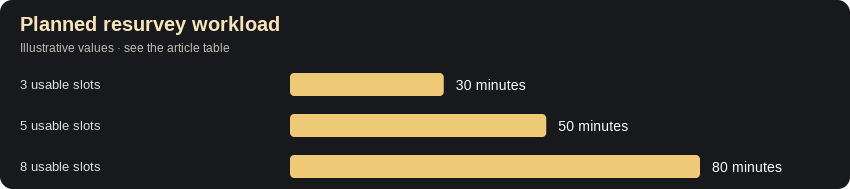
| Category | Value (minutes) |
|---|---|
| 3 usable slots | 30 |
| 5 usable slots | 50 |
| 8 usable slots | 80 |
Ten minutes per usable count; excludes travel and failed attempts.
You planned to count flower visitors at the meadow on Tuesday. By the time you arrived, the flowers were moving too much in the wind to see individual landings, and the temperature was below the threshold in your scheme's guidance. You packed up. On Thursday, you returned at noon under better conditions, recorded six qualifying bumblebees and two other insects in ten minutes, and sent in the result. To the project receiving the successful count, Thursday is a perfectly sensible observation. To the person comparing your survey effort across a summer, however, Tuesday is part of the story too.
A weather rejection log keeps those two things separate. Its job is not to manufacture a pollinator record for Tuesday or to claim that bad weather conceals a particular number of bees. It preserves the context needed to understand when somebody tried to observe, why the observation did not happen, and what was done instead. A rejection is an effort record, not a wildlife result. Without that distinction, a blank Thursday in one month and an empty count on Thursday in another can turn into apparent ecological evidence for opposite reasons.
This guide uses the UK Pollinator Monitoring Scheme's Flower–Insect Timed Count, or FIT Count, as a named example. Follow the relevant scheme's own rules and record separate local effort notes when needed. The weather log described here is a project tool, not part of an official submission unless that project explicitly says otherwise. It is useful for a single observer in a garden, a school group sharing a field rota, or a local team that wants to say how much of its planned monitoring actually happened.
Decide what the count measures before you count anything
At the simplest level, the observation records which insects visit a defined patch of target flowers during a defined interval, under stated conditions. You are not counting all the bees at the site. You are not counting all the insects using the patch that day. You are not measuring how much pollen got to a recipient flower. The defined flower patch and duration make the observation interpretable precisely because they rule out those broader claims.
The UK PoMS FIT Count quick guide asks an observer to choose target flowers within a 50 by 50 centimetre patch and watch them for ten minutes. It asks for the number of floral units, a definition that depends on the form of the target flower, and groups eligible visitors rather than requiring a species name. Under that guide, counts are carried out from April through September when conditions are dry, not too windy, and at least 13 degrees Celsius when sunny or 15 degrees when cloudy. Those are programme-specific eligibility criteria, not universal limits on when an insect can fly. [S1]
There is a good reason to keep the field protocol that narrow. Suppose a person checks a huge border for five minutes and another checks half a square metre for ten. Doubling the first person's tally to make it a ten-minute number does not reveal what would have happened if they had watched the same flowers with the same view. The observer who scanned the border may have missed small visitors on the far side. The numbers measure different experiences even if the unit you type next to them is the same. Duration, spatial extent and the definition of a visitor are not interchangeable.
A second distinction matters to a weather log. The eligibility question is whether an observation can be used under the study rules. It is not whether particular insects are physically capable of flying. An insect seen during a drizzly gear check is an interesting incidental observation. It does not turn the rest of the gear check into a valid timed session. Conversely, dry and calm conditions do not promise a positive count. If the protocol was followed correctly and no visitors were seen, zero is the result.
The UK PoMS 2023 annual report explains why the programme collects information about the surrounding habitat, flower abundance and the weather with timed counts. Those contextual observations can help explain variation in visitation. They do not make every change attributable to one variable. A garden can gain flower units, change its light exposure and lose a regular observer in the same week. Preserve the original measurements so those possibilities remain visible later. [S2]
Give five different events five different names
Start with a small vocabulary everyone on the team can use. The names themselves can change; their meanings should not change halfway through a season. Separate the plan, the attempted observation, the eligibility decision, the elapsed timing and the final result. The cost of collecting all of these is low if you record them as they happen. Trying to infer them from a spreadsheet of visitor tallies in autumn is considerably harder.
A planned slot is a date or window assigned to a location. Its record might say, for example, that a volunteer will visit the east orchard before lunch on Tuesday if the route is open. It is useful for calculating how much of the plan was delivered. It does not imply that anyone reached the orchard. Village paths flood, volunteers become unavailable and people sometimes decide not to travel when conditions make a valid session unlikely. Even a plan cancelled at home can be recorded as a plan; it must not become an onsite attempt.
An onsite attempt means somebody arrived and checked a real observation location. In this guide the attempt begins with the location and conditions check, before the formal observation timer. If you have a pair of waterproof boots in the car and you stop at the parking area without making a conditions check at the patch, treat it as an access issue or a no-check visit. There is no value in inflating your attempted monitoring effort by claiming work that did not happen at the observation site.
A pre-start rejection is a real onsite attempt at which you did not start the clock because something failed the eligibility check. Weather is the obvious category, but some rejections have nothing to do with weather. Flowers on the target plants may not have opened, the maintenance team may be on the patch, or the site owner may close that part of the route. Count these as distinct reasons. This is particularly important if a site is repeatedly unavailable: a recommendation for rescheduling is different from a recommendation for access arrangements.
An aborted session is an observation that began and did not finish admissibly. A shower may interrupt the count after four minutes. Another person might enter the quadrat area and move the flowers. An urgent obligation may take the observer's attention away before the timer ends. If permitted, keep a raw field note describing what happened. Do not scale three qualifying observations in four minutes to a ten-minute count, and do not silently enter the last six minutes from the same patch after the interruption and call the stitched observation uninterrupted.
A completed count is a timed session performed and recorded according to the applicable protocol. Its total can be zero. It is the only one of these events that generates an ordinary included visitor count. If a scheme permits a specific tolerance for some kinds of disruption, document it in your local guide by referring to the governing protocol rather than inventing it case by case. Readers should be able to reconstruct why two superficially similar situations were classified differently.
Keep rules narrow enough for two observers to apply the same way
A weather rule that looks clear from indoors can turn vague at the patch. One person says the wind felt moderate. Another says the leaves were moving but the flowers were readable. An observer exposed to wind at the field boundary may think the little area near the hedge is sheltered; the person kneeling at the hedge may discover repeated gusts are hitting the flower heads from a gap behind them. Start by identifying the scheme's actual conditions and record observations in the categories the scheme asks for. Do not invent a precise wind speed from a feeling.
Use recorded descriptors and keep them distinct. The quick guide's named temperature thresholds depend on whether conditions are sunny or cloudy. A shaded target patch under a partly blue sky is not the same information as cloud cover overhead. The official recording materials ask about the sky, the degree of sunlight on the patch, and movement of vegetation. When a rule or categorisation is unclear, note borderline conditions and ask a scheme coordinator for the correct interpretation. Do not create a new threshold in the field and later label it as official guidance.
Agree how you will document the thermometer reading, if you take one. A locally useful note can specify the instrument, whether it was held out of direct sun, where it was read and the time of the reading without pretending that values from a precisely controlled research station were obtained. A hot reading off the surface of a stone is not the same variable as ambient air temperature. A town forecast is useful in planning but cannot tell you how sheltered one flower patch was. Record forecasts separately from observations rather than overwriting the local measurement with an app prediction.
Weather can change within minutes. A glance at the patch ten minutes before your planned start is not a promise that the next interval will be valid. A suitable system records the local assessment at the start, any material shift while timing, and the end state when that affects eligibility. You do not need a continuous weather station for a volunteer count. It is enough to notice and record an event when it changes whether you could follow the observation method, such as the onset of rain or wind that prevents the observer from seeing landings.
Set three practical expectations. Write down the reason as soon as the decision is made. If you are between two categories, pick the applicable one based on the project's definitions and leave a brief explanation. And do not infer visitor activity from eligibility. The fact that rain forced a stop is evidence about the observation process. An observer's impression that few insects were flying when it rained might help frame a later question, but it does not define what the missing ten-minute record would have been.
Use one plan identifier and a separate identifier for each attempt
Try starting with two linked sheets. The first lists planned slots: a stable identifier, site identifier, target flower or choice rule, local date or window, intended time-of-day band and assigned observer. The second lists activity under each plan: attempt identifier, date and time, whether the check was onsite, eligibility decision, reason code, any observed conditions and, when there is a completed count, the identifier of the corresponding pollinator record. A sheet does not need to be elaborate to be effective.
Why two identifiers? Because one plan can lead to more than one attempt. A first visit can fail in the wind, a second can start and be aborted in rain, and a third can complete. If you copy the completed row over the first two, the history disappears. If you instead count all three as separate completed-to-planned opportunities, you inflate the planned denominator. A many-to-one link preserves how a single planned goal was attempted more than once. Later, you can count the plan once and the attempts three times, each for a different purpose.
Storage can be a shared spreadsheet, or a paper form copied into a tidy table after the trip. Avoid inventing a harsh distinction between formal public data and private scribbles: a well-kept field notebook can be an excellent event record. The real requirements are that dates, decisions and identifiers can be read by someone else; that private information is handled responsibly; and that the record does not depend on a cell's colour or an individual observer's memory. If colour helps you see the sheet, add plain-language status labels as well.
Use a controlled list of reasons short enough that somebody can pick one on a phone with wet fingertips. Possible reasons include rain, temperature, wind, access, no eligible blooms, observer unavailable, and interruption. Distinguish planned cancellation from a pre-start rejection. Keep one primary reason and a note for meaningful co-occurring observations. When temperature and wind both fail, record both in the local notes or approved fields rather than forcing one out of the history. If the team is specifically studying weather exclusions, agree whether a summary counts the primary reason only or all flagged reasons, and make that choice visible.
Preserve local date, local time and, when a system combines time zones, the zone or offset needed to interpret them. A plot of hour of day based on mixed local and universal time can make a carefully designed rota look erratic. Give site identifiers short, repeatable codes, but do not publish sensitive locations simply because a field form contains them. Record a location to the precision required by your study and distribute it only at an appropriate level of detail. A weather log does not need more geographic precision than its monitoring job requires.
An example illustrates the difference in practice. Your planned slot is ORCHARD-W18-AM, Thursday morning. Attempt A is checked at 09:08 at the expected patch; strong vegetation movement prevents starting, so you record wind as the reason. Attempt B takes place within the agreed Friday morning replacement window at the same patch. The count completes in ten minutes. Both attempts refer to the same plan slot. The completed count is linked only to B. A public tally has one result; your internal ledger has one planned slot and two checks.
Check the patch without turning the check into an unofficial survey
The moment before a timed count is easy to use badly. If you arrive expecting ten minutes of nothing, you might casually wait for a bee to land before pressing start. The session is then conditional on a visitor being present at the beginning. If you do this unconsciously on some days but not others, a table of apparently comparable counts mixes different start rules. Choose the start according to the study plan and document how the observer knows when the count begins. Selecting a time because an insect has just arrived is not the same as selecting a time because the weather is suitable.
Likewise, select the target flower according to an agreed rule before judging visitor activity. If your target flower is a particular patch of clover, do not walk from patch to patch until you find the liveliest one, then record it as if it were the original patch. Some projects deliberately permit a new target if the original is unavailable. That may be reasonable, but it changes the interpretation and should be recorded. A compatible replacement time at the same patch has fewer implications for comparability than a simultaneous change of site, flower and time band.
Before you begin, note the patch boundary and define the floral unit. A single plant with a packed flower head is not directly comparable to a whole group of separate blossoms just because both are called flowers in conversation. The programme guidance shows examples of units like individual flowers, spikes, heads and umbels. Record the actual unit and count used for the target plant. Avoid changing the unit when flowers become harder to count, then interpreting a numerical jump as a real difference in flower availability.
At the start of a valid count, position yourself so the chosen patch is visible without leaning so close that you cast a changing shadow or disturb the insects. The scheme guidance calls for tallying eligible insects in their categories, including ones present at the start, and avoiding obvious duplicate counts of a single insect as it moves among flowers inside the patch. Do the best you can without turning the tally into a claim of perfect individual recognition. The log is most honest when it documents both the procedure and its limits.
When many visitors are active, there may be a trade-off between accurate grouping and reliably seeing landings. Keep the count focused on the categories the protocol allows; uncertain groups can be recorded under suitable categories instead of being promoted to expert species-level identifications. Do not reclassify a wet or shadowed photograph by assuming the most common local species. Photographing insects can be a separate learning activity. If the monitoring guidance tells you not to take photos while counting, finish the count first and record the photo as a separate observation where appropriate.
Reschedule within the question your survey is trying to answer
An excellent weather log can reveal a weakness in a plan rather than rescue it. Suppose you want to compare morning and afternoon visitation. If every wind-rejected morning session is replaced with an afternoon session, the count of visits completed may look healthy while the original contrast has vanished. The apparent convenience of the reschedule has changed the target of the comparison. Define whether a replacement must remain in an intended time band. If it cannot, decide whether to leave the slot unfilled and run the afternoon observation as additional data rather than claiming a completed morning slot.
The same applies to the flowering season. If the only replacement date for an April target patch is in May, you may be looking at a different bloom stage or an entirely different flower assemblage. A comparison of seasonal visits under an accepted scheme is still possible, but it will not answer the same question as a balanced April and May sample. Record the originally intended window and any allowed extension. Do not edit the planned date to make replacement work appear on time. When a slot is closed, keep the status and the reason visible.
For a rota, agree up front what is more important when all the goals cannot be met: staying at the same site, staying within the same time band, or completing a certain number of valid observations. A fixed-site garden project may accept any eligible morning within a short window. A project testing a time-of-day question may require stricter temporal balance. A school project might care more that each group can practise the method than that counts are regularly spaced. These are different purposes, not grades of scientific seriousness. State the purpose so the choice of replacement is judged against it.
Define how many retry windows you can support without burning out volunteers. One alternative slot may be enough for a tiny project. A research team can have a more elaborate schedule, but recording every possible motion through a rota that nobody understands is not better than a simpler record maintained consistently. A useful compromise is to mark a single next reassessment window and close a slot when that window ends. If the work continues after that point, open a fresh slot with a clear reason. This leaves an interpretable plan even if spring conditions do not cooperate.
Record why each replacement was chosen. A note such as “same site, next eligible weekday morning” tells a future reader something different from “moved to sunny verge so event could proceed.” The second note is entirely legitimate if the goal is field education. It is not a substitute for a repeat observation at the original shaded patch. Suppose two sites are routinely replaced in different ways. When losses and repairs are visible, you can stratify, qualify, or decline the comparison rather than accidentally treating the names on the original rota as actual observation conditions.
Use clear denominators in the first season summary
You can describe an initial season without pretending to estimate a population trend. Count the planned slots, the slots attempted onsite, the number of onsite attempts, the attempts rejected before start, the started sessions aborted and the valid completed counts. These figures can overlap in controlled ways: a plan can be closed as completed after multiple attempts, and an attempted plan can be incomplete for the season. Name the denominator in every percentage, including simple effort dashboards meant only for staff.
Consider an explicitly hypothetical season of twelve slots. Nine were checked onsite at least once. Three were cancelled before anybody arrived. Across those nine slots, there were eleven onsite attempts: two slots needed a second visit. Three attempts failed before the timer started, one timed attempt was aborted, and seven attempts completed. Seven divided by eleven is the fraction of onsite attempts that completed. Seven divided by twelve is the fraction of planned slots completed, if each completed attempt belongs to a different plan. Neither number measures bee abundance, and the fractions differ because the questions differ.
Do not use a phrase such as “four unsuccessful surveys” without defining it. A project member may read that as four surveys with zero visitors; a volunteer may think it refers to rejected or aborted attempts; a funder may think it means four plans with no final result. In the example, four onsite attempts lacked a completed result. Some of their corresponding plan slots may nevertheless have produced a result after a repeat. Precise labels make it possible for someone to reproduce your figures and correct a misunderstanding.
Even with the counting logic right, beware of comparing one observer's rejection fraction with another's as if it measured diligence. One volunteer might draw exposed sites at dawn while another visits sheltered patches after lunch. A new observer may be especially careful about uncertain conditions and record them thoroughly. If a project wants to understand observer effects, design some overlap in sites and times and use a shared definition of success. The rejection fraction alone does not tell you why one person's route differs from another's.
Describe the inclusion rules in a short methods note. Include the target patch definition, the duration, whether restrictions such as minimum temperatures follow the named scheme, which statuses produce ordinary counts, and whether anything changed midseason. If you present a chart of rejection reasons, say whether a row can be included under multiple reasons. If you publish an example row, remove private details but retain enough context to let people see how decisions map to the final category. This makes the method reusable instead of just leaving a total.
Put a real planning question behind the chart
The chart accompanying this guide asks how much clock time a given number of successful ten-minute observations consumes. Three usable slots occupy thirty minutes of formal counting; five occupy fifty; eight occupy eighty. Those figures are multiplication, not field data. They do not include travel, classification discussions, clock setup, rejection checks, interrupted counts or data entry. They do not imply that a team typically completes any particular number of sessions. Label the bars as usable slots so nobody borrows them as evidence about failure probabilities.
Use that arithmetic to work backwards from an actual session budget. Consider a fictional school group that has ninety minutes at a site. Eight coordinated counts would require eighty minutes if all were run sequentially by the same observer. That leaves just ten minutes to get into position, assess patches, gather notes and reset. If a different group can watch a separate patch at the same time, elapsed group clock time can be shorter than the sum of observation minutes. But parallel groups still use person-time, and proximity can affect which insects are counted in which patch. State which resource you mean when you tell the group it can complete another observation.
Counting time is often the easiest part of the budget to know and the wrong part to optimise. If a single remote patch takes forty minutes to reach, there is more day-to-day uncertainty in access and travel than in the duration of its clock. If several nearby plots stay accessible under similar conditions, both the transport budget and the probability of weather losses may look different from the remote-site case. Use the log to discover which uncertainty costs you minutes. A simple record of time bands and which visits could use an existing trip can make next year's plan fairer to volunteers without changing the ecological sampling aim.
A common temptation is to extend a chart of usable slots with an assumed completion percentage. That can be useful for a planning scenario if the assumption is explicit. It is not an estimate of the weather rejection rate unless it comes from an appropriate set of comparable planned or attempted observations. A season with a single repeatedly cancelled exposed site does not establish how often suitable weather occurs throughout the county. For the first year, show the known count duration and set aside an explicitly estimated margin for other work. Replace that general margin with an evidence-based allowance only when your ledger can substantiate it.
There is also no reason to require a single chart to carry every message about the project. If a team asks whether it attempted surveys fairly across the day, a schedule-versus-completion table by time band will be more informative than counting totals by week. If a site manager wants to know which access problems recur, a calendar of closures can be more informative than a pie chart that lumps together spring and summer. Start with the decision and then decide whether numerical graphics help. A clear three-bar chart with honest units is better than an impressive multicoloured chart built from ambiguous zeros.
What the weather log can and cannot tell you about bias
On a sunny afternoon, the visitor tally represents eligible conditions and what an observer could detect with one method. On a cancelled windy morning there is no comparable tally. That missingness matters because scheduled activity, weather and visitor activity may not be independent. The same conditions that prevent observation might influence the behavior you wish you could observe. It is rarely safe to replace the missing morning number with a fraction of the sunny afternoon total, even if the sites are close.
This does not make every weather-restricted dataset biased for every question. If the intended quantity is the mean number of eligible visits per completed count during suitable weather, then the published estimate may have exactly the scope promised. The problem arises when the final claim silently widens from visits under the protocol to whole-day or all-weather activity. A weather log improves this second situation by exposing how limited the coverage was. It does not extend the scope of the available observations.
Consider two imaginary locations of equal size. On six of ten planned slots at the exposed location, wind makes a count ineligible; all ten slots are usable at the sheltered location. There are four and ten completed counts respectively. If you compare totals, the sheltered location had more opportunities to accumulate visits. If you compare mean visits per completed session, you have addressed that mechanical difference but the sets of weather conditions may still diverge. Each site's successful sessions can represent a different slice of the time you intended to observe.
You could show both the completed-session average and the coverage figures. You could restrict comparison to overlapping weather or time strata before calculating a summary, provided you retain enough information to justify the restriction and enough observations to say something useful. You could also decide that the research question deserves a new design. A table with many data cells is not, by itself, evidence that all the cells can be compared. Sometimes the most informative annual result is “we learned when this design consistently failed.”
Treat weather rejections as one source of structured missingness, not as the only one. A school holiday can move counts away from weekdays. A newly locked footpath can remove an important wet meadow from the route. A site can switch vegetation management and then be unsuitable for the original flower target. Wildlife observations reflect the joint operation of ecology and opportunity. A useful ledger records enough about the opportunity component that the research report does not have to guess why plots, observers or time periods dropped out.
A field workflow that survives a handover
Before leaving, check whether the intended site can be reached safely and whether there is an accepted alternate window. Bring a means of timing the observation, the protocol guidance, and whatever tool you need to record the local decision. A forecast may save an unnecessary trip, but treat a forecast cancellation as a different event from seeing rain at the patch. If you have a list of cases where a trip was cancelled based on the forecast, that can be interesting on its own. It should not be presented as observations of local conditions.
On arrival, confirm the planned identifier and exact patch or permitted target choice. Check that the flowers and the patch meet the chosen protocol. Record conditions before making the eligibility decision. If the attempt cannot proceed, select a reason, add an explanatory field note only where it helps, and link the attempt to the plan. Writing “mobile data was unavailable so I am uploading this later” is more helpful than backdating an entry without preserving when the check actually occurred.
During an accepted session, give the observer one job: watch the qualifying patch. A second participant can record times or notes, but should not run an independent count on the same small patch unless comparing observers is the specific purpose of the session. If a recording aid fails, follow the method you agreed to use. A stopwatch alarm that is barely audible, a boundary marker displaced by a dog or a note form that disappears when a phone locks are all recordable procedural events. Which ones invalidate a count depends on what was lost and the governing protocol, not whether a number was eventually written down.
Afterwards, ask two separate questions: Did this session qualify? Is the result ready to submit? A complete result might need transcription or review before being submitted, even if its eligibility is clear. These are not two versions of the same status. Use a small completion flag for the observation and another if you need to manage preparation or submission. A tidy workflow avoids mislabeling an eligible count as missing merely because somebody still has to copy it out of a notebook.
Leave enough guidance that a person taking over can understand the records without contacting you. Make the status definitions, protocol version and naming convention easy to find. Keep one example of each decision type and one example of a replacement chain. If a category changes halfway through the season, document the effective date and how old records are interpreted; do not retroactively relabel a whole season without recording the mapping. If you amend a note later, preserve the original fact that the amendment took place. Field data that nobody can review can become difficult to use long before they become statistically complicated.
Separate raw notes, publication-ready rows and later corrections
One useful file structure starts with a plan sheet, keeps a history of raw attempts, and builds a separate table of published summaries. A raw note can include ambiguity and incomplete observations. A submission row can be checked against scheme guidance. A published table can remove private information and report only details necessary for readers. These layers can live in the same spreadsheet if that is what the team understands. The important feature is that the published interpretation does not replace the record of what happened.
Review a few basic relationships before producing a chart. Every completed attempt should have a linked plan or be explicitly marked as an extra unscheduled observation. An incomplete attempt should not contribute to a protocol outcome total. A plan with several valid counts should have a stated rule for which, if any, counts it toward planned coverage. A rejected or aborted attempt should carry a reason that distinguishes procedural problems from the biological result. An empty result cell is never enough to establish what status applies.
What if a volunteer finds an old note that corrects the weather status for a completed count? Record the original entry, the corrected classification and the evidence for the change. Recalculate any summary that used the old classification. If the record was sent to a programme, use that programme's correction process rather than quietly filing a second row. A reviewable correction is a sign the project can learn. A spreadsheet that makes the correction look as though the previous record never existed can leave two groups with equally plausible but conflicting totals.
Preserve the difference between an uncertain field detail and a data processing bug. A barely remembered wind condition probably cannot be reconstructed to useful precision weeks later. A date encoded in the wrong time zone can often be corrected from other unambiguous records. The first calls for an uncertainty note, not a guess. The second calls for a careful correction and a check of other rows entered the same way. Either can matter to your conclusions; they require different repairs.
For seasonal comparisons, make any exclusion measurable. If some rows cannot be classified because old forms lack dates or status information, report how many and where they are concentrated rather than quietly removing them from every denominator. That will not recover the lost details, but it enables a future reader to understand whether your reported coverage was calculated over all planned records or only the ones you could classify. Once you understand the recurrent case, revise the forms before the next season instead of relying more heavily on arithmetic afterwards.
A pocket test for the next scheduled count
Try this dry run before sending several observers into the field. Give two people the same fictional route and ask each to classify five scenarios: a forecast cancellation at home, a wind rejection at the actual patch, a valid count with no visitors, a partly completed count interrupted by rain, and an eligible replacement at the same patch. Ask them to show which entries would be submitted as visitor observations and which would live only in the planning ledger. If their summaries differ, compare the status definitions before debating the best chart.
Then make the scenarios a little untidy. Suppose the initial slot failed on wind, but a replacement session in the same sunny patch succeeded only after the target plant's flowering had changed. Decide whether that falls within your replacement policy before a real route produces the case. Suppose a late shower occurs just after the scheduled end: confirm that place in the sequence can be determined from the notes before changing eligibility. Suppose access is clear but the observer discovers that the original patch marker is missing: distinguish what can be confidently reconstructed from what should be recorded as a new location.
A good failure exercise is one where neither observer feels obliged to rescue all the counts. If a session cannot be used, that is useful information. The project may have set an ambitious schedule or picked a windy stretch of path for a reason; the point is to preserve evidence of how the design actually met the world. Look especially for places where a volunteer feels punished for correctly marking a rejection. That incentive pushes hard-to-observe conditions out of the records and can make a dashboard look healthier while making the dataset less trustworthy.
For an effective review, reconstruct a week from the plan and attempt sheets without looking at the submitted set. Then reconstruct the submitted set from the attempts. You should arrive at the same list of eligible records that the team intended to transmit, while retaining separate information about slots that were never visited. If you cannot, the repair may be a clearer ID convention or a new status field rather than more form questions. A five-minute tabletop walkthrough has more value than adding fields that capture information nobody can later use.
Why it matters
The payoff is practical. Next spring you can explain why a corner of the garden went unobserved, protect the meaning of a real zero and give the next observer a route that reflects which parts of the old one worked. Your results can stay modest without becoming useless: valid counts show what was recorded under a specified method, while the ledger shows where that method could and could not be applied. More sophisticated models still depend on that separation.
The first time it drizzles over a planned count, create a line in the ledger, not a number in the wildlife column. The data you did not collect need an explanation, not a substitute. Once the observer can mark a rejection honestly, a successful count from the following morning can stand on its own, without being asked to tell the story of a morning nobody could observe.
Sources
- [S1] UK Pollinator Monitoring Scheme: FIT Count Quick Guide. The original programme guidance for patch geometry, timing, conditions, target flowers and visitor groups.
- [S2] UK Pollinator Monitoring Scheme: 2023 annual report. The programme's account of timed counts, habitat information, flower abundance, weather context and intended uses.