
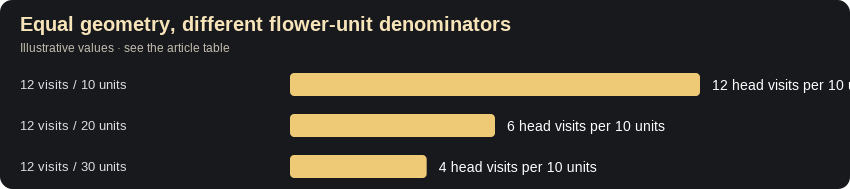
| Category | Value (head visits per 10 units) |
|---|---|
| 12 visits / 10 units | 12 |
| 12 visits / 20 units | 6 |
| 12 visits / 30 units | 4 |
Worked example of rescaling identical site visits for three alternative denominators. The ratios are not study results.
From standing height, a white clover lawn may look like a scatter of small white flowers. Crouch beside one white ball and the picture changes. It is a cluster of smaller flowers, not one solitary blossom. Some parts may be open, some still in bud, and some already brown. A bee can land on the cluster, move over several of its component flowers, and take off without ever alighting on a second cluster. Asked to count flowers and visits, two people can watch that same incident and produce quite different numbers. One records one flower head and one arrival. Another records several open flowers and several feeding contacts. Both may have seen accurately. They have not measured the same thing.
The distinction gets less obvious as the patch gets busier. A lavender stem carries an upright structure with small flowers at different heights. An umbel spreads its flower-bearing branches outward like the ribs of an umbrella. A daisy-like head compresses many tiny structures onto one platform. A single open buttercup offers a more readily distinguished blossom, but the several blossoms on a plant still do not make it several plants. If your aim is to keep a repeatable field record, the first question is not how many flowers there are. It is what counts as one.
The title uses what a bee sees as shorthand for the visible offer a patch presents. It does not mean that a head or spike is exactly how every bee divides a plant. A human tally unit is an observation convention. An insect may respond to the outline of the whole display, then choose a particular open spot. A small fly and a large bee can use the same structure differently. The strength of a floral unit is that other people can learn to count it, not that the unit captures everything that happens on it.
Plant, shoot, display, blossom, contact
Suppose a garden label says there are three plants in a bed. That may be enough for an inventory or a planting invoice. It tells you very little about how many things a watcher can see in flower on a particular afternoon. One plant might have no open display yet. Another might carry several flowering branches. In a creeping patch it may be difficult to trace visible shoots to separate plants without pulling up material. A planting inventory, a count of visible stems, and a count of open displays therefore describe different properties, even when they all use the word number.
A stem count counts recognizable axes. It is useful if you want the number of flowering stems of a plant with a simple architecture, but a branched stem with four clusters still counts as one stem under that rule. A floral display count instead treats each qualifying cluster on the stem as its own item, if that is the unit you have chosen. A blossom count takes the definition down a level. You might count individual open flowers on a spike, for instance, and get a larger number without there being a single extra spike in the patch. On a composite head, going down a level means recognizing actual component florets, not counting the conspicuous petal-like parts by eye and naming each one a separate flower.
Contacts and visitors add another distinction. Imagine a bee that lands on a head and probes six places while staying on it. For a landing tally that is one arrival. For a study of contacts with individual flowers it might be six contacts, provided you could actually observe and identify them under your chosen rules. For a timed count that attempts to count individual visitors only once, it is still one individual if the bee subsequently moves to a nearby head and you can follow it. The number of visual units beneath the insect does not dictate the number of events it contributes to your record.
You can choose a useful level by completing the sentence, “For this survey, one thing is….” Try saying it before the observer looks at the data. “One open head” can work. “One place where a bee seems to be feeding” may be too uncertain unless your observation setup permits you to see the contact. “One plant” is a poor choice if participants cannot tell where individuals begin and end without disturbing them. “One flowering spike on a distinct stalk” might be useful for one plant, but it needs a rule for branched structures. Give the next observer a description that can actually be applied on site.
How to recognize a head, spike, or umbel as a counting unit
For a head, look for the outline of one compact, separately supported cluster. In a white clover lawn, two globes can touch from your viewing angle but arise on different stalks. Trace each outline or stalk visually, without shifting the plant. The clusters are two heads if both meet your inclusion rule. One globe with a brown section remains one structure, so the decision is whether it qualifies, not how many heads it breaks into. Mark the distinction between “one head” and “one head with open portions” in your field notes rather than letting the person who enters your data guess.
For a spike in the field sense, follow a recognizable flower-bearing axis rather than reciting a definition about how every flower attaches. A lavender display is a useful introductory shape: several tiers of small flowers appear along a single upright portion, and side branches may make further upright portions. When you use one spike as the counting item, distinguish the axis from each tier and from each individual open blossom. Avoid treating a series of gaps between tiers as new spikes. The visual convention is not a botanical declaration that all spike-like forms have the same anatomy. Use the exact scheme guidance for a target when it gives you one.
An umbel has a recognizable radiating arrangement. Looking down into it can help you see the outer structure; approaching from the side may help separate overlapping displays. With a compound umbel, each small umbrella-like group may itself branch into smaller flower-bearing points. That is a hierarchy, not an instruction to count the smallest possible object. If your convention is one top-level umbel, write it down exactly that way. If someone instead counts its constituent umbellets, do not average the two tallies and label the result floral units. They belong to different levels.
Individual blossoms are the fourth useful field convention. Even where this is the clearest level, an attractive-looking bud and an open flower are not interchangeable if the project restricts its denominator to open flowers. State whether you count open blossoms, all visible blossoms, or blossom positions that meet a specified condition. A bud that opens between visits is a change in the patch, not a counting error. A flower hidden under a leaf, on the other hand, may be an issue of detectability. Counting what you can reliably identify from an agreed position is preferable to disturbing the plant to see the back side.
Think of each shape as a request for a precise noun. One head of clover. One spike-like display of lavender. One whole umbel in the chosen sense. One open buttercup blossom. More than one of these can occur within a square of lawn; that does not make them directly addable. If your target is clover, a buttercup in the square may belong in a site note, not in your clover count. An open-format garden inventory could record several plant types in separate rows. The project should not merge their counts unless it has specified what that merged measure means.
A real protocol that keeps the distinctions visible
The UK Pollinator Monitoring Scheme FIT Count quick guide gives a concrete example of how floral-unit counts fit into a timed observation. A participant chooses a target flower type, marks a patch fifty centimeters by fifty centimeters, and counts its floral units. The observation runs for ten minutes. The observer records insects sitting on or landing on the chosen flowers, not insects merely crossing the square or visiting a different plant inside it. The guide encourages identification to broad insect groups and asks participants to avoid counting the same individual again where possible. It also specifies a recording season and suitable weather for the UK scheme. These are rules for a named programme, not universal thresholds for insect activity.
The FIT Count field recording form makes clear that the number written in the flower box is not self-explanatory. It provides separate choices for individual flowers, heads, spikes, and umbels. It also distinguishes the area covered by target flowers from whether the small patch is isolated or sits within a larger flowering area. The form separates visitor categories and observations of sky, shade, and wind. An unidentified insect in scope is not to be silently lost just because the observer cannot give it a more specific label. There is a place for other insects. Consult the form and scheme guidance when actually entering a FIT Count.
The patch defines a small viewing area and the stopwatch defines the time available. Neither makes nearby flowering displays disappear as potential influences. A square at the edge of an extensive bank of lavender is connected to a different surrounding landscape from an equally sized square with the same spike count in a lone planter. The two squares can have similar tallies under your unit rule yet be screened by different vegetation, experience different shade, or sit in different contexts of potential insect traffic. The form's context questions prevent at least some of these distinctions from being lost.
The advice about concentrating on the target is particularly useful in a pocket garden. Suppose a hoverfly lands on an open buttercup, then rests on a white clover head inside the same marked square. If the target is clover, the buttercup contact is not part of the clover record. If the fly stays visible and you are tracking unique individuals, its clover attendance is the first qualifying observation for the target, not the second member of the tally. If you decide instead to compare the whole flower community, you have moved beyond that single-target question. Write a separate protocol suited to the comparison. Do not reinterpret FIT Count instructions to make one count serve both purposes.
The arithmetic in the chart, and what it leaves unchanged
The chart titled “Equal geometry, different flower-unit denominators” is an illustrative calculation, not data gathered in a survey. All three bars hold the numerator fixed at 12 head visits. The alternatives are denominators of 10, 20, and 30 floral units, in that order. Each bar is calculated as 10 × 12 ÷ the number of units. Twelve visits divided by ten units, then scaled to ten units, gives 12 head visits per 10 units. With twenty units in the denominator, the result is 6 head visits per 10 units. With thirty, it is 4 head visits per 10 units. There is no downward trend in the raw numerator. The lower bars reflect a larger divisor.
The words head visits here refer to the toy numerator exactly as the chart labels it. Do not equate them with the official FIT Count total of insects observed; a repeat visitor can matter differently in an arrivals study and in a tally that tries to count an individual once. Imagine replaying the same hypothetical observation record without changing the viewer, boundary, time, or count of arrivals. Rescale that unchanged numerator three times. This tells you what normalization does to numbers. It tells you nothing about what real insects would have done if somebody planted more flowers in the square, nor does it compare a particular pair of plants.
The change looks considerable: the middle bar is half the first, and the last is a third of the first. That does not mean the third patch was less suitable, nor that pollinators preferred the first patch three to one. There are not three sampled patches in the example. The chart illustrates three numerical frames for the same recorded hypothetical traffic. Equal geometry removes one variable from the illustration; it does not remove field differences from a real comparison. The unit behind each divisor has to be known before you decide what the calculation even describes.
Normalization can still be useful. If you are comparing visits to heads on the same target plant under the same protocol, a per-ten-head measure can aid description alongside raw counts. A reader can see both visitation for the watched area and how concentrated that traffic was among the counted heads. In a separate study, the divisor could be open individual blossoms, but a numerator collected for head arrivals needs interpretation at its own level. Calling the result attendance at individual blossoms would be misleading unless those contacts were actually observed. Preserve both the unscaled event count and the exact denominator label even if your publication primarily shows the standardized numbers.
Consider the inverse reading. A teammate sees a value of six and assumes only six events were seen. Show them the recorded twelve and the denominator twenty. The bar represents a rescaling, not a possible count read back from the plot without other information. When results are exported from a spreadsheet, put the numerator, divisor, unit name, scaling factor, and time window beside one another. A chart viewer should be able to reconstruct the three bars without guessing which count was divided by which. If the divisor is unknown or zero, there is no defined ratio for that row. Leave the derived cell blank or marked not calculable, with the reason, instead of writing a zero that looks like a result.
Writing a rule another observer can reproduce
An operational definition gives enough detail for someone else to make the same decisions, not just to recognize the noun. Start with the target identity at the level you can substantiate. Named species are valuable when you can distinguish them, but an honestly labeled target type can be more useful than confident but unreliable species names. Avoid giving two different taxa the same informal label if you plan to combine the records. A photo taken before or after the watch can preserve the identification evidence without a participant pointing a device into the patch during observation. Use a label such as “white clover, confirmed by reviewer” only if that review actually occurred.
Specify the stage that qualifies. One possible practice rule is that a recognized display counts if at least one constituent target flower appears open from the agreed viewing position. That admits a partly open spike, but not a spike in which all the visible flower positions are closed buds or spent remains. This is an example of a local convention, not a replacement for the target-specific guidance of any formal scheme. You may instead need a different convention suited to a plant or research question. In either case a criterion should be visible at the distance observers will actually use, and it should not depend on opening buds to see what is inside. Where stage is impossible to determine, record the issue.
Next decide how to handle the edge. Leaves projecting into the patch are not necessarily evidence that a target display lies within the boundary. Some displays arise outside and extend over your square; some stalks start inside and bend away. For a separate community exercise, you could use a written geometric rule based on the center of the qualifying display when projected onto the ground. Others may prefer another repeatable reference point. There is no reason to assume the first arbitrary rule is inherently better, but mixing rules without a flag is a real problem. Follow your scheme's boundary guidance whenever it supplies one. Practice with borderline cases before recording data.
This choice can change the connection between the floral tally and the visitor tally. Imagine a broad display whose center is just outside the boundary while an insect lands on the part overhanging the square. If the display does not qualify, a landing on it should not creep into the numerator of a display-based local record. Conversely, if you define attendance by the location of each contact, you need to explain how the denominator describes the same eligible space. Drawing a simple diagram for the crew is worth more than arguing after the count. Draw the border, a display that crosses it, and the position where a hypothetical visitor would or would not enter each tally.
Write a rule for uncertainty that does not force a guess. If two clusters appear inseparable even after a permitted change of viewing angle, you can note “cluster obscured” in a rehearsal or mark the row for review. A range, such as nine confirmed heads with one more possible, can be informative for your own field notebook. It is not a substitute number to enter into a scheme requiring a single count. For official submissions, follow the scheme's instructions or choose a clearer eligible patch before the observation begins. Never choose the clearer patch after seeing which one produces more activity if your comparison assumes a fixed sampling plan.
Finally, record the version of the rule. A class might begin by admitting all spikes with some open flowers, then discover that the late-season site has many mostly spent spikes and want a narrower rule. That may be a reasonable design change. Date it, explain it, and keep early and late records apart unless the original descriptions let you apply both rules to the same observations. If old photographs allow reclassification, save a new derived column rather than replacing old tallies. A version tag tells readers which time-series shifts are likely to be changes on the ground and which coincide with changes in what the observers decided to count.
A non-destructive field rehearsal
Pick an accessible place you are allowed to watch from, not necessarily the most photogenic patch. A practice garden can hold a clear example of each form: single blossoms, heads, spikes, and umbels. Get permission where needed and use existing paths or other stable places to stand. A visual square, a removable frame on a suitable surface, or a photo with a scale reference can help people see the agreed extent. There is no need to remove any flower, collect an insect, straighten a stem, or part dense growth just to settle a disputed tally. If the plot cannot be watched without entering sensitive vegetation, use a different plot for practice or record that the planned plot was inaccessible.
Have participants mark their own count in a notebook before discussing it. At first count only the floral units. Work from one side to the other or split the boundary into small visual sections, always following the same scan direction. Low-growing heads can otherwise vanish among taller stems while observers circle around and count the same conspicuous units twice. A hand-drawn boundary map with a few reference features can show which counts came from which part of the square. Even annotating a sketch “left branch” and “right branch” is enough if everyone can find them. For a real timed count, put the drawing aside before the stopwatch starts so that mapping does not compete with watching.
Use the rehearsal to look for discomfort or poor visibility as well as disagreement. If someone cannot kneel or hold still for the full session, a vantage point from a path or a seat might make the observation more accessible and stable. Agree on that position and check that it does not change what qualifies. In bright sun, a person leaning over the plants may cast a shadow into the watched area; the PoMS recording form explicitly advises against leaning over target flowers during the timed observation. Try standing to the side before you start the clock. Record if sunlight changes during the watch rather than trying to correct it by moving branches or modifying the patch.
Plan a quiet time when you can watch without being required to move abruptly. At a busy public site, someone may walk between you and the flowers, a dog may pass, or staff may need access. These are ordinary interruptions. Decide beforehand what makes a watch incomplete and how to set it aside without treating it as a completed zero. A completed zero indicates that someone had a qualifying opportunity to see visitors and saw none. An interrupted watch says that the effort condition was not met. Both are useful observations about the project, but substituting one for the other alters the interpretation of a series.
If at some point you want photographs of insects, aim for a second pass after the count. The practice aim is to leave the flowers and insects as you found them. Use a camera from the perimeter rather than blocking a feeding route with a mobile phone or repeatedly casting shade. A general site photograph, a clear image of the target unit, and a narrow sketch of one difficult junction can do different jobs. The site image shows context, the target image supports identification, and the sketch tells the next observer exactly which structure you counted. Keep a private tracking label if you need to match them later, but avoid recording bystanders or private property details when they add nothing to the measurement.
Test agreement by finding the disputed objects
An agreement test begins with two independent tallies of the same display at nearly the same time. If both observers call out their numbers as they go, the second can inadvertently match the first. Likewise, a count written down after discussion is no longer an independent observation. Have each observer mark the same eligible boundary on their own sketch and note the unit name, the stage rule, and any doubtful cases. Do it before flowers open, close, or change visibility enough to make a real difference between the two passes.
Suppose observer A counts 18 qualifying clover heads and observer B counts 20. These are invented numbers for a rehearsal. A quick tally comparison finds a gap of two, but the gap is the start of the examination. If they mark the items separately, they might discover that both included 17 heads, A included one that B did not, and B included three that A did not. Their combined set then contains 21 possible counted heads. The fact that they differ by only two in total does not mean only two inclusion decisions differed. Compare the marking maps and look for all four disputed decisions. By doing that, you can find whether they differ about partly open heads, the boundary, or something as simple as whether two overlapping clusters sit on one stalk.
The opposite problem is instructive too. Two people might report 18 each and still disagree on four specific objects if one includes two edge cases while the other includes two hidden behind leaves. Equality of the final number is not proof that they have learned the same rule. In a formal agreement study you could define a consistent matching procedure and measure how often counts assign the same items, but a short training session usually benefits most from finding the reasons for disagreement. If an item is truly concealed from one position, let the group determine a better position before counting. Do not call the smaller number a mistake if the person who reported it could not reasonably see what was there.
Use a second patch to test the revised rule rather than repeating the same answer from memory. For instance, after agreeing on how to include a partially open head, try a dense section containing both open and old clusters. If the unit is an umbel, include one place where a whole umbel and the smaller clusters within it can both be seen. The question is whether independent observers can now choose the same counting level at a new location. If they cannot, the rule may still need a recognizable anchor or the plant may not be suitable for that exercise. Save the first and revised protocols as separate versions in the notebook.
Agreement on floral units does not guarantee agreement on insect visits. For the visitor tally, two people should first agree whether they are counting individual insects, observed arrivals, or flower contacts. They should practice separately with one insect moving between units, an insect already sitting on the target when the watch begins, and an uncertain return after it leaves view. For a named scheme, use its guidance. For a local count, predefine a handling rule and record the limitations of following fast or abundant visitors. Training is working when observers can explain where they diverged instead of merely agreeing to copy the higher number.
Checks to make before the count reaches a spreadsheet
For a single row, start with the minimal record that allows reconstruction. A field identifier should connect the row to a place and time without requiring people to infer which of several beds you meant. Then record the target, the unit label, the qualifying stage or a rule identifier, the observed number of units, the time span of the watch, the visitor measure and its count. Add relevant context such as weather and nearby flowers. Keep summaries separate from the original raw fields. The standardized ratio can be recomputed later; the open or spent status you failed to record cannot.
A quick check can prevent accidental conversion of one sighting into several rows. If a worksheet separates visitor groups, you may enter group counts in separate fields rather than recording the full target denominator once for each group and then summing those denominators. The plot has not gained more heads because there were four kinds of insect. If another sheet repeats the same unit total against each group to assist filtering, flag that it is a shared field. Summing across those rows would produce a larger denominator than the observer actually saw. For an export with one row per group, you might preserve the count of floral units in a separate linked observation table instead.
Check whether the numerator has been typed as a rate or a raw tally. Using the middle bar from the chart, a teammate might import “6” instead of twelve, then divide it by twenty and scale again. The result would be three, an artifact of applying the same adjustment twice. One way to avoid it is to name columns after their measured quantities rather than using short terms like count and result in both the raw and processed sheets. Another is to enter only raw numbers and keep a formula column outside the part of the sheet people type into. No layout will rescue a merge that combines unlike units without checking them, but clear names make it harder to do accidentally.
Take care not to clean away genuine field patterns. If a clover count rose between mornings because new heads opened, it is valid for their number to change, even if the number of known planted individuals remains constant. If a spike disappears after mowing, a later plot may no longer have enough qualifying flowers for a comparable watch. Keep the loss of eligible displays in a site note or a planned-visit outcome. Do not overwrite the original count with a blank because the site changed. Conversely, do not fill a missing floral count with the most recent known value unless that estimate is explicitly marked and justified for a separate analysis.
What you can compare across plants and places
Imagine a community garden team with three valid watches, one for buttercup blossoms, one for clover heads, and one for lavender spikes. They use the same duration, patch size, and attempt at an individual visitor tally. What may they compare? A descriptive report can present visitors observed in each watched patch in the fixed time and say what the target was. It can then report each floral count in a separate column with the unit written out. A per-ten-unit number may be useful within each plant type to summarize a series of similar sites. Putting the same scale on all three plants does not make ten buttercups, ten heads of clover, and ten lavender spikes equivalent measures of open individual flowers, display size, or food available.
This matters even if all three records use the same high-level term. A head with many open constituent flowers may differ in size and visible stage from another species' head. A long spike, a short spike, and a branching form that resembles a spike in the field are not interchangeable because the same checkbox was selected. Plant type and unit definition belong in the analysis. If your question requires comparing food supply across species, choose a measure designed for that question. In some studies the accessibility of flowers or their resource characteristics may matter more than the number of display structures. A simple visit watch does not directly measure those properties, and measuring them may not be practical or appropriate in a public garden.
Consider what a visitor opportunity might mean in a city-scale comparison. If you intentionally select the most bloom-rich square at each park, your resulting values describe watched rich squares under your rule. They do not represent all surfaces, all flowers, or all opportunities in each park. To estimate something broader, you need a defensible plan for where to watch, an explicit target population, and repeat observations that reflect the variation at those places. If you have not collected those data, you can still report the narrow observations clearly. The improvement is not a more impressive statistical claim. It is a cleaner boundary around the claim you already have.
Time and geography also limit how to generalize a protocol. The two official sources here describe the UK Pollinator Monitoring Scheme. Their season, weather rules, species examples, and time conventions were specified for that programme. Reusing the idea of a small square and a timed watch in a different country does not mean your local spring runs on the same dates or your notebook belongs in the UK submission dataset. Check your local monitoring body for the appropriate instructions if you intend to submit records. Note how target plants are named in your area and whether the selection and inclusion rules need different validation. Even within one region, an upland patch and a warm city garden can present different flowering schedules.
One way to preserve comparison is to resist tidying everything into a single number. Report the observation window and raw visitor count first, show the floral count and its unit next, and place the derived ratio last. If a reader asks why the ratio is smaller at one site, the earlier columns let them see whether the denominator is larger, the raw visitor count is lower, or both. If the sites use different unit conventions, keep the ratio attached to its own convention, and do not sort the rows as if they ranked the plants by an equal amount of flower. That discipline makes a small observation more reusable than a polished ranking whose denominator cannot be recovered.
A field card you can carry
Before the count, write down the target, the boundary, and the one thing you will count. Add the stage and edge rules. Ask another observer to point to one qualifying unit and one nonqualifying example without touching either one. A person who can distinguish one head from its smaller florets in a plainly visible part of the patch has understood something essential. A person who can handle two crossing stalks at the edge has understood the rule well enough to put it to work. Choose a different example for practice if the answer depends on moving the plant. Photograph the target if appropriate, without interrupting the timed watch.
At the end of the watch, confirm that the numerator describes the intended thing. Check the start and end, the target flowers, and whether uncertain visitors were tracked in the appropriate category rather than silently excluded. Write a reason if the watch was incomplete. Review the denominator before comparing with another site: report ten heads as ten heads, not ten ordinary flowers. If your next visit uses the same protocol, you can explain an observed change rather than wondering whether a different person used a smaller building block. If it uses another protocol, keep both records as they are and explain the difference.
The useful limit of the number
The moment that makes a floral-unit count worthwhile is often the moment an observer stops and says, “I was counting something smaller than you were.” That is a better outcome than two precise-looking totals that conceal their meanings. Watch the patch without rearranging it. Decide what one means while the plants are still in front of you. Then make the numerator and denominator explicit enough that a reader can do the arithmetic again and tell when not to compare the result.