| Category | Value (minutes per window) |
|---|---|
| Morning | 30 |
| Midday | 30 |
| Dusk | 30 |
Illustrative observer effort; the UK FIT protocol is a separate daytime method, not a recommendation for night use.
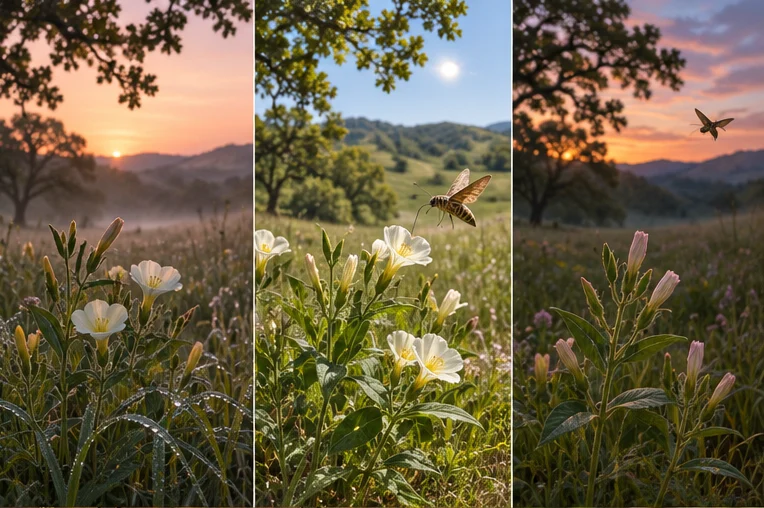
The flowers are the same, but the view is not. In the morning you can see a visitor turn on the nearer side of a bloom. At midday you can follow its departure toward another flower. At dusk you may only see a quick silhouette against the remaining sky. If your notes say “one bee,” “one fly,” and “one moth,” those three entries look equally definite after you type them into a sheet. They should not necessarily carry equal weight. An evening ledger has to preserve what you could see, as well as what you saw. Otherwise the measurements can tell you more about your vision and technique than about the visitors.
Start by asking a question your observations can answer: which kinds of flower contacts did I record in comparable morning, midday, and dusk watches of this patch, under stated viewing conditions? That wording leaves room for change across the day without making a single watcher responsible for proving who actually moves pollen at night. It also leaves space for one of the most useful outcomes a small study can produce: a precise account of when a comparison is impossible and what would make it better. You may find a new visitor group, establish a workable viewing position, or discover that twenty minutes of your seemingly tidy half hour were not useful for identification.
Choose the event before you choose the categories
A visitor can be visible near a flower without doing anything to it. Imagine a little fly suspended above a yellow cluster while a bee moves between florets. The bee contacts a flower. The fly may make contact later, or it may leave. If the recording rule counts every nearby movement, the hover and the landing are both observations, but the field sheet must not call them both flower visits. In this article's example, a qualifying contact is an animal first seen touching the target floral unit during the watch. A clearly observed mouthpart touching the relevant flower counts even if the animal's feet never land. A flyby is a separate note. If contact is uncertain, preserve that uncertainty rather than letting a guessed contact into the count.
“First seen touching” here describes an observation event, not a promise that the individual had never visited the site earlier. Decide whether movement to another counted floral unit while the animal remains continuously visible creates a new contact. The worked ledger in this article treats that continuous sequence as one encounter, even if there are several flower touches. If an animal leaves view and a visitor of the same broad type returns, the observer records a new qualifying encounter without claiming a new individual. The rules reduce a particular kind of double counting, but they cannot establish individual identity. Make the continuous-view rule clear enough that another observer could apply it and see where ambiguity begins.
Choose the target and define its boundary from a public or permitted viewing position. It might be a small visible cluster on one plant or several clearly bounded heads on a contiguous patch. If a flower head contains many small units you cannot keep separate from the path, use the head as the working unit and label it as such. A different scheme can use a different countable unit. One brush against the edge of a head is not an observation of every floret in that head. In a mixed bed, keep target and adjacent flowers separate. Otherwise the apparent shift could occur because you watched one plant type in the morning and a different one that remained visible at dusk.
Record the number of target units you can see and whether those units are open, on the verge of closing, obscured, or not confidently assessable. The open set need not be identical at all times for your observations to be valuable. It does need to be visible in the data. A record with no visits to eight open heads is different from a watch with no heads open. In the first case there was a defined exposure to detect visits; in the second, there were no open heads available for the open-head question. Keep the actual state instead of marking both entries with the same numerical zero.
The difference between a visit and pollination is another change of question. A visit observation can establish contact under the stated rule. It need not show pollen being picked up or deposited, whether the pollen would fertilize the flower, or whether the flower produced a seed because of that visit. A separate observation field can note a visitor contacting visible reproductive structures or carrying a visible load, if actually seen. Do not infer the composition or origin of that load. A contact ledger is a defensible individual project. A demonstration of reproductive effect calls for additional evidence and a different design.
Keep the clock in the data, not just in a window name
Choose three windows that are practical to sample repeatedly, not just easy to explain on a chart. Morning can mean a local-clock interval after morning travel is possible; midday can mean the part of the day around local noon that you actually intend to cover. Dusk should be defined relative to your local sunset or to a clearly described viewing condition. The provisional plan might define a thirty-minute period around local sunset, as long as the public access and safety limitations permit it. Write down the offset rule and its time reference. Simply writing “dusk” leaves ambiguity about whether you mean twenty minutes before sunset or an hour after sunset.
Save the start and end times along with local date and time zone. Keep an independent sunset reference if that is how you set your session. A lamp turning on, a cloud blocking the western sky, or a hedge casting shadow over the patch can alter the conditions during the same nominal window. Therefore, start of window relative to sunset is useful but cannot serve as the light observation itself. Record obvious changes and their approximate minute. A session marked “dusk” with steady illumination from a nearby path light can differ from a nearby session at the same minute with no direct illumination.
In a longer project, inspect which part of daylight or twilight your fixed clock schedule actually samples. A repeated evening appointment could shift from before sunset to after sunset as the calendar advances. A schedule anchored to sunset solves part of that problem but moves the watch on the clock, which can change the chance of a park being closed or a watcher being available. A useful sheet keeps the real times and environmental description so that the analysis can explain the choice honestly. It does not need to make all dates comparable by decree. If a time block is absent after a change in access hours, that absence should be visible.
Time windows are generally not independent samples when they come from the same patch on the same day. The weather, flowers, and many individual insects can be shared across them. For a small project, define a patch-date as the repeated block, then compare within that block before trying to summarize across days. Four good evenings on one site are four sessions, not four separate gardens. Three windows with exactly equal planned duration do not imply discrete visitor populations, either. An insect active around boundaries can be observed in more than one part of the day without having changed its role.
Some projects rotate the order of which patch or observer gets a slot. You cannot randomize when physical dusk happens. You can rotate which observer gets the best view, which of two patches is sampled first within one window, or which dates receive a planned repeat. Write down which parts are fixed by astronomy or safe access and which choices are under your control. If there is only one observer, avoid claiming an observer rotation took place. Instead, balance obvious practical differences where possible and record that the comparison depends on one person's consistent technique.
Read the effort chart as a plan
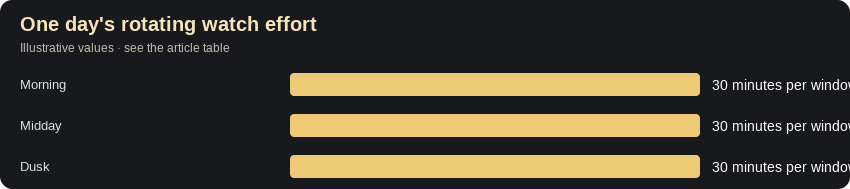
The bar chart is titled “One day's rotating watch effort.” Its three bars are 30 minutes in the morning, 30 minutes at midday, and 30 minutes at dusk. They total 90 illustrative observer-minutes if one person completes all three watches. They are not visitor counts, relative activity levels, estimates of abundance, or a recommendation to stay out at night. The example is a budget for comparable windows, not a finding. The distinct UK daytime protocol discussed below is not the source of these three bars.
In a field record it is worth distinguishing planned minutes, elapsed minutes, and minutes that met your viewing rule. Planned minutes describe the schedule, including cancellations. Elapsed minutes describe what actually happened on the clock. Eligible viewing minutes describe the intervals during which the observer could watch the target and apply the event rule with the chosen level of detail. A schedule can allot thirty minutes each and deliver thirty, thirty, and only eighteen usable minutes. That is not a reason to erase the threshold. It is a reason to describe the evening data and its denominator differently from the daytime data.
Valid minutes can also depend on the question. In a low-contrast period you may still reliably see a landing on the front bloom while you cannot distinguish one type of insect from another. In a simple project, keep a contact-level eligibility flag separate from an identification-quality flag. For example, a session can have thirty continuous contact-level minutes, of which only twenty were suitable for a classification comparison. If you display proportions of visitor groups, say whether the denominator includes confirmed contacts classified as unknown. For a conservative comparison you can use a common visibility grade defined at the contact or group level. Do not retrofit a different rule for each window because the numbers look cleaner.
When two people independently watch the same flower boundary, their minutes are not two disjoint opportunities to observe two sets of insects. You can describe the labor in person-minutes, but a joint estimate of flower exposure needs an explicit treatment of overlap. If one person looks at the front half and the other at the back half, record that design instead of merging arithmetic without units. For this ledger the safest first comparison is one named observer, one target, three planned watches, and an explicit account of where viewing conditions changed. A paired-observer check later can tell you whether your rules are easy for a second person to use.
Equal time does not equal equal detection. A moth-sized silhouette against the sky can be easier to see than a much smaller fly against dark leaves, and a moving animal may stand out against a pale bloom while a stationary one blends in. The geometry of your view changes as light fades. Bright sun can also create glare or backlighting. It is not safe to assume that every daytime minute is a perfect reference against which evening minutes can be corrected by a fixed multiplier. If you do not have a defensible way to estimate detection, report the observed pattern rather than manufacturing an adjusted one.
Compare the same rules at three very different viewing times
The first question after any sighting is whether contact satisfies the rule. The second is what group, if any, is defensible. A bee-like shape is not enough to rule out a hoverfly, and an insect that hovers is not necessarily a hoverfly. The USDA Forest Service pollinator brochure discusses how some flower flies resemble bees or wasps. The UK PoMS quick guide illustrates points of comparison such as the eyes and antennae. Neither implies that a person viewing a dark, fast silhouette must decide between those groups. If the view supports “fly of uncertain group,” that is a better record than a confident guess.
Wing count, antennae, how the animal uses the flower, and overall shape can be useful observations where conditions allow. Seeing one pair of wings clearly can help a comparison, but seeing only one pair in a blurred view is not the same as establishing there is only one pair. Decide in advance what combination of features counts as group evidence for your setting. A category such as “moth-like, low confidence” can preserve a fleeting observation without including that record in the more conservative moth totals. If a photograph taken without disturbance supports a better classification later, keep the original confidence mark and the reason for the revision.
Photo evidence is opportunistic unless you explicitly design the comparison around a camera. Taking images changes the work done by the watcher. If you spend two minutes reviewing a frame, record that time as an interruption under the agreed rule. If you use a camera in one window but not the others, that can create unequal evidence even when the field records look similarly complete. Keep image links and timestamps as supplemental evidence; do not count multiple images of one encounter as separate contacts. A camera that sees a different angle or a different part of the target can be helpful, but its records need a clear method and denominator of their own.
Distinguish weak identification from uncertain contact. If an unidentified animal clearly lands on a defined bloom, it can count as a contact with unknown group. If a silhouette passes behind a bloom and you cannot see whether it touched, it belongs among uncertain interactions regardless of whether it resembles a moth. This lets you compare all confirmed contacts separately from classification success. It also makes transparent how multiple kinds of uncertainty emerged. At dusk, classification may fail more often while contact remains visible; in midday glare over a deep tube, the reverse can happen despite a striking view of the animal.
A clear unclassified category helps avoid an accidental ecological claim. For example, suppose two certain contacts are classified at dusk and seven cannot be assigned to any group. A table that displays only the two known groups may imply they represent the entire window. Instead, display recognized group counts and confirmed-but-unidentified contacts together. If desired, show the group distribution among identified contacts as another calculation with its own denominator. If two of nine contacts are identified and one of those two is a moth observation, “half of identified contacts” and “one confirmed moth encounter in a nine-contact ledger” are both arithmetic descriptions. Only the latter says how thin the identification evidence is.
Work a hypothetical evening all the way through
Consider a fictional garden edge with a short accessible path and ten target heads visible from one side. A lone watcher chooses thirty active minutes for each of three windows. All ten heads are open at the start of the morning session. Later in the day, one head is obscured by a leaf that the watcher leaves undisturbed. The generally same boundary is still recognizable, but the number of assessable units falls to nine. Suppose the observer records eight confirmed contacts in the morning, eleven at midday, and six at dusk. Those are example contacts, not counts drawn from the effort chart and not the results of any real garden watch.
The morning entries break down as four bee, two hoverfly, zero moth, and two unknown. Midday has six bee, three hoverfly, zero moth, and two unknown. Dusk has one bee, zero hoverfly, two moth, and three unknown. Each set of categories adds up to its session count. Now add quality information. All thirty daytime minutes meet the contact rule. In the dusk window a passing cloud and inadequate contrast make the final eight minutes unsuitable for detecting contact. The observer records no eligible contacts in those eight minutes by definition; that is not a zero for insect activity. Of the six dusk contacts during its twenty-two eligible minutes, three were clear enough for group classification. The other three were clear contacts but nothing more.
You can describe what was recorded as contacts per hour of eligible watching, without claiming this is a population or full-night rate. Morning gives eight divided by thirty, times sixty, or sixteen observed contacts per hour of eligible watching. Midday gives twenty-two on the same basis. Dusk gives about 16.4 by dividing six by twenty-two and multiplying by sixty. Notice what happened: raw counts are smallest at dusk, but a time-only normalization puts its observed rate near the morning value. Neither number corrects for detection, false classification, obscured heads or changes in the environment. The difference shows why deciding the denominator matters, not why the true activity must be the same.
An evening observer can report two recognized moth contacts without asserting that no moth occurred in either daytime window. The day columns say zero recorded moths among the contacts viewed and classified under the ledger's rules, with uncertain contacts retained. By the same logic, refrain from a strong statement that hoverflies were absent at dusk. If both recognized dusk moth contacts occurred while the observer could see only the bright face of the nearest head, mention that positional detail. Comparing one head that remained reliably visible across all windows after prespecifying such a comparison can be useful. Choosing that head only after seeing the largest difference turns the comparison into an exploratory pattern, not a planned result.
A second way to inspect the example is to separate the identification fraction: six of eight contacts in the morning, nine of eleven at midday, and three of six at dusk were assigned to a group. Displaying these fractions next to the raw categories communicates the weak link in a comparison. It is not appropriate to apply a correction that assumes the unidentified contacts had the same mix as the recognized ones. Large or slow visitors might be easier to identify. It is also possible that a distinctive animal is overrepresented among known contacts because its outline stands out particularly well. Reporting the unknowns explicitly is a more honest choice than automatically redistributing them.
Use daytime schemes as protocols, not as borrowed authority
The UK Pollinator Monitoring Scheme's FIT Count Quick Guide describes an official Flower-Insect-Timed Count. Its basic structure includes watching a defined fifty-by-fifty-centimetre patch for ten minutes, recording the target and its floral units, and recording flower-contact insects by group using the scheme's rules. The guide sets a UK season and suitable daytime weather constraints, including dry and not too windy conditions and different minimum temperatures for sunshine and cloud. These settings belong to the scheme and should be followed with its current directions when participating. They are not universal dusk thresholds.
A named protocol establishes more than a duration. It specifies which targets and categories can be recorded, how to handle recognizable uncertainty, which opportunities are valid, and how to send records so someone else can interpret them. If your own project uses a thirty-minute session, applies a mouthpart-contact rule, allows a voluntary dusk window, or records repeated encounter events after loss from view, it is not automatically a FIT Count. Label it as a separate local ledger. If you complete a properly eligible daytime FIT Count on the same date, keep that record separate and do not replay its categories into the dusk spreadsheet without a documented mapping.
Workflows can still learn from one another. A bounded patch and a repeatable window help an independent project state its scope. Documenting flower units and weather keeps changes in the opportunity set visible. Group-level identification with an unknown option scales better for a learner than forcing a species determination. Apply those ideas as measurement principles without claiming that a daytime scheme was validated at night. In publication, show your locally defined rules next to your results, not in an appendix where someone could confuse a method inspiration with actual scheme membership.
If you work outside the UK, consult the relevant monitoring project or local site owner before contributing data. Local seasons, weather, species, and site access may differ substantially. The North American overview and UK methodology in this article serve separate purposes. The former supplies ecological background, and the latter is an example of a standardized field design. Neither assigns the members of your project to specific moth or bee taxa, nor establishes what they should see. The right way to link a regional observation to a broader knowledge base is to state location at an appropriate precision, name the method, and make the uncertainties explicit.
Let floral traits suggest questions, not settle them
A pale fragrant flower that is open as twilight falls gives you a plausible place to look for interactions you would miss during a daytime-only walk. A flat open flower gives you a particularly convenient line of sight into the center. Those are reasons to select a watch target; they are not a means of assigning a visitor to a group or declaring that the plant depends on that group. A pollination syndrome brings together recurring traits such as color, form, scent and reward that can help generate hypotheses about interactions. Those hypotheses belong in a “what we expected” note, not inside the evidence recorded next to a hard-to-identify visitor.
The Forest Service material places bees, flies, moths, beetles, birds and other groups in a broad natural-history context. This is useful in a garden where people habitually use “pollinator” to mean honey bee. It also provides an opening for careful, regionally grounded questions. Instead of declaring every pale tube a moth flower, ask whether evening visitors actually contact the opening, whether the same flower receives morning contact, and whether the observed contact reaches parts relevant to pollen transport. A group can visit flowers outside a stereotypical time, and multiple groups can visit the same flower type. Broader visitor roles and geographic patterns deserve their own evidence.
Expectations can create biased classifications. If you start a dusk watch believing the pale tube is exclusively visited by moths, you may code a faint silhouette as moth-like that you would have left unknown on a yellow composite. Have two readers classify the same short description or non-disturbing image without telling them which group the flower is “supposed” to attract. When discussing disagreements, compare what they could actually see. Do not add a new category after the first dusk watch simply to fit the story unless you record the reason and decide how the earlier observations should be handled.
Look at flowers, not just at visitors. Some units are opening during a watch or partly closed by the end. Some show a plausible fragrance change you can note without testing, but a human perception of fragrance is not a measurement of what a particular insect can smell. An apparent change in flower appearance after dark may come from artificial illumination rather than from the plant. Define which claims depend on direct observation and which are proposed explanations. A short section of unresolved ideas can be more useful in the next survey design than a polished account implying that the first night's results were predictable.
Treat lighting as a condition and avoid making its own experiment
Lighting can change both the observer's ability to see and the visitors' behavior. A bright path lamp may improve your confidence on certain contacts without making the site comparable with a naturally darker patch. A peripheral lamp can create a ring of apparent flying activity with no observed contact to your target blooms. Record ambient context, including whether artificial lighting is on and its approximate relation to the patch. Do not turn it on for the insects or test a series of colors or intensities as part of a casual watch. A systematic lighting experiment needs design, permissions and appropriate safeguards distinct from what this ledger proposes.
As an illustration of why observers should take that distinction seriously, a field experiment by Giavi and colleagues studied daytime plant–visitor interactions under experimental nighttime lighting, reporting responses that depended on plant species. That study and the conversation around it give a reason to document light rather than ignore it. They do not provide a universal correction for the number of contacts an observer misses, and they do not establish a simple prediction for an unstudied garden. This ledger makes no inference that a difference between its dusk and daytime watches was caused by the lamps.
Use existing light levels for observation. Avoid flash, repeated beams on flowers, light traps, and bait or scent lures. If you need a light to leave safely, prioritize safety and end the watch rather than describing the resulting exposure as an undisturbed observation. Keeping the dark enough for an ecological question does not mean keeping yourself in an unsafe situation. If an installation changes during the session and you can still watch safely, mark the time and note the changed viewing regime. In an analysis, report how many eligible minutes and contacts occurred on each side of the change rather than averaging them silently.
Weather may move in concert with light. Temperature, wind and precipitation can change rapidly in the evening, and a steady time of day is not the only feature that distinguishes sessions. A shaded patch might be comfortable for an observer but dark too early; a lee side might shelter flowers so the motion of the stem is less than elsewhere. Record a manageable set of weather conditions consistently. When you cannot separate co-occurring differences, describe them rather than writing a causal story: “Both of the high-uncertainty dusk watches occurred during falling visibility and a rising breeze” is a hypothesis-generating result, not a mechanism test.
Make the study small enough to repeat without harm
Choose a viewing point where you have clear authority to be, daylight access to scout, and a safe route out. A public path open by day can be closed at dusk; a visible garden edge is not permission to enter private property. Follow posted times and instructions and prefer a lawful, unobstructed spot you can use without stepping into a bed, approaching a nest, blocking other people, or disturbing animals. A private yard with the owner's permission may be better than a more biologically exciting site with uncertain access. If your safe practice allows watching only until sunset, a sunset-adjacent window is sufficient. It is more honest to call it dusk evidence than to make it stand for the night.
Observe at a distance and do not catch, handle or follow insects into cover. Do not touch blooms to get a better angle, pick samples, expose nests, or try to reproduce a visit by manipulating the plant. Cultural or maintenance activities in the area may also be more important than preserving your count. If someone needs to use the path, yield and record a break. Photos should avoid capturing identifiable people or sharing private location detail unnecessarily. If a land manager asks people not to photograph or report sensitive locations, honor that restriction and take an aggregated note instead when permitted.
Plan a stop rule that can be followed without debate. For example, end an evening session if the path is about to close or light is no longer sufficient for safe departure. Stop a classification run if even a familiar outline cannot be distinguished under your predetermined viewing standard; decide separately whether contact-level viewing can continue safely. A severe weather shift, discomfort with access, or a wildlife concern is enough to stop. A cancelled watch can remain in the record with its reason, making your observation effort more transparent. No table is improved by counting minutes achieved by ignoring safety or access restrictions.
The most useful scale is often the one you can afford to repeat. Start with one accessible patch and one dry date as a method check, then use several dates with morning, midday and dusk measurements when practical. Preselect the number of attempted dates or define a period in which you will try, and record the ones without eligible sessions. If possible, pair days so comparison windows on one date share patch, observer and target. In reporting, do not mix a day with only an evening session and a day with all three as though both provided matched comparisons. Keep a table of attempted dates so the pattern of missing windows remains visible.
A second patch can answer a different question. For example, one target might have a clear diffuse background while the other sits against a dark hedge. If your viewer positions differ, explain what their respective counts can and cannot compare. If both have different flower types, counts are per documented target and not a garden-wide census. Plan comparable replication before collecting the observations rather than adding a striking patch afterward only to illustrate the conclusion you want. It is perfectly useful to show an opportunistic second observation as an anecdote, as long as it remains visually and analytically separate from the repeated design.
Build a ledger that survives the first surprise
Start with two linked tables. A session table stores a stable session identifier, patch identifier, target definition and unit, planned window, start and end with time zone, observer and technique, conditions, planned and eligible minutes, and reasons for interruptions. Keep a field for access or safety changes that affect eligibility. Put start and end status of target flowers in an easy place to find. Store a contact table separately because even one minute can contain several observations. It can store time within session, target unit if distinguishable, contact certainty, broad visitor group, confidence and evidence, and a note about whether the observation was linked to a continuous encounter.
Here is a written rehearsal for the evening watcher. Near the opening, one recorded contact has an obvious landing but too little detail for a group. A second has an obvious wing outline passing between the observer and the flower, but not an obvious touch. The first is confirmed with unknown group. The second is uncertain contact and does not enter the confirmed-contact tally. On a third encounter the observer sees the animal touch a front head and follow continuously as it rises and touches the adjacent head before leaving. Under the chosen ledger rules this stays one encounter, but the contact note preserves the movement. If an otherwise similar animal comes back after being out of view, the next qualifying entry remains a new encounter, not a newly identified individual.
Write down corrections without erasing the original record. A later review may resolve an initially unknown visitor or reveal that the target unit was outside the original boundary. Add a revised decision, the reason, and the evidence viewed, keeping the original recorded status accessible. A species-level label needs expert or other appropriate evidence; the aim of this ledger is generally a defensible broad group, not the maximum possible number of species names. A higher-resolution software categorization is not automatically a verified field observation. If a reviewer is uncertain, leaving the entry unresolved is an acceptable result.
Use one row per interrupted or incomplete attempt even if there are no contact rows attached. If wind or a person briefly interrupts a session, record which minutes were interrupted and whether a fixed-window count paused or ended under the protocol. Do not fill the missing minutes by watching farther into dusk unless the rule explicitly provides for that and the timing consequences are documented. The decision to describe a shorter conditionally observed interval can be preferable to turning a schedule measure into a variable exposure with an unrecorded clock shift. In this article's simple illustration, the final eight unusable minutes stay as lost eligibility inside the scheduled half hour.
Two quick consistency checks can make the eventual table readable. First, sum all broad-group counts, including unknowns, and compare with the number of qualifying contacts. They should agree if each accepted contact has exactly one group state. Second, check that the stated eligible minutes do not exceed elapsed minutes, and check that the contacts used in a particular analysis are inside its eligible intervals. If a count is unusually high right after an interruption, inspect the sequence, observer notes, and changes in view before assigning an ecological meaning. These checks should reveal records to review, not automatically discard inconvenient outcomes.
Say what a reader can learn, then say where it stops
A usable one-page report states the result, the unit and the scope in the same sentence. One version for the fictional exercise might say: “On one patch-date, the dusk watch had six confirmed contacts in twenty-two eligible minutes, including two recognized moth encounters and three unidentified contacts.” A separate sentence can say how those observations compare to the other windows. A small table can include all three time windows, planned and eligible minutes, targeted visible units, contact counts, and recognized/unknown breakdown. Avoid embedding evidence only in a picture. Vivid artwork can help someone find the story, but it cannot establish that a depicted species was present.
If a repeated project has enough matched dates, display the distribution of within-date differences, such as today's dusk minus morning observed contact rate, rather than publishing only an across-date average with no context. Some days may have no usable dusk window, so a matched summary describes dates on which both sessions met comparable criteria; an all-session summary can tell a separate story about overall observation effort. Show the missingness so readers can judge how representative the matchable dates are. If most windy or rainy evenings were excluded, a comparison of clear evenings and mixed mornings is not a generic comparison of the whole day.
A report need not come to a binary verdict about the night shift. It can identify whether a group was observed in a particular window, how consistently that pattern appeared under similar conditions, and which future comparisons would reduce uncertainty. If every putative moth entry occurred near the path light, a useful next question is whether the same group can be observed at comparable flowering targets without that context using a safe method. If only one observer found hoverflies while a second reported unknowns, improve the classification exercise rather than jumping to a new time budget. A revised plan is an outcome, provided readers can reconstruct which records suggested it.
Finish with the most literal statement supported by the ledger. The agreed patch was watched at defined times; some contacts were clear and some were not; the clock and light qualified the comparison. Keep activities outside the view and actual reproductive outcomes outside the claim. This does not make the observation less interesting. It makes the clear part available for the next observer to repeat. Recording one well-supported evening visitor is worth more than declaring a whole unseen night accounted for.
Sources
- USDA Forest Service, The Simple Truth: We Can’t Live Without Them, including “From the World of Pollinators”. Natural-history background and examples of trait associations. These associations are not observational diagnoses.
- UK Pollinator Monitoring Scheme, FIT Count Quick Guide. Named daytime observation method, target patch and floral units, eligibility, and broad visitor categories.
- Giavi, Fontaine and Knop, Impact of artificial light at night on diurnal plant–pollinator interactions. Primary field study illustrating why lighting context can matter; it does not supply the values or predictions for this article's fictional ledger.
The three thirty-minute chart bars and every contact and rate in the worked garden example are synthetic; they are separate from the cited studies and monitoring guidance.