
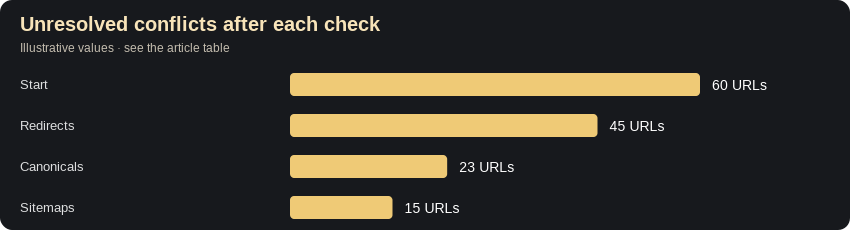
| Category | Value (URLs) |
|---|---|
| Start | 60 |
| Redirects | 45 |
| Canonicals | 23 |
| Sitemaps | 15 |
Illustrative calculation (not sourced observations). A fictional 60-URL conflict ledger; resolving 15 redirect conflicts, 22 canonical conflicts and 8 sitemap conflicts leaves 15 open. No effect on rankings is simulated.
Imagine opening an old grant report and following its citation to an article about a season of pollinator observations. Instead of the article that the report actually cited, you land on a new edition with a different date range and a different denominator. The title looks familiar, and the new table is loaded with numbers, but the result in the grant report no longer appears anywhere on the page. You might reasonably conclude that the report was wrong. In reality, a publishing cleanup redirected two versions of an article to the same address. The site fixes one kind of duplication and creates a much more expensive problem: readers cannot reconstruct the claim they are trying to verify.
Now take the opposite case. A single article appears at both a directory URL and an index-file URL. Its print view repeats the whole piece, and campaign tracking adds several more addresses that produce the same body. The archive appears richer from a URL count than from its actual coverage. Internal links wander among these copies. A new front end adds another variant. Even if all the variants work for a human, they make it harder for maintainers to answer a simple question: which link should an editor put in a bibliography today?
Both cases concern canonical URLs, but they are not the same editorial problem. The first is about preserving the identity of evidence across revisions. The second is about choosing one public address for interchangeable representations. A canonical conflict ledger starts by establishing the difference. It records what the systems emit, what the editorial team intends, and why a particular URL should consolidate or survive. The point is not to force every cluster down to one row. The point is to stop collapsing distinctions that readers depend on while removing accidental distinctions that only the software made.
The examples below describe a fictional archive. They are not measurements of Apiary, not a promise about search ranking, and not a prescription to apply production changes without review. They illustrate a decision process that works on a small publication with a spreadsheet and on a larger one with a release manifest. An editor, a site maintainer, and a reader should all be able to understand the resulting record without depending on whoever happened to implement the last rewrite rule.
Start with a definition of sameness
A research archive needs at least three separate definitions of identity. The work is the continuing editorial project, such as a guide to interpreting a regional bloom calendar. An edition is the identifiable state of that work that supports a citation, such as the calendar and methods as published in April. A representation is a way of delivering an edition: HTML at one address and the same text formatted for printing at another, for example. The main article can remain the public entry point without acting as the sole address for every edition.
Use a citation test to separate these layers. Ask whether a careful reader could replace one URL with the other in a citation without changing the evidence that the citation reaches. An added tracking parameter normally passes. A table that changes from counts of visits to counts of distinct insects does not pass, even if both editions discuss the same study and use the same large headline. A correction that changes the sample denominator can affect the interpretation of a finding without noticeably changing the appearance of the page. Comparing only its title and introduction would miss the important difference.
Then use a reading test. Does the alternate carry something a significant audience needs that the preferred version lacks? A Spanish translation is not merely an alternate URL for English prose. A transcript may convey equivalent spoken content while still filling a different discovery and accessibility role. An accessible table and a chart embedded in the same HTML can be equivalent for the intended claim; neither requires a separate URL. A downloadable observation file may support the article but have a different schema, license, or update cadence. It belongs in a relationship to an article, not necessarily in a cluster of interchangeable article representations.
The standard link relation has a more technical definition than an editor's citation policy. RFC 6596 documents the canonical relation and discusses duplicate content or a superset as a basis for use. That does not force an archive to declare every richer page the preferred edition. A page that combines years from different studies may contain old facts but make them hard to cite in context. Define a stricter local policy where a dedicated address keeps evidence easier to find. Record that the policy is an editorial choice, not an additional protocol requirement.
Sometimes neither test is decisive. Suppose the newer edition adds references but maintains the original claim, and the older edition was never released with a dated address. It is reasonable to leave the existing URL as the continuing work and preserve a change history there. But a dated release distributed with fixed audience-facing figures has a stronger case for a permanent edition page. The ledger makes this a decision with an owner and a rationale, instead of a side effect of generating an HTML filename. Preserve the most meaningful distinction that already exists before introducing a new numbering system merely to make migration easier.
Separating identity early also helps with bylines. A repository commit message names a person who fixed an error. That person is not automatically the research author. Likewise, a new editor's note is not evidence that the original author endorsed the correction. When deciding whether to consolidate pages, compare the credited authors, editorial roles, and declared dates alongside the tables and conclusions. If these facts diverge, do not let a template's generic author field settle the question.
What the signals do and what they do not do
A redirect changes what a request resolves to. For an obsolete duplicate that no longer needs to be independently reachable, this may be exactly what the archive wants. HTTP Semantics, RFC 9110 defines the meaning of status codes including 301, 302, 307, and 308. A permanent redirect is not an ordinary successful response with a hidden preference. It sends the client toward another resource. That is why a redirect is useful for a moved article and risky for a historical copy the archive promises to preserve.
A canonical annotation expresses a preference for another representation while allowing the original URL to remain accessible. This can be suitable for a real alternate pickup point, such as a print-friendly HTML presentation of the same content that readers intentionally open. Google documents HTML link annotations and, in supported contexts, HTTP link headers. A maintainable system should define which rendering layer owns the declaration. If an HTML template announces one target but a hosting rule adds an HTTP header announcing another, two teams may each believe they set the preference correctly, while the reader sees no obvious clue that anything is wrong.
A sitemap is a discovery and preference mechanism, not proof that a page is indexed. Google's guidance on consolidating duplicates orders redirects and canonical annotations as stronger signals than sitemap inclusion. Its sitemap documentation also describes submission as a hint, not a guarantee that a crawler will use it. This means that a sitemap advertising the migration destination is not a substitute for correctly routing or annotating a duplicate. All three mechanisms can reinforce an intent, but no single log entry saying a file was submitted proves the outcome.
The archive controls emitted signals, not a search service's canonical selection. A service can choose differently when its interpretation of a cluster diverges from the publisher's. Keep selection observations as separate evidence with dates, rather than editing the declared intent to match whichever observation arrived last. A selected canonical can be useful feedback, particularly when important edition pages are repeatedly consolidated. It is not permission to erase the distinction in your citation system. Conversely, internal reports can use the declared work and edition identifiers even while discovery systems are updating.
Internal links are the fourth source of evidence in the ledger. A bibliography generator, author page, and related-reading card can all pull from different inputs. They can disagree while every generated page returns a success status. Pick the address based on purpose: a broad introductory link may point to the current edition, while a sentence about a specific calculation should point to the identifiable edition that contains it. Treat those as intentionally different behaviors. Within each purpose, remove accidental link variations.
Do not equate canonicalization with hiding or access control. Google's guidance advises against using robots exclusions or removal tools as canonicalization methods. A robots rule affects what a crawler can fetch; it does not turn an alternate into the proper resource or protect private documents from a visitor who already has access to their URLs. Similarly, a canonical tag is no substitute for authentication. If a draft must not be public, fix access separately. Do not try to clean up the appearance of the search results first and assume the underlying access problem has been solved.
Turn the URL list into a working ledger
Start with a short inventory from sources you control: current route definitions, the last generated sitemap, authoritative editorial records, and public links sampled from the site. Do not require a commercial crawler to make the first pass. One lightweight fetch per relevant public address, an export of proposed redirects, and a copy of the generated page can yield enough evidence to locate a contradictory template. If the publication is large, stratify by article type and release history before increasing volume. A sample consisting only of today's newest articles is unlikely to reveal errors in retired copies.
Give each ledger row a stable ID that is not the URL. Write down the exact input address and the method, date, environment, and vantage used to test it. Capture each hop, terminal status, content type, and final URL. Store the canonical declaration from the raw source and any HTTP header separately, along with the destination each names. Record whether the input and the terminal URL occur in a sitemap. A note that says only 'canonical correct' hides which address was tested, whether a hop intervened, and whether a second declaration contradicted the first.
Next attach editorial identity. Record the work ID, edition ID, language, media type, visible revision label, and a short summary of what can be cited on the page. Add an ordinary fingerprint of normalized content to help find likely duplicate output, but make sure it excludes known per-request decoration. The fingerprint should not omit the title, byline, table notes, or cited values just because those elements are hard to extract. A hash is an equality check on an agreed representation; it is not a judgment that everything removed by the normalizer was unimportant.
Record the proposed disposition in controlled terms: keep distinct; keep as equivalent alternate with a canonical preference; redirect retired duplicate; or hold pending editorial review. Add a reason and owner for the disposition. A short reason is enough when it says what the generic category cannot. For example, 'print layout only; all captions, tables, credits and references identical' is more useful than 'duplicate.' A hold should name the decision needed and who can make it. A ledger where hard cases quietly default to redirect is little better than a rewrite rule with no scope.
Separate evidence of intent from evidence that a proposed fix works. An approved destination may appear in a draft release plan before it has ever served a usable page. Give planned fixes states such as ready for preview, preview verified, production verified, and observation pending. None implies another. Someone can verify every status and body hash at the intended public addresses while search-crawler interpretation remains unknown. Do not let a dashboard put both states under a reassuring green check mark that encourages reporting a result you do not have.
There is also a time dimension to collection. Redirect declarations and sitemaps may come from different release jobs. Preserve the exact deploy identifier or the timestamp of each artifact, and do not compare a sitemap obtained before a release with page HTML obtained afterwards as though both were simultaneous. When caching could explain a difference, inspect the release evidence and compare a fresh fetch against the affected path. If you still cannot align the observations, record a stale window as possible rather than guessing which artifact the reader must have seen.
Finally, store the business constraints right next to the technical decision. A grant paper may embed an edition URL, a partner may use the PDF in a lesson, or an accessibility feature may use an HTML equivalent to deliver content unavailable elsewhere. If a route has an obligation to remain readable, note that obligation without copying private agreements or personal information into a shared ledger. The short public-facing rationale may be 'permanent citation to the edition'; the operational owner can separately know which parties need advance notification if maintenance affects it.
One fictional conflict, from three reports to one disposition
Suppose an archive discovers these paths for a December article: /reading/shaded-bloom-transect/, /reading/shaded-bloom-transect/index.html, /reading/shaded-bloom-transect/?ref=field-letter, and /editions/shaded-bloom-transect/2025-12/. The HTML header on the index-file route prefers the directory address. The query route responds with the same body but omits any preference, and the sitemap lists the index-file address. The editions path differs in two sentences and one table note. At first, someone marks the entire cluster as duplicate based on similar titles.
Fetch the routes individually and preserve their terminal behavior as evidence. Confirm the article is actually present: an HTML shell with a correctly set title can still contain no article, while a generic fallback may return a successful status. Compare bodies with navigation and unrelated banners removed. Confirm which routes deliver the same edition using the citation test, including the contents of the footnotes. In this example, the first three paths are interchangeable HTML presentations of the current article. The December edition is not: it preserves an older sampling rule that explains which transects were included.
An appropriate disposition might be for the index-file route to redirect to the directory only if URLs that explicitly include the file are no longer required as representations. The query route might remain usable for the newsletter while pointing to the clean directory address, with attribution measured independently. The December edition should keep its own reachable identifier and a clear public link to its successor. A bibliographic reference to the older sampling rule should still resolve to the December text. These are decisions about this fictional case. A different site that guarantees permanent access to a legacy index-file path might choose differently.
The needed repairs touch several surfaces. Update the preferred destination in the sitemap, remove any link to the file URL from article cards, and make sure a redirect source isn't declared as preferred by another page. Give the December edition a self-referential preference if it is intended as a distinct indexable document; make the edition relationship visible to the reader rather than representing it only in metadata. Change a related-reading link if its claim actually refers to the older rule. Do not indiscriminately replace every mention of the older URL with the new one.
Run two separate tests after preview. In one, a reader coming from a campaign link reaches the current work and can copy a clean address. In the other, a reader coming from the grant report reaches the December edition, reads its sampling note and can locate the newer interpretation. Both are success paths even though they terminate at different addresses. The migration is done for this cluster when the URL behavior and the editorial paths both work, not when every URL terminates at the same page.
If a stakeholder asks why the archive did not consolidate the December page, record the actual disagreement: someone prioritized a single landing address, while another needed persistent attribution of a specific claim. A durable disposition reconciles the two by giving the work a clear current page and leaving the dependent citation intact. The record can pass to a new maintainer without a meeting to recover the team's memory. The same logic lets you reverse an earlier choice if a citation or license constraint was overlooked.
Treat the conflict count as a queue, not a score
The accompanying chart depicts a deliberately fictional ledger in which sixty URLs initially have unresolved signals. A redirect review resolves fifteen, leaving forty-five. A canonical declaration review resolves twenty-two more, leaving twenty-three. A sitemap review resolves eight more, leaving fifteen. The chart communicates an ordered sequence of reductions, not three parallel interventions independently measured against the same starting count. Each stage is conditional on the results of the previous one. No conclusion about ranking, indexing, or field performance follows from the illustration.
Notice what the counts mean. One URL can exhibit several contradictory signals. If its redirect now works but its sitemap remains stale, it should still be unresolved until all required checks for that URL clear. In the illustrative data, each reduction is the number of additional rows that cease to be unresolved during a stage. It is not the number of individual edits made. If the canonical sweep changes thirty templates but resolves only twenty-two rows, the chart shows twenty-two. The count must follow the published definition of completion, not the amount of activity.
Keep separate tracking columns for valid different outcomes. An edition classified as intentionally distinct should not be counted as an unsolved conflict simply because it has its own preference. A row awaiting an editorial evidence check is unresolved even if its route is technically clean. An approved and deployed fix awaiting a search engine recrawl belongs in an observation backlog, not necessarily in the application backlog. By exposing these categories, the ledger gives people enough information to do their work without misleading the user who only wants the number.
There is also a denominator trap. If the archive adds a partner's fifty historical links during the third stage, the unresolved count can rise despite genuine repairs. That is not failure. The team just found more work. Keep a fixed cohort for the chart and show discoveries in a separate count, or explicitly revise the denominator and mark the date. Do not hide discoveries merely to make the line go down. In a functioning archive, evidence that an old edition is still cited should be welcomed, even if it delays the cleanup.
Avoid comparing URL counts as though all readers are affected equally. Twelve conflicts on alternate spelling URLs can matter less than one contradiction on the only public copy of an appendix. Counting preserves operational visibility, but triage also needs severity and confidence. A stable citation lost in a redirect, an edition reachable only through navigation that no longer exists, and an alternate with a stale sitemap mention are three different priorities. Add one sentence explaining downstream impact to the row. This will give editors a more defensible fix order than a severity tag with no rationale.
One useful variant is a table with a column for actual change and one for anticipated effect. 'Removed unpublished index path from newly generated sitemap' is an actual change. 'Discovery system will choose the new path' is an anticipated effect. The discrepancy between the two is exactly why technical verification and external observation need separate dates. The same distinction helps during review when someone proposes a partial fix to stop readers from losing a link right now, while broader search consolidation remains pending. Publish the what and when first; do not pass a forecast as a result.
Watch for conflicts that equal-looking pages conceal
One important class of collision involves pagination. A first page of an article, a second page with the detailed methods, and a true single-page edition are not interchangeable unless the proposed destination actually provides the material a reader expects. Directing all pages to a first page that omits the rest should be treated as a content-loss decision, not a URL simplification. RFC 6596 discusses paginated resources when explaining appropriate canonical targets. An archive can choose a complete single-page destination when it exists; it should not pretend that a summary page is that destination.
Another collision involves filters. A tracking parameter that leaves the response editorially unchanged is different from a query parameter used to filter observations by season or region. In an image gallery there may be no reason to index every sorting permutation. In a research archive, a stable filtered view can be part of a cited analysis, and therefore has a distinct retrieval purpose. If the site does not want to support millions of filter URLs, save the material caveats and the dataset configuration in a stable edition or analysis record. Then migrate only after the new record provides the same information.
Format differences can also carry meaning. A PDF might be the paginated final report used in an external citation, while an HTML version is a convenient reading copy; compare figures, pagination references, alt descriptions, and footnotes before declaring preference. A spreadsheet may have specialized formulas not represented in a PDF. A Markdown export might include neither the custom gallery nor the accessible narrative that a chart relies on. Classify one as an independent resource if its use is different enough that consolidating would confuse citation, format expectations, or accessibility obligations.
A multilingual cluster creates two independent questions: which address represents each language, and how do discovery systems learn the relationship across languages? Google's localized versions guidance describes language and region alternatives, including reciprocal declarations. A Japanese or Spanish edition should not be pointed at English simply because English happens to be the first authored version. When multiple URLs serve the same language and material, deal with that duplication inside the language scope and test that the alternates still connect. Retain the language choice a reader can actually use even if you also improve the machine-readable relationship.
Images and shallow article shells create yet another false equivalence. Two pages that share a hero image, author banner, and opening paragraph can still contain different methodology after the first viewport. A client-rendered page may return the same generic shell at two URLs and fetch different content after load. Compare rendered outputs where needed. Nonetheless, inspect the source and HTTP headers separately for the canonical declaration. A metadata collision may be present even when both views look correct, because the rendering system replaces something at a different layer from the response the crawler initially inspects.
The simplest defense against false merges is to sample evidence intended to vary. Check the exact chart denominator, caption, table label, byline, active language, latest editorial note, and links to underlying files. If a particular content type uses the same boilerplate across its first five paragraphs, the comparison should reach beyond those five paragraphs. Similarity detectors are useful for finding pairs needing review, not for granting permission to move them. In a mature workflow, template output can propose an equivalence grouping; an editor still owns equivalence for citation-sensitive material.
Model the release so the archive can defend it
Before a change goes live, define its allow list. The list should contain the exact legacy inputs given new behavior and the specific destinations expected. It should also name edition paths that must not change. If a rule matches all paths within a directory, exercise both a path intended to move and a neighboring path intended to stay. Testing only positive cases gives a misleading sense of safety when the main risk is overreach. Static catalogs often have similarly named files that differ by language or vintage; the expected destination should be checked exactly rather than with a prefix match.
Use redirect chains as a symptom. Chains can develop when a sequence of migrations each moves the previous primary address to a newer candidate. Consider what happens when the earliest link passes through two addresses that still have active sitemap listings. The ideal maintenance disposition may be a direct route from the earliest aliases to the current destination plus clear editorial preservation for the editions that never should have moved. But do not "simplify" chains by sending everything to a category hub. The hub is useful navigation, not equivalent to the content a citation names.
Create route assertions before deploying. For a survivor, verify a successful status, expected content type, visible identity, and the declaration emitted by the chosen metadata layer. For a retired duplicate, verify the redirect behavior, destination, and a useful terminal response. For a retained equivalent representation, verify the alternate remains readable and its stated preference points to the right member of the group. Add a refusal case where no migration rule applies. The refusal case should produce the ordinary expected behavior for a nonexistent address, rather than teaching the test to accept a catch-all page because its status equals the test author's assumption.
Test extraction at different levels. A browser shows what a reader gets, including dynamic rendering and link focus. A raw-response check shows headers, redirect hops, or conflicting source metadata that the browser can hide. A source manifest comparison shows why a generated route was chosen and whether future builds can reproduce it. If one of these tests fails, annotate its perspective. 'Source has two canonical annotations but rendered page appears normal' differs from 'Reader cannot recover methods page'. Both matter, and they have different owners.
Choose a release order that minimizes mixed states. A new destination should exist and work before a rule routes traffic to it. Edition pages intended to persist should be checked before and after any broad rewrite toggles. Update sitemap and internal navigation as part of the coordinated release, and verify the actually published artifacts, not just the static preview. If mechanisms are served by separate deploy jobs, name their update order and how long readers might encounter inconsistent combinations. A ledger that says all mechanisms were updated together should have evidence for that statement.
Plan recovery explicitly. Keep the earlier route behavior, retained content, and the object that generated the sitemap available for rollback. Remove only the faulty mapping when possible rather than reverting unrelated corrected content. Note that caches and external services may take time to reflect the restored configuration; a rollback is a change you can verify at the publishing surface, not a time machine for every observer. When room permits, test a small subset before expanding a wildcard. This is sensible even on a static site where a mistaken rule can appear to work perfectly on the freshly built preview.
Release notes benefit from affected-reader scenarios rather than a wall of paths. Say whether old page links work, where dated editions are now displayed, and whether links to the latest edition need updating. If a migration did not change scientific claims, say that only after comparing the content and table methods, not because most files are identical. If a scientific correction did accompany the move, issue a correction notice that identifies the edition and the affected claims. Concealing an edit within a URL cleanup makes later verification more difficult and erodes trust.
Separate technical, editorial, and observational review
A maintainable ledger has three reviewers, even if a small organization assigns all roles to one person. An editor decides which distinctions readers and citation systems require. A maintainer decides how a route can implement that decision safely. An observer records evidence from public behavior or available search diagnostics after release. It is helpful to give the roles separate questions rather than simply asking everyone to approve the whole table. An author should not be expected to infer the consequences of a permanent redirect from a traffic report, and a maintainer should not be expected to arbitrate the meaning of a revised study alone.
Technical verification should be reproducible by a second person. Keep the given input, expected status, expected destination, stable identifying part of the body, and observation date. A check that merely records 'works in my browser' cannot isolate a location-dependent edge issue. On the other hand, do not keep personal information such as reader query details when a synthetic input exercises the same behavior. Note public and preview separately. Most arguments about whether a fix is live come down to looking at different hosts or different generations of the page, not an unresolvable engineering mystery.
Editorial verification should prove that readers can reconstruct the record. Pick a citation to a historical result and start at the address it names. Follow the cited table, open its underlying file if there is one, and find the replacement interpretation if it changed. Compare the byline and date to the record in the editorial system. Then try the path from the current landing page to earlier editions. This simple two-way check surfaces problems a crawler footprint cannot: an edition might still exist but have no usable link to its successor, leaving readers unsure which interpretive notes apply today.
Observational review comes last and can take longer. Public request success is available immediately in many cases, but discovery-selection evidence depends on a search system seeing and processing the artifacts. Google states that sitemap submission does not guarantee crawling or indexing, so don't set a deadline for an outcome outside your control. Keep inspection dates and distinguish tested URLs from the cohort as a whole. Missing observation should usually read "not yet observed" rather than "failed." An outstanding absence can still warrant investigation after collecting enough context; it does not justify silently calling the publishing fix unsuccessful or successful.
Archive operational decisions without turning them into author credits. A public correction note can say that an imported table's heading was corrected or an old address redirected to its replacement. The ledger can retain who reviewed the change and which route rule implemented it. Neither should imagine contributions that were not made. For syndicated pieces, consult the actual rights and reproduction terms with the appropriate internal owner. A canonical link is a machine-readable preference and does not resolve ownership, contractual requirements, or who may adapt the text.
Finally, publish a decision if it affects how the archive is read. When the classification is stable, the archive does not need to show every internal check to every reader. It does need a visible way to distinguish latest from cited, and amended from replaced. A modest 'Edition history' panel with dates, replacement links, and a short reason can be enough. It should map back to permanent addresses so that someone can use it in practice. A history label that lists only release names with no working links solves the catalog's aesthetics, not the reader's retrieval problem.
Use the ledger for preventive work, not perpetual cleanup
Once a few contradictory clusters are understood, ask what produced them. If all articles emitted a file URL in the sitemap while templates preferred slash URLs, generating both from the same route record may prevent recurrence. If dated editions are mistaken for duplicate representations because the database has no edition ID, add that identity to the data model rather than teaching the canonicalizer to guess from filenames. If only one locale has problems, check how the translation build derives alternates; a fix for the source language alone may hide a broken language relationship.
A simple release manifest can hold a work record with references to one or more edition records. Each edition can identify representations and their intended behavior. Computed output can then generate consistent declared preferences, internal links where context is known, and sitemap choices. Explicitly decide which generator wins if metadata is also available from a content management system or an edge layer. Give a test fixture one old edition, one language alternative, one print presentation, and one retired URL. The fixture should deliberately include a mistaken configuration so the test can prove it fails for the right reason.
What does this prevent in practice? A build that treats every edition group as interchangeable will fail the historical citation test. A sitemap generator advertising redirect inputs will fail the discovery assertion. A public owner who accidentally changes a domain in one data layer will get a visible mismatch rather than a background redirect chain. These are not increasingly clever rules about what engines should do. They are checks against contradictions in the publisher's own outputs. That boundary makes the work easier to automate and much easier to explain.
Preserve the possibility that a different policy is appropriate later. A long-form archive may adopt persistent identifiers or split a research program into its own domain. Those are reasons to revise the intent record carefully, not reasons to delete the ledger because its first migration is complete. A future maintainer will want to know why a PDF was not redirected, why a region selector reaches a separately translated version, and which table changed in March. Keep identifiers independent enough that the archive can move infrastructure without reinterpreting all of its prior decisions.
Also plan to remove retired diagnostic noise. Once a migration is verified and reviewed, the editors should not have to scroll past hundreds of permanently closed duplicate rows to find a fresh conflict. Archive the evidence with the release, preserve a compact historical log, and keep unresolved items in the active view. If the same cluster opens again, link the prior decision and check whether the assumptions have changed. This retains context without turning almost every routine article update into a backlog archaeology exercise.
The deeper lesson is that a site cannot outsource the meaning of an edition to a URL signal. Search and hosting tools can help present a preference, let a route move cleanly, and provide evidence about what the public is seeing. They cannot decide whether an earlier count is still a necessary citation or whether Spanish text duplicates English for the actual audience. That work belongs to the archive. A conflict ledger is worth keeping because it captures that decision while there is still enough context to defend it.