| Category | Value (days) |
|---|---|
| Daily visits | 1 |
| Every 3 days | 3 |
| Weekly visits | 7 |
Worked example where first yes immediately follows last no in each cadence.
The first flower you see is not necessarily the first flower that opened. Suppose you inspect a marked plant at 8 in the morning on April 6 and see only buds. At 8 on April 9, one flower clearly meets your definition of open. You have evidence that the observed transition took place after the first check and no later than the second. You do not have evidence that opening took place on April 9, that it happened during the night, or that the moment was halfway between checks. Even a crisp photograph on April 9 documents the flower at the time of the photograph, not when it first opened.
That distinction is useful beyond a naturalist's notebook. A garden crew may want more dependable timing for a spring walk. An observer may want to test whether a plant in a sunny courtyard tends to show open flowers before a plant beside a shaded wall. A volunteer coordinator may want to know when an extra trip would add the most information. All three can work with an interval. All three can make a misleading claim with a column labeled simply “first flower.”
This guide shows how to collect the two observations that bound an onset, what to do when either one is missing, and how to compare windows without converting convenience into biological certainty. It uses example dates rather than a calendar of expected flowering. April 6 is not a forecast for a particular species or region. If you are participating in an established monitoring program, use its species-specific instructions rather than treating the local worksheet below as a substitute.
Decide which event you are measuring
A stem can have colored buds, fresh open flowers, and dried remains at the same time. Those are different observations. Start by naming the event in a way that another person can apply. One useful target is the first seasonal occurrence of at least one fresh open flower on a particular tagged plant. This is not the date when the plant has its fullest display, when pollen first becomes airborne, when the first insect visits, or when half the plants in a bed are in bloom. If visitors care about whether a bed looks colorful, a later display threshold might be a better target for that question. The first-open date should not be quietly repurposed as an answer.
The USA National Phenology Network's field guidelines describe repeated checks on the same individuals or designated patches and explain why nearby observations on opposite sides of the transition improve estimates of onset. The network's phenophase primer illustrates how to recognize open flowers in different types of plants. In many cases, the relevant sign is that reproductive parts are visible within or between fresh floral structures. Flowers need not be conspicuous or have broad petals. Some species, particularly those with very small flowers, require more careful attention than a brief scan for color. Use the current definition for the actual plant you are tracking.
Do not equate a two-inch display with a two-inch flower. A cluster may be visible from across a trail even though only a few individual flowers have opened, while a single conspicuous petal-like part can draw attention before the relevant flower qualifies. If the species definition names a particular feature, try to recognize it beforehand using documented reference photographs. An observer who can explain “here is the feature I checked” will make more comparable observations than one who can only say “it looked like spring.”
Define the observation unit with equal care. A single plant can be a workable unit when individual boundaries are clear. A clonal patch might be easier to follow as a patch, provided its boundaries stay fixed. Draw the outline on a map or describe permanent edges such as a path corner and a rock. If you monitor a bed, define whether a single open flower anywhere in the bed qualifies or whether only designated plants count. A flower on a plant outside the boundary is of interest as context but cannot change the status of the monitored patch. Do not redefine the patch to include the attractive flowers you noticed on the way out.
It is worth recording a short definition identifier. A note such as “Rule A: fresh open flower meeting species sheet, whole marked plant B3, view from path” can link a field observation to the full protocol in a separate sheet. In a shared project, record the version or revision date. If volunteers later learn that their first rule misclassified some buds, the season's records should not silently become equivalent to observations made under the corrected rule. Review field notes and photographs where available, flag unresolved rows, and explain any comparison that crosses the definition change.
There is also a choice about “first.” The target here is first seasonal onset on an identified unit. If you started monitoring after a plant already flowered and returned to a nonflowering state, a later no-to-yes transition could mark a second flowering pulse. Your dates could still bracket the observed transition, but the word “first” would be unjustified. A project interested in every pulse can register distinct episodes and use a separate rule for what counts as the end of one episode. A first-flower project should begin early enough to provide credible pre-onset context.
A no is an observation, not an empty space
A valid negative has a job. It is evidence that the monitored unit did not show the defined stage when you checked it. A blank cell has a different job: it says nothing about the plant. The Nature's Notebook data documentation, also available through the network website, distinguishes positive, negative, and uncertain statuses. The project also records intensity for applicable questions, which is separate from whether the stage is present. That structure is helpful even for a personal notebook.
Use yes when at least one qualifying flower has been observed. Use no when you inspected the defined unit adequately and found none. Use uncertain when you checked but could not decide. If you did not examine the unit at all, preserve that as no observation. You may choose to record a reason for a missed check in your route log, but a route note about a locked gate is not a plant status. None of these categories says how important the volunteer's effort was. They say what the visit can support.
The evidence needed for yes and no is asymmetric. You can confirm a positive by clearly seeing one qualifying flower on the correct unit. You need not count all the others. To say no credibly, you need to have looked in the parts of the unit where a qualifying flower could reasonably be seen under the protocol. If dense foliage hides much of a tall plant, a close view of one unflowered branch does not make the whole plant a valid negative. Either track a branch as an explicitly different project unit or mark the whole-plant status uncertain. Neither option requires climbing, cutting, or breaking a rule to improve access.
A field note can explain which failure occurred. For example, “open-looking pink structure at far edge, cannot verify feature” is a status uncertainty, while “rain cancelled route” is a missed check. “Bed visible, tag B3 missing, identity unresolved” needs a different follow-up: the plant may be identifiable from landmarks and earlier photographs, or the record may have to stay unresolved. “First positive confirmed, upper stem blocked” is still a valid yes for presence if the qualifying flower was on the unit; the blockage might prevent an intensity estimate, but it does not erase the positive. These separate notes keep the data interpretable without requiring observers to record a paragraph every time.
An empty status does not become no simply because the visit time appears in a spreadsheet. A team may log one arrival time for twenty plants, but that does not prove every plant was inspected. If a partner took pictures of the flowering individuals and skipped the rest, count the verified positives and leave the rest unobserved. Do not fill the negative statuses just to make a table rectangular. If data collection software requires an entry for a missed plant, use its supported missing or not-observed option rather than borrowing the negative category.
Build the window from the observations you have
Write the last confirmed no as L and the first confirmed yes as U. For a target that had not occurred before L and becomes observable as an open flower within the monitored episode, onset is later than L and at or before U. The compact notation is (L, U]. A parenthesis excludes the lower observation and a bracket includes the upper observation. For field use you can simply write “after the April 6 check, by the April 9 check” alongside both entries. This convention is not a way to prove the absence of an opening and closing between earlier visits. It expresses the evidence about the transition you bracketed.
Here is a worked notebook example. All observations are at the same local hour unless otherwise stated. The dates, locations, and IDs are examples, not a published dataset.
| Plant | April 6 | April 7 | April 8 | April 9 | April 11 | What the notebook supports |
|---|---|---|---|---|---|---|
| B3, path edge | No | Uncertain | Not checked | Yes | Yes | After April 6, by April 9 |
| B4, shaded corner | No | Not checked | No | No | Yes | After April 9, by April 11 |
| B5, opposite bed | Not checked | Not checked | Not checked | Yes | Yes | Open by April 9; no confirmed lower bound |
| B6, wall edge | No | Not checked | No | Not checked | No | No at the last adequate check; no confirmed upper bound |
B3 is the example from the opening. April 7 does not narrow its window because that row cannot confirm either endpoint. April 8 was not checked. The April 11 yes does not replace the April 9 yes: once you have established the earliest confirmed positive, subsequent positives document persistence or recurrence, not an earlier bound. B4 really does produce a narrower two-day window because it has an adequate negative on April 9. In this example B3's upper bound and B4's lower bound occur at the same clock time on April 9, so the windows do not overlap. Assuming these are the intended onset episodes, B3 was earlier than B4 even though the precise dates for both remain unknown.
B5 might have opened before both B3 and B4, or it could have opened within B3's window. If you plotted B3 and B5 as matching point dates, you would create an impression of synchrony that the notebook cannot establish. B6 is not evidence of “never flowers.” It is a plant on which no qualifying flower was confirmed during the checks shown. If continuing visits are feasible, record the next one as a new visit; do not edit the April 11 no to reflect what you saw later.
If a day is represented by a local date without a time, be careful when windows appear to touch. Two teams might have observed the positive and negative on April 9 at different times. A yes on one plant at 5 p.m. and a no on another at 8 a.m. on the same day do not give the same ordering guarantee as a simultaneous check. With dates only, an equality of boundary dates generally does not justify an hour-level ordering. Write what the precision permits, or keep the original timestamps and explain how they were aligned.
When the arithmetic matters, decide how you are measuring duration. From April 6 at 8 a.m. to April 9 at 8 a.m. in the same time zone with no clock change, the elapsed time is three days. It is not four because the date labels 6, 7, 8, and 9 appear on a calendar. Across daylight saving changes, two observations at the same local clock hour on successive dates can be 23 or 25 elapsed hours apart. A simple local calendar-day width may be enough for a garden report, but use elapsed timestamps when comparing observations within days or when civil time changes might matter. Do not present calendar-day differences as precise elapsed hours.
Read the chart as a schedule illustration
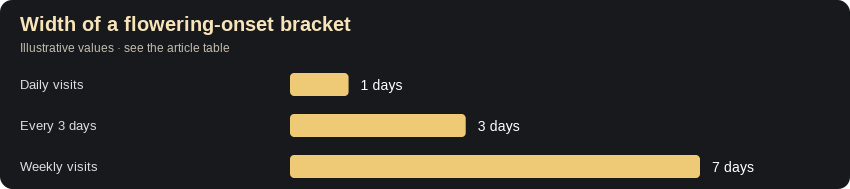
The companion bar chart, “Width of a flowering-onset bracket,” compares three hypothetical observation schedules. The displayed widths are 1 day for daily visits, 3 days for visits every three days, and 7 days for weekly visits. The demonstration assumes that in each schedule the first confirmed yes immediately follows the last confirmed no, with no intervening missed or undecidable checks. The bars are the lengths of observation windows, not amounts of flowering. They do not report an experiment, represent measurements from three gardens, or suggest that a plant takes one, three, or seven days to open.
The chart can be read as a planning example. Ask what decision you need to make before choosing a visit frequency. If you want to know whether two plants separated by a day or two reliably flower in a particular order, weekly windows are likely to overlap unless their onset times are much farther apart. If you only want to know whether a bed begins flowering in the first or second half of a month, weekly checks may be more useful per hour of effort. The deciding quantity is the width you can tolerate in the final report, not whether a schedule sounds ambitious.
The tidy bars should not be copied into a real dataset as an error estimate. Suppose you aim for daily visits, have a confirmed negative on Monday, a foggy view on Tuesday, no access on Wednesday, and a confirmed positive on Thursday at the original hour. Your realized width is three days. It is exactly the span between valid endpoints in that example, despite the label “daily” on the route plan. Similarly, a group that usually visits weekly might add a confirmed Friday no and Sunday yes after seeing buds on its regular visit and realize a two-day window during that period. Record actual visit dates and summarize actual widths.
An interval width expresses limited temporal resolution. It does not quantify the chance that the observer misidentified a plant, that a branch hidden from view had an open flower, or that the monitoring season began too late. Narrower windows are useful only with adequate endpoints. A flawless seven-day pair and an unreliable one-day pair should not be ranked by number alone. Keep a flag for difficult views and an observation rule with enough detail to distinguish a biological change from a change of technique.
Handle partial observations, short blooms, and conflicting records
A last no and a first yes can be strong evidence of a transition but still leave open an important possibility: an earlier flower could have opened and closed between checks. That is easier to imagine for a short-lived bloom or a species with flowers whose visible state changes with conditions. If a particular plant can look closed at dawn and open later, morning and afternoon checks may be measuring different visible states. Read the species notes and match conditions or time of day when practical. If the timing itself is under investigation, record the time of day deliberately and describe which state your protocol detects. An ordinary weekly notebook seldom resolves cycles shorter than its sampling interval.
This is not a reason to wait for perfect coverage. It is a reason to label what was established. “First confirmed open bloom” is valid if you checked your series and found no earlier confirmed yes. “First opening on the plant” is stronger and depends on how well the observation design could detect earlier flowering. A plot can label an onset window and leave a note about transient events and pre-season coverage. You can report a no-to-yes transition cleanly without making a claim about every moment outside it.
If the first visit already finds flowers open, report an upper bound only. Tracking this plant longer can help describe visits during flowering and any later end of flowering, but it cannot create a negative before the first positive. Search contemporaneous notes or photographs only if they actually show the same unit, meet the same standard, and retain a trustworthy observation date. An earlier photo of a different plant is not a substitute. Nor is an earlier landscape photo of your unit, taken from far enough away that qualifying flowers would be invisible.
If the last visit is negative and you never observe a positive, report no confirmation by that visit rather than a completed bracket. Some reports call bounded-only-on-one-side observations censored. A left-censored record has a usable upper boundary but no measured lower one; a right-censored record has a usable lower boundary but no measured upper one, assuming a defined future event is being tracked and relevant flowering has not been missed. It is safer for a small public log to spell out the evidence in ordinary language before adding a statistical label. A plant destroyed by maintenance or lost to a failed tag is not simply another late bloomer. End the series with the reason, not with an invented date.
Status conflict is different from missingness. Imagine one observer records no on May 3 because all visible flowers looked closed; a second observes what appears to be an open flower two hours later. Same-day records may both be right, or one observer may have looked at a different plant or feature. Keep the original rows, review identity, timestamps, visibility, and species rule, and log the reason for any correction. Do not resolve a dispute by selecting whichever row puts the date closer to an expected result. If it remains unresolved, exclude that observation as an endpoint or keep the window explicitly qualified.
A yes followed by a no is not necessarily a mistake. The first flower may have wilted before additional flowers opened, or the later visit may have provided a different view. For a series measuring presence of fresh open flowers at each check, preserve both statuses. Do not move the first confirmed positive to make the sequence monotonic. Test the unit or scoring rule if you discover many unexplained reversals; forcing tidy data is not the same as improving field work.
Compare two plants without awarding the earlier date to the earlier visit
Before ranking plants, write both endpoints in the same place. Say that A has a valid no on May 1 and a yes on May 5, while B has a valid no on May 3 and a yes on May 4. The recorded first yes for B is earlier. But A could have opened on May 2 and gone undetected until May 5; B could have opened after its May 3 check. B also could have opened before A. Both orders are compatible with the observations. The correct comparison is not “B opened earlier” or “they opened together.” It is “their windows overlap, so this schedule could not resolve the order.”
Now suppose A has a confirmed positive at noon on May 5, and B has an adequate negative at noon on May 6 followed by a confirmed positive on May 8. In this case A was already open before the last time B was confirmed not open. Under the same observation rule, and assuming the windows bracket first seasonal onset, A's onset precedes B's. You can reach that conclusion without estimates of either individual time. The difference could be larger than suggested by the nearest endpoints, so do not claim an exact lead of three days simply because the first positives were three days apart.
Sometimes the practical question is about combined display. Two plants with nonoverlapping onset windows can still flower at the same time if the earlier plant remains in bloom long enough. Two plants whose onset windows overlap may never have had open flowers simultaneously if their blooms were brief. Onset overlap and flowering overlap are different quantities. To document simultaneous flowers, a synchronized check of both units with confirmed open flowers is better evidence than matching onset bars. If the goal is overlapping forage, consider observing repeatedly through bloom, rather than taking first-flower records as a substitute for the full seasonal timing.
A plot of many plants can make the distinction visible with horizontal segments from L to U. Use visually distinct left and right markers and include an accessible table with both endpoints. The segment shows where onset could fall, not the duration of flowering. A one-sided record can carry an arrow or an explicit note instead of an invented endpoint. If the plot is crowded, label a subset of representative rows and provide all rows in a readable table. Avoid displaying a full-length segment for a plant simply because it was never checked; there is no information about bounds in that case.
Do not collapse everything to a midpoint to make the figure neater. A midpoint is a possible estimate under an assumption about where inside the interval opening happened. It is not a field observation. Using one as a display marker may be acceptable if it is labeled and the endpoints remain visible, but it becomes risky when date differences are much smaller than the windows. The midpoints of two overlapping windows can suggest a tidy ranking even though both orders remain plausible. Assigning every positive to the first-yes date has a parallel problem: units visited later can look systematically later even if biology was identical.
If you choose to compute a simple garden summary, report the number of units with two endpoints, the number with only one, the time spans represented, and typical bracket widths. Do not average individual lower and upper endpoints across different sets of plants without explaining who contributed to each calculation. In a serious research analysis, interval-censored methods can preserve uncertainty rather than assigning every individual an arbitrary date. They still depend on assumptions about the observation process, sampling, and missingness. A fancy model cannot recover a missed early pulse from a route that did not begin until the plants were already flowering.
There is a practical complication with bed and patch comparisons: a larger unit can qualify as soon as one of many plants opens. Even if the individual plants follow similar timing distributions, the earliest among many individuals is not the same target as the earliest among a few. Two five-plant beds are more directly comparable than one wide planting and a single tag, provided the visits and visibility are also comparable. If you deliberately want the first display visible anywhere along a walk, make the walk the unit and accept that breadth and landscaping are part of the measure. Do not then compare it to one plant as if they were the same statistic.
Work with regional limits, not a universal opening calendar
In a garden, the easiest way to overgeneralize is to select a date that feels seasonal. A plant whose buds swell beside a sunny masonry wall may look very different from a similar plant where the path stays shaded and cool. Two beds only a few minutes apart may differ in drainage, exposure, irrigation, or management. Plants from different sources may flower in different patterns even when they have the same common name. The reliable response is to identify the unit and record its setting, rather than assuming every nearby plant must share its schedule.
Treat source material with the same care. The network's Time to Restore guidelines accompany a project concerned with timing of nectar plants; its sample species and regional context are useful for understanding the project, not a target calendar for every site. The general idea of capturing a last no and first yes transfers. A predicted week, preferred monitoring season, or example species list does not automatically travel across latitude, altitude, or sharply different settings. A person monitoring a paved urban courtyard should not borrow another observer's expected week from a mountain meadow merely because both use the same field terms.
Regional variation also changes what “before the season” means. If first flowering is in early winter for the plant and location you chose, a route that always begins in early spring may produce only dates by which flowering was present. If the plant can bloom at several times, decide whether you are interested in onset after a specific recurring seasonal boundary or the onset of a particular pulse. Document how that boundary was chosen, and do not use a calendar-year change as a biological reset if blooms persist across it. The observation year can be a reporting convenience without being a new flowering episode.
Record site context at the level appropriate to the question. “South-facing public bed beside brick; drip irrigation visible; plant marked B3 from trail” can explain why a record might differ from a nearby unmanaged one. It is not a measurement of temperature, water supply, or soil composition. If you did measure a variable, identify the instrument and placement separately. If you did not, describe the setting without pretending to have quantified the mechanism. Maintain local labels even when sharing a simplified public chart; you or a collaborator may need them to interpret a surprising shift next season.
If a plant is replaced, transplanted, divided, or drastically pruned, record the change. A new plant can inherit the bed's role but should not inherit the old plant's individual history. Two observations on separate individuals cannot automatically serve as bounds on a single individual's flowering event. A continuing patch protocol might survive some changes, but a patch-wide removal or redesign should be annotated so readers do not mistake landscaping for phenological movement. Where public access or site ownership changes, leave a documented gap instead of changing the viewpoint in secret to keep the series complete.
An early bracket is not evidence for a particular cause
Imagine you monitored the same plant with the same protocol in two seasons. Last season's bracket was after May 5 and by May 10. This season's bracket was after April 28 and by May 3. Those windows are separated. If your observations reliably captured the target event on the same unit both times, the earlier transition this season is defensible. “The plant opened earlier this season” is not equivalent to “this site is warming” or “warming caused the change.” The latter claims need additional evidence.
There are several layers to that distinction. First, repeated observations of a plant tell you about that plant under the conditions of those observations. A comparison of two seasons does not directly estimate a long-term climate trend. Second, the plant's current circumstances may have changed even at the same site. Irrigation timing, a removed shade tree, pruning, pest damage, or a replacement specimen can change the local context. Third, a nearby weather station describes what it measured at its own location and exposure. It may be a useful comparison, but it does not automatically give the exact conditions experienced by a plant sheltered near a building.
Consider a season when you visited the site every day because the garden was close to work, versus one when you were there weekly. In the more frequently visited season you may detect flowering sooner after onset even if the biological timing stays the same. A comparison that uses only first-confirmed dates can mistake a change in detection delay for an advance. Compare actual windows and the completeness of early monitoring before investigating explanations. Where the windows overlap, say that earlier onset was not resolved; that does not prove onset was unchanged.
If the observation is part of a larger series, reserve a separate column for interpretation. “Very wet spring” may be a useful environmental note if it can be linked to a measured record, but the observation itself remains “no on this date; yes on that date.” A claim about why flowering shifts needs a rationale for the climate or weather variable and a study design suited to the claim. For an informative local record, it is already valuable to show what moved, how precisely the move can be timed, and which alternative explanations are still open.
There is a similar risk with pollinators. A first-open flower can indicate the earliest detected opportunity for a floral resource, but it does not establish how much nectar or pollen was available, which visitors used it, or whether a mismatch occurred. Those require measurements or observations of the resources and visitors themselves. A flowering window and a separate insect activity log are useful starting points if they cover the right species, site, and times. One photograph with an insect on the flower confirms an interaction on that occasion; it does not make the date a seasonal threshold for all pollinators.
Run a route that protects the evidence and the plant
Start with an observation route you can revisit reliably and legally. A public walk can work if the plants are visible from the permitted path and access is predictable. Obtain permission where appropriate, and do not assume that public access allows stakes, paint, ties, or permanent labels. A map, waypoint kept in a private notebook, reference drawing, or description relative to a fixed feature may be enough. If one plant is particularly sensitive, difficult to see, or behind a barrier, choose a unit that can be followed with less disturbance. A schedule is not improved by access that volunteers cannot actually maintain.
Before the expected transition, make a practice run with the protocol. Each observer should independently check the same few units from the intended viewpoint and describe what made an example yes, no, or uncertain. Compare those explanations before reconciling any disagreements. A discrepancy can identify a poor angle, an ambiguously marked plant, or an overlooked distinction between a colored bud and an open flower. If the practical view cannot reveal the relevant feature, change the unit before systematic monitoring or accept an appropriately more limited question. Do not stretch the definition each time the view is difficult.
During a normal visit, confirm identity first, then assess the stage. Note whether the view was adequate. If a positive is clear, record the observation without requiring a picture; if a photograph will help later review, take it from the authorized viewpoint without handling the flower. For tiny structures, lawful optical magnification may be more useful than a closer approach. Do not open closed buds, break off stems, or rearrange a plant to see its interior. Besides disturbing the site, handling can alter the very appearance you are trying to observe. Where even a careful look is not adequate, uncertainty is the scientifically better outcome.
Retain enough detail to return to the same subject. A volunteer recording “ring of flowers beside old oak” might see a different stem the following week. A small map with the route direction, a fixed corner, and the approximate positions of the tracked individuals can keep them straight. On multiple-observer projects, assign stable IDs and protect any sensitive location data when making the results public. An announcement for a casual walk can describe the general area without broadcasting the location of a plant that should not draw attention. Provide clear separation between information needed for the project's internal continuity and information needed to understand the public result.
Use the expected onset period as a reason to redistribute effort, not as a reason to presume the event has occurred. If weekly reconnaissance gives good early negatives and several buds begin to look close, add a short visit after a day or two, within access and safety constraints. If observations occur before and after a forecast interruption, a valid additional check beforehand may make the eventual gap a little shorter. If it is unsafe or impractical to visit, leave the gap as a real part of the evidence. Reporting a week-wide window is better than implying a visit took place.
Be aware that changing effort only when you expect a positive can complicate formal cross-site comparisons. One plant that received extra visits because it looked close may get a narrower bracket and an earlier first-yes date than one that appeared unpromising from a distance. That does not invalidate honest observations, but it should be documented. If a group is comparing volunteers or sites, use a common rule for when to intensify monitoring, or keep the actual schedules in the analysis. Record extra trips just as deliberately as scheduled ones so a later reviewer can see which measurements were available.
Share a result that can be checked next year
A useful record includes the unit ID, definition used, last confirmed no, first confirmed yes, actual width if both exist, and a short statement of any limitations that matter. Keep the underlying visit log. If someone later finds a dated image that genuinely resolves an uncertain visit, add a reviewed correction that records why it counts. Preserve the original status for audit or mark it as superseded rather than disappearing the old evidence. Documenting changes makes it possible to tell whether an apparently earlier opening came from new field data or a change in how the rows were interpreted.
In a small project, the last-no and first-yes fields can sit beside a plain text summary: “Path-edge plant B3: no at 8 a.m. April 6; open at 8 a.m. April 9; no valid observation in between.” For a one-sided case use “open by April 9; first visit already positive.” For an unresolved order use “A and B had overlapping windows; neither opening was confirmed earlier than the other by these checks.” These are all usable results. A field group can use them to choose a better schedule without quietly improving the past.
When summarizing a set of observations, explain if choosing only valid brackets changed which plants feature in the report. The omission may be harmless for a short route example, but systematic difficulty can matter. If the accessible street-facing beds all have tight windows while the inaccessible hillside beds mostly have only a first yes, a report limited to tight windows predominantly describes the accessible beds. Describe the exclusions. If early active plants were already flowering when monitoring began, show those partial records separately rather than interpreting the remaining later plants as a complete picture of the season.
Make timing choices visible in next year's plan. If the widest brackets came from separately missed visits, extra invitations to volunteers might help. If most gaps arose because the observer could not see the diagnostic structures, more trips at the same angle probably will not help. Rearranging the route to use a different permitted viewpoint or picking naturally easier units can improve evidence without increasing frequency. Where uncertain statuses cluster around one easily confused stage, a short shared training example may be more useful than adding reminders. The point of reporting intervals is not merely to warn that dates are uncertain. It is to see what kind of observation would make them less uncertain.
The next time you see the first flower of spring, jot down the time and enjoy it. Then find the last time you were actually able to say no. The distance between those checks is part of the result. Keep it visible instead of compressing it to a date that the plant never gave you.
Sources and further reading
- USA National Phenology Network: Time to Restore data collection guidelines. Project context, repeated checks of stable observation units, and the last-negative/first-positive framework.
- USA National Phenology Network: Nature's Notebook data documentation, with an equivalent network site address. Data status and intensity conventions; the documentation cautions that species definitions and response choices have changed over time.
- USA National Phenology Network: Phenophase Primer for Flowering Plants. Visual and written explanations of open-flower features across plant types.