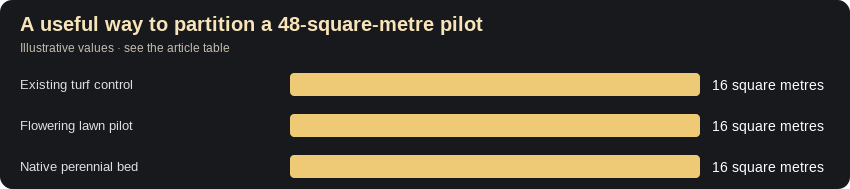
| Category | Value (square metres) |
|---|---|
| Existing turf control | 16 |
| Flowering lawn pilot | 16 |
| Native perennial bed | 16 |
Equal-area illustration to make comparisons tractable; not a landscape recommendation.
A household wants more flowers for insects but still needs a path to the back gate, a place for children to play, and enough open ground to move a wheelbarrow. Their first question is whether a bee lawn or a native perennial bed is better. Their more revealing question is whether they are asking one piece of ground to do three jobs. The strip that carries traffic to the gate may not be suitable for either option. The quiet corner the mower never quite reaches may have a good future as a bed. The sunny expanse between them may support low flowers and light use without becoming a conventional garden. A useful design can include all three outcomes without making any patch do something it cannot sustain.
Start by describing the jobs you want the yard to perform. Then map the conditions where those jobs happen, decide which changes are reversible, and observe them with a method honest about what a single yard can reveal. A bee lawn can offer flowers in a low ground layer. A thoughtfully planned native bed can support a wider range of growth forms and habitat functions. The comparison is not a contest between “green space” and “biodiversity.” It is a question about where plants will survive, what people will actually maintain, and which habitat functions the landscape already has or still lacks.
Decide what each kind of planting would be doing
A flowering lawn, often called a bee lawn, retains a lawn-like low profile while accommodating flowers capable of persisting under the expected management. It is not defined by how many species are printed on a bag. A lawn may already have usable blooms, even if no one planted them for pollinators. Adding low flowering plants deliberately, or changing mowing to allow existing blooms, are distinct interventions. Either can fail if the plants do not suit the ground or the people maintaining the lawn do not allow flowers to open.
A native perennial bed is a concentrated planting organized around plants native to the relevant region and suited to the actual site. It may contain flowering perennials, grasses, sedges or other appropriate plants. It can include tall stems, basal leaves, seed heads, and vegetation layers that would not persist under ordinary lawn mowing. A project could also add shrubs where their mature size fits. A native label does not promise good establishment, a full season of bloom, or a home for every insect guild. Those are design and management questions. A native bed selected only for an impressive early flowering display might leave an obvious gap later.
The roles do not collapse into “lawn feeds adults, bed raises young.” A particular bed may supply forage without meeting a given species’ nesting requirements. A lawn may include features other than flowers, and not every part of a bed will be used in each season. Name the function rather than assigning a biological result to a label. A first move could be to identify one existing resource worth preserving, one real gap you can plausibly fill, and one existing human use that must remain. Those choices let you work much more specifically than either a seed catalog or a photo of a flowering yard. They can also reveal that most of the trouble lies in only a small part of the site.
Walk the routes people really take
Draw the yard before deciding what to remove. Record fixed features such as gates, walls, stairs, gutters, storage and trees. Then walk from each entrance to the destinations people actually use. A habitual diagonal route across the middle of the grass is evidence about demand, not a resident's failure to understand the proposed path. A collection cart cannot turn through some neatly drawn bed corners. A mower operator may keep a broad corner clear to get around a trunk or hose. Watch one ordinary week if you can, rather than relying solely on an idealized plan drawn on a quiet day.
Sort ground use in plain language: a route that stays reliably open, an area rested between occasional uses, a play zone with repeated impacts, or a quiet patch traffic rarely crosses. A well-used lawn does not require every square metre of the parcel to remain mown. But some lawns are used heavily enough that low flowers do not solve the central problem. Flowering plants can still be worn down along a repeated tread, and compacted ground is not necessarily improved by scattering a new mix across it. A firm, accessible route using a locally appropriate surface can protect plantings on both sides more effectively than trying to make that route double as the planted habitat.
Do not move traffic into a worse place just to free planting area. Leave room for sight lines near doors or driveways, protect access to services, and avoid creating a new squeeze point for someone using a mobility device. Decide where people can stop to look at a flower without stepping into another person's path. Consider where a watering can or mower will go, and how an established plant will lean or spread at its full size. If nobody knows whether a proposed bed location leaves adequate passage, mark its boundary temporarily first. A garden hose laid where it is safe to do so, removable markers, or a sketch can reveal interference before any soil is disturbed.
Treat light, soil and water as separate measurements
A yard can be sunny from a kitchen window and dark close to the ground for most of the afternoon. Visit the candidate areas at different times and sketch when they receive direct light. Record which shadows come from deciduous trees, nearby structures, or evergreen vegetation. A patch that is bright in early spring may grow much darker after leaf-out, so one observation date does not describe the growing season. A sunny candidate with shallow soil and a nearby reflecting wall may present a different challenge from an equally sunny patch next to a regularly watered bed.
Next observe where water visibly sits after ordinary rain, which spots dry first, and where downspouts or slopes concentrate flow. Take care not to mistake a puddle after an exceptional storm for a permanent soil category. Avoid reading all soil properties from the surface. The gentle impressions a footprint leaves when soil is wet are not a laboratory measure of compaction, and bare ground can have several causes. Existing plants offer clues but are not definitive tests. Where past site use, contamination or subsurface utilities are uncertain, obtain appropriate local advice before disturbing the ground. No habitat style justifies unsafe excavation.
University of Minnesota Extension's bee lawn guidance identifies deep shade and heavy compaction as poor settings for the lawn approach it describes. Treat that as a reason to check suitability, not a reason to assume a native bed will thrive in the same difficult patch. A regionally appropriate shade planting can be a different job from providing masses of open flowers in sun. A narrow sunny edge might handle that floral job while the darker interior provides cover or remains in a durable low-impact use. Water use, seasonal heat, winter conditions and the way drainage crosses boundaries can make a locally sensible design unlike a similar-looking design elsewhere.
Map a seasonal gap before drawing a flower border
List the dates or periods in which the yard already has open flowers. Include woody plants, neighboring flowers visible from an authorized place, and the places people are willing to leave uncut during a bloom. A brief burst from a tree can be noticeable even when the lawn looks empty; the reverse can occur when a low ground layer is flowering after a spring canopy display has ended. What matters is the set of resources available across the seasons you can reasonably observe, not the largest number of species you can get on one survey day.
Choose a small number of observation periods rather than relying on month names to predict bloom. The first leaf-out period, a warmer part of late spring, and the end of the hottest expected stretch might be useful locally; a different climate will need other boundaries. Record “not visited” separately from “visited and no flowers were open.” Note when an event such as mowing, drought, or recent planting changed conditions. A spot may contain live, well-established plants that have no open flowers because the visit falls between their peaks. Alternatively, repeated checks may reveal plants failing to reproduce or survive in that setting. Do not make a permanent design decision on the basis of one absent bloom without considering those alternatives.
The better question may be which area can fill a resource gap without displacing a stronger existing resource. If the only longstanding flowers at the start of summer are near the planned bed, avoid removing all of them before replacements are able to contribute. If a new lawn has sparse blooms by midsummer, a perennial bed elsewhere on the site could cover part of that shortage while the low planting establishes, even if the bed is not large. Conversely, abundant existing flowers in established beds do not force a homeowner to plant the last open sitting area. A household might gain more by protecting the flower patch it already knows how to maintain than by doubling the total area it has to weed.
Give the pilot a shape and a reason
The chart divides forty-eight square metres into three fictional areas of sixteen square metres each: a retained existing turf comparison, a flowering lawn pilot, and a native perennial bed. These are square metres of planned footprint, not the fraction occupied by flowers, not observations of insects, and not three equal recommendations for a yard. Sixteen plus sixteen plus sixteen equals forty-eight. The point is to illustrate why known area simplifies field notes. If three patches are equal in area, there is no further area conversion when you compare aggregate measurements made using the same method, although equal area by itself does not make the habitat or observations equivalent.
Imagine the area as three squares four metres on each side, assuming the land fits this shape. The example retains a separate route around the pilot, so its area is not taken out of any of the sixteen-square-metre patches. The three squares have broadly similar sunlight and start with records of their prior condition. The turf comparison is kept under its documented ordinary management. The flowering lawn patch keeps a low profile, while the perennial patch is taken out of routine mowing. The project records both the difference in plants and the difference in management, rather than pretending that only one variable has been changed. A gate approach would remain outside all three plots if it required dependable access.
An actual plot might use three unequal areas, or a narrow planted strip and one much larger lawn area. You could then compare coverage in fixed subplots of the same size, express estimates per unit area where measurement supports it, and still report the original footprint for maintenance planning. A tiny strip may contain a larger proportion of boundary than a broad rectangle. Some insects, observers and maintenance actions cross boundaries. A count divided by area is not magically adjusted for these edge differences. Record the length and kind of edge if edge may matter, and do not reinterpret a small household pilot as a replicated trial simply because there are three categories in the chart.
Distinguish a comparison patch from a scientific control
The chart label “Existing turf control” is shorthand for the retained comparison under prior management in this example. It does not announce that the site provides an experimental control capable of isolating cause. In a single yard, a quiet bed often replaces a quiet piece of ground, not a randomly selected patch. People may preserve the higher-traffic open area as turf and assign the shady fence edge to the bed; the resulting areas started different. Their plants may differ for reasons unrelated to treatment. If the yard has no three comparable locations, that is a design fact rather than a failure of the record.
A pilot intended to choose a layout for your yard can benefit from monitoring each candidate before the change. State what you can fairly compare afterwards. You may ask whether flowers persisted in each location under its planned use, rather than treating the outcome as a plant competition. If mowing in the retained area changes too, document that instead of calling it an untreated patch. Existing turf can contain flowers and can change with weather without any added seed. A new planting may have an establishment period with more water or weeding than the old area required, so a comparison of labor should distinguish setup from ongoing maintenance.
For a more controlled project, several comparable plots, randomly assigned treatments where reasonable, observations over more than one establishment season, and explicit measurement methods would strengthen claims about causes. That may exceed a household's aim. Adequate evidence for “this particular damp strip is a bad place for the path I use every morning” is not the same as adequate evidence for “this planting method outperforms all alternatives.” Most yard decisions should not wait for the second claim when the first is the one that matters. Write down which claim is being tested so the data do not get promoted into an answer to a different question once they look interesting.
Track plant persistence and maintenance, not just opening day
A planting can look good on opening day and create an impossible maintenance routine a month later. In a lawn pilot, look for whether the intended low flowers persist through the actual mowing, traffic, and irrigation that the household can maintain. In a bed, look for survival, establishment, basic shape, and whether the intended layers or flower sequence have begun to appear. Record unwanted plants separately from intended plants temporarily without blossoms. Take repeat photos from the same authorized spot in similar light, with a known frame or simple location marker where suitable. Photos can make changes easy to discuss without turning the record into a claim about every part of the plot.
Write a second ledger for work. Count recurring tasks and establishment tasks in different columns. If a planting looked better only because it received extra hand watering from a nearby hose, say so. If volunteer help made weed control possible one month but will not be available next year, the pilot has not proved a sustainable workload. A larger bed might be low labor eventually and difficult at establishment. A low flowering lawn might fit a route better and still require ongoing management distinct from a conventional turf rectangle. The actual decisions should depend on the household's capacity and local guidance rather than a universal assertion that one style takes less work.
Create a checklist of observations that would justify intervention. Bare patches can mean trampling, drought, failure to establish, or recent maintenance; the remedy differs. A crooked edge from people skirting a puddle suggests a circulation or drainage problem. An impressive patch that flowers only when a neighbor unintentionally skips a mowing round tells you about the consistency of care, not necessarily that a particular plant is unsuited. Repeatedly restarting an unsuccessful area can use more materials and labor than choosing a role its conditions fit. Decide when to stop and reconsider rather than doubling the area and hoping that scale fixes the original limitation.
Observe flower visitors without treating counts as a census
If you watch insects, choose an observable event: for instance, one encounter with an insect landing on an open flower in a marked observation patch during a timed visit. Define what you will do if an insect moves between adjacent flowers, if you lose sight and it returns, or if you cannot tell which group it belongs to. For a household tally, the important practice is using the same rule consistently, not designing a taxonomy lesson from each visit. Record watch duration, date, approximate conditions, plot, and immediately relevant events such as a recent mowing. Use only identification categories you can support from visible features or a good photo.
Do not turn one tally of encounters into a count of individual insects. The same bee can move through a patch more than once. Your ability to see a fly on a low flower next to a lawn edge may differ from your ability to see a smaller visitor deep in a tall bed. A dense ground layer or a long bloom stalk creates two different viewing problems. A count that rises may reflect more open flowers, easier sighting, changed time of observation, or a combination. Note these differences and retain the individual watch results rather than reporting only a season total. Alternate observation order where practical so the same patch is not always recorded at the warmer minute of the session.
Observe on ground you may lawfully use, at a comfortable distance and without catching or disturbing visitors. On public land, stay on permitted surfaces, do not pull flowers or move stems or logs, and follow local rules for photographs and access. Use a zoom lens if one is already available rather than stepping into a garden to get a clearer identification. Watch the path and stop if there is a potential hazard. These constraints matter for comparability too: if a site cannot be seen safely from the available path, treat its visibility as unmeasured instead of recording a zero or extending the observation into a restricted area.
Use the mowing study for the question it can answer
Lerman and colleagues' 2018 field study compared nominal mowing intervals of one, two and three weeks in sixteen suburban yards in western Massachusetts. The result relevant here is that a higher count of sampled bees was not equivalent to higher sampled richness or more balanced representation among species. The study also found differences in lawn flowers under the tested intervals. The authors' work is evidence about those treatments in that setting. It is not an experiment comparing an installed flowering lawn with a newly planted regional perennial bed, and its intervals are not planting or mowing prescriptions for somebody else's climate.
Transfer the reasoning rather than the treatment. Decide which outcome is relevant to your job. A person aiming to preserve some flower visits while retaining a low ground layer may reasonably track encounters, bloom persistence and whether passage remains comfortable. A person aiming to add seasonal resource diversity might care more about open plant types across dates and plant structure left after bloom. If you plan to track visitor richness, be clear when identification is to a coarse group instead of species, and don't claim that having observed three visible groups establishes the total species richness of the yard. If the pilot collected only encounter counts, use that unit. Do not add stronger labels after the fact.
Two observations can coexist without contradiction: a flowering lawn can offer useful forage in an area that otherwise would have had little, and a carefully managed bed can serve additional functions at low-traffic spots. Minnesota Extension explicitly frames bee lawns as a complement to a diverse planting rather than a substitute for all perennials, trees and shrubs. It does not follow that every homeowner must add all of those features or use the same plants. The mowing study is a warning against overreading one outcome; the extension work is a reminder to choose site-appropriate practices. Neither turns a well-framed yard observation into a population survey, and neither elevates a shopping list over a site plan.
Run three site sketches before committing
In a narrow family yard, the middle is used several times a day. Mark a continuous firm trip between gate and kitchen, retain good functional ground where it still works, and evaluate whether a small quiet side pocket can support the more protective planting management of a bed. A flowering lawn trial could fit the open area that is lightly used, but should not be placed in the trampled center simply to keep the diagram symmetrical. The test outcome is not a ranking of bed against lawn. It is whether one can add a seasonal flower resource without narrowing the path or creating a task too frequent for the household.
In a sunny street-facing yard with almost no cross traffic, a broader conversion might be possible. First check visibility, boundary permission, maintenance commitments and the routes needed to reach equipment. Some color can be kept low where people need an unobstructed view. A quieter interior pocket could hold taller plants, without allowing their mature height or lean to hide a path. If there is already reliable early bloom, choose another season gap rather than replacing it automatically. Put an observation marker on your own side of the boundary, and ensure there is a clear place to pause without spilling people out toward the street.
In a shaded courtyard, two strategies could be inappropriate in their familiar sunny-yard form. The conditions may favor a shade-calibrated regional planting or simple retention of an existing useful cover rather than a flower-dense lawn. Look for a separate brighter pocket where resources can be added without changing the entire courtyard. Where soils stay saturated or there are persistent runoff problems, investigate those separately before assuming that a generic native bed will handle concentrated flow. Each scenario gets a layout from the same audit questions but produces a different planting plan. That is the work the audit is meant to do.
Plan for the weeks when a household needs something different
An accessible route that works only when nobody parks a cart on it does not provide much reserve. A play zone that must remain inactive whenever flowers open may place one goal in conflict with another. A bed that depends on every member of a household remembering which tall stems should be left and when can fail because no one agreed on the boundary. Plan a small margin around the jobs that must work regularly. A visible edge or a clear no-mow strip is useful when it prevents ambiguity. It need not come at the cost of a large engineered border. Start with clear instructions and a layout whose maintenance is legible to a person who did not draw the original plan.
Think through holidays, shared maintenance, access when plants grow outward, and how the space behaves in winter or during dry spells. Decide where leaves, garden materials, or movable equipment are put so they do not accidentally smother a new planting or force everyone to walk through it. If a person outside the household normally maintains the yard, review the limits of the planting when it is easy to see rather than assuming clues will work in every season. A single stable diagram with a short task list can preserve more habitat than a detailed species annotation nobody opens during routine work.
Reserve a reversible response for common failure modes. For disturbed grass near the gate, move or narrow the trial and protect a better path. For a bed that looks thin in its first season but has good survival and manageable effort, preserve the site long enough to see how it develops rather than classifying it solely by first-season flower totals. For a patch where desired plants repeatedly die or do not establish, record the problem and look for a better match rather than buying a larger version of the same experiment. A decision to retain some existing turf need not be a failure of conservation. It is an honest recognition of where that turf already does a job the planting plan must respect.
Make the end of the pilot a decision meeting
Choose criteria before collecting the last round of notes. A household might require the gate route to stay usable every day, at least one low-flower patch to persist under ordinary care, the bed to add open flowers in a specific gap, and the continuing maintenance to fit an available block of time. These examples are not ecological standards. They are decisions with testable criteria. If a project has several objectives, do not silently trade a failed access requirement against a high flower count by awarding a combined score. Some criteria describe necessary functions, others describe benefits worth improving. Discuss them in that order.
At the meeting, lay out observations side by side rather than a winner's photo. Include the dates and missed checks, the weather or maintenance changes that affected the pilot, and which measures were comparable. A good summary might be: “Our low patch kept its cover and had open flowers on four of six visits. The taller bed added flowers in the late visit period while staying clear of the gate. Visitors were harder to see in the tall bed and we did not estimate relative abundance. Both are small enough to maintain.” The exact numbers in that sentence are an example of a report format, not another set of data. They show how a practical observation can be clear without claiming more than a person actually measured.
Decide whether to enlarge, keep, relocate, or end one part of the trial, then document the reason in one sentence. Enlarging need not mean copying the whole pattern. A bed can expand in a quiet corner while the bee lawn remains at its current size. A lawn trial's value may be preserving low use rather than turning it into the largest planted feature. If the whole yard is newly functioning better, no further expansion is required to justify what has already worked. The strongest transferable lesson is often a small rule: let traffic have a good route, preserve existing plants that fill seasonal gaps, and assign each added patch a job it can keep doing after the first year.
Let the boundary do some of the maintenance work
A design decision often treated as decoration is the shape of the junction between two uses. An acute wedge of lawn beside a bed can invite tiny repeated passes with a mower, and the useful flower edge may turn into a row of accidentally cut plants. A smooth turn large enough for the actual equipment can let ordinary maintenance stop reliably at the intended boundary. On a site maintained chiefly by hand, a neat curve might matter much less than where the gardener can put a bucket without crushing plants. Do not decide the shape only from the overhead drawing. Try the work at a scale in which a person can turn, pause, and see the part of the yard on the other side of the tool.
A boundary also tells the observer what counts. In the pilot, imagine that low blooms persist mostly along the sunny edge, while the center of the flowering lawn remains grass. A fixed view of the first half metre along the border would capture useful edge information, but it would not represent the full patch. Conversely, a single central sample might make an edge-focused habitat addition invisible. Decide in advance whether the question is about use at the perimeter, average flower cover across the patch, or the contrast between the two. Mark each subarea in the notes, and use photographs to communicate that geography without asking readers to infer it from a particularly attractive close view.
Separating edge from interior can guide redesign. A pilot where flowers persist around the outside but fail in the traveled center need not be abandoned if only the outside had to supply flowers. The next version might formalize a low flowering side strip and give the center a more durable surface. If all planting growth leans into an access corridor from one direction, shift or reshape the bed before reducing its overall size. A block of plants can have the right height on paper but still occupy more space as it settles. The observation that matters is often not “more plants” or “fewer plants” but how the maintenance and circulation coincide at a boundary.
Compare one decision across two seasons
Return after conditions that could plausibly reverse the first result. A spring trial may never test summer foot traffic, shade after full leaf-out, or the water limitations that actually control a planting. If the household records only a mild month, it should not commit to a plan that demands the same performance in the driest part of the year. Similarly, a summer snapshot misses whether the bed retained the physical features that were intended to remain during winter. Write a few specific recheck questions at the end of the first season: did the same route stay usable during the wetter period; did flowers fill the previously identified gap; did the work remain manageable after establishment?
Do not expect the comparison to settle neatly in a single year. A previous year's record can still help distinguish a recurring site issue from one unusual management change. If early flowering opened up after a deciduous canopy was altered, record that change before attributing any new resource solely to the planting. If a neighbor's lawn was converted during the same period, the total flowers visible locally may have changed even when the three plots stayed the same. The alternative is not to monitor every nearby yard. It is to say which conditions were stable enough to support the decision and which were not. That kind of repeatable comparison makes a much better guide for the next small change than a universal verdict.
Record a short audit another person could repeat
Begin with a sketch dated to the current season. Outline the yard zones, distinguish essential routes from occasional use, and describe the conditions of each candidate. Next note the habitat resource already present, the gap you want to address and the observation that made it visible. Assign the pilot areas and decide what activities will stay unchanged within them. Keep other recent changes in the record, especially if they affect the comparison area. For each visit, enter dates, minutes, conditions, observable flower or insect notes, care work since the prior visit and any restriction on what you could observe. File a handful of representative photos rather than presenting a curated gallery as the data.
End the record with an explicit uncertainty statement. If shade, watering and traffic differ between patches, don't attribute observed differences solely to planting style. If the visitor watch series was interrupted, don't report totals as though elapsed effort matched. If plant identity was uncertain, describe what you could verify. A reliable yard audit is a short trail from the original reason for the change to the possibility of checking it again later. It does not require turning a garden into a permanent research plot, and its numbers are not endorsements of one regional design for another.
The lesson is narrower, and more useful, than a verdict about which garden type wins. Keep the plantings where they can establish, keep the paths where people will use them, and make the transition in pieces small enough that you can learn from it. Some places will reward low flowers that are allowed to persist in lawn. Others can support a tall, diverse, more seasonally varied bed. Places used for frequent trips, play or access may call for a dedicated solution first. An audit that accepts all three possibilities at the start can produce more effective habitat than a plan that asks the entire yard to do the same thing.
Sources
- University of Minnesota Extension, Planting and maintaining a bee lawn. Regional, research-based context for establishment limits, maintenance and the relationship between low flowering turf and diverse plantings.
- Lerman et al. 2018, To mow or to mow less. USDA Forest Service record for the original study, including treatment scope and differences among sampled abundance, richness and evenness. The chart in this article does not contain study observations.