Every haircut is a small business transaction. Someone has to pay rent on the chair, keep the clippers sharp, hold a state license, decide how customers get through the door, and set a price that the neighborhood will accept. Because a barbershop is so small and so visible, it shows the choices behind a business more clearly than almost anything else on a commercial street. You can stand in the doorway and see the whole operation: the chairs, the waiting bench or the lack of one, the price board or the booking app, the people who work there.
This article looks at those choices through three real barbershops in Fremont, California. They do roughly the same work, which is cutting hair, trimming beards, and sending people out looking sharper than they came in, but they are organized in three different ways:
- Don's Barber Shop on Fremont Boulevard, a long-established neighborhood shop run the traditional way.
- Royal Luxe Cutz on Decoto Road, a new independent shop opened within the last year by a barber with more than 14 years behind the chair.
- Garrison's Barber Studio on Paseo Padre Parkway, a private, appointment-only studio run by a barber licensed since 2008.
None of these is "the right way" to run a barbershop. Each one is an answer to a different set of questions about risk, overhead, schedule, customers, and personal style. Below, we describe each shop using what its own website says, place all three inside the larger story of how American barbering has changed, and then look at the national numbers: how many barbers there are, how many shops have payroll, how many barbers work for themselves, and where the trade is heading. At the end there is a practical guide for customers choosing a shop, a guide for barbers choosing a model, a short FAQ, and a box with each shop's address, phone number, and links.
Why barbering is a good lens on small business
Most small-business stories get told through restaurants or tech startups. Barbering is a better teacher in some ways, because the unit economics are so simple. The product is one person's skilled time. The main costs are space, tools, supplies, licensing, and the barber's own hours. The main question is how to fill those hours with paying customers at a price that covers everything and leaves something over.
That simplicity makes the trade-offs easy to see:
- Time is the inventory. An empty hour in the chair can never be sold later. Every business model in barbering is, at bottom, a strategy for keeping the chair full.
- Trust is the marketing. People rarely switch barbers on a whim. A good barber builds a book of regular clients, and those regulars are the real asset of the business, often more than the lease or the equipment.
- The license is the gate. Every state requires a license to cut hair professionally, so the barber's skill is certified before the first paid cut.
- The model shapes the day. A walk-in shop, a shop that takes calls and texts, and an appointment-only studio produce very different working days for the barber and very different experiences for the customer.
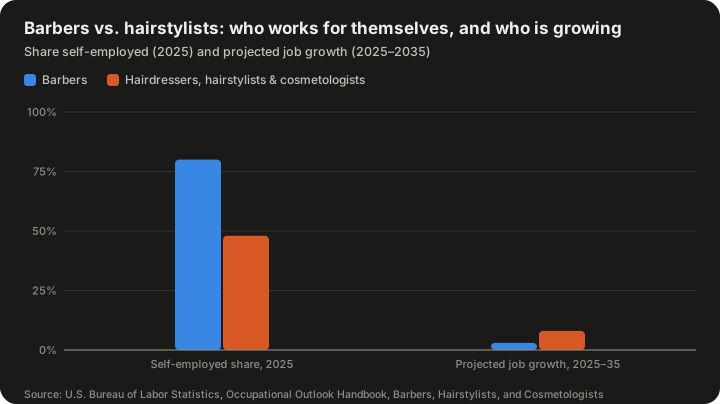
Barbering is also heavily made up of owner-operators. According to the U.S. Bureau of Labor Statistics (BLS) Occupational Outlook Handbook, about 80 percent of barbers were self-employed, compared with 48 percent of hairdressers, hairstylists, and cosmetologists. That is an unusually high share. For most barbers, the question is not just "where do I work?" but "what kind of business do I run?"
The three paths
Path one: the classic neighborhood walk-in shop (Don's Barber Shop)
Don's Barber Shop sits at 40950 Fremont Blvd, Fremont, CA 94538, and can be reached by phone at [(510) 722-5721](tel:+15107225721). It is a long-established local shop that Don has owned essentially from the start, and it is run the traditional way: a neighborhood shop where the relationship is with the place and the people in it, not with an app.
The shop's own website keeps its message short and direct. It opens with "A fresh haircut, a clean beard line, or a close shave," and invites visitors to "Make time for the details at Don's Barber Shop in Fremont." It encourages customers to "Bring the look you have in mind and talk through the length, shape, and finish before the cut." That last line matters. It describes the consultation that happens in the chair, which is the heart of a traditional shop. The conversation about the cut happens face to face, not through a booking form.
Services. The site lists five services: a haircut ("Talk through the length, shape, and finish you want"), a haircut and beard trim, a beard trim ("A trim and tidy-up for your beard"), a shave, and a haircut-and-shave combination. It does not post prices. Every service says "Call for current price," and the site notes that a current full price list has not been confirmed and that service categories are also listed on the shop's Yelp profile.
Hours. According to the site, the shop is closed on Monday, open Tuesday through Friday from 9 AM to 6 PM, Saturday from 8 AM to 3 PM, and Sunday from 10 AM to 4 PM, Pacific time. The site adds that holiday hours may vary and suggests calling to confirm.
Booking. There is no online booking link. In the site's words, "No online booking link is listed. Reach the shop directly for current availability." The way in is the phone or the front door.
Where to find it online. The site links to the shop's Yelp page, its Instagram, and its Facebook page, along with Google Maps directions.
What this model gets right. The traditional neighborhood shop has the lowest barrier for the customer. You do not need an account, an app, or a confirmation code. You call or you show up. For many customers, especially older regulars and people who get a haircut when the mood strikes, this is the most natural way to buy a haircut. For the owner, a long run in one location builds something money cannot quickly buy: name recognition on a busy road and a base of customers who have been coming for years. The site's gallery labels, "Razor detail," "Beard detail," "Clean tools," and "The finish," hint at what a traditional shop sells: basic, well-executed grooming done the same careful way every time.
What it has to manage. The traditional model asks the shop to absorb uncertainty. Customers arrive when they arrive, so some hours are crowded and others are quiet. A shop that does not post prices online asks the customer to call first, which some people like (they get a real person) and some younger customers skip in favor of shops that show everything on a screen. None of this is a flaw; it is the trade the traditional model makes in exchange for simplicity and accessibility.
Path two: the experienced barber goes independent (Royal Luxe Cutz)
Royal Luxe Cutz is at 3872 Decoto Rd, Fremont, CA 94555, in the Decoto shopping center near the McDonald's at Decoto Road and Fremont Boulevard. Its phone number is [(510) 790-0409](tel:+15107900409), and its website also lists a text line, [(510) 935-5487](sms:+15109355487). The barber behind it has been cutting hair for more than 14 years and opened this shop within the last year. That is one of the most common turning points in a barbering career: after years of building skill and a client base, the barber takes on a lease, a sign, and the full responsibility of ownership.
The shop's tagline is "Grace in Every Style." Its website describes the business as offering "Affordable men's, women's and kids' haircuts, fades, color, and hairstyling with careful technique and a royal finish," and says it is "Proudly serving Fremont's Sikh, Indian, Pakistani, Afghan and Muslim families." The listed team is Vo, G, Lucy, and Cindy.
Services and posted prices. Royal Luxe Cutz is unusual among the three for how much it publishes. Its site lists prices "as posted September 2026," with "up" meaning the price starts there. Among them: a men's cut at $23, a women's cut from $35, a senior women's cut at $30, kids' cuts (10 and under) at $20 for boys and $25 for girls, a beard trim at $20, and a men's cut and color special at $60. It also lists color from $70, highlights from $90, perms from $90, an up-do from $55, eyebrow service at $15, and several shampoo and treatment options. The site says color, highlights, perms, and up-dos are quoted in the chair based on length and thickness. Haircut styles named on the site include low taper fades, Edgar cuts, fades, head shaves, line-ups, long cuts, neck trims, and short cuts, and color services include balayage, bleach, gray blending, highlights, ombré, root touch-ups, and single-process color.
Hours. The site lists Monday through Friday, 10 AM to 7 PM, and Saturday and Sunday, 9:30 AM to 6 PM.
Booking. Royal Luxe Cutz has no online scheduler. Customers call, text, or walk in. The FAQ says plainly that "Walk-ins are welcome," and the site notes that texting your arrival time gets a confirmation reply. This is a hybrid between a pure walk-in shop and an appointment shop: the door is open, but a quick text lets the customer and the barber plan around each other.
Where to find it online. The site links to its Yelp listing and its Instagram, @royalluxecutz68, and the FAQ & Guides page points to both for reviews and recent work.
A shop that teaches. One of the most interesting things about this new independent shop is that it publishes a library of guides on its own site. They are a good example of how a new shop can build trust before a customer ever sits down:
- Affordable Haircuts in Fremont: How to Compare Real Value argues that a low posted price is only part of the picture. It warns that a listed price may not include shampooing, styling, beard work, or design work, and it defines value as "a fair price for clean tools, responsible technique, clear expectations, and a result you can maintain." It also says, "Value is not the lowest number at any cost."
- Edgar, Low Taper, Fade & Scissor Cuts and Fades, Line Ups & Detail Work explain the cuts the shop is asked for most.
- Balayage, Highlights & Gray Blending covers its color work.
- Why Professional Barber Tools Matter says good results come from "the complete system: the right motor, sharp blades, sanitation, maintenance, and skilled hands," and notes that "Dense hair may require slower passes and more torque."
- Cordless Trimmers: RPM, Torque & Close Cutting looks at how modern trimmers changed detail work.
- How Barbering Became a Licensed Art traces the move from household skill to licensed profession, describing the barber's chair as "a professional environment, not an unregulated experiment" and arguing that "Technical standards do not remove creativity; they give creativity structure."
The FAQ also speaks to customers with specific needs. It says scissor-only cuts with no clippers are standard work, that customers with religious or family reasons for uncut or scissor-only hair should say so when they sit down, and that beards can be shaped without losing length. It says customers who wear a turban, patka, hijab, or scarf should tell the barber before the cut so the shape suits how the hair sits underneath, and that re-wrapping at the shop is fine. That is a clear example of a new independent shop finding its customers by naming them and serving them well.
What this model gets right. The experienced-barber-goes-independent path combines years of skill with the freedom to set the shop's own direction: its prices, its hours, its team, and its community focus. Royal Luxe Cutz uses that freedom to compete on clear, published, affordable prices and on a broad menu that serves men, women, and children under one roof. Its FAQ makes the comparison directly, saying cuts often cost $40 to $60 elsewhere while its posted cut prices start at $20 to $23.
What it has to manage. A new shop carries the classic startup risks: a lease, build-out and equipment, staff schedules, and the need to become known quickly. Low prices mean a shop needs steady volume, which is one reason walk-ins and text-ahead matter so much to this model. Posting prices also means keeping them current; the shop's own guide notes that "Prices can change, so calling before a visit is still the best move."
Path three: the private, appointment-only studio (Garrison's Barber Studio)
Garrison's Barber Studio is at 38750 Paseo Padre Parkway, Suite B1, Fremont, CA 94536. Its site describes Garrison as "A licensed barber since 2008, with an appointment-only studio in Fremont." After a long career, he chose a private, solo studio rather than a busy multi-chair floor, which is the "studio" or "suite" model that has spread across the grooming trades.
The site's message is about time and attention: "Your cut. Your time. Fades, classic cuts and beard work with Garrison in Fremont—by appointment only." Elsewhere it says, "Appointment only. A chair reserved for you," and in the visit section, "Your time. Your chair."
Booking. All booking runs through Garrison's Booksy page. The site states: "By appointment only. No walk-ins. Your appointment is confirmed through Booksy." It also explains the rhythm of the calendar: "Appointments for the following week open on Tuesdays." Hours are not posted as fixed times; the site says to view current availability on Booksy. Verified-client reviews are linked through Booksy as well. No phone number or social accounts are listed on the site, and directions are offered through Google Maps.
Services and posted prices. The site says its prices and durations were checked against the Booksy listing on October 25, 2026, and a "+" means the price starts there. The menu is built around time slots, which is typical for an appointment studio:
| Service (as listed) | Time | Price |
|---|---|---|
| Haircut w/ZERO fade/Taper fade | 45 min | $50 |
| Haircut | 30 min | $45+ |
| Haircut & Beard | 45 min | $60+ |
| Any Haircut followed with Hot towel on face | 1 hr | $70 |
| Custom Haircut (burst fade, drop fade, fringe, design) | 45 min | $60+ |
| Senior/Kids 12u Haircut | 30 min | $40+ |
| Senior haircut and beard | 30 min | $45 |
| 2 Haircuts back to back | 1 hr 15 min | $90+ |
| Beard Maintenance and line up | 30 min | $30 |
| Line up & clean up | 20 min | $25 |
Notice how every service carries a duration. In a walk-in shop, time is managed by the queue. In a studio, time is the product being reserved, and the menu tells you exactly how much of the barber's day you are booking.
What this model gets right. The studio model gives the barber control. There is no waiting room full of people watching the clock, no guessing how busy Saturday will be, and no scramble when three walk-ins arrive at once. The customer gets a guaranteed slot, a quiet one-on-one setting, and the barber's undivided attention. For a barber with a long-established client base, this can be a way to keep doing excellent work at a sustainable pace.
What it has to manage. An appointment-only studio depends on the booking calendar and on clients who plan ahead. Someone who decides at noon that they want a cut by two o'clock may not find a slot, and a studio with no walk-ins cannot pick up passing traffic. The studio also relies on a third-party platform for scheduling, reminders, and reviews, which brings convenience along with platform fees and rules the barber does not set.
The three models side by side
| Classic walk-in neighborhood shop | New independent shop | Private studio / suite | |
|---|---|---|---|
| Fremont example | Don's Barber Shop | Royal Luxe Cutz | Garrison's Barber Studio |
| How you get in | Call the shop or come by during posted hours | Walk in, call, or text your arrival time | Book online through Booksy; no walk-ins |
| Posted prices online | No; call for current price | Yes, full menu with "up" prices | Yes, with service durations |
| Typical overhead | Storefront lease and multi-chair shop costs, built up over years in one location | New lease, build-out, equipment, and staff schedules, all fairly new | Smaller private space or suite rent; booking platform costs; usually one chair |
| Pros for the barber | Established name and location; steady regulars; simple operations | Full control over prices, hours, team, and focus; builds equity in own brand | Control over schedule and pace; predictable days; less idle time if the book is full |
| Cons for the barber | Busy and slow hours swing with foot traffic; less visible to people who shop by app | Highest startup risk; needs volume quickly; must keep prices and info current | No walk-in traffic; depends on clients who plan ahead and on a platform |
| Pros for the customer | No account or app needed; familiar, low-friction, face-to-face | Clear prices; broad menu for the whole family; walk-in flexibility | Guaranteed time; private, one-on-one setting; no waiting room |
| Cons for the customer | Must call to learn prices; possible wait at peak times | Possible wait at busy times if you skip the text | Must book ahead; no same-day drop-ins |
| Who it suits | Regulars, people who like routine and a familiar room | Families, budget-minded customers, people who want color and cuts in one place | Planners, people with tight schedules, people who prefer a quiet chair |
How the trade has changed
From barber-surgeons to a licensed profession
Barbering is one of the oldest organized trades in the English-speaking world. In London, the barbers and the surgeons were united by Act of Parliament in 1540 into the Company of Barber-Surgeons, and that union lasted about two centuries until a 1745 Act split the surgeons off into their own company, the forerunner of the Royal College of Surgeons of England. The barbers kept their company, which survives today as the Worshipful Company of Barbers. The surgeons' side of the story is preserved in the records of the Company of Surgeons.
In the United States, the push to license barbers came at the end of the nineteenth century. Minnesota passed Chapter 186 of its 1897 General Laws, "An act to regulate the practice of barbering, the licensing of persons to carry on such practice, and to insure the better education of such practitioners." It is often described as the first state barber licensing law. The Minnesota Supreme Court upheld a conviction under that law in State v. Zeno in 1900, pointing to public health and protection from diseases spread by unclean and incompetent barbers. Licensing spread state by state, and today the BLS notes that "All states require barbers, hairstylists, and cosmetologists to be licensed."
The barbershop as a community institution
The barbershop has never been only a place to get a haircut. In Black American communities especially, it has been a business, a meeting room, and a civic space at the same time. Historian Quincy T. Mills traces that history in Cutting Along the Color Line: Black Barbers and Barber Shops in America (University of Pennsylvania Press, 2013), which treats Black barbershops as both businesses and civic institutions, and argues that their role in community and politics grew out of their role as enterprises.
That community trust is strong enough that medical researchers have built programs around it. In a trial published in the New England Journal of Medicine in March 2018 and led by Cedars-Sinai researcher Ronald G. Victor, barbers at 52 Black-owned barbershops in the Los Angeles area encouraged 319 Black male customers with high blood pressure to meet with specially trained pharmacists at the shop. After six months, systolic blood pressure fell by an average of 27 mm Hg in the barbershop group versus 9.3 mm Hg in the control group, and 63.6 percent of the barbershop group reached a level under 130/80 mm Hg, compared with 11.7 percent of the control group (ScienceDaily summary; Healio report). The study is a reminder that a barbershop's relationship with its regulars is a real social asset, not just a marketing idea.
The three Fremont shops each express community in their own way. Don's Barber Shop is a fixture of a busy commercial road. Royal Luxe Cutz names the families it serves and writes guidance on cutting hair for customers who keep it covered or uncut. Garrison's Barber Studio offers a quieter, more private relationship between one barber and his clients.
Licensing in California today
In California, barbers are licensed by the Board of Barbering and Cosmetology, which says on its site that it licenses over 50,000 establishments and over 560,000 individuals. The rules changed significantly in 2022. According to the Board's own SB 803 questions and answers, Senate Bill 803 (Roth, Chapter 648, Statutes of 2021), effective January 1, 2022:
- reduced the barbering program from 1,500 hours to 1,000 hours, and the cosmetology program from 1,600 to 1,000 hours;
- removed the practical (hands-on) exam, so only the written exam is now required for licensure;
- created a new 600-hour, non-chemical hairstylist license (with implementation dependent on regulations);
- kept the apprenticeship route at 3,200 hours, with a 39-hour pre-apprentice training to be given by the Board;
- allowed a streamlined path for people licensed in another state to be licensed in California in the same practice.
The Board's FAQ also notes that SB 803 originally proposed removing haircutting and styling from licensing altogether, but that language was put back, and a license is still required to cut hair. For a barber choosing a business model, the license is the constant underneath every option: it applies to the barber in the traditional shop, the barber who opens a new shop, and the barber in a private studio alike.
Booking apps and the rise of the appointment
For most of the twentieth century, a barbershop was a walk-in business. You came in, you took a seat, you waited your turn. Phones changed that a little; smartphone apps changed it a lot. Booksy, the platform Garrison's Barber Studio uses, was founded in Warsaw, Poland, in 2014, according to its Wikipedia entry. In a January 2021 press release, the company said more than 13 million consumers were actively using its app across six markets. Those are company figures, but they show how quickly online booking became normal for grooming.
Online booking changes a barbershop in several ways at once:
- It turns time into a reservable product. Each service gets a duration, as Garrison's menu shows.
- It reduces idle time and no-shows through confirmations and reminders, though the customer has to plan ahead.
- It puts reviews and portfolios next to the booking button, which makes the platform a marketing channel as well as a calendar.
- It costs something. Platforms charge subscriptions or fees, and the barber accepts the platform's rules.
Not every shop needs it. Royal Luxe Cutz shows a middle path: no scheduler, but a text line that confirms your arrival time. Don's Barber Shop keeps it simplest of all: call the shop. All three approaches still work in 2026, which is part of what makes barbering interesting. The new way did not erase the old way.
Studio suites and the solo professional
The private studio is the other big structural change of the last two decades. Instead of renting a chair on a shared floor or owning a full shop, a barber or stylist rents a small private room, fitted out for one chair, and runs a one-person business inside it. Sola Salon Studios, one of the best-known suite operators, says it launched the "salon suite rental concept" in 2004 with its first studio in Denver. It opened its 400th location in 2018 (Franchising.com) and announced its 700th location, in Coon Rapids, Minnesota, in December 2023, saying it supported "more than 20,000 independent beauty professionals" across its U.S. and Canadian locations (International Franchise Association).
The suite model fits the numbers in the next section. When 80 percent of barbers are self-employed, a large market forms for spaces where self-employed barbers can work on their own terms. Garrison's Barber Studio, a single-barber, appointment-only studio in a suite address, is a local example of that broader trend, whatever the specific arrangement behind its lease.
Social media as the new shop window
A barbershop used to advertise with a striped pole and a sign. Now its window is also a phone screen. Two of the three Fremont shops list Instagram accounts (Don's and Royal Luxe Cutz), both list Yelp pages, Don's also links a Facebook page, and Garrison's points customers to verified reviews and photos through Booksy and a style gallery on its own site. Royal Luxe Cutz goes further with its library of how-to guides, which serve as both education and search-friendly marketing. A fade photographed well is a portfolio piece; a review is a referral that keeps working long after the customer has left.
This shift has a cost in time. Taking good photos, answering messages, updating prices, and replying to reviews is unpaid work for a solo barber. It also has a benefit: a barber who goes independent can carry a following from one location to another, because clients follow the person and the portfolio, not just the address.
Pricing pressures
Barbers face the same cost pressures as everyone else: rent, supplies, insurance, and the cost of living for the barber. National price data show those pressures reaching the customer. In the BLS Consumer Price Index, the annual average for personal care services in U.S. cities (series CUUR0000SEGC) rose from 247.168 in 2015 to 343.859 in 2024, an increase of about 39 percent. Over the same period, the index for all items (CUUR0000SA0) rose from 237.017 to 313.689, about 32 percent. In other words, personal care services, the category that includes haircuts, rose somewhat faster than prices overall.
| Year | CPI: Personal care services (U.S. city average) | CPI: All items (U.S. city average) |
|---|---|---|
| 2015 | 247.168 | 237.017 |
| 2017 | 257.370 | 245.120 |
| 2019 | 271.354 | 255.657 |
| 2020 | 283.174 | 258.811 |
| 2021 | 297.540 | 270.970 |
| 2022 | 313.659 | 292.655 |
| 2023 | 328.923 | 304.702 |
| 2024 | 343.859 | 313.689 |
Annual averages, not seasonally adjusted. Source: BLS Consumer Price Index, via the BLS public data API.
The three Fremont shops respond to price pressure differently. Royal Luxe Cutz publishes low entry prices and relies on volume and a broad menu. Garrison's Barber Studio prices by time slot, so a longer service costs more and the calendar does the rationing. Don's Barber Shop keeps prices off the web and quotes them by phone, which lets the shop adjust without reprinting anything. Each is a reasonable answer to the same question: how do you charge enough to stay open without losing the people who keep you open?
Growth and the numbers
The national data show a trade that is growing in some ways and changing shape in others. Three sources tell complementary parts of the story: the Quarterly Census of Employment and Wages (counts of shops with payroll), the Current Population Survey (counts of people working as barbers, including the self-employed), and the Occupational Outlook Handbook (pay, self-employment, and projections).
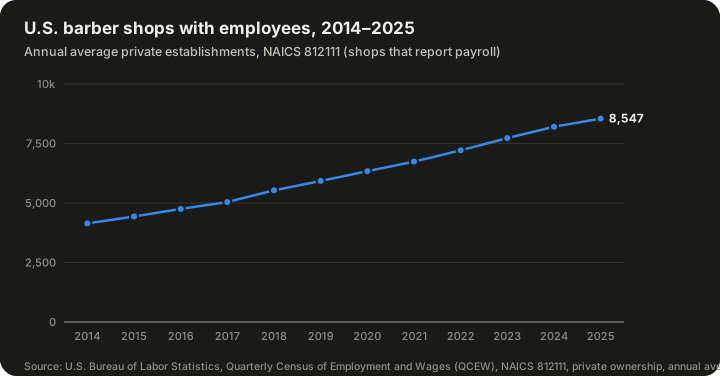
Barber shops with employees have doubled since 2014
| Year | U.S. barber shops with employees | Employees in those shops (U.S.) | Average annual pay in those shops (U.S.) | California shops | Alameda County shops |
|---|---|---|---|---|---|
| 2014 | 4,143 | 18,254 | $22,161 | 210 | 11 |
| 2015 | 4,434 | 20,350 | $23,492 | 244 | 11 |
| 2016 | 4,752 | 23,010 | $24,450 | 301 | 14 |
| 2017 | 5,041 | 25,111 | $25,970 | 316 | 14 |
| 2018 | 5,534 | 28,633 | $27,705 | 383 | 15 |
| 2019 | 5,926 | 30,936 | $28,978 | 419 | 17 |
| 2020 | 6,337 | 26,034 | $27,947 | 462 | 21 |
| 2021 | 6,739 | 28,361 | $32,420 | 480 | 26 |
| 2022 | 7,214 | 30,715 | $35,402 | 531 | 31 |
| 2023 | 7,728 | 33,534 | $37,431 | 616 | 31 |
| 2024 | 8,205 | 34,794 | $38,411 | 661 | 30 |
| 2025 | 8,547 | 35,340 | $39,421 | 726 | 33 |
Source: BLS Quarterly Census of Employment and Wages, NAICS 812111 (Barber Shops), private ownership, annual averages, from the QCEW open data files. Fremont is in Alameda County.
The Quarterly Census of Employment and Wages counts business locations that report payroll for unemployment insurance. By that measure, the number of U.S. barber shops with employees rose from 4,143 in 2014 to 8,547 in 2025, more than doubling. California grew even faster, from 210 to 726, and Alameda County, home to Fremont, went from 11 to 33. Employment in those shops nearly doubled as well, from 18,254 to 35,340, and average annual pay for their employees rose from $22,161 to $39,421.
Two cautions keep these numbers honest. First, this series only sees shops that have employees on payroll. A barber who works alone, a barber who rents a chair as an independent contractor, or a studio like Garrison's that is run by one self-employed person may not appear here at all. Second, the count rose every single year, including 2020, while employment dipped in 2020 and recovered after. That pattern fits a trade where many small operators keep their doors open and staff up or down as demand allows.
The pre-2014 picture comes from a different Census program. Census Nonemployer Statistics, which count businesses with no paid employees, recorded 75,644 nonemployer barber shops in 1997 (1997 table) and 80,961 in 2001 (2001 table). Even back then, one-person barber businesses outnumbered shops with payroll by a wide margin. That is the deep structure of the trade: most barbering businesses are a single barber.
How many people work as barbers?
| Year | Barbers employed (thousands) | Hairdressers, hairstylists & cosmetologists employed (thousands) | Barbers: share women |
|---|---|---|---|
| 2011 | 89 | 758 | 24.0% |
| 2013 | 127 | 786 | 19.2% |
| 2015 | 116 | 707 | 22.1% |
| 2017 | 135 | 806 | 15.6% |
| 2019 | 137 | 803 | 23.0% |
| 2020 | 102 | 646 | 25.6% |
| 2021 | 103 | 713 | 24.7% |
| 2022 | 123 | 720 | 24.8% |
| 2025 | 141 | 747 | 17.7% |
Source: BLS Current Population Survey, Table 11, "Employed persons by detailed occupation, sex, race, and Hispanic or Latino ethnicity," annual averages for each year shown. 2025 figures are 11-month averages that exclude October because data were not collected during the federal government shutdown.
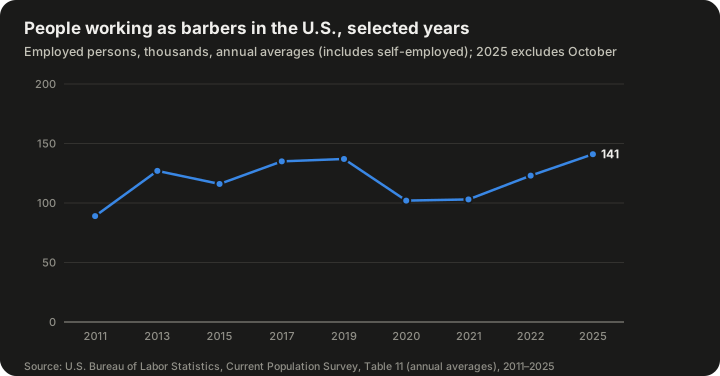
The Current Population Survey asks households what work people do, so it includes self-employed barbers that payroll records miss. Its counts are survey estimates and bounce around from year to year, so the trend matters more than any single number. The trend is clear enough: about 89,000 people worked as barbers in 2011, about 137,000 in 2019, a sharp drop to about 102,000 in the pandemic year of 2020, and a recovery to about 141,000 in 2025. Over the same period, hairdressers, hairstylists, and cosmetologists stayed in a range of roughly 650,000 to 800,000. Barbering is a much smaller trade than general hairstyling, but by this survey it has grown faster since 2011.
The survey also shows who barbers are. In the 2025 annual averages, 17.7 percent of barbers were women, compared with 92.0 percent of hairdressers, hairstylists, and cosmetologists; 29.0 percent of barbers were Black and 43.4 percent were Hispanic or Latino. Barbering remains mostly male and has strong roots in Black and Latino communities, which echoes the community-institution history described above.
The BLS Handbook uses a different estimate method, built for its projections. It counts 75,800 barber jobs and 595,000 hairdresser, hairstylist, and cosmetologist jobs in 2025, for 670,800 in the combined group. Different surveys measure different things, so the Handbook and the household survey should not be mixed in the same calculation; they agree on the overall shape, which is that barbers are a smaller, heavily self-employed slice of the hair trades.
Barbers vs. hairstylists: self-employment and growth
| Measure | Barbers | Hairdressers, hairstylists & cosmetologists |
|---|---|---|
| Jobs, 2025 | 75,800 | 595,000 |
| Share self-employed | 80% | 48% |
| Median hourly pay, May 2025 | $18.37 | $17.21 |
| Projected growth, 2025–2035 | 3% (2,500 jobs) | 8% (45,900 jobs) |
Source: BLS Occupational Outlook Handbook, Barbers, Hairstylists, and Cosmetologists.
This comparison explains a lot about why barbering produces so many different business models. When four out of five barbers are self-employed, the trade is less about finding a job and more about building a practice. The Handbook projects slower job growth for barbers (3 percent from 2025 to 2035) than for hairstylists (8 percent), but it also estimates about 80,300 openings a year across the combined group over the decade, most of them from people changing careers or retiring. For barbers, slow headline growth combined with steady turnover means that a skilled barber with a strong client base can still find room, particularly by choosing a model that fits their market.
What barbers earn, and how it has changed
The Handbook lists the May 2025 median wage for barbers at $18.37 an hour. Older Occupational Employment and Wage Statistics releases show where that came from: the May 2012 national median for barbers was $12.06 an hour, and the May 2020 median was $15.61 an hour. These wage figures come from employer surveys of wage-and-salary workers, so they cover only the minority of barbers who are on someone's payroll, not the self-employed majority whose income depends on their own prices and bookings. The QCEW average pay figures in the first table, which rose from $22,161 in 2014 to $39,421 in 2025, tell a similar story for employees of barber shops with payroll.
For self-employed barbers, which describes most of the trade, income is shaped by the business model more than by any wage survey: how many hours are booked, what each service costs, what the space costs, and how many clients keep coming back.
How a customer chooses
There is no single best kind of barbershop. There is a best fit for a given person on a given day. A few honest questions help:
How do you like to plan? If you decide on a haircut the morning you want it, a shop that welcomes walk-ins or answers the phone is your friend. Royal Luxe Cutz takes walk-ins and texts; Don's Barber Shop invites you to call for availability. If you like to lock in a time a week out and never wait, an appointment studio like Garrison's fits, with the next week's slots opening on Tuesdays.
What do you need done? If the whole family needs cuts, or you want color, highlights, or a women's style along with a fade, a broad-menu shop like Royal Luxe Cutz covers a lot under one roof. If you want a fade, a beard line-up, and a hot towel in a quiet room, the studio menu is built for that. If you want a straightforward haircut, beard trim, or shave from a traditional shop, Don's lists exactly those services.
How do you want to learn the price? Royal Luxe Cutz and Garrison's Barber Studio both post prices online, with the usual caution that "up" or "+" prices depend on the hair and the service. Don's Barber Shop asks you to call for current prices. Either way, it pays to say what you want before the cut starts. As the Royal Luxe guide on comparing real value puts it, "Clear communication prevents a 'cheap' service from becoming an unexpected bill."
What setting feels right? Some people love the energy of a busy shop. Others prefer a private chair. Neither is better; they are different experiences.
Can you see the work? Look at Instagram, Yelp, Facebook, Booksy reviews, and the gallery on each shop's site. Look for cuts like yours, on hair like yours.
Do you have specific needs? If you need a scissor-only cut, wear a head covering, or keep your hair uncut for religious reasons, look for a shop that says so, and say so yourself when you sit down. Royal Luxe Cutz addresses these needs directly in its FAQ.
A simple rule: when you find a barber you trust, keep going back. Regular visits make the barber's job easier and the result more consistent, a point the Royal Luxe value guide makes about keeping a fade or neck trim on schedule.
How a barber chooses a model
For a barber, choosing a model is choosing a life as much as a business. Here are the main trade-offs, framed through the three Fremont examples.
The traditional neighborhood shop
Best for: a barber or owner who wants to be a fixture in one location, likes a steady flow of familiar faces, and is comfortable with a full storefront.
What it takes: a lease on a visible storefront, equipment for multiple chairs if there are other barbers, an establishment license, and patience. A traditional shop earns its reputation over years. Don's Barber Shop, owned by Don essentially from the start and still run the traditional way, shows what that patience can produce: a recognizable name on Fremont Boulevard, a simple way for customers to reach the shop, and a basic, clear service list.
Watch out for: uneven traffic, and the need to stay visible to younger customers who search by phone. A simple website with hours, services, a map, and social links, like Don's, goes a long way.
The new independent shop
Best for: an experienced barber who has outgrown working under someone else and wants to set the prices, the hours, the menu, and the culture.
What it takes: savings or financing for the lease and build-out, a plan for the first lean months, and a clear identity. Royal Luxe Cutz shows several smart moves for a new shop: a clear tagline ("Grace in Every Style"), published prices, a broad menu, a walk-in and text-ahead policy that keeps the door open, a named team, a defined community it serves, and a library of guides that answer customers' questions before they ask.
Watch out for: the gap between opening day and a full book. A new shop has to reach customers quickly, and low prices only work with steady volume. The barber's own years of experience, more than 14 in this case, are the biggest asset, because skill and a loyal client list travel with the barber.
The private studio or suite
Best for: a seasoned barber with a loyal client base who wants control over pace and schedule, and who prefers one-on-one work to a busy floor.
What it takes: a book of clients willing to schedule ahead, a reliable booking platform, a clear service menu with durations, and a calendar policy. Garrison's Barber Studio shows the essentials: appointment-only, no walk-ins, a Booksy page that handles scheduling and reviews, the following week opening on Tuesdays, and a menu built on time slots.
Watch out for: isolation and dependence. A solo studio has no walk-in traffic, so the barber has to keep clients coming back and attract new ones through referrals and online presence. Platform rules and fees are part of the cost of doing business.
Questions every barber should answer
- How many hours a week do I want to cut, and when? Walk-in shops need coverage during open hours; studios let you set the calendar.
- Where will my clients come from? Foot traffic, phone and text, or an app?
- What is my monthly fixed cost, and how many cuts cover it? A low price needs volume; a high price needs a full, loyal book.
- Do I want to manage people? A multi-chair shop means staff schedules; a studio means working alone.
- What do I want my name to stand for? Tradition, value and range, or a private premium experience? All three can work.
FAQ
Is a walk-in barbershop better than an appointment-only studio? Neither is better overall. Walk-in and call-ahead shops are more flexible for last-minute haircuts. Appointment-only studios guarantee a time and a quiet setting. In Fremont, Don's Barber Shop asks you to call for availability, Royal Luxe Cutz welcomes walk-ins and texts, and Garrison's Barber Studio is appointment-only through Booksy.
Do barbers in California need a license? Yes. California barbers are licensed by the Board of Barbering and Cosmetology. Since January 1, 2022, the barbering program is 1,000 hours and the practical exam has been removed, leaving a written exam, according to the Board's SB 803 FAQ. The apprenticeship route remains 3,200 hours.
How many barbers are there in the U.S.? It depends on the source. The BLS Current Population Survey estimated about 141,000 people employed as barbers in 2025 (an 11-month average). The BLS Occupational Outlook Handbook, which uses a different method, counts 75,800 barber jobs in 2025.
Are most barbers self-employed? Yes. The BLS Occupational Outlook Handbook says about 80 percent of barbers were self-employed, compared with 48 percent of hairdressers, hairstylists, and cosmetologists.
Is barbering a growing field? Barber shops with employees more than doubled in the U.S. from 4,143 in 2014 to 8,547 in 2025, according to the BLS Quarterly Census of Employment and Wages. The BLS projects 3 percent job growth for barbers from 2025 to 2035, slower than the 8 percent projected for hairstylists, with steady openings from turnover.
What is a barber "studio" or "suite"? It is a small private room where a barber or stylist runs a one-person business, usually by appointment. Suite operators such as Sola Salon Studios have grown quickly since the concept launched in 2004. Garrison's Barber Studio in Fremont is an example of the appointment-only private-studio model.
Why don't all barbershops post prices online? Some prefer to quote by phone so they can explain what is included and keep prices current. Others publish full menus. Royal Luxe Cutz and Garrison's Barber Studio post prices online; Don's Barber Shop asks customers to call for current prices.
Can I get a scissor-only cut or a cut that works with a head covering in Fremont? Royal Luxe Cutz says scissor-only cuts are standard work and that customers who wear a turban, patka, hijab, or scarf should mention it before the cut. Whatever shop you choose, tell the barber what you need before the cut starts.
How do I book at each of the three shops? Don's Barber Shop: call (510) 722-5721. Royal Luxe Cutz: walk in, call (510) 790-0409, or text (510) 935-5487. Garrison's Barber Studio: book on Booksy.
Visit the shops
Don's Barber Shop (classic neighborhood shop) Website: donsbarbershop.pages.dev Address: 40950 Fremont Blvd, Fremont, CA 94538 Phone: [(510) 722-5721](tel:+15107225721) Hours (per site): Tue–Fri 9 AM–6 PM, Sat 8 AM–3 PM, Sun 10 AM–4 PM, closed Monday Social: Yelp · Instagram · Facebook Royal Luxe Cutz (new independent shop) Website: royal-luxe-cutz.pages.dev · FAQ & Guides Address: 3872 Decoto Rd, Fremont, CA 94555 Phone: [(510) 790-0409](tel:+15107900409) · Text: [(510) 935-5487](sms:+15109355487) Hours (per site): Mon–Fri 10 AM–7 PM, Sat–Sun 9:30 AM–6 PM; walk-ins welcome Social: Instagram @royalluxecutz68 · Yelp Garrison's Barber Studio (private appointment-only studio) Website: garrisonsbarberstudio.pages.dev Address: 38750 Paseo Padre Parkway, Suite B1, Fremont, CA 94536 Booking: Booksy (appointment only, no walk-ins; next week's slots open Tuesdays)
The bottom line
Three barbershops within a few miles of each other in Fremont show three honest answers to the same business problem. Don's Barber Shop keeps it traditional: call the shop, come in, talk through the cut, and leave with a clean finish from a place that has been part of the neighborhood for a long time. Royal Luxe Cutz shows what an experienced barber can build when they go independent: published prices, a broad menu for the whole family, a walk-in door with a text-ahead option, and a library of guides that earns trust before the first cut. Garrison's Barber Studio shows the private-studio path: a reserved chair, a calendar that opens every Tuesday, and one barber's full attention.
The numbers behind them point the same way. Barbering is a licensed, mostly self-employed trade; shops with employees have more than doubled nationally since 2014; the number of people cutting hair for a living has grown since 2011 despite the 2020 drop; and the tools for running a one-person business, from booking apps to suites to social media, have never been more available. What has not changed is the core of the work: a skilled person, a chair, and a customer who wants to look and feel right. How you build a business around that chair is up to you.
Sources
- Don's Barber Shop (official site)
- Royal Luxe Cutz (official site)
- Royal Luxe Cutz: FAQ & Guides
- Royal Luxe Cutz: Affordable Haircuts in Fremont
- Royal Luxe Cutz: Why Professional Barber Tools Matter
- Royal Luxe Cutz: How Barbering Became a Licensed Art
- Garrison's Barber Studio (official site)
- Garrison's Barber Studio on Booksy
- BLS Occupational Outlook Handbook: Barbers, Hairstylists, and Cosmetologists
- BLS Quarterly Census of Employment and Wages: open data files (NAICS 812111)
- BLS Current Population Survey, Table 11, 2025 annual averages
- BLS Current Population Survey, Table 11, 2019 annual averages
- BLS Current Population Survey, Table 11, 2011 annual averages
- BLS Consumer Price Index: Personal Care Services (FRED series CUUR0000SEGC)
- U.S. Census Bureau Nonemployer Statistics, 1997 (archived)
- U.S. Census Bureau Nonemployer Statistics, 2001 (archived)
- California Board of Barbering and Cosmetology
- California Board of Barbering and Cosmetology: SB 803 Questions and Answers (July 2022)
- Minnesota General Laws 1897, Chapter 186
- State v. Zeno (Minnesota Supreme Court, 1900)
- Worshipful Company of Barbers: History
- Royal College of Surgeons of England: Records of the Company of Surgeons
- Quincy T. Mills, Cutting Along the Color Line (University of Pennsylvania Press)
- ScienceDaily: Barbershop blood pressure trial (March 2018)
- Healio: Hypertension intervention in barbershops cuts BP levels (March 2018)
- Booksy (Wikipedia)
- Booksy press release, January 27, 2021 (Business Wire)
- Franchising.com: Sola Salon Studios opens its 400th location (2018)
- International Franchise Association: Sola Salons opens 700th location