| Category | Value (percent of visits tripping) |
|---|---|
| Group A: 3 of 12 | 25 |
| Group B: 6 of 12 | 50 |
| Group C: 9 of 12 | 75 |
Worked proportions used to distinguish an observed behavior metric from measured seed yield.
On a stalk of flowering alfalfa, a bee lands on one purple floret, works its way into the side, and moves on. At the next floret the same visitor leans in, and part of the flower springs toward the tall upper petal. To someone counting from the path, that was two visits. To someone watching the flower, those two visits had distinct endings. The second offers a visible clue about how this plant presents pollen. It does not tell you whether any pollen from another plant landed on the stigma, much less whether the plant will make a seed.
That difference is the point of looking closely at alfalfa, or lucerne, Medicago sativa. It is an unusually good outdoor example of what happens when a convenient tally stands in for a more difficult result. You can count arrivals, or you can watch a change in the shape of a flower, or you can ask whether a plant has produced mature seed. Each question needs its own observation, and the first two are possible on a short public outing without touching the insects or plants. Once you have seen even one clearly visible trip, an apparently ordinary count of visitors starts to look like the beginning of the record rather than its conclusion.
The equipment is inside the floret
Alfalfa belongs to the legume family. Look first for the individual flowers in the cluster rather than treating the whole cluster as one flower. The large upper petal is often called the standard or banner; smaller petals to the sides are wings, and the lower keel encloses the reproductive column before release. The column brings the stamens and the pistil into remarkably close proximity to the insect's route when the keel is pushed enough to separate. The arms of the insect do not pull a lever in the way a person would operate a spring latch. Its position and pressure as it reaches for the reward can do the work. This is the mechanism that crop pollination literature calls tripping.
What usually catches the eye is the abrupt change, followed by a changed resting position of the column against the standard. An insect can get in the way of that motion and contact the released structure. Pollen carried from earlier flowers may reach the stigma, and pollen from this flower may be picked up for a later visit. Notice that these are two different directions of movement, and it matters which pollen touches which surface. A sudden visible motion is good evidence that the flower released. It is not a way to see the origin or destination of each grain, especially at normal watching distance. The USDA crop handbook's alfalfa chapter covers the mechanism and the historical evidence behind its role in seed production.
The trapdoor metaphor is useful for recognizing a change of state. It is less useful if it makes you imagine the flower resetting after every bee. A tripped floret is no longer the same starting opportunity for a first release. When a flower snaps open and the next bee lands on it, that second bee is not presented with the same enclosed column the first visitor had. Treating the second visitor as having failed to trip the floret would be like grading a key by how often it unlocks a door that was already open. The relevant starting observation is not just “purple flower present” but “individual open floret observed with column still enclosed.”
Wind can shake a whole stem and a petal can bend and return. Neither observation by itself is the snap you are trying to score. A change seen while no insect was on that floret is not an insect-attributed release. If several insects or overlapping florets make the timing hard to follow, admit the uncertainty. A specimen photograph can help an observer learn the overall arrangement of the petals; a before-and-after view of the same flower helps establish a change; neither replaces the missing interval if the bee was out of sight when the change happened.
A five-step chain with a gap at every step
A landing in the cluster is the broadest thing to notice. A foraging contact with an individual floret is narrower. A newly tripped floret is narrower again if you require evidence that the arriving visitor caused it. Beyond that, the process of pollen transfer is not exhausted by tripping, and the production of seed is not exhausted by pollen transfer. Putting those ideas in order helps identify a claim whose verbs are more confident than its data.
Start with encounter. Someone walking through the stand could notice more airborne visitors in one patch than in another. That is useful for deciding where to stand on a later outing, but it does not identify what flowers those insects approached. When an insect lands and works inside one floret, it has supplied evidence for a floret visit. It may feed without opening the keel. A new release during a visit shows one plausible means of making contact with pollen and the reproductive column. An exposed column, however, does not show whether there was enough suitable pollen, whether any grains landed on the receptive surface, or whether the pollen was moved to or from a different plant. Fertilization and later development are farther along still.
Even if someone did know that pollen crossed from one plant to another, they could not convert the finding directly into mature seeds. There are biological steps between pollen deposition and seeds, and each step has a different appropriate measurement. Recording pods on a return visit would answer a different question from counting mature seeds; recording seed mass would add a new outcome. None is a synonym for the fraction of seen foraging contacts that released a column. Those distinctions are particularly important if someone wants to borrow a result from a crop study to interpret a casual observation of a verge.
Consider a camera that captures one visitor's route perfectly along a flowering stem. It could show a string of visits and several releases. It could not show that the visitor arrived with no pollen from other stems, or which grains it gave up next. A camera pointed at ten nearby stems might document more of its movements but still not usually see viable grains on a stigma. More complete motion footage is helpful evidence for the behavior it shows. It does not make the unmeasured stages visible by association.
Describe your strongest observation with the narrowest applicable verb. “Visited” is not an insult to the insect. “Tripped” is a more informative verb when you have the evidence. “Deposited pollen on a stigma” belongs to a study that measures deposition; “increased seed yield” belongs to a comparison capable of detecting that effect. Crop studies sometimes measure more than one of these outcomes and are more useful for that reason. A public viewing exercise can stay at the behavioral stage and still teach why two pollinators might have very different visible interactions with the same plant.
Not every route to nectar has the same ending
Watch where the insect approaches. At a favorable angle you can see one visitor work from the front toward the throat and another reach along the side. The historic USDA account distinguishes honey bee pollen-foraging behavior on alfalfa from nectar gathering that often bypasses tripping, and recounts observations of avoidance with experience. The helpful take-away is that a bee's behavior on a flower can differ, not that you can read its motive every time from the front of its head. Label the approach you saw and the release outcome separately, even if they often line up.
Calling a side approach nectar collection from a distance can be reasonable as an interpretation if you can see a feeding posture, but a side approach alone does not prove that the insect obtained a reward. Calling any side approach nectar robbing is broader still and risks suggesting a floral puncture you did not witness. State what was visible. If the insect appears to feed and the column clearly remains enclosed, those facts suffice. In a field log, “side; intact after visit” makes an unambiguous pair of observations. “Robbed nectar” bundles them with further assumptions about path, resource, or damage and can become impossible to correct later when the clip is all you have.
The other easy overstatement is the universal ranking of bees. Alfalfa has historically been pollinated by insects including honey bees, alkali bees and leafcutting bees in particular seed-growing contexts. A discussion of managed alfalfa leafcutting bees in the crop literature is not a rule about every leafcutting bee in every region. Nor should a honey bee that trips one floret be dismissed because someone reported a low average trip fraction for honey bees somewhere else. If the goal is a transparent public observation, keep the name of the visitor at the level the image or the field view actually supports. One clearly tripping unknown can still answer a question about flower behavior; a named insect with an obscured contact cannot supply a trip.
Bee Basics: An Introduction to Our Native Bees provides general North American context for leafcutting bees, including the use of leaf pieces in nesting by leafcutters. This explains why the common name can be interesting but not diagnostic of the action being observed on a floret. Finding a cut leaf does not identify the bee that rushed between flowers in front of you. Seeing a bee-shaped subject in an illustration does not certify a species, either. The nesting behavior, the identity of the visitor and the visible flower action belong in different fields in a notebook.
For the same reason, do not infer that every bee on an alfalfa plant is wild or that every leafcutting bee is managed. Those categories concern the animal's population or the landholder's operation, not just what shape was discernible in a photo. They are seldom necessary to answer a question about a newly released column. If a public plot has signage describing a known planting or a researcher supplies documented context, record that context source separately. An assumption from proximity to a field, shed or nesting block is not equivalent to a verified identity.
Decide whether you are counting arrivals or floret visits
A visitor can arrive at a stalk, climb from one floret to another, circle the cluster, leave for a neighboring stem and return. If your purpose is simply to measure how often insects arrive in a clearly bounded patch, the stalk-level arrival may be the right unit. If your purpose is to estimate how often a contact trips a floret, use the individual flower visit as the unit, provided you can track it. A stalk with many florets can contain several events during a single arrival, and those events can be produced by one insect. Using a stalk arrival as the denominator and individual newly opened florets as the numerator can generate a percentage above one hundred, even though neither original count was in itself wrong.
Set the boundary before starting. In a small clear view, a floret visit could begin when a visitor engages with the flower and end when it clearly moves to a different flower or leaves. Adjust the recognition rule to what you can see without blocking a path or approaching the insects. A brief repositioning on the same flower need not become an extra visit. An insect that leaves and comes back can make another visit, but the new starting state may exclude it from an intact-floret comparison. Some events are only arrivals: you know something landed in the cluster, but cannot tell which flower it used. Keep those separately if they are helpful rather than inventing floret contacts.
Say what you will do when two visitors arrive at once. In a pair watching together, one can log the established focal floret and the other can note crowded intervals, without treating the two people as two independent samples of that floret. A lone observer can prioritize the original focal flower rather than switching each time a larger insect appears. On a dense stem, records of “floret unresolvable” may outnumber clean ones. That is evidence about the recording setup. It should not be interpreted as a propensity of the insects to hide tripping, since the shape of the flowers and the viewing geometry could produce exactly the same pattern.
Record carried-over opportunities as well as visits if you need to explain why some windows are uninformative. Ten minutes at the end of the day with mostly previously tripped florets are real observation effort even if there are no intact-floret contacts to score. Describing that session as a trip fraction of zero would confuse no opportunity with an opportunity in which no trip occurred. Similarly, ten minutes with intact flowers and nobody visiting is useful for arrival activity, but there is no per-visit behavior fraction. Different zeros need different denominators.
Three groups, equal visits, different fractions
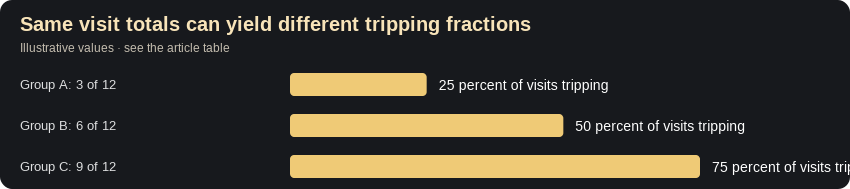
The graph uses invented observation groups A, B and C. Each has twelve comparable, fully observed visits to initially intact open florets. Three of Group A's visits trip the focal floret, six of Group B's visits do so, and nine of Group C's do. Dividing each number of trips by twelve gives 25 percent, 50 percent and 75 percent. The percentages are the fraction of visits in which the floret was seen to release. They are not the fraction of all flowers successfully pollinated, or of ovules fertilized, or of flowers that later produce harvestable seed.
The letters do not correspond to honey bees, bumble bees or leafcutting bees. Nor do they correspond to named fields, time periods or places in the sources. Using imaginary groups avoids lending a misleading local precision to the historical literature. The equal denominators isolate the difference between the outcomes: a survey plotting only visits would draw three equal bars of twelve; a visit-to-release tally would preserve the differences the three visitors or circumstances produced in this worked example. Equals on one metric can be unequal on another, and even a better metric does not turn the groups into a field experiment.
At this scale a single classification matters. With twelve eligible visits, one reassigned event changes the fraction by about 8.3 percentage points. If Group B's score includes one apparent trip where the lower petal quivered but the column stayed enclosed, recoding it as a confirmed no-trip visit would yield five of twelve, or about 41.7 percent. If the view is genuinely too poor to know, it should not be called a no-trip to make the arithmetic tidy; among the remaining eleven clear visits the confirmed proportion would be five of eleven, about 45.5 percent. Label that latter quantity as the fraction among scorable visits, not among all original visits.
You can also report simple descriptive limits in the presence of known, eligible but obscured outcomes. Suppose that among twelve initially intact contacts there are five definite trips, five definite no-trip contacts and two whose endings were hidden. Denominator twelve is still meaningful for asking what happened among the eligible visits. The lowest trip fraction consistent with those records is five of twelve; the highest is seven of twelve. The scorable-subset value is five of ten. These figures do not give a confidence interval, compensate for choices about where to watch, or tell us what actually happened to the two flowers. They make the consequence of the unknowns easy for a reader to audit.
There is a separate problem if the starting state is hidden. A visit with an unknown beginning is not automatically a known intact-floret contact with an uncertain ending. List it in the broader visit tally and say why you cannot classify eligibility. You can add an uncertainty note without pretending to know how many originally enclosed columns were present. It is tempting to use every row because a larger number looks persuasive. A smaller count with transparent prerequisites is more useful than a large mixed count whose interpretation changes as the view gets worse.
Make a short, repeatable watch from outside the plot
Use a permitted public viewpoint or a garden where you have permission. A distant patch of alfalfa behind a fence is not an invitation to cross it. Do not approach occupied bee equipment, enter private crop rows or rearrange plants for a better angle. If you cannot see a relevant detail from the permitted place, move only within the allowed route or mark the contact unscorable. A comfortable view across the flower rather than directly along the stalk can make the outlines easier to track; it is more important that the view stay clear than that every record have an attractive close-up.
Start with a particular section of one or more clearly distinguishable flower clusters. Note the time and observation duration, the rough conditions, and which side of the flowers the observer could see. Choose a small unchanging area for that timed window. Write down whether flowers in that visible area began mostly intact, mostly already released or too difficult to classify. This is a rough description of opportunity, not a measure of every floret in the greater patch. If the angle would require you to crouch into a walkway or lean into the cluster, choose a simpler view. The observation does not need to produce a column of clean results to succeed.
For each contact, sketch one line. It can contain a session ID, an approximate time into the watch, a floret label that makes sense from the viewing angle, starting state, approach, and outcome. Record a cautious visitor group if supported. “Small dark bee-like visitor” can be refined later if a photo helps; “bee” can be downgraded to “unidentified insect” when footage shows a feature you missed. The number of uncertain entries is informative, especially if the grouping relies on body size in videos taken from several distances. Notes about the observer's view are a practical way to distinguish a flower result from a recording limitation.
Make a clean distinction between “I saw the snap” and “it looked released when I looked again.” The latter is a useful before-and-after observation but may not attribute the event to the particular visitor; another interaction may have taken place outside the frame or during a pause. If a camera legitimately helps from the same permitted viewpoint, keep the whole setup nonintrusive. Point the camera at the flowers, not across people in an adjacent path, and avoid illuminated aids that change the scene. A short recording before and after the contact is more valuable for this question than a highly cropped still of an attractive insect.
Set a convention for pauses. A five-minute window cut short by rain or maintenance is not a full five-minute observation. An obscured interval lasting half of a nominal watch can be left in the session record as interrupted, with the visible time separately noted. Whether to include those sessions in an arrival-rate comparison is a methodological decision; excluding a disrupted window from one calculation does not require erasing the records from another. For example, a fully observed release at the start of a truncated watch may still illustrate the mechanism, even though the entire window is unsuitable for comparing arrivals per unit time with an uninterrupted visit.
A tiny field log can retain more than a large tally
Imagine an outing with six noted events. First, a striped bee lands on floret A and reaches from the side; the column remains enclosed. Next, a similar-looking visitor approaches floret B and a release is clearly visible. A third bee lands on B, now released. A fourth visitor contacts intact C, but the wind pushes the flower behind a leaf before the ending. A fifth grabs part of the cluster briefly without showing any resolved floret contact. The last insect presses into intact D and departs without a visible release even though the required area stays clearly in view the whole time.
The tally might show six stalk or cluster encounters, depending on the arrival boundary, five floret visits and four visits to observed intact florets. Three of those four have clear outcomes, one release and two no-release outcomes. “One of three scorable eligible visits” is quite different from “one of the six insects was a successful pollinator.” The former accurately recounts a classification made under visible conditions; the latter misidentifies the unit and assumes success in later steps. Changes to individual records have predictable meanings. Finding a replay of the hidden interval might turn C into a scorable visit. Learning what kind of bee visited B would refine the visitor identity, but the previously confirmed release would stay confirmed.
Controlling the published summary becomes easier if the log keeps these fields separate. You can tabulate eligibility from starting state, then evaluate the tripping fraction from outcome among those eligible visits with clear endings. You can retain identity uncertain as a category or limit a visitor-group comparison to outcomes with sufficient evidence for both the group and the flower. Do not write one “quality” flag that conceals which part of the observation was strong. A perfect insect view with an obscured column and a poor insect view with a perfect snap each convey a different truth. Neither is higher quality for every possible reuse of the record.
A small codebook can help when different people watch. Use “trip confirmed” for a new release with a clear starting state and attribution, “no release confirmed” for an intact flower that remains intact through a visible visit, “already released” for an ineligible but trackable visit, and “state or result uncertain” with a note for the remainder. Someone revisiting clips should not be forced to translate “miss,” which might mean no arrival, failure to release or a poor view. A clean codebook benefits the audience as much as the recorder. The point is a clear audit trail, not a taxonomy of every posture an insect can assume.
A fraction is not a place on the map
Historic accounts in the crop handbook describe different pollinator results under different growing conditions. Treat those reports as evidence for the contexts that produced them. A crop planted for seed and watched under described conditions is not equivalent to a roadside remnant that receives occasional visitors. Forage plantings, seed fields, public display plots and mixed verges can have very different flowering schedules and neighboring plants. Even two simultaneously flowering patches need not attract the same insects. Seeing alfalfa's tripping action in a new region verifies the visible action and context in that record, not every old regional comparison.
Conditions can influence both the bees' interaction and the observer's chance to detect it. Shifting shadows make it harder to see the column. Wind can cause swaying and hide plants on one side of the plot more than the other. As one set of flowers ages or is visited, the availability of intact flowers changes across a day. Nearby alternatives may affect which insects show up, which are repeatedly counted, or what they do on alfalfa. If one visitor group is observed only early in clear light and another only when the stem is backlit, a difference in visible trip fractions has at least two plausible stories before any species explanation even begins.
It helps to report a local comparison with its boundary included in the sentence. A useful statement might read “on two morning watches from this trail, among clear contacts with initially intact florets, we saw a release in four of nine contacts of a certain coarse visitor type.” Add the count of eligible obscured endings if relevant. That sounds less sweeping than a species tendency declared for the whole state, but it also gives another person enough detail to decide whether a comparison at another site would be fair. A record that includes no watch duration or flower state can rarely be made equivalent later, no matter how accurate its coordinate is.
Remember the individual insect problem. A bee observed visiting nine florets might account for nine contact events, but it is not nine independent bees. Even when there are nine different bees, they may be drawn disproportionately from one local population or one corner of the site. When you intend to generalize beyond the visible contacts, concurrent observations at more sites or dates, with a design that respects clustering and repeat visits, offer a better path than extending one insect's sequence for another minute. A small public natural history outing has no obligation to estimate a species-level probability. The clustering problem matters mostly when someone tries to repurpose those useful observations as a wider inference.
Separate effectiveness per visit from activity over time
The three bars in the worked graph share the denominator of twelve visits. A separate question is whether groups make those twelve visits in the same time. Imagine a group with a one-quarter trip fraction and another with a three-quarter fraction. At sixteen comparable visits in an hour, the first would produce four trips under the hypothetical fractions, while at four comparable visits in that hour the second would produce three. A higher per-visit trip fraction can coexist with fewer trips per time period. This arithmetic exercise does not show that either visitor provides more pollen or that the apparent rates are stable, but it demonstrates why “efficient visitor” and “largest recorded contribution” need not name the same visitor group.
Availability complicates the arithmetic further. Once a particular flower is tripped it is no longer at risk of a first trip, and the proportion of eligible contacts can change. An hourly tally in the morning may not extrapolate to the afternoon because it is watching a different mix of opportunities. The same caveat applies when you add visits across stems with different numbers of intact flowers in view. The average must answer a deliberate question: are you estimating releases per time watched, releases per eligible visit, or releases per visible initially intact flower where you can track the full transition? These denominators describe behavior, effort and opportunity differently.
In a reader-facing result, keep raw counts close to the fraction and describe how much observation time each group represents if the times differ. If the denominator is tiny, a horizontal line in a table labeled “not enough evidence for comparison” may communicate more faithfully than a brightly colored rank order. If multiple visits probably came from the same individual, say so. If visibility differs by group, do not hide the uncertain fraction. Each choice helps prevent the arithmetic from becoming a supposed fact about insects when it is also a fact about which interactions were possible to see.
What more evidence would support stronger claims?
Ask first which step you are trying to establish. If you want to know whether some pollen reached an individual stigma during a visit, use measurements of deposition made in a study designed for that question rather than inferring them from the contact visible in a public clip. If you want to know whether pollen came from another plant, even documented deposition may be insufficient without a method suitable to distinguish the source of those grains. If you want to know whether visits were associated with more pods or seed, follow the flower or plant units that comprise the comparison and measure an outcome where the competing explanations can be evaluated. Discuss those designs when reading published research; there is no need to reproduce interventions to enjoy watching on a trail.
It is also worth asking how the crop comparison was built. Did the study record visits under the same conditions in both groups? Were flowers at similar stages? Were the investigators comparing insect groups at the same site, comparing abundance over time, or testing an effect on some aspect of a seed crop? These choices tell you whether the outcome is a rate of activity, evidence of pollen movement, a count of pods, or a quantitative seed result. A paper reporting one result is not incomplete simply because it does not supply the others. The error occurs when a reader attributes the unmeasured results to it.
Some changes can be discussed as possible mechanisms without claiming they happened in a particular field. Different visitor routes can alter how often a flower opens; different flower presentations might affect contact; flowers with received pollen still have later developmental requirements. This is a causal sequence to investigate, not a set of automatic conversions. Pointing to the weakest link can make a result more useful. When the visible evidence is strong through the release but absent beyond it, the sound conclusion is that the visitor tripped the flower and entered a pathway that can transfer pollen. That preserves the natural interest without suggesting an invisible measurement was made.
Three common interpretations to test on the way home
The first is that flowers with lots of insects must be receiving more effective pollination. Some highly visited flowers may receive frequent useful contacts. But the visit metric alone can increase because bees spend more time on already released florets or take routes that do not release them. A count of activity is still a legitimate result if you label it correctly. It can answer when or where the patch appears busy, and it can identify where closer observation might be worth the effort. Just do not use an answer about busyness to fill in a missing measurement on reproduction.
The second is that seeing a dramatic trip gives enough information to rank visitors. A video showing a visitor trip one flower is strong evidence for that encounter and could make an excellent demonstration. For a comparison you also need denominator information and consistent criteria for which visits are visible enough to score. Someone filming only the dramatic clips is not sampling ordinary visits. If two animals appear in the sequence, you may not know whether they had the same opportunity, or if one arrived at a flower that was already released. Before reaching for a ranking, ask what kinds of visits could have been recorded but were not.
The third is that a season with good crop yield validates a handful of visible encounters. Crop yield can depend on many things beyond tripping, and a small local encounter sample does not represent a whole season. If a season report is relevant, link to it and keep the levels separate: observations of a flower behavior in a location are one piece of evidence, and the crop outcome is another. A credible connection between them would need to show how the observations represent the growing conditions and how comparison rules account for competing causes. Chronology alone is not a causal design.
There is a companion mistake in the other direction: assuming that a rare or missing observation proves the mechanism or visitor is absent. If you did not see a trip on one watch, inspect the eligibility count and the view. A single visit to an already opened floret provides little opportunity to see the first release, and a half-obscured watch cannot say what happened out of sight. Reporting “no confirmed release in this short observation” is useful because it places a boundary on your own evidence. It leaves room for a different observer, viewing angle or flower stage to add information rather than treating the first notebook as the final say.
An observation that can travel without losing its meaning
A small report can be a paragraph plus a chart or table. Name the plant and the location at the level appropriate to the shared record, and say when and for how long you watched. State whether the observational unit was an individual floret or an arrival to the patch. Describe how you judged the starting state and what counted as a new release. Report raw counts and the number of obscured or ineligible visits. If the chart is based on invented numbers like the example here, place that information by the graphic rather than deep in the notes. If it is based on your watch, make the denominator and uncertainties clear enough for someone else to reconstruct the plotted values.
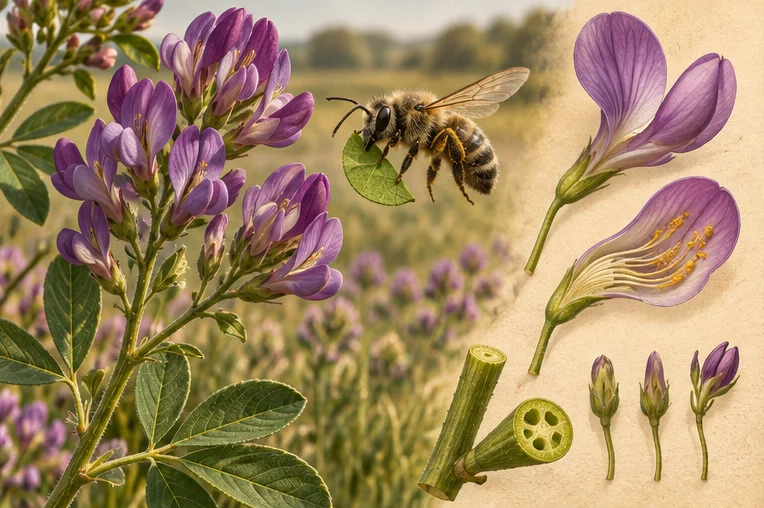
Use the image for its proper purpose. An editorial illustration can direct attention to an arrangement of petals, to the way a bee approaches a flower, or to a place along a path where the observation is imaginable. It is not a photograph of the events in your chart and cannot establish identification or pollen movement. Likewise a photograph of a bee near alfalfa documents proximity, not automatically floret use. For a record intended to show a trip, the context and before-and-after evidence supply information that a dramatic image alone cannot. You may offer both: one picture to invite the reader to look, and a much more prosaic sequence or note to show what happened.
If you return another week and find the patch already cut or past flowering, that result is worth keeping beside the earlier observation. It does not erase the earlier watch and is not a new zero of visits to intact flowers. It changes which questions can be asked with the next timed session. If you return and find new flowering stems with clear views, apply the same contact and state categories rather than adjusting the rules to make the numbers line up. A second sample need not confirm a first sample to improve it: it can establish that the same approach works under different viewing conditions or reveal that a seemingly clear field category is actually difficult to reproduce.
The durable lesson is simple enough to try before you know every name on the plant or every species in the air. Pick one allowed viewpoint, choose one open floret that you can follow, wait for one contact, and watch what the flower itself does. Let each label stop at the edge of what you saw. The flower is a surprisingly good teacher because its most visible motion sits in the middle of an extended biological process. The trip is more informative than a landing, less conclusive than measured pollen transfer, and farther still from a harvest. A good field note keeps all three facts intact.
Sources
- S. E. McGregor, USDA Agricultural Research Service, Insect Pollination of Cultivated Crop Plants, originally 1976. Consult the alfalfa chapter, especially its tripping and pollinator sections, for the mechanism and historical context, not universal modern visitor percentages.
- USDA Forest Service and Pollinator Partnership, Bee Basics: An Introduction to Our Native Bees. The queued USDA archive copy returned a gateway error during direct review; the issuing-agency copy was used for the bee natural-history context.
- Canadian Food Inspection Agency, The Biology of Medicago sativa L. (Alfalfa). Background on the crop and its reproductive biology.