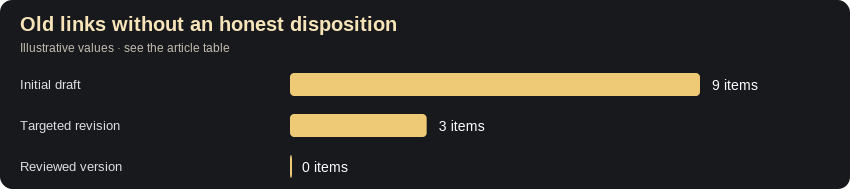
| Category | Value (items) |
|---|---|
| Initial draft | 9 |
| Targeted revision | 3 |
| Reviewed version | 0 |
Constructed audit of 9 fixed, distinct cases. First review resolves 6; second resolves the remaining 3. Not observed performance or a conformance score.
A teacher opens a link from a workshop she taught three years ago. It used to lead to “Reading a Local Rain Gauge,” a two-page handout. Today it leads to the organization's latest lesson about a different gauge and a different reporting convention. There is no visible indication that the earlier lesson was withdrawn. The browser had no problem following the link, but the teacher can no longer explain which lesson her old class used or why the present material is different.
A second teacher encounters the same old link while preparing a new class. She wants an activity that can be used now, not a record of what happened to an old one. She would be well served by a clear replacement if it fits her group. She is not well served by being led there silently. A new activity might not meet the original audience, use the same equipment, or make the same claims. Keeping both jobs visible helps both teachers: the original destination explains the old item's status, and the current destination lets the reader choose what to use next.
A withdrawal notice is a destination, not merely text in a file. It names a specific item, says what happened and when, and distinguishes historical evidence from current instructions. A replacement has its own claim to identity. An archive record has a separate purpose again: enabling a citation to refer to what was actually published, where lawful and appropriate, rather than to whatever the publisher recommends today. A single site can support all three without allowing an unreliable worksheet to masquerade as current.
This article explores those destination choices through fictional materials. It does not prescribe an institutional correction policy or give a propagation checklist. Actual removal, retention and access depend on the organization's authority, applicable restrictions and the nature of the problem. The editorial question here is what different readers should be able to understand when they arrive at a particular address.
Name the status before naming the replacement
Corrections and withdrawals solve different problems. A correction repairs an identifiable error while allowing a reliable version of the work to continue under the publisher's procedure. A withdrawal removes an item as a current recommendation because the publisher no longer stands behind its use or has another reason to take it out of circulation. A publisher may have distinct policies for mistakes, supersession, access restrictions and integrity findings. Do not make every change sound like misconduct or all withdrawals sound like routine updates. Use the status that is accurate for the item and organization.
Imagine that the original rain-gauge handout used two conflicting measurement conventions within the same exercise, affecting how learners interpreted several results. The owner may decide to remove the affected edition from teaching use. The newly reviewed activity might make a narrower claim and specify different materials. “Withdrawn” tells a teacher not to hand out the old version. “Use the new activity if its equipment and audience fit” offers a next step without suggesting that the files are interchangeable. The status and the recommendation can sit side by side, but they should not impersonate each other.
Now consider a different case: a misspelled museum name in the acknowledgments of a lesson with no effect on the activity. The organization may choose a dated correction or a documented minor change, according to its policy. Treating the whole lesson as unreliable would overstate the problem. Keeping continuity is useful when the essential identity, interpretation and applicability remain stable. A status notice should tell a reader what changed rather than selecting a dramatic word because it is easy to style in a banner.
There is also ordinary replacement without known error. A new worksheet designed for current software may supersede one written for earlier versions, while the old worksheet remains accurate for the old interface. The historical document may be usable within that limited scope. If the publisher calls it withdrawn for operational reasons, it should explain the practical difference without implying it was found inaccurate. A reason can be brief, but it should answer the decision the reader faces. “No longer supported for the current application” conveys a different action from “Do not rely on the scoring instructions in this edition.”
Crossref's version control, correction and retraction guidance concerns scholarly records and metadata; its current versioning page distinguishes several publication states and describes relationships for editorially significant updates. A local handout does not become a Crossref record by adopting one useful distinction. The practical analogy is that an old identifier should not silently come to mean a new claim. A status notice can identify and relate the former and current items without pretending their content is unchanged.
Make the old address answer the question it actually receives
An old article URL, a PDF download path and a versioned archive identifier do not necessarily receive visitors with the same intent. An article URL that was the primary address of the handout often has historical meaning to the people who cited it. A raw download link may be followed by someone expecting the old file. A versioned identifier may be used to verify precisely what an edition said. Decide what each address represented before choosing a destination. The most convenient routing setting may be the worst answer to the reader's question.
A notice at the old item address can do several pieces of work within one screen. It identifies the original title and edition, marks it as withdrawn from use, gives the date and concise reason that can appropriately be shared, and points to a replacement if one is suitable and available. If an archive record is accessible, describe it as historical and separate it from the current-use route. This helps readers who arrive from a citation understand what happened even when they cannot access the old bytes.
Do not let the status depend on a fleeting banner. A page title such as “Withdrawn: Reading a Local Rain Gauge, 2023 edition” remains useful in a browser tab, an ordinary bookmark, or the first portion of an accessible heading list. A centered note saying “Important update” is harder to recognize, especially when there are several versions of the same item. Put the descriptive status beside the first title and identify the edition in text. The exact presentation can vary across devices; the relation must not.
If the original address was a direct file, be honest about the change in what it serves. A reader who expected a PDF should not receive a different lesson silently under the old filename. Where a notice is feasible, a human opening the address should be able to reach it on recognizable terms. The service should not mislabel an HTML notice as a PDF or give automated clients a replacement file without telling human readers what changed. That is a separate implementation decision from whether the notice is an appropriate destination.
Sometimes the organization has a stable general catalog page and separate identifiers for each edition. The general page can point to recommended current materials while a version-specific address preserves status for the exact edition. If no version-specific addressing existed, the old page can still identify which old editions were distributed under it and describe when access changed. Do not invent a precise edition identity the publisher cannot establish. An uncertain historical association should remain uncertain rather than looking exact because a familiar title was pasted into the notice.
Let a replacement be a new, independently readable item
A current resource page should identify itself in its own right. Put its title, version, intended audience and material prerequisites near the front. A visitor arriving directly should not need to know the withdrawal history to interpret it. If jurisdiction, device or age level changed, state the applicability plainly. A replacement can serve much the same audience without performing exactly the same lesson. Let the reader make a choice instead of making the redirect decide.
Use qualified relationship words. “Replaces the 2023 handout for the current workshop” is narrower than “replaces the 2023 handout.” “Related current lesson” is more honest when the new activity covers only part of the original scope. Some withdrawn handouts have no available replacement, and that fact deserves its own sentence. Do not send a reader to a generic catalog page marked “new version” when nobody has prepared one. A useful current-use route can point to a deliberately scoped alternative, which need not be a direct successor.
Do not reuse an original title with a new version number to obscure a substantive extent change. A current activity might use normalized values rather than raw readings or require a calibrated device that the old handout did not require. State the change where it affects preparation or interpretation. A teacher who substituted the new file without reading it could otherwise repeat the old exercise with incompatible instructions. The notice should alert them to this distinction; the replacement should be clear enough to use on its own.
The new resource may link back to the withdrawn record under a heading such as “Edition history.” It need not lead with that history if the first job is current use. Make it obvious that the history link is not another download for instruction. If the materials share a series name, use distinct version labels and metadata so they remain recognizable apart from the site. Renaming a download after the fact does not give a local copy a new identity. The surviving filenames and internal version marks can help readers identify which edition they hold.
If a current resource itself needs a correction, handle that through the policy for the new resource. Do not use the former withdrawal notice as its sole revision log. The two editorial objects should be related, but their histories should not collapse into a single ever-changing explanation. A reader citing a post-withdrawal lesson needs a stable statement about that release, not just a link to the older dispute that motivated it.
Preserve citation identity without promising all files remain public
A historical reader may need to establish the title, publisher, date, edition and recorded disposition of the handout. In some settings the publisher can retain the original file with a prominent status notice. In others, privacy, rights, safety, or institutional policy may prevent offering the file at all. Do not assume preservation requires public distribution, or that withdrawal requires the organization to destroy everything. Follow the applicable authority rather than asking a route choice to decide retention law or policy.
A public record can preserve citation identity even when content is not accessible. It might show the original publication details and date of withdrawal, explain that the file is no longer offered, and provide a current resource if known. This does not guarantee an independent reader can verify every former sentence. Say so. A closed archive or withdrawn file is not accessible evidence just because a summary describes it. A citation can accurately identify a historical object and still note that it was unavailable for consultation.
Where there is authorized archival access, keep the record and item bound to the original version rather than creating a corrected file and naming it the unmodified original. An archive can provide a clearly identified access copy while retaining provenance about how that copy differs from the object as distributed. A stamp added to a PDF changes the bytes; it can be described as an annotated archival copy rather than a byte-identical copy. If exact preservation matters, retain the verified master under the appropriate controls and manage the access presentation separately.
The Library of Congress Recommended Formats summary compares digital format preferences with distinctions among textual, visual and other types of work. It is useful background when a publisher chooses formats for an authorized preservation record. It does not itself define a withdrawal procedure, authorize retention or decide what may be disclosed. The useful borrowing is to treat enduring files and metadata as planned objects, not as whatever export happened to be on a public drive when a page changed.
There may be reasons not to expose even all the original metadata. When a notice concerns redistributed personal data, for example, repeating sensitive details in the status title could recreate the problem. Identify the item at the level the relevant authority permits and provide non-sensitive information sufficient for its stated purpose. An honest notice does not need to disclose every detail of a dispute. It does need to avoid describing a different resource or implying that an inaccessible original has been publicly verified.
Choose response behavior according to what exists now
If a maintained notice is itself the resource served at the old item landing page, the page can be successfully delivered while plainly saying the handout was withdrawn. If a client requests a raw file that is intentionally no longer available, the service may choose a gone response with an explanatory representation, depending on its design and policy. The HTTP semantics standard's discussion of 410 Gone concerns a target no longer available under conditions likely to be permanent. It does not set an editorial rule about how a handout must be cited. Evaluate the web response and the statement it carries separately.
A redirect is appropriate for relocating the same resource or for a clearly designed route to a maintained notice. It is not a substitute for a withdrawal history when its only effect is to land on a different handout. If a site chooses to redirect old landing pages to a notice registry, the final page should still identify the requested item, not just display a list with hundreds of entries. A different title at the end of a successful redirect can be a silent misattribution even though none of the requests technically failed.
Sometimes a former address is outside your control, such as a link directly to a file once shared by another institution. The publisher can maintain an authoritative status destination under its own control without claiming it can update the old service. Explain the relationship to the former title and known edition. Readers arriving through a citation or a catalog can distinguish the status from the distributed copy. It is not necessary to promise that every copied URL will work in order to maintain one credible destination.
Status codes are particularly easy to overinterpret on systems with generic fallback pages. A browser can report a working page because a missing path was caught by the homepage. A not-found error can be technically correct and still unhelpful if the publisher could maintain a useful identity record. Inspect what the reader actually sees or gets, not just the successful or unsuccessful request. A useful retained route answers the request's human meaning within the organization's constraints.
Think through the distinction before choosing whether a generic control says “download” or “read notice.” Users may have local copies of the old file. A visible notice can help them identify which copies are affected and what not to use. Sending them a replacement as if it were the old download removes that opportunity. An absent original artifact is a fact to communicate, not an opportunity to fill the space with whatever document is still available.
Reproduce the fictional audit without overselling what improved
The illustrative chart is titled “Old links without an honest disposition.” Its unit is items. The categories are Initial draft at nine, Targeted revision at three, and Reviewed version at zero. The counts refer to nine fixed, distinct cases in a constructed editorial scenario. The first revision resolves six and the next resolves the remaining three. No numbers come from Crossref, the Library of Congress, public traffic records or measured conformance. The table gives an exact textual representation of the chart.
| Review stage | Old links without an honest disposition (items) |
|---|---|
| Initial draft | 9 |
| Targeted revision | 3 |
| Reviewed version | 0 |
Define a case as a named legacy link and the expected presentation of the old item's status. In the fictional initial draft, two distinct landing pages silently route to later lessons, two direct file destinations serve a replacement under the former name, one archived registry record omits its edition, one historical link reaches only a generic index, two notice pages link to successor activities with incorrectly broad applicability statements, and one deleted download provides no route to its permitted status record. That is nine cases. A case counts once even if several readers encounter it.
The targeted revision gives the first four old destinations recognizable, item-specific notice routes, identifies the edition in the registry, and replaces the generic index landing with the correct record. The two overbroad successor statements and the deleted download's explanatory route remain unresolved. These issues are deliberately not interchangeable. A link can reach the right notice and still misstate how the successor should be used. Technical delivery and editorial disposition are different checks, even when the count groups both.
The fictional reviewed version gives accurate successor scope and an honest explanation or appropriate status link for the deleted download. Zero refers to those nine named cases under this toy review. It does not mean all possible legacy links have been found, that every archive is accessible, or that the publisher has satisfied a legal or institutional requirement. One unresolved sensitive case in a real review can matter more than several routine routing defects. Write the scope beside the bars instead of asking readers to reverse-engineer it from the title.
The chart should remain intelligible as a slide or excerpt. Preserve the item unit, the three exact labels and values, and the constructed status. An accessible text alternative can describe the sequence from nine unresolved items to three to none among the named cases. Saying “professional review eliminated bad links” overstates the example and changes its subject. The review is about whether the destinations honestly communicate disposition, not solely whether the links can be followed.
Write the notice from the standpoint of three arrivals
For a teacher arriving from an old syllabus, the notice must say whether she may reuse a file she already has. Give the identifying date, visible version marker or other reliable clue, and a direct action. “Do not use the 2023 edition for instruction” differs from “We have a newer edition.” If the reason can be shared, explain its effect: the scoring keys conflict, the equipment version is unsupported, or a source table is unreliable. Do not provide instructions for fixing the old file unless that remedy is independently authorized and appropriate.
For a researcher, the immediate questions are different. Which item did the syllabus cite? Was it changed after publication? Can the researcher consult the relevant version or only a record? A citation note can identify the former publisher and edition and state the limits of access. Link to a current lesson separately so following the research path does not silently change the cited material. If the archive does not expose the file, allow the description to say that plainly. The reader can then judge what corroboration is available.
For someone arriving only because she needs current teaching material, a concise next destination is valuable. If the successor is suitable only for users of a specified device, say this before the link or in its visible label. If there is no suitable successor but there is a catalog of related material, identify it as a search route rather than a direct replacement. The user should be able to leave the old context quickly without having the site erase it. A direct, descriptive link is enough.
These paths need not all receive equal visual prominence. Where the material should no longer be used, status and scope come first. A quick link to the permitted current worksheet can follow. A citation route can sit below that if the use case is less common. The crucial point is that each route is recognizable without a menu whose options all say “view resource.” A clean design makes distinction easier, not invisible.
Historical teaching records also have different reuse purposes. A teacher might cite the old lesson to document what was assigned, not to assert that its instruction was accurate. A researcher studying curricula might seek the original to compare topics. A colleague editing a new workshop might use the approved current lesson. A notice can explain that an archive link is for documentation without discouraging legitimate historical research. If the underlying artifact is unavailable, it can still describe what is known without speaking for every future use.
Maintain the record without turning it into a living accusation
A status page needs an owner and a reason to exist after the immediate response ends. Record an appropriate date, scope and account of why the status applies. Reasons should not accumulate vague dramatic language with each revision. If the organization can say only that the old file failed an applicability review, that is better than implying deliberate wrongdoing. If the issue was an erroneous value in several exercises, identify the affected parts as permitted. Readers should be able to recognize which uses were undermined.
Differentiate the date on which the old material was published, the date it became unavailable for use, and the date the notice was amended. A reader reconstructing a workshop series may need all three. A replacement sometimes appears long after withdrawal, and the notice can record that change without implying that the replacement was available at the time. If the reason was refined after an investigation, date the amendment and keep the correct description visible. Do not silently backdate a new explanation.
Avoid mixing a live status page and an immutable original in one vague document label. The old handout's version is an historical identity. The notice can be updated when access policies or replacement resources change. Treat their dates and states independently. If the notice is archived later, state its own version and the item it describes. This avoids the confusion of a folder called final that holds an obsolete lesson, a current notice, and several alternative drafts.
Maintenance also includes admitting uncertainty about older distributed editions. A team may trace a version to a release archive without being able to identify every locally edited printout. Give the reliable markers and the scope of the claim. If a photocopy has no date, do not declare it unaffected merely because its filename is unknown. A useful notice can give a way to recognize the relevant edition or direct readers to current materials while acknowledging that the old copy cannot be identified. The goal is clarity about evidence, not comprehensive authority over all reproductions.
Distinguish an annotated access copy from a usable replacement
Suppose an archive can display an old worksheet with a visible warning on each page. A reader arriving from the notice may still need to know that the file is historical and annotated, not the current instruction. Put the edition and status inside the copy where possible, because files travel beyond their original tab. If a cover leaf was added or a passage redacted under policy, give a clear account of the change. Do not claim identical original bytes unless that relationship was actually verified before the modifications. Documentation of an intervention can be as important as the intervention itself.
A current replacement, by contrast, belongs with current-use instructions. It may deserve a printable companion or a version statement at download. If the organization presents both files in one small area, name the actions rather than merely describing their file format: “Open current teacher handout” and “View annotated 2023 archive copy.” Avoid giving the old material an inviting generic download button while marking the new document only by a date. A date is essential identifying information but a poor substitute for explaining which file can be used.
Sometimes an excerpt from an old work can be public even though the complete work cannot. Say what the excerpt includes, whether anything was removed, and whether it is evidence of only selected pages. Otherwise a catalog visitor may assume she has the full originally distributed handout. The enduring public record does not have to include an excerpt where no suitable authority exists. A reliable description of what is withheld is preferable to an apparently complete artifact that is not what it claims.
For searches inside a private collection, distinguish retained records from current instructional materials through catalog labels and metadata. This does not require taking the historical record out of every search result. Someone looking for citations may want it to be findable. Someone looking for an activity should see its status before choosing it. Filtering by disposition can help if labels remain legible in the results. Where the catalog cannot express status clearly, a single named notice page can do the work that a bare record cannot.
Test the actual destination, not a preferred interpretation
Create a small set of named arrival cases for the route design itself. One case opens a former item page from a copied syllabus citation. One opens the former raw file address. Another follows the new activity from its own catalog. Another asks for the original edition from a historical reference. Ask each tester to name what they landed on, whether the requested edition is available, and what they can appropriately use next. Do not tell them beforehand that the old title is withdrawn. Finding out is part of the test.
If a teacher cannot find the notice because the page opens on a fragment below its heading, check the actual citation that led there. Older materials may link directly to a section heading or an inline example. A maintained record may not be able to retain every anchor, but it can respond intelligibly to important former addresses. Avoid leaving a former deep link stranded in a content region unrelated to the item. Where specific mapping is unachievable without guessing, make the landing heading unambiguous and let the page identify the edition.
Check whether historical and current records remain distinct after opening or downloading. A browser tab can abbreviate titles; the displayed filename can differ from the URL. Documents printed without headers may lose a version noted only in site metadata. Do not infer that a good desktop crop proves the identity of a downloaded file. At least one visible marker of status and version on the relevant artifact can prevent an ordinary handoff from making two editions look identical. The needs of sheet and page are not exactly the same.
An automated status check is useful for detecting missing routes, but it cannot decide whether the text truthfully describes the requested handout. Inspect both. A working URL does not validate a succession claim; correct language in a draft does not prove that requests reach it. Accessibility review may also be necessary if the status is indicated only by color or if descriptive text is separate from the destination control. Test navigation in realistic contexts, then keep the acceptance criterion narrow enough that someone can repeat it after the next redesign.
Do not let the audit extend into an inventory of every place a copy might have propagated. This review concerns the destinations under the publisher's stewardship and the meanings they convey. There can be many independent copies, some of them lawful and legitimate for historical uses. The former address can still remain worth maintaining. Its central job is to answer one persistent question: what is the status of the thing that was here, and where should I go for the purpose I have now?
Preserve the distinction in an editorial handover
When responsibility moves to another team, supply a short record of the old work's identity, its disposition, and any access restrictions. Give the successor's exact title and explain the scope of the association. Do not leave the next owner to infer that a listed link is required to resolve to a teaching file rather than a notice. An ordinary maintenance ticket can record which values are public and which are held under approved controls. A later redesign can then preserve the distinctions without needing to reconstruct the original discussion.
A good handover gives at least one example of a decision the public record supports. In the fictional case, a registrar might confirm that the workshop syllabus linked to the withdrawn edition, while a teacher might verify that a locally stored copy with the same release marker should not be handed out. Neither conclusion requires the editor to certify the student's later work or assess every photocopy in circulation. A narrow purpose makes it easier to decide what the destination must contain after its immediate urgency fades.
Also describe which information is not known. If the publisher has only a period of distribution rather than a confirmed edition date, give that range and note the limitation. If a formerly linked artifact cannot be retrieved, do not write that it was reviewed in full. A careful sentence about missing provenance is a meaningful part of a record, not an invitation to fill the blank with details from a similar document. Old links sometimes offer fragments of evidence rather than a whole release history.
Finally, distinguish correcting the notice itself from updating the old material. A mistaken withdrawal date can be fixed in the record with an appropriate amendment. That does not change what the handout said or which claims it contained. Preserving those layers helps a reader cite each thing for the right purpose. A notice can be reliable and current while the thing it describes remains withdrawn.
Consider what changes when no successor is available
A common temptation is to delay the status page until a new lesson can be published. The result can be an ambiguous interval in which people keep opening or recirculating the unreliable file because its removal has no stated meaning. An accurate notice can exist before a successor. It can say that the older edition is withdrawn, identify the affected work, and report that there is no approved replacement at present. This is a complete answer about status even when it is not a complete answer to the teacher's original preparation problem.
An alternative listed during that interval needs a truthful relationship. It might address the same background question but offer no classroom activity. It might provide a new method but require different equipment. Label what is available rather than calling it a replacement because the organization wants a populated slot. When a proper successor becomes available, update the notice with the date and the scope of substitution while retaining the old disposition. A later improvement in resources does not change what someone would have found at the time of withdrawal.
There is an opposite transition when a notice once linked to a successor that has itself been retired. Do not let the older record blindly route into a chain that ends at a third activity with no explanation. A versioned relationship can remain historically true while becoming unsuitable for today. Separate “the 2024 lesson was the replacement released at that time” from “the currently approved resource is this newer lesson,” if the publisher has verified it. A reader checking chronology needs the first claim and one making a decision now needs the second.
A plain design is often best: a descriptive title, a direct statement about the older edition, a bounded explanation, and separate routes for current use and historical identification. Not every item requires a large permanent page. It does require an answer that does not conflate two editions or use success in a browser as evidence of accuracy. The most valuable work may be deciding what the publisher can truthfully say before choosing the visual layout.