| Category | Value (units) |
|---|---|
| Dead wood | 8 |
| Hollow stems | 17 |
| Open soil squares | 6 |
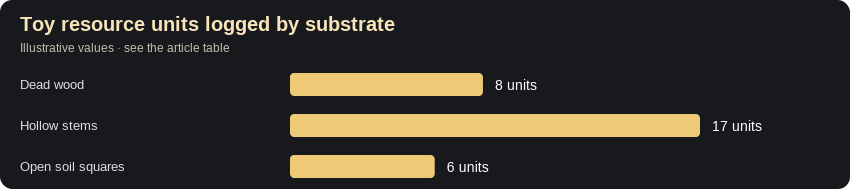
Illustrative values, not sourced observations. The groups use deliberately different resource units and must not be summed into nest capacity.
A gardener counts holes in a fallen branch. A second person counts holes in the soil beside it. Both intend to document nesting opportunities, and both put the result into a field called openings. The counts look compatible until the maintenance team needs to use them. The branch may contain insect tunnels, splits or weathered marks that stay recognizable for months. The soil may carry several entrances that change after weather, or none visible on the day of inspection. The next actions depend on which substrate was observed, when it was observed and what people actually recorded.
A useful garden inventory starts by naming what can be counted without guessing. A piece of dead wood, a defined set of standing stems and a square of exposed soil are three different things. Each can be described and revisited. None is a direct measure of the number of bees that could develop there. Their numbers can sit together in a list of maintenance responsibilities without turning into a common ecological capacity. The distinction is small in a spreadsheet and large in the field.
This article describes how to preserve it. The purpose of the record is to help someone keep track of features, observations and management changes, not to identify hidden nests. The toy chart shows eight wood items, seventeen stems and six soil squares, and its point is that those numbers have no meaningful combined habitat unit. It is an example of a portfolio of resources, not an invitation to rank them on one biological scale.
Begin by separating substrate, structure and use
The substrate is the material or physical setting. A fallen branch is a wood substrate. A standing hollow stem is plant material with a possible passage. A soil square is a defined observation frame placed in a larger ground surface. An entrance is a narrower feature that might be visible within any of these settings. Do not rename the whole item as an entrance or infer the rest of the structure from the shape visible at its edge.
Use is a separate record. A watcher might see an insect arrive, inspect an aperture, bring material or disappear into it. Some observations support stronger inferences than others. A photographed shape by itself rarely establishes active nesting, the user or the number of cells. Evidence that a cavity was used at one time need not show current use. These distinctions matter just as much for soil as for wood, though the places and signs often look different.
The Xerces Society nesting resources page describes different kinds of places and materials available to pollinators, including soil, stems and wood. Its nesting and overwintering habitat guide places natural features in a broader setting of nesting and shelter. Neither source provides the toy chart values. Their distinction among resources is the reason not to treat every visible hole or every piece of material as an interchangeable object.
A field record can carry three plain clauses: “A fallen branch was recorded; one round opening was visible on the inspected face; no animal behavior was monitored.” Each can stand on its own. Replace that sentence with “one bee nest” and the three distinct questions collapse into a claim nobody verified. A longer note is not always required. A few well-chosen columns can express the same distinctions as plainly as the sentence.
Include the purpose of the inventory. A manager checking what has been retained after winter may need a feature-level record. A researcher studying documented use may need observation effort and a more carefully designed field method. A volunteer orientation can show what resources to look for while explicitly declining to count users. Different objectives can share the same initial fieldwork without forcing everyone to answer a more ambitious biological question than they set out to ask.
Read the toy chart in its actual units
The companion chart is titled “Toy resource units logged by substrate.” It shows invented entries under three headings. The labels are broad substrate families in the teaching example. The bars are lengths on a graphic, not a standard scale of nesting resources. The table repeats the chart values and spells out what a single entry could mean in this example.
| Substrate in the toy chart | Illustrative units |
|---|---|
| Dead wood | 8 |
| Hollow stems | 17 |
| Open soil squares | 6 |
The eight can be imagined as defined wood items, the seventeen as individually logged hollow stems, and the six as complete quadrat records containing exposed soil under a stated viewing rule. None is taken from a survey or cited study. The number of apertures on each item is unspecified. Neither the extent of the wood nor the total exposed area within the soil squares was measured. Occupancy, availability to a particular species and success of development are all unknown.
Nine wood entries would mean a different count only under the same item definition. Splitting one branch into two management pieces might change the count without adding any usable structure. Likewise, subdividing a soil square would increase entries without changing the ground. A group of stems assigned a single identifier by one observer and individual identifiers by another would produce totals that reflect their choice of units. Keep a field for the way the inventory was made, or a future chart can report bookkeeping changes as habitat changes.
Anyone can add eight, seventeen and six and obtain thirty-one. That would be a count of dissimilar entries in a teaching list, not thirty-one nesting places. It would not give the total amount of space, the number of individual cavities or the number of offspring. A wood item might have several visible tunnels or none. A square could contain many apertures or no visible one. The most responsible result of the toy calculation is to stop before the sum is called an ecological outcome.
Even comparisons of bar height need labels close by. Seventeen stems does not indicate that this hypothetical garden favors stem nesters over ground nesters. The sizes of the units are unrelated, and their functions depend on conditions not stated by the count. A chart that makes three visually comparable bars needs explicit wording about what is not comparable. Otherwise an educational picture intended to teach the difference can end up reinforcing the mistake.
A wood item is a place with a history
Start a wood inventory by recording the item, its location within a permitted site and what portions were visible. Useful descriptions can include a standing dead part, fallen branch or substantial piece of decaying timber; its broad condition; and whether a face has visible holes, splits or cavities. A measured dimension can help identify or compare the item, but it is not enough to convert every visible opening to a usable nest. The dimensions of an accessible passage may not be known from an external view.
Wood already contains a history of decay, breakage and activity by other organisms. Some cavities can arise from former insect tunnels; cracks and knots can yield a similarly interesting surface. An apparent opening might lead only a short distance or have an obstructed entrance. If a photographed cavity is a cave in one angle and a shadow in another, preserve the observation conditions. Do not insert objects or remove bark to settle the ambiguity for an ordinary walk.
A peer-reviewed example is Cane, Griswold and Parker's study of nesting substrates and materials in North American Osmia, accessible through the U.S. Forest Service research archive. Their comparisons include species recorded using existing cavities in dead wood and pithy stems, among other settings. That evidence supports keeping substrate distinctions visible. It does not allow a person to assign the species using a branch from a particular hole, or to generalize all recorded habits to all wild bees.
For maintenance, note what happened to the item rather than silently updating its category. A branch may break, settle, lose an exposed portion or be moved under an approved plan. Its current orientation can differ from the one under which earlier observations were made. A new visible opening after a break is not necessarily a new structure constructed by an animal. Document change to the object and change in observation separately so the reason for a new count remains recoverable.
Safety and conservation can be in tension. A dead limb above a path needs appropriate assessment; a resource inventory is not authorization to leave a hazardous feature or to move it without review. Conversely, a maintenance label of dead should not automatically mean ecologically disposable. Record the concern and the decision under the site's process. A note describing what was retained, what was altered and what could not be safely monitored is more informative than a simple penalty or bonus in a running habitat score.
A stem record needs an entrance and a date
A standing stem might be hollow, or it might contain soft pith that some insects can excavate. Both possibilities matter, but a casually visible opening does not reveal which is present throughout the stem. Keep naturally hollow, pithy where known, visibly opened, and not assessable as distinct descriptions if the inventory can support them. Do not assume that a stem count is a count of available entrances. A stem can have an intact end or multiple broken ends, and the structure behind each can be different.
Stem scope deserves particular attention in a repeated survey. An observer can record stems individually or record them in a defined stand if individual tracking is not feasible. An individually numbered stem can be revisited after a storm. A stand-level count may be easier for routine maintenance, but tells less about which specific objects persisted. Neither approach turns an opening into demonstrated use. State which unit the observer tracked and how views were assigned to it.
Visible material at an entrance can be interesting without identifying an occupant. A disk or apparently packed covering may warrant a photo and a dated description. It does not establish that living insects remain behind it or what they might be. If an insect is seen repeatedly entering, log that behavior and the limits on identification separately. A count of stems with traces, a count of stem observations and a count of identifiable animals would name different data products.
The maintenance history of a stem can matter even when the current entrance looks unchanged. A standing plant may have been cut above an earlier break, a fallen stem becomes harder to relocate, or several stems may have been cleared since the last visit. Record what was done, the area and time, and whether the older objects remain identifiable. A new cut may expose material without implying that this particular point was useful to an insect. A cut made into an occupied structure could also disrupt it. Retain uncertainty and consult site guidance rather than viewing the chart as instructions for trimming.
There is a wider seasonal question too. Stems may provide shelter at a time that a light summer watch is unlikely to reveal. A landscaping record should not promote “no visitors seen today” into “safe to remove anytime.” The Xerces guide explains that a variety of plant features can matter for nesting or overwintering. Decisions about retaining, moving or cutting them need relevant local context. A good inventory can tell the maintenance crew which features were observed without requiring everyone to infer an occupant from a distance.
A soil square gives a repeatable frame, not a list of burrows
The soil entry in the example is a square, more commonly called a quadrat when the bounded area functions as a sampling unit. The boundary lets observers return or compare views under a consistent definition. It does not divide an underground patch of soil into isolated structures. A burrow may not follow the outline of the square, and an opening in the frame might not belong to the question being asked. Document visible soil and cover under the chosen field rule before making claims about use.
An exposed surface can be loose-looking, crusted, pebbly or mixed. The same square may offer a bank edge and a flatter patch. A walk can note these observable differences. It should not use them as a reliable test of hardness, depth or suitability for every bee. A local patch can change after rain, erosion, vegetation growth or maintenance. Record the condition and date; do not suppose that an earlier photo represents what is exposed now.
A rounded feature in soil could be an insect entrance, a gap left by roots, or another kind of mark. If a watcher sees repeated activity at the same opening, the behavior can support a more specific record. Keep that observation separate from the square's resource status. A square that qualifies as open soil under the inventory rule can have no recorded activity. A square that contains only a little exposed ground can still show a well-documented entry event. An inventory and a use survey should be allowed to disagree, because they record different things.
A useful case from primary research is Sardiñas and Kremen's field study of ground-nesting bee microhabitat. Using emergence traps in their study, they examined nesting incidence in relation to multiple habitat variables. Slope and soil compaction were important predictors in the community-level results they reported. This was evidence in a defined setting, not a rule for reading plans of every lawn. It helps explain why ground use cannot be inferred from bare area or a simple count of visible signs alone.
A soil square may be covered by litter one season and exposed in another, or patch boundaries may shift without anybody deliberately managing it. Record those changes with separate entries for view and state. If it became impossible to relocate the square after a washout, do not treat it as a zero count of entrances. If the square was relocated intentionally, establish a new unit or clearly state the changed procedure. Small mapping ambiguities can accumulate into large mistakes when reports span several seasons.
Maintenance changes the evidence people can see
Consider a crew that clears a path in spring. Before the work, there are logs at its edge, stems along the fence and a small exposed bank. Afterward, the logs are placed elsewhere with approval, some stems are left and the bank is hidden from the monitoring path by a new boundary. A dashboard of visible items might show dramatic losses. Some changes could be losses of resources, some changes in ownership or access, and others differences in viewing the same material. The chart cannot distinguish them unless the notes do.
Use separate statuses for retained in place, moved, removed, obscured and not revisited if they fit the inventory. Those categories have different consequences. A moved branch could retain physical features while experiencing changes in moisture or exposure. Removed material is no longer a resource on that site. An obscured soil square may have changed less than its visibility. An inaccessible stem cannot be assumed lost just because it no longer appears in new photos.
Preserve the reason a decision was made. Safety, site access, plant health and local conservation guidance are real considerations. A record that notes why a hazardous branch was handled is more useful than a mystery in a year-over-year chart. If the decision came from a responsible site authority, record it under the appropriate process. An observational inventory alone should not imply authority to leave hazards, modify land or transport dead wood.
Maintenance records can give conservation work more credibility as well. “Eight defined wood items retained under our site plan” is a statement that can be checked. “Eight new bee homes created” requires additional evidence and a definition of home. Even if the objective was to improve nesting opportunities, reporting the observed material action is worthwhile on its own. Readers who understand how features changed can ask better questions about whether and by whom they were used.
A site may change its policy without any immediate count changing. For example, a section could be designated for less frequent cutting or a bank left outside a routine vehicle route. A map can preserve those stewardship commitments separately from material counts and observation results. In another year, any difference might be examined relative to those decisions. Do not report an intended policy as proof that organisms responded, but do not leave it out when it helps explain the sequence.
Evidence of a visit does not always identify a nest
An animal hovering close to a substrate may be examining it. It may be passing. It may be doing something a person could not see. A recorded entry through a visible opening establishes more, but it still needs an identified unit, time and behavior. Identifying a bee from the encounter is another question; some observations may not resolve a taxon beyond a broad group. The relationship between visitor and opening should not rest on guessing the occupant by its environment.
Watch records can note events such as approach, entry, exit or apparent transport of material. Consider which evidence was actually visible. One entry event can correspond to one individual returning several times. Multiple insects might use the same location on different occasions. Unless individual tracking and the design justify it, count episodes rather than individuals. Nest counts, if a study can support them, would require their own definitions and evidence.
A hole, a cap or a pile of earth is a trace. Some traces can motivate more focused watches. They can outlast the action that produced them and may be altered by unrelated causes. Appearing next to a relevant substrate does not establish a unique link with a known user. A clean-looking entrance is not proof of occupation, and a weathered or partly covered entrance is not proof that nothing ever used it. Retain a trace field even when occupancy is unknown.
If an observer sees emergence under a suitable research protocol, the resulting evidence does not automatically give the number of hidden chambers or successful individuals in the entire wood item or soil square. That depends on the sampling method, effort, identification and what the endpoint represents. The distinction is central to interpreting sources such as an emergence-trap study. A natural history walk can report visible encounters well without pretending to have performed that kind of work.
Compare like units over a period you can defend
A year-over-year wood inventory can compare the number of defined items retained, provided the coverage and definition remain similar. A stem inventory could compare unchanged stems and newly exposed ends if it tracked both from the start. A soil inventory could compare cover in repeated squares under an agreed view and season. These are three potentially useful trends. Combining them under a shared slope in a graph requires a definition that would make such a slope meaningful. The original example intentionally has none.
Accept that ordinary records sometimes need a broken series. The first season may have logged individual stems; the second may use patches because individual tracking isn't sustainable. Rather than converting a patch count into an invented number of stems, show where the method changed. A supplemental count can help create a bridge if it is appropriately observed. If not, two qualified series are better than one that claims a continuity it never had.
A unit can also disappear for good physical reasons. A branch may decay into fragments small enough that its former ID no longer means anything useful. A soil frame can be buried by erosion. Record the date and what supports the status. Assigning a new value of zero without that background can hide the difference between loss of the object and loss of the rule that once made observations possible. Both are important to maintenance.
If the project covers different sites, carry the scope of each site inventory along with its counts. The eight hypothetical wood entries do not say how large the observed garden was, how much of it could be visited or how its wood was distributed. A comparison between equal numbers can hide very different densities if an appropriate area and protocol would even support that calculation. Heterogeneous counts need a carefully described context, not arithmetic alone.
Use change statements that name their units. “Previously recorded stem stand still present; no standardized count this visit” is a result. “Three quadrats had newly visible exposed edges” is another. “Reported total improved” obscures both. A good display can group useful information without writing a score that exceeds it. Readers interested in stewardship can see several changes side by side and decide which merit follow-up.
Overwintering is not a count of active nests
A garden may offer sheltered features for many organisms even on a day when nobody was observed entering them. Nesting and overwintering are related habitat questions, not necessarily the same process or time period. Material left in place through winter can be relevant independently of its apparent summer occupancy. Keep the reason a feature was retained visible if a reader might otherwise infer that the site verified who used it.
The Xerces downloadable habitat guide discusses the range of natural features, including wood, stems and ground conditions. It also points out that artificially concentrated structures and natural substrates can require different stewardship. An artificial block might offer entrances in an easily counted grid. That convenience does not make it equivalent to all natural settings or support comparisons based only on opening totals. A ledger should identify the type of structure before suggesting a common scale.
Seasonality can complicate before-and-after photographs. Vegetation hides some surfaces at one time and reveals them at another. A shallow cover may protect a place while making it look less open to a person. A fitted field plan can record shelter and visibility separately rather than assuming that every count rises with preferred management. If a goal concerns preserving the resources through different seasons, an observation scheme should say when features were assessed and which periods were not covered.
Keep management recommendations as local as the evidence. A dry stem in an appropriate area might be retained under a local plan; another site might need a different treatment for safety or other obligations. The decision is not derived from the toy chart. Decisions about actual places should take account of authorities, ecological context and applicable obligations. This article supplies a record design, not a single prescription for the material it describes.
Build a record somebody can use on Monday
Imagine the file handed over to a new caretaker on the morning after a storm. The person needs to know which branches were already on the ground, which stems are part of a retained patch and where the observation squares were last visible. They do not necessarily need a biological classification for each item. Give the handoff the fields that make the scene recoverable: object or square ID, map or orientation information at an appropriate privacy level, date, substrate, condition and follow-up status.
Then put optional evidence in a separate section. For observed physical structures, record which faces were seen and what was visible there. For behavior, record what was observed, during which interval and with what limits on recognition. For maintenance, record what changed and why. This format avoids treating a repair report, observation note and habitat inventory as competing versions of the same field. They can each supply facts without overwriting one another.
A branch file could record one item with two visible candidate openings and no watch. A stem file could record a standing group with an individually checked hollow opening and one entry event. A soil field sheet could indicate a partly open quadrat with a visible mound and a four-minute watch through which no visits were recorded. That is already a useful mixed record. An analyst can reproduce how many items and watches there were without mistaking either one for a verified nest.
Unknowns deserve a place in the schema. If the view is obscured or access was not granted, say so. If the substrate was never assessed, leave that category absent rather than inferring its value from a neighboring entry. Record “not monitored” separately from “none observed,” and distinguish observing an entrance from seeing an animal enter it. This makes small datasets capable of surviving later interpretation by people who were not there.
Write down the original purpose of the procedure and how the count is derived. For example, wood counts may include only pieces under a defined stewardship plan, while stems are individually logged in a named strip and soil frames follow a particular sampling route. Those rules are part of the data. A dashboard showing eight, seventeen and six without them loses much of what makes the figures useful. A short data dictionary and a map version can do more for reproducibility than an elaborate chart title.
Use separate questions when preparing a follow-up
Suppose a volunteer asks whether new nesting resources were created by a recent project. The first answer can be based on the physical changes documented. Perhaps a zone of exposed soil was retained or standing stems remained through a specified period. A second answer could concern traces or observed behavior. A third might require a design to estimate documented use or subsequent development. Make sure the follow-up question does not quietly switch from the first to the third in the minutes between planning and writing.
An inventory also helps identify tradeoffs. A project favoring open conditions in one part of a site need not erase every standing stem nearby. A flexible plan might keep a mosaic of features where compatible with management priorities. Statements about that arrangement should be based on maps and observations, not on a score that prefers a higher count across incompatible units. Preserving variety is a more legible goal when each resource is named separately.
If a team wants to know whether more staff hours should go toward wood records or soil observations, compare the maintenance decisions the work will support. One setting may need safety documentation and a stable inventory of objects, while the other needs periodic checks after cover or weather changes. The fact that stems have the tallest bar does not prescribe how to allocate work. Counts of differently defined entries show the workload only under a separate, justified effort model.
Requests for a unified habitat metric should begin with a definition of what it predicts and why its inputs are comparable. A validated index built for a particular target could be useful. Simply assigning one point to a piece of wood, a stem and a quadrat is not validation. Report a set of indicators when the shared scale is absent. A multi-part report is sometimes the honest answer to a multi-part setting.
Keep captions from promising an interior view
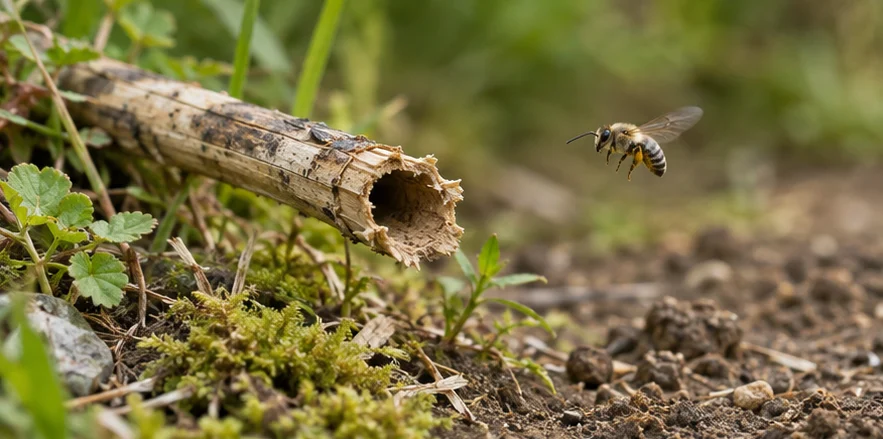
The companion photograph-style art should be labeled as an editorial illustration, not evidence of an identified bee at a recorded site. Its purpose is to make different substrates easy to notice at once. Even a real scene containing a flying insect beside a stem and bare ground would not identify where that insect nests. The visual proximity is a natural starting question, not an answer about route or resource use.
For the chart, a caption can state, “Eight invented dead-wood items, seventeen hollow stems and six open soil squares. The groups use different units and should not be summed into overall nesting capacity.” Keeping the qualifier close to the values prevents a copied graph from appearing to report thirty-one spaces available for bees. The caption needs no speculation about the organisms simply because the article concerns pollinators.
An actual caption can name the date, site scope and use evidence where available. If the feature was recorded but not watched, do not put an all-purpose word such as occupied into the title. If some behavior was seen, identify exactly what. Good caption practice is the simplest way to keep the categories distinct once records appear on signs, in reports or in meeting slides. The shortest true caption is often clearer than the most excited one.
A second check when three inventories meet
Consider the annual summary. The wood count stayed at eight, but two former items were replaced and the old ones no longer sit at the original location. The stem inventory also remains at seventeen after an unusually windy week, but only a portion of the objects can be matched to the prior survey. The soil report carries six frames, one of which now has markedly more cover. Identical bar heights would hide four different maintenance questions. Preserve identities and states when continuity matters. A total alone does not preserve either.
An editor can use the same imagined summary to test the map. Do the wood symbols represent complete visible items, locations of traces or just managed points? Do the stems represent individual objects or entries in a grouped record? Do the soil outlines represent the same observation frames as last time? The map can distinguish them with a legend rather than assign identical symbols to everything. If the legend and table differ, clarify which was designed for management and which was designed for observation.
Where someone asks for an update about nesting, answer from separate evidence. A detailed report might say that some features were retained and possible entrances documented, but that use was not systematically monitored. A different team may have supervised a permitted study and obtained evidence of particular behaviors under known effort. Recognize the added information without treating it as proof of a larger outcome than the method supports. The two products complement one another when their scopes are honest.
This approach gives everyone a better next question. A caretaker can check whether the physical resource survived. An observer can return under a comparable protocol and look for use. A researcher can decide whether a proposed comparison needs stronger sampling, independent evidence or different measures. None has to start by undoing a false total. The garden can keep the variety that made it worth noticing, and the record can keep the variety that makes it scientifically interpretable.
Check the change before changing the tally
A field coordinator can test the ledger with a simple hypothetical. Imagine a fallen branch offering an obvious accessible face. It rotates after wind, and its visible holes disappear from the path view. The wood item count need not change. The count of visible openings under that view does change. Whether the apparently hidden entrances remained accessible to insects is another question. Classification by visibility preserves what the camera saw without predicting a consequence it could not establish.
Do the same for a soil square obscured by a seasonal layer of leaves. If the stated procedure scores exposed soil, the change belongs to that field. If there was no reliable view of the soil, the appropriate result may be unassessed rather than zero. A report can preserve both the status of the frame and the conditions that limited inspection. Later visits can then distinguish a changing surface from a changing view. This practice is especially valuable when an attractive final chart would otherwise hide all of the difficult cases.
A robust stewardship summary can end by describing what has remained available to inspect, what has been deliberately retained, and which hypotheses still need observations. Such statements have identifiable units and dates. They can be compared next season without assuming that every preserved feature has the same ecological function or that evidence of a bee behind an opening was ever acquired.