
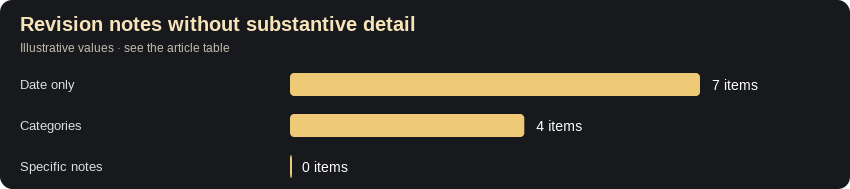
| Category | Value (items) |
|---|---|
| Date only | 7 |
| Categories | 4 |
| Specific notes | 0 |
Constructed checklist scenario for this brief, not measurements, ratings, or results from cited sources. Each displayed count represents checked items in the named example.
Two people arrive at the same article on Friday. One has never seen it before. The other read it on Tuesday and copied a figure into a meeting memo. Near the title is the word “Updated” and Friday's date. The first reader might take it as a welcome sign that someone is maintaining the page. The second reader has a harder question: did the figure change, and does the memo still say the right thing? The date is legitimate information, but it doesn't answer that question.
Now imagine the article also says, “We corrected the chart's count of completed visits from 62 to 56. The earlier chart included six test entries; the comparison with the prior month is unchanged.” The Tuesday reader knows exactly what to check. The Friday reader can continue with the corrected chart without having to read the earlier version. The note tells both of them what changed and how far the change reaches. The figures in this opening example are invented, but the problem is common to any page used as a reference after release.
A useful revision note is a short explanation of what a reader needs to update in their understanding or work. It isn't a transcript of editing activity. It also isn't a substitute for fixing the content. A changed method, a corrected number and a change in heading style do not deserve the same treatment merely because all caused a file to be saved. The job is to show which change matters, where it is and what it means for a person who relied on the previous material.
A date and a revision note answer different questions
A date answers a chronological question. It may distinguish when an article first appeared, when a substantive change was made or when the current version was published. A revision note answers a semantic question: what is different about this edition? A site can expose a useful date and still fail to explain an alteration that matters. Conversely, a detailed description with no date or version can make it difficult to tell which archived copy it applies to. If both pieces of information are relevant, present them in a way that doesn't make the reader guess what each one denotes.
“Last updated” often collapses several events. A host might change a navigation theme, an editor might correct a caption, or a team might revise the data behind the main result. Those are different reasons for writing a date. Some publishing systems also use general modification fields that can change when an unrelated template or metadata field changes. Decide which date the public page is promising to report. A site can track all operational events internally and still reserve a visible substantive revision date for changes that affect the article.
Date the note to the release a reader can actually encounter, not simply the moment the editor discovered the issue. If publication and discovery have a meaningful gap, both may belong in the record with separate descriptions. Time can matter when a page gives practical instructions or readers are circulating snapshots. For a routine revision, the publication date and a version identifier may be enough. The editorial policy should define the level of time precision rather than allowing an automatic timestamp to imply knowledge it doesn't carry.
There is no need to call every new paragraph a correction. An article can be updated to discuss a new period without being wrong about the old one. It can add an explanation because readers reasonably asked for it. Conversely, a small change to a single digit can be a genuine correction even if it involves only one character. Categorize according to what happened to the claim, not how long the edit took or how many characters were touched. The standard for clarity is whether a reader can tell if what they knew yesterday is still true today.
Write the note backward from the reader's decision
First identify the person the note is for. A casual reader wants enough information to trust that the page they see is current. Someone who quoted the result needs to locate the earlier wording or value, see the replacement and decide whether they need to correct their own work. A reader following instructions needs to know whether their next step changed. These audiences can share a concise note if it starts with the changed item and practical consequence instead of starting with the editor's process.
Federal plain-language guidance emphasizes organizing content around what readers need to know. The queued Federal Plain Language Guidelines address currently leads to Digital.gov's plain-language guide series. The CDC Clear Communication Index is an agency tool for developing and assessing public communication. Its emphasis on identifying an audience, a communication objective and the main message makes a useful design analogy here. Neither source dictates a universal revision-note format or determines the fictional counts in this article.
A practical structure is: when, what, why and consequence, with a locator as needed. Not every note needs a sentence for every field. “Corrected the field methods: observations were made weekly, not daily; the dataset and results were unchanged” supplies the heart of the change in a short sentence. If the consequence is that someone should use a replacement file, say so and supply a usable path to it. If a cause is still under review, don't fill the why field with a guess. A precise description of the affected material is more valuable than a speculative cause.
Sometimes a note should state what did not change. Scope that reassurance narrowly. “The overall recommendation is unchanged” is not the same as “nothing important changed.” If the corrected number was used in a table and chart, a reader can still need to replace a citation even if the article's takeaway is the same. Avoid claiming that results were unaffected until dependent calculations, summaries and copies have actually been checked. A defensible statement may say only that the specified comparison was recomputed and its direction remained the same.
Often the consequence is obvious from the change, so the note can stay brief. Replacing a data file with a corrected version communicates the necessary action more clearly if the old file is visibly superseded rather than merely linked from a dated history. If a change requires no reader action, do not manufacture one. The main goal of plain language is not to force every artifact into a template, but to let the audience find the meaning with minimal inference.
The fictional chart counts missing specificity, not quality in general
Illustrative chart: Revision notes without substantive detail. The chart compares three constructed treatments of the same seven revision entries. A note is counted if it fails to identify the affected passage, figure, file or claim and convey the meaningful change. The numbers are not observations, W3C or agency results, editor ratings, or scores from the CDC index. They are a teaching example with a fixed denominator and one review rule.
| Fictional treatment | Revision notes without substantive detail (items) |
|---|---|
| Date only | 7 |
| Categories | 4 |
| Specific notes | 0 |
All seven entries in the first treatment display dates but no substantive descriptions. The second treatment adds revision categories to all entries. In three cases those categories, together with the fields already shown in that treatment, identify the affected item and make the meaningful change clear. Four remain too broad. In the final treatment, each example supplies sufficiently specific detail for this narrow check. The sequence resolves three cases and then four more; adding the bars would count the same cases more than once. Zero means none of the seven remain underspecified under the stated rule. It does not mean that the corrected results were independently validated, that all mirrors were updated or that users can understand all seven notices.
To rehearse what a category can do, imagine one row titled “Chart 2, text size,” whose category reads “Increased axis-label text.” The meaningful change for that row is already visible. An entry titled “Analysis” with category “Methods” does not give the same clarity. It could conceal a new inclusion rule, rewritten prose, a correction to a formula or a change in the link to the protocol. The intermediate column is useful insofar as it identifies the entry without asking the reader to open every version. Categories can support navigation; they cannot be a substitute for the missing details.
One way to audit the final column is to ask a neutral reader to restate each change without seeing the revision diff. Suppose they can say that a caption now states the data are illustrative, but cannot tell whether the chart values changed. If it matters to the article's prior users, add explicit wording about the values. The note should stand on its own even if nobody agrees to review an old copy. Another audit can examine whether the facts in the note match the release. These are separate checks and both are worth doing.
Distinguish a clarification from a correction that changes a result
A clarification makes an already supportable statement easier to interpret. A factual correction replaces a statement the previous edition got wrong. The line can be subtle. An article that accurately described its site but used an obscure facility name might clarify which facility was involved. If the article identified the wrong facility, fixing the name is a factual correction. A reader may have made a different inference based on the incorrect site. The stronger label gives that reader a reason to revisit their notes.
Suppose an article reports usage per participating site. It never claimed to report usage per resident, but the chart omitted the denominator from the axis caption. A correction to the chart may be substantively important if the original display made an unsupported reading plausible. A note can say that the denominator was always participating sites, and that it is now named on the chart. Do not use “clarification” to minimize the effect of a misleading presentation. Explain what the older version showed and what the new version makes clear.
A corrected result often has a lifecycle beyond the main number. Did it change ranks, thresholds, direction of comparison, quoted language or recommendations? If an earlier “largest” becomes “second largest,” readers need to know that even if the underlying value changes by a small amount. Identify which conclusions survive a correction by testing them. The author should not assume the old conclusion is unaffected because it sounds broadly plausible. If a dependent claim is no longer justified, mark it as replaced or withdrawn and say why in terms the reader can follow.
Method notes tell people whether results are comparable
A wording change in the methods may identify what was always done. A real procedure change can make new results different in meaning from those reported before. Suppose a monitoring article originally reports counts for all submissions, then releases an analysis restricted to completed submissions. The new release can be better suited to a particular question without revealing an error in the old one. Explain the new unit and why it was chosen, then indicate whether the trend has been recomputed on a comparable basis. Readers cannot tell from “methods updated” whether the same result has simply become easier to understand.
When values are recalculated, communicate which version of the method produced each result. Readers who need to compare estimates across editions should know whether a difference arises from new observations, different selection rules or correction of an implementation issue. If several changed at once, separate them rather than naming only the one easiest to explain. A useful note can link to a brief methods appendix when the exact workflow matters. The public summary still needs the main implication, because an appendix is not a reasonable place to hide a reversal of the principal finding.
Consider a fictional report that changed its baseline from a single year to a three-year average. “We now use a three-year baseline” gives useful detail but doesn't say what numbers were revised or whether prior values were recomputed. The report might publish a new series rather than rewriting the old one, with a note warning against treating the two as directly continuous. A more precise note names the affected chart and whether its older points were recomputed. It can briefly explain why the method changed without claiming the new baseline is appropriate for every use.
Method changes can also affect uncertainty without changing a central estimate. Suppose a more appropriate uncertainty analysis yields wider intervals around the same numbers. If the article previously presented narrow ranges as evidence for a firm distinction, the revised note needs to address interpretation, not only the unchanged central values. State which chart or analysis changed and what readers should not infer from the revised intervals. The point is to make it possible to compare the evidential strength across versions, not merely the displayed point estimates.
Document what was actually done before choosing reassuring wording. If a method correction required rerunning analyses, automated checks should look beyond whether a file was produced. Compare expected rows, labels and units, examine changes that should have occurred and investigate differences that should not have occurred. An editorial reviewer can then accurately say what was checked. “The bottom-line pattern remains” is a meaningful claim only when its intended comparisons and qualifications are clear.
Values need addresses, units and an account of their reach
Numerical correction notes are most useful when they identify the affected item and both values, if it is appropriate to repeat the superseded value. Give the unit and scope. “The March completion count in Table 2 was 56, not 62” is more useful than “corrected six visits.” Was six the former value, the amount removed, or the new number of records? Including a locator prevents the reader from applying the change to another number with the same unit. If mistakes are extensive, group the note around the affected structures and provide an itemized record where it is navigable.
Do not repeat a superseded value in a way that could be mistaken for current advice. Formatting it as plain introductory text above a long, easily clipped note can leave a misleading quotation. Indicate that it is the earlier value before naming it, and make the corrected value easy to find. In a case where repeating the old wording creates a safety, confidentiality or other serious concern, describe the nature and scope of the correction without perpetuating the harmful material. Detailed traceability and prudent disclosure can be balanced.
A number can remain the same while its units or sign are corrected. An article that labels a fictional amount per week as per month has made a substantial error even if the graphic doesn't change shape. The correction note should state the old and new unit explicitly. If a figure was shown as increasing where it should have been decreasing, the corrected sign may need to appear in the headline and summary. A generic note about presentation would mischaracterize the practical effect.
Trace the downstream uses of the value. An article might quote a figure in prose, a table, a text alternative, a downloadable data file and a prepared summary. Other pages might reuse it. A short internal impact list helps the editor decide what should be verified before release and what copies cannot be updated directly. A change to the prose alone could leave the corrected claim less reliable for someone who used the data or an accessible description. Different views should not silently preserve different versions of the evidence.
If a correction is discovered in a source the article used, the relevant question is what role that source played. Perhaps the original article quoted the source historically and the later correction is an additional event to document. Perhaps the old value was treated as a current estimate and should now be replaced. Name the source version and determine which dependent claims still stand. Updating a link to a corrected source without updating the prose can leave readers unable to verify either version.
Formatting is sometimes more than cosmetics
Some formatting changes are genuinely minor. Adjusting spacing around headings or fixing an obvious spelling mistake that doesn't affect meaning need not make a public log harder to scan. A publishing policy can say that small nonsubstantive edits may be made without individual notices. That policy should not be used to dismiss changes in emphasis, navigability or access that materially alter what people can learn from the page. The consequence for the reader matters more than the editing tool used.
A table that no longer aligns headers with values can communicate wrong data without changing any underlying cell. Correcting the header relationship is a presentation change with factual consequences for people who read the earlier display. Explain that numbers were unchanged, if verified, and which association was wrong. A caption giving the wrong date or geography deserves a clear note even if corrected by the team responsible for layout. Calling it “visual cleanup” risks telling people that nothing about interpretation matters.
Accessibility fixes can deserve visible identification when they change how readers can use or interpret material. Adding a usable equivalent for a previously inaccessible chart doesn't necessarily change the result, but it does change what a reader can access and may uncover differences between previous presentations. Carefully check the equivalent against the current figure rather than assuming the existing caption is enough. A useful note might say that Table 3 now has usable column labels and a text summary, while the figures and analysis are unchanged. The writer should verify that last clause against the updated artifact.
Links are another borderline case. Replacing a dead route to the same public document can be routine maintenance. Replacing it with a later edition whose evidence differs is a substantive change to what readers can verify. If a citation now leads to new evidence supporting a revised sentence, record the relationship between the two changes. Otherwise a reader consulting a cached version of the prose might reach a current reference that no longer supports it. Record the identity and version of important sources, not only their clickable addresses.
A staged example for an ordinary publication
Imagine a fictional local data guide with four charts and a download. The publisher notices that the second chart contains training records alongside production records, then discovers that the methods section describes the intended exclusion correctly. The first question is which evidence changed. The methods description may already be right: the fault is failure to apply the described rule. Updating the method prose to legitimize the old result would conceal the mistake. Instead rerun the affected views and explain that the earlier analysis did not implement the stated exclusion.
Suppose the guide also gets a more readable column label and a paragraph explaining what a completed visit means. These can be listed separately if they help readers, but they are not equivalent to correction of the data. A short lead can disclose the substantive change, while a detail history lists the smaller edits. If the chart count changed from the invented 62 to 56, check whether the six records also appear in the download and whether the values were used to compute a rate. A concise note can be built only after the update reaches its actual boundaries.
Now suppose a reader used the old download to create a graph. Simply replacing the linked file and keeping its old name may make it hard to determine which version was used. Give the corrected file a stable identity, and provide clear version information where readers can find it. If the earlier file can remain safely accessible, mark it as superseded so it won't become the default through an old bookmark. If the older material cannot be retained, preserve an appropriate public description of the change and an internal record that lets a reviewer verify it.
The team's draft note might initially read, “Updated Chart 2 and related files.” This accurately reports activity but misses the substantive fact. A better version distinguishes the correction from housekeeping: “We corrected Chart 2 and the March download so they exclude test records. The count of completed visits is 56; the earlier edition showed 62.” If the direction of comparison did change, carry that change into a separate sentence. The example in the opening deliberately assumes it did not; a real note can make that claim only after verifying it.
Now imagine a related second case in which someone proposes starting the next edition using completions rather than all visits. This is a measurement choice, not necessarily another correction. Write “The April edition reports completed visits; the March edition's original series counted all visits” if that is accurate. Give readers a comparable recalculation if one exists and explain what it includes. The difference between the two case notes is the difference between repairing a claim and adopting a new way to describe a subject.
Find the right location and the right duration for the note
Readers who arrive by a deep link might never see a small log below the article. In a document with a corrected headline or central result, a short notice near the lead can orient them before they act on an older understanding. A small correction to a late table may be best noted near that table and in the version record. Pictures and captions can be copied without their parent pages, so consider which parts need visible version labeling. Choose placement according to the chance a reader will miss a consequential update, not based on where every other site puts a date.
Public attribution and detailed history can coexist. A short note can state the main change; an expandable history or a separate record can list items that need finer locators. Both should remain accessible to someone who needs them. Avoid hiding essential information behind an unlabeled control or styling it so it is hard to read. Ask someone unfamiliar with the revision to find the current version and describe what happened. Timing a search is less important than observing whether they stop at the correct place with an accurate answer.
Formats also have different histories. A posted PDF, a cached version, a summary in an email and a current web page are not automatically synchronized. Correct the artifacts the publisher controls, mark replaced versions where appropriate and identify copies that cannot be changed directly. If the earlier information was communicated to known users in a context where the change matters, the editorial plan can define a proportionate way to notify them. Do not write in the note that all readers were notified simply because the new edition exists.
Crossref's Crossmark update-policy guidance provides one primary example of how participating publishers make update policies and document status visible. A general editorial site doesn't need to implement Crossmark to learn from that distinction. It can link an article and its revision record in a way that helps readers identify which article the note applies to and whether a copy reflects the current state. Do not attach scholarly status labels casually if they imply an editorial action that the publisher did not take.
Decide how long the prominent note should remain and where it goes afterward. A visible correction should not evaporate merely because a homepage campaign changes. If it is archived in the version history, the connection to the article and affected version should remain usable. An older reader arriving months later may have exactly the same question as the Tuesday reader in the opening. Preservation does not require displaying every routine change at the top forever; it requires a dependable way to find substantive history.
Separate the reader-facing note from the internal evidence
A useful internal record can contain the source of the report, details of the investigation, file differences, checks performed, ownership and decisions about downstream copies. The public note is not that entire record. It should contain the details a reader needs to understand the effect of the change. A personnel disagreement or a long account of what an automated tool did is rarely necessary to that purpose. Conversely, do not hide a key methodological change just because its history involved an internal process.
Write down three things before release: the verified change, the uncertainty and the derivative artifacts reviewed. Suppose the team has corrected the main finding and is still checking a supplementary spreadsheet. A current note can say exactly which view has been fixed and acknowledge the ongoing review if leaving the file available would otherwise mislead. A handoff should tell the next editor when and how to finish. Avoid a statement of total completion when the team verified only one surface.
A link to a diff can be helpful for readers familiar with the format, but many readers won't distinguish changed content from whitespace, generated timestamps or moved markup. The note supplies significance the diff cannot infer. The reverse is also true: a skillful summary is not a substitute for source control or a defensible internal record. Editors can verify the public note against the evidence without publishing private material or forcing every reader to reconstruct the investigation.
When groups maintain several language editions, preserve which versions the change affects. A factual correction should be applied wherever the mistake appears. The change may be a wording clarification in one edition but repair a broader misunderstanding in another. Don't infer that an updated source language automatically corrected every translation. A stable link and dated note can help readers tell when the version they depend on incorporates the fix.
Test the change after publication, not only before
Open the current public page and verify the corrected item in its actual presentation. Open the linked file independently and make sure the version named in the note is what a reader will get. Check a meaningful derivative such as an accessible text summary or the share preview if it carries the changed claim. Verify date and scope differences from a prior copy or known archive, where available. A satisfied internal preview does not prove that the reader has received the same version.
Ask a second person to read the note without the private incident record. Can they identify the earlier and revised meanings? Can they tell if their copy is affected? Can they find what they now need to cite or use? If they can give the right answer only after an explanation from the editor, the published note still has work to do. This is an exercise in comprehension and retrieval, not a request for compliments on transparent language.
Check whether the wording inadvertently implies certainty about subjects you did not review. “No other data changed” could be read to include an entire dataset when only a chart was checked. Write the narrower known fact: “The other three figures in this article were compared with the previous release and are unchanged.” If later investigation turns up another change, issue an additional update rather than quietly stretching the older note. A precise record makes it possible to distinguish events over time.
Use an interim notice when the investigation is not ready
Sometimes the editorial team knows enough to withdraw reliance on one item before it knows what should replace it. An affected file may have been exported with an uncertain filter, or the team may have discovered that labels in a summary conflict with the data. An interim notice can name the affected material and what readers should not rely on while verification proceeds. It need not guess a corrected value. This is a separate state from either leaving the original fully endorsed or labeling the whole publication withdrawn. Choose the scope supported by the evidence, then make that scope easy to find.
A notice like “We are checking the April totals in Chart 2; do not use those totals for comparison until this note is resolved” is more useful than “Under review.” It identifies both the part under question and the consequence for readers. If related tables are being checked too, list those affected surfaces. If it is not yet possible to tell how far an error reaches, say that the scope is still being assessed. Do not reassure readers about unrelated sections unless the basis for distinguishing them is clear.
Plan how the note will be closed as part of posting it. Name an owner for the review, decide how the current state will be recorded and put the eventual resolution where people who saw the interim notice can find it. The closing entry might say that the values were confirmed, that the values were corrected, or that the comparison is no longer supported. An interim note that silently disappears can leave careful readers with no way to tell what happened. Linking the stages provides continuity without making readers monitor a page indefinitely.
A replacement notice should also reconcile earlier instructions. If the interim note told people to stop using the chart, the resolution should identify the corrected version now suitable for use, or state that a replacement is not available. If someone already copied a value, help them recognize which copy is affected rather than merely declaring the review finished. A successful investigation and a successful handoff are different. The first determines what is sound; the second makes that judgment usable.
Sometimes investigations reveal an issue outside the publication's control, such as an amended source not yet available in the edition the article cites. State the dependency instead of giving a firm timeline without grounds. A reliable interim note communicates the reader's options now. It doesn't promise that every future question has been settled.
Avoid the false choice between silence and an exhaustive changelog
Not every edit deserves a permanent public entry. An endless log of punctuation fixes can make it harder to find a correction to a result. A short note about a major change can be disproportionately valuable even if the page also has a detailed private history. Define a visible threshold based on whether a reasonable reader might use or understand the content differently, then make exceptions explicit when needed. An entirely silent formatting fix and a prominent notice about a corrected value can be consistent outcomes of the same policy.
Editors can use categories for this purpose as long as they serve the reader. “Method,” “value,” “wording” and “presentation” can help someone scan a history. Add the affected item and meaningful effect when the category cannot carry them. Report which copy and which part changed if the article could be quoted in several places. These small choices are what let a short revision note carry more information than a large, inscrutable changelog.
Keep the note accountable. If it tells readers they can still compare values through time, verify that the periods and units actually align. If it promises a version history, maintain the link and the accessible view. If it tells them a result was corrected, correct the result everywhere you claim to have corrected it. At its best, a revision note is not a performance of honesty. It is a practically useful part of delivering the current record.
A Friday reader shouldn't need Tuesday's page open in another tab to learn what matters. A date says where to place the change in time. A specific note tells the reader how to change their own understanding. Give them both when both are needed, then let them get back to the work for which they came.
References
- Federal Plain Language Guidelines original address, verified as redirecting to Digital.gov's plain-language guide series.
- CDC Clear Communication Index. CDC's official resource for planning and assessing understandable public materials; it does not supply the invented audit data.
- Crossref: Update policy page. Primary documentation describing update-policy visibility for Crossmark participants.