| Category | Value (stems) |
|---|---|
| Mud-like | 7 |
| Leaf-like | 6 |
| Resin-like | 3 |
| Unclear | 5 |
Illustrative values, not sourced observations. Each stem counted once; occupancy remains unknown.
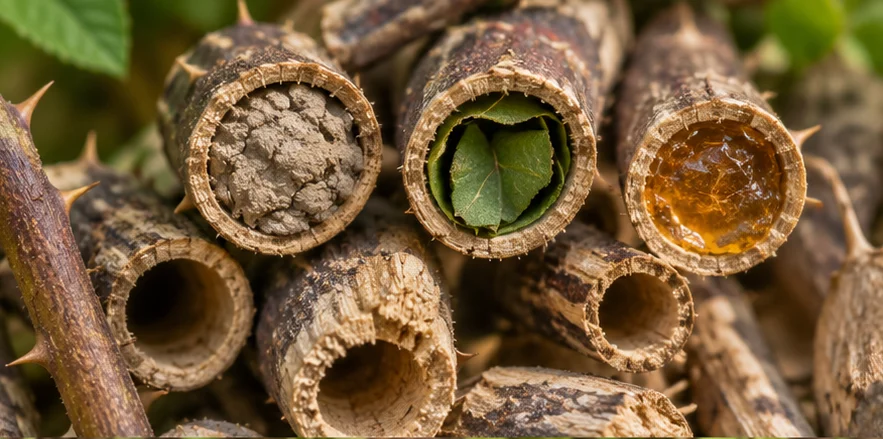
At the edge of a garden, several dead stems end in dark circles. One circle looks as if it were plugged with clay. Another has overlapping green-brown edges that resemble cut leaves. A third catches the light like old varnish. For an observer who has never looked at stems this closely, the differences feel like answers: three materials, perhaps three insects, perhaps three families still inside. But the only thing the observer can establish from that first look is that the entrances look different.
That is not a disappointing result. A small patch of material gives us a way to ask better questions about a part of the garden that is normally invisible. It can document a change between two visits, guide attention toward an insect carrying material, or show why a tidy-looking plot actually contains a variety of small structures. The mistake is not seeing a clue. It is counting what the clue cannot reveal.
The soundest field note starts by distinguishing appearance, activity and identity. “Brown granular material obstructs the opening” is an appearance. “An insect repeatedly brought brown material to this opening” is observed activity. “This insect is a particular species” requires identification evidence of its own. A photograph may support the first statement beautifully and the other two not at all. Neither a confident caption nor a field guide with a matching example closes that gap.
The entrance is only the visible end
In an intact natural stem, the piece you can see usually represents a very short part of the possible cavity. Its edge might be flush with a cut stem, recessed a little, or hidden by a ragged rim. From outside you typically cannot tell how far a passage runs, whether it bends, what closes its far end or whether the obstruction is an outer closure rather than another structure visible near the entrance. A distinction useful to a researcher can remain impossible to make in an ordinary garden photograph.
A stem may contain natural hollow sections or a soft interior that a suitable insect can excavate. Woody stems, dead branches and abandoned tunnels also provide very different opportunities. Describing a stem as pithy does not establish that an insect opened it. Describing it as hollow does not establish that its open end has a suitable protected space behind it. Those are characteristics of the substrate, separate from evidence of an animal using it.
Some cavity nesters make a sequence of separate compartments. In an idealized drawing, the nest looks like connected rooms with a closure at the entrance. Actual configurations vary. A space can contain several cells, a smaller number separated by unused space, no brood at the time of observation, or evidence of earlier use only. An external disk is not a window onto those arrangements. Even when a researcher knows the insect that constructed it, the external look of the closure is not a tally of what lies behind it.
Sometimes an observer sees a narrow band at the far end of what looks like an open tube and wonders whether it is a cap installed unusually deep. It might be. A natural node, pith, crushed plant tissue or accumulated debris can also close the view. Without stronger evidence record its position and appearance rather than treating every end to visible darkness as animal construction. Strong observations leave the distinction intact for a later visit.
Number the observation unit before deciding what happened. For the illustrative chart in this article the unit is one stem, with one designated visible opening scored per stem. That is an arbitrary choice that makes the exercise easy to audit. In a real plot, a broken branch may offer several possible openings. State whether your unit is the stem, the opening or an observed visit. A change among those units can make a graph grow without any new activity.
Mud-like is a visual description
A mud-like closure may present a matte surface, fine granules, darker areas that suggest moisture or rough patches where material seems layered. Those details are useful in a note because another observer can compare them with the next photograph. Instead of writing “the mud bee returned,” describe the shape, color and visible texture. A later view may show that the first apparent plug was loose material caught by a plant fiber. A cautious description still helps recover what happened.
Mud and mineral particles genuinely appear in some insect constructions. The US Forest Service agroforestry note on nesting resources discusses soil-based materials alongside plant pieces, resin and other gathered substances. But mud-like material does not provide a one-to-one lookup from building material to maker. Other insects can use similar material; a single broad group can use a variety of materials; and the appearance of the mouth need not reflect everything used deeper inside.
Think of color as a poor independent witness. A dry deposit looks different in direct sun, in shade or after rain. Fine brown leaf pulp can look rather like earth. Soil caught on a damaged end can acquire the appearance of purposeful construction as it dries. If the only evidence for mud is that the picture looks brown, write “brown material, texture unresolved” or use the unclear category. Reserve mud-like for the pattern you defined rather than the strength of your intuition.
Repeated visits can make an observation stronger without changing its category. Suppose an opening is clear on Monday, covered by a partial granular band on Wednesday and closed by similar material on Friday. The dates establish a progressive change, if the photographs show the same opening. They still do not establish a builder if nobody saw it. Evidence of directed placement would improve the construction inference, while a single view after work crews passed or after heavy rain may leave more alternatives open.
A slight depression or lump is not a reliable clock. Weathering can round edges, cracks can appear when material dries, and a change in apparent shape can result from a new camera angle. Do not assign an age to a closure simply because it looks fresh or pale. Document what changed between dated visits. If the light differs enough to undermine the comparison, say so. “Not previously visible” is usually more defensible than “built today” when the observer did not watch construction.
Leaf-like does not always mean a cut leaf disc
When an entrance has clear overlapping pieces with a coherent edge, the structure can suggest leaves or petals. A fold, thin margin or faint vein can be more informative than a color alone. If you can see only a green patch, the case is weaker. Green pigment darkens and surfaces weather; a natural fragment can also hang across an opening. Describe the particular visible features that support the group and keep the original record if those features later become less clear.
Leaf-derived structures can vary from pieces laid together to finely processed plant tissue. In the peer-reviewed North American Osmia nesting materials study archived by the US Forest Service, James Cane and colleagues compare documented nest substrates and materials and describe leaf pulp in many records. That is a useful counterweight to a common shortcut: a green or leafy surface at an entrance does not identify a leafcutter bee, and a rough wall of processed tissue need not look like recognizable leaf pieces.
A leaf showing a neat missing segment is a different clue from a finished closure. The missing area may suggest collection, but without following a chain of observation it does not connect that leaf to a particular stem. A separate insect could have carried the piece away. The nearby opening could already have been covered when the cut was made. Record the leaf and stem as two observations unless you actually followed material between them.
A small detail can help a reader see what you mean without making the evidence sound stronger than it is. “Three thin, overlapping pieces with dark margins cross the aperture” communicates more than “obvious leaf nest.” If margins can no longer be resolved after exposure, write “outer surface now dull and dark; overlap not visible in this image.” A reliable notebook contains changes in the observer's ability to see as well as changes in the material.
Plant stems can also bear fibers from their own broken ends. A fresh break might curl, compress or give rise to a ragged edge that resembles foreign material. If the apparent pieces appear continuous with the stem wall, record that fact rather than fitting them into a convenient category. A field classification should allow a structural explanation to remain on the page. It is perfectly possible for an ambiguous stem to make a dataset more honest.
Resin-like is a surface clue, not a test
Imagine a dark closure with a glossy exposed patch and several pale particles seemingly embedded in it. An observer might call it resin-like by appearance. That description is useful so long as it means lustrous or apparently cohesive material rather than chemically verified resin. Reflected light from moisture can be similar. Plant exudate from an old wound can look glossy too. The shape you see in a photograph does not establish whether the substance was gathered, secreted, produced by the plant, or merely damp.
Resin is familiar from natural history accounts of some cavity builders, and gathered materials can be mixed or layered. A granular surface may contain a binder that is not obvious in the light. A shiny patch might occupy only a corner of a predominantly fibrous closure. Write down mixed features instead of assuming every object must belong wholly to one group. If you publish a simplified chart, explain the decision made for the visible working categories and retain the original descriptive notes.
Do not scratch a surface to assess hardness, apply tools or solvents, pull on a fragment or break a stem open to settle a casual classification. Even if the opening appears old, the passage behind it is not sufficiently understood to justify perturbing it for a photo. A photograph at a slightly different angle, if naturally accessible, is a better default. If that is not enough, the ethically sound result is an unresolved classification. It costs very little compared with disrupting a shelter.
Resist describing the shiniest spots as sticky when no contact was made. Stickiness is a physical property, not an optical one. Use “shiny,” “amber-toned,” or “appears smooth” as appropriate. The same principle applies to claims of sand, wax or silk from appearance alone. Words that seem interchangeable in casual speech imply different evidence when entered in a plot survey. If you record what made the material look resin-like, future observations remain useful even if the inferred substance changes.
Unclear is a result, not an empty box
Some stems should remain unresolved even in a well-designed survey. An aperture can be in shadow, the object can be too far away for the lens, or only a very small corner of the material may be visible. A classification policy that requires a definite answer in each case encourages observers to convert limitations into extra results. The resulting chart looks complete because all ambiguity has been reassigned to categories that seem biological.
Define unclear in advance. For example, use it where a visible possible closure does not meet the image or descriptive threshold for any of the three material-like groups. Record the reason separately: insufficient detail, mixed cues, partially obscured surface or unresolved nature of the material. If a stem was never inspected, it deserves a missing-observation flag rather than automatic inclusion in unclear. If no obstruction was seen at an adequately examined cavity mouth, that is another observation rather than a material group.
Consider how the selection rule changes what percentages mean. Our chart describes only a toy set of already selected stems with visible candidate closures. It excludes stems with unequivocally open ends, those without an inspectable end and those never visited. In a garden survey, those exclusions would make the result a conditional description: among the kind of openings we scored, this is the distribution of visible labels. It would not answer what proportion of garden stems bear closures or what fraction of hollow stems an insect chose.
A good observer can disagree with another on the same image. One person may privilege layered edges and assign leaf-like; another may focus on granular texture and call it mud-like. The disagreement is useful if it leads to better category definitions. When two observers work independently, preserve both original judgments alongside any agreed record. Do not erase the existence of ambiguity just because one person has the final say. The finished chart can annotate a disputed entry rather than pretending every decision carried the same certainty.
With mixed appearances, you can permit more than one secondary tag while requiring a single summary category for one particular chart. For example, keep “fine particles on shiny matrix” in the notes, and assign unclear in the summary if no agreed priority rule applies. This is different from adding the stem to both mud-like and resin-like in a graph whose total claims to be stems counted once. Whatever you do, explain which level of classification the graphic represents.
Before publishing, take a small withheld set of images and see whether the labels can be applied under the agreed rules. This is a consistency check, not an identification experiment. If the image set avoids the hardest cases, its apparent success says little about difficult stems. Include weathered surfaces, imperfect viewing angles and mixed scenes in any test of whether your note-taking instructions can support the distinctions the report wants to make.
A worked chart with a deliberately small claim
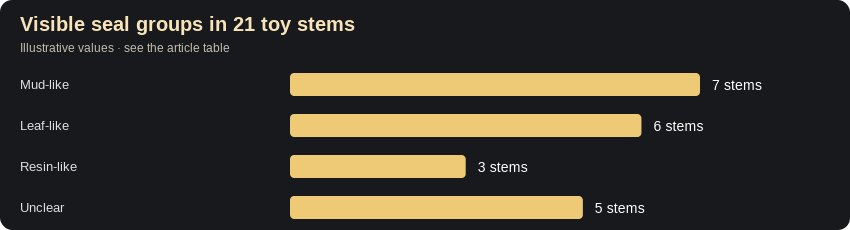
The companion chart shows a wholly invented group of twenty-one stems. A fictional observer inspected one designated opening at each stem and made a single surface classification of visible candidate seal material. The counts are 7 mud-like, 6 leaf-like, 3 resin-like and 5 unclear. The table repeats the chart in a form that can be checked without relying on color or shape. None of the values came from the cited sources or from a real site.
| Visible appearance | Toy stems counted | What was established about occupancy |
|---|---|---|
| Mud-like | 7 | Unknown |
| Leaf-like | 6 | Unknown |
| Resin-like | 3 | Unknown |
| Unclear | 5 | Unknown |
| Total | 21 | Unknown for all 21 |
The sum is seven plus six plus three plus five, or twenty-one. Sixteen stems received a descriptive material-like group and five did not. The extra arithmetic says nothing about the unseen interiors. Sixteen classified surfaces are not sixteen identified nests. Five unresolved surfaces are not five unoccupied stems. A reader should be able to see this without finding a disclaimer printed at the bottom of the page.
A poor caption would say “Seven mud bees, six leafcutters, three resin bees, and five other insects.” That sentence invents individual insects, identities and a residual category out of visual attributes. Another poor version would say “Sixteen nests detected.” That is less visibly wrong, but still turns a descriptive score into a claim of origin. “Visible seal groups in 21 toy stems” accurately states the grouping, unit and scope. A note adds the important condition: each stem counted once, occupancy unknown.
The one-stem rule prevents category inflation but does not produce a census. If one insect worked on multiple stems, the chart would not detect that. If several organisms used one cavity over time, the chart would not count them separately. No statistical adjustment will recover facts absent from the observations. If users need individual or species data, they need a suitable identification and sampling design. Calling the graphic provisional is not sufficient if its title still asserts the wrong unit.
Even useful shifts in these groups would have limited meanings in a real repeat survey. An increase in unclear cases after storms might reflect obscured surfaces rather than different builders. An apparent loss of resin-like surfaces might follow a change in illumination or observer instructions. A decrease in observed closures could be caused by stems falling or being removed. Compare the same defined units and track what was available to observe, not only what remained easy to classify.
Occupancy has several meanings in a stem
An old closure can outlast the occupant that made it. An intact-looking face cannot guarantee a living insect behind it. A damaged closure could reflect an animal leaving, another animal entering, weathering, or mechanical contact. Parasites and other cavity users introduce more possibilities. A real account should identify which interpretation is supported by the time series and which remains possible. From a single static picture most such distinctions remain open.
Even active use needs clear terms. Seeing an adult enter once supports “an insect entered.” It does not automatically support “this adult laid eggs.” Watching repeated trips with material supports stronger language about activity consistent with construction. Watching an animal exit establishes an exit event, not necessarily emergence after development. It may have been inspecting or sheltering. A careful field note allows these behaviors to stand on their own rather than translating each directly into a life stage.
Small holes in a cap invite narratives. “An opening appeared in the material” is a fully useful observation. “A young bee emerged” requires evidence beyond the geometry of the opening. Holes may form for other reasons, and a series of isolated photographs rarely records every actor. If you actually observed a departure from a previously documented closed stem, note what you saw, when, and whether identification was possible. Leave any inferential step visible to the reader.
A cavity user may not be a bee. Other insects can use stems or preexisting holes, and some wasps use similar materials. Without watching the builder or examining adequate identification evidence, an observer should not even assume that a relatively convincing closure belongs to the group they were hoping to find. In a habitat note, it is often enough to say that the site has resources used by a variety of cavity-associated insects and that a particular entrance remains unattributed.
It is useful to distinguish the original builder, any later occupant and any transient visitor. These need not be the same. Imagine a shiny obstruction around which a small insect pauses briefly. Even if you can identify the visitor from a photograph, you have not necessarily identified who placed the obstruction. Conversely, a well-documented builder from last season is not necessarily the animal seen at the same stem today. An observation record should carry separate fields for behavior and identification whether or not both are known.
A reliable offspring tally is a different kind of project. It may need specialized methods, permissions, and a plan that accounts for incomplete observations. A casual walk should not open stems or alter closures in search of this number. The appropriate value for our chart is unknown. When a question cannot be answered without disturbing a site, choosing a different question is often the best use of a public natural-history visit.
Watch without turning the site into an experiment
Begin by deciding what a revisit can answer. Will you record changes in visible material, note whether an insect interacts with a named entrance, or compare the availability of standing stems? These goals call for distinct records. They share a useful rule: start with observations that are possible without moving the object. Examine accessible habitat from established paths or other permitted positions. An untouched entrance is better evidence for later comparison than one rearranged to suit the camera.
A photo can often show both the rim and the material with no contact. Take a wider orientation image alongside a detail, if permitted, so a later observer can identify the same stem. Do not insert a ruler or point into the opening. An approximate scale taken safely beside, rather than through, a view is only useful if it does not disturb anything. A name tied to the position in a small sketch may be more practical than tagging the stem itself.
Protect the meaning of the identifier. One easily recognized cane can break near the preceding observation point and expose a new opening. Calling the new opening an updated version of the old one may misrepresent what was seen. You can keep the stem identifier while recording separate entrance identifiers and note the incident. Conversely, if a flower stalk is merely photographed from the opposite side, that should not produce an extra stem record.
Timestamp each observation when possible and note the light, weather, framing and distance issues that affect comparison. A cloudy day can hide a sheen visible in bright low sun. A close view can show granular structure that a broader shot misses. If an earlier photo has a necessary limitation, treat that as part of the evidence rather than retroactively filling in detail from a later picture. A record of what cannot be seen helps prevent false before-and-after conclusions.
If insects approach, record behavior from a respectful distance and leave if observation appears to interfere. Do not block a flight path to test whether an insect finds another entrance. You do not need to prove persistence by forcing a return. A quiet interval with no visible visitors is not evidence the cavity is empty; it is an interval during which none were seen under the stated conditions. A fair report records the duration, rather than presenting “no activity” as a property of the stem.
Build a record that survives a second visit
Make the smallest consistent record useful. For each selected stem, note an identifier, the observation date, the visible opening or section examined and a short description of the surface. Add separate fields for visibility, classification confidence and any animal behavior actually seen. If sharing observations publicly, omit location details where the land manager or a conservation protocol requests it. An identifier can recover the plot without publicizing exactly where every object stands.
Describe the material before filing it under a category. “Uneven tan grains and no clear layers” is possible to review. “Mud-like with moderate confidence” tells the next observer how it was categorized. Both are preferable to retaining only an abbreviated code. A later project might merge or refine categories, but it cannot recover sight lines or texture if every entry was reduced to a letter at the time of observation.
Start the next visit from the orientation view, not from your remembered conclusion. Checking that the stem and entrance match is especially important after gardening, mowing or high winds. If the unit cannot be relocated, mark that result separately rather than scoring its former entrance as open. If a tag or label used by another project has shifted, defer to the documented observation plan instead of moving it back yourself. Stable identification of units is a prerequisite for claiming that a photograph reveals change.
A simple transition log may be more informative than two disconnected bar charts. One row can say a previously obscured stem now has a mud-like visible face after the observer could see it clearly. Another records that a photo from the same angle shows new material spanning an opening previously visible as clear. These are different kinds of change. A bar chart can combine them into one extra mud-like observation; notes preserve which case involved a new view and which involved a change in the object.
Keep track of visits with no biological activity and visits with no opportunity to observe. The former might say “watched the opening unobstructed for five minutes; no visits seen.” The latter might say “view obscured by foliage throughout.” Combining both as zero visits hides observation effort. In another season you could make the same mistake comparing an hour of sustained observation against a brief pass along a path. Behavior counts only make sense beside a description of effort and visibility.
When a confident identification is the wrong reward
Many natural-history platforms and questionnaires encourage observers to supply the most specific name they can. That can be valuable when the documentation supports it. It can also reward a sharper name than the underlying image deserves. If the picture shows only an entrance, record it as a trace or an observation of an unidentified structure where appropriate. When identifiable insects are pictured nearby but not demonstrably connected to the opening, keep those records separate.
Additional evidence may support identification at different levels. A well-framed photograph of an adult can sometimes support identification more narrowly than a photograph of material alone. Other visual features may not separate similar species under ordinary conditions. A vetted naturalist can help interpret good documentation, but no expert can create missing features. State the identification level actually justified by the evidence and retain any uncertainty if a determination remains tentative.
Suppose an adult visits a leaf-like entrance on two successive days and the observer can identify it broadly as a bee. That still leaves the question of what it did. A time record of inspection versus deposition will help more than a discussion of whether its color matches a memorable species. If it brings a fragment, describe the carry and placement. Conversations about taxonomy can then focus on the adult as documented, while the stem record remains a dated account of activity.
Misclassification is not symmetrical. People familiar with garden leafcutters may overassign overlapping surfaces to that group. People looking for mason bees may see mud wherever a granular plug appears. Clear, predefined surface descriptions protect against that bias without insisting that observers ignore what they know. The goal is to keep prior natural-history knowledge from quietly becoming the decisive evidence in a case it cannot settle.
It can be useful to write two captions for a strong image. The evidence caption states the visible features and conditions. The context caption explains that different cavity users gather or process a variety of materials. When put together, these captions inform without suggesting that generalized knowledge verifies the identity of the occupant. A striking visual deserves an equally careful account of which claim it actually supports.
A garden can keep its useful mess
The Xerces Society's nesting resources discuss stems and plant materials in a larger habitat picture. Its nesting and overwintering guide explains natural structures that offer places to nest or shelter. A downloadable edition of that guide describes how some bees use hollow stems while others can excavate suitable pith. The distinctions matter because a garden filled with flowers can still lack places to nest or wait out a season.
Shelter is not visible on demand. Some activity may occur out of the observer's season, below a portion of the stem that is masked by vegetation, or in substrates not represented in the plot. Leaving a range of appropriate natural features where compatible with land management can support habitat without expecting a visible sign on each one. The absence of a photographed plug is not a grade on the gardener's efforts. It may simply reflect which kind of feature was inspected.
Maintenance choices should consider the site rather than attempting to keep every standing stem in every place. Paths, accessibility, fire requirements, disease management and local regulations can all matter. A land manager can often designate areas where ordinary stems and leaf litter can stay, while maintaining other areas for their necessary purposes. A garden that cannot preserve a particular stem need not force a biological interpretation of whatever is removed. An inventory of habitat features is useful on its own.
There is no need to replace natural stems with a large artificial installation merely because their entrances are easier to count in a grid. Artificial nesting structures create different conditions, require appropriate stewardship, and are not a neutral sampling frame for a garden. Visibility is a convenience for the observer, not proof of ecological quality. The Xerces guide situates natural features within a wider set of nesting and overwintering resources. A few labeled photos should not be treated as a comparative trial between those choices.
If the goal is a gentle educational activity, let the uncertainty become part of it. Compare two photographs and ask what features differ without asking children to name a species. Ask which conclusion requires a continuous observation, and which can be seen in a still image. A session can end with ten defensible observations rather than ten guesses. That is a richer picture of field science than treating every tiny cap as a multiple-choice question.
What changed, and what would it take to know more?
Picture a follow-up to the opening walk. The glossy patch is less conspicuous after the weather changes. A newer photo reveals thin material at its margin, but it is not clear whether the margin was visible earlier. The mud-like opening now has a small gap. An unidentified insect was photographed entering a nearby stem that appeared open. It is tempting to announce that one insect emerged and another resettled, but those links are not recorded. The observations are already interesting without supplying that narrative.
An honest summary would keep the locations and times separate. “A gap appeared between visits in the granular covering of stem B. At the time of the later visit we also saw an unidentified insect enter stem C.” The account preserves the temporal evidence and gives no actor credit for a change it did not witness. A stronger follow-up could track the same openings with repeated, appropriately spaced observation and seek photographs of any behavior that occurs naturally. It does not need to probe the stems.
Distinguish repeatable descriptions from repeatable conclusions. Another reader should be able to find the photographed thin pieces or identify the uncertain angle, even if they disagree about which summary group is best. That kind of recoverability protects against false consensus. If your interpretation depends on a detail too subtle for the photograph, identify it as a note made in the field rather than telling the reader the image shows it. Neither record needs to stand in for the other.
The small numbers in the companion chart are useful because they stop in exactly the right place. Twenty-one refers to the toy stems, seven to a mud-like look, six to a leaf-like look, three to a resin-like look and five to unresolved appearances. Nothing in that total establishes how many adults or offspring were inside. It is possible to organize a set of observations beautifully while still answering the biological question with unknown.
The caption that should travel with a photograph
A photograph usually outlives its original caption. It can be saved separately, cropped, or used as an example at a group meeting. When you prepare a shareable note, put the uncertainty in the main sentence rather than a private annotation. “Leaf-like material at an entrance in a dead stem; identity and occupancy not established” is both safe to detach and clear on its own. A more dramatic title can do lasting damage if it travels farther than a later clarification.
If the photograph is actually an editorial illustration, say that directly. An illustrative image can make stems, rims and surface materials easier to notice, but it is not a field sighting. The reader should never have to infer its status by recognizing artistic lighting or noticing that no location was supplied. Keep this boundary visible in captions, especially in a piece with a fabricated dataset beside it. The image teaches where to look; the table teaches how to count a defined set; neither proves a fact about a particular garden.
An image with an adult and closed stem in the same scene still demands a well-phrased caption. If the insect was only passing, the word “at” can wrongly suggest contact. If it touched the rim briefly, write that. If it carried material and placed it, describe the action. Improving an observation is often a matter of choosing a verb that matches the documented relationship, not collecting extra adjectives for the surface. In public records, a verb can smuggle in just as much inference as a species name.
The pleasure of looking closely does not depend on certainty. A handful of preserved stems lets you notice texture, repeated patterns and small changes that a cleanup would erase. Name what you can see, record what you actually watched, and say what remains unknown. Leave the shelter intact for both its possible users and anyone who may return to learn more. A good field note describes a small visible place without mistaking it for the whole world behind the opening.