| Category | Value (stems) |
|---|---|
| Recently exposed | 6 |
| Weathered | 12 |
| Uncertain age | 5 |
Illustrative values, not sourced observations. Open stems are opportunities, not occupied nests.
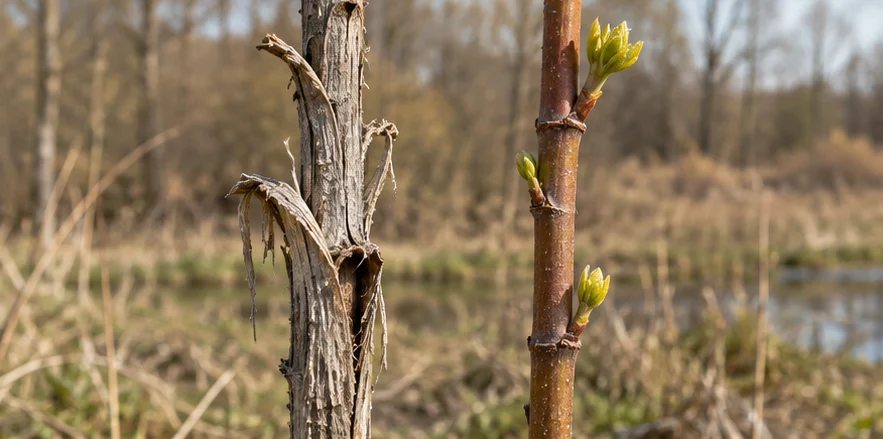
Two dead flower stems stand in front of a spring planting bed. One is upright and pale at its broken tip. The other is darker and already had an opening when the garden was last surveyed. A quick inventory could put both under the same plant name and call them the same kind of nesting resource. Yet their histories differ. One opening may have been available for a few days; the other could have been exposed through a whole period of insect activity. Their appearance, exposure and possible use are different questions even if the two stems grew from the same plant.
Keeping those histories separate matters in ordinary maintenance. A gardener may want to know which standing stem features are available, which were already exposed during an earlier growing season, and which ought to be left undisturbed because their history is uncertain. None of those questions requires opening a stem to see what is inside. Instead, a repeatable surface observation can track whether the end is visible and open, which observations establish its history, and what remains unknown. A record of possible shelter is useful on its own. It should not be promoted into a census of occupied nests.
This article uses first and second year as shorthand for different stem cohorts, not universal age labels for perennial plants. The age of a root crown and the age of a particular stem are not the same. The time since a stalk senesced and the time since an opening appeared are also distinct. State what each age label is relative to: growth, senescence, exposure, or first observation. A small garden can have newly dead stems, already weathered stems and a fresh opening on an older stem within a few feet of each other.
Read the chart as an illustrative surface count
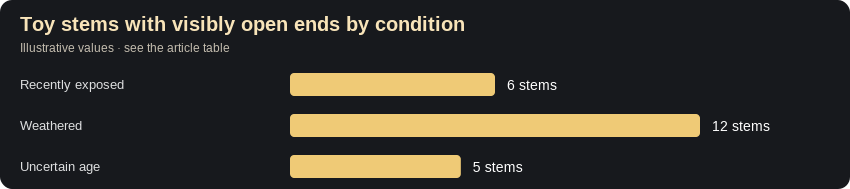
The chart contains invented values: six recently exposed stems with visibly open ends, twelve weathered stems with visibly open ends, and five stems of uncertain age with visibly open ends. They add to twenty-three. The count unit is stems, not openings, insects, nests or surviving offspring. No garden was surveyed for the numbers, and the chart did not come from either Xerces source. The largest bar is simply the weathered class in this example, six higher than the recent class and seven higher than the uncertain class. Nothing about seasonal preference or occupancy follows from that arithmetic.
| Illustrative condition class | Stems with visibly open ends |
|---|---|
| Recently exposed | 6 |
| Weathered | 12 |
| Uncertain age | 5 |
The example gives each stem one display class. That is a reporting simplification. In an underlying record, appearance, exposure date and confidence about stem age can be separate fields. A weathered stalk may have acquired a fresh fracture yesterday, and a stem of uncertain age may have an opening whose first appearance was well documented. A rule for the chart might give a documented recent exposure priority, then classify a remaining item as weathered only when its field evidence supports that label, leaving unresolved cases as uncertain. A different rule could select a different display category without changing the basic observation. Preserve the underlying facts so the calculation can be audited.
There is no denominator of all eligible stems in the graph. It therefore does not show a proportion open within any condition class. A patch containing many old stems might produce twelve visible openings even if its open fraction is smaller than that of a recently exposed cohort. If the project wants proportions, it needs consistent counts of open, not visibly open and unassessed among eligible stems. Do not treat all stems not included in this chart as closed. Some might have been hidden or not within the frame at all.
The Xerces Society nesting resources set stem features in a wider context of nesting materials and behavior. Its guide to nesting and overwintering habitat explains why retaining some natural features can matter and directs attention to what might already be using them. These references support distinctions between a possible nesting feature, its shelter context and a confirmed observation. The chart and survey schema here are teaching examples, not copied field data or prescriptions from Xerces.
Identify the physical unit before naming its cohort
Start with one standing stem and a rule for what counts as that stem. A single stalk may branch near the top. Several stalks may emerge from the same crown, and a cluster may be impossible to separate reliably from a normal path. If one counted record represents an individually distinguishable stem rising from a marked area, avoid counting each of its exposed branches as extra stems. If multiple openings are relevant, put them in a separate field or table. A stem with two visible openings still contributes one stem to a stem-level tally. This is one reason unit labels need to travel with the results.
Define eligibility in terms another observer can reproduce. One study might focus on standing dead flowering stems within a set of ground plots. Another might include broken stems leaning within a boundary. The two designs can both be useful, but they don't count exactly the same resource. A fallen stem in the leaf litter should not be added on one day and excluded the next simply because it is easier to notice. If the stem condition has changed while it remains identifiable, record that transition. If it leaves the scope of the standing-stem inventory, make the reason distinguishable from physical disappearance.
For a small plot, a photo from a fixed angle can supply a stable pattern of field landmarks and help distinguish stems close together. Take notes from a place that does not disturb the habitat. Avoid attaching labels directly to a potentially occupied or fragile stalk. Use stable plot markers or a visual sketch instead. If it is not possible to link a stem confidently across visits, do not invent a persistent identity from a similar appearance. Make it a new or unresolved record with a possible linkage, depending on the purpose of the survey.
Plants with recognizable basal structure are sometimes easy to identify even outside flowering, but dead stems can be difficult to classify. Keep taxonomic confidence separate from stem confidence. You may be certain that a particular photographed stem is still in place and unsure what species it belongs to. You may recognize the plant group in the patch while being uncertain which of two old stalks is the one you saw before. Each statement supports a different inference. Neither should be upgraded silently because the other is clear.
Separate age of the stem, age of the opening and age of the record
Think of a stalk and its opening as separate events. A stalk can grow during one growing season, die back or senesce, and remain standing. An opening can form later through weathering, a break or documented maintenance. The first visible opening date in an archive is not necessarily the date it formed. If the end was intact on one visit and open on the next, the event can sometimes be bounded between those observations. If the earlier end was hidden, the first known visible date remains useful, but the same earlier bound is not justified.
Weathering provides clues, not a calendar. A rough edge or faded surface can indicate exposure to conditions but not precisely how many days it has been open. An old stalk can break and reveal a newly exposed surface. A fresh-looking end can appear on a stem that remained sheltered. Use a descriptive field such as pale break, darkened end or surface split, with photographs where appropriate. Reserve time estimates for evidence that can actually support them. An informed appearance-based classification should be labeled as inferred, not dated like a documented maintenance event.
Age is often relative to the first winter after growth or senescence. If a protocol uses such terms, define them in local context rather than imposing a fixed date that may not fit the site. A mild climate or atypical weather can change the timing of plant and insect activity. A gardener who inherits a bed midway through winter should be prepared to record many stems as uncertain cohort. That is a better starting point than assuming every dead stem grew the previous season. The worksheet should welcome unknown history rather than forcing a guess that could lead to harmful cleanup.
Consider two stems from the same patch in a hypothetical record. One was photographed intact in February and visibly open in April. The other has a visibly open end in both photographs. The first opening can be bounded after the February image and by the April image if the same stem and its view were confirmed. The second opening predated the February view, but its age is otherwise unknown. Both can count as visible features in April. They do not provide equivalent evidence about opportunity duration. A brief timeline preserves that distinction better than a shared seasonal adjective.
A visible end is not a nest inspection
A visibly open tip describes a surface feature. Depending on plant structure, it may show an apparent hollow, exposed pith or a broken section whose interior cannot be judged from the viewpoint. Some stem-nesting insects use existing voids and other groups can excavate suitable material; the details depend on the organism. A feature that looks open to a person does not tell whether it has usable depth, an appropriate diameter or suitable internal conditions. Be precise about the strongest conclusion: there is an apparent external opportunity worth describing, not a verified functional nest.
A capped-looking end needs the same care. Debris, plant tissue or another process could obscure an opening. Some forms of closure may be consistent with insect activity, but an exterior photograph alone may not identify what made a covering or whether anything is inside now. Record observable appearance and uncertainty. Do not probe the end, pry at a plug, tap the stem or cut it apart to resolve the category. A field form can describe a possible closure without calling it inactive or inviting further manipulation.
A reliably observed insect entering a stem might provide useful behavior evidence. It does not establish what happened inside, whether the same entrance was used earlier, whether eggs or immature stages are present or whether anything will emerge later. Document the observation independently from the structural inventory. A good record can carry a confirmed entrance event and unresolved nesting status without contradiction. This distinction matters when a map or maintenance plan might otherwise treat an unconfirmed behavior as either a confirmed brood site or permission to remove everything else.
A particular concern is rereading older photographs through more confident language than they support. A blurry image that hikers once called “bee in a stem” might show only a silhouette on the exterior. Retain the original evidence, update the interpretation with care and avoid upgrading the plant or insect identification beyond its clarity. A mark on a historical photograph can guide a later passive watch. It should not become a permanent label of active occupancy for an area whose stems may have changed or decomposed.
Use research results at their appropriate scale
The participatory study of dead perennial stems supplies primary evidence for the importance of distinguishing cohorts. It tracked occupancy across seasons in sampled gardens, before and after the first winter in relation to its definitions and treatment history. The authors reported bees and wasps using dead cut stems in subsequent growing periods in their study. That distinction makes a chronological record useful: stems exposed during earlier active periods warrant different caution from newly standing stems that have never offered a documented opening.
The paper is not evidence that every first-year stem in every climate is empty or that unknown stems can safely be treated like the newest cohort. The study context, sampled plants and treatment definitions matter. In a given garden some stalks may have broken early, been trimmed before a volunteer arrived or hosted organisms other than the ones summarized in a particular study. If the records do not establish when an opening became available, avoid inventing that history from a calendar. It is reasonable to seek local guidance on garden practice; do not turn a monitored study into a universal instruction to cut anything labeled old or new.
Read the Xerces guidance in the same way. It describes general habitat opportunities and the importance of leaving potentially useful features through part of their life cycle. A picture showing the sequence of dead stems, available cavities and insect development helps explain why repeated cleanup can be consequential. Such illustrations do not classify a particular unidentified stem in your garden. Favor nondisturbance when age and use are uncertain, particularly where doing nothing still serves the site's goals. If necessary maintenance conflicts with a plausible habitat feature, involve the relevant site managers and conservation expertise rather than improvising on a single count.
A survey project does not have to reproduce the researcher's sampling methods to benefit from the paper. There is a difference between taking a field inventory of visible features and directly inspecting occupants under an approved study with appropriate methods. Do not describe the former as validation of occupied nests, and do not make habitat protection contingent on conducting the latter. A credible conservation inventory can answer where apparently useful features are retained and when those features first enter the record, stopping at that useful scope.
Construct a small repeatable observation sheet
A compact record can include plot code, stem or group identifier, visit date, whether the endpoint could be observed and the observed state. Use distinct categories for visibly open, not visibly open and not confidently assessed. The second category describes what the view supported, not proof that no opening exists. Add a condition note for intact, broken, fading or collapsed, and a separate field for the strength of any age estimate. Reliable notes on past maintenance can be linked without claiming they affected ones that were not in the documented area.
Time fields can include when the stem was first recorded, last seen intact and first known open, when relevant. Two observations bounding a transition can support an interval rather than an exact date. If the stem was not observed in between, record that fact. A historical inventory showing the stem was already open does not reveal how long it had been that way. If the comparison needs the minimum known duration of exposure, specify that you are calculating time since first confirmation rather than estimating time since the actual opening.
One design separates a stem table from a visit table. The first table registers units and their first known description. The second tracks what was assessed at each visit, the visible state, whether identity was reliable and any accompanying photographic record. A third, optional layer notes management events or exceptional conditions with their known date range and footprint. If adding a separate table would be excessive, keep those types of information in different fields. The aim is to avoid letting a new interpretation overwrite the earlier observation from which it was drawn.
Prefer simple reason codes over forcing every ambiguity into notes. An unavailable end could be hidden by leaves, out of frame, facing away or no longer present in the defined unit. Those cases mean different things for repeat coverage. Do not infer that an opening filled in because a broad photograph no longer shows it. Do not infer decomposition from an unresolved identity in a dense cluster. A robust data sheet makes it possible to retain a useful low-confidence observation without filling in a missing behavior or transition.
Compare cohorts without confusing exposure with preference
Older standing stems have had more time for some changes to occur. They have also had more time to disappear. An inventory made on one date sees the survivors, not the initial cohort. A low count of weathered stems might indicate that most collapsed, not that few were originally present. A high count of visible openings among surviving older stems can reflect both exposure and persistence. If the question concerns how many stems become available or remain intact, identify a starting cohort and track what happens to its members. A series of cross-sectional counts can still be useful, but it answers a different question.
For an example independent of the chart, imagine ten newly observed stems tracked through two visits. Four are now visibly open, three look intact and three cannot be linked confidently to earlier photographs. It is reasonable to report four confirmed openings among ten initially tracked, plus the other results. It is not reasonable to say that six remain closed. A summary restricted to seven identifiable stems gives a different fraction, which applies to the reidentified group. Neither fraction estimates actual use. The example shows why age-group comparisons need careful denominators and visible gaps.
Observation methods may see recent and old stems differently. New growth can conceal earlier stubble. Tall intact stalks may be easier to identify from a normal route than broken lower stems. Leaf drop can reveal previously hidden features without creating them. If a new observation strategy changes the view, don't interpret every apparent gain as newly available habitat. Keep comparable viewpoints where safe, label what changed, and decline to infer transitions for which identity or visibility is unresolved. Older cohorts may be particularly vulnerable to selection by visibility.
A plot containing many stems from one plant group is not a collection of independent patches. Stems may share exposure, maintenance history and opportunities to break during the same event. Several plants along a trail may also share recurring disturbance. Count units at the level relevant to the question. A garden can report a descriptive tally of observed stems without treating each as an independent test of age. If it wants to compare patterns across sites or plant groups, record the surrounding structure and sample distinct plots or locations as appropriate. More rows do not automatically expand the spatial scope.
Keep management events from rewriting the past
A maintenance record can establish that work occurred on a known date or in a defined interval. It may not show which particular stems were touched or that every exposed end originated in that event. Store the footprint and confidence of the match. If a record says one corner was trimmed, a newly observed opening elsewhere cannot be automatically assigned the same date. A photograph before and after the event may support a stronger link for visible stems. Preserve the original observer's distinction between noted event, correlated change and verified cause.
Also record unexpected events such as wind damage, a fallen branch or an access change if they affect interpretation. A fresh-looking end might reflect a natural break rather than a crew action. A missing stem might have collapsed under snow or moved outside the visible frame. These are alternatives, not guesses to install in every empty field. If a cause is not evident, report it as unknown. This lets later decisions account for uncertainty without distributing unearned blame. A tidy annual chart should not depend on every transition being assigned a causal story.
Avoid using a new display category to overwrite old history. For example, a stem recorded as recently exposed in spring may carry a weathered condition in autumn. That does not make the first entry wrong. A data model with dated visits can show both. If a correction changes the earliest supported exposure date, preserve the record of the correction and why it was made. A distinction between new evidence and aging itself helps readers understand timelines. Without it, a later observer may appear to discover activity when they only updated the label for the same feature.
Where practical, review a management plan with people who know the site and whose responsibilities include access or habitat. A small crew can propose a low-disturbance strip and use a map to show which areas contain old or uncertain stems. There may be reasons to maintain a clear path, control hazards or meet local stewardship requirements. Rather than declaring that any visible stem settles those decisions, retain context and seek appropriate alternatives. An honest inventory makes specific accommodations possible without claiming general authority over a site's requirements.
Work through a two-visit example
Suppose a fictional plot contains four labeled stalks. In March, the first is visibly intact at the top; by April its end looks broken and open. The second is already visibly open in both visits. The third is partly obscured in March and clearly open in April. The fourth is visible in March but cannot be identified confidently in April among several fallen stalks. Under a stem-level counting rule, April supplies three visible openings with reliable identities and one unresolved continuity record. It does not establish three newly created openings or prove that the fourth disappeared.
The age information varies. The first opening can be bounded between the visits if its March view was adequate. The second predates the earlier record, with the actual exposure time still unknown. The third is first confirmed in April, but the earlier hidden state prevents an opening-date bound. The fourth is not a verified loss without further evidence. None was inspected internally. A result table could show each stem's visible state and date confidence, then summarize open counts separately. The same simple record helps avoid both inflated discoveries and falsely precise estimates of age.
This fictional example is not a component of the twenty-three illustrative chart counts. It shows why a photo pair can support a better conclusion than two aggregate tallies alone. If the project is choosing areas for continued low-disturbance management, the unknown stems can still be included with a cautious status. If the project is comparing how long known openings persisted, only stems with adequate repeated identification contribute. Different eligibility rules can apply to the same record, provided a reader can see which one was used for each outcome.
A later visit may add a possible closure on the second stalk. That observation modifies what can be said about its external state, not about an unseen occupant. Keep the older open record and document the newer appearance. If the goal is to distinguish a possible closure from a lost view, record angle and visible extent, not a guess about internal conditions. A map meant for stewardship can flag such stems as features to avoid disturbing. It need not wait until disputed biological use can be settled before making a low-risk choice.
Make the observation useful when no stem can be classified exactly
Sometimes the easiest field result is a group estimate or a photograph of a stand from a normal viewing point. That may only establish visible stem structure at the patch level. It is worth retaining if the method and limits are clear. Do not invent individual stem histories in a dense stand to make each row fit a single-stem format. A patch record and a stem record can coexist in the same archive if the units are explicitly different. The patch may be valuable for a map while remaining ineligible for counts by individual condition class.
Where identification is uncertain, describe the feature independently of the plant name. A cautious report could state that the area contains standing dead stems with some visible openings, and that growth year or time since exposure is unknown for most. This is enough to invite careful management and a future repeat visit from the same viewpoint. It does not promise that all structures have biological value or that preserving them will produce a measured population change. Explain the value of the observation in terms appropriate to what it actually documented.
A simple training exercise can help. Ask two volunteers to classify the same set of photographs and record why their judgments differ. If one counts stems while another counts open branches, fix the observation unit. If one assigns age from color alone and another keeps it unresolved, clarify which visual features justify a descriptive label and which histories require earlier evidence. If they disagree about visibility, keep a not assessed code and refine the camera framing for future visits. The exercise can improve repeatability without requiring a real habitat to be manipulated.
Public maps and reports can share the pattern without disclosing an unnecessarily precise location for sensitive features. Include the actual date range, counts and method, and explain whether locations are shown as aggregate plots. The generated image for this article is a natural-history illustration, not a field photograph and not evidence of conditions in an identified garden. Real documentation used for decisions should retain the connection among the observed feature, its location at the appropriate scale and the time of observation. A visually convincing scene and a dated record do different jobs.
Preserve new evidence without changing the question midseason
A useful survey can follow stems that were already visible at the opening visit and also add later discoveries. Those streams should not be identical in the analysis. The first stream has a defined starting set and lets the project describe persistence among its tracked members. The second tells what is presently discoverable. For a picture of available features, both may matter. For an estimate of how many original stems developed visible openings toward the end of the watch, newly discovered stems do not belong in the denominator. A note that distinguishes baseline cohort from subsequent discovery prevents the project from interpreting improved coverage as a biological transition.
There will be cases where the next visit is better than the first. A low observation angle may become accessible when plants around the patch die back, or a volunteer may find a photograph that shows the point of emergence more clearly. An earlier uncertainty should be reconsidered only to the degree the new evidence resolves it. A newly found original photograph can genuinely improve the bounds on first exposure. A clearer current view cannot establish the prior state from nothing. Store evidence date and review date separately so the archive does not imply that the latest assessment was what people knew at the original visit.
Think about how the operation of the survey affects the habitat. Moving a screen or heavily pushing vegetation aside for a cleaner photo can change the conditions being monitored and may disturb concealed occupants. A passive fixed viewpoint generally yields fewer finely resolved counts than a close inspection; accept that tradeoff when nondisturbance matters. A group can report both the number it could observe and the proportion of its planned area that was actually visible. The precision of the result is not improved by invasive methods inappropriate to the intended activity.
One property likely to change across the year is the number of visible eligible stems, even if the total structure in a patch changes little. New growth can hide old material; a storm can bend stems into the frame or out of it. A seasonal plot of visible openings should therefore carry the count of usable observations and the definition of the viewing frame. Where the window changed substantially, show separate segments. If an independent research project has direct information about use of some stems, report it alongside the visible feature data without merging the two as though visibility were equivalent to confirmed occupation.
Preserve a patch when you cannot preserve every record
A stewardship plan based on surface evidence can make room for multiple kinds of uncertainty. Suppose a public bed needs clear access near a walkway, while an interior stretch can remain undisturbed. Rather than testing which stems are occupied, the crew can map the proposed maintenance footprint and identify places where known older or uncertain features lie inside it. Alter the footprint when feasible and appropriate through the site's usual process. In this example success means that a particular area of standing material was not disturbed, not that a later number of emerging insects can be credited to the plan.
If several groups use the site, share the distinction between newly maintained and previously exposed areas in a way that is easy to recognize. A broadly marked management area may suffice without a detailed public directory of suspected nest spots. Record the reason for leaving that area in the plan and give a future volunteer enough context not to reverse the decision casually. Do not assume a temporary restriction proves any particular internal condition. A management label can persist while the biological status remains unknown, and the archive should distinguish those meanings clearly.
A partial inventory may also identify the most worthwhile places for a later passive observation. If one area has repeated visible records and a clear viewing route, returning there can improve precision about persistence. If another area is almost entirely inaccessible, map it as an evidence gap rather than adding speculative detail. Care does not have to be allocated in the same proportion as survey effort. An unassessed refuge can deserve nondisturbance even if the project cannot count it. This is an important reason not to display unassessed areas as empty white space without labels.
Finally, judge a monitoring program against what it was designed to show. Can another person reproduce the stem-level count under similar conditions? Can they tell the difference between a new visible opening, a newly detected old opening, and a stem whose status is unknown because the view changed? Can a crew avoid a potentially sensitive patch without being told that every stick inside it is occupied? If the answers are yes, a modest surface survey has delivered something useful. It has made manageable decisions possible while leaving the internal biological questions to evidence that can address them responsibly.
Close with a defensible interpretation
An honest summary might say that the team documented surface openings in recently exposed, weathered and uncertain-age stems, and that several monitored examples could be linked across visits. It can state how those categories were assigned and how many stems could not be assessed. It should not claim the count represents active nests. If the work informs stewardship, describe which existing features were retained or which uncertainties shaped the plan. That makes the decision visible without implying a biological outcome was directly measured.
When someone asks whether first-year stems are different from second-year ones, ask which definition of age and which endpoint matter. Time since growth, time since a visible opening and time since the record started are not substitutes. A useful survey preserves all three when it can and admits when it cannot. That small discipline gives the gardener better options: interpret the visible conditions carefully, improve the next round of observations and leave potentially occupied structures undisturbed rather than turning a provisional label into a reason to inspect them.
Before an annual comparison, write down the management questions separately from the count questions. For example, a drop in open ends may justify checking whether a maintained border shifted, whereas a drop in reidentified stems may simply expose a problem in the viewpoint. A rise in the weathered category might reflect persistent stems becoming older rather than a change in overall resource availability. Separating those interpretations helps prioritize an extra photograph or staff conversation without turning every difference into a demand for intervention.
Preserve the boundary of the observed area, especially when new growth makes a subset difficult to see. A clean comparison may need to use only locations represented on both dates while reporting the newly visible area separately. This protects the record from an apparent gain produced entirely by the route, and it gives the project a better basis for choosing a view next season.
Check whether temporal bins still mean the same thing after a revision. If the first edition defined recent as opened since the previous visit, and visits became less frequent, the label now covers a longer possible span. Document that discrepancy or use explicit exposure bounds and a consistent grouping rule for subsequent reporting. A label can be stable on paper even when its underlying observation interval changes.
Sources
- Xerces Society: Nesting Resources. Background on different natural nesting features and groups, not a source of the fictional stem counts.
- Xerces Society: Nesting and Overwintering Habitat for Pollinators and Other Beneficial Insects. Habitat guidance; the organization's fact sheet PDF is another route to the resource.
- To provide pollinator nesting habitat, cut dead perennial stems in their first winter. Original participatory field study; its conclusions concern the study's methods, locations and cohorts, not every standing stem.