
| Category | Value (kg) |
|---|---|
| Whole field mass | 10 |
| Fine fraction | 6 |
Illustrative calculation, not sourced observations. Toy 10 kg total and 4 kg coarse fragments.
A field crew returns with a bucket of soil that takes two hands to lift. The laboratory report, by contrast, is about a carefully prepared portion that could fit into a small jar. Everybody calls both things “the sample.” That shortcut is convenient until the team multiplies a concentration measured in the jar by the mass of the bucket. If much of the bucket was stone that did not enter the analysis, the calculation has quietly changed which material the result represents.
A useful soil report attaches a result to its denominator. A texture result might describe what shares of a fine fraction are sand, silt and clay. A constituent reported in milligrams per kilogram might refer to kilograms of a specified dry analytical material. A field description might express large fragments as a percentage of the soil volume at a particular depth. None of those quantities is inherently interchangeable. They differ both in the material considered and in the measurement against which it was normalized.
This guide uses a ten-kilogram example to make the bookkeeping visible. It is a conceptual example, not a prescribed sampling or analytical procedure, and it assumes that anyone handling actual material follows the procedure for the property and project in question. The main question is straightforward: when someone reads a number, can they identify what was weighed, what was excluded, and what later estimate can legitimately use it?
Start with the sample as a physical object
At the site, “soil” can mean the material occupying a defined space, the material a tool recovered, or the part brought back for analysis. An excavated interval may contain mineral grains, larger fragments, roots and other material; some things encountered in the interval can be too large for the collector's container or inappropriate for the designated laboratory sample. That does not make them unimportant to the field interpretation. It means the limits of the collected specimen need to be recorded in addition to its measured mass.
In a laboratory context, fine earth commonly refers to the fraction smaller than two millimeters, but the particular method determines the actual preparation, size and reporting basis. Further processing can result in an analytical subsample much smaller than the fraction it represents. Distinguish separating a material-defined fraction from selecting a representative aliquot of that fraction. The first changes which kinds of material a number describes. The second aims to leave the target fraction unchanged while reducing the amount handled. The two steps need different checks, and a single line that says “sample processed” does not document either one well.
The NRCS Soil Survey and Web Soil Survey provide context for soil survey descriptions and mapped information. A survey interpretation may show the occurrence or characteristics of fragments for a mapped component or layer. It does not establish the mass of fragments in a particular bucket collected by a field crew. For actual preparation and reporting details, consult the relevant analytical instructions, such as those linked from the Kellogg Soil Survey Laboratory guidance. The study still needs its own measurements to relate the laboratory result to the specimen.
A report can avoid ambiguity with a short sample lineage. Name the excavation location and depth; identify the recovered field specimen; identify the fraction separated from it; then identify the aliquot analyzed and the stated basis of the result. Use identifiers that survive a tape label falling off or a spreadsheet being sorted. If a large fragment was measured in the field but not carried back, that observation belongs in the field specimen's context rather than being falsely added as a measured laboratory mass. When those categories are legible, the absence of a container on the lab bench does not erase the existence of a rock in the ground.
Reproduce the bucket chart
The figure is an invented mass balance, not a result from a USDA dataset, a recipe for a target sample size, or a prediction about rocky soils. Assume the ten kilograms refer to the net mass of all collected material on a consistent dry basis, excluding the container. Four kilograms segregate into the example's coarse fraction. The remaining six kilograms are fine earth. Assume there is no other removed material, no spillage, and no difference in water basis between measurements. Those deliberately simple assumptions make subtraction legitimate.
The chart shows two bars because it contrasts the whole recovered mass with the laboratory's eligible fine fraction. A text equivalent is ten kilograms of whole field mass and six kilograms of fine fraction. The coarse four kilograms are accounted for in the arithmetic but are not a third bar. The fine fraction is sixty percent of whole mass by weight, and the coarse fraction is forty percent by weight in this example. Neither number is a measured proportion of soil volume or a statement about the volume of fragments in the soil before excavation.
To audit the example, imagine two tared pans on the same scale. Write ten for the starting net mass. Put six beside the fine pan and four beside the coarse pan. Check that six plus four returns ten. Then draw a line connecting the six to the reported result. Notice that the line connects the chosen material to the analysis; it need not mean that every gram of six kilograms was put through the instrument. A representative subsample could provide a measurement for that fraction without its individual mass being the basis used to scale the whole field specimen.
If the example were field moist rather than dry, the subtraction would require compatible moisture states. An apparently simple balance like ten kilograms at collection and six after drying cannot be assigned a four-kilogram coarse fraction merely because the numbers fit the template. Some of the difference could be water. Likewise, if a tool or tray retains material, an unexplained deficit does not prove that everything missing was coarse. The example's closure succeeds because it explicitly describes a complete two-part accounting under the same conditions.
Precision deserves a note as well. Measuring to the nearest kilogram is sufficient for the illustration, but if recorded values in a practical ledger are rounded at different stages, the displayed values may not sum exactly. Retain the actual available measurement precision and state how close a check is expected to be. The decision to investigate a discrepancy should take measurement resolution and method into account rather than relying on a universal closure threshold for all soil handling. Write down whether any reported difference is within an agreed tolerance or simply unresolved.
Carry units through the intended calculation
Suppose the laboratory reports an invented concentration of one hundred milligrams per kilogram of fine earth on the example's dry basis. If the reported concentration adequately represents the six kilograms of eligible fine earth, the estimated amount of constituent in that fraction is six hundred milligrams. Multiplying by ten would instead give one thousand milligrams. That second calculation can be tempting because ten is the actual field mass. It would implicitly assign the same concentration to the four coarse kilograms, something this analysis did not test.
There are three different numbers an analyst might be trying to report. The first is the measured concentration in fine earth, which remains one hundred milligrams per kilogram in the premise. The second is the estimated amount in the fine-earth material recovered, six hundred milligrams. The third is the concentration for the whole recovered specimen. That third number cannot generally be obtained without knowing the relevant contribution from the coarse fraction. Dividing six hundred by ten gives sixty milligrams per kilogram of whole specimen attributable to the fine fraction. It is not automatically the total concentration of the whole specimen.
If the objective and evidence establish that the selected constituent is absent from the coarse material, or if a stated calculation intentionally represents only the fine contribution, report that basis expressly. Otherwise keep the unknown. For an illustrative contrast, suppose a separate compatible analysis found fifty milligrams per kilogram in the coarse material. Its four kilograms would contribute two hundred milligrams. Combining separately estimated constituent amounts gives eight hundred milligrams over ten kilograms, or eighty milligrams per kilogram of whole material on the stated basis. That result depends on the second analysis. It is not a corrected version of the fine-earth result, and the original one hundred remains the concentration for the fraction it describes.
This simple balance is appropriate only for an additive quantity and compatible definitions. A measured property can depend on preparation or on interactions among constituents. Averaging two pH values by mass is not the same exercise as summing quantities of a conserved constituent. A classification, an index of structure or a method-defined extractable measure can require its own interpretation. Before scaling, confirm what numerator the laboratory test actually supplies. Correct multiplication never rescues a mismatch in what was measured.
Write calculations with units on one line and check that the mass denominator cancels. Milligrams per kilogram of fine earth times kilograms of fine earth can give estimated milligrams. Milligrams per kilogram of fine earth times kilograms of whole soil leaves a material mismatch even if kilograms cancel typographically. This is why preserving fraction identity in a label can be more important than choosing how many decimal places to display. A units error is not always caught by a familiar unit symbol; sometimes the extra words following the symbol carry the decisive information.
Water, stones, and packaging are different subtractions
Begin bookkeeping with a container tare where the method calls for one. Do not treat an apparent field mass as net just because somebody named the column “soil mass” on a spreadsheet. A liner, bucket or bag can be present in the scale reading. A receiving laboratory may weigh a different package after transfer, so net and gross figures should not be directly joined without checking their bases. A robust record says which were observed independently, not only what the final result calculator assumed.
Moisture is another distinction. Material can lose water without losing soil. Conversely, a packed wet cap around a stone can contribute to a field reading while ending up in a different fraction after preparation. Keep moisture conversions tied to the specific method and material they represent. A moisture determination on the fine fraction does not automatically establish the water content of the entire excavated material, particularly when other components retain or shed water differently. If a study only has a field-moist whole mass and an analysis reported against a dry fine fraction, the connection may require additional information.
Do not assume that “air dry” is shorthand for any dry basis. An analytical protocol can use air-dry material for handling while reporting a result on another defined moisture basis. Repeated measurements made on different preparation states can look inconsistent when they simply have different denominators. The NRCS Soil Survey Field and Laboratory Methods Manual provides context for separate preparation states, particle fractions and conversions. For a real report, name the method used and respect its measurement and reporting definitions rather than borrowing a default correction from a simplified example.
An unexplained loss should remain an unexplained loss until the record resolves it. A crew might record ten kilograms at the start of a controlled dry exercise, recover six kilograms of fine earth, and weigh only three and a half kilograms on the coarse pan. Half a kilogram would be unaccounted for. It would be wrong to enter four kilograms in the measured coarse column by subtraction unless the procedure explicitly supported attributing the entire remainder that way. Keep observed and inferred masses in different fields. If the missing material can be located or the entry fixed, document what changed.
This limited example also protects the meaning of unsampled material. A boulder exposed along a sample interval may not go into the container. A measured or estimated volume describing the site belongs in the field description, not in the sum of recovered kilograms. If a project needs a representative stock or mass for the entire interval, the plan has to account for such material explicitly. The boundary of what went into the bucket cannot be used as if it were always the boundary of a defined volume in place.
Weight and volume answer different physical questions
The chart's forty percent coarse fraction is a share of the recovered dry mass. A soil description may instead use the volume that fragments occupy relative to the whole soil volume in place. Consider two imaginary samples, both with the same mass of rocks. If the rock materials have different densities, those equally heavy amounts need not occupy equal volumes. If the same rocks were rearranged in fine material with a different pore structure, the denominator of the whole volume could change as well. A mass percentage carried into a report as a volume percentage therefore represents an assumption, not a convenient change of label.
For a narrow quantitative demonstration, assume the four kilograms of coarse material occupy an independently measured 1.6 liters and the whole volume represented by the specimen is eight liters. The illustrative coarse volume fraction would be twenty percent: 1.6 divided by eight. Its mass fraction would still be forty percent. This example assumes the assigned total volume is suitable for the comparison and that fragment and whole volumes are defined compatibly. It is not a proposed density for all rocks, a reconstruction of how the original bucket was packed, or a claim that a liter of loosened soil stands for a liter of undisturbed soil.
When using a bulk density in an estimate, identify its object. Is it mass of dry fine earth per volume of fine-earth fabric, mass of fine earth per volume of whole soil, or mass of all dry material per volume of whole soil? Those choices can lead to different numerical densities. A coating removed from a fragment or a porous fragment can raise additional method-specific questions. Do not substitute particle density for bulk density or presume all published values use the same denominator. Write each label in full when composing the calculation rather than relying on similar abbreviations.
The Kellogg Soil Survey Laboratory Methods Manual includes calculations that distinguish mass-based fractions from whole-soil volume and that retain different sizes of rock fragment as appropriate. Its value here is to show the measurements needed behind the terminology. Do not copy a method's assumed inputs into a site-specific estimate if the procedure, material or reporting purpose differs. A methods manual is not a guarantee that absent project measurements can be filled from a nearby map.
If the result needs to scale to land area, the fractional distinction remains important. A reporting depth defines a volume only when paired with appropriate area and boundary information. A representative mass per unit of whole volume may then support a stock calculation for the target fraction. At that stage ask whether the sample location, thickness, fragment estimates and laboratory outcome represent the area being summarized. A correct conversion for one specimen is not evidence of spatial representativeness. A soil map can help plan that question but cannot make a convenience sample answer it.
A texture number is not the contents of the shovel
Think of an imaginary fine-earth sample with equal proportions of sand and silt and a smaller share of clay. Those texture proportions describe the specified fine fraction under the problem's method. When the fraction is reported as forty percent sand, another forty percent silt and twenty percent clay, it sums to one hundred percent of that fraction. It does not leave room in the same hundred-percent column for larger rocks unless the writer changes the denominator for every row. A texture description with a fragment modifier can carry both pieces of information, but the label itself remains meaningful only under the rules of the classification.
Using the toy specimen, if the prepared six kilograms genuinely has those fractions on the stated mass basis, it would include 2.4 kilograms sand, 2.4 kilograms silt and 1.2 kilograms clay in this simplified case. Their sum is six, not ten. Adding four kilograms of the separated coarse fraction recovers ten. Relative to the whole recovered dry mass, those amounts correspond to twenty-four percent sand within the tested fine component, twenty-four percent silt, twelve percent clay, and forty percent coarse. This last partition is a whole-recovery bookkeeping exercise. It is not the normal form of the fine-earth texture report and should not be mistaken for one.
This kind of distinction is easy to lose in a graph. A stacked display of the fine-earth percentages at the left and a single bar for coarse volume at the right can be valuable if the captions clearly say that they are measured against different things. Adding them to a single stacked total can create a physically meaningless result. A good figure references the workflow that actually generated the quantities. Mark whether parts describe recovered dry mass, in-place whole volume, or percentages within the passing fraction. Those extra words are more important than making two bars visually comparable.
A question about how soil behaves in place may require both particle description and arrangement. Finer grains do not promise any particular amount of plant-available water on their own, and a measure of rock abundance does not by itself establish root access or drainage behavior in a particular layer. Avoid extending the mass balance into predictions it did not model. Separate the data and the subsequent interpretation: first say what was measured, then name the additional hypotheses or evidence that address use in place.
Decide when to retain the coarse fraction
A study measuring a property intentionally defined on prepared fine earth may not need to analyze every separated fragment. It can still benefit from recording measured coarse mass, field descriptions or other information necessary to describe the parent specimen. That protects a later reader from trying to apply the fine-earth number to a denominator that the lab never tested. If another group later wants to characterize the coarse part, the original analysis can remain valid even if that additional question is unresolved.
If a decision depends on the whole specimen's composition, identify before sampling which components need separate measurements and how common definitions will be justified. The material excluded by one standard may not be suitable for the same measurement procedure as the material included. A valid combination requires more than two numeric rows with units that look alike. Consider which test fraction, reporting basis and quality checks apply to each result and whether their numerators describe the same addable quantity. When they do not, reporting separate descriptors may be the correct final output.
Material retention also has practical limits. A reserved component should be appropriate to the method and maintain an identifiable path back to the parent sample. A labeled empty bucket cannot tell a future analyst what you left in the field. A retained fraction can lose usefulness if the target property changes under handling or storage, so do not promise future analyses just because an object remains on a shelf. Where removal or disposal is appropriate under the plan, preserve the decision, provenance and basic measurements in the record. Use project and laboratory safety procedures for actual materials.
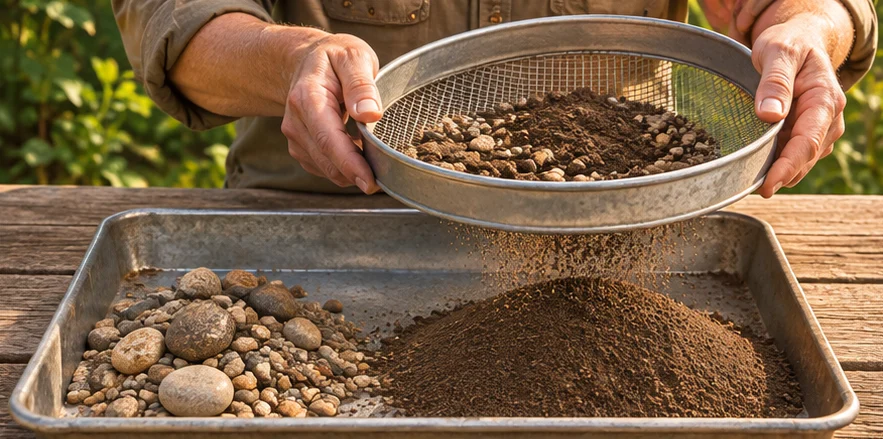
An editorial package can document a coarse fraction even when images of it never make the report. Use a small inventory with size or description where relevant, how it was accounted for, and whether any proportion came from an estimate rather than a weighing. A photograph of a tray makes the distinction concrete but does not replace those fields. If the only surviving evidence is a photo, say what it demonstrates and what it cannot quantify. It is better to leave a denominator unresolved than to give a good picture numerical powers it does not possess.
Review a method change before calling it a soil change
Imagine two review years. In the first, the laboratory reports a dry fine-earth concentration and the field team records masses in each measured fraction. In the second, the laboratory reports an ostensibly similar number but the supplied metadata does not identify a fraction, and the field mass was recorded wet with a bag. A graph with one clean line might imply that a decrease reflects the site. The correct first move is to compare definitions. Are both values from the same preparation, fraction and moisture basis? If not, can the available metadata support a valid conversion for the target question? Sometimes the only safe comparison is within each appropriately described method.
A change in fragment abundance can affect relationships among whole and fine results even if the fine-earth concentrations happen to be stable. Suppose two toy specimens each contain ten dry kilograms and each has a fine-earth concentration of one hundred milligrams per kilogram. One has six fine kilograms and the other eight. The estimated quantity attributable to the measured fine fraction is six hundred or eight hundred milligrams, respectively. The fine-earth concentration did not increase. The amount of relevant material changed. A report should not summarize that outcome as a twenty-unit increase in concentration. Label the metric and its support and separately identify what remained constant.
The opposite phenomenon is possible too. If repeated records show a different fine-earth concentration but stable whole mass, do not say that a whole-specimen aggregate necessarily changed by the same percent without knowing the component proportions and composition. Good reporting identifies which data went into each estimate. If some of the apparent change results from substituting volume for mass or estimating a fragment ratio differently, record that method break. A later analyst should be able to choose which intervals can be compared without relying on memory of a caption.
Design a continuity check that looks at definitions before values. Use one comparison row per result with field specimen identity, prepared fraction, water basis, units, depth, handling exceptions and analytic method. Compare parallel versions side by side. A field changed from measured to estimated belongs in a separate quality column, not in the same series with only a tiny footnote. If archived samples or sufficiently detailed intermediate measurements remain available under the appropriate handling conditions, they may allow a more defensible comparison; the record should state what was actually verified.
The label “same site” does not resolve all these questions. A crew can resample the same marker while changing the interval, the treatment of visible fragments or even what portion of the pit was considered retrievable. That means the sampling support changed while the location alias stayed stable. Write depth and specimen selection into the field record so a change can be separated from a surprising result. Spatial continuity, analytical comparability and historical documentation are complementary checks rather than substitutes.
Create a record that catches two kinds of mismatch
The first is a material mismatch: multiplying a result for one fraction by another fraction's mass. The second is a state mismatch: combining masses from different water or preparation states. A useful worksheet can catch both by requiring comparable labels and a reason for any conversion. Separating gross from net, measured from inferred and fine earth from whole soil need not make field entry much harder. Give people a short set of choices plus room for explanatory notes and a way to flag uncertainty.
For the fictional bucket a reviewer should be able to locate the starting dry net mass, fine fraction and coarse fraction, then trace a chosen amount estimate without depending on a scribble on the tray. Record the water basis before listing the mass fields in an example. Keep a separate balance that indicates whether the actual measurements close under that basis. If closure requires assuming that nothing else was removed, flag the assumption rather than describing it as a new observation. The chart is designed from known toy parts, so closure is exact, but a field worksheet should be prepared for cases that do not add up.
Carry the identity of the analytical aliquot. It might have a lab accession number, a different preparation identifier, and a separate reporting date. A useful handoff includes the exact result or its authoritative location and enough information to know which fraction it describes. Preserve the original report before converting terms into a cleaner standardized table. If you find a mismatch, repair the derived row and add a note rather than editing the lab's original document so future reviewers cannot see what changed.
One way to test the workbook is to enter an intentionally unsuitable result such as a wet whole mass with a dry fine result and make sure the amount calculation does not proceed automatically. A second test can use dry whole mass with a fine result and check that a labeled amount attributable to the fine fraction works only when the fine mass is filled. A third can leave the coarse composition unknown and confirm that the sheet does not publish whole-specimen concentration without qualification. These checks are more convincing than one demonstration in which all inputs were compatible from the start.
The next version of the workbook might offer classifications of coarse materials in several size ranges. Do not let the existence of extra columns silently move the cutoff used for older rows. Give each method version its own declared definitions. If a harmonized category can genuinely be derived from the source records, retain both the original records and the new grouping rules. A shortcut that makes reports visually comparable can make the estimates less comparable if it changes how actual materials enter the denominator.
Report uncertainty separately from arithmetic
A common analysis begins with known mass and an uncertain concentration. The balance-scale reading might be precise while the subsample does not capture fine-fraction variation well. Or the concentration estimate could be reproducible and the actual recovered mass poorly known because handling records were incomplete. These uncertainties affect different terms in a scaled estimate. Describe what each rests on rather than reducing all the variation to the number of decimal places in the final amount.
Use a simple sensitivity example when it clarifies the decision. Imagine the fine mass is fixed at six kilograms and a plausible range of comparable concentrations is ninety to one hundred ten milligrams per kilogram. Then the fine contribution under those stated bounds ranges from five hundred forty to six hundred sixty milligrams. This calculation is not a statistical confidence interval. It is a record of how chosen inputs affect a result, and its usefulness depends on justifying the chosen range independently. If the concentration range is simply invented in a classroom, label it accordingly.
By contrast, the uncertainty about an untested coarse fraction may not be bounded by the same reasoning. A fine-fraction replicate does not tell you what composition a rock has. If the whole-material estimate is needed, consider which additional evidence can resolve that unknown rather than producing an impressively narrow range from fine-fraction measurements alone. If the project does not need a whole estimate, leave that question open and report the measured fine result appropriately. Transparency does not require making an estimate for everything.
Assess representativeness independently. A complete balance of kilograms for the recovered sample does not establish that its proportions represent a whole plot. A sample taken at a convenient accessible location can miss larger features that were obvious elsewhere or were excluded by the sampling device. Spatial questions require a design that represents those places and a record of exceptions. The useful learning is that you can validate all the arithmetic and still need to revise the scope of the claim.
Put a denominator in the caption and the takeaway
A compact caption can read: illustrative recovered dry masses, ten kilograms for the whole specimen and six for the fine fraction; four kilograms of coarse material are the difference under the example assumptions. This tells someone reading the page in plain text the same thing the bars show. Do not imply that the chart depicts natural density, field volume or a national survey. It compares two related masses in one accounting example, not two independent field samples. The different-looking textures in an accompanying illustration are descriptive rather than measured evidence.
A real report can use the same structure with appropriate detail. Where the result is a concentration, label it with its material and moisture basis; where it is a stock or amount, say how it was scaled and what component was excluded or independently assessed. Include the laboratory method and relevant provenance so another reader can tell whether two columns share a definition. If the field estimate refers to whole-soil volume, put that distinction next to the value instead of expecting a glossary at the end of a report to repair a misleading unit.
One final check is especially helpful when a result will pass through several editors. Ask a person who has never handled the specimen to tell you, from the caption and unit labels alone, whether the number applies to the recovered whole, the fine fraction or an in-place layer estimate. If they cannot tell, tighten the labels before publishing. If they say the whole bucket was analyzed when only its fine fraction was represented, the report still has work to do even if every technical formula is correct.
The takeaway is not that stones should always be removed or always retained. It is that both physical actions change what evidence is available and need to be reflected in the record. A soil survey can give broad context, a collection note can describe the field material, and an analysis can estimate a property for its prepared fraction. A reader should be able to use each of those honestly without pretending they are all measurements of the same object.
A sample label that travels into a second project
Consider a numeric archive assembled for educational exhibits. A second group finds a field specimen reference and a fine-earth result, but its goal is to compare the mass of material transported from two sites. The original record may support that question if net recovered masses were independently recorded on a compatible basis. The lab result cannot be used as a substitute field mass, and a mass written beside the lab aliquot does not tell how much coarse material came along. Give the records distinct units and names even when they remain linked under one parent identifier.
A third group later needs only the particle-size distribution within the fine earth. It should not be forced to reconstruct excavated volume to use a result explicitly and adequately defined for its fraction. Keeping the data modular is useful: the sample record can carry a physical history, the lab record can specify what the instrument measured, and each secondary analysis can state which metadata it needs. A single composite "soil description" field often works for the first draft yet frustrates later reuse. Good structure lets readers reuse trustworthy parts without overinterpreting incomplete ones.
An ordinary two-row text table can travel even when a graphic stays behind:
| Item | Illustrative dry mass |
|---|---|
| Whole field mass | 10 kg |
| Fine fraction | 6 kg |
Both rows refer to the same specimen and basis. The second is a subset of the first, not a separate measurement to be added to it. If a partial export shows only the table, that relationship and the fictional status should still be visible. It takes only one clarifying line to prevent a sixteen-kilogram interpretation of a ten-kilogram exercise.
References
- NRCS Soil Survey and Web Soil Survey, for soil survey and map context, not the quantitative toy values.
- Kellogg Soil Survey Laboratory guidance, for official procedure and submission resources.
- Soil Survey Field and Laboratory Methods Manual and Kellogg Soil Survey Laboratory Methods Manual, Current Methods, for preparation and distinctions between mass and volume bases.