
| Category | Value (signs) |
|---|---|
| Same category | 16 |
| Higher under revision | 4 |
| Lower under revision | 2 |
Illustrative only. Invented values, not taken from a source dataset or an official target. Define paired recoding with archived exemplars when trail sign damage categories change; preserve policy change versus actual degradation.
A park team opens its inspection dashboard and finds that the number of badly damaged trail signs has jumped. No storm stands out on the calendar. The photographs show several familiar signs, and a reviewer notices that the new inspection form classes faint directional arrows as a more serious problem than the old form did. The dashboard has combined at least two kinds of change: signs changing in the landscape and rules changing in the office. It may also have combined changes in what was photographable or which routes were inspected. A count without version information cannot tell any of these stories apart.
The cure is not to keep a poor rubric forever. A team may have good reason to distinguish a legibility problem from a surface blemish, or to prioritize information that is essential at a junction. The remedy is to preserve the original observation and the rule that produced it, then apply both versions to the same archived evidence when a comparison is needed. If the photographs were taken at different times, they can help ask a separate question about physical change. Pairing by both evidence and purpose prevents an editing decision from appearing as deterioration in the field.
This is a maintenance example, not a trail signage standard. The U.S. Census Bureau's Statistical Quality Standards are useful as a methodological analogy because they distinguish coding and processing problems from measurement and coverage problems and call for planning and evaluating quality. They do not govern this park illustration or prescribe a sign inspection policy. The aim is to apply the distinction with enough specificity that a later reviewer can reconstruct which part of a dashboard shift came from a new rule.
The word damage usually hides two jobs
Start by asking whether a rating describes physical condition, the impact on wayfinding, the urgency of action, or some combination. Peeling paint can be a physical defect even when letters are clear from the intended route. Slight contrast loss on a critical arrow can impair use without making the panel look visibly battered. A fallen support is a different issue again. If the system uses one severity label for all of these, the rubric needs to state how they interact. Otherwise reviewers fill in the weighting themselves and the same final category can mean several different things.
A change in priority does not always imply new damage. Suppose a previously obscure junction becomes the official detour, so the sign now carries more wayfinding responsibility. Its current condition may justify a higher urgency rating under the park's priorities. The wood, paint, and contrast may not have changed at all. A well-designed record has a place for physical findings and a place for current action status. It should not require editing yesterday's description to justify today's dispatch.
The reverse problem is also possible. A protective coating peels from an inactive panel intended for removal. The physical condition worsens but no immediate wayfinding consequence follows because the panel is no longer in service. A project that conflates priority and material condition will be unable to show why some defects receive attention sooner than others. Separate fields make it possible to choose a useful operational priority without losing the facts needed for a historical condition series.
The revision memo should give one sentence naming the construct changed. “Specify a more reproducible boundary for blocked arrows” describes a refinement of a classification rule. “Treat any obscured turn arrow as a higher maintenance priority” describes a change in how an observation influences action. “Add stable or loose mounting from a documented check” describes a newly measured feature. Each may be worthwhile, but they yield different bridging options. An old photo could support the first, help with the second if the old junction context is known, and supply no defensible answer to the third if the relevant mounting evidence was never recorded.
Take care with illustrations used to explain a version. A particularly weathered panel beside a newer one looks like a clean before-and-after story. Unless the panels actually represent same-unit repeated observations, it is only an illustration of two appearances. The editorial image for this article makes no claim about a specific trail, the date of inspection, or a measured change. An archive image tied to a dated inspection has a different evidentiary role and can be selected as a scoring example if it meets the purpose of that example.
Keep the original rating and its evidence separate
An inspection system should retain source evidence or a reference to it, the observed features, the categorical rating, and the rubric identifier. Those do not need to live in one giant record, but their associations should be recoverable. The object could be a sign panel, a face on that panel, a mounting assembly, or a whole station that includes more than one directional message. Define the unit before rating. A busy junction with four directional faces should not count as four signs in one report and one sign in the next without explanation.
The version identifier belongs at the rating level. One organization may issue a new mobile app before everyone is trained on the new criteria. Another may roll a form out district by district. Recording the inspection date is necessary, but it may not establish which rules were applied, especially for records submitted late or regraded months later. Record the actual version where known and leave it unknown where it cannot be recovered. A default assigned by date should be described as an inference, not quietly treated as a field observation.
Preserve the time of inspection separately from the time of annotation and the time of publication. A picture taken last spring may be scored this winter for a bridge study and then used in a report next year. A record dated only at publication can make the sign appear to have been inspected in a period when no one looked at it. If the file has a camera timestamp and a manual inspection date, retain the distinction and investigate conflicts rather than choosing whichever date helps a plot line run cleanly.
Keep observation notes at the level they genuinely support. “Diagonal crack across the lower right corner” is different from “panel unstable.” The first could be well supported by a photo. The second may require evidence that an old photograph cannot supply. “Arrow not legible in this reproduction” is not automatically “arrow not legible to a trail user,” since image compression, glare, and camera angle may interfere. A useful source record says how its conclusions were obtained. Those details later determine whether archived evidence can fairly be used under a revised rubric.
An archival correction and a new version should be different transactions. If an old record says face A was photographed but the original inspection sheet unmistakably identifies face B, a traceable correction can fix a clerical error. If a reviewer assigns a new severity because the rules changed, create a new versioned rating and keep the old result. One improves the fidelity of a record to the original event; the other adds a new interpretation. Both can be justified. Neither should be a silent overwrite.
A bridge study holds the evidence still
Take one eligible evidence packet per observation unit and apply both rubrics to it. An evidence packet can include images taken together and written observations available at that inspection. If the question is how the rule alone affects classifications, the underlying packet must be the same for both ratings. Running yesterday's rule on a close-up and today's rule on a new wide-angle photograph changes two things at once. Any rating difference would then be difficult to interpret.
Select bridge cases deliberately enough to reveal how the rule works. A set of canonical exemplars may cover scorings from minor to major and include close borderline examples, unusual mounting, glare, and signs with conflicting features. Exemplars are good for training and for probing decision boundaries. They are not automatically representative of the entire inventory. If the project wants to estimate how often a rating would change across an inventory, draw a credible sample of eligible records or explain why the set is purposive and limit the estimate accordingly.
Archive information can limit eligibility in ways a polished migration plan does not anticipate. Suppose the new rubric distinguishes an unreadable sign at the user's approach from one that looks worn in close-up. If archived evidence contains only cropped face images, the former criterion may be unscorable. Label that eligibility problem and show how many records it affects. Do not treat the absence of a wider image as proof that the sign looked fine in context. More archival data entry does not repair a missing view.
Rater assignment can also become confounded with version. If the staff member who wrote the new guide grades every revision and another person grades every historical rule, a between-version difference can partly reflect reviewer judgment. There is no single ideal staffing solution, but a credible plan could spread both rubrics across readers, include common anchors, and keep a modest duplicate set to show ordinary disagreements within each rubric. If the same reader applies both versions to one packet, consider spacing or randomizing tasks to reduce memory of the original score. Record which parts of this plan were actually possible.
Whenever feasible, withhold the previous rating from a fresh grader until they have scored the evidence under the assigned guide. Access to the previous label can anchor the new result or provoke a desire to change it, depending on project culture. The point is not to conceal task-relevant historical evidence. It is to avoid letting the answer to one measurement determine another one that is supposed to be assessed independently. After the scores are saved, an adjudicator can review disagreements with both results in view and preserve the original judgments.
Separate individual scorer variation from definition uncertainty. A reader may make an evident clerical error or choose an incorrect branch of a decision tree. Another difference could be a defensible result of how each rule treats the same example. A third difference may arise because the revised definition still leaves an unclear boundary. Keeping short reasons beside the ratings helps the team specify whether the appropriate remedy is clerical repair, a clear note about policy change, or another refinement of the rubric.
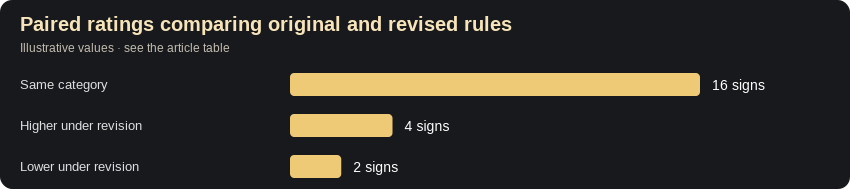
Paired ratings comparing original and revised rules
This chart contains invented counts, not field observations, a target for agreement, or numbers from the Census Bureau's standards. Its unit is signs with one usable paired grade per sign. In the toy example the old and new guides share an ordered scale, and each of the twenty-two signs has enough archived evidence for a grade under both versions. The categories describe revision minus original in direction only; they do not claim that a grade difference measures physical distance between categories.
| Outcome under paired review | Signs |
|---|---|
| Same category | 16 |
| Higher under revision | 4 |
| Lower under revision | 2 |
Six of twenty-two moved category and sixteen did not. About 72.7 percent stayed in the same category within these fictional usable pairs, while about 27.3 percent moved. Of the six cases that moved, four moved higher and two lower. These are counts of movements after applying a different rule to the same evidence. There is no passage of field time in the table, so the higher bar is not an observation of four signs physically worsening. Neither is the lower bar a report of two completed repairs.
The counts cannot identify a change in the number of signs above a particular intervention threshold. A move from minor to moderate may stay below a repair trigger, while another move between adjacent categories could cross it. The chart does not identify the original or revised category for each sign or how many thresholds each movement crossed. Simply subtracting two downgrade counts from four upgrades yields a net of two directional movements, not a change of two in any named severity class. To answer an action question, use a table that retains both actual categories and the current policy threshold.
The NIST/SEMATECH graphical techniques gallery is a useful reference for choosing exploratory views of data. It is not a source of the chart's invented numbers or an official recommendation for a sign-rating graphic. A compact direction chart can signal that a version effect is worth inspecting. A detailed transition matrix, a table of excluded cases, and a run-sequence display marking version adoption may be better for explaining the system to an operations team. Give each display one clear question rather than asking a single colorful bar to substitute for a protocol.
A transition matrix shows which boundaries matter
Put old categories down the rows and new categories across the columns. A cell counts records with that specific pair of labels. If the categories have the same meaning and order except for particular boundaries, the diagonal shows unchanged results and the neighboring cells show crossings. If names or meanings changed substantially, label the axes explicitly and resist treating the diagonal as automatic agreement. Two codes both called moderate may have different operational definitions. Two codes with different names may be equivalent for one purpose but not another.
Now add the action rule. For example, a team may consider any sign with an obscured directional arrow a high-priority work item under the new policy, even if much of the panel remains readable. It can show which paired ratings would change dispatch status, regardless of changes that occur within the same priority group. This separates the number of rating disagreements from the number of policy consequences. A change that moves very few signs might still affect a critical set of directions, while many changes elsewhere might be routine codification with limited impact on work scheduling.
A single agreement percentage is not enough when categories have very different base rates. Imagine that most archived signs are clear and receive the least severe category under both rubrics. Overall agreement would be high even if every example near an important boundary changed. A training evaluation might disproportionately include edge cases so the team can see how interpreters handle them. An inventory estimate should instead describe the sampling proportions or any justified weighting needed to connect that enriched set to the full inventory. Neither goal requires misrepresenting the other.
Be cautious with summaries that assume equally spaced scores. If categories are ordered, it can be valid to say one precedes another in severity. That does not mean the transition from minor to moderate has the same impact as moderate to severe. Assigning the numbers one, two and three can be a useful internal code, but averaging them as though the distances were observed physical quantities is a separate choice that needs justification. For many decisions, threshold counts and the actual paired cells convey much more. If some new categories are not even ordered with respect to the old ones, use labels such as comparable and not comparable instead of inventing a direction.
A version comparison should also reserve a place for unknowns. If a sample contained several signs with damaged or missing archive files, the transition matrix describes only the subset with both ratings. A table of eligible and ineligible records by route, date, or sign type can reveal that the strongest-looking inventory pattern comes from the easiest cases to regrade. If the archive retains photos mainly for more dramatic incidents, the eligible subset may be enriched for high severity. “Same category in 72.7 percent of eligible toy pairs” is accurate. “Most historical records would stay the same” is not supported unless there is evidence about representativeness.
A second comparison keeps the rule still instead
Assessing physical change over time calls for a different pair. Use observations from the same sign or clearly defined unit at two times and apply a common defensible definition. Provided both evidence packets support that definition, the comparison removes the rule change as a source of scoring difference. It does not automatically remove different angles, lighting, or occlusion, and it cannot remove physical replacement disguised by a reused site number. Keep a broad statement about what remained comparable as well as what changed.
Imagine a sign panel viewed in full shade in May and under specular glare in October. In the October image an arrow looks almost invisible. That could reflect deterioration, but it could also be a feature of the recorded image. A supporting note, well-matched source image, or documented context may help. If October evidence cannot distinguish those possibilities, “condition change unscorable” is a better result than a confident decline. The rubric is held constant, but the observations themselves still need to be considered.
Conversely, a visible crack that starts in May and clearly extends in October under comparable views is direct descriptive evidence of change in that physical feature. It may not change the category because both observations fall within the same class. A condition series that stores only ordered labels can miss important movement within categories. Retaining qualifying observations makes it possible to report clearer examples: “crack extended across the arrow face, but both grades remain moderate under the current rule.” This is more useful than treating an unchanged bar chart as evidence nothing happened.
Replacement and repeated position need particular care. A crew might replace a sign at a station while leaving its identifier unchanged for routing convenience. A study of the condition of individual panels cannot interpret that as the same object improving over time. A station-level serviceability series could call it an improvement at the station, and make the panel replacement the explanation. Both accounts are reasonable if their units are defined. A single anonymous row called “marker changed” does not let a later reader distinguish wear, restoration of an existing object, and installation of a different one.
Where both kinds of evidence are available, consider presenting the two comparisons side by side. One column summarizes differences from scoring the same archive under two rules. Another summarizes differences over observed time using one rule. This helps a manager understand whether a conspicuous jump is associated with a rule or with change in the physical inventory. It does not give permission to subtract one rate from another indiscriminately. Each may come from an eligible subset with different characteristics and times. The comparison is diagnostic, not necessarily an exact decomposition of a published trend.
Do not splice an unbridgeable gap into a clean-looking trend
A report may discover that signs inspected before a certain year were never photographed from approach distance or that a processed archive stores only previous category codes, not source evidence. A conversion table based on one recent set may fail for these historical records. A prior label sometimes contains enough information for a deterministic mapping if old and new definitions align completely for that class. But if the same old category can become two different new categories depending on an unrecorded feature, the new grade is not identified. A note saying “no comparable historical measure” is a result, not a lack of effort.
If historical reconstruction matters, put forward options with costs in information and uncertainty. One possibility is to retain each era's reported categories and mark the break on the graph. Another is to build a broad common category that both eras really measured, after explaining the detail it sacrifices. A third is to estimate a conversion from adequate paired data under explicit assumptions, display uncertainty and scope, and keep the observed records distinct from the estimates. The choices depend on the purpose. A rough historical description does not justify retroactively assigning authoritative maintenance grades to specific signs.
The horizontal axis of a chart is a good place to show deployment complexity. Rarely does a change land identically at every site on a single day. Some regions may still use archived forms, while others adopt the new rubric during training. Annotating one statewide switchover date could hide the mix. Consider separate series by rubric or a companion plot for the share of observations under each version. When data points contain a hybrid of both schemes, a smooth line can tempt readers to explain every rise by weather. Breadth does not require hiding interruptions.
Check changes in the inspection frame as well. If a new campaign deliberately prioritized highly trafficked junctions or included many signs not previously catalogued, the population under inspection changed alongside the rubric. Even perfect scoring agreement would not preserve the meaning of the rates across dates. Show the count inspected and the criteria for inclusion. Separate counts of all currently known assets from rates based on a more limited completed subset. Versioning helps with differences in classification; it cannot adjust away an undocumented change in what is counted.
A particularly tempting mistake is using today's asset inventory as the denominator for every past year. If there were signs installed later, retired earlier, or temporarily excluded, dividing historical findings by present-day eligible signs produces a percentage with incompatible pieces. Keep a date-specific denominator or explicitly define a fixed cohort of signs that can be compared. A fixed cohort is helpful for a narrow longitudinal question. It may not represent the full responsibilities of crews in a growing system. Choose which story the denominator is meant to tell and label it in the figure.
Build an exemplar library that earns trust
An exemplar explains a rule with a real observation, but it can become outdated after the rubric changes. Preserve what it was chosen to demonstrate, the scoring version it belongs to, and the evidence that was shown. When the new scoring differs, keep both examples linked rather than substituting an image without notice. A trainee who sees the same sign rated differently in two documents should be able to tell whether the difference reflects a revised aim, another view, or a mistake. Confusion is a training problem, not a reason to hide the old text.
Select some borderline packets, not only the most photogenic examples. One can show fading that does not enter the message area, fading that touches a directional element but leaves it legible, and fading severe enough that the route information cannot be recovered under the stated observation condition. Document any confounding image quality limitations. A clear scoring rule should explain why neighboring examples fall on opposite sides. If nobody can write that explanation without referring to an intuitive vibe, the boundary needs more work before it is used to justify trends.
Add examples of records that should not be graded. A face in shadow, an obstruction whose permanence is unknown, and a missing context photograph might each leave different criteria unassessable. Training sets often make any difficult picture look like a puzzle with a hidden correct answer, when the technically correct answer is sometimes insufficient evidence. Encourage reviewers to use that category without penalty. A dashboard team can then improve future collection rather than accept artificial certainty.
Keep the examples and independent quality checks separate. If every test case was already discussed in training, high agreement might reflect memory rather than a well-specified rubric. A small set of new evidence packets scored independently can reveal a boundary problem not found in familiar examples. Record disagreements and decide whether the next change concerns the guide, the capture procedure, or record identity. This is an application of the broader distinction among coding, measurement and data coverage described in the quality standards, not a claim that those standards certify the process.
Give a grader the evidence needed without showing the answer
An evidence packet should contain all ordinary information required by both rules, if it exists. Consider how it will appear to the reviewer. A thumbnail hides the very lettering a full-sized image shows, and opening a single file can omit a paired approach shot stored under another name. The best version identifier will not save a bridge exercise if one grader uses the whole evidence packet and the other uses only a thumbnail. Record the packet revision and the source images included, not only the asset number.
When the rules differ in their evidence requirements, the packet can contain a shared core and clearly marked contextual fields. A reader can apply the original version to the features it calls for and the revision to the additional fields it requires. If the earlier decision maker actually had access to less information, distinguish the question “how would each rule classify this common complete evidence?” from “how much did a real historical workflow differ from the new workflow?” The former isolates definitions more closely. The latter may intentionally include changes in evidence collection. An operations report can address both without calling them the same comparison.
Give the review screen an explicit unscorable option with a short reason. A rater who must choose one damage grade to proceed may move every uncertain case toward the middle category. Then the published bridge presents artificial agreement between two superficially similar compromises. A reason such as blocked approach view or unidentified panel tells the next team how to improve data collection. A setting that accepts “grade required” at upload but allows “evidence insufficient” at review can preserve a valid workflow without encouraging a false physical judgment.
When two archived examples are substantially alike, avoid always presenting them consecutively with their similar old labels displayed. A grader may carry a decision across them without noticing a detail that actually drives the revision. A simple randomized order, combined with distinct cover information for the rubric version, helps make each case answerable. It is equally important that the project not erase chronology when that chronology is evidence needed for a particular rule. Blind the irrelevant answer, not the facts required to grade the observation.
Compare a policy break with a genuinely new field problem
Suppose a dashboard jumps at the same time the park authorizes crews to flag faded directional arrows earlier. The archive bridge finds that several older images with faint arrows would cross a priority boundary under the revised rule. That provides direct evidence that the changed policy can generate more flags even when appearance is held fixed. It does not show whether all additional current flags are due to the policy. To answer the latter claim, the comparison needs evidence about what was inspected after the change, what changed on the signs, and whether the new historical bridge subset represents those cases.
Now suppose independent observations show a common type of damage where the rubric had not changed: several same-unit photos taken comparably before and after the period show physically broken corners. That evidence provides a separate reason for a real increase in defects. A competent report can say both things happened. It need not give a precise percentage attributable to each unless the data support an actual decomposition. Policy-aware reporting does not imply that a physical problem is unreal. It identifies the evidence necessary for each part of the story.
The distinction also helps when the dashboard appears to improve. If a revised rule downgrades widespread surface scratches because the wayfinding message remains clear, the total count above a dispatch threshold may fall without a single surface repair. There may be genuine relief for the maintenance queue, but that is relief from a new allocation policy. Call it a shift in work priorities, not a restoration campaign. If the park did repair a separate set of supports, give that claim its own completed-work or same-asset evidence.
An undated “as of” label can hide either educationally useful result. When using old images to explain an active queue, distinguish current operational status from the original observation. An old photo may justify a recheck, not a claim that the sign remains in the photographed condition. A new follow-up may change the action without resolving exactly when the physical change occurred. Maintaining both the historical and current fields lets the team respond to today's needs while avoiding artificial precision about the past.
Make a handoff that survives another software change
The next application should be able to import old records without claiming more certainty than the original system stored. Keep a durable source identifier, original inspection timestamp if known, observation unit, evidence reference, actual rule identifier, and coding reason or review notes. Store administration events such as publication or dispatch separately from the physical observations. An exported file should carry enough context to interpret a label even if the app's quick-help sidebar is no longer available. A private dictionary keyed to version names can explain criteria and synonyms without embedding image data in every spreadsheet.
Record who owns future corrections and how they are communicated. When a report is regenerated after a versioned score changes, its release should say which values were updated and why. An analyst might need to reproduce the previously delivered dashboard, while an operations lead needs the best current estimate. Giving both a date and a version makes those goals compatible. A repaired history is most valuable when a later reader can still recover the difference between what was known and what was subsequently added.
Give the people who maintain signs a way to challenge an implausible result without changing the archive themselves. A crew member may happen to know a pictured sign was removed before the date in the header. The claim should lead to checking source evidence, not replacing a surprising entry by consensus. Record whether the issue concerns identity, time, scoring, or the operational meaning of the category. These routes for correction help reviewers distinguish a trustworthy disagreement from ordinary data repair. They also give managers a more reliable basis for determining whether to improve future photography, clarify guidance, or fix how records are linked after replacement.
When distributing an exemplar library internally or publicly, keep only useful content in the version being shared. An example of lettering contrast does not need a recognizable visitor standing beside it. A diagnostic image of the face may not need exact location information outside the team. If cropping is required for disclosure, retain an authorized original where appropriate and ensure the crop has not removed evidence needed for its grading role. A sanitized teaching example and a full inspection packet can coexist without being mistaken for the same file.
In the finished dashboard, an honest note can be short: ratings from the new rule are shown separately; archived cases with adequate evidence were dual scored; the revised grades are not claims of physical change. Put that note near the affected values. A reader should not encounter a line that jumps by twenty signs on the main page and have to search an appendix to discover that the measure changed. Precision in writing is a cheap safeguard for otherwise substantial inspection work.
Revision is often the right response to a poor rubric. It lets people measure what they should have measured all along, or prioritize what now deserves attention. But a tool that understands its own changes is more useful than one that simply has a better current label. Keep the field observations, preserve both scoring versions, and compare each under conditions suited to its question. Then a change in the rules can be documented as a change in the rules, and a worn arrow can be documented as a worn arrow.