
| Category | Value (stations) |
|---|---|
| Reference only | 3 |
| Sample only | 15 |
| Both by design | 2 |
Illustrative only. Invented values, not taken from a source dataset or an official target. Use fixed surface-wear reference stations to diagnose measurement changes while separately preserving a probability sample targeting typical park assets.
At one entrance to a public garden, a maintenance team measures three marked points on a sheltered test surface before starting its inspection route. The points help tell the team whether its gauge is behaving about as expected. Farther along the path, a randomly selected paving segment is behind a maintenance barrier. Someone proposes using a reading from the entrance instead: it is a real number, it came from the same instrument, and it would bring the spreadsheet back to its planned row count. But it would not replace the missing evidence about the selected segment. The two readings have different jobs.
A fixed reference helps reveal changes in the measurement process or, in a different design, changes at a specific site. A probability sample is meant to support a statement about a defined population through a documented selection mechanism. More observations at the reference may make it a better diagnostic. They do not confer the inclusion probabilities of whatever park assets were hard to reach. That distinction is easy to forget under a deadline, especially when both results are printed in the same units and brought back by the same crew.
This article uses a fictional surface-wear inspection. No example is an official safety, accessibility, calibration, or maintenance requirement. The goal is to show how to design two useful streams of evidence, deal with overlap deliberately, and respond when part of a sample has not been measured. Nobody needs to choose between checking their instrument and sampling their site well. They do need to prevent one activity from being mistaken for the other.
Start by identifying the job, not the point on the map
The word sentinel can refer to several things. In this example it means an intentionally retained station that is revisited to make a diagnostic comparison. One kind uses a protected reference artifact whose relevant property is expected to remain stable under the specified handling. Another kind follows a fixed feature of the site because the team cares about what happens there. A third kind keeps a historically important location visible even after the broader sampling frame changes. Those are all legitimate, but the monitored quantity and the interpretation of a change differ. Write down which one you are using.
A fixed protected artifact is useful for checking the measurement process. Suppose a team places the same gauge against a stable reference step before and after a field route. If its reading shifts, that can prompt questions about the device, its setup, handling, or the reference itself. By contrast, a fixed exposed paver may genuinely wear or move. A change there could come from the instrument or the paver. Repeated measurements of it can make a valuable time series for that paver, but it is not automatically a stable check standard. Avoid using the same word for both without explaining its intended role.
For the broad sample, start with the target. Are you estimating the average condition of paving units listed in an asset inventory, the fraction of path segments meeting a defined criterion, or wear at a randomly picked point of walkway surface? Equal weighting of individual pavers, equal weighting of segments, and area-based weighting answer different questions. The target determines what enters the frame and how a random selection supports the result. A convenient reference location is not a substitute for resolving that design choice.
Each unit has physical and administrative boundaries. A site inventory may record a full panel where the crew can only inspect a marked portion. A selected path segment may contain repair patches of different ages. If the outcome is the worst defect within the segment, specify how its area is scanned and what counts as visible. If the outcome is wear at a point, record how the point was chosen. You cannot judge whether another reading is comparable until you know what the original reading would have measured. Good role labels should be paired with equally clear measurement definitions.
The U.S. Census Bureau's Statistical Quality Standards provide a primary reference for defining survey targets, building frames, documenting selection, and producing estimates from samples. They apply to the bureau's work. A park inspection is a different setting, but the analytic discipline travels well: preserve how objects got into the sample and what inferences that method permits. A probability selection is a documented route into an analysis, not an honorary status that can be bestowed after a reading has been collected.
Use a check station to ask what might have changed
The NIST/SEMATECH measurement process characterization chapter distinguishes calibration, repeatability, stability, bias, and uncertainty. Those ideas are helpful for interpreting a station whose purpose is to monitor a measurement process. Several successive observations can reveal a drift or step that a single check misses. They can also reveal that observed scatter is larger than the team expected. But a stable-looking trace at one station is not proof that every field reading was good across the full range of surfaces and conditions. State what the check covers.
A reference is most useful when it can help distinguish plausible explanations. One convenient example is a stable, independently characterized comparison object that can be checked under repeatable conditions with the field instrument. Another is a pair of reference levels that span some of the working range, so that an offset at one end is not blindly taken to apply everywhere. Choose checks for the problems the collection might face, and record the fixture, geometry, conditions, operator, and instrument version. A flat line from an inadequately defined check can be reassuring without being informative.
A physical station can fail too. Movement, cleaning, replacement, or damage can change the artifact that was supposed to be stable. A sheltered reference might still be affected by seasonal conditions or a small change in how it is mounted. An unusual check is a cue to inspect the reference and the measurement process, not a license to automatically change all the field values. NIST's example of control of bias and long-term variability using a check standard explicitly includes changes to the check or reference among possible explanations for recurring signals. Its calibration setting has specific procedures; use the underlying distinction rather than pretending the toy inspection has adopted those limits.
A practical inspection team can define an action rule for a questionable check, such as independently repeating it, reviewing whether the reference moved, or holding the affected batch pending clarification. The action rule is not necessarily the same thing as a statistical control limit or a tolerance on the actual walkway. If the gauge check shifted, a batch might need review even if all the measured pavers looked fine. Conversely, a stable gauge can report serious defects. Instrument performance, data disposition, and acceptance of a park asset are distinct decisions.
Timing can make the reference more informative. A check at the entrance before leaving illuminates the state of the procedure at that moment. A second check after the route can show whether something was different by the end without revealing exactly when it changed. If it matters which field rows were affected, schedule additional checks around battery replacement, device changes, or a long break. Record the order. A failure at the last check does not by itself prove every earlier reading failed. The evidence may support a review window rather than a sweeping diagnosis.
Do not ask the reference to represent conditions it cannot expose. A smooth comparison piece may not catch a problem in measuring deeply textured pavers. A sheltered station may not reveal handling issues on a sloped or wet surface. A second designated comparison or an independent field repeat might be needed. It is legitimate to say the reference checks consistency for a stated feature and setup. It is not legitimate to say a clean result makes all observations valid, regardless of how different the field methods were.
Chart: Planned roles of marked inspection points
The chart and matching table are illustrative only. They describe twenty invented stations, one per row assignment in an imagined inventory. These are counts of design roles, not sourced observations, a calibration target, measured wear, a safety standard, or a recommended sample size. The NIST reference provides methodological context, not data for these bars.
| Planned station role | Stations |
|---|---|
| Reference only | 3 |
| Sample only | 15 |
| Both by design | 2 |
The chart depicts mutually exclusive display categories. Three stations have only the reference role and fifteen have only the sample role; two have both. Seventeen stations therefore belong to the sample stream and five belong to the reference stream, but those numbers share two stations. Adding seventeen and five would count the double-role stations twice and would not be a count of distinct stations. The union is twenty, not twenty-two. The counts say nothing about how often the team visited each station.
The “both by design” designation is meaningful only when both roles are explicitly justified. A station can appear in a sample because it had a known chance of selection under the sampling design, and be useful for a repeated check for a reason documented separately. In another design a subset of eligible stations might be included with certainty as a defined stratum and analyzed accordingly, not simply weighted as if they were lucky draws. If the reference feature is a separate artifact at the same site, its calibration value should not be confused with the sampled surface value. One address can hold distinct objects.
Notice why a location cannot become both by administrative convenience. In this example, if a sample-only point is unavailable and a reference-only point is chosen on the spot, there is still no documented sample-selection path for the substituted result. The original status of the reference mark did not change. A field log may describe the extra reading as an exploratory observation. The sample estimate must continue to treat the original unit appropriately, including as missing if required. A plot of completed versus planned roles would reveal the gap instead of concealing it.
What replacement really requires
A selected segment can be unavailable for many reasons: construction, unsafe access, a closed gate, uncertain identity, or an obstruction at the precise time of the inspection. Start by recording what blocked the measurement and whether the unit is still eligible. Permanently removing a paver from the assets in scope is a frame question. Failing to reach a still eligible paver is a missing-data question. Seeing the selected area but not being able to resolve its wear is a measurement question. Calling all three “replace” loses the information needed to respond correctly.
A replacement can be defensible if it is part of an explicit design with a known mechanism and analysis consequences. A planned reserve drawing from the same appropriate frame differs from asking the crew to use whatever looks similar. Even an advance reserve list is not a guarantee of unbiased coverage. If all hard-to-reach units share a characteristic related to the outcome, conveniently completed replacements can still miss that characteristic. The project should explain which units remain out of the results, how a reserve is activated, and what the resulting estimate represents.
For example, a project might draw ordered reserve units within predeclared route groups and use a fixed rule when a sampled segment is no longer eligible because it was removed before the target date. That rule would not necessarily be applied to a still eligible unit that the team simply failed to access. The relevant selection and missingness steps need distinct bookkeeping. There is no general command to replace both. An orderly list is a tool to implement a design, not evidence that the design handles every reason for missingness.
Changing the estimator calls for similar care. If one stratum has fewer observations than planned, an analyst may be able to reflect that via established weights or a stated adjustment. A weight can represent a selection scheme or a justified reallocation of influence. It does not make a purposive test station a random sample unit. Nor does it recover observations from strata with no support by simply increasing the weight on another kind of surface. If an adjustment would require assumptions about missingness, name them and consider showing sensitivity when the decision is important.
Try a simple invented example. Suppose twenty segments were originally intended to contribute equal weights to an illustrative count, sixteen were measured, and four were blocked. Of the sixteen measured, four meet a fictional review criterion. Four out of sixteen, or twenty-five percent, describes the completed sample. If the eligible missing units could be either outcome, the complete twenty-segment set could contain four through eight such segments, or twenty through forty percent, accepting the observed classifications. Those are arithmetic limits, not a confidence interval or an estimate for the park. They reveal what the missing rows could change without pretending to know their results.
Now imagine that the crew fills the four holes with easily available reference or nearby diagnostic observations, none of which meet the review criterion. It can then calculate four out of twenty, but the new twenty is not the originally selected set. The output resembles the low end of the uncertainty example without evidence for it. The problem is not that the new readings are fabricated. It is that the denominator quietly changed meaning. Reporting them separately preserves both useful information and the limits of the original design.
Make valid overlap operational rather than accidental
Set up two independent role fields in the collection system. One records reference participation and the other membership in the survey design. Derive mutually exclusive display categories afterward if a graph needs them. Retain the independent fields so a double-role station can contribute appropriately to each stream. If someone changes a field, log why. A single editable dropdown that sends every row to exactly one report can hide the real case of overlap and encourage users to promote a helpful diagnostic reading when a sample is missing.
At a site with both roles, give measurements appropriate identifiers. The reference step might be measured at the beginning of the route, while the selected walkway surface is measured several minutes later under the field protocol. Those two readings can share a station label and still belong to different datasets. A primary key constructed solely from site and date can cause one to overwrite the other. Distinguishing object, visit, role, and observation method is not mere database tidiness. It preserves what physical thing each value describes.
If one shared observation genuinely serves both roles, document why it is suitable for both. A designated fixed location that happens to enter the probability sample can legitimately appear in the population analysis under its selection rule and also in a well-defined local monitoring series. It may not be an appropriate instrument check if its physical wear is changing; it is then a site sentinel instead. Do not declare the diagnostics independent merely because the same value appears in two report tabs. Shared evidence should be recognizable to anyone combining the results.
A cohort can be fixed for a legitimate population-monitoring purpose. A probability sample selected at the beginning of a project can be revisited to measure change in its original eligible cohort. Depending on the objective, additions or removals from the population may require a maintained frame, new units, or a separate refreshment sample. The fact that the original selection was random does not guarantee coverage of installations built years later. State which population remains in scope. A fixed probability panel and a set of purpose-chosen sentinels can look alike by the third inspection without having the same inference.
If a reference object is replaced, protect the continuity of its record. A new artifact can be checked against an independent standard or compared in an overlap period, where feasible. Do not simply splice its results into the old series as if no physical change occurred. Likewise, if a selected unit is repaired or resurfaced, the meaning of a continued panel label may depend on whether the target is the location or the original asset. The replacement could be an outcome of interest, not grounds for deleting the unit. Decide how identity persists across physical change.
Diagnose disagreement without choosing the more comforting stream
Consider a reference series that stays stable while the survey mean worsens. The stable reference supports the narrower diagnosis that the check process did not detect a relevant instrument change under its own conditions. The sampled surfaces may really have shifted, or their measurement may have been affected by something the check did not expose. Perhaps more difficult surfaces were represented, or a new staff practice affected wet but not protected reference surfaces. The evidence invites investigation. It does not automatically certify the survey change as biological, mechanical, or environmental truth.
The reverse can happen too. The sample result can look stable while the reference drifts. Some process errors might occur in opposite directions or affect only certain runs. A stable population estimate under one summary can also hide changes underneath it. Do not discard the reference because it disagrees with the headline. Find the run, device, and subjects it could be diagnosing. If the reference changed at the same time as the gauge and there is no independent check, document that the source remains unknown.
Agreement between streams can also mislead. If both use the same sensor and procedure, an unrecognized error may move them together. A fixed exposed station may experience the same weather as nearby sampled sites. That agreement may support consistency under shared conditions; it does not provide independent proof the process is correct. A separate verified reference or a repeated measurement by a different documented method can sometimes help isolate the issue. Name the shared influences before interpreting alignment as corroboration.
Avoid repairing observed values by mechanically subtracting whatever change appeared at a sentinel. A comparison correction is only defensible under a model of how the reference signal relates to the field measurement, along with evidence that the relation is applicable. A difference seen on one material, at one end of the range, or under different environmental conditions may not transfer. Hold or flag the affected field observations when the correction is unsupported, and record the decision. A diagnostic helps choose an investigation; it does not automatically supply a universal numeric adjustment.
If the device is confirmed to be at fault, treat data quality consistently rather than target convenient rows. Define the affected period or method version using traceable evidence. Apply the action to all relevant records and retain the original file. A faulty batch can affect an estimate by producing questionable values and by making some units unusable. These effects should be reported separately. When the loss changes the distribution of survey coverage, uncertainty about the population can increase even after the faulty readings have been correctly removed.
An inconvenient case can become a good training exercise. Suppose the reference shifts by a similar amount on every repeat with two different gauges, while a separate check on a comparison object remains stable. That points toward investigating the original reference rather than immediately adjusting both instruments. Suppose instead that one gauge shifts on every available artifact and the other stays stable. An instrument issue becomes a more plausible target. These are patterns of evidence, not guaranteed diagnoses. Their value is that a team can write down what different explanations predict before changing data.
Give the field crew a plan for blocked units
A practical route sheet can record the planned unit, planned time window, eligibility decision, actual access status, measurement result, and role. Prepare an allowable revisit process rather than improvising after the first barrier. If a unit cannot safely be accessed, the crew needs permission to leave a missing record and continue. Making an empty row feel like a failure encourages substitution. A supervisor can review incomplete coverage without asking volunteers to cross a boundary or invent a representative replacement.
Decide how many follow-up attempts are realistic and why. Repeatedly visiting only the most accessible times can still miss assets with a different access pattern. A planned trip with alternate timing or coordination can improve coverage without changing the selected unit. If the observation has a seasonal reference or must occur within a defined interval, a later visit may no longer answer the original question. Preserve it as a supplemental observation if useful. It should not be backdated or interpreted as interchangeable because the surface appears similar.
Record opportunistic measurements in a separate stream if they help maintenance. A crew may see an important condition outside its selected route and need to log it. The public benefit of that observation need not depend on including it in a probability estimate. It can be reported as a specific case, targeted follow-up, or local incident. Denying all value to nonsampled records is as much a mistake as blending them into the survey. The correct use follows from how they were discovered and what decision they need to support.
A reserve design also needs a handoff rule in the software or field notes. The original unit identifier should remain present with its disposition even when a reserve is activated. Save which reserve was selected and under what condition. Do not renumber reserve readings into original slots until the two histories are indistinguishable. A reviewer should be able to reconstruct who was first eligible, which rows led to activation, and how the estimator treats those changes. If that history is absent, a full-looking table can conceal substantial frame errors.
Compare intended and completed coverage before numerical adjustment. A simple table by asset type or route can show planned sample count, successfully observed count, eligible missing count, and out-of-scope count. Keep repeated reference checks out of those counts unless their station also entered the design and the actual measurement meets the survey definition. Accounting at the unit level can often reveal problems quickly enough to schedule an appropriate revisit. The report is not just a postmortem; it can guide the fieldwork while changes are still possible.
Visualize the two evidence streams honestly
A reference plot can show checks through time under a consistent setup, marking device and artifact changes. A survey plot can show estimated condition or distribution across eligible assets under declared weights and scope. Use different titles and denominators. When the same site appears in both, mark the overlap and explain what role each value served. A reader should not have to infer from legend colors whether a time-series dot was repeatedly measured at one place or represents the average of many selected places.
A useful report can include a short account of noncoverage beside the sample figure. “Three selected locations were inaccessible and two frame entries had been removed before the target date” is a different description from “five observations were unavailable.” If the distinction affects weighting or scope, show the consequences. The reference stream could be complete and the survey still have a coverage problem. Conversely, an interrupted reference schedule can raise a measurement question even when every survey unit was reached. Two separate completeness rates make those possibilities visible.
Avoid pooling measurement frequencies as if repeated checks added new sampled units. Five reference stations visited twenty times may produce one hundred high-quality observations about repeated checking. They do not become a survey of one hundred locations. Likewise, multiple measurements within a selected segment may improve its estimate but not the number of sampled segments. Report levels distinctly: records, visits, stations, and sampling units. A chart labeled transparently can use repeated observations without selling them as independent coverage.
If a manager asks for a single status line, answer both parts succinctly. One fictional report could say that scheduled references showed no detectable shift under the stated check procedure, and that fifteen of seventeen planned sample stations supplied eligible measurements. No numerical claim about the park is implied unless a separate estimator supports it. Include what was done next: an eligible revisit, a supplemental observation, or a stated limitation. A specific statement about incomplete evidence is more useful than one combined “inspection passed” headline.
Test the reporting system before the first route
A dry run can use a handful of invented cases. Give the first a reference-only observation at a stable point. Give the second a sample-only measurement. Give the third both roles with separate objects and values. Then add a blocked sample and an independently documented reserve. Run the exports. They should preserve the original roles and dispositions without requiring users to repair the totals by hand. Check that the chart of unique stations, the count of reference checks, and the count of completed eligible sample units are genuinely different outputs.
Also create a case in which a check fails but no field observations yet exist, and another in which field observations exist but the day's closing check is missing. The system should not record both as identical zeroes. The first may stop or trigger review of collection under the team's procedure; the second limits the evidence about how the instrument behaved later in the route. Planning for these cases clarifies what the project can infer across time. A small test file can reveal much about the design's assumptions without risking actual measurements.
Practice a legitimate dual role with an observation recorded twice by accident. The system should be able to distinguish two records serving different purposes from two copies of the same measurement. Storage identifiers and bookkeeping rules may need to permit shared source records while preventing unintentional repeat counting. If two different people measured the same place under a planned reproducibility exercise, treat it as such rather than automatically de-duplicating it away. Good recordkeeping is not identical to removing all repeated values. It is knowing which repetition was intentional and which unit is being counted.
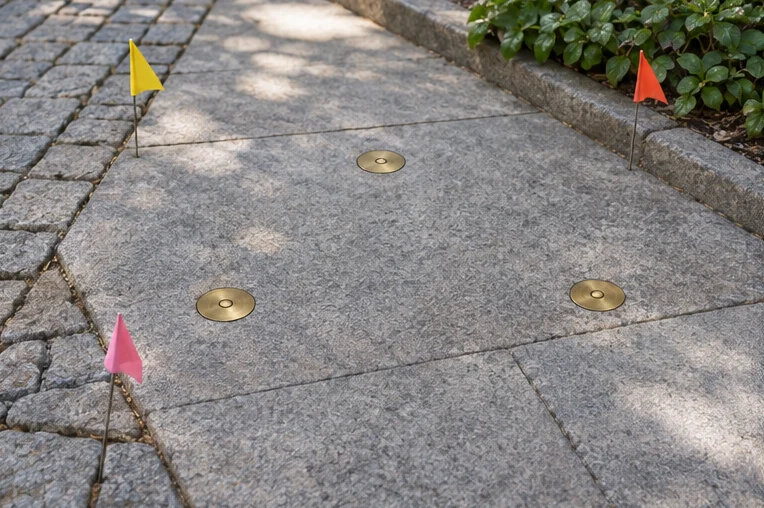
Carry the lesson through to public interpretation. An editorial photograph of brass marks and flags can communicate what a reference and a sampling marker might look like, but it is not a documented view of this fictional study. A caption saying “illustration of the two station roles” preserves that status. Similarly, a toy graph can teach the categories without implying that three or fifteen is an appropriate staffing or sample target. A report's visual polish should make its provenance easier to understand rather than giving the illustration the authority of measured evidence.
Keep the archive useful for the next season
Months after a survey, a follow-up team might want to compare old and new results. They should be able to find the reference setup, its raw reported values, the frame as it existed at each target time, and the inclusion rules used for the published estimate. If only the final mean survives, the impact of substituted or missing units may no longer be reconstructable. A short versioned method note and a preserved original list can be worth more than several decorative charts in the long run.
A future analysis might separate conditions by pavement material or installation era. That comparison needs identifiers that let analysts know which attributes were recorded at the time and which were filled from later records. If a material changed after resurfacing, the current label may not describe the old measurement. Reserve locations and diagnostic readings can likewise acquire new roles over time, but only prospectively or under a transparent revised design. Do not let a new classification rewrite why an earlier row joined its original estimate.
If the original survey was too incomplete for the planned inference, use the archived details to improve the next design. Persistent barriers may require changing the frame or arranging different authorized access. Discrepancies at the reference can motivate another check level or better control of positioning. Heavy use of a reserve list can indicate that the activation problem was foreseeable enough to address earlier. These are different design responses. An archived distinction between sampling and measurement makes it possible to see which investment would actually solve the problem.
For organizations that only need a lean archive, retain the items that tell why each observation exists. A report should identify which measurements were linked to the check role, which qualified under a field sample, and which were held or redirected because of access or uncertainty. Where public detail is unnecessary, release summaries and keep any operational specifics only in the appropriate project record. The burden of preserving good metadata is small when fields are built into the procedure and large when someone has to reconstruct them from memory.
Ask how much the convenient reading could change the answer
A practical sensitivity exercise can compare the eligible observed result with several explicit assumptions about the missing units. For binary outcomes, the all-favorable and all-unfavorable allocations illustrated above are straightforward limits for the planned set. For continuous measurements, any limits need a defensible range for the target observations; a minimum and maximum from convenient reference readings do not establish the range of unmeasured field pavers. If the project uses a model to predict the missing values, keep the predicted and observed ones labeled separately. The analysis should explain why the model might transfer across the particular access gap rather than assume missingness is equivalent to random deletion.
Consider a sample that loses four segments, all behind barriers set up for active repair. These are not four arbitrary missing marks. Their shared condition may be strongly relevant to a surface-wear estimate. Small weights on that group do not necessarily make its absence harmless, especially if deterioration is rare but concentrated. Show the class that was missed and whether it falls inside the time and population definition of the estimate. In some circumstances the best outcome is to report a result limited to accessible segments and explain that it does not cover the active repair group. That is a change in scope, not an unseen assertion about the repaired surfaces.
A paired survey can face the same problem on only one side of the comparison. Suppose the originally selected sites were all measured before a project, but the reopened route no longer permits several original points to be inspected. A fixed reference monitored in both periods cannot fill those precise pairs just because its calendar is complete. Compare actual paired units under the stated rule, record the missing follow-up group, and, if helpful, separately describe changes at the stable monitoring locations. A good graphic can put those findings next to one another without treating the repeated reference schedule as evidence that every field pair was completed.
Finally, interpret a close numerical match cautiously. Perhaps the sample mean calculated without the blocked units is nearly the same as the mean after adding the convenient points. That agreement tells you those added values did not move this particular statistic much. It does not show what the missing units would have contributed or justify using the same substitution next time. Report sensitivity as evidence about a named calculation, not as a retrospective repair to the design.
Return to the barrier on the original route. The reading at the reference station remains useful. It helps tell whether the gauge deserves further review, and it can remain in the record even when the selected surface cannot be reached. The missed sample also remains useful information: it explains a limit in coverage. Protecting those two facts gives the crew a sound answer at the end of the day, even without a complete table. Keep the sentinel checking what it was built to check, and let the sample reflect what was actually selected and observed.