
| Category | Value (items) |
|---|---|
| Headline | 8 |
| Body | 3 |
| Reviewed translation | 1 |
Constructed checklist scenario for this brief, not measurements, ratings, or results from cited sources. Each displayed count represents checked items in the named example.
Consider a fictional public conservation bulletin. Its source says that monitored gardens in two districts used less water during a six-week observation period. The localized headline says that local gardens are saving water this season. Both statements sound compatible at a glance. Only one identifies the gardens that were observed, the place the evidence came from and the period during which the comparison was made. The new headline sounds more relevant to the audience, but it has quietly turned the audience's home into the place the evidence describes.
This can happen even when the translated body is good. A headline editor, a newsletter producer and a social preview generator may each work from a different field. A familiar place name can seem like a reasonable substitution for a location that readers do not know. A phrase such as “last spring” can seem natural when an article is first written and become misleading when a translation appears much later. None of these errors is caught simply by deciding that the sentences are grammatical. The unit to check is the claim that reaches the reader, including the limits that make it true.
A scope note does not have to look like a formal caveat. “In the monitored gardens” is a scope note built into the subject. “During the pilot” is one built into the time frame. A single verb can signal whether the study observed a difference or the author is recommending action. The translator's job is not to force the same words into every sentence. It is to preserve the information that determines to whom, where, when and under what conditions the statement applies.
Geography has several roles
The place where an intervention happened, the population from which data were drawn and the audience receiving the story need not share a location. A translation usually changes the last of these. It does not by itself change either of the first two. A case study from another country can be useful to local readers precisely as a case study. It need not be presented as a measurement of their community. If the writer wants to add local context, make it a distinct statement supported by local evidence or pose it as a question.
Watch for words that acquire their meaning from the outlet rather than the source: here, nearby, local, domestic, regional, our area and nationwide. “Nationwide” is particularly easy to replicate mechanically even though a new edition may circulate in another country. Name the country or administrative area when the referent could change. Do the same for an unmarked city name that exists in more than one place. Readers should not have to identify the original outlet before they can tell where the evidence was collected.
Do not assume that matching a jurisdiction's name matches its boundaries. A study in the central municipality is not necessarily a study of the metropolitan area. A functional service area may include only parts of several jurisdictions. If the source says “the district” but gives its measurement boundary as an area served by a utility, name the relevant boundary in the translation. Where a highly specific name makes the sentence unwieldy, a short map note or an introductory phrase can help, but the headline should still avoid implying a broader geography.
Use descriptions where a name may not render clearly for unfamiliar readers. A translated name, source spelling and short geographic gloss can coexist if each plays a useful role. The source spelling can help a reader locate a cited table or map; the gloss can explain the site's relationship to a better known place. Neither gives permission to pick a better known place as a stand-in. Write “sites outside the capital,” for example, only if that relationship is supported. A precise-sounding gloss is still a factual claim.
A country-level statement sometimes hides a narrow study. A trial conducted at four institutions spread across a country is not the same as a nationally representative sample. Preserve the distinction between geographic distribution and representativeness. “A four-site study in Country A” can be concise and honest. “Country A found that” makes an institution or nation speak for a conclusion drawn under a smaller design. The translator should make the difference clear even if the original outlet had a headline that assumed its audience already knew the pilot.
Dates have several roles too
Make separate space for when something took place, when it was measured, when the underlying report was published and when this translation appeared. These rarely need to be listed together in the headline. They do need to be distinguishable during editing. A release published this morning can describe observations collected two years ago. A translation posted today of a notice issued yesterday may report a plan that has since changed. The translator should not make observation and publication dates implicit synonyms.
Relative time words deserve a deliberate pass. “This summer” may refer to the source publication date, the season in the original place or a future schedule announced for a later year. A translation into a locale in another hemisphere can make the word summer sound especially clear while changing its apparent months. Use dates, months or a justified local season description as appropriate, especially when the period is necessary to interpret the claim. If calendar conversion is needed, verify the result and retain a traceable reference to the original.
Preserve whether the announced period has begun, ended or been extended. “The service runs through March” is not the same as “data were collected through March.” When the sentence involves a future schedule, distinguish what was planned when the source was written from what is known at publication. The editor must not silently update a date by inference. If current status cannot be verified, attribute the schedule and give its date, or omit an implication that it is still operating.
In an event or reporting period, check whether the boundaries include the end date and what calendar or time zone the source used where that affects interpretation. A midnight cut-off in one jurisdiction can be a different date in another. A fiscal year can look like a familiar four-digit year while covering different months. The translated sentence should not imply comparability between fiscal and calendar figures just because both can be formatted as years. Use a short qualifier and a locator where readers can check the original period.
An archive requires special attention. A page can be labelled “updated” because a typo was fixed or a translation was added, not because the underlying evidence changed. A recent timestamp should not make an old observation sound current. Record the version of the source used by the translator and give the date of the original result when readers might confuse it with the display date. This is particularly important for articles that share automatically when a new language version is published.
Who was counted?
A noun can make a sample expand in one keystroke. “Participants who completed follow-up” can turn into “participants,” then “residents,” then “everyone.” The failure is larger than a stylistic issue because different people may be represented in each term. For a result involving a count, fraction or comparison, identify the underlying group. For a descriptive statement, identify whose experience was reported and whose was not covered. Make these distinctions with ordinary language rather than asking readers to learn the reviewer's terminology.
A translated term for school, worker or household can imply a particular legal or administrative category. The source may use the words operationally instead. If “household” means the unit on an account, people sharing one address can be counted differently from how a national survey would classify them. Explain the unit where necessary. A locally familiar administrative term is useful only if it fits, not merely because it sounds official. A short explanatory phrase is often safer than selecting a precise equivalent whose scope the editor hasn't checked.
Distinguish who was eligible, who enrolled, who was observed and who appears in the final calculation. A passage may use all those groups in succession. When a translated summary compresses them into one sentence, it can attach a rate to the wrong denominator. The easiest check is to point the editor to the exact relevant row in the source, including the heading and any footnote that describes exclusions. Do not rely on looking up the number alone. Several tables can print the same percentage for different groups.
Scope matters just as much when an article is about institutions rather than people. A result observed in facilities with an existing maintenance program may not describe facilities lacking that program. Schools in a particular pilot may have volunteered; the result does not thereby sample all school types. If readers are being asked to judge local applicability, those conditions can be more useful than another sentence about how encouraging the result is. Keep the condition close to the finding, where someone reading only the first paragraph will get it.
An illustrative checklist, not a performance league
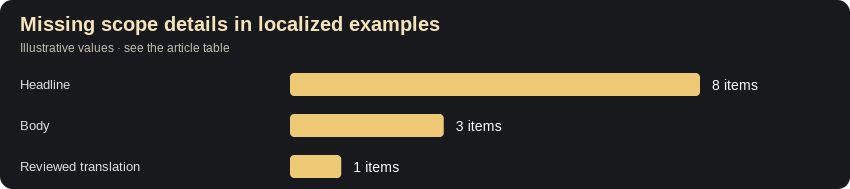
Illustrative chart: Missing scope details in localized examples. The numbers below are a constructed editorial exercise, not measured quality ratings or results from W3C. For this exercise, use the same inventory of eight scope details across three versions of one fictional story. Count an item as missing when it isn't adequately conveyed in that version; an item absent from one version and present in the next counts only in the version where it is absent.
| Example version | Missing scope details (items) |
|---|---|
| Headline | 8 |
| Body | 3 |
| Reviewed translation | 1 |
The invented inventory includes the study country, the two pilot districts, the participating sites, the observation dates, the comparison period, the unit that was measured, the kind of evidence and an explicit warning against reading the case as a local forecast. This is an exercise inventory, not a claim that every headline should contain eight clauses. In the fictional headline none of those details survives. The body supplies five of the eight. Review adds two of the three missing details, leaving one still absent. The three bars should not be added: they count omissions against the same inventory in different artifacts.
The chart says where editorial work is still needed, not how consequential each omission is. Leaving out the exact observation dates in a tightly scoped headline is a different defect from naming the wrong country. A good headline and deck can split detail while avoiding any false implication in either. The one remaining omission in a reviewed translation could still block release if it is the denominator for the headline number. Counting omissions is a way to surface questions, not a substitute for judgment about them.
Keep the headline accurate without turning it into a methods section
Try a three-tier structure. The headline carries the narrow subject and what was observed. A deck identifies the place or period that would otherwise be ambiguous and describes the most important restriction. The opening paragraph connects the result to the actual population, then supplies the remaining context as space allows. The division is an editorial choice, not an excuse for a misleading headline. Each tier should remain accurate alone, even when the combination is considerably more informative.
Compare two fictional alternatives: “A garden pilot recorded lower water use” and “New approach saves water in our gardens.” The first is scoped by the word pilot and by the verb recorded. Readers still benefit from knowing where and when. The second claims causality, selects a geography tied to the outlet and implies continuing results. A supporting paragraph later in the article cannot make the second headline a faithful translation. Reconstructing the phrasing rather than filling a set character count is often what fixes the problem.
Use the same test on title cards, push notifications and search descriptions. If a line appears by itself, do not depend on a caveat hidden under a click. An ambiguous generic alert is sometimes less useful than a slightly more specific one whose results are modest. Editors can avoid ungrounded geographic language without lengthening the sentence by removing intensifiers, a redundant adjective or an unnecessary forecast. The available space should prioritize information that changes the meaning, not words chosen merely to make the result sound fresh.
Local editors can create new headlines, but flag the work as a new editorial artifact rather than a transparent mechanical pass. Give the editor the exact result and the source passage carrying its rationale, plus a few constraints that can't be lost. The editor may discover a better way to communicate them. A rigid word-for-word order tends to reward awkward literal phrasing; a loose briefing that says only “sell the story” tends to lose specificity. The scope record gives room for natural writing without ambiguity about what can change.
When a source headline already overstates its body, translate the evidence rather than repeating the overstatement. Document the correction privately and clarify the narrow claim publicly. If a translation must preserve a title as a quotation, introduce it as the title and avoid announcing it as the translated outlet's own finding. A source provides evidence to be checked; it does not transfer the responsibility to describe that evidence faithfully.
Build a compact scope record from the source
A useful worksheet starts with an identifier for the claim, the selected source version and an evidence locator such as table, paragraph or figure. Then record the place, period, unit, population, evidence type and meaningful exclusions. A short field for the role of a statement distinguishes an observation from an estimate, an author's interpretation or a recommendation. The record is a reference for editing, not a mandatory template for the final prose. A little specificity in the record saves the translator from guessing where a number came from.
Separate required content from optional explanatory context. If a date is essential to understanding whether a service still runs, mark it as required in the surfaces where current status is implied. If a city name is nice context but a country and study setting are sufficient for the headline, record that division. Avoid a simplistic rule that every field must be present everywhere. What matters is what each piece of copy actually asserts and what reasonable readers can infer without additional information.
Record the source's comparison in plain words. “Second observation window relative to the first in the same participating gardens” is clearer than “savings” as a private label. The former makes it harder for a writer to accidentally treat the result as a comparison with nonparticipating gardens. If the known outcome is lower usage per monitored site, keep that unit rather than generalizing to reduced regional demand. In many cases the most important limit is part of the denominator or comparator and never appears in the source's formal limitations section.
If there is uncertainty in the source, distinguish it from uncertainty about the translation. A study might estimate a value within a range; a translator might be unsure whether an administrative term has a direct equivalent. The first belongs to the evidence; the second is a question for review. Don't replace an unclear translation with a blanket statement that the study is unreliable. The evidence might be clear, and the target term simply needs a concise explanation.
Leave a space for intentional adaptation. Note, for example, that the localized edition gives a parenthetic explanation of a jurisdiction, or that it adds a separately sourced sentence about the audience's city. This makes the change visible and reviewable. It also helps distinguish useful additions from accidental substitutions. When a second translator sees the localized edition later, the record can show what was present in the source and what was authored for local readers.
Three passes do different jobs
On the first pass, reconstruct the intended claim from the primary source. Read the table notes, verify the time period and determine whether the reported trend is about people, sites, visits or some other unit. Take a short note on what the evidence leaves unresolved. If the source is inconsistent, flag that before asking a translator to produce a clean answer. A translator cannot legitimately resolve incompatible figures by selecting the one that reads better, even if it happens to be the one used in the source's own promotional copy.
On the second pass, compare each localized claim against that record. Map the headline, deck, body summary, named figures and captions separately. Set the original prose aside temporarily and read the translated passage as an ordinary target-language reader would. What place does it seem to mean? How recent does it sound? Whose experience does it describe? Then return to the evidence and inspect any differences. This test catches changes introduced by implication even where the important words are present somewhere else.
On the third pass, open what will actually ship. Headline and description fields may be truncated by a template. A language switcher may load a stale translation or another version of a note. A numeral may render correctly in the draft and become ambiguous in the target publication. Try narrow and wider layouts where feasible, including one way a reader might encounter the isolated headline. A language review does not guarantee intact display. A visually correct display does not establish factual scope. The two checks are both necessary when a template can change what users see.
If a team works in parallel, preserve the version each person reviewed. One person may check a translated body while another is still shortening the title, and both can honestly finish their work on incompatible copies. Lock the specific fields that have passed or mark changes that require rechecking scope. A final small comparison of changed facts is usually less expensive than rereading the entire translation. It also makes a defect traceable rather than leaving everyone uncertain which revision introduced it.
The passes can be lightweight. For a small editor's note, one reviewer with the source and a finished page can do all three in sequence. For a multilingual report with many headlines and charts, separate roles may be practical. The essential distinction is between finding the evidence, testing the translated meaning and validating the published presentation. A single status called “translation complete” often masks an incomplete pass.
Full example: one observation, several possible rewrites
Imagine a fictional report in which twenty municipal gardens in two districts had their irrigation water recorded from the beginning of April through mid-May. The report compares that observation with a preceding reference interval. It does not estimate how other gardens would behave or whether the observed change can be credited solely to a new technique. A local outlet wants to translate the report for readers in a different place. These facts are invented to demonstrate scope; they are not measurements and do not describe a real conservation program.
A flawed opening might say: “Our parks are saving water this spring thanks to a new irrigation method.” The possessive changes the place. Parks broadens the institutions. The current progressive changes the time. “Thanks to” assigns a cause not established by the stated design. The line is fluent, but four important relationships moved. In a review, name those problems individually. That gives a local editor far more to work with than a comment that simply says “not close to the original.”
A defensible opening might read: “Twenty municipal gardens in two districts recorded lower irrigation use during the April-to-mid-May monitoring period than in the preceding reference interval. The comparison does not establish how the approach would perform in other places.” The actual issue would need a year, country and an evidence locator. This version protects the distinction between the observed group and the audience, and distinguishes a recorded change from a transferable effect. It may be shortened for a headline, but any shorter version should preserve both the pilot framing and the fact that the outlet is not reporting a local outcome.
A separate localized sentence can be useful: “Garden managers here also face restrictions during dry periods,” if a suitable local source is available and the statement fits the release date. Cite that source separately and avoid implying the local rules match those in the study districts. Without supporting local evidence, a question can do the job honestly: “Could an approach like this be tested under local water rules?” This invites interest without promising the result.
Now imagine the plot from the original document has a title that fits easily on desktop and is shortened for the translation. If the translated chart says “Savings during pilot,” check whether it displays absolute amounts, a difference from the comparison interval or a site-level proportion. The caption should name the unit and reference period. The headline may still use more approachable language. A number supplied without its relationship to the chart is not made accurate by the existence of a better explanation elsewhere on the page.
Finally, check the link text. If readers go from the translated sentence to a source in another language, tell them if that assists navigation. Identify the relevant section or table in the language of the original when that makes it findable. A translation note, an official translated edition and the original evidence are related but distinct destinations. Keep the original reachable rather than quietly replacing it with a secondary summary that does not expose the measurement limits.
Units, dates and names can be adapted without adapting the result
Readers can reasonably expect familiar units and date formats. A conversion should retain the original quantity's meaning and approximate precision. If a values table uses water consumed per irrigated area, converting only the water volume while dropping or neglecting the area unit changes the result rather than localizing it. If the source rounds its estimates, giving a highly precise converted decimal implies information the study did not supply. Preserve the source unit in a note when it helps readers verify the arithmetic, and be explicit when an amount is approximate.
Distinguish a percentage change from a change in percentage points. The target language may express the distinction differently, but it is not optional. A proportion moving from a fictional ten percent to twelve percent rose two percentage points, equivalent to a twenty percent relative increase from the original value. Neither phrase is an acceptable substitute for the other without the right frame. If a translated headline says an outcome “increased by twenty percent,” the editor should verify that relative change was the intended message and, when useful, give the starting value so the scale is clear.
Where dates are written with numeric month and day fields, avoid formats that a target reader could interpret in reverse. A month name can be clearer in prose, while a suitable consistent date format can work in a structured table. Where an original year spans more than one local year system or fiscal convention, keep the original and any equivalent tied together with a clear label. Conversion should help the reader place the observation in time, not make the article pretend it was organized under the destination's calendar rules.
Names pose a similar tension. A custom rendering of a program name can make an initiative sound like a matching local program. If the program is distinct, state that its translated label is descriptive and preserve the source name where needed for searching or identifying the official material. Avoid assigning a familiar local institutional title to someone whose original role carries different powers. When the organizational structure does not matter to the claim, a plain description can be both more readable and more accurate.
Do not infer equivalence from a shared measurement label. An administrative definition translated as “full-time” or “licensed provider” may not reflect the destination's legal terms. If the distinction bears on who appears in the results, retain the source's operational definition or link to it. The reader needs enough information to decide whether a comparison or local application is plausible. That judgment cannot be assigned to a translator's choice of a familiar word.
Mark language changes in the document as well as in the copy
A translated page can contain passages still written in the source language: a quotation, an original warning, a reference title or part of a bilingual table. Separately from factual equivalence, there is an accessibility task. W3C's explanation of WCAG 2.2 Language of Parts describes the purpose of identifying changes of human language so user agents and assistive technologies can present passages appropriately. It also describes exceptions, including proper names, technical terms and words that have become part of the surrounding language. This is an informative explanation of the criterion, not an editorial rule requiring literal translation.
W3C Internationalization guidance on language declarations in HTML explains how to set the document's default language and indicate a change within it. In a web edition, the translated page's default should describe the edition the reader is on. Identify genuine language changes using suitable markup rather than guessing from visual styling. A block in italic text is still italic text; it does not tell an assistive technology to interpret the passage in a particular language.
Don't assume that embedding a language annotation inside the visible label of a link guarantees identical behavior in every interface. The W3C accessibility explanation discusses limits that can arise when an accessible name is exposed as a single string. Check that the underlying page marks its languages properly, and inspect how important elements work in representative use. The fact that a particular product announces one name awkwardly does not, by itself, prove the underlying markup was omitted. Conversely, a correct sounding automated voice reading is not a substitute for inspecting the actual language declarations.
A bilingual scope note illustrates why these checks belong together. If a key source phrase remains in the original language, a fluent reader may understand quite a lot from it. A monolingual reader of the translation must not be required to infer the article's core limitation from that note. Put the limitation plainly in the target-language copy and keep the original phrase for verification when helpful. The correct language tag improves access to retained evidence. It is not a translation, and it cannot repair a missing statement about population, time or geography.
Check what happens when the translation is quoted
The clipped version of a story may be the first one that matters to a reader. A headline can be quoted in a meeting, inserted into a report or embedded on another site. A chart can appear alone in a slide deck with no surrounding explanation. Choose labels and captions that survive reasonable excerpting, especially for results most likely to be reused. This is not a guarantee against deliberate misquotation. It makes the intended meaning visible without requiring everyone to find a paragraph hidden farther down.
Review content that may not be apparent in the main layout. Image alternatives, table captions and plain-text notifications are all opportunities for the story to lose a key restriction. If an image is purely decorative, its role differs from that of an image carrying an important limitation. If a chart contains evidence, ensure the accompanying text, table or other accessible representation communicates the relevant values and scope. A translated illustration caption should not imply the illustration depicts the actual communities observed when it was designed only to evoke a setting.
Space is often tighter in navigation lists or a newsletter. Where the full technical headline will not fit, write explicit short copy rather than hoping a truncation algorithm stops at a safe place. Consider a sentence that begins with “Local gardens” but qualifies it several words later; the qualifier may be the only part that gets cut. Frontloading the meaningful subject, such as “Two-district pilot,” often makes the short version safer as well as clearer. When a sentence cannot tolerate truncation before its limitation, the important information has been placed too late for the use case.
Version consistency matters in these secondary products. A correction to a headline on the main page is incomplete if the preview still makes the broader claim and can be updated. Record which derivatives need separate changes. An editorial team can't retract every screenshot, but it can issue a clear correction and fix the artifacts it controls. Knowing which platforms render separate copy is useful before release and saves time when a version needs to be repaired.
Handle differences between audiences without speaking for either
A translator can make prerequisites easier to understand without referring readers to a nonexistent counterpart. Imagine that the source assumes readers know how outdoor water is billed. In the target edition, a short explanation can describe the system actually used by the observed gardens, if the source supplies it. A comparison to the destination's billing system would be new reporting. That additional comparison could be valuable, but it needs its own evidence and byline or editorial attribution where appropriate. Separating the two keeps a useful explanation from being mistaken for an attribute of the observed setting.
A report's discussion of transferability is not an invitation to erase the original scope. If authors suggest that an approach might travel well under certain conditions, preserve both the modal phrase and the conditions. “Could be tested elsewhere with compatible equipment” is not “works elsewhere.” If a new community has independently tried the approach, handle those observations as a second case. Readers may learn more from two bounded cases than from one apparently universal claim that neither actually demonstrated.
In some publications, localization includes examples designed for the reader's own jurisdiction. That practice is compatible with translating a review if the provenance remains clear. A fictional example can show how to calculate a share in familiar units without claiming that the measured proportion was found locally. A reported local fact can be introduced in a separate paragraph with its own source. A document layout that visually separates a translated result, an illustration and local editorial context supports that distinction. Put the same boundaries in words for readers who cannot rely on visual styling alone.
Reviewers with local expertise can improve such decisions even when the language itself is straightforward. They may know that a term is used differently across municipalities or that a common calendar phrase has a regulatory meaning in the destination. Their role is not to certify that the original evidence applies locally. It is to find unintended local implications and help the editor choose a translation that avoids them. If jurisdictional facts are genuinely needed, verify them before adding them rather than inferring them from a familiar term.
How to log an omission that survives the first review
Return to the invented chart. One item remains absent in the reviewed translation. Suppose it is the comparison period for the claim “recorded lower use.” The reviewer should mark the exact sentence, the required comparison and the source location where it could be verified. If the source describes that period adequately, add it where readers need it. If the source itself doesn't supply it, rewriting “lower” as though the comparison were known will not make the statement more defensible. Name the unknown, attribute the finding narrowly or withhold the comparison until it is verified.
This distinction prevents a checklist from becoming a game. A line that says “compared with earlier reporting” might turn an empty cell green while still leaving the reader unable to identify the comparator. Define the expectation in terms of meaning: the reader can tell what the comparison was made against and can distinguish it from a comparison with the audience's local conditions. Then choose the shortest sentence that does the work. The criterion is not whether the translation contains a specific word for “previous.”
An unresolved item should have an owner, a proposed next action and a statement about publication impact. “Reviewer to confirm year in the methods appendix; don't release promotional headline until resolved” is specific. “Check dates” is not. A minor point can be marked acceptable to omit when its absence changes no plausible reading. That judgment should be separate from a claim that the item was translated. The count remains honest while the release decision reflects the importance of the omission.
If you correct a mistranslation after release, explain the difference directly. “An earlier version described the trial results as local. The observations were made in the two named study districts, not in this outlet's region.” That says what a reader should update in their understanding. Silently replacing an adjective can fix the current page while leaving people who read the original with an incorrect memory. The response is proportionate when it tells readers what changed and preserves the original scope without implying that the entire story was fabricated.
A brief handoff can make the limits durable
For each important localized finding, leave the next editor a few lines: what was observed, who or what was counted, where and when, and the strongest claim that the evidence justifies. Add one obvious misreading to avoid. The misreading is often easier to remember than a complete checklist: “This is a comparison within participating sites, not evidence about all sites in the region.” Once the copy is ready, ask someone who sees only the target edition to tell you what it says. If their account shifts place, population, time or strength of evidence, revisit the line they actually read.
That exercise is useful even when the translator and author are the same person. During drafting, the original evidence is fresh in memory and can fill in any gaps. Readers cannot fill them from the author's memory. Reading isolated public copy breaks that illusion. A reader can be invited into an unfamiliar place and given enough context to make sense of it without rewriting the map or claiming the evidence belonged at home all along.
Good localization does not make a story less useful by admitting where its evidence ends. It gives a reader a more useful question to ask next: whether their setting resembles the studied one, which differences matter and what further observations would settle them. A fluent headline can be a good invitation to that inquiry. It works best when the boundaries travel with it.
References
- W3C: Understanding Success Criterion 3.1.2, Language of Parts. Informative guidance for programmatic identification of language changes, including exceptions and presentation considerations.
- W3C Internationalization: Declaring language in HTML. Guidance on a document's default language and marking changes within it. The fictional story and chart counts are not W3C findings.