| Category | Value (items) |
|---|---|
| Initial draft | 5 |
| Targeted revision | 2 |
| Reviewed version | 0 |
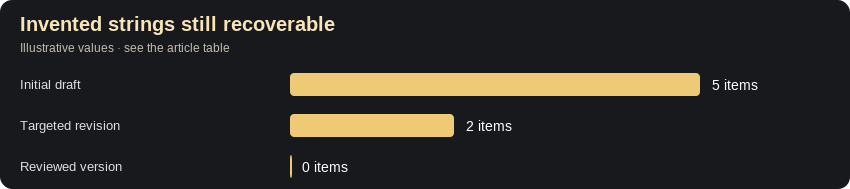
Constructed audit of 5 fixed, distinct cases. First review resolves 3; second resolves the remaining 2. Not observed performance or a conformance score.
A museum prepares a public version of a fictional exhibit planning packet. The private source includes staff notes, mock contact details and a few comments about display options that never made it into the exhibit. An editor draws black boxes over several strings in a copy and exports the packet as a PDF. When it opens, the boxes look convincing. But the export has preserved information the team meant to leave behind. Part of it exists as a separate text representation and part in supporting content outside the visible page. The display changed; the information intended for release did not change enough.
The proper goal for a public-release copy is not to make internal information difficult to see. It is to make sure the released artifact does not include the information outside the approved scope. When somebody can read a page visually, hear its accessible text or encounter a preview on another route, each representation should tell the same public story. Redaction is therefore a production and verification task, not just a design treatment. Sometimes the best public version is a clean rebuild with only approved material rather than an edited version of a complicated private file.
All examples in this article use files the publication team owns and has authority to review. The packet, strings and audit counts are invented and deliberately harmless. The workflow is for preventing disclosure in one's own drafts and release destinations, not inspecting other people's files for hidden content. Do not put genuine sensitive information in a test fixture, screenshot or support request. If an actual exposure has already occurred, follow the organization's authorized response process instead of trying to prove what another person received.
Define the publication boundary before choosing the tool
Start with the public purpose of the document. The museum's packet might have to show the exhibit schedule, the contents of a teaching station and a public point of contact. Internal brainstorming, private scheduling information and unrelated draft comments do not serve that purpose. Ask the person authorized to approve the public version which information belongs in it. Keep that decision separate from the editor's ability to remove a field. A program can remove any selected object. It cannot tell the team which details are approved for release or what retention obligations apply to a private original.
A release brief can be short and explicit. Name the intended audience, the document's purpose and the copies that are in scope. For example, the review covers the printable PDF, a thumbnail used by the exhibit directory and the file served by the public download link. It does not cover making a new release of the original editable project. The approved public material includes the exhibit timeline, object descriptions and gallery contact channel. Other notes remain in the restricted source. This plan makes it easier to determine whether a preview or appendix unexpectedly crosses the boundary.
Do not assume the visible shape of a form tells you where a detail is stored. A public identity can appear in the title and a private contact in a comment. The wording under a graphic, the caption associated with it and the metadata carried by an export can all have different origins. Some content can be removed entirely; some may need a public replacement, such as using a role instead of a person's name. These decisions should appear in the brief as positive instructions about what to publish. Otherwise the production process can become a search for every phrase that looks internal without a clear route to a useful finished document.
Identify the private master and protect it independently of the public copy. A workroom document may need to be retained for governance or historical reasons. Protecting it does not require placing the original in the folder that serves public downloads. Use clear destination names, distinct file paths and appropriate restricted access. The public export should never depend on the audience looking at the right layer of a file that contains the master. If an internal reviewer needs to see both, provide the comparison through the authorized review process, not as part of the artifact the public is about to receive.
Understand covering, removing and rebuilding as different operations
A visual cover can signal where material should be withheld. It may be useful while discussing a draft internally. But placing an opaque shape over a live line of text may leave the text as a separate object in the exported document. The reader sees the cover when the program paints the page. That instruction does not necessarily remove the content underneath. Likewise, a crop can determine what appears within a frame without necessarily discarding everything outside it from the source asset. The publisher must use a process that changes the actual content of the release, not merely its normal presentation.
A dedicated redaction feature has a different purpose. Adobe's Acrobat documentation on redaction and sanitization distinguishes applying redaction to visible content from removing hidden data such as metadata and embedded content. A marked box still awaiting application is not the same as a saved redacted output. Treat specific product documentation as a description of the named tool, not a guarantee that any file bearing a redaction-style box is safe. Different tools and versions can behave differently. Validate the public artifact rather than expecting a visual convention to enforce the release policy.
A clean rebuild starts from approved data or text. For a short handout, it may be faster to recreate the headings, lists and figures in a fresh document than to reason through every hidden object in an elaborate production file. A rebuild can also enable a better accessible structure. It needs a careful comparison with the approved brief; a newly written document can introduce factual errors, or inadvertently carry private text through copied fragments. A clean rebuild is not a license to skip verification. It is an option when inherited complexity makes removal difficult to prove.
Decide which method fits the material. A few straightforward corrections to a long archival copy may favor a documented redaction workflow that keeps the necessary context intact. A handout with many imported pages, notes and images may be safer to rebuild from selected public sources. If a process is unfamiliar, practice first with harmless invented files. The final choice should account for whether the organization can verify the kind of output it will actually serve. If it cannot, describe that limitation internally and do not substitute optimistic labeling for additional review.
Include nonvisual content and derivative assets in the release scope
Start with the visible page, but do not make it the entire scope. Accessible text, transparency, comments, forms, annotations, document properties and embedded objects describe different channels through which the same document may carry information. Not every product contains each of these, and no publisher should assume the presence of one means all others exist. The practical lesson of Adobe's official sanitization guidance is to consider nonvisible information explicitly. Consult the tool's documentation about what its sanitation step covers and keep verification tied to the output.
A scan can have both an image of a page and a separate recognized text layer. A page designed as an image may have meaningful text outside it, such as a description written for someone who cannot see it. A safe release can retain helpful accessible text as long as it represents public information only. Deleting every text layer might block a particular disclosure pathway, but it can also remove the only equivalent for a reader who cannot use the image. If the source is unsafe to carry forward, recreate appropriate accessible material in an approved output rather than destroying usability by default.
Think about what is served alongside the file. A public website may offer a preview generated before redaction; a gallery card might link to a lower-resolution image separately; a digital archive may store a PDF and a thumbnail under different names. Removing a public copy of the PDF does not necessarily remove a different asset that shares its title. These are separate publication surfaces, and the review needs to cover the ones the team intends to maintain. A thumbnail that seems too small to read in a dashboard may still be available in a larger official image. Inspect the real delivered view, not only the editor's idea of it.
The Library of Congress summary of digital format preferences provides background on different kinds of digital material and format considerations. It is not a redaction specification or an instruction to choose a particular encoding for the public packet. Its practical use here is to frame the question of which objects exist, which must be preserved and which belong in a distinct public copy. A preservation master and a distribution file can have different purposes. Documenting that difference improves both the protection of private information and the reliability of the public record.
Work through a five-string exercise built entirely from harmless fixtures
Set up one mock packet using five made-up phrases: “Copper Kite,” “Cobalt Acorn,” “Violet Lantern,” “Marble Orchard” and “Paper Telescope.” None represents a person, credential or actual museum decision. Give each a distinct intended destination or representation and record the mapping in a private test sheet. For this exercise Copper Kite sits in page body text under a rectangle, Cobalt Acorn is in a retained text representation of a mock page image, and Violet Lantern is in a comment intended for internal review. Marble Orchard is in the draft title of a thumbnail, while Paper Telescope is left in a companion attachment. The test asks whether each exact intended-to-withhold fixture is still available anywhere in the specified release set.
In Initial draft, the editor has covered the obvious visible lines but has not produced or verified a safe output. All five test phrases remain within one or another of the specified release artifacts. In Targeted revision, the authorized team rebuilds the page text, produces a new accessible text version for the image and drops the internal comment, then verifies those three omissions. The stale thumbnail and the unapproved attachment are still in the proposed package. That leaves two unresolved items. In Reviewed version, the team regenerates the thumbnail from the approved copy, removes the unintended attachment from distribution and checks the release set again. The five known phrases are no longer present in the specified test outputs under the defined checks.
Illustrative chart data: Invented strings still recoverable.
| Prototype | Invented strings still recoverable | Resolved fixture strings out of five |
|---|---|---|
| Initial draft | 5 | 0 |
| Targeted revision | 2 | 3 |
| Reviewed version | 0 | 5 |
The bars show five, two and zero remaining fixture strings, respectively. Five minus the three addressed in the first pass gives two. Resolving the last two gives zero. Each distinct phrase is counted once per pass, even if it appears in more than one representation. The rows measure the same five mock items across successive releases, so summing the bars does not give a count of distinct disclosures. The figures are not observed performance, a measure of real incidents or an assurance score. They have no source in the Library of Congress, Digital.gov or the tool documentation. This test illustrates why visible and supporting surfaces both matter.
The final zero answers a deliberately narrow question. A package could omit all five fixtures and still accidentally include an unrelated unapproved image. The checker needs complementary evidence about the permitted content, the expected artifact list and visible quality. Likewise a failed fixture is a reason to stop the mock release and investigate, even if the body text now looks right. The number helps teams communicate what remains to be addressed; it does not convert a black rectangle into evidence that anything has been removed.
Prepare an independent safe text representation
Make the alternate text describe the approved page, not the private source. If a public exhibit diagram deliberately omits an internal label, the accompanying description should not quote the label to be thorough. At the same time, it should give a useful account of what the public diagram shows. Consider a room layout where the original notes identify people or work schedules. The public version might discuss accessible circulation, display locations and emergency information the organization is authorized to publish. A revised description can convey the approved spatial relationships without retaining names or personal details.
Check the result as somebody using text rather than relying solely on the visual proof. Read the intended headings and descriptions in the distribution copy. Verify that any available text view conveys what the owner meant to release and that its presence is purposeful. An alternative is not supposed to be a dumping ground for raw input that the layout excluded. Nor should the publisher call a scanned image a fully readable public handout if removing its unsafe text made essential material unavailable to readers who need it. Rebuild necessary descriptions from the same approved scope as the visual copy.
Proof extra information inserted by design or tooling. A page can have a title drawn on the cover, a separate document title, labels in a navigation pane and an introductory summary in the website listing. Each can be accurate yet refer to a different stage of the project. Keep names meaningful and within the same release boundary. A “draft staff roster” label can itself disclose context even if the names were removed. Whether that context belongs in the public version is an approval decision, not an automatic reason to keep whatever text the template already had.
A reviewer should also consider what a person can learn by combining approved fragments. In a tiny roster a role, date and schedule may together identify somebody even though no personal name appears. An approved public copy should meet its purpose with the information necessary for that purpose. Do not use invented flags as the only privacy assessment. A protected example tests the workflow without requiring actual private information, while the authorized content review addresses the real scope. Keeping these functions separate avoids leaking details through the very materials made to teach or prove redaction.
Keep the controlled stage separate from public delivery
Work on the restricted source in an appropriate internal location. Prepare the release artifact in a separate stage where it can be inspected without making it public. A team should not assume that placing a working file under an obscure name makes it private. Access policies and publication routes deserve explicit checks by owners. Choose the public destination from the approved handoff, and confirm that the file promoted to it is the one reviewed. If a deployment workflow copies every asset in a directory, the release folder should contain only what the team intends to ship.
A file label can support the separation. Give the approved output an unambiguous version identifier and keep the filename useful to the reader. Internal comments or odd version names should not accidentally appear in public properties or storefront listings. The team may choose to record a checksum or equivalent artifact identifier for the reviewed output. That allows a handoff to compare two copies on the basis of their contents. It does not establish that either version is accurate, accessible or appropriately redacted. It only helps check that the verified version is the file actually being carried forward.
Preview generation needs its own timing. Build the gallery thumbnail and the page preview from the approved output or an approved source prepared specifically for that purpose. Avoid generating either one from the master because the export looked too small in the layout. Where a display can use more than one size, verify the relevant sizes from the public artifact path. A listing card made from an older page image must be treated as an older release even if it shares the title and color scheme of the new copy.
Review attachments and companion downloads as distinct release decisions. A checklist might legitimately include an approved worksheet and a read-only public packet. It should not include the editable planning document for convenience. If an attached source is not needed, omit it rather than hiding its link below the fold. If a file is important and approval is pending, describe that state internally and withhold it from the public package. A visual check of the main PDF cannot stand in for verifying its surrounding distribution bundle.
Read the release note as someone who never saw the master
A public copy may need a short note explaining why information is absent without exposing what was withheld. In this fictional example, “This public edition omits internal planning notes and includes the confirmed exhibit schedule” gives a useful description of scope. It does not mention who was in the earlier notes or ask a reader to reverse-engineer the document's process. The Digital.gov plain language guidance supports writing with the intended reader and task in mind. Use this orientation to explain what the reader can do with the current packet, not to produce a detailed inventory of private material beside it.
There are legitimate reasons a release may display a marker of omission. A historian may want to know that an extract is incomplete, or a reader may otherwise confuse a gap with a printing mistake. Decide whether a clear note, a neutral marker or a newly designed public edition best communicates the fact. Do not choose a black block because it looks official. Whatever visible convention is used, the actual output still needs to omit unapproved information, and its accessible presentation should make the marker intelligible where it matters. If the note is not important to understanding the public version, avoid unnecessary signals that distract from the exhibits or imply a formal decision the site did not make.
Do not let a correction to a public release imply that all recipients now hold the revised copy. A publication may be able to replace files and listings it controls. It cannot automatically alter downloaded files sent earlier or copies others have made. If an issue affected actual material, the owner can assess scope and authorized responses. For a harmless test, there is no need to publish or circulate the fictional failure to demonstrate it. The exercise can stop at review, where its results show which internal processes would keep unapproved material off public paths.
Review the package in the order a recipient encounters it
Begin with the listing title, short description and preview. These can contain more internal detail than the final pages if they were supplied earlier by a different team. Check the reader's actual landing page or an authorized staging copy. Make sure the release page clearly identifies the public edition and reaches the approved file. Then review the visible pages at ordinary viewing scale, including the cover, margins, appendix and diagrams. The layout can still introduce unintended clipping or create a blank area that confuses the account, even after all prohibited content is gone.
In the working copy, a second reviewer can compare the expected content against the actual distribution artifact. For the invented fixture, looking for the known words through ordinary authorized review operations is a reasonable way to see whether they appear in the text representation. The primary requirement is that the public output contains only approved content and communicates it as intended. A successful check for several expected absences does not eliminate the need to read the file. Restrict this proof to owned or explicitly authorized artifacts, and avoid turning any review record into an inventory of real private material.
Next inspect attachments and previews the way the release plan expects them to be used. An attachment may remain in an export even if nobody linked to it visibly, or a listing may point to a different companion than the one the reviewer opened manually. Verify the expected objects and compare them against what the maintained destination actually serves. If the preview service has different behavior from the project's staging setup, record that as a separate open check. The phrase “safe staging file” should not be used as proof of safe external distribution before the distribution path is inspected.
Finally review essential public context through each supported mode. Can someone understand the schedule through extractable or accessible text and read the information about the public contact channel? Are meaningful diagrams still accompanied by descriptions that represent the new edition? Are supporting files named in a way that distinguishes the output from the master? Redaction verification should not reward a document that withholds everything merely because there are no remaining test phrases. The desired result is a useful public copy that omits only what should not be released.
Write pass and fail conditions with enough detail to reproduce them
“Looks redacted” is not a pass condition. Define the disposition of the known mock phrases, the set of surfaces that must be reviewed, and the public facts that must remain accessible. For the five-fixture test, a failure can be stated without quoting real content: one intended-to-withhold fixture remains in a companion asset. A successful round can say that the expected checks found none in the five designated locations and that the approved materials remained present. Do not leap from a narrow proof to a global guarantee. Name which destinations, versions and checks were actually used.
Add a known-failure test before trusting the process to catch a mistake. In a private fixture, deliberately leave one harmless string in its designated supporting surface and confirm that the workflow catches it. This tests whether that surface is truly being reviewed rather than whether a checklist exists. Then release nothing from the intentionally failed stage. Create or select a corrected fixture for the next step and re-run the defined checks so the outcomes cannot depend on remembering which defect was previously found. This dry run can show where a missing approval or handoff might allow a faulty file to escape without touching real material.
Repeat the review when a late change alters the package. A change to a single caption may require regenerating a print export, a website preview and a linked slide. If the reviewer approves an amended source while the old preview is still awaiting replacement, mark that entire path unresolved. A version recorded at the beginning of the review should still identify the artifact being approved at the end. Otherwise approval can drift from one file to another without anyone intentionally overriding it. This is a common publishing problem regardless of output format and can be prevented with concrete delivery records.
A documented exception needs an owner and a consequence. If the team cannot verify whether a third-party preview refreshes immediately, it should say what was checked and what remains unknown. Depending on the situation, the owner may decide to wait, replace the maintained route or provide an approved alternative until verification is possible. Do not set the same pass flag for “looked clear in an authoring application,” “checked in stage” and “verified at the intended destination.” The result should let the team understand where the work stopped without having to uncover what the reviewer meant by “done.”
Work through a disagreement about what still belongs in public
Imagine a gallery educator says the printed packet needs a distinctive description for a lesson that formerly used the label “Copper Kite” internally. The removal brief, however, treats that phrase as withheld even though the teaching concept itself is approved. The team does not have to decide between keeping the entire internal label and deleting the lesson. It can rewrite the description using the approved public name and keep the relevant layout or instructions. Verify that the audience can still find the lesson and that the new copy remains consistent with the actual exhibit. The safe alternative solves the publication problem instead of making the original distinction less visible.
Another disagreement can arise when a thumbnail is used as a record of an earlier release. The archivist might have a good reason to preserve the artifact privately. The current website may have no reason to display that same image as its active preview. Give the old and new objects different roles and destinations. Decide who may access the preserved version, who can publish the current version and how to communicate the difference without revealing omitted material. The notion of an archive master is helpful precisely because it acknowledges preservation without equating it with general public access.
If the required public purpose cannot be met without a contested detail, let the authorized owner decide the scope. Do not accidentally turn a design reviewer into the person approving disclosures. The content editor can identify candidate wording, suggest an alternative illustration and document how the document would read under either approved choice. That is useful work while a decision is pending. It does not justify distributing the draft with the contested material still embedded, nor does it support saying the audience lacks no information when a necessary passage is still blocked.
People sometimes disagree about whether a type of content needs another check. A developer may be confident that an export procedure omits comments, while an editor remembers that a related preview was made separately. Both can be correct about their parts of the process. The practical resolution is to name the exact artifacts and show how each was produced and checked. Verification should clarify the scope of confidence, not require one person to defend an entire production chain from memory. A narrow test on an authorized mock package can reveal the real gap without disclosing or reproducing private material outside its approved setting.
Make the release decision independent from the appearance of success
Release only the objects in the approved set, using the location and process the publisher controls. A designer's file can be an important intermediate without being a suitable object for public transfer. An automated workflow that packages sources for convenience needs the same release boundary as a person selecting attachments manually. Build the expected inventory from the approved materials rather than using a whole folder and then trying to remember every exception. In a private stage, compare the planned list with the produced one. An unexpected object is a release issue even when its thumbnail or title looks harmless.
Sometimes there is a reason to stop rather than keep modifying the export. If the tool cannot demonstrate that the output meets the required scope, the publisher can use an authorized alternative such as a plain public edition prepared from approved data, or pause until the proper review is possible. Say which specific check could not be completed. This is not a statement that all PDF exports or complex documents are untrustworthy. It is a decision to use a release process the team can verify. Protecting the audience's ability to read the safe content is still a requirement when switching formats.
A late request for a public link deserves the same care as a full launch. Someone might want to share a proof with one interested person rather than list it on the site. That is still a distribution outside whatever internal scope the proof was prepared for unless the review policy says otherwise. Do not use an unfinished artifact merely because it is going to a smaller audience. If a distinct review version is approved for particular recipients, keep that decision, version and destination separate from the general public release. Privacy boundaries are properties of a distribution decision, not of how many recipients one expects.
After authorized release, use proportionate follow-up. Verify the expected destination, preview and surrounding links as appropriate without reprinting sensitive material in test logs. If a public copy is found to be inconsistent with the approved one, refer it to the responsible owner and report which surface was observed. Do not speculate about individual recipients or try to access other people's devices and copies. A replacement at a destination the publisher controls may reduce ongoing exposure, but the previous release should not be inaccurately described as erased. Specific truthful status is more useful than a general promise of cleanup.
Handle a separately approved slide without restoring its private context
A teaching group may ask for one public slide from the packet after the document review is finished. Create the slide from the approved diagram and explanatory copy rather than extracting from the private project because that feels faster. The request for a smaller release changes the object under review. It can also change the surrounding context: a diagram caption that named the gallery's ordinary public contact in the packet may disappear on the slide, while an embedded thumbnail can be generated by an entirely different tool. Agree on what information should travel with this new object before supplying it.
Check both content and scope after the change. A slide can correctly omit the private material yet make a misleading promise about the exhibit if the original explanatory note was lost. Include enough approved text for it to stand on its own or provide a clearly labeled route to the full public packet. If the slide must work for people using nonvisual access, prepare the appropriate text equivalent from its public contents. Do not assume that an accessible description intended for the full packet still accurately describes a narrow crop or a rearranged diagram.
Keep the result bounded in the release record. “Approved public packet and standalone teaching slide checked” identifies two objects, not an open approval for future extracts or alternate exports. A later team can reuse them as approved inputs and still review whatever new package it assembles. This distinction reduces both unnecessary rework and the risk of treating the complete private source as a supply of ready-made public fragments.
Preserve what a future reviewer needs, not the material omitted from the release
A future reviewer can benefit from seeing the scope, decision authority, output versions, pass conditions and dates. They do not necessarily need the restricted wording reproduced in a broadly shared checklist. Use approved references or neutral identifiers indicating what kind of information was withheld. In a rehearsal, labels like Copper Kite can be shared precisely because they are invented and carry no real sensitive information. In actual work the protected source and any detailed review notes should remain within their authorized access boundary. The public-facing notice can say what the new edition contains and, when appropriate, the general reason it is abridged.
Review repeated defects by type. If old thumbnails keep surfacing, the fix may be to generate public previews only from approved outputs and make that rule easy to test. If accessible descriptions remain linked to the master, the fix may be to establish a clear source for public descriptions and check parity during review. If attachments are included unexpectedly, verify the package boundary rather than expecting a sharper visual check to catch something not shown on a page. A good process addresses the place the wrong information was able to travel, not just the one file where a symptom appeared.
The black rectangle can remain a visible marker if that is the approved design. What it means is that the publication chose to omit something, not that the shape can protect the content by itself. A trustworthy publication process starts with approved information, protects the master, checks a deliberate distribution copy and treats text and thumbnails as real parts of the release. Readers should get a clear and accessible exhibit packet without receiving the private planning record. The strongest proof is not how confidently a publisher describes the rectangle. It is a defensible account of what the reviewed release actually contains and how that version reached the intended destination.