
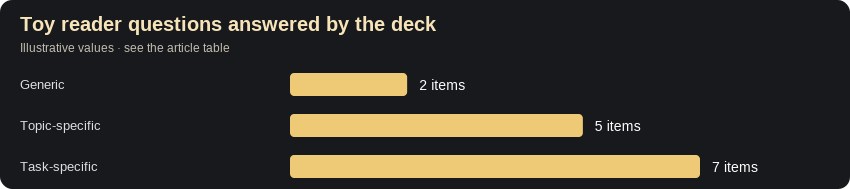
| Category | Value (items) |
|---|---|
| Generic | 2 |
| Topic-specific | 5 |
| Task-specific | 7 |
Constructed checklist scenario for this brief, not measurements, ratings, or results from cited sources. Each displayed count represents checked items in the named example.
A reader stops on a headline about a creek gauge. She has not decided whether to read the rest. She wants to know whether the story will help her set up a field log, interpret a study, or understand why a particular visit produced no measurement. Below the headline she finds a sentence that promises an in-depth look at a timely topic. It says almost nothing false, but it also tells her nothing that settles her choice. The editor has written a deck without deciding what the deck is there to answer.
A deck is the short explanatory text attached to a headline, often visible before the reader starts the body. It can say what the headline is too brief to tell. That might be the first step in a how-to, the scope of a research finding, or the reason one field observation is uncertain. A useful deck keeps the first reading decision in view and describes the material the article actually provides. It is not a miniature table of contents, a compulsory teaser, or a place to claim a result the body does not establish.
This article offers three kinds of examples, a fictional chart, and a practical way to test short descriptions against concrete reader decisions. The chart is a constructed demonstration, not study evidence or a public communication score. The best test of a deck is not whether it sounds more important than the next one. It is whether the intended reader can tell what the material is for without being misled about what it contains, what it can prove, or what they should do next.
Find the first meaningful decision
Begin by naming a specific reader in the context of the article. A field volunteer choosing which form to use, a student looking for a research comparison, and a returning participant wanting to verify an unusual notebook entry have different first questions. The same individual can be any of those readers at different moments. Do not define the person solely by age, job title or supposed reading level when the relevant difference is what they are trying to accomplish. Describe the choice that happens just before they start, continue, or leave.
Next distinguish the deck's job from the author's favorite fact. An author who discovered an interesting historical method may want to start with its origin. A volunteer seeking a next step may need to know first whether the guide applies to an already scheduled observation or a new site. In a research digest, the central finding can be more useful than a general introduction to the topic. In a field note, what the observer could not measure can be the fact that prevents a reader from interpreting the account wrongly. The right opening is determined by the decision and the evidence, not by the order in which the writer learned things.
The Federal Plain Language Guidelines and Digital.gov guidance on organizing information provide context for writing and organizing around reader needs. The CDC Clear Communication Index is a separate tool for planning and assessing public communication. Its main message guidance illustrates the value of making the main message easy to find near the beginning. These sources inform the general choices in this guide; neither tells authors that every environmental article must use a deck or that a fictional checklist counts as a CDC assessment.
Phrase a candidate question as something a reader could plausibly ask in their own words. “Is this the record I use when one visit was not completed?” is sharper than “What information is in this article?” “Did the study compare sites equally?” is sharper than “What were the results?” “Could the observer see both banks?” is sharper than “How was coverage measured?” The chosen question should be narrow enough that an editor can tell whether a deck gives a useful answer. If two questions compete, choose the one that affects the earliest meaningful choice and leave later ones to the body or an adjacent navigation link.
A deck need not appeal to everyone equally. For a method article the intended reader might know basic field terms; for an entry in a public reading series they may not. Explain specialist terms where necessary but do not make the text unnecessarily imprecise. If the article only addresses records with a specific attribute, that limitation may be essential even when it requires a few extra words. The objective is a clear usable choice, not language simplified until the evidence disappears.
Give the how-to an entry condition
Consider a fictional how-to with the headline “Make a Field Log After a Missed Visit.” It teaches readers how to mark a scheduled visit as missed and preserve its reason, not how to find a replacement location. A generic deck might say, “A practical guide to keeping useful records for better decisions.” It promises usefulness but does not tell a volunteer what kind of record, when to use the guide, or what it will help them decide. It could appear below nearly every article in the archive.
A topic-specific deck might say, “Learn the basics of documenting missed field visits in a survey log.” This is clearer. It identifies the subject and suggests a guide rather than a story. But a reader who wants to know whether to enter a zero or a missing observation still has to guess which part of the problem is addressed. Topic specificity matters; it may not be enough when the reader is already standing at a decision.
A task-specific deck might say, “If a scheduled visit did not happen, mark it as missed instead of entering zero observations. This guide shows what to retain in the log.” This gives the condition, the first decision, and an accurate description of what follows. It should only be used if that distinction is in fact supported by the article's stated procedure. If the applicable protocol handles exceptions differently, an unqualified command would be misleading. Adjust the deck's scope rather than declaring a universal rule for every program.
Here the first question was what to enter after the absence. The deck does not need to include the exact field labels, the rule for calculating a later percentage, or every reason a visit might be canceled. Time spent on those details in the deck can bury the central distinction. Conversely, if skipping a condition would lead a reader to use the method in an unsuitable context, keep that condition. The test is not minimal word count by itself. It is whether the useful instruction survives in a form the reader can act on without going beyond the evidence.
An alternative how-to angle may be about whether the guide fits a user's available materials. If a procedure applies only when a count sheet or known time record exists, put that requirement near the beginning. A reader without it can then decide whether the guide offers a different path for missing records. Do not advertise “fix every incomplete log” when the body only covers known missing entries in otherwise documented data. Honest scope reduces wasted reading and promotes exactly the kind of completion the guide can support.
Give the research digest a finding and a boundary
Take another fictional headline, “What Changed When the Observation Window Moved?” Its digest compares two blocks of observation from the same teaching study, controlling nothing beyond the stated setup. The intended reader asks whether the evidence shows a change in counts or proves an explanation. A generic deck might read, “New evidence offers an intriguing look at field observations.” It sets a research tone without answering the difference that matters. A topic-specific alternative might say, “A comparison of two observation windows shows different recorded counts.” This identifies the direction of inquiry and says there was a difference, but leaves scope and interpretation unclear.
A more task-specific alternative could say, “The later observation window had more recorded visits in this sample. The digest explains why the comparison cannot isolate a change in animal abundance.” This gives a useful takeaway and boundary without suggesting the observations were invented by the reader or equally supported everywhere. For the fictional setup, the claim describes recorded visits rather than individuals. In a real digest, verify the exact outcome, support, time window and uncertainty before choosing that language. Do not use the template to assert a result absent from the actual study.
Sometimes a digest should lead with the limitation. A reader choosing whether to cite a number needs to know whether it comes from a preliminary estimate, a limited sample or a reproducible synthesis. A deck can directly state the relevant support: a comparison within these recorded sessions, not a forecast for all future events. That may make the title less dramatic. It also makes it more useful to the reader who must decide whether the result belongs in another report. Good editorial restraint is not equivalent to withholding useful findings.
There is also a danger of overstating a negative lesson. If a study did not measure why counts changed, say that the comparison does not establish the reason. Do not say “the reason is unknowable” or “the later window made no difference.” These claims go beyond the scope in a different direction. A fair deck should state the available proposition and avoid turning lack of evidence for a mechanism into evidence that no mechanism exists. In concise editorial language, limits can be precise rather than bleak or vague.
If the real findings are mixed, identify the principal contrast relevant to the reader instead of inventing a single direction that every result follows. You might describe a measured increase in one outcome and stability in another if the distinction gives the reader what they need to decide. Put the unit, denominator or comparable period in the deck when its absence would lead to a wrong inference. Other details can remain in the body. Make the choice based on the actual study and use audience shortcuts only when they do not change the claim.
Give the field note an honest observation boundary
Now consider “The Far Bank Was Out of Sight,” a fictional note from an observer reviewing a river reach. Its intended reader asks whether the absence of a feature in the note means the observer saw nothing there or never saw that part of the river. A generic deck might say, “Notes from a challenging day outdoors.” A topic-specific deck might say, “A field note about visibility on a riverbank survey.” Both fit the broad subject. Neither distinguishes a zero observation from an unobserved area.
A more useful deck might say, “The observer recorded conditions on the near bank. Trees blocked the far bank, so the note does not establish conditions there.” This is not a command or a general finding. It gives the support of one account and its limit. The body can describe the site, field time, viewing condition, and method at greater length. If visibility was partial rather than absent, revise the deck to preserve that fact. A modest sentence can prevent a major error without sounding like an emergency notice.
Field notes can be vivid without disguising their source. An observer may remember a line of trees or a brief patch of sun that made one stretch readable. Those details belong when they describe why evidence was collected or missed. They should not be treated as calibrated measurements unless appropriate evidence supports that claim. A deck might identify that it is a first-person observation, a compiled record, or a retrospective interpretation where readers would otherwise infer the wrong perspective. The amount of detail needed depends on how those distinctions affect use.
For a different field note, the first question might concern what changed from the previous visit. If the only result is that a sensor's position could not be confirmed, say so rather than turning an incomplete comparison into a finding of stability. If the note describes one verified occurrence, use scope words that keep it tied to that time and location. An observation can matter because it is specific. Broadening it into a universal claim for punch does not improve its usefulness.
A field-note deck can also support a decision not to read on. Someone seeking a complete timing record may discover the article only documents visible conditions and choose another source. That is a success if the deck communicated the limit honestly. Do not evaluate every short description by the number of clicks it wins. A good fit includes helping people avoid spending time on material that cannot answer their question. This is where respecting reader choice matters more than maximizing suspense.
Reproduce the 2, 5 and 7 as an exercise, not a result
The illustrative chart uses a separate fictional brief with seven predefined questions and three draft descriptions. It is not a summary of measured reader behavior, a test of the three examples above, or a CDC index score. Imagine a pilot help page for volunteers finishing a scheduled river survey. A reviewer in this toy setup counts a question only if its answer is explicit in the candidate text, considering no other page material. The purpose is to show how a known checklist can be reproduced rather than to recommend stuffing seven answers into every actual deck.
The seven questions for the toy help page are: who is it for, what record is affected, what condition makes the help relevant, what entry should be chosen, what detail must be retained, what should not be entered, and where the reader finds the steps. Define the target responses before scoring. For this exercise the responses are field volunteers, the survey log, a scheduled visit that did not happen, the missed status, the reason, not a zero count, and the steps immediately below. Some questions may be inseparable in ordinary prose, but each criterion has a stated condition in the toy comparison.
The fictional Generic draft reads, “Field volunteers can use these steps below to improve their records.” It explicitly answers who and where, for two items. It does not identify which record, condition or entry, what detail to retain, or what entry to avoid. The Topic-specific draft reads, “Field volunteers: If a scheduled visit did not happen, use the steps below to mark it missed in the survey log.” It answers who, what record, when, which entry and where, for five. It does not expressly state which detail to retain or what not to enter. The Task-specific draft reads, “Field volunteers: If a scheduled visit did not happen, mark it missed in the survey log, keep the reason, and don't enter a zero count. Follow the steps below.” It explicitly answers all seven.
| Illustrative draft | Toy reader questions answered | Questions in the fixed checklist |
|---|---|---|
| Generic | 2 | 7 |
| Topic-specific | 5 | 7 |
| Task-specific | 7 | 7 |
Two plus three gives five, and five plus two gives seven. No readers were tested and no real communication materials were scored. The imagined reviewer checks for explicit content in a fixed set of statements. Under this rule “mark missed” alone does not explicitly answer the separate checklist question about whether a zero should be entered. A different scoring rule might count implied material differently; that would be a different result and should be described as such. Reproducibility requires specifying both the questions and the rule.
More answered questions do not automatically mean a better deck. A particular field site may only need the condition and the distinction between a missed visit and a true zero. Listing the location of every form field would increase the checklist count without helping the first decision. The longer task-specific line demonstrates the toy difference, not a rule that seven points must fit on a card. An actual reader might interpret a deck differently, or rely on the heading to answer part of the question. Real testing needs that delivered context and the audience relevant to it.
Test the reader's inference, not just a matching phrase
A modest use test can ask someone to read the headline and deck, then describe what they expect the body to do. Do not reveal the desired phrase in the question itself. Ask which problem the guide fits, which result the digest claims, or what is unobserved in the field note. If the reader repeats words but draws the wrong conclusion, that is useful evidence. They might say “the study proves abundance rose” even after seeing an accurate number, because the deck omitted the fact that it counted visits. The goal is correct interpretation, not successful recital of the copy.
Check one near-miss scenario. Show the missed-visit guidance to a volunteer who did perform a complete visit and observed no target events. They should be able to tell it addresses a different condition. Show a limited research comparison to a reader trying to answer a broader causal question. They should be able to identify the limitation rather than treating uncertainty as a result they can cite. Show the river note to a reader looking for evidence about both banks. A successful deck helps each distinguish fit from superficial resemblance.
Record the actual context of the test. A reader seeing a headline, deck and graphic inside the article may have useful clues absent from a small index card. A search or mailing preview may shorten the text. Differences between these contexts can matter more than differences in the entire long sentence. Verify the places where the descriptions are actually used and keep results separate. Do not infer that a deck works in an isolated announcement because someone understood it with the full article open.
A useful test transcript should preserve the reader's reasoning in a short record, not only a pass count. Which words or missing qualifiers shaped their inference? If they considered a nearby alternative, what made it seem plausible? If the wrong task was chosen, would a scope phrase or clearer title resolve it? This evidence helps direct revision. An unexplained numerical rating encourages editing the whole sentence on intuition, even if only one word made the claim too broad.
When recruiting or reviewing actual readers is not possible, say that clearly. A structured author review can still identify inaccurate or vague language. It is not a replacement for observing how the intended audience uses the material. The CDC guidance on developing communication products points to testing with the intended audience; the fictional counts in this article are deliberately much narrower. Mark editorial tests as editorial tests and treat their results as a starting point for further evaluation rather than a public performance claim.
Select the amount of detail with a promise audit
Read the deck once to identify what it promises, then look for where the body fulfills each promise. In a how-to, this can mean identifying the exact step or prerequisite a reader was told to expect. In a research digest, find the data and limitations for the stated result. In a field note, find the recorded observation or documented boundary. If the only place a claim appears is in the deck, the text might need a substantively stronger body or a weaker promise. Editing the headline to imply the same unverified thing does not solve the problem.
Look for both positive and negative promises. A phrase such as “no specialized equipment” sets an expectation that can be falsified. If a later step depends on a tool that most readers do not have, decide whether the deck should mention it or whether the procedure actually has an equivalent alternative. Saying “not a guide to choosing new sites” can also be useful where another article handles that task. The short form is not because of a ban on context; it is a way of putting the necessary context in view early.
Compare the deck to the page's roles. A headline may bring a memorable phrase; a deck can resolve its ambiguity. An introductory paragraph can then expand without forcing the reader through identical sentences twice. For example, the headline “Four Readings and an Empty Line” could refer to almost anything. A deck that says the empty line marked a visit never made gives the reader a handle, while the lead can tell how the crew established the dates. If both headline and deck repeat the same broad claim and neither tells what material it concerns, the space has not been used well.
A ten-second trimming exercise is helpful once the draft is truthful. Keep the condition, a concrete noun naming the topic, the first answer and an essential boundary if there is one. Remove the general sales language and anything that belongs at the next decision. Compare the result against the source again. If the trim deleted the scope of a claim, put it back or choose a more compact wording. More concise is not automatically more plain-language if important information was removed in the process.
Do not confuse a broad invitation with a substantive promise. A person might enjoy an opening that says the piece follows how a field team reconstructed incomplete records. If the project is a personal narrative, that can be an accurate useful description. But “everything you need to know about monitoring” is rarely an accurate descriptor for one limited report. Specific words can establish expectations without turning every item into an instruction. Your job may be to orient a reader to an experience, establish the scope of evidence, or support an action; use the language that follows from the particular assignment.
Choose one primary task without abandoning the others
A common objection is that an article serves several readers, and any one deck might disappoint the others. Sometimes distinct routes solve the problem better than longer phrasing. An article front can describe the principal research finding and include links labeled methods, detailed results and observation notes. A separate quick guide can start with the task a volunteer needs. An archive index can describe the coverage of the record without trying to replicate the lead of the feature article. Each entry gives a reader a clear first choice while preserving access for people who come with different purposes.
Where there is only one deck, name the overlap among audiences that are both likely and important. A note that says which part of the river was assessed can serve both a scientist and a local reader, even if their later questions differ. Choosing that overlap can be better than forcing a reference to every possible concern. If a secondary audience needs a particular caveat to avoid harm or error, preserve it visibly where appropriate. Audience prioritization should not become an excuse to remove facts necessary for responsible interpretation.
Test for real competing tasks rather than assuming that all refinements are mutually exclusive. A user might ask “is this for my missing record?” and “what should I put there?” at the same moment. Those answers fit well together. Once the same person needs instructions for deploying a replacement sensor, the guide may be serving a different task or may need a separately described section. Cluster questions by decision, not just by subject. Topics like field notes and missing data can relate to very different actions, so a single broad title may not orient the reader adequately.
If the publication has repeat readers and first-time readers, distinguish what each brings. A recurring note can appeal to people who already know a station alias, but other readers may need the geographical or method context. Include the useful concrete term rather than only an internal code, then provide additional metadata where the body or landing record supports it. If a short line cannot establish both the subject and exact coverage, favor the distinction that prevents the most likely wrong choice, and give readers an accessible route to the rest.
Check the surfaces where the line may split
A deck displayed on a full-width article may appear again on a small phone card, in an email digest, or in a text-only export. Do not assume the whole sentence is visible everywhere. Check the first useful words and what happens when the rest is cut. A line that reads “this guide shows how to interpret the count … without treating it as abundance” can become misleading if the final part routinely disappears. Consider moving the limitation nearer the source claim or rewriting the short version so it can stand without relying on a clipped ending.
This is also a reason to test the actual title and deck together. A card title can already provide the record name, leaving the deck to state the decision. An isolated summary may need to repeat the name because the headline will not travel with it. Different copies can be legitimate if each describes the same material honestly. Keep the core meaning and important qualifications consistent and document where variations are intentionally rendered. A separate mail preview should not quietly turn a conditional guide into a promise suitable for every situation.
Visual cues cannot take the place of missing words in every context. A background photograph might show both riverbanks even though the note documents only one. An inverted card can present a field note and a research report in the same visual style, while clear text can still establish the difference. A person who cannot see the picture or who receives the deck without it should not have a weaker or more misleading basis for deciding. Use text to carry the essential scope instead of requiring a color, decoration or hero image to explain what the article is.
One useful verification is to read the plain text without the design and state the first expected decision. Then read the delivered card at the relevant sizes, using the actual body and title to detect a mismatched transformation. If the copy intentionally differs in the two surfaces, check both. A truthful source document can still lead to a misleading user screen when a formatter drops the qualifier. Note the observed layouts and don't imply that a single preview tested every browser or export.
Keep a compact record of editorial choices
Write a brief before editing the deck: intended reader, first question, article type, evidence-supported answer, and the mistake the deck should not invite. Provide a relevant title and body reference so future editors know where the answer came from. For a repeated series, preserve a small set of concrete accepted examples rather than a universal list of forbidden words. That lets a later writer understand why one deck leads with a decision while another leads with a finding or limitation.
When a revision changes the evidence, revisit the deck even if nobody specifically requested new promotional text. A study digest might be rewritten after a correction changes the count or its support. A field note might be expanded after a later observation confirms another bank. A guide might add a legitimate alternate approach for incomplete logs. Retain dates or scope where relevant so the short description accurately identifies the edition people will actually read. Old exports may still circulate; describe new findings and limitations clearly rather than assuming every copied snippet updates itself.
Track why you rejected alternatives. A generic deck may be grammatical yet fail to distinguish between nearby choices. A specific deck may answer the wrong first question, even though its individual statements are correct. A detailed task-focused deck may do too much and bury the important instruction. These are different reasons for change, and noting them makes a review more constructive than simply asking for “stronger” or “punchier” copy. One reviewer can identify the principal inference while another checks audience and evidence fit; the two roles complement each other.
Use actual retest questions when possible. Ask what the reader expects to find, whether they know what action or interpretation the deck supports, and whether they can recognize a case it does not cover. Record the answer briefly and change the wording accordingly. If you have only author review, say that it was an editorial prediction. An honest small review is more useful than an invented audience score. The chart's hypothetical counts make the scoring rule inspectable, but a real outcome needs its own observation.
Know when the useful deck is a smaller promise
Good editorial decks are not always packed with all available detail. Consider a technical record whose first important point is that it does not include verified times. A short line explaining that scope can do more for the reader than an impressive list of the few timestamps the draft reproduces. The right first answer may be absence, a constraint, or one confirmed comparison. It can also give people the next step where the article genuinely supports it. Describing a small, useful thing accurately is better than promising a complete answer the article cannot provide.
A final rehearsal can apply the same question to each of the three formats. For the how-to, could the intended reader tell whether their situation qualifies and make the first correct choice? For the digest, could they state the result and avoid a stronger inference? For the field note, could they identify what was seen and what was not established? Compare those answers with the material behind each line. If the meaning holds in the delivered frame and the source supports it, the deck has done its job.
The chart and its table make one narrow point: a toy generic text can explicitly answer two of seven predetermined questions, a more topical one five, and a task-specific one seven. The rest of the article explains how a real reader's first question might instead justify asking fewer, better questions in the first place. The aim is not to put every answer above the fold. It is to give the right person enough accurate information to decide what to do next.
Use reader vocabulary without inventing certainty
Sometimes the best technical name for a process is not the phrase a reader will recognize before opening the article. A deck can connect ordinary language to the approved term without treating them as exact substitutes in every context. Imagine a dataset defines incomplete observation intervals by a particular rule, while readers commonly ask what to do if they had to stop early. Start with that condition and identify the actual term the guide uses. The reader can tell that the article applies, and the body can explain the limits of the definition before they act.
The reverse problem is a common term that carries a stronger inference than the source. “Missing” can mean a sample was lost, a scheduled visit did not occur, or an observer saw nothing relevant. If the guide concerns just one, name it rather than choosing a word that has several plausible readings. “No visits recorded in a complete session” and “no session record” imply different evidence even though a dashboard might render both as an empty space. An accurate deck can make this distinction without requiring the reader to learn an entire data model first.
For an unfamiliar subject, ask readers how they describe their problem before giving them your favored wording. The answers can reveal the difference between the site's category names and the audience's entry point. Use the vocabulary that communicates what the article delivers without adding a claim the source does not make. Do not treat one person's expression as evidence all audiences use it, and do not present informal interviews as a measured score. A few grounded examples can nonetheless guide a better draft.
A small handoff note can record the source phrase, the chosen reader-facing phrase and why they are equivalent for this particular use. Reopen the comparison if the article scope or definition changes. This is more durable than merely saying “simplified for the public,” which leaves a later editor unsure what meaning was intentionally preserved. Reader-first language should bridge uncertainty, not conceal it behind friendly words.
References
- Federal Plain Language Guidelines and Digital.gov: Organize the information, for reader-first organization and clear language context.
- CDC Clear Communication Index, main message guidance, and Developing effective communication products, for communication planning and reader testing context. Neither agency supplies the seven-question exercise or its counts.