| Category | Value (relative units) |
|---|---|
| Far left | 42 |
| Left center | 54 |
| Right center | 65 |
| Far right | 73 |
Illustrative only, not taken from a source dataset. Invented light gradient illustrates spatial confounding, not an observed site.
The school greenhouse has one bench and room for sixteen pots. Half are going to receive a new potting mix and half a reference mix. A volunteer carries in the new pots first and puts them at the sunny end. By the third week they look taller. A display board declares a victory for the mix. On the other hand, the new pots could simply be responding to their positions. The experiment gave the new mix and the sunny end the same address. There is no observation of a reference pot at that end or a new-mix pot at the shaded end to help separate the two explanations.
The trouble would not vanish if every plant were measured with a better ruler. This is a design problem. Assign the mixes to experimental units by a chance process that does not use favorable spots as a reward. If known positions are very different, arrange the chance process so that both treatments are represented within comparable sections. Then document who or what went where. These are ordinary planning steps, but a clear allocation saves more interpretive trouble than pages of measurements collected after a weak comparison has begun.
Random assignment does not make a greenhouse uniform. A bright edge can remain brighter, a fan can keep blowing past one row, and the bench surface can slope slightly. Randomization changes which units receive the treatments. The important claim is that the assignment rule did not reserve a favorable environment for one mix. Blocking, when appropriate, goes further by ensuring comparisons in predefined groups of similar units or positions. This article develops those distinctions with one invented light chart, then explains why moving pots during an experiment answers a different design question.
Start with the comparison, not the arrangement
A tidy bench is not yet an experimental design. Write down the comparison the team wants: for example, the average difference in height change after three weeks between seedlings grown on two named mixes, under the specified watering and fixed-position bench routine. State whether all pots will start with comparable plants, and choose a measurement rule that someone could repeat. A person measuring the top of a leaf and another measuring the highest point of the stem may produce two distinct outcomes under the heading height. Resolve such differences before the photographs look persuasive.
The NIST/SEMATECH guidance on choosing an experimental design distinguishes objectives such as comparing choices, screening factors and modeling a response. A two-mix bench trial is a comparison unless more factors are actually varied by design. Adding a note about light does not turn the trial into a properly allocated experiment on light. If the team really wants to test whether the mixes perform differently under two named light conditions, the design needs planned replication and a meaningful treatment comparison within those conditions. The observation of a naturally sunny end might suggest such a question without resolving it.
Define the experimental unit as part of the question. If a mix is assigned separately to each pot and pots can receive it without interfering with neighbors, the pot can be the unit for that effect. Three stems in one shared pot do not represent three independently assigned pots. Likewise, if one tray is filled with the new mix and one with the reference mix, then every pot inherits its tray's treatment. Measuring eight pots on each tray is not eight independent tray allocations per treatment. Distinguish the objects measured from the objects actually randomized.
Write down what other practices remain the same and what differs by intention. Using one watering regime makes sense if the project asks about the two mixes under that regime; it does not prove the result applies under every watering schedule. If trays share water or shadows, there may be interference between pots even when individual assignments were planned. The correct response is to consider how exposure actually works, not to claim that assigning a label by chance makes units physically independent. Scope the question so it fits what the bench can support.
Why one end of a bench can tell a misleading story
A light gradient is a regular change in light with position, perhaps because the right end is close to an unobstructed window. Other gradients might follow temperature, airflow, watering order or access. The center may be better protected from drying than two edges, so the pattern need not be a straight slope. Near a doorway, repeated brief changes can make one spot harder to characterize than a single average suggests. Even a position effect irrelevant to height might matter for another outcome such as time to wilt. Begin with a map of the actual arrangement rather than assuming any one sensor reading summarizes the whole environment.
Confounding occurs here when the treatment indicator and position pattern are inseparable for the desired comparison. If every new-mix pot is on the right and every reference pot is on the left, an observed group difference can represent mix, position or both. A bench map makes the problem immediately visible. A spreadsheet sorted into two groups can hide it, especially if the position field was never recorded. Adding position to a model may appear to solve the issue, but the design never supplied direct comparisons of both mixes in the same regions. Any separation would rest on additional assumptions about the position trend and how it relates to outcome, which the original trial may not support.
A regular alternation such as new, reference, new, reference spreads mixes along a simple left-to-right trend better than two solid halves. It is not the same as random allocation. Its fixed pattern can match a repeating bench feature, such as alternating places over supports or different spaces between drip lines. If the arrangement was chosen after looking at the healthiest seedlings, the pattern also tells nothing about how plants got their mix. A careful blocking scheme can deliberately balance positions and still use chance within each comparison set. That offers a clearer rationale than trusting a pleasing symmetry.
Sometimes the most honest use of a confounded pilot is to learn about the bench and design the next experiment. Keep the plant measurements, photo and allocation as historical records, but do not sell the height difference as a causal mix effect. If both new and reference pots grew adequately, that observation may be practically useful. The stronger claim about their comparative performance can wait for a design capable of distinguishing it. A setback in attribution is not a reason to discard all evidence from the session or pretend the original positions did not matter.
The illustrative chart shows light readings, not plant results
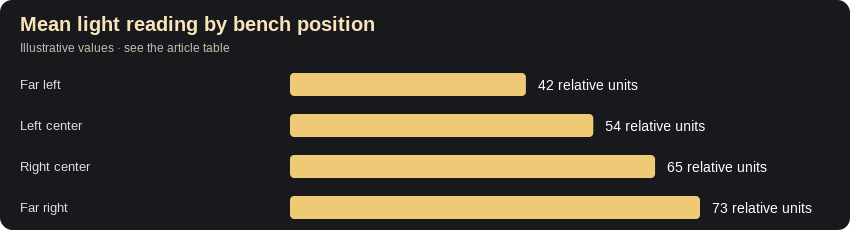
The figure “Mean light reading by bench position” shows four invented position means in relative units. The far left is 42, the left center is 54, the right center is 65, and the far right is 73. This is a teaching illustration of a spatial gradient. None of the values is an observation from NIST or from an actual greenhouse. The handbook link explains design choices. It did not generate the light readings. The label relative units deliberately avoids implying that these numbers represent an instrument with a published physical calibration or a particular plant-light measurement.
| Illustrative bench position | Mean light reading in relative units |
|---|---|
| Far left | 42 |
| Left center | 54 |
| Right center | 65 |
| Far right | 73 |
The two left positions have a simple mean of 48, and the two right positions have a simple mean of 69, if each position mean receives equal weight. Their difference is 21 relative units. This arithmetic describes the toy bench, not a measured exposure difference through the life of a plant. It does not show that seedling height responds linearly to light, or even how height responds at all. If you assigned the new mix only to the right two positions, the same group label would also select the two higher toy means. That conceptual overlap matters without inventing a growth effect.
The adjacent differences in the invented means are 12, 11 and 8. The exact shape of the trend is not the lesson. Do not try to infer from these four toy bars whether the exposure decline followed distance, whether there was a shadow at any particular hour, or whether a biological threshold was crossed. A real characterization would document the meter, placement, timing, repeated readings and distribution behind each bar. It might find changes in direction over a day or a gradient in another variable rather than in light. The term mean would have a defined averaging scheme that the chart reader could inspect.
The chart measures no experimental intervention and does not estimate a treatment effect. A useful caption says that these are illustrative light readings to explain why position can be a nuisance factor. A separate diagram can show pot assignments if the reader needs to see where comparisons occur. Avoid combining light bars and height outcomes on different scales without a clear reason. In this example, it is easier to distinguish the concern from the result by keeping the one teaching graph about bench position alone.
Randomize the part you can actually control
A simple fixed-position plan starts by labeling sixteen eligible spots on a map. Give every pot an identifier, and decide if pot-to-position assignment or mix-to-position assignment is the part being randomized. If all pots are exchangeable before treatment, one workable plan draws eight new-mix labels and eight reference labels into the sixteen positions using a documented shuffled list. Then place and label the pots according to that allocation. The intent is not to make the scene look scattered after the fact. It is to keep assignment from depending on a person's preference for a plant or a position.
If pots have already grown unevenly before treatment, their existing variation should be addressed explicitly. You may choose to measure starting height and state that the outcome is change from baseline, then randomize assignments without selecting from the results. A design could also predefine groups of similar starting plants and randomize treatment within them, if that matches the question and feasible setup. Take care not to introduce a second unlogged choice of positions afterward. The allocation must reflect all important steps that can cause treatments to coincide with a favorable start or spot.
A physical draw can be enough for a garden class if the labels are indistinguishable before drawing and the rules are recorded. A computer shuffle can be convenient for larger work. Save the resulting allocation, since code choices and the starting order can matter if someone tries to regenerate it. If a random seed was used, record it along with the procedure and software where useful, but do not rely on the seed alone as the entire historical record. The saved map tells you exactly what was intended regardless of whether later software generates the same order from the same initialization.
For a similarly planned allocation, see the NIST/SEMATECH section on completely randomized designs. The principle transfers to a small greenhouse example without a complicated statistical package. Randomization is a procedure with a defined set of possible assignments. It is not permission to pick a visually convincing result from several shuffled versions. If the rules require a balance, make that eligible balance part of the design before running the assignment. If a chance result is somewhat uneven and allowed under the design, don't move pots around to make it seem more random.
Use blocks for predictable position differences
Suppose the bench can be divided into four adjacent zones of four spots each. All zones are usable, but they clearly differ in their exposure. Set each zone to have two new-mix and two reference-mix pots. Randomize which two spots in each zone receive the new mix. This makes the treatment comparison available in every zone rather than simply hoping a complete randomization balances them on one small realization. If the block boundaries were chosen for bench conditions, the resulting allocation is a simple example of randomized blocking.
The NIST/SEMATECH section on randomized block designs explains blocking as a way to account for nuisance factors while randomizing where appropriate. Here, the four zones help organize the design because position-related conditions are not themselves the treatment of interest. Within a zone, plants receiving the different mixes share the broad local environment. A zone still need not be uniform. More closely related positions can make comparisons more informative, provided that enough treatments and units can fit inside each block and the logistics support the plan.
A toy allocation could put reference, new, reference, new in the first zone and new, reference, reference, new in the second, with other valid orders in the remaining two. The exact sequence is unimportant unless it is the one actually executed. It is important that all allowed assignments satisfy the two-and-two rule within blocks and that chance, not convenience, selects the order. The team should not choose the sample arrangement printed in an article for every class. Write the map with positions labeled and use the actual draw's record. Two classes following the same design need not generate the same layout.
There are limits to this simple scheme. Grouping into zones by position makes sense when the biggest concern is broad environmental variation across the bench. Blocking on initial plant size might be comparatively useful for a different trial, and more intricate arrangements are possible if both sources matter. Do not impose so many restrictions that meaningful treatment comparisons become impossible. A pair of very small spots in one corner cannot provide a separate comparison of three mixes at once. A sufficiently simple design that is followed correctly can be more valuable than a sophisticated one that the field team silently abandons.
Save the allocation and log the exceptions
Record the position map before the experiment begins, with enough detail to distinguish near and far edges, rows and columns. Put a non-hazardous pot identifier and position identifier in the field sheet, not only the treatment written on a label. Use an allocation table containing at least unit ID, assigned treatment, assigned location, any block and when assignment happened. Keep a view the team can consult for care. If reviewers can measure outcomes without knowing the mix and that is feasible, store treatment information separately from those measurement views while retaining the link in the master record.
Version the main allocation and track exceptions rather than editing history in place. A pot may be moved when there is a spill or a spot may become unsafe or unavailable. Write down what changed, when, why and which other units were affected. If the original design required fixed positions, this is a deviation. It need not erase the outcome; it does need to be visible to the person interpreting it. Changing position and updating the same cell as if the pot had always been there would erase potential exposure differences. A spare bench map annotated on the event date often beats trying to reconstruct a movement from memory.
Special attention is needed when a plant does not survive or a measurement is missing. Do not replace it quietly with whichever spare looks most similar at the end of the trial. That can turn treatment or position effects on survival into an invisible selection step. Predefine any replacement window and state which outcome it can support. For a trial without replacements, retain the assigned ID and its outcome status. If the primary height analysis uses only surviving plants, don’t describe it as covering all assigned pots. Report the missingness or survival outcome separately and avoid pretending the unavailable heights were zero.
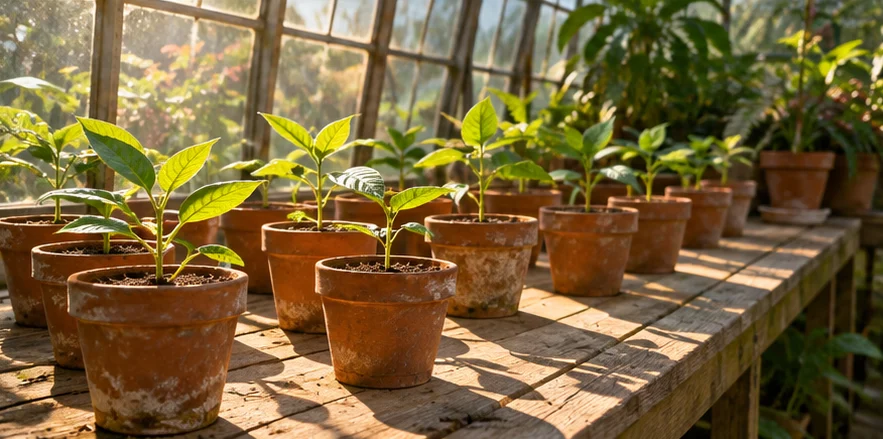
The final account should distinguish planned and realized placement. An original map plus a move log lets the reader see both. The wide article illustration is neither one: it shows how light can strike seedlings unevenly, not what spots or treatments the experiment used. A photo of a real trial can provide helpful context if dated and labeled, but it still cannot establish where every pot spent every day. These materials have different purposes, and accurate captions are part of a dependable record.
Rotating pots is a different intervention
Moving pots later is often described as randomization, but the roles are different. Initial randomization assigns treatment or placement before exposure. Rotation specifies how exposure changes during the trial. A rotation schedule might intend to give pots time in more than one region. Whether it makes the realized exposures comparable depends on the schedule, compliance and biology. Equal time in a bright and dim spot is not necessarily equal in effect if one plant gets the bright interval early and another late. Changes through the day, growth stage and irregular weather can matter. The same time total is not always the same sequence or intensity.
Manual movement can introduce practical issues beyond light. Handling may change how often pots are touched, the direction of support, drainage conditions or time out of a water tray. If a move happens only when the brightest pot appears to be doing poorly, the decision responds to an emerging outcome. That is not the same as a preassigned schedule. Such movement can be reasonable garden care, but it changes what the experiment can support. If relocation is the intended common treatment routine, document it and retain a timeline linking each pot to each interval.
Researchers have tested these choices in particular greenhouses. Brien and colleagues' greenhouse microclimate design study examined relocation and statistical designs and emphasized the challenge of giving plants comparable exposure at comparable stages. A later experimental comparison of blocking and re-arranging pots found benefits of both approaches in its setup, with a particular small-block design performing well for the traits measured. Another high-throughput crop phenotyping study reported that its systematic shuffling procedures reduced spatial variation in a different apparatus. These are reasons not to treat a technique as universally best without its context.
The title's comparison is between a defensible chance allocation and simply awarding one condition the sunny end. It does not say that a fixed first assignment always beats a thoughtfully planned move schedule. If your actual question is how well the mix works when pots are shifted weekly, rotation is part of the regime being evaluated. Randomize the treatment under that regime and consider balancing the relocation sequences as a separate design choice. If you want to compare fixed positions against moving, that is a separate treatment question needing independent allocation and suitable replication. A pot cannot provide two simultaneous histories just because its weekly average position could be calculated.
Analyze the difference the design actually made possible
For a straightforward balanced block example, first show the raw outcomes by block and treatment. Calculate the difference between the two treatment means within each block, then summarize those planned contrasts in a manner consistent with the design. If all four blocks have the same allocation and comparable purposes, the average of four block differences is an intuitive teaching summary. More formal models can use the block structure to represent shared environment and estimate uncertainty. Do not choose a method only because it gives a more dramatic estimate. Explain any missing blocks or imbalance before interpreting the result.
For illustration, imagine four invented treatment differences in height change of 2, 0, 1 and minus 1 centimeters. Their equal-block mean is 0.5 centimeter. It does not show the new mix gives half a centimeter more growth in all zones; one block favors the reference and another shows no difference. These values are not part of the light chart. They show why a summary benefits from a display of the component contrasts. A treatment difference might vary by position, and with only a small number of blocks the data may not support ambitious claims about which environmental feature caused that variation.
Plot a comparison against the recorded positions to diagnose patterns, not to redefine the test after seeing its outcome. An unusually large pair difference near the door might prompt a check of the move log or a classroom discussion of possible interactions. It should not trigger deletion because the point interrupts a story. A preplanned set of quality rules can distinguish a broken stem or mistaken ID from an inconvenient result. If findings depend on removing one record, say so and show the reason. A transparent sensitivity comparison usually teaches more than a solitary edited point estimate.
Avoid interpreting the light chart as an adjustment factor for centimeters of growth. You cannot subtract 21 relative units from a treatment mean measured in centimeters. Even if a real meter had calibrated units, correction would require a warranted model linking exposure and growth with appropriate data. A properly randomized or blocked layout gives the analysis a defensible comparison even when the physical mechanism is not estimated. Direct measurements of light can still clarify the setup and suggest follow-up work. They do not retroactively replace the planned design.
Scale expectations to the number of real experimental units
A single small trial can be useful, but the precision of its findings is limited. Measurements on the same pot over many mornings provide information about that plant's growth curve; they do not create new independent treatment allocations. Several leaves measured on one plant likewise support a more detailed description without multiplying the replication count. State how observations are summarized within the unit. A clear distinction between pots, observations and blocks prevents inflated confidence about the number of independent comparisons the project made.
Replication can support broader questions if it happens at the right level. Repeating the study across several independently allocated benches or separate sessions can reveal whether a result depends on one particular setup. A single bench with sixteen pots does not automatically represent different buildings, seasons or watering routines. If several benches share one treatment controller, assignment and analysis should recognize that relation rather than calling every spot an independent experiment about the controller. Always ask which unit could actually have received a different treatment under the design. That question often locates the proper level of replication.
If the team can expand, choose between adding pots within these zones and testing independent environmental settings. The first may improve comparison under this one type of bench environment. The second may broaden what conditions the results speak to, provided the allocation and implementation are documented. Convenience often favors adding more readings in the existing space. That can be a reasonable choice for precision, but it cannot supply generalization to settings never tested. A short report can explicitly name what a second experiment would add rather than making the present design do every job.
It is possible to report a lack of clear evidence without saying the two products are equivalent. A noisy small trial in which an estimated difference is close to zero may be compatible with both no meaningful effect and effects important to gardeners. An equivalence question requires defining what size of difference matters and collecting sufficient evidence to resolve it. This article is about allocation, but a good layout does not guarantee enough units or enough care to answer every hypothesis. A defensible claim follows the design, the data and the question together.
Map the environment before treatments appear
A brief check with no assigned treatments can help the group identify a useful blocking variable. Mark the usable spots and make comparable observations under the expected schedule. A light check might use readings at a consistent height above each pot position, while a second note records the approximate time, whether direct light was present and whether the blinds were in their usual position. The goal is not to produce an exact season-long exposure estimate. It is to see whether the bench has an obvious structure relevant to the design. A single afternoon pattern may be enough to prompt a cautious block plan, but not enough to assert that the same ordering applies throughout the day.
At some sites, the most informative pattern may extend across the depth rather than the length. A window-facing row might differ consistently from a row behind it even when the left and right ends look similar. In that case a four-zone left-to-right diagram from the example is not automatically the right design. Sketch the arrangement with its actual edges. Compare alternative block layouts in terms of whether each contains both mixes and whether the conditions within a block are more comparable than those across blocks. If a shelf or watering arrangement can only accommodate an intact tray, identify the tray constraint before making each pot an independent slot in the allocation list.
Keep environmental observations distinguishable from exploratory plant outcomes. A quick pretrial measurement can suggest which positions might differ. It is different from discovering that plants grew well in one arbitrarily chosen treatment group and then choosing a block definition to remove uncomfortable results. If a concern appears after allocation, save the observation and consider it during interpretation, but label any new analysis as exploratory where appropriate. A design decision made before collecting the response has a different evidential role than a model chosen to make a particular interpretation fit.
One common trap is to average incompatible readings. A meter turned toward the glazing in one spot and laid flat in another may not have measured the same quantity. If the purpose is relative comparison, keep the orientation, height and schedule consistent and avoid changing the numerical scale partway through the bench. Plants grow into different heights and neighboring canopies can develop over time. If later readings are taken at canopy height, record that choice as distinct from the initial empty-bench mapping. The toy graph intentionally avoids these complications by being invented rather than masquerading as a measurement.
Try a paper rehearsal with the people who will run the bench
An effective allocation can be rehearsed before anyone uses the actual pots. Draw a map with the proposed spots, put down labeled cards as placeholders, and walk through how the team will apply the assignment. Point at one pot identifier and ask who can tell which treatment it should receive, who will verify it and which records are needed later. Try reading the map from both sides of the bench. A row labeled left might become ambiguous when a helper approaches from the opposite end. A direction tied to a fixed feature, such as the window or the end closest to a physical sign, is less likely to reverse by accident.
A rehearsal is also a chance to check that the materials can be applied as designed. If a mix is prepared in one container and used for several pots, acknowledge any preparation batch effects relevant to the intended claim. One batch of each mix might suffice for a limited demonstration about those batches. It cannot independently separate variation among preparations from the mix labels. If the project intends to generalize to future batches, it may need more than one independent preparation. This is another case where eighty measured leaves or sixteen pot positions do not substitute for replicated units at a higher level.
Include realistic exceptions in the rehearsal. Suppose a block loses one position to maintenance before treatment. If the allocation hasn't yet happened, the team can revise the eligible map, document the reason, and define an appropriate replacement design. If the loss happens after pots are assigned, the assigned map is now part of the record. Move a real pot when needed for safety or care, but retain the event and avoid replacing the original assignment in a spreadsheet. The best plan does not demand that volunteers keep an unsafe experiment unchanged. It distinguishes an acceptable deviation from an unnoticed change.
Check ordering effects in measurement, not only position in growth. If measurements always start with one mix and take an hour to finish, time of day may matter for some outcomes. A fixed-order protocol might be adequate for a stable outcome measured over a very short window. Otherwise, use a suitable planned order, schedule comparable measurement periods, or balance timing across treatments. Record the actual sequence if it helps explain decisions. An excellent placement rule does not automatically balance every later step in a study. The assignment is a foundation, not a substitute for specifying what the observers actually did.
Compare two proposed ways of adding rotation
Suppose one group wants to move every pot through four zones. They propose starting the new mix on the right and shifting every pot one zone each week. At the end, all pots may have spent the same nominal number of weeks in each zone. However, all new-mix pots still had the right zone earlier than the reference group, so the timing of exposure remains associated with treatment. If growing seedlings react differently in their first and fourth weeks, the simple total of zone time does not answer the concern. A rotation design needs to think about sequences, not merely count visits to slots.
Another proposed plan spreads both mixes across the four starting zones and assigns or balances sequences within that setup. All pots are handled at the same scheduled points, and missed moves are logged. Under that plan a result pertains to the specific rotation regime. It is not necessarily relevant to every pot grown permanently next to the window. If a researcher wanted to estimate both a mix effect and the effect of rotation itself, separate planned groups would be needed. Comparing this rotating class to a historical fixed-placement class may also compare seasons, staff or materials. A clearly framed experiment saves the story from assuming that the label rotation means the same thing everywhere.
No plan makes time a simple correction by itself. Brightness can vary among weeks, and moving may matter if the person doing it waters or handles one group differently. Changes in plant height can alter which neighbors cast shadows. In some projects the benefit of comparing fixed nearby positions more cleanly outweighs the complexity of arranging exposure histories. In others, a regularly moved production system is the actual behavior of interest and deserves a matching design. Choose between these plans based on the question, logistical limits and expected conditions, not on whether the rows look impressively even in a final photograph.
Write the conclusion a reader can audit
A usable report gives the number of independently assigned units, the treatment contrast, the allocation method and the layout. It explains any movement and the main outcome's handling of missing plants. It names the actual bench rather than implying a result for every greenhouse. Ask someone who did not work the experiment to find one pot's intended spot and follow any later change in the log. If the data support only a local difference under fixed placement, that is a result, not an embarrassment to be hidden by broad adjectives. The light gradient explains why design mattered; it does not certify that a treatment won. Keep the plan, the raw observations and the interpretation together so the next class can improve the comparison instead of reenacting the sunny-end mistake.
Sources and illustration note
- NIST/SEMATECH: How do you select an experimental design?
- NIST/SEMATECH: Randomized block designs
- NIST/SEMATECH: Completely randomized designs
- Brien and colleagues: Accounting for variation in greenhouse experiments
- Blocking and re-arrangement of pots in greenhouse experiments
- Optimizing experimental procedures for high-throughput plant phenotyping
- The chart and table use fictional means of 42, 54, 65 and 73 relative units, not sourced light measurements. The header image is a generated illustration, not documentation of the experiment.