| Category | Value (contacts) |
|---|---|
| Wet bed first | 9 |
| Wet bed second | 12 |
| Dry bed first | 8 |
| Dry bed second | 8 |
Illustrative values, not sourced observations. Two watches per site, no wetness mechanism proven.
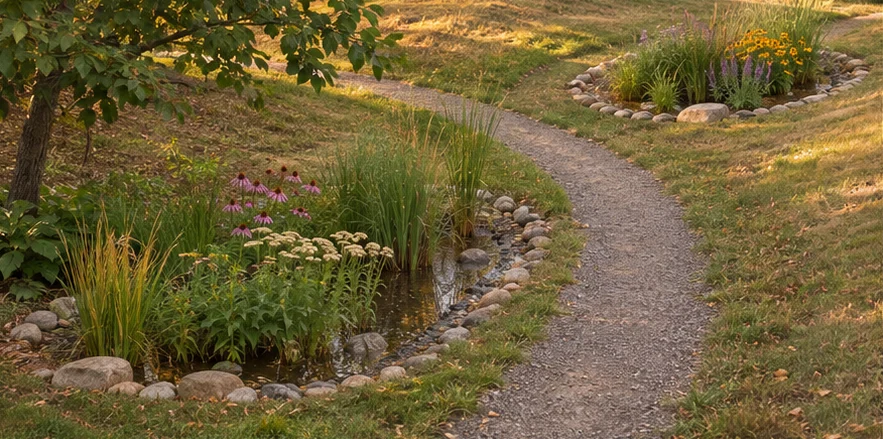
Two beds can face each other across the same path and offer insects entirely different choices. One holds runoff after rain; it has a low basin, flowering stems at several heights, and an edge that catches afternoon shade. The other sits above the path on firmer ground; fewer stems are open but the sun reaches it earlier. A visitor might pass between the beds in seconds. Put a watcher at each and it is easy to get a difference in the tally. It is much harder to tell which difference between the beds the insects responded to.
A paired watch helps with the first problem. Use the same counting rules at both locations, watch in the same time block, and describe which flowers and areas the counts represent. You can then say something precise about the observations. But an existing dry bed does not magically become a control just because it is convenient and nearby. It is a reference bed: a second place that helps put the first count in context. Water is one of several properties that differ, and the watcher has not independently varied it. That distinction does not make the comparison uninteresting. It tells you what question the comparison can actually answer.
Decide whether you are comparing beds or flowers
A bed comparison can answer a straightforward question about the garden as planted: where did we see more floral contacts per equal watch effort? Choose a viewable area within each bed, document how that area was selected, count contacts across the open flowers included by the rule, and retain floral composition as part of the description. If the rain garden offers twice the flowering display in the watched area, that may be part of why it is useful to visitors. Automatically removing that variation could make the answer less relevant to a manager who wants to understand use of the whole planted feature.
A flower comparison asks a narrower question: how often were equivalent displays of the same flowering taxon contacted in the two settings? For that question, choose the same taxon where it is open on both sides and use the same definition of a flowering unit. A sunflower looking head, a spray of clustered small flowers, and a single tulip do not necessarily offer equivalent targets merely because a notebook labels each one a bloom. Decide what the unit is for the target taxon and make it reproducible. If suitable displays never overlap, no amount of arithmetic can create the missing comparison. Report that the shared flower question could not be addressed that season.
Either version needs a boundary. A rain garden basin can have a wet center, intermediate slopes, and a drier rim. A count on the rim cannot stand in for the center merely because both fall within the installation. Sketch the patch, give it a stable identifier, and describe whether it lies at the inlet, center, slope or rim. In the reference bed, note its slope and position relative to the path too. Nominal bed names should not replace field descriptions. A garden designed to receive runoff may be dry on the observation day; an irrigated upper bed might actually be damp.
One practical design begins with two records, a bed record and a watch record. The bed record carries stable details such as footprint, drainage position, planting scheme, management and known changes. The watch record carries momentary conditions such as open flowers, shade, wind, timing and visible surface condition. Do not enter a permanent label like dry in place of a watch observation like no standing water visible. Separating the sheets makes it much easier to explain a later reversal, especially when the planting stayed the same but the flowering display changed from one watch to the next.
Give both watchers the same countable event
For an illustrative local protocol, a contact could be an insect touching an open flower in the defined watch patch and making an observable contact there. Install the definition in the field sheet before the first watch. A hovering insect that leaves without touching a flower does not count. Walking on a leaf does not count. Contact with a flower just outside the boundary does not count. If an insect moves between three different flowers in the patch, decide whether that is three contacts or a single recorded visitor. Those are different measurement designs. In this article's example, a separately visible contact with another flower is recorded again; the tally does not estimate how many individual insects were present.
Agree as well on ambiguous cases. If an insect stays on a flower and shifts its body without leaving, do not inflate the count by adding every repositioning. If it leaves the field of view and a similar insect returns, do not claim to recognize it as an individual. If a watcher loses sight of a contact behind a flower head, note the limitation rather than infer a second contact. Large insects and exposed flowers are easier to track than small insects and flowers tucked behind foliage. Using the same rules does not guarantee that detectability is equal, so a patch so dense that its flowers cannot be seen may need a narrower, clearly described viewing area.
An official model for standardizing short watches is the UK Pollinator Monitoring Scheme Flower-Insect Timed Counts. The scheme instructs participants to choose a target flower and uses a ten-minute observation of a defined small patch under specified conditions; its materials explain the insect group recording method. It is a valuable example for designing comparable watch effort. The illustrative contact tally here is not a record submitted under that scheme. If participating in the official scheme, use its counting and identification rules rather than substituting the contact definition in this article. If running a local study, document exactly which parts were borrowed and which were changed.
Train the observer on a patch outside the comparison first. It is useful to time a practice watch and independently compare what two people actually marked. The goal is not to get impressive agreement after both watchers see the same numbers. It is to find mismatched interpretations before they affect the project: what counted as touching, how a bee moving across a compound head was handled, whether an insect entered the patch before or after the watch started. A one-paragraph shared rule and two short rehearsal watches often make those discrepancies easier to resolve than a detailed analysis of incompatible tallies at the end of the month.
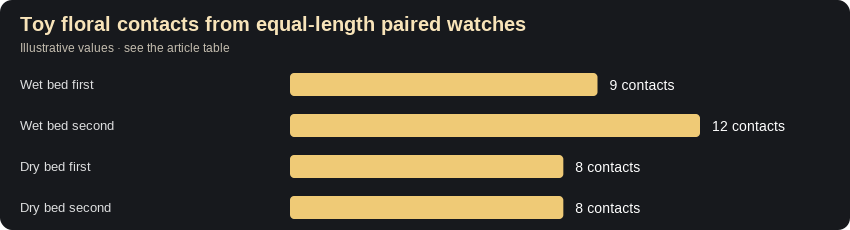
Toy floral contacts from equal-length paired watches
The four bars and the following table show the same invented counts. The unit is contacts. For illustration, suppose the observer watched both patches for equal time in an early pair and repeated the procedure in a later pair; “first” and “second” index the paired blocks, not the order of the beds within a block. There are two watches per bed. The values are not sourced field observations, and they do not establish a wetness mechanism.
| Watch | Contacts |
|---|---|
| Wet bed first | 9 |
| Wet bed second | 12 |
| Dry bed first | 8 |
| Dry bed second | 8 |
In the first pair the wet-bed patch had one more observed contact, and in the second it had four more. Across the equal watch efforts the wet-bed patch showed 21 contacts and the dry-bed patch showed 16. If these had been real observations with ten minutes per watch, the two totals would describe 20 observed minutes per bed. The paired differences are more informative than the totals alone because they show the contrast was not the same in both blocks. The table cannot tell whether the later change was associated with the sun emerging, different flowers being open, a second insect visiting repeatedly, or an observer's changing ability to see into the patch.
The direction agrees in these two toy blocks, but neither the number of contacts nor the difference supplies independent replication of beds. Twenty-one contacts may include repeated contacts by one insect. Two blocks may share the same weather episode and nearly the same flowering display. Two bed identities remain two bed identities. Even an extensive time series across that pair would refine the account of the pair, not create a collection of independent gardens with systematically assigned wet and dry conditions.
Make the pair close in time, not just in distance
Pairing is the choice to compare observations made under a common recorded block of circumstances. A block could be two watches conducted at the same time on the same morning by two observers. It could also be neighboring windows covered by one observer, with a rule for the maximum separation of start times. Do not pair a morning watch in one bed with a later afternoon watch in the other merely because they share a date. That pairing would leave the time contrast in the data pretending to be a bed contrast. Record actual start and end times, including whether a watch was interrupted or shortened.
With two observers, simultaneous watches reduce shared weather differences but introduce an observer comparison. If one person consistently sees small insects better and always stands at the dry bed, their difference in detection joins the other habitat differences. Switch assignments across blocks or rotate them by a prespecified schedule. Have both people use the same instruction and practice it beforehand. If they disagree about how to tally the same visible contacts, solve that disagreement before sending each to a different patch. A regular switch makes a watcher-specific pattern easier to see later than a one-time check.
With one observer, watch order matters. Alternate the bed that goes first, or prespecify an order through a simple random assignment by block. Balance early and late positions over the schedule where possible. The point is to avoid always giving a warming morning or rising wind to the same bed. This is not randomizing the beds to wet and dry conditions; it is protecting a measurement comparison from a predictable ordering problem. Retain the order as a field, so a surprising contrast can be plotted by sequence rather than guessed from memory.
Decide what makes a paired block unusable before looking at its counts. A mowing crew appearing halfway through one watch, rain beginning during one window, or glare making a patch unreadable might invalidate the paired difference under a local protocol. Preserve the completed part and its reason code. A valid zero is an eligible watch with no countable contacts. An interrupted watch is incomplete, and a watch that never occurred is missing. If a change affects only one bed, it may be informative about site-specific conditions, but the difference should not masquerade as a matched weather comparison. Reschedule both watches if the aim is to retain the paired design.
An observer checking the habitat immediately after a rain event should not assume the standard insect watch window survives every storm condition. Water response and visitor activity are separate records. An eligible weather window for insect observation might not coincide with the period of deepest ponding. A separate visual check after rain can document what happens to the basin even when no visitor comparison is possible. Label those records differently: an inlet or ponding check is not a zero-contact watch. Trying to keep every data stream on one watch sheet may make the fieldwork look tidy, but can erase the very conditions that explain why some watches could not happen.
Measure water without naming it the cause
The word wet can mean surface ponding, damp soil, recent rain, water entering from an inlet, or simply membership in a planting zone. Those are not interchangeable. Pick an observable definition that suits the question and report it. A visual status with distinct categories such as visible standing water, no visible standing water, or view obstructed is useful when observers cannot safely reach the soil. A more ambitious plan could document comparable soil moisture readings, with the depth, location, device, and timing recorded. A reading from one spot should not be treated as the moisture of a bed with a deep center and raised edges.
Use a consistent location and avoid disturbing the watched flowers. If a reading taken before a watch requires plunging through the patch and shaking stems, take an appropriate reading afterward or from a nearby documented observation point. In either case, record whether the measurement coincides with the actual patch. A garden with mulch and dry-looking leaves can have different conditions below the surface. A row that says “no standing water” is a reasonable statement; a row that says “dry soil” on that basis alone is a stronger, unsupported inference.
There is a connection between garden design and habitat, but design criteria do not identify the cause of a local contact difference. The USDA Natural Resources Conservation Service E570A document, Enhanced Rain Gardens for Wildlife is a specific U.S. conservation enhancement associated with stormwater runoff control. It describes adding nectar- and pollen-producing plants for wildlife habitat. Use this document to understand that program example and check its scope if consulting its criteria. Its requirements are not universal planting recommendations for every site, and they do not predict the contact tally in either patch. Building or changing a rain garden to meet runoff goals calls for appropriate local design guidance, not extrapolation from a short insect watch.
A useful field description says what the compared patches experienced. “The wet reference name denotes the bed connected to the inlet; no standing water was visible during either insect watch” is more informative than “wet habitat attracted more visitors.” If the project aims to describe contacts after water reaches the basin, decide how that time is indexed: since the start of rainfall, since water first entered, or since visible ponding ended. The dates or times might differ even in the same storm. Keeping such details in the record offers a path to a better follow-up analysis without claiming that association is causation.
When the measured water difference is absent or reversed, keep the originally defined bed labels and report the observation. Do not rename the beds after seeing the tally. You can separately analyze conditions using a prespecified measure of observed wetness, but the identities of the two locations remain fixed. If the upper bed was irrigated before the watch and appeared wetter than the basin by the chosen measure, that is informative about the supply of comparable observations. It is not a problem to solve by quietly editing a category so that the garden behaves the way its diagram suggests.
Describe flowers, shade and surroundings before they become explanations
At watch time, record the flowering taxa actually represented, the number of open floral units under your definition, and how much of the watch area was viewable. A bed's planting list is not a census of its current display. A clump present in April may not be flowering during a June watch. A tiny proportion of the flowers listed on paper could account for most actual contacts on a particular morning. Note if most contacts fall on one taxon, but avoid rewriting the target list after seeing where the insects went. If a second question emerges, publish it as exploratory or use it to design a later watch.
Shade and shelter deserve observations at patch height, not just an area-wide weather description. Two observers in the same temperature and under the same cloud cover can see one patch shielded by a shrub and another shaken by wind over the path. Record whether sun reached the watched flowers and note large changes within a watch, rather than assigning a single site permanently to sun or shade. Wind can also change what the observers see, for example by tipping heads behind leaves. A visibility problem is a measurement concern; it is not direct evidence of an insect preference.
Management has a calendar too. A patch recently deadheaded may have little blossom; a patch watered by hand may have temporarily different soil conditions; a cut path edge may offer better visibility from the standard observing position. Record the timing of maintenance if known, and say when it is unknown. A handful of useful fields collected consistently beats a long free-text catalogue recorded for only one bed. Ask the gardener in advance which practices are shared between beds and which are not. Do not infer that either management regime explains the contacts unless design or evidence can support that statement.
Inventory what is immediately around each patch. A planting beside a second flowering bed can attract insects into the neighborhood without sending all of them to the patch being watched. A hedge can change air movement and access. Exposed soil, mulch, traffic, or a fence may differ at short distances. An area map or appropriately framed photograph is useful for explaining which neighboring features are stable and how routes between the patches might change with flowing water or path use. None of these details obliges the observer to measure a separate covariate for every possible influence. The aim is to avoid presenting a known difference as though it did not exist.
Published field work can help explain why this care matters. A primary study of bioretention basins as stepping-stone habitats investigated planted basins, plant communities and evidence of dispersal, using several methods and acknowledging limited field replication. The paper is useful context for thinking about flowering resources and movement among plantings. It is not verification that water alone explains observed activity in a local pair, and its basins and evidence are not the small invented dataset shown here. Keep a source's setting, methods and outcome attached to it rather than importing its strongest language into a different study.
Think in advance about which variables should be matched and which should be reported as part of what the bed supplies. If question one is about total contacts on the existing design, forcing identical flower displays would answer something else. If question two is about the same flower in two settings, a shared taxon and similar open display are central to interpreting the watch. One protocol can collect both sets of information if the effort and exclusions are separate. It is often cleaner to do a modest whole-patch comparison, then plan a shared-flower follow-up rather than split a short watch into several unmarked activities.
Read the table as an account of visits, not a census
The toy difference of five contacts over equal effort may be useful to a gardener deciding what to watch next. It does not demonstrate that the wet bed harbored five more insects. More movement by a single visitor can change a contact tally. One observer's field of view can include repeated actions in one patch and hide the same actions among tightly packed blossoms in another. If the report needs a comparison of unique individuals, it will require a method that can distinguish individuals or responsibly estimate them. Without that method, use the word contacts consistently, including in captions and any social summary.
A low contact count is not good evidence that a habitat offers no value. A watch was taken during a limited slice of time and measured only visible contacts with the designated open flowers. It did not measure whether insects nested, rested, sheltered, crossed the area between patches, or visited flowers outside the defined view. A planting can matter at other times of day or at a point in the season not yet watched. Avoid switching from “few contacts seen during two eligible watches” to “little pollinator use” across a whole season, even when the shorter wording fits more neatly under a photograph.
Likewise, contact does not establish pollination. It can document a visit worth investigating, but the observer may not know whether pollen moved to a compatible flower and what effect that transfer had. A study that measures pollen placement, deposition or reproduction asks a different question. A visitor that never brushes the relevant floral structures may contribute a contact under the local rule while contributing little to pollination on that visit. Report the observed behavior where the level of detail permits it. Do not convert contacts into claims about fruit set or ecosystem service without measurements that address those outcomes.
Take the same care with identification. A practical record can use broad groups or unknown rather than assign a species based on hurried impressions. Define categories before the watch, let an uncertain contact count as a contact even if it cannot be classified further, and report how many are unknown if producing group breakdowns. If one bed's flowers are easier to see up close, it could seem to have more named groups simply because more visitors could be identified there. A comparison of total contacts and a comparison of group composition have distinct visibility and identification constraints. They should not be presented as interchangeable.
Do not let a convenient denominator substitute for the question
Equal-length watches give a clear denominator: minutes of observation. If equal visible areas were also specified and consistently implemented, describe that as a second design feature. Do not call a count per equal time an estimate of all activity in a large bed when only a visible segment was watched. Dividing by the total square area of the installation does not solve this; the contact numerator never covered most of that area. If the goal is to estimate a typical segment, select segments under a documented sampling rule and record which eligible segments were excluded for practical reasons.
Suppose the toy comparison represented 20 visible floral units in the wet patch and 10 in the dry patch throughout both watches. Straight totals would still be 21 and 16. A calculation dividing by display size would suggest fewer contacts per floral unit in the wet patch despite more contacts to the entire display. That calculation poses a different question. It assumes the counted units were suitably comparable and consistently available, and it ignores potential saturation and changes in how a visitor traverses a display. Those hypothetical flower numbers are not part of the chart. In real work, choose which measurement is primary and report the unscaled counts alongside any derived rate.
Near an empty display the distinction is especially important. If an otherwise valid whole-patch watch has no open flowers, the rule can establish that visible contact with open flowers in that patch was zero. A per-flower rate is undefined at a denominator of zero. A same-flower paired comparison may simply be ineligible if no target display is available in either patch. Mark that separately from a watch with a qualifying display and no contacts. If missing flowers occur mostly on one side, the shared-flower result applies only to blocks with overlapping bloom; it no longer describes the whole collection of scheduled blocks. Both results can be useful if kept separate.
Be wary of pooling minutes over pairs that failed eligibility. An interrupted six-minute watch beside a complete ten-minute watch does not become the planned matched comparison just because both can be expressed as rates. Visitor activity could change within those minutes. If you opted to retain such watches as ancillary descriptions, say why the pairing failed and do not let the alternate calculation overwrite the main record. When the same amount of effort is demanded of each patch in each block, the reader can reconstruct the result directly instead of reverse engineering a correction they never saw in the field.
Show pair-to-pair changes rather than just adding up everything. Two paired differences of one and four contacts carry more context than an isolated wet total of 21. In a longer series, plot the differences by date or block and retain the open flower counts on the same timeline or in an adjacent view. If well-formed whole-patch differences and shared-flower differences tell opposite stories, both may be answering their own questions correctly. Examine which flower displays and dates were represented in each subset. Reconcile the subsets before trying to reconcile the numbers.
A reference is a useful comparison with a known limit
Matching observations on watch length, period, and flower taxon removes some straightforward interpretive obstacles. It does not make one location the counterfactual for the other. For a water-only claim, you would need a credible answer to what the same sort of patch would have been like at the same time under another water condition. Here the lower patch was not randomly assigned its water regime, and the upper patch was not assigned a complementary regime. Their soil, plant history, shading and surrounding habitat may have differed before anyone decided to count. Name the dry patch a reference, because reference states what it does: it anchors a comparison without promising that everything but moisture stayed the same.
A before-and-after event does not necessarily fix the problem. An observer might see more contacts in the basin after a storm than before it, but the interval may also change temperature, flowering and the placement of insects in the landscape. A second nearby bed watched over the same interval helps describe whether both beds changed in a similar way. It does not automatically establish that their earlier trends or responses would have been identical in the absence of water. A series of analogous reference pairs and a design appropriate to the specific change can improve the evidence. Do not apply causal language simply because the arithmetic now includes two differences instead of one.
A stronger observational comparison would use multiple independent pairs across a defined group of gardens, match the observation process, and track the major site differences and selection criteria. Counting three patches within the same rain garden and three within the same dry bed improves description of those places; it is not equivalent to comparing three independently situated gardens. Even with many pairs, an association estimated across installed beds could still reflect systematic planting differences tied to design. Clarify whether the target is expected use of each type as actually planted or the effect of changing water while holding other things steady.
A water-focused experiment, if genuinely needed, would start with comparable units, a defined moisture treatment, prespecified measurement and independent replication. Assignment of treatments and shared conditions would need to suit the scientific question, and any work altering a stormwater installation would require appropriate authorization and engineering safeguards. An exploratory garden watch should not be used to justify rerouting water or adjusting site drainage. The point of distinguishing reference from control is not to require every project to become an experiment. It is to let attractive local observations stand on their own rather than stretching them to fill the place of missing evidence.
Plan the season around overlap and preserve what did not qualify
A single week can make two beds look more alike than they are. In a garden where spring flowers dominate one bed and summer flowers the other, a shared-flower count has a built-in calendar constraint. Plan the schedule to include periods meaningful to the original question rather than only dates with tidy comparisons. If the team also wants a whole-patch record, it can document the unmatched flowering periods without pretending a different plant is a substitute for the target. Maintain a planned schedule that marks weather cancellations, the absence of qualifying flowers and access disruptions. At the end, compare the times that actually qualified with the times the project was intended to describe.
A limited local project can still learn from a repeated difference by making an inexpensive follow-up more specific. If most of the early wet-bed contacts were on one visible strip, a future round could compare that strip with equally visible patches elsewhere, including elsewhere within the wet bed. If the time of day may explain a big change, make balanced observations in the morning and later in the day without changing the area or rule at the same time. If both improved evidence and an intervention are out of scope, document the unresolved explanation and leave it unresolved. That is preferable to spending a season refining a design solely to salvage the first headline.
Distinguish use of the patch from redistribution between the two patches. A visitor leaving one display for the next can contribute contacts to both, and two simultaneous counts do not establish where the visitor came from. A concentration in one bed can be important to the gardener without signifying more activity across the property. To ask a garden-wide question, define the sampled garden area and measure both patches and other relevant habitat under the same sampling scheme. To ask how visitors move across the path, record directly observable movements in a dedicated watch with a stated endpoint. Do not infer a path merely from two contact tallies rising and falling.
The same distinction affects how you summarize exceptions. If a block includes an abrupt pulse of contacts when a cloud moves, preserve the pulse instead of smoothing it away as a statistical nuisance. An identifiable event such as mowing may disqualify a paired block under a chosen rule; a genuine burst of visits under eligible conditions is part of the result. Count validity should depend on whether the observation was performed as planned, not on how typical the outcome looked. Report unusual blocks and show the summary with and without a specified questionable block only if readers can see why that second calculation exists.
For an audit-friendly record, give the two patches identifiers and establish a pair identifier before observing. The log should connect each patch to its bed and location, each watch to its pair and observer, and each contact summary to the rule version. Store actual durations, weather changes, flowering display, visibility and water observations next to watch status. Keep a place for changes that affect only one side. A binder with separate sheets or a simple table can do the job provided blank cells have explicit meanings. Someone returning next year should be able to distinguish “no contacts,” “not watched,” and “field not recorded” without asking what an empty rectangle meant.
The short form of the result should be no less careful than the record behind it. For the fictional example: two equal-duration pairs yielded five more visible floral contacts in the watched part of the runoff-receiving bed than in the watched part of the upper reference bed. The lower patch had one and four more contacts in the first and second blocks, respectively. No change in moisture was assigned and no mechanism was tested. For real results, add the dates, the kind of flowers counted and whether the set represents a shared flower or the whole surveyed patch. If the actual tally flips later, the original observations remain useful as a seasonal or weather-specific comparison, not an embarrassment to be edited away.
Garden decisions do not have to wait for a causal result. A manager can preserve a heavily contacted flowering strip while checking that the garden still serves its runoff function. A volunteer can schedule another watch at the same display or document events on the opposite side of the path. What the pair does not tell either person is that making another area wetter would reproduce those visits. As long as the comparison reports what was matched, what visibly differed, and what remained unknown, the dry reference has done a useful job without being recruited as a control.