
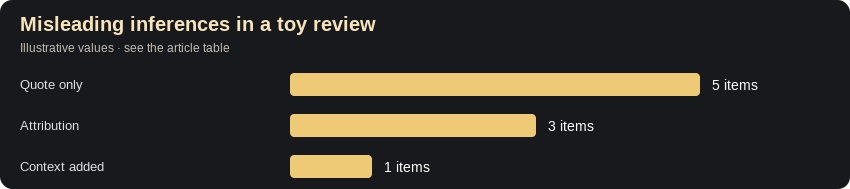
| Category | Value (items) |
|---|---|
| Quote only | 5 |
| Attribution | 3 |
| Context added | 1 |
Constructed checklist scenario for this brief, not measurements, ratings, or results from cited sources. Each displayed count represents checked items in the named example.
At the end of a spring garden project, a volunteer says, “It felt like the new border brought more bees.” An editor lifts the sentence into a bright card over a photograph. The surrounding article says that bee activity increased after a redesign. A social preview says the new border brought more bees. By the time the story travels, one person's impression has become a result, and a result has become a claim about what caused it. No one needed to alter the words inside the quotation marks for the evidence to change shape.
The original sentence can be entirely worth publishing. It tells us how the project looked to somebody who helped with it. That is relevant when an article explores community experience, motivation, or decisions about what to investigate next. It is not, on its own, a count of bees, a sample of a whole site, or a comparison with a garden that did not change. Use the quote for the work it can do and provide separate evidence for work it cannot do.
This article follows a fictional research digest from raw quote to checked paragraph. Its people, observation conditions, and chart counts are invented. The exercise asks whether readers are invited to confuse speaker, method, and result, not whether readers are sufficiently skeptical to repair the story themselves. It ends with practical checks for cards, captions, transcripts, and corrections, where a claim can lose its context after the main article has been carefully edited.
Write down the type of each statement
A direct quotation is a claim about what a person said or wrote. To use it responsibly, verify the wording, whether the sentence is complete enough to carry its intended meaning, and where it came from. If said in an interview, record when and under what circumstances. If drawn from a written statement, identify the document and its version. Any claim inside the words has a separate evidentiary status. A faithfully transcribed statement may be an impression, an explanation, a prediction, or a factual assertion that needs independent checking.
Attribution tells readers who is responsible for the statement and in what capacity. “A garden volunteer who worked at the east border” supplies more useful context than “an expert said,” when the person's relevant role was tending the site rather than analyzing the project. A study investigator who describes an estimate may have direct knowledge of the analysis. An independent reviewer may assess its strengths and weaknesses. A person affected by a change may describe the experience of living with it. None of those roles automatically makes the person a representative of every other role.
A nearby paraphrase has a different job. It translates a relevant point for the reader without pretending to reproduce the speaker's exact words. If the speaker is describing what the site seemed like during occasional visits, “The volunteer recalled seeing more activity near the border” may be accurate. “The volunteer found that the planting increased local bee abundance” is not. The second substitutes a measured result and causal assignment for a recollection. Changing the verb changes the evidence even when the general subject stays the same.
A finding is a result supported by a defined method and source record at an appropriate scope. In an observational project, that may mean a comparison among observations that share a stated unit and collection rule. It may be a result about landings rather than individual insects, or about the recorded visits rather than an entire season. The result can be narrower than the speaker's commentary or wider than any one person's experience. It can also disagree with a vivid quotation, which is a reason to explain the disagreement rather than a reason to bend the finding to fit.
The distinction does not require a special typographic system, but it benefits from steady language. “Said,” “recalled,” and “expected” are not interchangeable with “measured,” “estimated,” or “found.” “Records show” should not introduce something supported only by an interview. “The researchers attributed the difference to” is weaker than an independent claim that the project established the cause, but still requires a source that actually makes that attribution. Use verbs as labels of the evidence relationship, not simply as ornaments to avoid repeating “said.”
The official plain language guide series emphasizes writing, design, and testing for the intended audience. The CDC Clear Communication Index is a framework for developing and assessing public communication materials. Those resources support the general discipline of checking what readers can understand. They do not give a numerical rating for these fictional editorial versions or establish a special rule for garden quotations. The bar chart in this article is a constructed review example, not a reproduction of either framework.
A three-version trial with five fixed questions
Imagine a small garden group is evaluating a border redesign. One volunteer, Maya Reed, arranged supplies and visited the east border on several mornings. She did not compile the observation records or analyze the project. During an informal walk, a reporter asked whether the east border felt different. Reed said, “It felt like the new border brought more bees.” The notes preserve that sentence and her role. Nobody at the project made a formal determination about what caused any change.
The underlying record is intentionally modest. In the toy scenario, an observer recorded eleven qualifying flower landings across four ten-minute watches before the borders changed and fifteen across four ten-minute watches afterward. Watches covered the east border only. The local protocol counts a qualifying landing as an event; it does not track individual bees or determine how many distinct insects were present. The before and after watches were not deliberately matched for weather, and the exercise supplies no unchanged comparison site. These facts are included so the scope can be stated, not to invite statistical inference from a small made-up series.
Agree on the five misleading inferences before reviewing the versions. The first is that Reed was the project's researcher or an independent scientific analyst. The second is that her quoted words express an analysis rather than an impression. The third is that the data counted distinct individual bees. The fourth is that observations covered the whole garden. The fifth is that the redesign caused the apparent change. For this exercise, a proposed inference remains when the version's public phrasing and immediately available context fail to distinguish or rule it out. This is a checklist judgment about a toy artifact, not an estimate of how many people would misunderstand it.
In the Quote only version, the article places a stand-alone line under a result-style heading: “The project worked: ‘It felt like the new border brought more bees.’” There is no visible role, question, method, or scope. The words “felt like” offer a clue to a cautious reader, but the surrounding heading primes readers to treat the sentence as a result. For this exercise none of the five interpretations is explicitly resolved. All five remain on the list. This is not a statement that the quotation logically asserts every one of those claims. The test is designed to flag ways the display could invite a substantive but unsupported reading.
The Attribution version adds: “Maya Reed, a garden volunteer who arranged supplies, was describing her impressions during a walk through the east border.” This explicitly resolves the speaker-role and impression-versus-analysis questions. It does not establish that east border was the scope of the observation records; someone can give a quote in one corner about a study of a whole garden. There is still no explanation of what was counted and no clear limit on the causal framing in the heading. Three items remain: counted unit, study area, and causation.
The Context added version places a statement beside the quote: “The records describe flower landings, not distinct bees, and cover the east border only. The observer recorded eleven landings before the redesign and fifteen afterward, across four ten-minute watches in each period.” The two added clarifications resolve unit and geographic coverage. Yet the headline still says “The project worked,” and there is no nearby explanation of what the comparison can establish about cause. One item remains. The final bar intentionally is not zero. A more detailed supporting paragraph can coexist with a misleading headline.
The chart and table record the same invented checklist.
| Version | Misleading inferences remaining (items) | What this version resolves |
|---|---|---|
| Quote only | 5 | None of the five defined checks under this toy review |
| Attribution | 3 | Speaker role and the fact that the quote reports an impression |
| Context added | 1 | Adds the counted unit and site coverage; causal framing remains unresolved |
The chart title is “Misleading inferences in a toy review.” It measures items on the same five-check list across the three versions. Attribution removes two flagged items, and context removes two more. Neither the numbers in the table nor the eleven and fifteen landings came from a study or from the sources linked here. The chart does not report how many readers reached each conclusion, how confident they were, or how important each mistake was. A reviewer should be able to reconstruct the sequence from the versions, rather than interpret the decline in the bars as a result from an actual trial.
Repair the remaining headline
One repair is to name what was recorded: “East-border watches logged more landings after the redesign.” That is still a potentially fragile statement unless “more” is attached to a time interval, comparison, and precise record. A deck can make the comparison clear: “In this example, four ten-minute watches before the redesign logged eleven landings; four afterward logged fifteen. The comparison does not show what caused the difference.” A quotation may then follow as a volunteer's reaction. The example illustrates how an article can report a directional change without claiming that the redesign explains it.
Do not bury the correction to the causal claim in the last methods footnote. Readers receive headline, deck, and quote in different combinations. A statement like “The new border brought more bees” might be all a person sees in an email or a copied screenshot. Putting “the cause was not established” in an appendix cannot prevent a misleading circulation of that headline. Put essential width and limits into the short version, or reduce the short version to what it can carry honestly.
Compare two verbs: “after” indicates sequence; “because of” indicates explanation. A good sentence can honestly use the first without implying the second. The distinction is not a claim that before-and-after studies are useless. It is a claim that observing two groups at different times is not by itself a solution to competing explanations. In the toy example, weather was not matched and other setting changes were not ruled out. A writer who says “after” should also watch tone and framing, because an enthusiastic title can reintroduce the cause as a practical inference even when the preposition is technically cautious.
Avoid adding detail that sounds like precise proof. The difference between fifteen and eleven is four landings in this fictional effort. Calling it a surge can overstate what the counts and design tell us. Reporting a relative difference without the original counts may magnify the impression, especially with small numbers. The shorter statement can simply describe the change in counts and say that the visits were recorded in short watches with no unchanged comparison plot. The reader can then understand both the observation and the limits.
A hypothetical fourth version can close the last checklist issue, but it does not belong to the queued chart. If you mention it, keep it in prose and distinguish an editorial revision from a measured fourth data point. It could say: “The east-border tally was higher in the later watches. These watches cannot show whether the redesign caused the difference. Reed, a volunteer involved in supplies rather than record analysis, said it felt as though more bees were visiting.” This has no reason to claim that the final article is beyond all misunderstanding. It resolves the particular causal issue flagged by the exercise.
Read the sentence before and after the quotation
A direct quote has boundaries that can matter as much as its quoted words. Consider an interview in which a coordinator says, “I thought the redesign made a difference. Then we realized the later watches included only the sunniest mornings.” The first sentence is vivid alone. In context it introduces an initial impression that the rest of the interview complicates. Publish it alone beneath a confident headline and the speaker appears to endorse an interpretation they had just withdrawn. Use the nearby sentence, summarize the change of view, or choose a different section of the interview. Copying every word between a pair of quotation marks does not absolve the editor of the omitted context.
Questions matter as well. “Was the new path easier for your family to navigate?” and “Did the redesign objectively improve access for all participants?” are very different prompts. A short “yes” cannot travel without the subject of agreement. Reporting that a visitor said “yes” to a broad conclusion they were not asked about would change the statement. If quoting a short response is not useful without a long explanation of the interview, paraphrase the relevant experience accurately and retain the original recording or notes for verification.
Watch for qualifications inside the sentence. “In the plots I visited,” “during the last week,” “once the gate reopened,” and “if you limit it to the morning watches” are not stylistic clutter. They define the speaker's scope. Removing them changes the perceived claim even if the remaining words flow well together. Brackets can clarify a pronoun when the referent is certain, but changing a pronoun to a broader group can invent agreement. In doubtful cases, use a clear paraphrase outside quotation marks rather than achieve a compact line through several ambiguous edits.
Tone and genre can also alter a statement's import. A participant joking about a “bee invasion” is not necessarily giving a literal description of abundance. A researcher comparing a project to a busy train station could be illustrating a timing pattern, not asserting equal rates of movement. If spoken irony or a metaphor supplies character but weakens clarity, a short sentence can establish the context first. If readers would need an elaborate note to know the statement is figurative, it may be better as an anecdote within the full article than as the evidence-bearing line at the top.
Keep voice, fact checking, and disagreement in separate sentences
Separate two editorial questions that arrive together. One is whether the quote is accurate as a representation of speech. The other is whether the claim inside the quote is accurate as a description of the world. If a source said the team observed forty separate bees and the worksheet contains forty landing events, the wording may be verified while the factual claim still needs correction or context. Publishing the exact sentence beneath a verified photo does not resolve the second question. Correct the claim nearby, ask whether the source meant events, or use the underlying record instead if the disputed wording adds nothing.
A researcher can also make a claim outside the scope of the paper they authored. The person may reasonably have an informed view about neighboring habitats, but the study could have sampled only one managed plot. “The lead author said the result may apply more broadly” is a statement about their judgment. “The study found that the result applies everywhere” is a claim about evidence. A role label should help the reader understand access and perspective, not transfer the authority of one measured finding to everything a speaker might say.
Treat an independent critic with the same care. An expert not involved in a study can identify limitations, explain why a design is useful, or suggest alternative interpretations. The critic's comment does not automatically invalidate a result, just as an author's enthusiasm does not establish a causal interpretation. Be precise about what is in dispute. Two sources may agree that the recorded landing count rose and disagree about whether that change is surprising. Writing “experts disagree on whether counts rose” would invent a controversy about the observations. Writing “the cause remains untested” may capture the substantive issue better.
Fairness is not achieved just by choosing one quote in favor and one opposed. A story could feature a neighborhood observer who carefully describes personal impressions and a manager who makes a sweeping causal claim. Their statements answer different questions and may have different support. Explain that difference instead of presenting two declarations as equally informative evidence about the same outcome. Conversely, don't dismiss experience because it cannot estimate a population. A resident may accurately report that a path felt easier to use or a bed was more pleasant to visit. That answer matters when the question actually concerns that resident's experience.
Use ordinary callouts to mark distinctions that recur. “What the study recorded” can open a brief paragraph with the sample, observation unit, and comparison. “How one volunteer experienced it” can introduce the quote. This is preferable to labeling the first section “Facts” and the second “Opinions” if the latter includes factual accounts of personal events. People can report real experiences without collecting systematic measurements. Labels should clarify what evidence backs a statement, not assign a crude credibility score.
Put the paraphrase where it can help, without making it an echo
A paraphrase is most helpful when it does a job the quote does not. It can identify the issue plainly, unpack a term, or explain the boundary of a claim. If the direct quote says “It felt like the new border brought more bees,” repeating it immediately as “Reed felt the new border brought in more bees” adds little. Instead say that Reed was describing visits she noticed near the east border, not the count collected by observers. Then put the recorded comparison and its scope in a separate sentence. The reader gets the voice and the method without having to separate them alone.
A useful paraphrase can preserve uncertainty that is easier to hear than to read. In a spoken interview, a source may hesitate and give an answer with a clearly conditional tone. The transcript may make the answer look more definite than it sounded. Rather than inventing hedging words inside quotes, use an accurately framed paraphrase such as “The technician suggested that wind might explain part of the difference, but did not offer a test of that explanation.” This is not permission to call every claim hypothetical. Check the speaker's actual words and context. Where the material is equivocal, say what can be established instead of smoothing it into a stronger claim.
A paraphrase can also expose terminology drift. Imagine that the researcher refers to encounters per watch while the interviewee says bees per visit. An editor should not merge them into a single term for readability unless they refer to the same thing. Introduce the formal unit in words a reader can apply: an observer logged each qualifying landing, so the same insect could contribute more than one event. A short exact phrase from a source can still appear nearby as a quotation. It serves as voice or illustration, not as a substitute for defining the unit.
Avoid building causation into a translation between technical and ordinary language. “Associated with” does not mean “caused by.” “The later watches had more qualifying landings” does not mean “the garden's pollinator population grew.” “A larger share of the watched sessions included a landing” does not necessarily mean “there were more landings per session.” These are distinct questions. A plain-language sentence can keep the comparison, unit, and scope without using specialist shorthand. If the only simple phrasing you can find feels broader than the source, take another pass rather than treating precision as jargon.
It can be useful to show the reasoning explicitly once. For instance: “The before and after tallies refer to landing events under the same trial definition; the report did not identify individual insects. Since the team didn't match weather conditions or compare with an unchanged site, it can't tell how much of the difference came from the redesign.” This explanation supplies two bridges. It clarifies what the observed difference means, then separates that observation from a causal inference. No quote needs to carry either bridge by itself.
Identify what will travel away from the article
Check the headline, deck, pull quote, captions, notification text, image alternatives, and share cards separately. A vivid phrase may be harmless in the paragraph where it is contextualized and misleading in an isolated card. A small quote label like “Maya Reed, volunteer” can preserve role, but it cannot supply study area or comparison design if the card claims to announce the result. If the card's space cannot support the essential limits, reduce its claim or choose a quotation whose meaning stands on its own. A neutral “A volunteer describes the redesigned border” may be better than reprinting causal language large and restoring qualifications in small type.
Captions have their own risks. A photograph of several insects on flowers may accompany an authentic quote but depict a different site or date. Readers could infer that the image documents the measured change. Label whether a photograph depicts the scene discussed or is illustrative. Avoid staging reconstructed moments as if they were captured during the actual research. If an illustration is generated, it can offer a sense of subject without proving where the interview happened, how the garden looked, or which insects were observed. The newsroom record should distinguish documentary material from a designed visual.
Transcript excerpts need similar care. A long interview can be searchable and still be quoted out of context if the public player begins in the middle of a qualified answer. Make the useful passage easy to locate, retain the question where it affects meaning, and check timing. If a quote appears in audio with clarifying narration, make sure the corresponding text includes the clarification. This is not about preserving every pause. It is about preserving statements, corrections, and cues that change the meaning of the statement. A clear written recap can help people who are reading quickly or listening without seeing the layout.
Translation can change the strength of an assertion even when the translated words sound natural. A colloquial “it felt like” might be replaced by an unqualified causal verb in a headline translation that aims for punch. Ask a reviewer fluent in the language to restate the scope and level of certainty, not merely check each word. Distinguish a translated quotation from a translated paraphrase according to the publication's conventions, and preserve any relevant uncertainty in the extra text around it. If a rendering changes which group or time period the source meant, fix both the public version and any excerpts based on it.
Think about fixed and moving sections of a page, too. On a wide screen, a claim and a caveat might sit next to each other. On a phone, the quote could appear before the caveat, after an unrelated photograph, or on its own in a carousel. Edit the strongest surface as though a reader could encounter it first, because deep linking, notifications, and sharing make that common. Put the crucial context next to the claim, or keep the standalone claim narrow. An article should not depend on every reader encountering exactly the editor's original sequence.
Review the evidence trail without making it public by default
A small quote record can include the person, role, relevant setting, date, original medium, timestamp or page reference, and notes on material omitted around the chosen words. A finding record can hold the dataset or report version, the location of the result, comparison definitions, units, coverage, and uncertainties. Cross-reference the two when they appear in the same paragraph. Keep access to supporting recordings and contact information consistent with consent and editorial policy. Verification does not imply that every source file or identity belongs in the published story.
When the supporting note is thin, label the gap rather than filling it from expectation. A colleague may remember a remark but not its exact words. Without an adequate source, paraphrase with appropriate attribution if the substance is verified, or leave it out. Do not manufacture a clean sentence and put it between quotation marks because it seems consistent with the person's views. If the data definition is uncertain, use a cautious description or hold the claim while checking it. A plausible voice and a plausible result are not replacements for actual records.
Version discipline is especially helpful for written statements. A press release could be updated after a reporter saved a local copy. A speaker might later clarify whether they meant observations, individuals, or days. Document which version the article relies on, and don't silently attach new wording to an old quotation. The later clarification can be attributed separately. When a correction changes interpretation, say so clearly. Keep the original and revised versions in an appropriate editorial log so the team can see what was verified at each stage.
A supporting link should point to the nearest useful primary evidence when practical. Link the report's methods for the definition of a landing, the relevant table for the two observed counts, and the interview or statement for the person's own words where it is appropriate to share. One generic organization homepage does not let readers distinguish these three sources. If privacy prevents release of a recording or the trial did not make raw records public, be transparent about what can and cannot be independently inspected. Do not label a press release as underlying data or a project website as an independent replication.
Test likely inferences rather than asking whether the article is clear
Give a reviewer the headline and caption without the body. Ask what they think was measured, by whom, and where. Then give them the paragraph containing the quote and ask how the statement was verified. Finally show them the methods summary and ask what the comparison can establish about cause. Record the answer you receive before supplying the correction. This test can reveal confusion that a general question such as “Does this make sense?” would miss. A reader can understand every word and still come away with a mistaken description of the evidence.
A useful alternate scenario involves someone who will reuse the material. Ask a newsletter editor to draft one line for a tiny preview. If their natural summary changes “recorded landings” to “bees” or “after” to “because,” inspect where the source article invited the change. That result does not establish that every reader would make the same shift. It identifies a fragile place for a preventative edit. Point to the line or surface that is likely to travel, and put a distinguishing word there rather than adding another dense paragraph in the last section.
The toy figure's five checks can inform that test without becoming a universal standard. A different article may need checks for who funded a study, whether a quotation predicts a future outcome, whether a summary reports a median or an average, or whether data were collected before or after a policy change. Select checks based on potential readers' actual decisions. Keep them the same when comparing two versions if you want the comparison to be interpretable. If you change the rubric, report what changed rather than drawing a long trend line through incompatible totals.
Test a case where the quote is genuinely the evidence for the question. An article about how volunteers describe their own work can reasonably center on their words. The relevant finding might be about themes in a set of interviews if that set was analyzed with a stated method. A single quote can exemplify a theme without establishing how frequently it appeared. Ask whether the surrounding text says “one participant described” or “participants generally reported,” and whether the latter statement has support. The point is not that testimony is inferior; it is that the evidence must fit the claim.
Make a correction fit the kind of mistake
A misquotation, an ambiguous attribution, a wrong unit, and an overstated conclusion demand different repairs. A misquotation requires checking the original and correcting literal wording or removing the passage. An attribution problem may require adding the role, date, or situation. A wrong unit requires changing the chart or surrounding text wherever the faulty unit appears. An overstated conclusion requires reconsidering the claimed inference, not merely fixing one adjective. Correct all affected versions, including cards and captions that may still circulate.
State the changed distinction plainly when it matters. “We previously described the counts as distinct bees; the records count landing events and may include repeat visits” is more useful than “This paragraph was updated for clarity.” “We previously attributed the increase to the redesign; the observation series records a later increase without establishing a cause” tells readers what conclusion to revisit. If the exact statement was correct as speech but the surrounding framing misrepresented the source's point, say that rather than suggesting the source misspoke.
During the next edit, run the shortest credible test. Read the quotation alone, then in its intended presentation. Say who spoke, what they had direct knowledge of, what the record measured, and which interpretation remains unsupported. If the quote makes the story stronger but the current surroundings ask it to be a finding, change the surroundings. If the article cannot tell those things clearly with the quote present, it may be more honest and more readable to give the finding its own space and preserve the speaker's words elsewhere.
A second editorial test: what would change if the quote disappeared?
Take the draft paragraph and remove the quotation without changing anything else. If the claim now has no evidence, identify what the speaker could actually support. In an interview feature, losing the subject's voice may be a serious loss even if the rest remains factually correct. In a study digest, removing a sharply worded reaction should not make the measured finding impossible to verify. Try the opposite test as well: remove the method and leave the quote. Notice which claims can no longer be stated. These are helpful experiments during revision, not directions to remove either component from every article.
Imagine that a second volunteer says the border felt no busier after the change. The description of their experience can join the first if the story benefits from showing a variation in perceptions. It does not automatically cancel the observed landing events or require recasting the before and after counts as uncertain in a different way. Tell readers what each person saw, where they spent time, and what standardized observations contributed separately. A second quote creates another account, not a replicate of the field method. If either speaker heard the result before being interviewed, state that detail when it shapes the question the article is asking about their reaction.
Sometimes the most honest replacement is a note that the study did not ask a particular question. “The team counted flower landings; it did not survey volunteers about their impressions.” That sentence makes room for the anecdotes while preventing them from being absorbed into the study. Conversely, “The project collected participant interviews but did not count visits to the flowers” describes a different evidence base. In both cases, quote with confidence about what was documented and reserve claims about what the method cannot establish. Readers gain a clearer story when testimony and measurement stand next to each other without being assigned the same job.
Sources and further reading
- Federal plain language guidelines, now pointing to the official Digital.gov guide series. Audience-focused writing, design, and testing for understanding.
- CDC Clear Communication Index. Official public communication assessment framework. The garden scenario, numbers, and toy chart do not come from this index.