
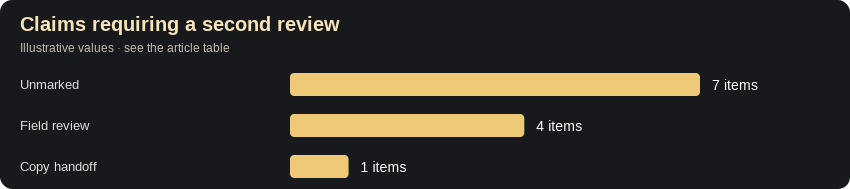
| Category | Value (items) |
|---|---|
| Unmarked | 7 |
| Field review | 4 |
| Copy handoff | 1 |
Constructed checklist scenario for this brief, not measurements, ratings, or results from cited sources. Each displayed count represents checked items in the named example.
A science reviewer approves a sentence that says a field crew recorded twenty visits during four completed survey periods. By the time the article is polished, it says there were twenty visitors across four sites. The new words sound ordinary. They are also a different claim. One animal can account for several visits, and a completed survey period is not necessarily a site. The reviewer did not approve the rewritten sentence. The copy editor did not intend to change the underlying result. A review process that only preserves the word approved will have trouble showing where the error entered.
Now imagine the same article with a short handoff record. Its reviewer notes that “visits” is the counted unit, that four refers to qualifying periods, and that the figures must not be interpreted as counts of individual animals. The editor uses that note while revising the article, and a later check compares the title, lead, figure and caption to those commitments. Better writing and factual fidelity are not competing priorities; they need a shared record of which meanings must survive polishing.
This article proposes a small review contract for editorial material that relies on scientific observations, methods, names and numbers. Its example chart is invented. It does not test a real review system, assign responsibility for scientific misconduct, or authorize changing a public page. The examples are private draft and verification exercises. Adapt the procedure to the actual publication's policies and the stakes of the work rather than assuming a checklist replaces appropriate evidence or expert judgment.
Name the roles without making them interchangeable
A science review asks whether the claims, data interpretation and terms are defensible within a chosen scope. A copy edit can improve organization, wording, consistency and presentation. Both can catch factual problems, but giving either role a broad label does not establish that every possible task was performed. A reviewer may have checked how three rows were interpreted without inspecting field instruments. An editor may have verified source names and date spellings without rerunning an analysis. Keep the responsibilities explicit enough to avoid assuming that the other person already did the hard part.
The NISO CRediT role descriptors illustrate distinctions useful to research publishing, including validation, data curation and writing review and editing. NISO describes roles; its taxonomy is not itself an authorship test. The ICMJE guidance on authors and contributors provides a medical publishing example in which accountability and approval matter separately from performing one contributing task. These references inform the distinctions, not this article's sample workflow or counts. A publication should identify its own governing policies for attribution, verification and release rather than transplanting a different field's rules wholesale.
Talk about responsibility in operational language. Who prepared the data? Who identified the correct statistic and limits on its use? Who revised the copy? Who can decide whether the final wording is still a faithful expression of evidence? Who will hold a claim if it needs a further check? Try answering for one chart and one narrative paragraph. An answer such as “the archive reviewed it” might sound reassuring but give no one enough information to resolve a disputed denominator. A small team may have one person in several roles; the work and decisions remain distinct even when the name repeats.
Do not imply an endorsement by naming a reviewer. A person can read a selected passage or flag a method problem without approving the whole article. Preserve the scope and version of the work they checked and follow the appropriate process for any public attribution. Treat an outside data provider as a source rather than a collaborator unless their role justifies that description. Separating these facts protects the usefulness of review and lets people offer candid help without signing on to conclusions they did not evaluate.
Write a contract for meaning, not for phrasing
Before polishing the copy, identify the claims most likely to change meaning in revision. A review contract can be a short table rather than a formal document. Give each important claim an identifier or stable location, state the proposition, link to the exact supporting evidence, and write down the critical qualifiers. For a number those might include unit, denominator, observational support, sample size, time span, whether the statistic is rounded and what was excluded. For a name they might include the entity, edition of a nomenclature source and places where ambiguity needs to be avoided.
The contract should not freeze every sentence. Many rewrites preserve the measured proposition while improving readability. For example, “Twenty visits were recorded in four eligible periods” and “Across four qualifying observation periods, the crew recorded twenty visits” carry the same constraints under the same observation design. “Twenty animals used the site” introduces a proposed distinction between individuals that the original did not establish. “The rate doubled” requires an earlier comparator and a consistent denominator. Record what must stay invariant while giving the editor room to write.
A useful check for a proposition is to ask what would make it false. If the reported count was visits, treating each visit as a different animal is unsupported. If the count concerns eligible periods, adding a missed session to the denominator changes the meaning. If the article says a feature was observed in sampled plots, omitting “sampled” can change a bounded description into a site-wide claim. Frame conditions of use in plain editorial language, not only in technical notes that the copy editor may never see in time.
Set a policy for exact versus approximate expressions. Numbers can be rounded for presentation, but a rounded threshold can change which categories a reader thinks qualify. If a comparison involves a fixed number of decimal places only for readability, preserve the original computation and say which values were rounded for display. If exact counts are needed because the sample is small, retain them along with any summary. A statistic that becomes much easier to read after rounding might also become unable to distinguish two outcomes. The review contract can tell editors which distinction drove the decision.
For a term, list permitted plain-language alternatives only when they truly preserve the concept. “Colder than the comparison site during the measured interval” is not automatically equivalent to “a cooler microclimate.” The latter may imply a durable characteristic beyond the short observation. A relevant limitation should survive in the visible prose, not be hidden entirely in an internal ledger. Someone reading only the sentence and its nearby context should not have to trust a private note to supply the condition that would have made the sentence true.
Attach a source to the exact version and display
A source reference should be specific enough to locate what was checked. A landing page for a collection might explain the dataset without containing the table used in the article. Link the particular report, release or data location that supports the claim, where appropriate. Keep a private reference to version and selection when additional detail is needed. If the chart uses filtered data, note the filter and what labels signify. A later reviewer needs to know whether a changed result reflects a changed filter, dataset edition or calculation.
If review happened at an early draft stage, preserve the artifact or its relevant claim record as the baseline. “Version reviewed” can be a date and immutable draft reference, a revision identifier, or another stable way to retrieve the material. A title alone does not distinguish two working copies with the same filename. Record which elements were in scope: body text, figure, data table, summary or just the attached methods paragraph. It is entirely legitimate to review a bounded part. It is misleading to reuse that review after replacing the part without checking.
Make a separate record of evidence that was not available or not used. A reviewer can confirm that the reported ratio is correct from a released table without knowing whether independent field data reproduce it. A bibliography can confirm a source's title without supporting every assertion near that footnote. If a quoted team name is uncertain or a report is provisional, explicitly note that status. The copy editor should not unknowingly turn an unresolved detail into a polished declarative sentence because every surrounding sentence looked ready.
A clear example involves source-age drift. Suppose a graph was calculated from a fixed data download and its supporting URL now displays a revised series. If the author replaces the caption with the revised total but keeps the earlier graph, the published artifacts no longer agree. The handoff should either retain the older edition with accurate context or trigger a deliberate recomputation from the new material followed by the relevant checks. Changing only one surface just to keep it apparently current produces a mixed edition that neither review saw.
Keep privacy and permissions in view when preserving evidence. You need not make internal reviewer correspondence or restricted inputs public to justify a faithful summary. Preserve records within their authorized locations, identify which kind of evidence was inspected, and offer appropriate references for readers. Do not use private observations in an open working sample merely to make a test more realistic. The mock examples in this guide are sufficient to exercise most workflow controls without moving any private material out of its intended context.
Work the example chart as a fixed queue, not a performance result
The illustrative chart describes seven claim items in one fictional article. The labels Unmarked, Field review and Copy handoff are stages in that imagined workflow. The bars count claims still requiring a second review under the example rules. At the first stage all seven have been flagged but lack completed dispositions. In Field review, three are resolved with relevant evidence, leaving four requiring a second review. In Copy handoff, three more are resolved or narrowed with a documented evidentiary check, leaving one still open for the next reviewer. The handoff has made work visible, not magically completed it.
| Illustrative checkpoint | Claims still requiring a second review | Claims in the fixed example |
|---|---|---|
| Unmarked | 7 | 7 |
| Field review | 4 | 7 |
| Copy handoff | 1 | 7 |
The chart is constructed, not an observation, audit score, recommendation from either cited source, or result from a real editorial team. The arithmetic is seven minus three to get four, then four minus three to get one. The denominator stays seven because the stage comparison follows the same seven claims and no claim enters or leaves the set. Narrowing a claim in this example resolves it only if the new statement was checked against the appropriate evidence. Making a detail less specific is not in itself a satisfactory disposition.
A consistent checklist for the example might include seven initial tickets: raw count, denominator, comparison period, place name, taxonomic spelling, causal description and uncertainty note. Let the first three be resolved during the field review. Let the place name, confirmed taxonomic spelling and a suitably revised uncertainty note then be resolved with evidence by the copy handoff. Leave the causal description awaiting a further examination of study design. That produces the required sequence while maintaining substantive uncertainty. It avoids claiming that copy polish alone fixed a research problem.
In real reviewing, a late change can increase the number still open. A rewrite may introduce an additional claim, or a formerly closed issue may reopen because a source edition changed. Counts can move in either direction under a truthful workflow. Report an added or reopened category and explain how it affects the starting set instead of preserving a neat downward line. If a chart tracks a changing scope, say so and show both counts and denominator where useful. A small chart with a clear definition is preferable to a large dashboard that equates fewer visible flags with better evidence.
Do not use the bar of one as an argument to publish a single unresolved high-stakes claim. Some issues are important enough to hold an entire release; others can be omitted or described as outstanding without distorting the remaining material. A count measures workload only under the declared definition. The review scope, implications and decision owner belong in the record regardless of how close the graph looks to zero.
Reopen claims when the comparison has changed
One useful workflow marks factual risk rather than editorial activity. A comma insertion can be low risk in one sentence and matter in a sentence where it shifts how a limiting phrase is read. Changing the order of a list may be harmless, or it may turn “associated features” into a ranked list implying relative importance. Do not classify revisions by how many characters changed. Ask whether the proposition, measured subject, evidence, scope, time, or likely reader inference changed.
Check units particularly closely. If the draft reports twenty observations over four completed periods, a rewrite stating five per period expresses a derived arithmetic summary and needs verification that the intended statistic divides the two quantities meaningfully. If the periods were different lengths, the arithmetic may still describe an average per eligible period but cannot automatically be called a rate per hour. If the procedure counted visits, calling the result visitors changes the numerator. A handoff note can supply all of these distinctions in one small row and prevent a much larger rewrite late in production.
Names are equally capable of changing evidence. A common name can refer to several taxa, and a local place name can refer to the watershed, station or nearby town rather than the measurement site. If a style change substitutes a name from a different edition of an authority, check whether it is truly the same entity under the article's scope. Modernizing familiar vocabulary can be useful, but it does not license replacing historical labels in evidence without explanation. When an entity is unresolved, preserve that fact rather than publishing the most plausible spelling as confirmed.
Check qualitative wording for causal strength. “Higher counts occurred during the shaded sessions” does not alone establish that shade caused the increase. A copy editor trying to remove repeated phrases might write “shade increased counts,” moving from observed association to causal attribution. Clarifying this difference is substantive science editing as well as good prose. Do not reserve recheck requests only for numbers. A short verb or modifier can change the whole claim without any other words changing.
Time and geography are similarly vulnerable to efficient prose. “A rise was recorded at the downstream station on May 6” might be shortened to “The river rose in May,” effectively changing its support. One phrase describes an event at one documented location and moment; the other sounds general. If the evidence really supports a broader summary, the change can be approved after review. If the original location mattered to how the measurement should be interpreted, keeping it in the sentence is better than burying it in a map caption or relying on readers to guess.
Look also at claims embedded in the metadata. A dramatic title can be stronger than the body text. A caption may mention an exact temperature that was never checked in that display. A chart label might say all sites even though the note carefully says sites with complete records. A short accessible description may inadvertently repeat a corrected myth that no longer appears in the prose. Treat labels and captions as communication, not decoration outside the review boundary. Where a short summary cannot carry a key qualification, narrow the claim until it can.
Use review statuses with owners and clear reopening rules
A simple process might use Proposed, Checked with scope, Needs evidence and Reopened. The exact words matter less than who can mark each one and why. Checked with scope can mean a named comparison was verified against specified evidence in a particular draft. Needs evidence can identify which input is absent. Reopened can specify the change that invalidated the former check. Do not let a general copy approval overwrite a science flag simply because the screen prefers one last overall status for every page.
Keep comments and decisions distinct. An editor's question in the margin is not necessarily a defect, and a reviewer's suggested phrase is not necessarily a completed check on the new wording. Mark when a suggestion has been acted on and who rechecked the resulting claim. In small teams, agreement in a shared discussion can be sufficient if the outcome is recorded with the artifact. The tool does not have to be complicated. A compact decision line saves more work than a rich message archive that nobody can search when the final title changes.
Set an owner for contested wording. That person does not need unilateral permission to invent a compromise. They need responsibility for bringing the right reviewers together and choosing an authorized disposition. The possibilities can include revising and rechecking, explicitly leaving a matter unresolved, dropping a claim with care, or holding the relevant work. “Delete the qualifier” may not be a valid simplification if the qualifier determined which table applied. Do not silently reduce evidence to vague agreement in the interest of moving on.
A status note should be useful the following week. Include the version, item and source plus a plain sentence about what ended the issue. This need not duplicate all technical detail. It simply connects the approved meaning to a recoverable source and identifies when the decision must be revisited. For example, “Numerator and eligible periods checked against release B; reopen if interval definition or release changes” is specific enough to guide a future edit. “Stats good” is not.
Define a minimum recheck when there is no obvious change in meaning. It can include checking that round-tripped units, symbols, names and qualifiers still appear correctly after editing and export. Proofing software can change hyphens, special characters or capitalization in ways that matter to a domain. Even when the wording is approved, a generated figure or layout may not preserve it. Validate the finished intended readable artifact privately where appropriate, and do not confuse a draft-only test with permission to alter or publish the live edition.
Walk one marked claim from field notes to polished copy
Take a fictional row designated Claim D. It says that the lower transect had twelve recorded crossing events during three complete observation intervals. Field notes show one interrupted session not counted in the qualifying denominator. The graph counts events, not individually identified animals or crossings per minute. A scientist checks that the aggregation used the agreed filter. A copy editor wants a cleaner line and proposes “Twelve crossings were recorded at the lower transect over three complete observation intervals.” If the surrounding definition already identifies what a crossing is, this preserves the proposed meaning.
Now propose “Four animals crossed each interval.” That turns an average of events into a uniform distribution and invents individual identity. Even if twelve divided by three is four, both added claims require different evidence. The appropriate response is to flag the new proposition, not merely change “each” to “on average” and leave animals unverified. If readers genuinely need the per-interval breakdown, find the approved table and present its observed counts under the declared denominator.
Next suppose a redesign shortens the caption to “Twelve crossings from four field sessions.” This misstated denominator is not fixed by the body using three. The article now gives contradictory guidance to two readers. Reconcile all displays and consider a brief note explaining the exclusion rather than asking readers to decide whether the headline or caption should win. Sometimes the most important polish is structural: move one qualifier to where it can prevent an error without making the story hard to read.
A final pass can compare the source table, approved sentence, visual claim and accessible text. Note whether the revision changed the proposition or only presentation. Where a new figure regenerated from the approved inputs is available, check that the values and labeling still align. This is a private exercise and does not require updating a public page. Draft verification gives editors evidence to decide what is ready under their publishing workflow without conflating review and deployment.
Design the handoff for changes that arrive out of order
A review rarely arrives in a straight line. A photographer supplies a caption after the body is polished. A second dataset becomes available while the layout is being tested. Two editors may revise different representations of the same result. The baseline contract should be small enough that these changes have obvious places to land. Keep one reference for the accepted meaning, and give proposals and unresolved notes their own record rather than letting whichever editor touched the document last become the source of truth.
Suppose an illustrator produces an attractive depiction before the data review is complete. It can be useful editorial art without inferring that it shows an actual measured site, season or species. If its caption blurs that distinction, check the implication before the article leaves editorial review. A chart built from the fictional seven-claim exercise needs the corresponding illustrative label even when the surrounding article discusses real standards. Neither artwork nor source placement makes the chart observations. The production handoff should identify which visual assets are evidence and which are explanatory.
A last-minute replacement of a source should trigger a comparison rather than a link substitution alone. If the new version contains the same relevant values and definitions, that finding can be recorded as a bounded verification. If it introduces new denominators or corrections, decide whether the claim should be recomputed or remain tied to the original as a historical statement. In either case avoid relying on the fact that one file has a later date. Recency is not evidence that a particular number has or has not changed in the relevant part.
Leave the record useful if somebody has to pick up the work in the middle. List outstanding claims in order of consequence and indicate whom to ask about each. The follow-up for an uncertain spelling usually differs from the follow-up for an unsupported causal inference. A handoff that identifies both problems but asks one person to approve everything invites scope confusion. Good ownership is specific, and a review that cannot be finished today should still make tomorrow's work easier rather than reassigning ambiguity to whoever opens the editor next.
If notes disagree, preserve the disagreement long enough to understand its source. One reviewer might have seen an earlier chart and another its revised caption. It is possible for both observations to be correct about their versions. Another disagreement might reflect different standards about what counts as a qualified observation period. Record the difference and resolve the definition openly. A merged line that says both reviewers approved the claim is not a compromise when neither evaluated that exact statement.
Make names, units and qualifying language survive a detached excerpt
Think of a press excerpt posted without the methods section. It quotes the polished lead, and readers have no reason to search the article for a hidden qualification. If the original claim only concerns observations in four specified periods, preserve that constraint in the excerpt where relevant. That may require choosing a different sentence or omitting a number that cannot be used responsibly in such a short space. The solution is not automatically to pack the whole methodology into a social caption. It is to match the strength of the public statement with the space available to say it accurately.
Attach units to machine-readable exports as well as printed labels. A downloadable table may display an integer that stood for meters in a figure and was reused as a general indicator elsewhere. A changed suffix or missing measure can lead to a calculation error far downstream. Include the unit and counting definition in metadata or documentation, and test that the exporter's transformations preserve them. A small metadata review can be more important than another pass over typography if an article dataset is likely to become a source for subsequent work.
A similar concern arises when a scientific name appears abbreviated in second use. In context it may be clear which entity is meant. In an isolated index entry or an accessibility description it may not be. Where the ambiguity matters, identify the entity accurately and do not ask readers to infer it from conventions they may not know. When labels have been modernized, distinguish the text reporting the current interpretation from a faithful transcription of a historic record. Copy editing can keep both intelligible without silently updating the evidence itself.
Stay honest about what the photograph or caption can support. A picture of plants at a location may illustrate a category discussed in the article without showing the exact individuals included in a quantitative survey. State the relationship rather than implying the image independently verifies the count. If a final figure illustration is no longer tied to the original source, review the caption as new content. Clear visual and textual statements help readers use what was actually supplied, even when the article leaves the format in which it first appeared.
Close the private review without confusing it with a release decision
At private handoff, the editor can provide a short packet: reviewed source version, copy revision version, unresolved claims, key decisions and evidence that the final planned displays agree with checked wording. The packet should not contain unrelated internal communications, nor should it claim a deployment occurred. If public publication is not authorized or a source issue remains open, the status is draft, verified within scope, or held under the applicable conditions. A finished proof and a publicly released article are different outputs.
Use a negative rehearsal before adopting the workflow. Seed a private copy with one changed denominator, a scientific name shifted to a different entity, and one stronger causal verb. Run the ordinary handoff and see whether the workflow reveals each change. Include a harmless rephrasing to see whether the reviewer can avoid reopening all copy indiscriminately. It is valuable to limit unnecessary friction: a process that escalates every harmless change encourages teams to bypass it. A process that escalates only changed digits misses changes in meaning.
Include one case in which somebody asks for a concise final status but no one has verified a revised chart label. The correct answer is to say what was verified and identify the unverified part, not to downgrade it silently to a matter of style. Include another case in which a previously open issue was resolved by removing an unsupported claim. Verify that the claim really was removed from all intended outputs and that the remaining text does not make the same assertion indirectly. Dropping an unsupported sentence is a valid disposition only when the misleading meaning is gone.
Keep proof fidelity separate from evidence review when reporting outcomes. A proof might faithfully display a still unsupported claim. The evidence review might correctly identify a valid result that the current layout crops out or joins to the wrong heading. State both checks. A final reviewer who sees only green circles may not know which one was performed. Good operational reporting makes clear that a caption match does not validate underlying sampling, and a correct calculation does not verify its publication layout.
Finally, hold the sample chart to the same standard. The three bars show seven, four and one open claims in one defined fictional queue; the accompanying table gives their values and fixed denominator. Nobody should describe that comparison as evidence that doing a copy handoff automatically removes six issues or establishes publication readiness. It shows why a good record can distinguish what was checked from what remains. The reader who understands that has learned the actual purpose of the process.
Keep the next handoff small enough to repeat
Choose one substantial claim to test on the next draft. Write down the proposition, units or defining terms, evidence and review scope. Let an editor revise it, then compare the final intended displays against the agreed meaning. If something new was introduced, send the specific change back to the appropriate reviewer with relevant context. If the meaning survived, record that without reopening the whole article just to prove caution. Success consists of a useful distinction between changes that require new evidence and changes that simply make the writing better.
The article does not become safer by making its prose sterile. It becomes easier to trust when an exact qualifier can survive a plain-language rewrite, a figure can carry an honest caption, and review remains attached to the artifact it actually evaluated. Science review and copy editing can improve the same publication in different ways. A visible handoff lets each do its work without recruiting the other to approve something it did not see.
Choose how much to show the reader about the review
Not every internal annotation belongs beside the finished prose. Some describe unfinished hypotheses, administrative details, or material whose disclosure is restricted. Decide which facts a reader needs to understand the status of the claim: the nature of the check, the evidence it concerned, any important limitation, and whether the displayed article was the version checked. A concise reviewed-methods note can be meaningful when it tells exactly what was examined. A prominent badge with no description can be less useful even if it was generated automatically from a large internal record.
Suppose the organization published a previous edition that reported the count of individual animals when the supporting table counted events. A correction can state the nature of the error without publishing internal correspondence. It can give the old and corrected interpretation, note whether associated conclusions or displays changed, and identify the edition carrying the repair. If the earlier article was quoted elsewhere, that factual distinction helps a reader decide whether those derivative statements also need updating. Merely replacing a word behind the scenes may be enough to improve the page for new visitors but can fail to explain why retained copies differ.
Keep attention on material improvements rather than proving that every person touched every part. For a private mock review, name the source range and definition, verify the revised sentence, and mark the corresponding table and figure as checked or not checked individually. The result can be an incomplete but honest handoff. Over time a team can extend the same method to complex reports by grouping claims according to shared evidence. Confirming one set of definitions does not imply approving every independent conclusion drawn from the data.
Handle translated or condensed copies as new presentations
A translation may retain every numeric value and still change scientific strength. A term with an ordinary equivalent might imply a broader class in the receiving language, or a translated verb could suggest certainty the original reserved. Give the translation team the same meaning contract, distinguishing immutable relationships from phrases that can be adapted. Check the translated proposition against the evidence rather than insisting on word-for-word equivalence, and name the part that actually received another review.
A condensed adaptation makes different choices. If it removes the interval definition from a rate statement, a literal numeric match will not protect meaning. If it removes the unsupported conclusion and keeps only a bounded count, that can be a responsible change. Document why key material was retained, changed, or withheld. A condensed text that cannot safely convey a complete qualification should not force the qualification into a tiny footnote simply to keep the most striking result.
Do not make the original review label travel to every adaptation automatically. A fact verified from a stable source can be reused, but each representation should still be checked for fidelity and changes in interpretation. An internal note can distinguish evidence verified for the underlying proposition from presentation confirmed in each derived version. That small distinction prevents both duplicate effort and borrowed confidence. It also gives a later editor an obvious place to start if a problem appears only in one language or shortened form.
Where time is tight, prioritize the material that is most likely to be quoted or acted on. That might be a title, one caption or the first sentence rather than the longest section. The goal is not to hide complex work from readers but to say, in every place that makes a claim, enough about what was observed and what can reasonably follow. Review remains visible when the limits travel with the facts people actually encounter.
References
- NISO CRediT role descriptors, for examples of distinguishable research and writing contributions, not an authorship test.
- ICMJE: Defining the Role of Authors and Contributors, for an example of separating authorship, approval and accountability in medical publishing. Neither source supplies the illustrative chart values or mandates this article's process.