
| Category | Value (items) |
|---|---|
| Initial | 8 |
| Manual review | 4 |
| Corrected edition | 1 |
Constructed checklist scenario for this brief, not measurements, ratings, or results from cited sources. Each displayed count represents checked items in the named example.
The web proof looks ready to publish. The table of contents works, the pictures have alternatives, the notes open and the text can be enlarged. Then someone opens the book file sent to the distributor. The first chapter leads to a glossary instead of chapter two. A chart has become a flat image without its text description. At a larger reading size a boxed explanation extends below its visible window. Nobody knowingly made any of these changes in the manuscript. They arrived between the document the editor approved and the document the reader received.
Export is an editorial stage because a publication's meaning depends partly on its structure. A heading is not useful if it becomes ordinary text. A link to data doesn't help when it silently opens an unrelated page. A picture's alternative must make it into the book and remain connected to the correct image or surrounding content. Looking carefully at the source HTML is still useful, but it can't demonstrate that the delivered EPUB preserved any of those relationships.
This article gives a repeatable way to test that survival. It focuses on reading order, access to alternatives and links, and enlarged text. The examples are original and fictional. The procedure is an editorial proof, not a substitute for the full conformance requirements of a standard or an exhaustive accessibility evaluation. The important shift is practical: test a particular edition of the book as a person can obtain it, not just an earlier file known to render well.
Separate three objects that look like one book
The first object is the manuscript. It can be structured HTML or another source capable of producing HTML. It has relationships the editor can examine directly: which headings introduce which sections, which notes cite which claims and where a figure's description belongs. When that object is correct, a later bug can be investigated against a stable starting point. But manuscript correctness is evidence about the manuscript only. Keep its version or export identifier so a tester can determine whether the material under review came from it.
The second object is the generated package. It contains resources and instructions that don't necessarily have analogues in a single HTML page. A chapter may have been split into several content documents. Page navigation, assets, resources and their identifiers can be generated from a different part of the build. A correction to a source link may require a corresponding change to the resource layout. Give the package its own test status and record which exporter configuration made it, since a harmless change to the source template doesn't explain every resulting difference.
The third object is the reading experience. One reading system can open the package directly; a distribution platform might create an adapted edition or have its own behavior when it opens the file. Font preferences, viewport sizes and supported navigation interactions can vary. The package can contain a technically correct route that is hard to discover in a particular reader. Sometimes the platform, not the book, is what needs repair or qualification. Separate those findings rather than assuming that resolving one reader defect changes the package itself.
This three-object split pays for itself on the first retest. If the source was changed but an old output still loads, testing the manuscript cannot verify delivery. If the exact same verified output behaves differently in two reading systems, rerunning the identical export may not resolve the difference. Record the actual file, version or sufficiently distinctive artifact identity that accompanies each finding. The lesson is not to collect as much metadata as possible; it is to keep observations attached to the object they describe.
What the EPUB specifications help you locate
The W3C EPUB 3.3 recommendation describes a package document that identifies resources and establishes a default reading order through its spine. The EPUB navigation document is a related but distinct structure. These facts explain why a functional table of contents doesn't prove that ordinary sequential reading works. A reader can select each chapter by name through the table of contents and still encounter a chapter in the wrong place while turning pages. Conversely, a correct sequential route doesn't mean the navigation links are complete or accurately named.
W3C EPUB Accessibility 1.1 addresses accessibility of EPUB publications, including requirements concerning discovery of accessibility features and publication evaluation. Metadata can help a prospective reader learn what the publication offers. It does not repair missing alternative content or qualify an untested edition by itself. A team should make claims about the particular publication that was evaluated and read the actual requirements rather than inferring conformance from the presence of metadata or a short proof checklist.
The technical vocabulary is useful to an editorial reviewer when it directs the next investigation. If all the chapters open individually but the main route skips one, inspect the authored order and the resulting spine before editing the table of contents by hand. If a displayed label is right but lands at the wrong paragraph, inspect its destination and the identifiers present in the output. If notes are available in one navigation path but missing from another, distinguish a deliberate auxiliary arrangement from a broken link. The goal of locating the relevant structure is to test a hypothesis, not to show off a standard's internal terminology.
The test should also preserve the difference between EPUB content and a specific reading-system control. Font enlargement is a reader-facing outcome, and a particular setting is not guaranteed to expose every book in the same way. A reflowable edition, which is the main case considered here, is intended to adapt its presentation to the available space. A fixed-layout edition needs separate evaluation appropriate to its design and available alternatives. Don't draw a conclusion about either from a web screenshot or a device someone used with a different format.
A small chart for a deliberately limited audit
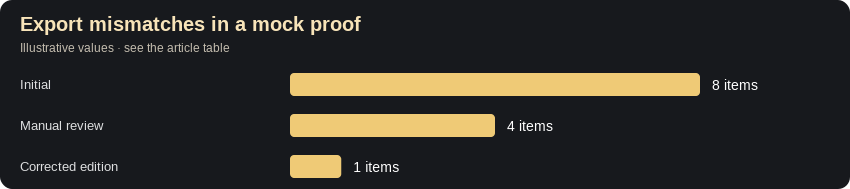
Illustrative chart: Export mismatches in a mock proof. The entries below compare three snapshots of one invented set of eight identified mismatches. They are not measured EPUB defect rates, user ratings, validator results or findings from W3C. A case counts while the original reader-visible mismatch remains reproducible in the fictional proof environment. If a new bug appears in real work, track it separately rather than forcing the audit to fit this small denominator.
| Stage of invented proof | Remaining export mismatches (items) |
|---|---|
| Initial | 8 |
| Manual review | 4 |
| Corrected edition | 1 |
The initial eight cases can be imagined as a chapter sequence error, a missing figure alternative, an incorrect note destination, a failed return link, a clipped sidebar at enlarged text, a very wide table, a contents link to the wrong paragraph and a missing chart-data fallback. In the fictional manual review, the team adjusts its export and verifies that four cases no longer reproduce. “Manual review” here names the checkpoint after that interim work, not an implication that inspecting a file alone fixes it. Three additional repairs are verified in the corrected-edition snapshot. One issue still remains open.
The values count outstanding cases against the same initial list. They are not three groups of eight, four and one different cases to add together. Saying seven of eight were resolved is fair inside the invented example. Saying the edition is 87.5 percent accessible is not. The denominator leaves vast areas of behavior unexamined, and a single remaining mismatch might prevent a reader from reaching crucial content. A work log may use counts to track progress; a release decision needs the severity, affected scope and consequences of each unresolved issue.
In the imagined release decision, set the remaining case to be the missing chart-data fallback. The alternate data are needed to read a quantitative result that the short caption doesn't convey. Many visual checks would pass, but a reader needing the alternative cannot obtain the underlying evidence. The existence of one open item after many repairs is therefore not a persuasive reason to ship. If the unresolved issue were instead a cosmetic display quirk with the content and navigation intact, the outcome might be different. Write the rule for accepting that limitation rather than letting the count make the decision.
Follow the sequence without taking shortcuts
Begin with the book closed or reset to its normal starting condition. Enter the actual publication rather than opening the exact chapter from an editor's recent-items screen. Identify what the intended initial experience is, then move through the default sequence without using the table of contents as a rescue path. Read across boundaries where the exporter likely split content or inserted a section. The opening cover and the end matter deserve attention, but the test should not stop when the first main chapter looks fine.
Then start a separate navigation test. Open the contents and choose items at different levels and locations. For each target ask whether the label is intelligible, whether the expected section is present and whether the landing point gives sufficient heading and surrounding context. A link to the top of the right file can still fail that test if it lands on an unrelated passage before the named section. If the design offers a page list, landmarks or other navigation, verify the behavior relevant to the intended readers separately rather than assuming the contents list exercises those routes.
Look inside content documents as well as between them. A logical reading order also concerns where chapter text, captions, sidebars, examples and tabular material occur. A visual layout can make a note appear immediately after its trigger even though the underlying content is placed elsewhere. An audio or screen-reader experience can expose that difference. The judgment is not whether the visual and nonvisual paths literally match in every detail. It is whether each path preserves the appropriate sequence and relationships without leaving required material stranded.
Spot-check transitions where a reader can easily become disoriented. A long figure description might be placed in an appendix, where sequential reading encounters it again. Is the duplication intentional? An auxiliary note can be useful when opened by link but confusing when inserted in the middle of the narrative without context. Conversely, a required safety or methods limitation should not be parked in an optional route simply because its position looks cleaner. The user's reason for encountering a section is part of what makes its order appropriate.
Follow a reference all the way back
When a reader opens a note, the task is not complete until they can resume reading where they started. Test a link near the beginning and one late in the book; include a note shared by multiple references if there is one. The destination should be identifiable, the content should be present, and the reader should have a workable path back. A valid internal address can land on the wrong note. A return link can work from one occurrence and quietly put the reader at another. Verify the identity and the journey, not only that movement occurred.
Reference failures often appear after splitting one source document into several. An identifier that was unique in a single file may now live in a different file than the link expects, or repeated identifiers can behave differently after export. Editors need not manually inspect every package path to find the problem. Pick a known reference, follow it in the book, compare the result with the manuscript and inspect the specific resource relationship if they differ. A narrow reproducible check is better than a general complaint that footnotes seem broken.
For external links, confirm both what they promise and what opens. A source reference may lead to a different language, a viewer, a downloadable file or a location requiring an account. A practical label can prepare the reader for relevant changes in context. Destination availability can also depend on connectivity. If material is essential to understanding the book, decide which part belongs inside the package instead of assuming a reader can look it up whenever they want. Not every external source needs to be copied into a book. The reader should still have the crucial explanation in the offline mode the edition intends to support.
Test a couple of links without connectivity as part of that decision. An external citation may predictably fail offline but still be a valid citation: the text should identify the source sufficiently to recognize it later. An internal chart description represented as necessary reading should not be unavailable merely because the reader is offline, if the book itself is meant to supply that description. Distinguish the harmless loss of optional context from a missing equivalent for an important part of the book.
An out-of-date link can be particularly misleading after corrections. The visible text may name the corrected edition while the address leads to the superseded report. Check important named versions, not only titles. Likewise, chapter rearrangement can leave a cross-reference pointing at the correct subject in an obsolete section. Fix link text and destination together. When the reference has two intended uses, such as a citation and a related example, label them so the reader can choose.
Check that every alternative still performs its job
Inspect a selection of images across the book, including straightforward illustrations, functional icons or linked images, and at least one complex figure whose meaning is not exhausted by a short sentence. Compare each item in the ebook with the role assigned in the source. Decorative and informative images need different treatment. A figure conveying numbers may need more than a generic visual description, while repeating a lengthy caption verbatim inside a short alternative can make reading cumbersome. The objective is to convey the information or function, not to count how many objects have an attribute.
If an exported chart has an available data table, test whether the link to it works and whether the table actually represents the final chart. A route to the wrong revision can be as damaging as a broken route. Check labels, units, values and any notes distinguishing examples from observations. Then try to return to the main text. A complex alternative stranded in a remote appendix may technically exist but still be hard to locate and use. A good route tells the reader why to follow it and gives context on arrival.
Watch for chapter exports that turn content into static images. A proof may preserve fonts and spacing perfectly while losing document text, structure and meaningful navigation. If text is still present visually but not reachable as text, reviewers should investigate the exported representation. The solution isn't to claim that a high-resolution image is equivalent to a chapter. Preserve text and its relationships wherever the format and production method allow, and provide an appropriate equivalent for material that genuinely needs to remain graphical.
There may be retained audio or other supplemental media. Verify what information a reader needs if they cannot use it or if their device doesn't present it as expected. The fallback should be tied to the particular content, not simply a generic instruction to visit a website. The book's advertised features should reflect the edition being checked, particularly if a distributor changes how media are packaged. A test on one platform shouldn't silently certify an alternate edition that removed the supplement.
Review alternates that are themselves links. The fact that an image alternative describes the object does not necessarily identify the action if the image is the only content of a link. Readers need enough information to know where the link goes or what choosing it does. Inspect the visible surroundings and the accessible presentation. This is especially important if the exporter strips nearby labels or changes the organizational context. An alternate route that makes sense on the website can become ambiguous in an ebook page with different neighbors.
Increase the text until the layout stops being comfortable
A normal size pass can miss a surprising number of errors. Set a meaningfully larger text size in the actual reader if the format and system support it. Inspect ordinary paragraphs as well as especially fragile content: sidebars, lists, extracted quotes, long URLs, examples, tables and chapter titles. Decide whether a user can continue reading all of the content without unintended clipping or overlay. An enlarged page that still looks neat may hide material inside a cropped box; a less elegant wrap may be fine if the whole passage remains readable and understandable.
Check more than one reading width. A broad tablet and a narrow phone can differ even at the same nominal reader setting. A horizontally scrollable data region may allow necessary browsing for some tabular content, but it shouldn't require the user to pan the whole book back and forth for ordinary lines of prose. Make it clear what can scroll, verify that important columns remain understandable and offer a usable equivalent where appropriate. Focus the test on whether the information and relationships survive, not whether every line breaks in the designer's preferred place.
Some readers change line height, font family, margins or contrast as well as text size. Those choices can expose a box whose height was designed for one typeface or a label that becomes lost when background styling is overridden. An important warning should not become indistinguishable from decoration when the dark theme changes. A reading system's behavior can vary, so record the relevant settings and test the particular conditions rather than claiming a general percentage of scaling from a nominal button label.
Fixed-layout material needs a separate briefing. Zoom can enlarge an image of a page, but it doesn't necessarily make that page reflow or preserve easy navigation across a narrow viewport. Do not promise a reflowable reading experience for a format that doesn't give one. Identify necessary alternatives, describe the actual behavior and evaluate the format's requirements with appropriate expertise. The proof can include checks of particular presentation options without assuming that they provide equivalence across all uses.
A practical remedy for fragile layout is to simplify how the book expresses its content. A boxed aside might become an ordinary identified section; a wide comparison grid might have a linear companion structured by row. Those changes can preserve meaning more reliably than shrinking the text to keep a desktop-looking composition. Change the manuscript or export template responsible for the defect, and check a fresh generated file. Hand-adjusting a styled screen in a viewer doesn't repair what will be sent to readers.
Make each test reproducible without the editor standing nearby
Save the exact input and output version, the reader and its version if known, the device or viewport, the starting place and the settings that mattered. Then write the route someone would have to follow to see the defect. “Sidebars broken at large size” is less useful than an account of which sidebar, which screen and what part disappears after enlargement. A good report distinguishes whether the text is clipped, whether it overlaps something else or whether the place from which it opens has vanished. Those observations suggest different fixes.
Record the expected result from the intended editorial structure. If a link lands in the wrong paragraph, identify the intended destination. If a heading sounds like body text, distinguish loss of its structural role from a difference in announcement conventions. If the tester was trying to verify a particular data alternative, record the figure and the version of its values. This prevents a later fix from simply pointing at whichever available file is closest in name. A clear expectation is evidence about the book's design, not a description of the reader's preferences.
Use screenshots or recordings where appropriate but don't let them replace steps. Visual evidence can show clipping, but a still cannot show what happened to reading focus or whether speech skipped a paragraph. A recording of one interface is not proof that the package necessarily behaves that way elsewhere. Save both the observation and its known scope. If the problem is hard to reproduce, note the conditions under which it was and wasn't seen rather than discarding it or assuming every copy has the same defect.
A useful proof matrix need not balloon into an impossible inventory of every device. Choose combinations tied to likely reading contexts and known production changes: a primary distribution platform, a representative narrow viewport, a larger frame, an appropriate nonvisual route and an offline check for required material. Shared findings can then be distinguished from environment-specific ones. If a high-priority environment cannot be tested, state that limitation. “Not tested” is not an additional kind of pass and should not be rolled into a coverage badge that implies comprehensive evaluation.
Make one comparative test use the actual reader acquisition path if the publisher can access it in proof or final form. A sideloaded copy can answer questions about the generated package and a reader's direct handling of it. An edition obtained through a store or lending platform may reflect separate processing and need its own check. If no downstream edition is available yet, clearly label the scope of any current verdict and specify which tests should be repeated when it exists. A promise to retest is not the result of a retest.
Give validators and readers different work
Structural and automated checks work well at finding certain classes of fault. They can flag resource relationships, syntax or patterns the checker knows how to detect. They can be run repeatedly after a build and make it easier to notice that a repaired package introduced another problem. They cannot decide that a reader who opens a link got the right conceptual target, that a diagram's description is adequate or that a chapter's sense has survived a rearrangement. A clean run is useful evidence, not the complete argument for release.
A hands-on proof works the other side of that gap. It can show that the correct destination is confusing, that required context is hard to reach or that a book becomes tiring to use under a setting it technically supports. Hands-on work can also miss an obscure invalid resource; most people won't open every route in an exploratory session. Use automation to protect known structure and manual reading to check understanding and tasks. Neither is replaceable by asking an editor to scroll through screenshots of the manuscript.
When an automated report and a manual observation disagree, don't make them vote on one verdict. For example, a package can support the correct chapter order and still start at a restored location because the reading app remembered an earlier session. Reset and reproduce. Conversely, something that visibly works once may be tolerated by one reader even when the package doesn't meet a documented requirement. Understand which object each observation concerns before deciding which fix or qualification follows.
Put some tests into a small regression set if the book will be updated repeatedly. Include an ordinary launch, a boundary across generated files, a note and return link, a required alternative, an enlarged text passage and a meaningful reading task specific to the publication. Keep the set stable enough to compare releases while adding new cases for changes in method. If every edition changes the test script entirely, a recurring problem can escape because nobody repeats the route that previously failed.
Work an invented defect from clue to verified repair
Suppose a chapter refers to a chart and offers an accessible data alternative. The manuscript opens the correct table under the chart. In the export, the same link opens appendix B at its first heading. Looking by eye at the ebook confirms that the material exists later in the appendix. The first task is to write the mismatch accurately. The book is not missing the appendix, and the link did not do nothing. The link failed to carry the reader to the specific material it promised.
Inspect the generated link and the identifiers associated with the exported table. Perhaps the conversion renamed the destination when it split the source. A fix can change how references are produced, while preserving a clear heading and entry point at the target. Do not simply drop the link and put a vague note in the caption, especially if the alternative is essential to understanding the figure. Check another chart using the same mechanism because the faulty behavior may be a template problem, not an isolated route.
Build a new proof and launch it by an independent path so the tester doesn't accidentally view an older copy. Start at the sentence that refers to the chart, follow the alternative, verify its data, check that its presentation is usable at enlarged size and return to the reference. Try a second reading system if the behavior was environment-specific or if distribution calls for it. Only then mark the reported issue verified for the tested scope. A passing screenshot in the author's preferred reader still would not prove the resulting file the distributor delivers has the fix.
The same logic applies when the correction is primarily editorial. Imagine that the alternative table uses the wrong units because it was copied from last year's edition. Renaming its destination gets the reader to an inaccurate alternative more efficiently. Correct the table or its generation source first, then check the route as well. In a project report, track wrong destination and wrong evidence separately if they were both found. Their resolutions need different verification.
Preserve the small pieces that tell people where they are
Page numbers may have different meanings in a print counterpart and a reflowable file. If the ebook supplies a page list or print page references, establish which edition they refer to. A reader following a classroom assignment may want the text associated with a particular print page, not the numerical position assigned by their software. An export that leaves a reference to page seventy but loses the mapping intended to make it usable creates a problem even if the chapter order is perfect. Test an actual page reference from the book, including whether it identifies its frame of reference.
Search offers a separate test of orientation. Find a phrase occurring only once in an intended chapter and try opening it from the reader's results. Check that the passage remains usable when isolated from the opening pages of that chapter. Some readers will enter through search rather than through the spine or table of contents. If a section consists of images, an unsuccessful text search is a clue about its representation, not conclusive proof of the exact exporter failure. Compare the package content and another reader before deciding what happened.
If a book contains several scripts or sources in other languages, spot-check that names, punctuation and available language information survive conversion. A chapter with correctly visible characters can still lose useful distinctions in speech or meaning. Work with someone who knows the relevant content when necessary. Describe the exact observation rather than saying a language is unsupported because a particular device lacked a voice. The objective is to preserve the publication's material while keeping reader limitations separate from the package's mistakes.
Use the same errata process for meaningful export errors
The file may be released already when a defect is discovered. Start by identifying the affected edition and acquisition route. A corrected file in the author's build folder doesn't help someone whose library delivers the earlier one. Conversely, if the bug occurs only after one platform's transformation, the package sent directly to other readers may still be sound. State what you were able to check and label the copies that need attention. Do not release a generic accessibility assurance to compensate for an inability to inspect the platform.
An update note is appropriate when an export error affected access to content or a reader's understanding. It could explain that the original download omitted the appendix links, that the revised edition restores them and that the chapter text was otherwise unchanged, if that last fact was verified. A note need not announce every adjustment to page breaks. It should answer the questions someone with the older book has: whether their copy is affected and how to obtain a revised one or reach the missing material.
Download the revised edition through the actual delivery route after replacement where possible. Choose a known sign of the difference, such as the corrected chapter identity or the restored figure route, and verify it in the reader rather than relying only on an upload timestamp. If a platform continues to provide an older copy to some readers, identify that condition and the route they can use for help. A reliable update note says what version is available, not what every device is presumed to have received.
For a future release, preserve an example of the failed route in the proof checklist. Note which test would have revealed it before distribution and whether that test is now automated, manual or both. This gives the next editor a concrete task instead of an abstract warning to “check the ebook carefully.” An export proof improves over time by remembering the actual ways a book stopped carrying its own meaning.
Choose a release decision by consequence rather than by count
Some revisions are safe to publish with a clearly described limitation. Others should wait. An edition isn't ready merely because seven of the eight items in the mock chart are closed. A reader who cannot reach the data behind a main chapter may have lost access to a major part of the work. Missing explanatory text that affects interpretation should be treated very differently from a decorative icon that uses an unintended shape. Decide whether any essential task is broken under the conditions the release promises to support.
Make the publisher's public description match what was verified. If one version is reflowable and another behaves differently, identify the versions. If an accessible substitute is offered, check that it actually contains what the advertised limitation makes important and that a reader can obtain it without an unreasonable detour. A link to a general support page is not the same as a usable equivalent for a missing chart explanation. Do not use a cautious metadata label to hide a problem the team can describe plainly.
Retesting a corrected edition involves its own people and files. One person can confirm that a build is available; another can open the result through the relevant reader and verify the outcome. In a small team the same person can do both if they keep the steps distinct. Record which edition was superseded and how it is identified. Existing users may still have that version downloaded, so a corrected upload does not necessarily change every reader's copy. Acknowledging the distinction helps the team design remedies that match what it actually controls.
Ultimately the editor is not proving that the manuscript once looked right. The editor is asking whether the delivered book carries the meaning along the path a reader will take. Check sequential order independently of navigation, follow significant alternatives in both directions and enlarge the actual text. The result is a smaller and clearer claim than “all accessibility checked”: this identified edition was tested for these reader tasks, with these outcomes and these unresolved limits. That claim is useful because it can be checked again after the next export.
If a revised file changes location identifiers, check what happens to bookmarks, saved reading positions or citations that depend on those locations. A reading app might treat the revision as a new book, or retain a position that no longer refers to the same paragraph. Tell readers how to find the revised passage by chapter and heading when numbered positions cannot be compared directly.
References
- W3C Recommendation: EPUB 3.3, including the package document, spine and EPUB navigation document.
- W3C Recommendation: EPUB Accessibility 1.1, including discoverability and evaluation. Neither recommendation provides the constructed audit counts.