| Category | Value (views) |
|---|---|
| Clear from path | 7 |
| Obscured | 4 |
| Not safe to watch | 3 |
Illustrative values, not sourced observations. Conditions are illustrative; never approach or test an opening.
A person leaving a park notices two insects fly toward the same low spot beside the path. One disappears from view behind grass; the other turns across the path and heads into the planting. It is tempting to walk back, part the grass, and settle whether there is a nest. That is precisely the step the observer should skip. The insects have not been identified, the entrance has not been confirmed, and the path is being used by other people. A note from a normal public position can still help the site manager. It should report what was visible, where ordinary users pass, and what nobody could tell from that position.
Keep the goal small. This is a method for making a nonintrusive record and handing it to the people who manage a public or shared site. It is not a guide for finding an entrance at close range, diagnosing the level of sting risk, or deciding whether anything should be removed. You may not need to stop at all. If you cannot make a note without standing in the way or staying near insect activity, move on and write down what you already noticed from somewhere away from the site. A missing photograph is a reasonable outcome; an injury or a crowd gathered around an opening is not.
The useful first decision is whether to stop
Look at the route as a route, not as an observation platform. A wide park path may have places where people are permitted to stop without interrupting the walking line, but a narrow path around a blind corner does not. Do not step into vegetation, a bike lane, a road, soft ground, or a closed area for a better angle. Do not stop in a crossing, at a curb ramp or on the only clear route around an obstacle. If standing still would change the flow of people or oblige somebody to move toward the suspected activity, skip the watch. You can report a brief sighting once you have continued to a suitable place.
A stand-off is not a number that can be certified from an article or from the apparent size of the insects. Site layout, activity and the observer's circumstances differ. Never approach to work out where the limit is. Do not cross an existing closure or stand on its edge to see what prompted it, and follow site staff instructions. If insects are already in the space you are using, activity changes while you are watching, or you cannot judge where you could leave freely, end the observation rather than remain to complete a tally. No record earns its value by requiring a person to stay in an uncomfortable or hazardous place.
CDC/NIOSH's guidance on insects and scorpions for outdoor workers is relevant to why staff and volunteers take stinging insect encounters seriously. NIOSH's stinging-insect safety sheet also distinguishes ordinary sting injuries from severe reactions needing immediate medical care. Those sources are safety resources, not species keys or guarantees for members of the public. For an active emergency use the local emergency process rather than spend time getting a picture or completing a natural-history record. The discussion below concerns a possible site feature noticed without an ongoing emergency.
For children, groups, pets or anyone who cannot leave the spot easily, no deliberate observation is required. A field leader should not hand out a closer look as a reward, make a child a spotter, or ask another person to test whether they can stand somewhere more comfortably. The existing observation is enough for a handoff if it relates to a place where people must pass. If a safer alternative route is not obvious, rely on the staff or authority responsible for access. A sighting does not grant a passerby permission to create a closure or send people down an unapproved route.
Write what happened before naming what it was
“Insects repeatedly flew into the same small area of the bank” is more informative than “hazardous bee nest,” if repeated flight is the only fact. A single flight near a flower is not equivalent to a flight into a gap. An insect going behind grass might have entered a concealed opening or simply passed out of view. Two similar-looking insects might be the same insect seen twice. To avoid implying a stronger identification than the evidence supports, use words such as “insect,” “possible entry activity,” or “identity unresolved.” If a photo or ordinary view did not show a group clearly enough to identify it, say so.
Describe the direction of movements if it was visible without chasing them. For example, “three movements were seen toward the same grassy edge during a brief stop; the last part of each flight was obscured” can tell someone where to look using their own procedures. It does not claim three insects, three entries, or a count of nest occupants. If a movement visibly crosses the route, say where it crossed in relation to a landmark. A route crossed by an insect does not establish that people were being pursued or that the same thing will happen next time.
Give the note a date and approximate local time. Time lets someone distinguish a report from earlier in the week, relate it to maintenance schedules, or understand why views in a pair of notes differ. It does not tell us that the same activity continued during the unobserved interval. If you watched briefly, note the rough duration only if it can be estimated honestly. Do not make up a timed count from a passing glimpse. A precise timestamp and an uncertain count are both possible in one entry; keep the precision of each field separate.
Write down whether you could see the place where the insect disappeared. Continuous visibility to a fixed point is different from a clear view of some nearby flight. Neither by itself proves a nest. If part of the bank was blocked by vegetation, state what was hidden instead of assuming the obscured section was where a nest entrance lay. A clear view of one segment of path is not a view behind the bank, and the report should not imply that you searched the whole feature. The phrase “from the path” belongs beside the observation, not merely in the story that introduces it.
Put the possible entrance and the public route on different lines
A note for site staff should describe both the suspected activity and the way visitors use the space. A location can be close to a walkway in map distance and separated from it by a fence or an unmown strip. Another may be near a turn, seat, bin or entrance that causes visitors to pause at the closest point. Record the relation to fixed features from the public route rather than stepping closer to measure. “Vegetated slope to the left of the wayfinding sign going toward the gate, below the rail” is a useful type of description. “About an arm's length from danger” claims a measured gap and a diagnosis that the observer may not have.
Do not treat one person's clear route as everybody's clear route. A parent with a stroller, a wheelchair user, or a cyclist slowing for walkers may have fewer options for changing position on a narrow segment. A maintenance worker may have to be in the planting even while the public stays on the pavement. Do not make predictions about who will be stung. Describe the physical constraints that staff can verify: a single available route, a service gate, poor sightlines, a seat immediately beside the area, or a posted restriction whose scope you observed. It is not your job to time a queue or prove that people can be rerouted.
A rough distance can communicate scale if it is available without movement and clearly labeled an estimate, but it should not become a safe-distance instruction. A picture taken with zoom compresses apparent separation; it may make a bank look as though it touches the path. Identify the vantage point or include a safe, wider view if you already have one. Named landmarks often work better than a numerical estimate made from memory. If you do not know how far the activity was from the traveled portion, state the relationship using words such as “across the railing” and leave the distance uncertain.
Keep route observations time-bound. “The walkway was open when I passed” is not permission to use it later, and “two people passed without incident during the short observation” cannot establish safety. The absence of a reported sting is not a negative test of an opening. Similarly, observing an empty path at sunrise does not tell you how people use it at a scheduled event. If you know a busy period from a posted schedule, mark that as context rather than claim you watched a crowd that was not there. The job is to give the manager something they can investigate, not to characterize every day from one visit.
Toy path views by condition
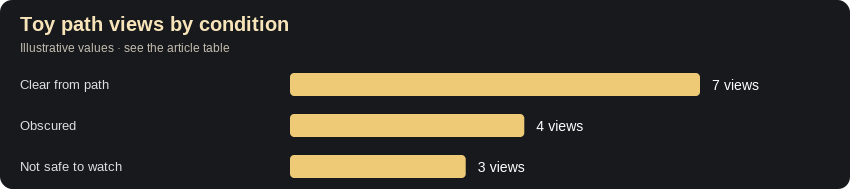
This chart and table show the same invented count of 14 example views. The unit is views. They do not describe a real path, do not count insects or nest entrances, and do not estimate injury risk. “Clear from path” means the designated feature could be seen from an ordinary permitted position without interfering with path users. It does not mean the location was cleared by staff. “Obscured” describes an otherwise permissible look in which the feature could not be resolved. “Not safe to watch” describes a decision to skip or stop, not an instruction to investigate further.
| Condition | Views |
|---|---|
| Clear from path | 7 |
| Obscured | 4 |
| Not safe to watch | 3 |
The labels refer to observing conditions, not to the status of a population. Seven clear views could all belong to a single site that happens to have a good sightline. Four obscured views could arise from tall grass around an inactive opening or from the same shade across several different sites. Three stops could relate to crowded paths, activity near the public route, closures, or other reasons the watch could not be completed. Nothing in the table establishes which reason applied on any row, since the entire dataset is fictional. Real records should retain the actual reason when it is known.
The denominator is useful for transparency: of fourteen planned or brief view opportunities in this invented exercise, seven permitted a clear look and seven did not. Of the latter seven, four were obscured and three were skipped or stopped. Do not interpret those seven missing clear views as seven places with no nest. For a specific watch, a view may be clear and no insect may be visible during the observed interval. That is a qualified observation about that interval alone, not a permit to handle or open the feature. Never approach or test an opening to move a row from obscured to clear.
These categories are valuable particularly when a report is mostly unavailable observations. A coordinator can see that lack of documentation came from access and visibility, not from volunteers deciding the sites were uninteresting. A field log can add a separate column for the kind of activity visible during a permitted watch. If the activity field is blank, explain whether it was not observed, not recorded after a fleeting glimpse, or unavailable because the watch never happened. These are different reasons to have an empty field. A clean chart of view conditions should keep those differences legible in its underlying notes.
Leave the opening alone, including when it looks inactive
A crack, entrance-like hole or space beneath a root is a structure; it is not an identification. A person can record an opening visible from the path without knowing who made it, what uses it, or whether it is occupied at that time. Some features can be used by more than one kind of animal over time. Vegetation or an insect's route may obscure what is actually going on. The absence of insects at a visible opening during a short window is not a positive finding of vacancy. There is no reason for a passerby to probe, cover, water, smoke or otherwise modify an opening to settle the question.
Do not part foliage, tap the substrate, shine a device into a cavity or put equipment in front of an apparent flight route. These actions can disturb a site and expose the observer in ways an ordinary path observation avoids. Do not place household chemicals, bait, barriers, flags or signs on a shared site. A field note and the manager's own procedures are the appropriate boundary for an unqualified observer. If documentation requires a close image to be useful to a specialist, that specialist and the site manager can decide whether, when and how an authorized assessment is warranted. Not obtaining that image is not a mistake.
The Xerces Society's overview of bumble bee nesting and overwintering describes the annual colony cycle and discusses uncertainty about where bees nest and overwinter. Its nesting and overwintering habitat guide is relevant to why quiet natural features can matter even when a person does not see a nest. These are habitat resources prepared by a conservation organization. They do not identify the inhabitants of a particular opening, and they do not tell a visitor it is safe to move anything that looks similar to an illustration.
The distinction between a seasonal pattern and a present observation is especially important near a path. A discussion of how bumble bee colonies change over a year does not show that a particular cavity is empty on a particular day. A report that says flight was not visible in a brief cool or shaded period is not evidence of a seasonal transition. Do not schedule a close approach for a time you expect lower activity. Instead, let staff decide any monitoring based on site policy and professional guidance. No simple calendar rule resolves what an observer actually saw in a few moments.
Let photographs prove only what their framing supports
A picture can help locate a report if it shows which side of a path the observer means and what landmarks are present. This is often more useful than a heavily cropped image of grass. If you can take a photograph without breaking the ordinary safety and access boundaries already described, a wide frame can show the path, barrier or sign and the general direction of the activity. If the only available view is an existing snapshot, do not return for a better one solely to complete a template. The manager can use an approximate location note to determine whether a separate assessment is needed.
If a close-looking photograph was made with zoom from a permitted position, label it as such and preserve the original rather than guess the physical distance shown. A sharp wing on one frame may support a broad group identification by a qualified reviewer but may give no evidence of repeated entry. A sequence tracking insects to a landmark can be useful for behavior even if the insects are too small to identify. Do not imply every kind of proof comes from the same image. In a report, phrases such as “shows route only,” “shows general flight area,” and “identity not discernible” help people know which question a photograph can answer.
Avoid recording people unnecessarily, especially children or identifying details of an incident. A public map pin that draws people to the suspected spot is not necessary for a private operational report. Share enough location information through the site's ordinary reporting route for the manager to find the feature, and keep the public reporting audience in mind. A vague report suitable for a discussion board may be less useful to staff; a precise internal location may be inappropriate for a public natural-history post. It is possible to write both versions from the same evidence without making either more certain than the other.
A photo can mislead even when unedited. It captures a glance along a line of sight, where the path edge, a nearer leaf and a distant opening may appear stacked together. A dark spot in a frame might be shadow rather than a cavity. Still images might not show whether an insect moved through the frame toward or away from a feature. Preserve what you observed directly and say what you inferred from the image later. If those disagree, mark the disagreement instead of choosing the version that makes the report more dramatic.
Hand off the location, the evidence, and the uncertainty together
The recipient should be the owner or manager who can assess the site through the proper process, such as a park office, facilities desk, property manager, trail organization or designated maintenance contact. Use the ordinary reporting channel and avoid sending inexperienced people to verify the site for you. If the path is shared by several institutions, name the nearest fixed landmark and the direction of travel in the report so the recipient can identify the correct responsibility. Do not assume the person who maintains a sign also controls nearby land. Forwarding an uncertain observation to the right contact is different from issuing an instruction to field staff.
A brief fictional handoff could read: “Around midafternoon I saw several insects fly toward the grassy bank on the left when walking from the pavilion toward the south gate. The end of the flight was hidden by grass, so no entrance or species was confirmed. I was on the path and did not approach. Where I noticed the activity the path narrows beside a rail, with no passing space on that side. No visitor incident was observed during the brief look. Please assess under your site's procedures if appropriate.” This records the movement, observation limits and access constraint while leaving identification and management with the recipient.
If someone reports a sting, distinguish their account from what you saw. A report such as “staff told me a sting had been reported earlier” is secondhand unless you witnessed it. Avoid including personal names or personal medical details in an ecology log, and refer urgent incidents through the appropriate channels. Multiple reports may deserve a prompt staff review even if nobody can identify an insect. Do not ask for identification as a precondition for relaying a public access concern, and do not label the report a confirmed nest simply because the recipient will need to give it attention.
The site manager may decide that no further observation is needed, may ask for a different location detail, or may arrange an assessment. The reporter should not treat an unanswered note as a reason for a closer independent check. For any requested follow-up, provide what can be reported from existing observations or a naturally available permitted view that does not create risk. If the manager asks for something beyond that, explain the limit. Avoid personally surveying the opening, altering the site, or drawing visitors into a cordoned or narrow area to help explain what you saw.
Keep the record useful when it was not possible to watch
Visibility can fail for many reasons that have nothing to do with the activity itself. A mower could change the vegetation between visits. The sun can produce a silhouette in one direction and show the same stems clearly in the next. A crowd can occupy the only ordinary spot for stopping without turning the area into a dangerous habitat. Code the visit outcome and the reason separately. “No watch; pedestrian congestion” gives a manager concrete information and avoids implying the insects produced the decision. “Obscured by grass from path” records limited visibility without classifying abundance.
A planned watch ended for a safety or access reason should remain in the record even if nobody completed an activity field. Explain whether the watch was never started, was stopped, or was partially attempted from an ordinary position. For counts of observing opportunities, decide what counts as one beforehand: a planned look at a location during one round, for example, not every moment someone considered turning their head. Even if the team only makes descriptive reports, stable definitions keep a spreadsheet from mixing locations, people and moments as if they were the same thing.
If several observations came from the same path on the same day, keep their link to that path. Four separate volunteers reporting an obstructed view may mean that the same grass was in the way four times. It does not demonstrate that four candidate nests were present. If labels or platform uploads make duplicate reports likely, match them by broad landmark and time without assuming identities. A later sighting from the opposite end of the walkway may describe the same movement differently. Preserve the reports as separate observations while making any proposed match explicit.
Contrast a skipped watch with a clear but uneventful one. The first says the observation was not undertaken or could not be completed. The second can say no related movement was seen during the brief stated period and from that angle. Neither should be read as all clear. If the goal is a monitoring report rather than an immediate safety handoff, retain the number of planned looks and how often a valid observation was possible. It is tempting to summarize just the clean views, but a route that often cannot be watched is underrepresented by those views alone. Describe that limitation without returning at risk to fill in blank spaces.
Distinguish three observations that can look alike in a report
One fictional observer writes, “There were insects among the flowers beside the east railing. I did not see their flights converge on an opening.” That report supports flower-side activity, not a ground nest. A second writes, “Several movements appeared to end in the same small area near the base of the bank; the view was blocked below the stems.” That is a stronger reason to note possible entry activity, but the end of each flight remains unobserved. A third writes, “Repeated movements appeared to pass through a particular visible gap; group unidentified; no approach.” The third observation supports a more specific location and behavior, not a pest determination or a claim that everyone using the path was at risk.
Teach this difference by keeping the same access rule in all three examples. Whether the evidence is weak or strong, the observer stays where it is already permissible and sensible to be. Better evidence is a welcome consequence of a normal vantage point, not permission to obtain a closer one. If good evidence is unavailable, the manager can still use verified details about foot traffic and sightlines. Conversely, compelling footage of activity at a gap does not supply details of the walked route if the recording shows only the gap. Do not exhaust a volunteer's attention on identification when the route geometry is what staff need first.
Sometimes the word “busy” comes from reputation rather than observation. A paved trail may be crowded on summer weekends but empty during the watch. The note can separate “school exit posted half a block away” from “students were passing in groups when I looked.” If a scheduled event is imminent and the possible activity is near the one accessible entrance, share that operational context with staff without making volunteers test the approach. A staff member can judge whether a prompt assessment is warranted. Seasonal habitat guidance and a rough sighting do not, by themselves, specify the best response.
Consider a bank where no insect was seen but soil disturbed by maintenance opened a view into a cavity. In a nature journal, one can note a cavity and a recent change in the bank without claiming occupancy. In an operational report, the same entry can include useful route information if the bank is immediately beside a work zone. An empty observation field should not be filled with a guess about insects simply because the form was intended for them. Retaining the observed structural detail may be more useful than forcing a yes-or-no nest entry.
Keep the handoff and later decision records separate
A report that reaches staff may eventually be linked to an assessment or no-action decision. Keep the incoming report intact rather than replacing its original language with the later result. A subsequent professional assessment may find an occupied feature, a different insect group, or no identifiable evidence at that time. Each tells the reader something about a different inspection. Where a later report explicitly confirms something, cite it as the later assessment and include its date. Do not claim the initial observer verified it. If a new visit finds nothing, that also does not prove no activity was visible earlier.
Being able to separate reports protects against another error: confusing a temporary access change with a biological conclusion. A route might be closed while staff assess, because weather or construction is interfering, or for another reason not given publicly. Record the closure as an access condition and follow it. The fact that a barrier later comes down does not tell a passerby what insects were present or whether any management action occurred. A good handoff does not require the recipient to disclose confidential operational or health information to make the original observation valid.
For a volunteer team, a compact form can keep the work aligned. Include time, location, vantage point, visibility, activity actually seen, path condition, reason for stopping or skipping, whether any image is available and where the report went. A date should not be optional if the note may be read days later. Approximate times and directions can be captured without tracking every person nearby. Do not use a required “species” field that forces observers to choose the closest match when identity is unclear. If a platform requires a finer identification than can be justified, keep the note elsewhere or choose an appropriately broad category when available.
Set an internal rule about how local notes are shared. A staff report may need a landmark precise enough to locate the segment. A classroom result can use anonymous site labels and a chart of view conditions. An open conservation record should avoid sharing exact location details when that would risk disturbance or curiosity visits, subject to the program's practices. Remove photos of unrelated people before broad distribution where possible, while retaining original evidence appropriately for the responsible recipient. The common requirement is that the details support the audience's legitimate use rather than motivate a public search for the opening.
Make a short safety-first practice exercise
Use a familiar route without any actual suspected nest to practice the reporting choices. Give participants an invented detail, such as movements disappearing behind a bank near the second bench, and ask them to describe where that would be using normal public landmarks. Compare notes for accuracy without walking into the bank. A listener should be able to locate the general segment from the report and understand that no species is known. In a second scenario, move the imagined sighting to a crowded ramp. The correct result is a passing note or a skipped watch, not a plan to make a crowd wait while the group finishes the exercise.
Test the data categories without making observation an obligation. From an ordinary permitted location, one fictional feature might be visible through a clear line of sight. Another might be concealed by vegetation. A third can be assigned “not safe to watch” because the route already requires unobstructed movement. Notice that the second and third are not interchangeable. The second describes what a responsible watch could not resolve; the third says why there was no responsible watch there. Keeping that distinction gives the next person better information about how the report was produced, without inviting them to improve the vantage point.
In a larger monitoring project, the exercise can reveal unwanted incentives. A scorecard that awards points only for clear photographs encourages people to take photos where they should move on. A requirement to get an outcome at every planned location invites guessed classifications. Evaluate the records by whether they state what was observed and why limits were respected, not by how many suspected sites turned into confirmed ones. Mark a correct decision to leave the area as a completed reporting decision even if it produced no insect detail at all. It is possible to improve record quality without increasing the amount of watching.
A good review asks two people to read a sample note and underline the phrases that describe observation, inference and action. If both underline “aggressive nest” as an observation even though the note only describes movement near a bank, the reporting language needs work. Replace claims about intent, such as “the insects were guarding the trail,” with observable features such as repeated movement across a fixed section. If the observer actually saw contact with a person, precisely describe that event separately. This distinction lets staff respond to the event itself without being handed an unsupported biological explanation.
A plausible example of the full record
Imagine a route between a library entrance and an outdoor seating area. One side of the path is bounded by a curb and the other by a low planted bank. A volunteer passing in ordinary use sees several insects approach the same section of bank from the seating side. The view beyond the grass is unavailable. People leaving the library form a short queue at the nearest doorway, and there is no nearby standing area that would not narrow the pedestrian route. A correct response is to keep moving and document the initial view away from the activity. No longer observation is needed to make that choice.
The note would hold some separate entries: an approximate time; a landmark and direction of travel; visible flights toward the bank with their endpoints obscured; a busy walkway with no sensible stopping position; a choice not to watch; and no qualified identification. The preliminary sighting is still real within the example, even though the planned observation was not made. It does not belong under “clear from path.” Nor should it be erased because the volunteer did not get an image. If the project distinguishes passing sightings from fixed watches, retain both designations instead of choosing one to cover every purpose.
Now imagine that staff ask whether anybody was stung. “I did not see a sting during my passage” reports the actual evidence. “Nobody was stung” would claim more. If asked exactly where a cavity was, state that no cavity was visible, then repeat the useful landmark. If the path has furniture that shifts during the day, add only where it was when observed. These limits do not weaken the report; they keep the recipient from looking for evidence the observer never claimed to have. A manager who later checks the location will be able to distinguish what came from the passing sighting and what was learned in an authorized assessment.
Another observer in the same fictional setting could find the path calm a day later and note no visible activity while passing. That does not clear the original report or establish continuous absence; it adds a different date, view and set of conditions. If staff have marked the path or sent instructions, those supersede any choice about stopping. Do not tell others to ignore a sign after noticing that nothing seems to be flying. The observational record describes the limits of personal evidence; access directions come from the people with responsibility for the site.
The practical value of a good note is that it gives two people somewhere to start without requiring them to share the same guess. The observer can report an uncertain event and a physical constraint. The manager can decide how to assess the site, whether visitors need information, and whether the observation warrants action under applicable procedures. The record is complete when it says what could be known from a normal permitted position and what could not. That is a better final line than “nest confirmed” obtained by a test the observer should never have made.