
| Category | Value (records) |
|---|---|
| Form one | 8 |
| Form two | 6 |
| Form unresolved | 3 |
Illustrative values, not sourced observations. Invented example for the stated comparison; not a biological threshold, ecological estimate or observed dataset.
Two primrose flowers can look much alike until a viewer looks into their openings. In a pin flower of the common primrose, the stigma sits near the mouth of the corolla tube. In a thrum flower, anthers occupy the higher position, while the stigma is lower on a shorter style. The structures trade relative positions. That is variation in flower form within Primula vulgaris, not evidence that the two flowers belong to different species. It is also not a visible record of which plant's pollen reached either flower. Those are three different entries in an observation ledger: species, floral morph, and evidence about pollen movement.
Two studies show why the entries should remain separate. R. Ornduff's study of pollen flow tracked pollen production, removal and composition on stigmas in a British population. The mix of pollen on stigmas was not simply what the arrangement of floral organs might lead a reader to predict. Margaret Webster and Philip Gilmartin's developmental study used comparisons across stages to ask how the forms develop. The two papers make sense together because one explains aspects of architecture and the other examines outcomes in a population. Their data do not merge into a single set of flowers followed from bud to seed.
Species is a different judgment from form
Pin and thrum are convenient names for the long-styled and short-styled forms in the common primrose. The style is the structure that bears the stigma, the surface relevant to pollen receipt. Anthers are parts of the stamens that release pollen. In the pin, the higher stigma appears near the opening and the anthers are lower in the tube. In the thrum, the anthers appear near the opening and the stigma is farther down. The terminology refers to the floral configuration. It does not turn the flowers into separate species or imply that the higher structures are the only reproductive parts each flower possesses.
Calling pin a female flower and thrum a male flower would therefore be wrong. The more conspicuous structure at the entrance is not a census of what the flower contains. Both forms have the structures for pollen release and receipt, arranged differently. Similarly, the historical use of terms such as reciprocal positions does not require the organs to occupy precisely the same coordinates across all individuals. It captures a relational arrangement: the higher pollen presentation in one form corresponds approximately to the higher receiving position in the other, and the lower positions likewise invite comparison.
Species determination should come from its own evidence. A flower pictured from straight on may have an obvious central structure while leaves and other identifying features are absent. That may be enough to recognize the apparent placement of one structure yet not enough to confirm a species. Conversely a well-documented record of common primrose can be a reliable species record while the view into the flower is inadequate to identify the form. Make these separate outcomes possible. The combined statement “species supported, morph unresolved” is more useful than a generic confidence score for the whole photograph.
There is also a difference between describing a morph and classifying a developmental stage. A bud that has not opened may conceal both anthers and stigma. Its hidden structure should not be interpreted as a short style. A mature flower viewed sideways might be partly covered, with sunlight making the frontmost structure more prominent than it really is. Neither case should be forced into the two familiar names merely because the visible photograph lacks the full arrangement. “Unresolved” describes the available evidence. It does not coin a third floral morph or imply that the original plant was unusual.
The observation unit belongs beside each judgment. A flower is not automatically a distinct plant in a dense patch; several flowers may be visible from the same plant. The number of photographed floral faces is not a species count or a morph frequency among individuals without further information. A patch overview can count many blossoms but may not show which share a plant identity. A close image may show reliable morphology but not reveal how many other blossoms were nearby. Each source earns credit for the unit it actually records.
What the developmental paper adds to the visible differences
Webster and Gilmartin compared pin and thrum flowers during late development in P. vulgaris. The paper reports that cells of the pin style were longer than those in the thrum style, and that the different anther positions were associated with a different developmental pattern in the corolla tube. The authors also reported a wider tube mouth in thrums in their comparisons, associated with differences in upper tube cell width. Read those as results of the developmental study, not as a list of independent field tests for every primrose photograph.
The difference in the tube mouth is a particularly good example. A reviewer looking at portraits taken from unequal angles might be tempted to use apparent opening width as a decisive morph marker. In a study with explicit comparisons, the width is an interesting measured feature. In a photograph, the apparent width depends on framing, view angle, focus and the state of the flower. A broader appearance can prompt a closer look at the position of the stigma and anthers. It should not overrule uncertainty if those structures cannot be identified.
The paper distinguishes the development of features that are easily bundled together under the single word form. The timing of visible differences and the tissues that account for them need not be identical. That makes the final configuration more informative than merely saying one flower is a scaled version of the other. It also makes an equally important limit clear: an image of the finished form does not expose the cellular events that produced it. Developmental evidence supports that part of the explanation. A picture of the finished flower supports a different kind of statement.
It is helpful to separate the form as a biological category from whatever cues are visible in a given image. An early image can be poor evidence for classification even if it captures a real developmental stage of a plant that will later be classified confidently. If the same plant is reliably documented at maturity, a collection may link the later morph determination to the earlier image. The earlier image does not thereby become independent evidence of the morph. Give the classification and the linkage their own provenance so that someone reviewing the early frame does not mistake an inference from later material for direct visibility.
For this article, there is no need to turn the developmental findings into a genetic test, a cultivation plan or field intervention. The evidence of interest is how recognizable structures come to differ and how confidently those differences can be read. A labeled published diagram is often better than trying to reveal hidden floral parts during a walk. There is intellectual value in knowing which part of the arrangement is concealed by the tube and leaving it concealed in the actual flower. The ledger can still store the visible clues.
What might happen to pollen, and what was actually counted
A reciprocal arrangement gives a plausible route for pollen movement. If a visitor contacts anthers at a higher position in one form, pollen could be placed on a part of the visitor that later contacts a high stigma in the other. A comparable argument can be made for lower positions. The word could matters. A visitor's orientation, how deeply it reaches, what material is already present, and which flower it visits next can all change the path. The shape identifies a possibility worth studying. The transfer remains a separate outcome.
Imagine a visitor carrying grains from several prior encounters. It reaches a stigma at the appropriate height, but the grains on the body region that touched it happen to come mostly from another part of its route. The geometry can be exactly as predicted while the composition of the deposit differs. A long visit may give more opportunities for contact but is not a count of successful transfers. Even a removed grain might subsequently be lost or carried to a different recipient. Put the word movement next to the interval and endpoint the study actually investigated.
Pollen can be counted at production, removal, carriage and deposition, with different denominators. Production might describe grains manufactured per flower or anther. Removal is a decline from the donor structures under the conditions of a study, not a list of proven destinations. Carriage describes what is found on a visitor. Deposition concerns pollen already found on the recipient structure. Fertilization and viable seed are later outcomes. A summary that substitutes generic pollination success for all five makes the papers harder to use even if its numbers were copied correctly.
Ornduff's original paper, published in the 1979 journal volume, describes visits to a British population from 1971 through 1976. It reported different pollen production and removal patterns for the two forms, as well as recipient stigma pollen loads differentiated by apparent pollen type. The fraction of their pollen removed from anthers was higher for thrums than for pins in the study's observations, while pins produced more pollen. The numerator and the denominator are therefore both important. A higher removal fraction does not by itself identify which form exported the larger absolute number of grains.
The paper reports that the composition of pollen on stigmas varied, and that different collection methods yielded somewhat different results. In particular the observed interform pollen flow was generally below the author's expectation for random pollen flow. The author interpreted much of the same-form pollen as possibly coming from self-pollination or from another flower on the same plant. That is a proposed interpretation of part of the load, not a genetic assignment of every grain. A grain classified as belonging to the same form as its recipient need not have come from the recipient's own flower.
The study also reports seed differences between forms despite similar ovule counts. That further illustrates why later endpoints deserve their own rows. A stigma with grains present has received a load. The grains do not necessarily represent successful fertilizations, and even fertilization does not establish the number of developed seeds. The abstract is valuable precisely because it offers several kinds of observations instead of a generic pollination total. The relative contributions at one point in the record should not automatically be read as ratios at the next.
An expectation of random movement has a denominator
Random is not a synonym for equal percentages. What would be expected under a random flow model depends on which opportunities enter the reference. The abundance of potential donors, their relative pollen production, and the availability of flowers to visitors can affect a baseline. Two forms present in equal numbers do not necessarily produce equal quantities of pollen. If observed frequencies change over years, an expectation that assumes a fixed underlying mixture may need reexamination. The original paper's comparison is more informative when reported with its scope rather than translated as a universal decline from fifty percent.
Here is a separate fictional example showing how this works. Suppose there are four available flowers of each form, but one hypothetical form contributes twice as many grains per flower to a modeled pool. If every modeled grain were equally likely to reach the recipient under the model, the reference mixture would not be half from each form. This calculation is not offered as a reconstruction of Ornduff's method or a natural law. It shows why a baseline should name what is being treated as equally available before readers infer bias toward or away from a category.
Likewise, a natural population's exposure is not fully specified by counts on one date. Flowers can open or fade across the observation window, visitors may be active at different times, and some plants can have more flowers in accessible positions than others. An observed morph ratio at the plant level is informative but does not supply every ingredient relevant to transfer. A report about actual pollen movement should state what its sample covers and avoid presenting changes in a plant inventory as if they were changes in visitation or fertilization.
Such caution is not a rejection of function. The arrangement makes an intelligible prediction about where contact could take place. A population study can show deviations from a reference model without settling every cause of those deviations. The two conclusions belong logically together: a plausible route exists, and the measured pattern in that particular population did not reduce to the simplest expectation. Natural history grows more interesting when the record can show the difference rather than suppress it to protect a tidy story.
Toy records by distinct evidence
The figure and table contain invented record counts. They are not data from Ornduff or Webster and Gilmartin, a prevalence estimate, or a target for classifying flowers. Imagine each observation record refers to one pictured flower with a separately supported species identification. Assign each record once, according to the floral configuration visible enough for the coding rule. In the toy labels, form one and form two simply stand for the two named forms; form unresolved means the available view was inadequate under the toy rule.
| Record classification | Records |
|---|---|
| Form one | 8 |
| Form two | 6 |
| Form unresolved | 3 |
The rows sum to seventeen records. Fourteen could be assigned to either of the two forms, and three could not. Eight out of fourteen is about 57.1 percent of the assigned examples, while eight out of seventeen is about 47.1 percent of the full invented archive. Those fractions answer different questions. The first concerns the resolved portion; the second concerns how many archive records were confirmed in the first form under the rule. Neither describes a population ratio or says how many flowers of a real species occur in any place.
The unresolved category is purposely not defined as other. A record might qualify if the mouth is hidden by a stem, if the image quality is poor, or if the identifiable structure cannot reliably distinguish the forms in that particular view. The underlying flower might belong to either form, but the chart does not assign it. If unclear images systematically hide one form more often, the resolved subset could have a biased composition. Nothing in this fictional chart can diagnose that bias. An actual study would need to consider which cases it could classify and how that relates to visibility and sampling.
The unit also blocks a quiet leap from records to plants. Some records could represent the same plant on multiple dates. Multiple pictures of a single flower should not count as multiple records unless the sampling method actually defines them that way, and even then they should not be treated as independent flowers. A reporting table can preserve picture IDs, observation IDs and plant IDs separately where available. Distinguishing them makes it much harder for an enthusiastic gallery editor to accidentally produce an ecological census.
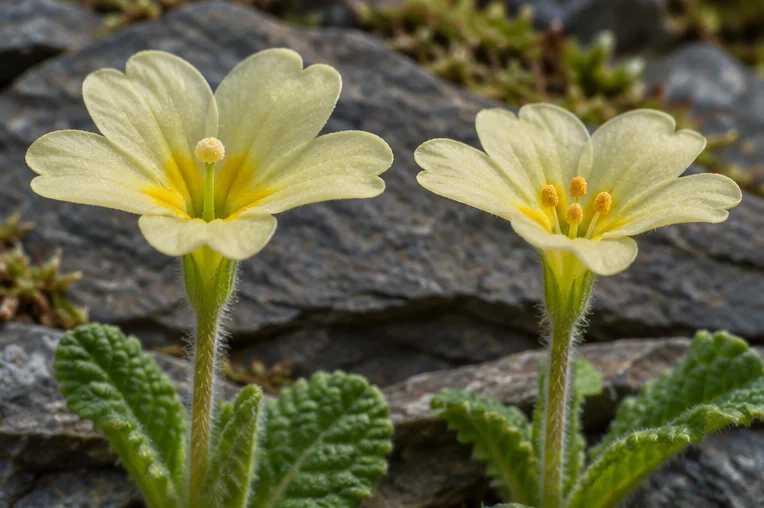
The accompanying art evokes an equivalent low viewpoint for two blossoms. It has no evidentiary role in classifying either form or identifying an exact species. Showing the same angle in both halves makes the comparison easier to imagine. The illustration cannot show that two actual observations were taken at matching stages or establish which pollen reached either specimen. Treat it as an aid to recognizing what the story is about and keep that label near the image.
Read from the flower opening inward, not from the label outward
Imagine a public archive contains a photograph of a primrose taken with the flower facing the viewer. The petals form a clear ring and a small structure stands above the dark tube. The species determination comes from a fuller series of pictures or an independently reviewed botanical record. For the form determination, the first task is to ask whether the structure near the center can be recognized at all. If the center is just a pale disk with no discernible outline, color is not enough. If several similar structures appear around the mouth and the individual outlines are visible, the record may better support an observation about where the anthers are positioned.
In a second archive image, the view is oblique. The closest wall of the tube hides the central area but reveals some interior detail on the opposite side. A reviewer might be able to name one structure while remaining unable to place another relative to it. Record that asymmetry instead of giving the overall image a yes-or-no rating. A published figure can show the normal arrangement in profile, but matching one visible feature to a diagram does not recreate the missing view. It makes the inference more plausible and tells the next reviewer exactly what the image did not resolve.
Use comparable views when evaluating relative positions. “Higher” refers to where a structure sits in relation to the corolla tube, not its position on the screen. A leaning stalk or a camera tilted below the flower can turn the biological vertical direction sideways in an image. Scale is equally important. If a detail is magnified much more in one image, apparent organ size is not direct evidence of a difference. A good record can describe a relative placement without claiming an absolute measurement when the relevant scale is unavailable.
Two pictures can be useful together without being a matched pair. One may show the full flower and another may use a published specimen in section to make the deeper structures intelligible. Present the first as a photo record and the second as an explanatory diagram or study image with its own origin. Do not let a transition between two pictures imply a single specimen if they are different. Readers can follow the architecture perfectly well if the captions state that one image explains a feature the other does not show.
For a passive review, do not force access to a hidden feature by pulling on a corolla, turning a plant out of its natural position, or collecting reproductive parts. Existing published photographs and section diagrams can explain the form. An ordinary observation can stop at what is visible. This matters especially when documenting a small or sensitive patch: the value of a field note is that it preserves the condition encountered, not that the observer redesigned it to achieve a cleaner comparison.
Make the evidence for pollen flow explicit
One helpful distinction is between seeing a path and measuring an outcome at one endpoint. A visitor seen first at one form and then at the other demonstrates a movement between flowers if the identities and continuity are clear. It may have carried pollen, and it may have made appropriate contacts. In an ordinary observation the pollen itself is generally not tracked. The path is valuable evidence for opportunity rather than a full transfer record. Give it a unit such as followed visitor transition and distinguish it from grains identified on a stigma.
In a recipient-load study, the movement is inferred from what was measured at the destination; the observer need not have followed all individual carriers. The resulting evidence can address what kinds of pollen arrived without showing exactly when it arrived or the whole route it took. Label it as a deposition or pollen-load measure, as appropriate. If a summary leans on a percent of the load assigned to an opposite form, preserve the recipient form, the method and the denominator. There is no single unqualified “percentage of pollen exchanged” hidden in those figures.
An especially common confusion is assuming that any same-form pollen on a stigma came from another individual. The donor possibilities include the same flower, a different flower of the same individual, or some other compatible source category depending on the evidence and biological system. The term geitonogamy refers to transfer between flowers on one individual. It is not a record of transfer between two unrelated plants. In Ornduff's abstract, the interpretation about self-pollination and geitonogamy is offered to explain some of the same-form load. Keeping that interpretation distinct from the grain classification avoids a false origin claim.
The distinction works in the other direction too. Suppose a method can distinguish likely donor morph for a deposited grain. That is stronger than simply counting grains, but it may not distinguish among different individual plants of that morph. Claims about distances or parent identity need additional information. Research using another method may obtain that information, but it should not be projected back onto this study unless the facts are in its own record. Measured pollen movement at one scale is not automatically a map of gene movement on every scale.
Separate the evidence for a function from evidence about it at a particular site. If a teaching display says the reciprocal arrangement can promote exchange between forms, it summarizes a biological possibility and hypothesis supported by floral architecture and relevant work. If it says that most of the pollen on these particular stigmas came from the opposite form, it announces an empirical result. The latter should be kept or removed based on the actual sampling result, not based on whether the geometry is compelling. The two statements can differ without undermining the value of either kind of study.
Day-to-day changes are another reason not to identify an origin automatically. A visitor observed in one hour may contact flowers in a different sequence at another. Ornduff's study examined a population across visits in different years, not one continuous following of every insect. Without evidence for a marked individual or another defensible link, a return seen in an archive should not be assumed to be the same carrier. Losing the bee behind vegetation makes the continuity unresolved rather than establishing exactly where the presumed next flight went.
Separate deposition from what happens afterward
Reproductive outcomes give natural history writing an appealing ending: a grain reaches a stigma, and a seed arises. That short version omits several gates. The grain may persist or be lost; some deposits may not lead to successful fertilization; the flower may fail to mature seeds for other reasons. An observed load can provide evidence of arrival without resolving these later events. If the article needs a seed outcome, use a source that measured seeds under conditions comparable to the claim rather than extrapolating a final total from the pollen rows.
The later seed observation can also give a narrower type of information than the writer wants. A fruit with several seeds may show successful production at that point, but it does not say what contacts caused it. The relationship between seed counts and ovule counts might be important to the question, in which case state which was measured and how the comparison was normalized. In Ornduff's abstract, the report of more seeds per flower for thrums is alongside similar ovule counts for the two forms. That is useful context for the population studied, not a promise that the same ranking holds everywhere the species occurs.
Careful phrasing is especially important around compatibility. A pollen load and a mating outcome are not interchangeable, and a difference in flower shape does not by itself diagnose whether any particular mating occurred. Conversely, a pollination record with pollen from the same form is not evidence that the plants in question must belong to separate species or that a species identification must be wrong. Form, deposit and reproductive outcome belong to the same natural history story but are not ways to confirm each other without additional evidence. The source offers a more useful puzzle than any categorical shortcut.
Assemble a ledger that someone else can use
Start with an observation identifier, actual date or bounded date if known, and the documented unit. Keep a field for taxonomic determination and its evidence. Then give the morph a separate status and note the feature that supports it, such as a recognizable stigma at the mouth or a set of clearly identifiable anthers there. Avoid recording “usual appearance” as a reason. For archived material, retain a reference to the original frame or source figure rather than only a cropped detail that loses orientation.
In a different set of fields, store observations of visitors, contact, or pollen outcome. A good ledger can contain a strongly supported flower identification and no visitor data at all. It can also store an interesting visitor movement with a form unresolved. Unless you make those partial records allowable, a reviewer is pushed toward filling every unused slot with a guess or throwing away the useful parts of the record. There is ordinarily no reason for a field needed by one inference to become a gate for storing all other observations.
Treat a verified negative as distinct from a blank. Suppose a flower is visible for the full defined observation window and nobody is seen approaching it. That can support a negative within the recorded window if the observer could detect approaches. A cropped frame without the surrounding space cannot. A negative morph identification is different again: not seeing a recognizable stigma at the mouth is not proof of the thrum form unless the evidence adequately resolves the relevant placement. Refusing those shortcuts does not make the data unhelpful. It keeps the next person's options open.
Repeated pictures can establish continuity if they genuinely follow the same object and preserve identifiers. They can help corroborate that a structure persists across angles or that hiding one structure is a problem of projection rather than anatomy. The extra views should be treated as evidence for the same observation unit, not as new plants. If the field team cannot connect the pictures reliably, leave the link tentative. A visual resemblance is often enough for a story illustration and insufficient to count as a repeated measurement.
For real comparisons, document how samples were chosen, not just how they were labeled. A visitor gallery might favor the most photographable blooms, flowers at convenient heights, or records showing a recognizable central stigma. Its disjoint classification counts then describe the gallery, not necessarily the plants available to catalog. A population estimate would need a sampling frame and some plan for unresolved observations. It is easier to write a strong claim about a selected set than to rescue an unsupported population claim after the fact.
Revisit the result when the level of the question changes
Suppose someone asks which form “supplied more pollen.” Start by recovering the question they need answered. If they are asking about pollen available at the donor structures, the production counts matter. If they are asking about pollen lost from the donor, a removal measure describes another quantity. If they want to know what was found on other flowers, recipient evidence matters much more. If they are ultimately interested in successful parentage, none of those alone is a sufficient answer. The phrasing sounds like a request for one fact because supply is doing several jobs. A more precise follow-up can preserve the relevant facts rather than choose a number that only appears to answer.
For a numerical teaching example with no real primrose data, imagine that one flower produces one hundred grains and twenty are removed. Another produces forty grains and sixteen are removed. The second flower lost forty percent while the first lost twenty percent, yet the first lost more grains. Neither calculation establishes the proportion of the removed pollen that reached stigmas. Showing the two denominators beside the absolute counts avoids the false impression that one of the percentages must be wrong. In a report about a population, the comparison would also have to specify how many flowers and plants represented each form.
Further mismatches arise when readers interchange averages of percentages and percentages from pooled counts. Several stigmas with small loads may have a large average proportion of a particular type even when the corresponding absolute count is small. A few stigmas with large loads can dominate a pooled fraction. Neither summary captures the other unless the denominators line up or the algebra happens to cancel. Identifying whether a source describes proportions on individual stigmas, a range across them, or a pooled proportion is valuable before quoting any number in an interpretive caption.
Preserve method distinctions when revisiting an older report. Ornduff's abstract notes that the two stigma collection approaches gave somewhat different results. A writer interested in actual magnitude should keep those details with the values rather than assemble one figure from numbers reported under both methods without showing the distinction. A later review can find limitations in a measurement and still recognize a useful observation. The scientific point is that how a result was obtained is often part of what the result means, not background material a short story is always free to discard.
These small checks help when an article is used as a training resource for newcomers. Ask a reader to point to the part that concerns the shape of the flower and the part that concerns its pollen load. If they can find both without borrowing a term from the other, the layout has done useful work.
A few captions that do not confuse the evidence
Use the narrowest label that still communicates the observed result.
For a resolved image, a caption can say “Common primrose, pin form; the stigma is visible near the mouth.” That is a claim about identity and recognizable anatomy. For a less complete image, “common primrose; floral form not determined from this angle” still communicates a useful identification. For a study figure, “recipient stigma loads compared by morph in the studied population” names an endpoint. None of those descriptions needs to imply that the viewer saw pollen crossing between individual plants.
For a chart about classifications, put the unit next to the labels. “Eight records of form one” is not “eight plants,” and an unresolved group is not another form. A picture legend should not classify invented art as an observation just because it sits beside a table. The supplied illustrative count makes a general lesson about resolved records available without requiring readers to interpret the bars as any published distribution. If the diagram and chart move to a slide, keep the words invented and editorial illustration with the respective assets.
Read the final paragraph for accidental mixing of verbs. “Looks like,” “has,” “was observed with,” and “led to” imply different relationships between evidence and conclusion. A form can suggest how pollen might move. A visitor may have been observed at an opening. A field study can measure a deposit. A reproductive outcome can be counted. All four are good sentences when they use the right evidence. Only a figure in the right source should answer the question of how large a particular difference was and what comparison justified it.
The best takeaway is not that primrose forms are hard to classify. It is that their visible difference opens several questions worth asking. The flowers belong to the same species; a sound record can distinguish the relevant morphology without inventing a second taxon. The literature can explain how the traits develop and separately show where grains were found. A good ledger reflects that richness. It gives one line to what the flower is, another to the organs an observer could identify, and a separate result to the movement that a study actually measured.